Enhancing Student Learning with High-Quality Rubrics
Learn about the anatomy of a rubric, how to write effective rubrics, and the advantages of using rubrics for student assessment. Discover how rubrics can improve student learning outcomes in various academic settings.

Download Presentation

Please find below an Image/Link to download the presentation.
The content on the website is provided AS IS for your information and personal use only. It may not be sold, licensed, or shared on other websites without obtaining consent from the author. If you encounter any issues during the download, it is possible that the publisher has removed the file from their server.
You are allowed to download the files provided on this website for personal or commercial use, subject to the condition that they are used lawfully. All files are the property of their respective owners.
The content on the website is provided AS IS for your information and personal use only. It may not be sold, licensed, or shared on other websites without obtaining consent from the author.
E N D
Presentation Transcript
IMPROVING STUDENT LEARNING with HIGH-QUALITY RUBRICS Presented by Presented by Heather Lettner Heather Lettner- -Rust, Professor of English and Director of Civitae Core Curriculum Rust, Professor of English and Director of Civitae Core Curriculum and and Jeff Lokey, Assistant Director of Curriculum Assessment Jeff Lokey, Assistant Director of Curriculum Assessment
AGENDA 11:30 AM - 12:00 noon Introduction Rubric Components Advantages of Using Rubrics Types of Rubrics Rubric Guidelines and Tips Rubrics & Canvas LMS Rubrics & AI Resources 12:00 noon 12:30 PM Workshopping Your Rubric
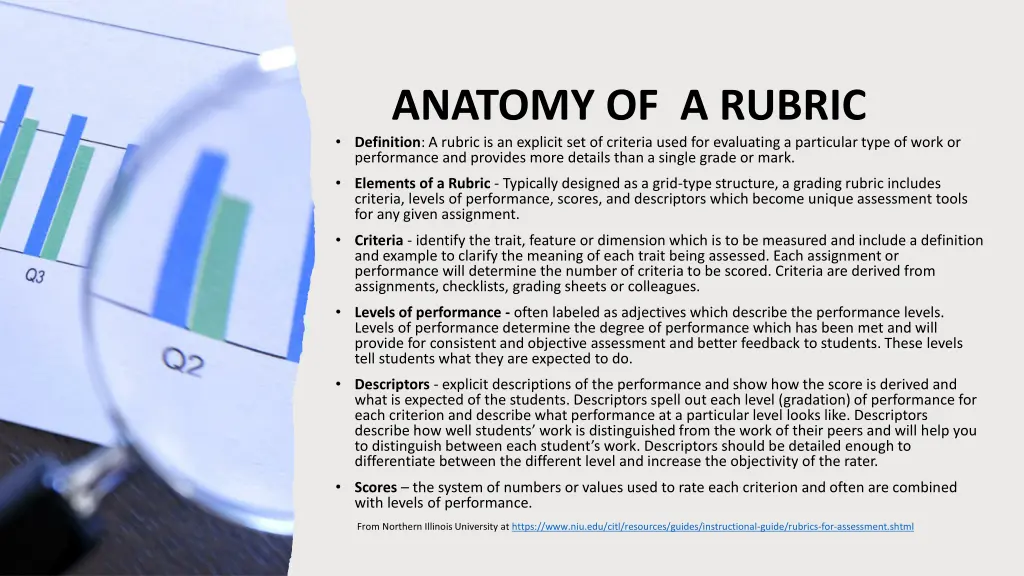
ANATOMY OF A RUBRIC Definition: A rubric is an explicit set of criteria used for evaluating a particular type of work or performance and provides more details than a single grade or mark. Elements of a Rubric - Typically designed as a grid-type structure, a grading rubric includes criteria, levels of performance, scores, and descriptors which become unique assessment tools for any given assignment. Criteria - identify the trait, feature or dimension which is to be measured and include a definition and example to clarify the meaning of each trait being assessed. Each assignment or performance will determine the number of criteria to be scored. Criteria are derived from assignments, checklists, grading sheets or colleagues. Levels of performance - often labeled as adjectives which describe the performance levels. Levels of performance determine the degree of performance which has been met and will provide for consistent and objective assessment and better feedback to students. These levels tell students what they are expected to do. Descriptors - explicit descriptions of the performance and show how the score is derived and what is expected of the students. Descriptors spell out each level (gradation) of performance for each criterion and describe what performance at a particular level looks like. Descriptors describe how well students work is distinguished from the work of their peers and will help you to distinguish between each student s work. Descriptors should be detailed enough to differentiate between the different level and increase the objectivity of the rater. Scores the system of numbers or values used to rate each criterion and often are combined with levels of performance. From Northern Illinois University at https://www.niu.edu/citl/resources/guides/instructional-guide/rubrics-for-assessment.shtml
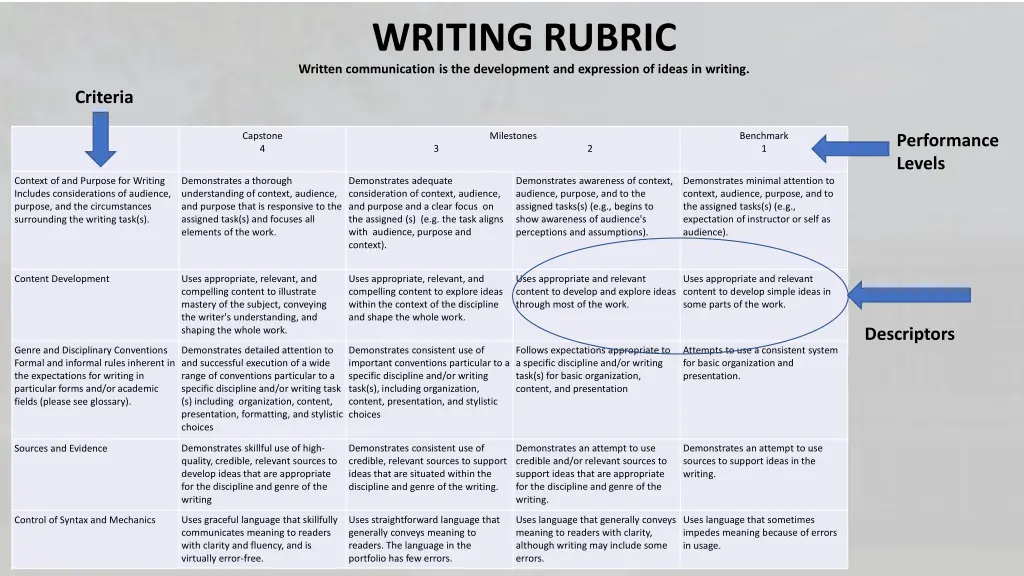
WRITING RUBRIC Written communication is the development and expression of ideas in writing. Criteria Capstone 4 Milestones Benchmark 1 Performance Levels 3 2 Context of and Purpose for Writing Includes considerations of audience, purpose, and the circumstances surrounding the writing task(s). Demonstrates a thorough understanding of context, audience, and purpose that is responsive to the assigned task(s) and focuses all elements of the work. Demonstrates adequate consideration of context, audience, and purpose and a clear focus on the assigned (s) (e.g. the task aligns with audience, purpose and context). Demonstrates awareness of context, audience, purpose, and to the assigned tasks(s) (e.g., begins to show awareness of audience's perceptions and assumptions). Demonstrates minimal attention to context, audience, purpose, and to the assigned tasks(s) (e.g., expectation of instructor or self as audience). Uses appropriate, relevant, and compelling content to illustrate mastery of the subject, conveying the writer's understanding, and shaping the whole work. Uses appropriate, relevant, and compelling content to explore ideas within the context of the discipline and shape the whole work. Uses appropriate and relevant content to develop and explore ideas through most of the work. Uses appropriate and relevant content to develop simple ideas in some parts of the work. Content Development WRITTEN COMMUNICATION VALUE RUBRIC for more information, please contact value@aacu.orgE Demonstrates detailed attention to and successful execution of a wide range of conventions particular to a specific discipline and/or writing task (s) including organization, content, presentation, formatting, and stylistic choices Descriptors Genre and Disciplinary Conventions Formal and informal rules inherent in the expectations for writing in particular forms and/or academic fields (please see glossary). Demonstrates consistent use of important conventions particular to a specific discipline and/or writing task(s), including organization, content, presentation, and stylistic choices Follows expectations appropriate to a specific discipline and/or writing task(s) for basic organization, content, and presentation Attempts to use a consistent system for basic organization and presentation. Demonstrates skillful use of high- quality, credible, relevant sources to develop ideas that are appropriate for the discipline and genre of the writing Demonstrates consistent use of credible, relevant sources to support ideas that are situated within the discipline and genre of the writing. Demonstrates an attempt to use credible and/or relevant sources to support ideas that are appropriate for the discipline and genre of the writing. Demonstrates an attempt to use sources to support ideas in the writing. Sources and Evidence Uses graceful language that skillfully communicates meaning to readers with clarity and fluency, and is virtually error-free. Uses straightforward language that generally conveys meaning to readers. The language in the portfolio has few errors. Uses language that generally conveys meaning to readers with clarity, although writing may include some errors. Uses language that sometimes impedes meaning because of errors in usage. Control of Syntax and Mechanics
WHY USE RUBRICS? Makes grading/assessment more efficient for instructors Encourages consistency by applying the same standards for all students' work, preventing grading "drift" over time. Specifies all traits to be evaluated in student work no "hidden agendas. Provides specific feedback on strengths/weaknesses of the work. Serves as a training resource when multiple raters evaluate an assignment. Can decrease the number of student complaints about grades.
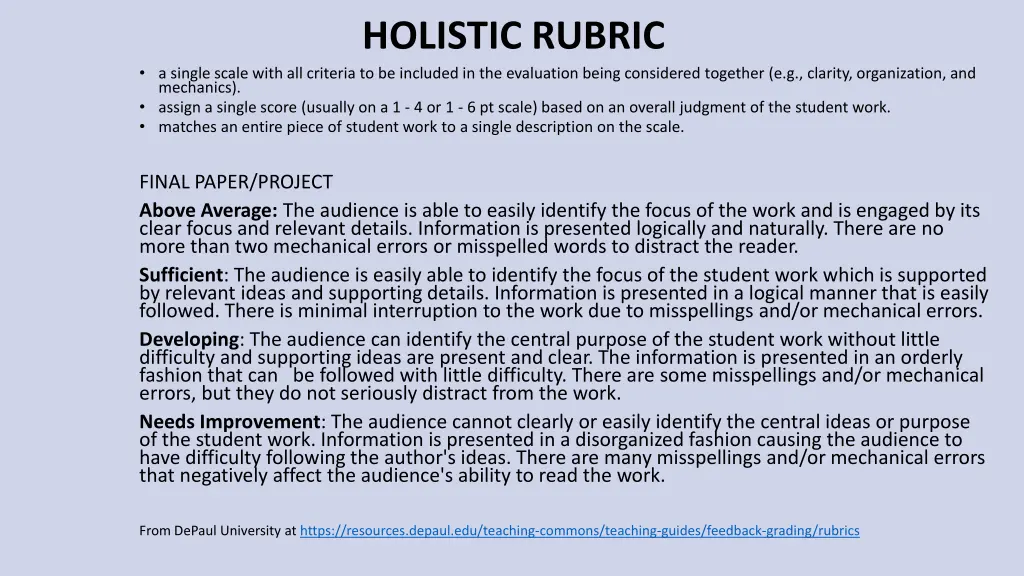
HOLISTIC RUBRIC a single scale with all criteria to be included in the evaluation being considered together (e.g., clarity, organization, and mechanics). assign a single score (usually on a 1 - 4 or 1 - 6 pt scale) based on an overall judgment of the student work. matches an entire piece of student work to a single description on the scale. FINAL PAPER/PROJECT Above Average: The audience is able to easily identify the focus of the work and is engaged by its clear focus and relevant details. Information is presented logically and naturally. There are no more than two mechanical errors or misspelled words to distract the reader. Sufficient: The audience is easily able to identify the focus of the student work which is supported by relevant ideas and supporting details. Information is presented in a logical manner that is easily followed. There is minimal interruption to the work due to misspellings and/or mechanical errors. Developing: The audience can identify the central purpose of the student work without little difficulty and supporting ideas are present and clear. The information is presented in an orderly fashion that can be followed with little difficulty. There are some misspellings and/or mechanical errors, but they do not seriously distract from the work. Needs Improvement: The audience cannot clearly or easily identify the central ideas or purpose of the student work. Information is presented in a disorganized fashion causing the audience to have difficulty following the author's ideas. There are many misspellings and/or mechanical errors that negatively affect the audience's ability to read the work. From DePaul University at https://resources.depaul.edu/teaching-commons/teaching-guides/feedback-grading/rubrics
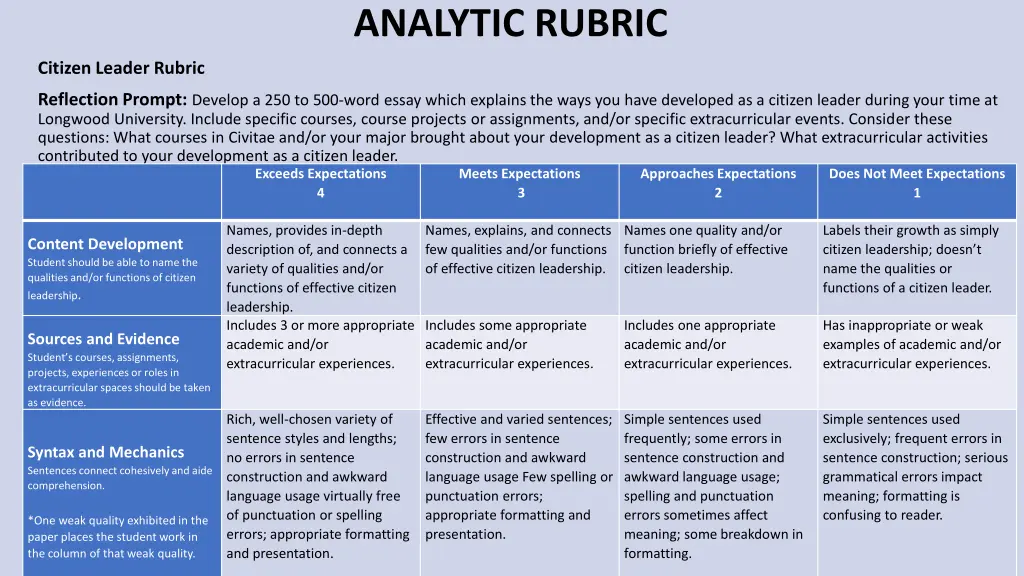
ANALYTIC RUBRIC Citizen Leader Rubric Reflection Prompt:Develop a 250 to 500-word essay which explains the ways you have developed as a citizen leader during your time at Longwood University. Include specific courses, course projects or assignments, and/or specific extracurricular events. Consider these questions: What courses in Civitae and/or your major brought about your development as a citizen leader? What extracurricular activities contributed to your development as a citizen leader. Exceeds Expectations 4 3 Meets Expectations Approaches Expectations 2 Does Not Meet Expectations 1 Names, provides in-depth description of, and connects a variety of qualities and/or functions of effective citizen leadership. Includes 3 or more appropriate academic and/or extracurricular experiences. Names, explains, and connects few qualities and/or functions of effective citizen leadership. Names one quality and/or function briefly of effective citizen leadership. Labels their growth as simply citizen leadership; doesn t name the qualities or functions of a citizen leader. Content Development Student should be able to name the qualities and/or functions of citizen leadership. Includes some appropriate academic and/or extracurricular experiences. Includes one appropriate academic and/or extracurricular experiences. Has inappropriate or weak examples of academic and/or extracurricular experiences. Sources and Evidence Student s courses, assignments, projects, experiences or roles in extracurricular spaces should be taken as evidence. Rich, well-chosen variety of sentence styles and lengths; no errors in sentence construction and awkward language usage virtually free of punctuation or spelling errors; appropriate formatting and presentation. Effective and varied sentences; few errors in sentence construction and awkward language usage Few spelling or punctuation errors; appropriate formatting and presentation. Simple sentences used frequently; some errors in sentence construction and awkward language usage; spelling and punctuation errors sometimes affect meaning; some breakdown in formatting. Simple sentences used exclusively; frequent errors in sentence construction; serious grammatical errors impact meaning; formatting is confusing to reader. Syntax and Mechanics Sentences connect cohesively and aide comprehension. *One weak quality exhibited in the paper places the student work in the column of that weak quality.
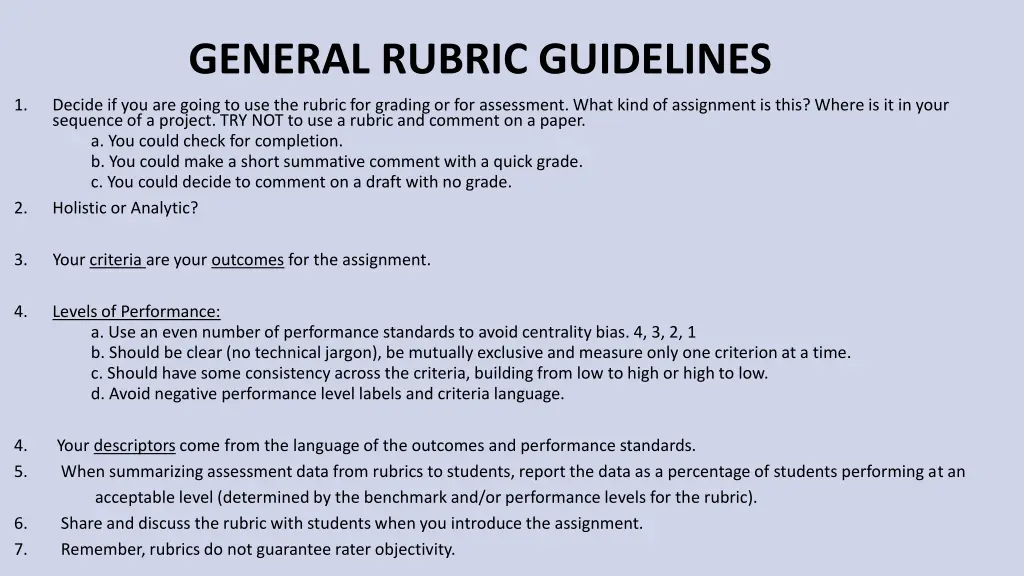
GENERAL RUBRIC GUIDELINES 1. Decide if you are going to use the rubric for grading or for assessment. What kind of assignment is this? Where is it in your sequence of a project. TRY NOT to use a rubric and comment on a paper. a. You could check for completion. b. You could make a short summative comment with a quick grade. c. You could decide to comment on a draft with no grade. Holistic or Analytic? 2. 3. Your criteria are your outcomes for the assignment. 4. Levels of Performance: a. Use an even number of performance standards to avoid centrality bias. 4, 3, 2, 1 b. Should be clear (no technical jargon), be mutually exclusive and measure only one criterion at a time. c. Should have some consistency across the criteria, building from low to high or high to low. d. Avoid negative performance level labels and criteria language. 4. Your descriptors come from the language of the outcomes and performance standards. 5. When summarizing assessment data from rubrics to students, report the data as a percentage of students performing at an acceptable level (determined by the benchmark and/or performance levels for the rubric). 6. Share and discuss the rubric with students when you introduce the assignment. 7. Remember, rubrics do not guarantee rater objectivity.
ADDING A RUBRIC TO A CANVAS COURSE https://community.canvaslms.com/t5/Video- Guide/Rubrics-Overview-Instructors/ta-p/384253 Rubric for Bad News Email in ENGL 470 Professional Writing Canvas Fall 23 ENGL 470
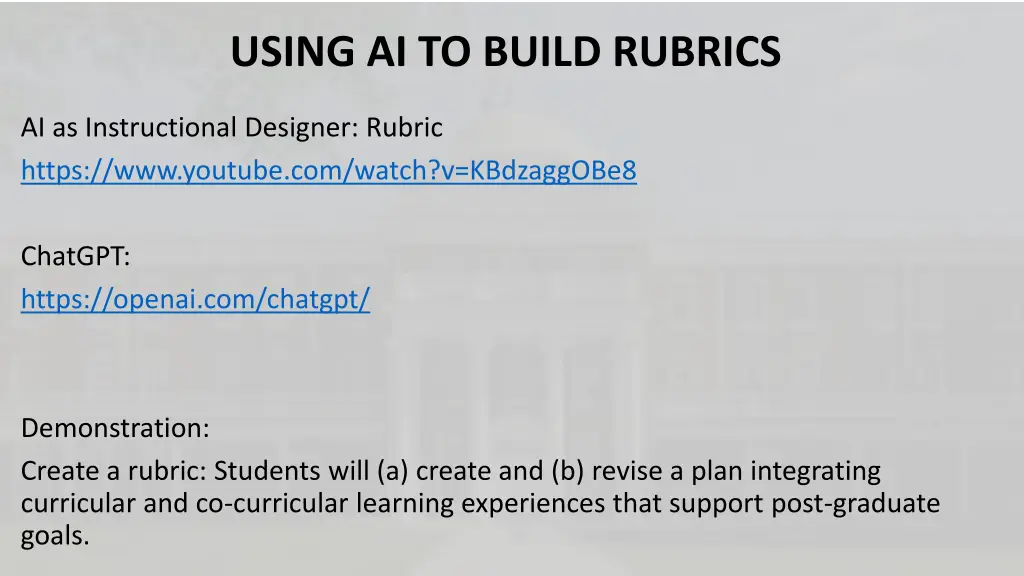
USING AI TO BUILD RUBRICS AI as Instructional Designer: Rubric https://www.youtube.com/watch?v=KBdzaggOBe8 ChatGPT: https://openai.com/chatgpt/ Demonstration: Create a rubric: Students will (a) create and (b) revise a plan integrating curricular and co-curricular learning experiences that support post-graduate goals.
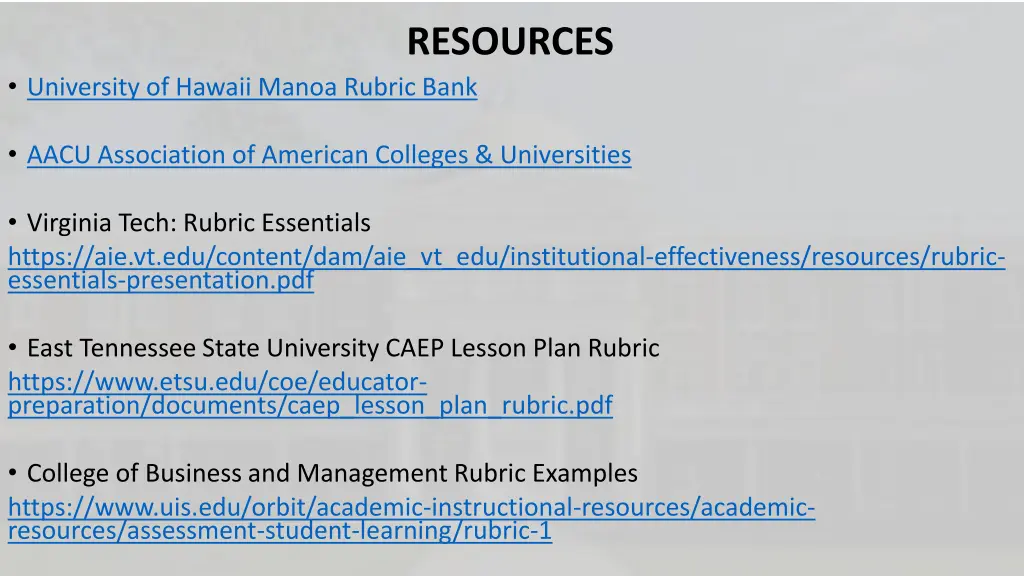
RESOURCES University of Hawaii Manoa Rubric Bank AACU Association of American Colleges & Universities Virginia Tech: Rubric Essentials https://aie.vt.edu/content/dam/aie_vt_edu/institutional-effectiveness/resources/rubric- essentials-presentation.pdf East Tennessee State University CAEP Lesson Plan Rubric https://www.etsu.edu/coe/educator- preparation/documents/caep_lesson_plan_rubric.pdf College of Business and Management Rubric Examples https://www.uis.edu/orbit/academic-instructional-resources/academic- resources/assessment-student-learning/rubric-1