Explore strategies such as pre-entry assessments, student support services annual plans, and career advising to improve academic success and student retention rates at colleges. Learn about the importance of tailored support for diverse student needs.
Please find below an Image/Link to download the presentation.
The content on the website is provided AS IS for your information and personal use only. It may not be sold, licensed, or shared on other websites without obtaining consent from the author. If you encounter any issues during the download, it is possible that the publisher has removed the file from their server.
You are allowed to download the files provided on this website for personal or commercial use, subject to the condition that they are used lawfully. All files are the property of their respective owners.
The content on the website is provided AS IS for your information and personal use only. It may not be sold, licensed, or shared on other websites without obtaining consent from the author.
Student Support Services Annual Plan WHAT? Improves chances of academic success for students HOW? Informed programme/career choice, access to financial resources, adapting to college life, additional academic development, responsiveness to students with special needs, producing employable students. WHY? Effective and efficient students support services will lead to higher retention and throughput rates. Target 30 June 2015 (to be implemented at college level, integrated and included in college s plans) support, leadership 2
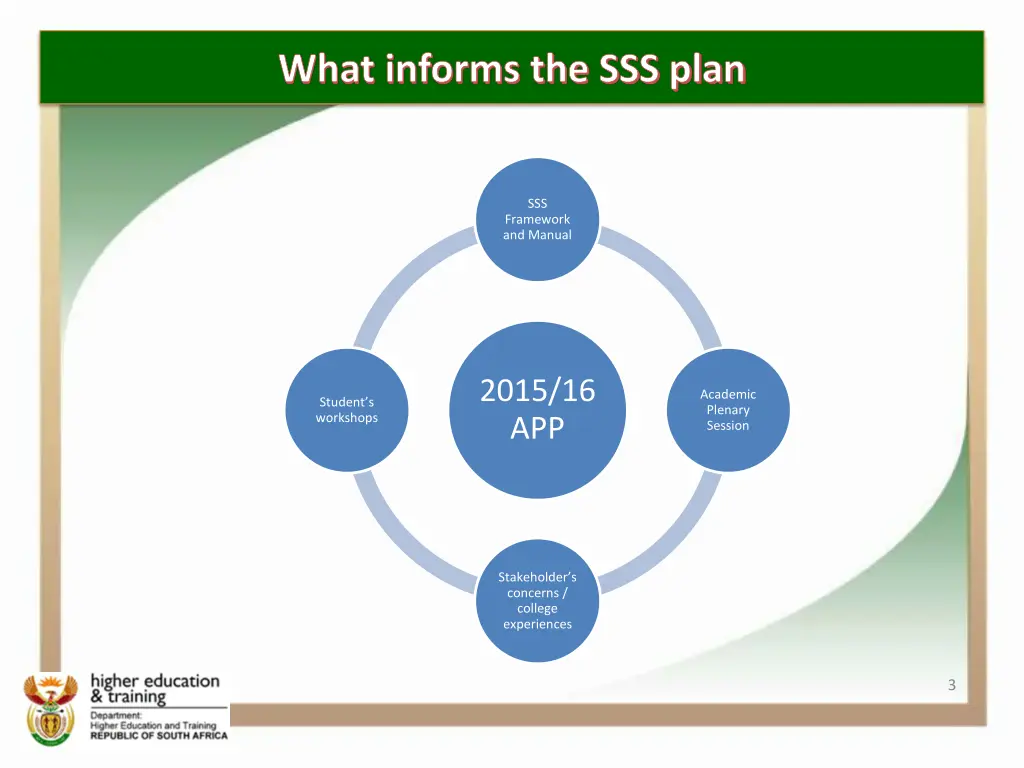
What informs the SSS plan SSS Framework and Manual 2015/16 APP Academic Plenary Session Student s workshops Stakeholder s concerns / college experiences 3
PRE ENTRY Critical for welcoming and adapting the student to college life. (who do you use? 3rd level students? Are they adequately trained?) 48 colleges provide Selection and Placement tests, Budget to be in place for renewal of operating licenses Provision of adequate resources (venue, computers & manuals) Committee to assist with analyzing results for placement (SSS unit and Fundamental lecturers) e.g interventions to address components of poor performing subjects, e.g. Algebra & Comprehension Provide students with feedback timeously. provision and budget to capture data. 4
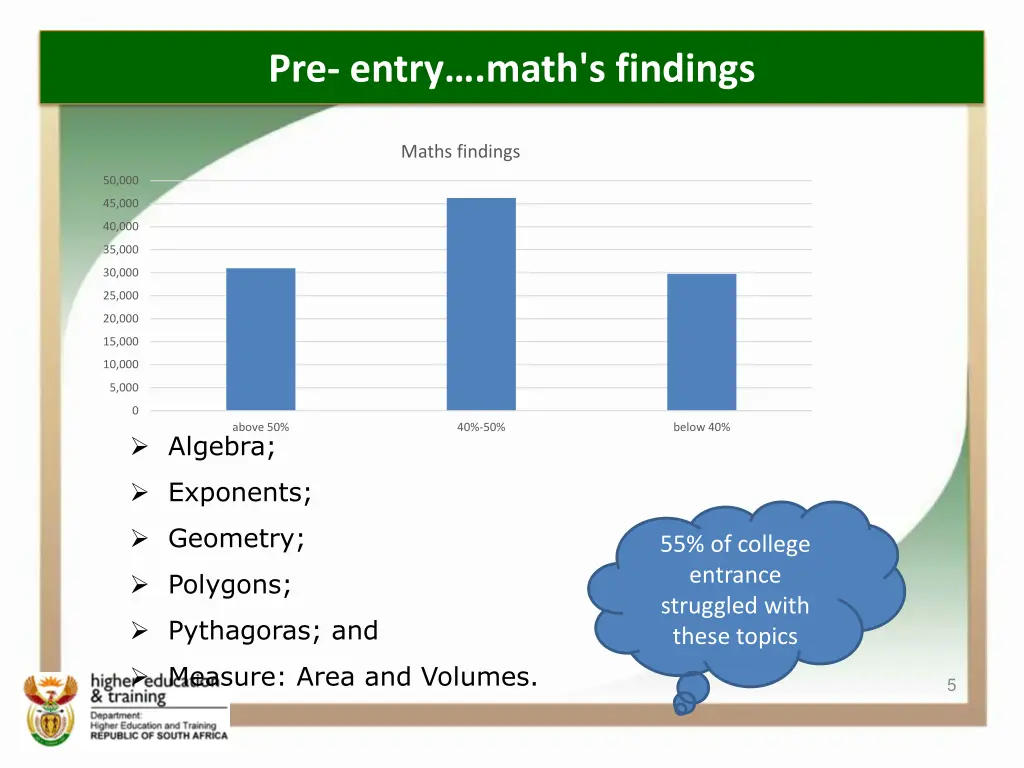
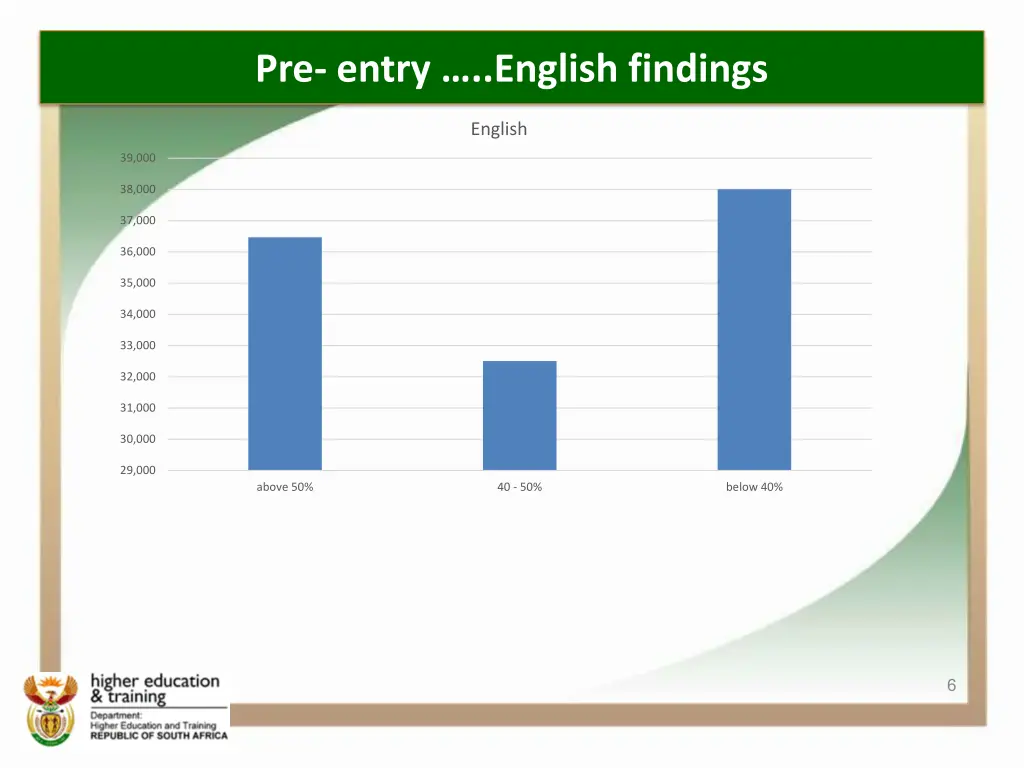
Pre- entry.math's findings Maths findings 50,000 45,000 40,000 35,000 30,000 25,000 20,000 15,000 10,000 5,000 0 Algebra; above 50% 40%-50% below 40% Exponents; Geometry; 55% of college entrance struggled with these topics Polygons; Pythagoras; and Measure: Area and Volumes. 5
Pre- Entry cont. Proper career advise based on the results of the diagnostic tests Standardised process of providing career advised by trained personnel Selection tests to be provided conducted from September of previous year to avoid backlogs during registration. Target a particular no of students for early registration. 7
Orientation programme Ensures readiness of students to begin their academic year, fully prepared in every way. grooms the emotional intelligence of a student and adapting to the of the student community, life, culture shock, diversity etc . They will not only know their lecturers, many of their peers and the college layout but also what is expected of them and who to contact if they encounter problems. They will also know that many other challenges will be discussed with them during the year at specific times on their timetable. - Compulsory orientation programme at the beginning of each year (what do you need content, resources (staff/financial) - Peer mentors / college buddy s to assist students to ensure proper integration (innovation/ local industry, partnership with SETAs or CDS) 8
BURSARY SCHEME The allocation for college fees to all qualifying and deserving students must be prioritised (keep to the allocation) Target for claiming of bursary funding aligned to the bursary schedule Inform students on the outcome of their bursary allocation The allocation for travel and accommodation allowances must only be reflected subject to the availability of funds Ensure transparent and effective communication on bursary administration processes (currently communication and engagement occurs / instigated by the student s unrest)
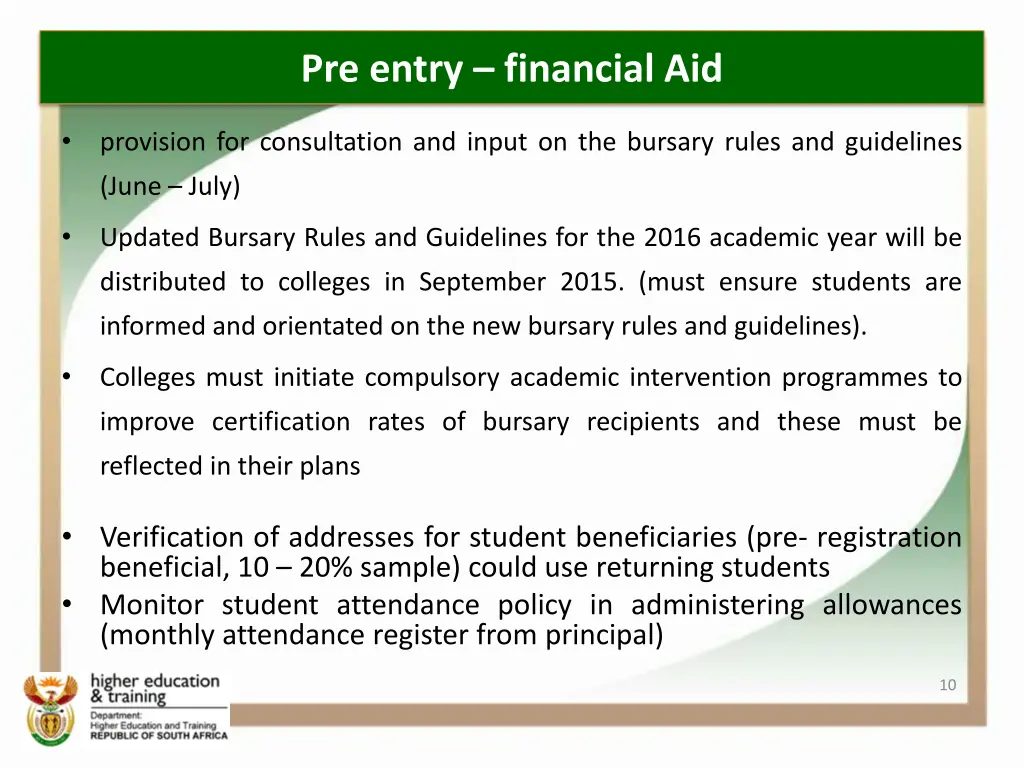
Pre entry financial Aid provision for consultation and input on the bursary rules and guidelines (June July) Updated Bursary Rules and Guidelines for the 2016 academic year will be distributed to colleges in September 2015. (must ensure students are informed and orientated on the new bursary rules and guidelines). Colleges must initiate compulsory academic intervention programmes to improve certification rates of bursary recipients and these must be reflected in their plans Verification of addresses for student beneficiaries (pre- registration beneficial, 10 20% sample) could use returning students Monitor student attendance policy in administering allowances (monthly attendance register from principal) 10
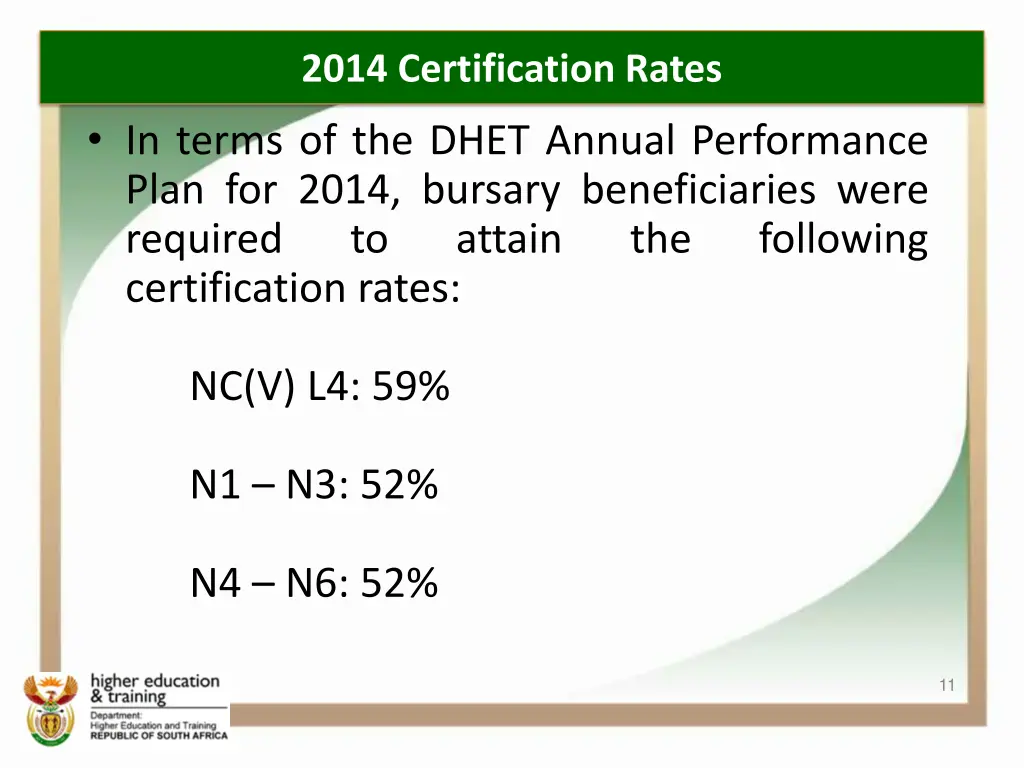
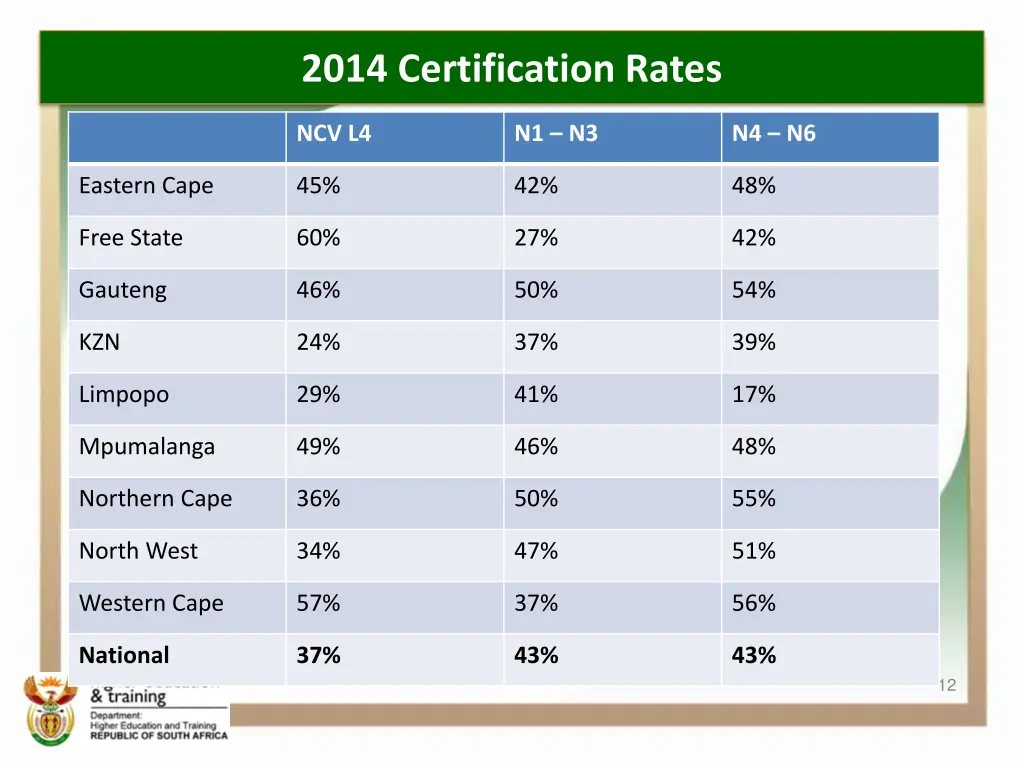
2014 Certification Rates In terms of the DHET Annual Performance Plan for 2014, bursary beneficiaries were required to attain certification rates: the following NC(V) L4: 59% N1 N3: 52% N4 N6: 52% 11
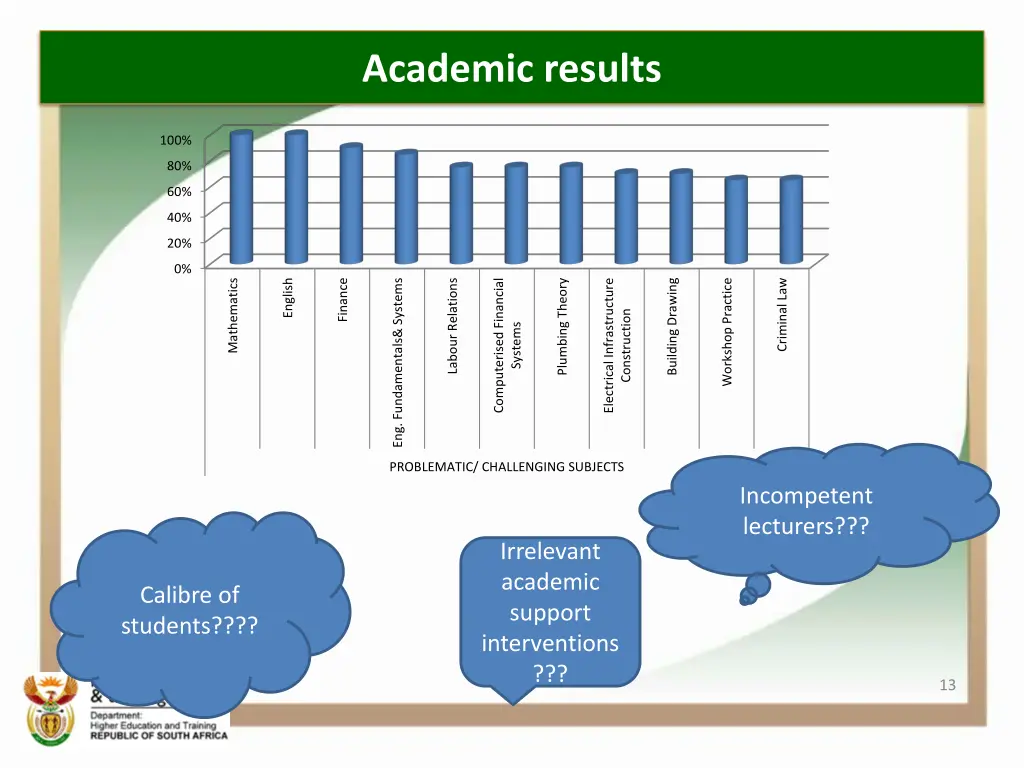
Academic results 100% 80% 60% 40% 20% 0% English Finance Workshop Practice Mathematics Building Drawing Criminal Law Eng. Fundamentals& Systems Labour Relations Computerised Financial Plumbing Theory Electrical Infrastructure Construction Systems PROBLEMATIC/ CHALLENGING SUBJECTS Incompetent lecturers??? Irrelevant academic support interventions ??? Calibre of students???? 13
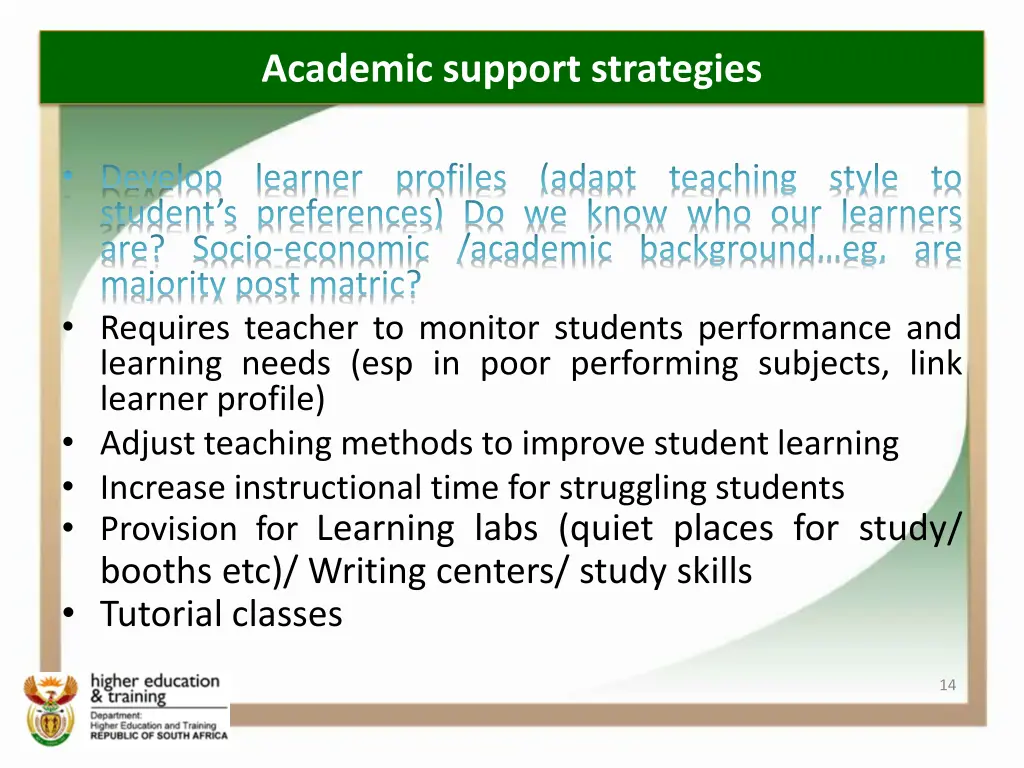
Academic support strategies Develop learner profiles (adapt teaching style to student s preferences) Do we know who our learners are? Socio-economic /academic background eg, are majority post matric? Requires teacher to monitor students performance and learning needs (esp in poor performing subjects, link learner profile) Adjust teaching methods to improve student learning Increase instructional time for struggling students Provision for Learning labs (quiet places for study/ booths etc)/ Writing centers/ study skills Tutorial classes 14
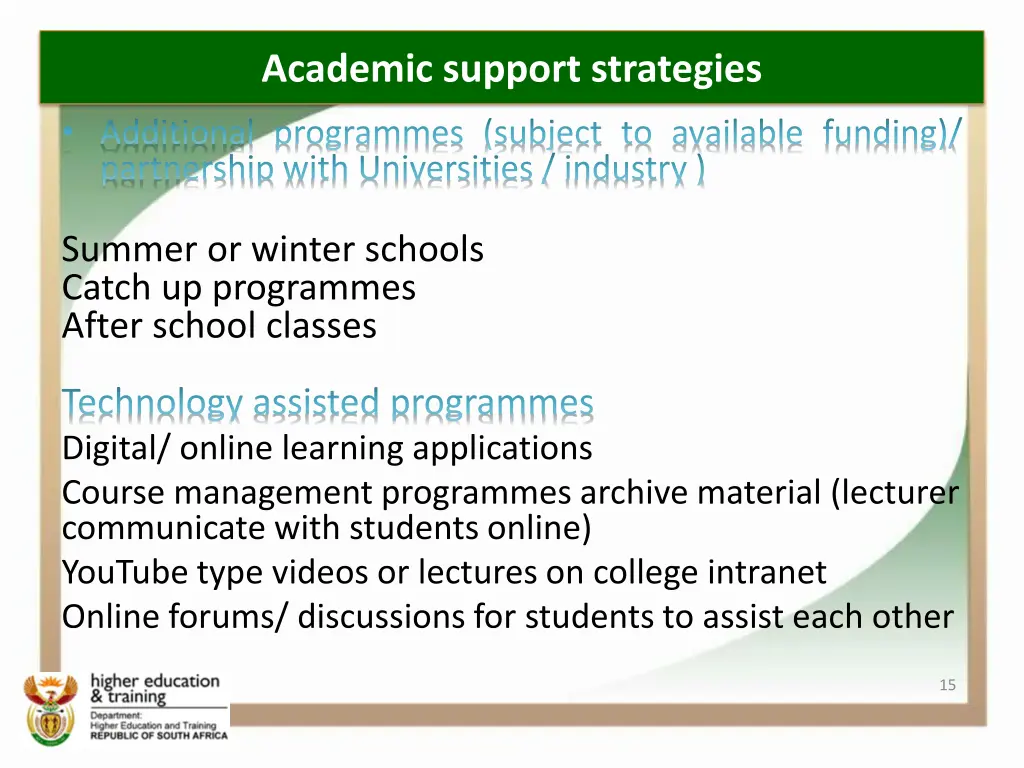
Academic support strategies Additional programmes (subject to available funding)/ partnership with Universities / industry ) Summer or winter schools Catch up programmes After school classes Technology assisted programmes Digital/ online learning applications Course management programmes archive material (lecturer communicate with students online) YouTube type videos or lectures on college intranet Online forums/ discussions for students to assist each other 15
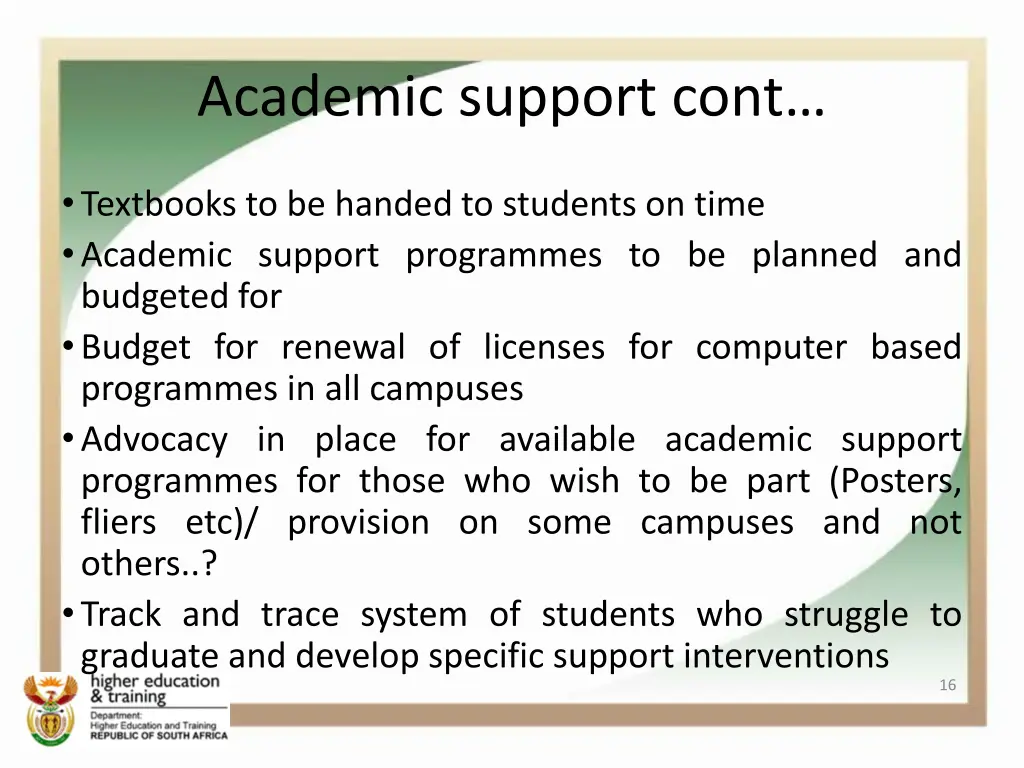
Academic support cont Textbooks to be handed to students on time Academic support programmes to be planned and budgeted for Budget for renewal of licenses for computer based programmes in all campuses Advocacy in place for available academic support programmes for those who wish to be part (Posters, fliers etc)/ provision on some campuses and not others..? Track and trace system of students who struggle to graduate and develop specific support interventions 16
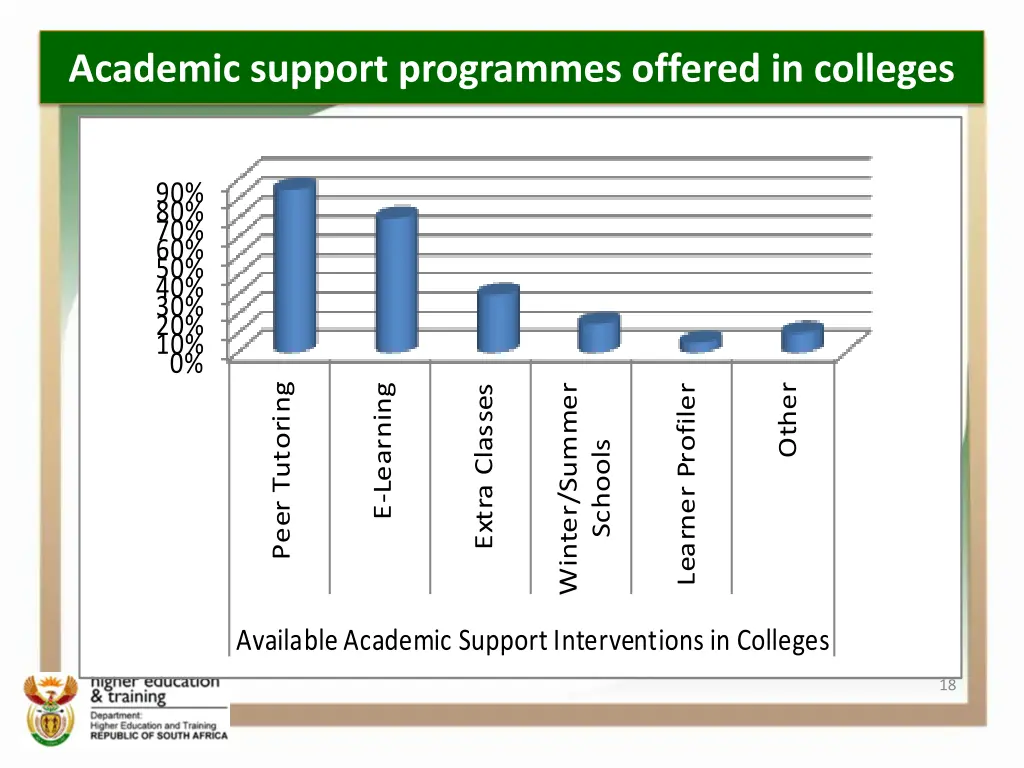
Academic support programmes offered in colleges 90% 80% 70% 60% 50% 40% 30% 20% 10% 0% Peer Tutoring Other E-Learning Winter/Summer Learner Profiler Extra Classes Schools Available Academic Support Interventions in Colleges 18
Student leadership SRC is an integral part of student life and a critical cooperative governance partner in a college. SRC members take responsibilities that enhance student life on campuses. This means that the SRC members are empowered to invest in people and communities. SRC guided by constitution, each college should have an up to date constitution in place (annually)/ per constitutional guidance. Preferably February of every year, each College SRC should be in place and fully functional. SRC orientation programme on college processes, role, participation in governance structures and leadership theories/ conflict management 19
Psycho- social support The aim of student health and well-being is to assist the student to become independent, both academically and personally. A healthy mind, emotional and social well-being as well as successful relationships with self and others are as important. Assist in developing a well rounded student that is well balanced Health peer programmes Sporting codes/ programmes Support groups for students/effective referral systems 20
Learners with special needs Learners with special education needs to be accommodated in our TVET Colleges (infrastructure and assistive devices) It is critical for Colleges to determine the number of students with special needs and the type of special needs that students have to enable them to successfully perform and adapt to the College environment. Colleges should have a data base of applicants with special needs (irrespective of the capacity of the college to support those students). This will assist the College to determine the number of students with disabilities that require assistance and access in their surrounding communities. 21
Exit Support WORKPLACE BASED EXPOSURE (WBE) Objective: to improve National Certificate (Vocational) {(NC(V)} students employability by providing increased opportunities. Plan and budget for WIL implementation transport for students, accommodation, and insurance. Brief and prepare college staff to play their roles in implementing workplace-based component of college programmes. Plan the workplace component of the curriculum and obtain or develop task books/log books. Recruit host employers and prepare them to manage and mentor students during WIL/WBE placements. Select and prepare students for the workplace-based component of their programme. Plan and budget for college staff to support and monitor students during their placement. workplace-based learning 22