Enhancing TDD MU Beamforming for mmWave Distributed Networks
Explore how to improve Time Division Duplexing (TDD) Multi-User (MU) Beamforming in mmWave distributed networks by addressing efficiency and repetition issues through proposed modifications. The document discusses the background, motivation, training procedures, and comparisons, aiming to enhance the existing scheme for better network performance.

Download Presentation

Please find below an Image/Link to download the presentation.
The content on the website is provided AS IS for your information and personal use only. It may not be sold, licensed, or shared on other websites without obtaining consent from the author. If you encounter any issues during the download, it is possible that the publisher has removed the file from their server.
You are allowed to download the files provided on this website for personal or commercial use, subject to the condition that they are used lawfully. All files are the property of their respective owners.
The content on the website is provided AS IS for your information and personal use only. It may not be sold, licensed, or shared on other websites without obtaining consent from the author.
E N D
Presentation Transcript
January 2018 doc.: IEEE 802.11-18/0175r1 MU Beamforming for mmWave Distributed Network Date: 2018-01-10 Name Affiliation Address Phone Email Tony Xiao Han Huawei Technologies Tony.hanxiao@huawei.com Mengyao Ma Huawei Technologies Yan Xin Huawei Technologies Chenlong Jia Huawei Technologies Submission Slide 1
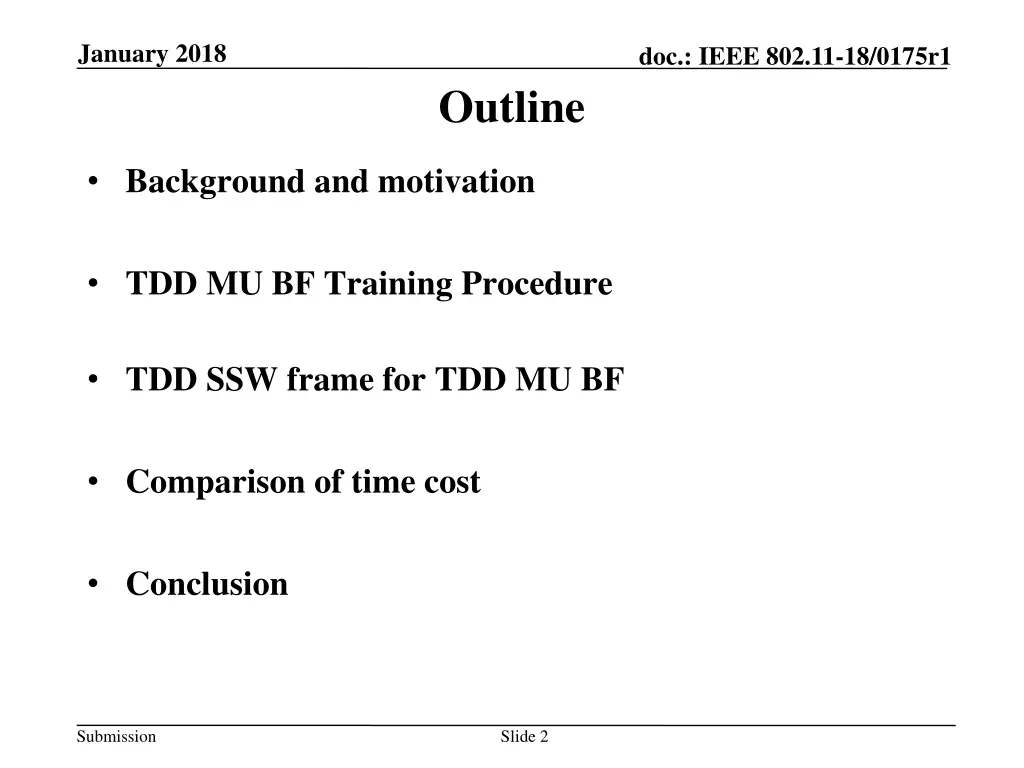
January 2018 doc.: IEEE 802.11-18/0175r1 Outline Background and motivation TDD MU BF Training Procedure TDD SSW frame for TDD MU BF Comparison of time cost Conclusion Submission Slide 2
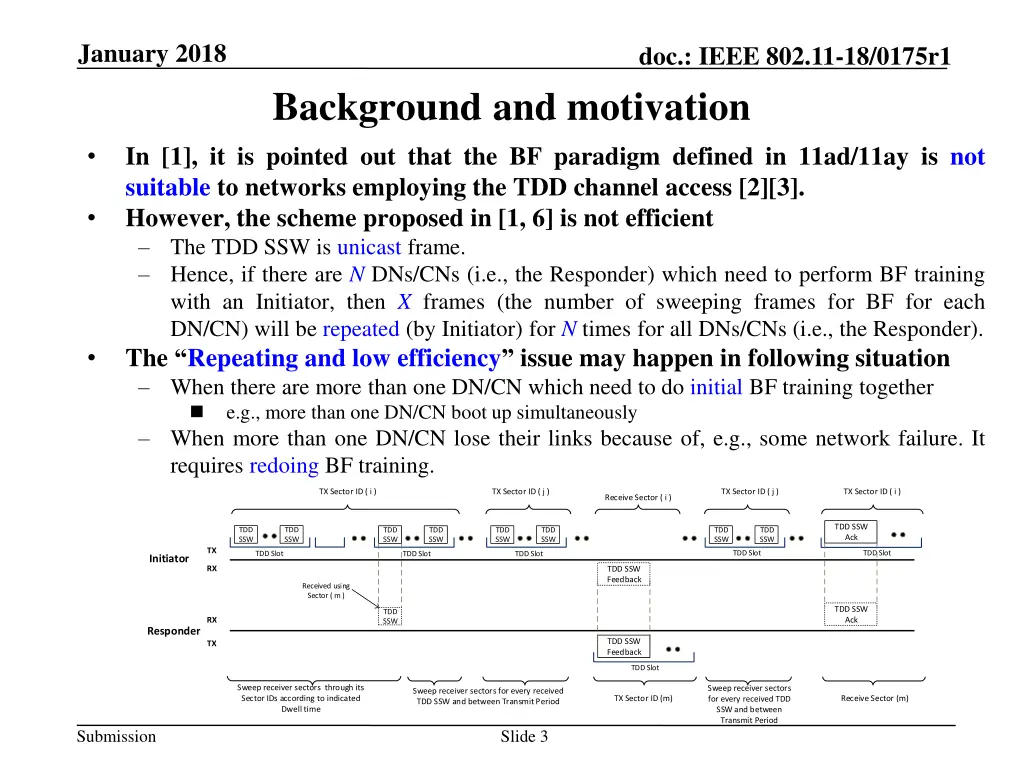
January 2018 doc.: IEEE 802.11-18/0175r1 Background and motivation In [1], it is pointed out that the BF paradigm defined in 11ad/11ay is not suitable to networks employing the TDD channel access [2][3]. However, the scheme proposed in [1, 6] is not efficient The TDD SSW is unicast frame. Hence, if there are N DNs/CNs (i.e., the Responder) which need to perform BF training with an Initiator, then X frames (the number of sweeping frames for BF for each DN/CN) will be repeated (by Initiator) for N times for all DNs/CNs (i.e., the Responder). The Repeating and low efficiency issue may happen in following situation When there are more than one DN/CN which need to do initial BF training together e.g., more than one DN/CN boot up simultaneously When more than one DN/CN lose their links because of, e.g., some network failure. It requires redoing BF training. TX Sector ID ( i ) TX Sector ID ( j ) TX Sector ID ( j ) TX Sector ID ( i ) Receive Sector ( i ) TDD SSW Ack TDD SSW TDD SSW TDD SSW TDD SSW TDD SSW TDD SSW TDD SSW TDD SSW TX TDD Slot TDD Slot TDD Slot TDD Slot TDD Slot Initiator RX TDD SSW Feedback Received using Sector ( m ) TDD SSW Ack TDD SSW RX Responder TDD SSW Feedback TX TDD Slot Sweep receiver sectors through its Sector IDs according to indicated Dwell time Sweep receiver sectors for every received TDD SSW and between Transmit Period Sweep receiver sectors for every received TDD SSW and between Transmit Period TX Sector ID (m) Receive Sector (m) Submission Slide 3
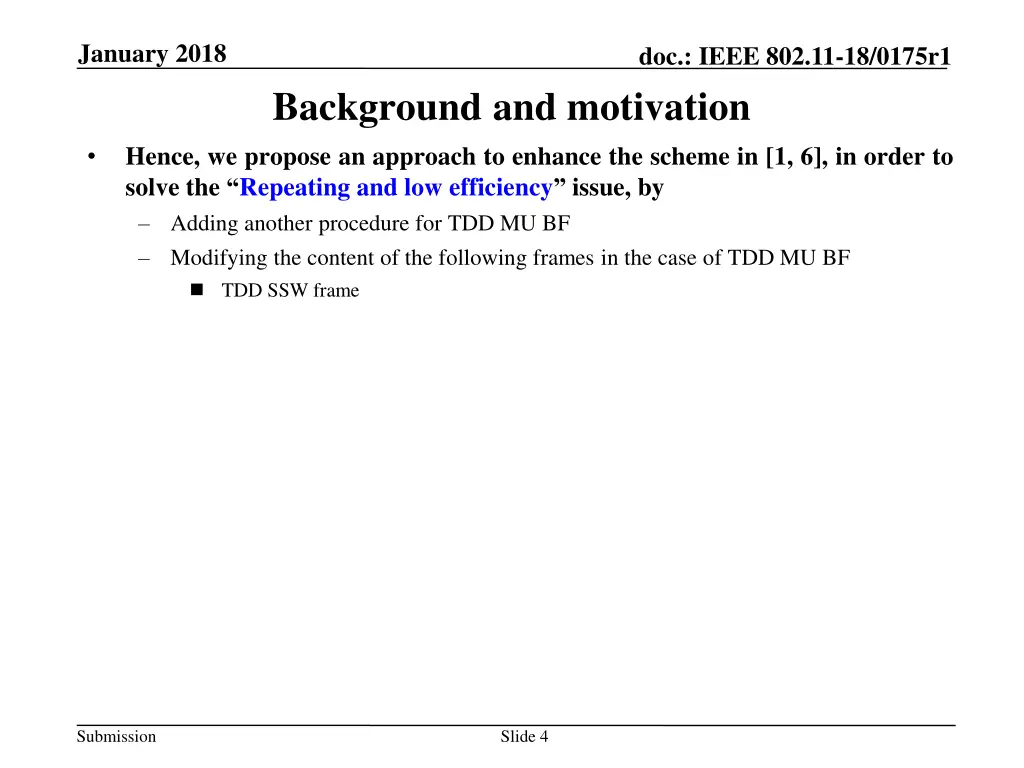
January 2018 doc.: IEEE 802.11-18/0175r1 Background and motivation Hence, we propose an approach to enhance the scheme in [1, 6], in order to solve the Repeating and low efficiency issue, by Adding another procedure for TDD MU BF Modifying the content of the following frames in the case of TDD MU BF TDD SSW frame Submission Slide 4
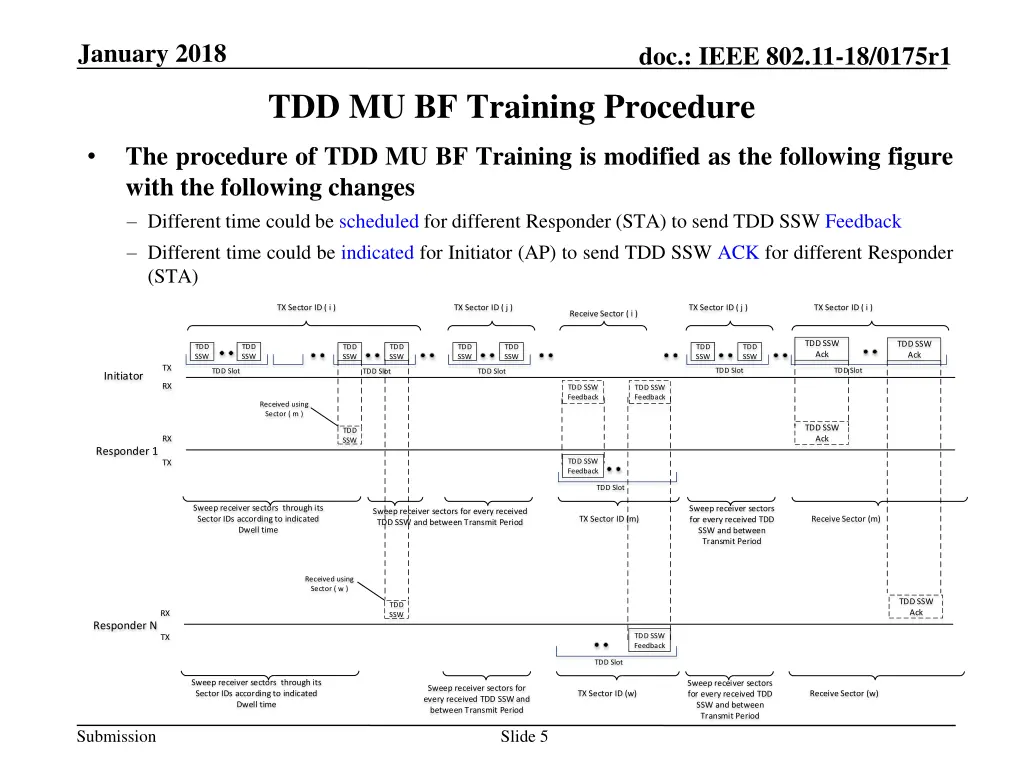
January 2018 doc.: IEEE 802.11-18/0175r1 TDD MU BF Training Procedure The procedure of TDD MU BF Training is modified as the following figure with the following changes Different time could be scheduled for different Responder (STA) to send TDD SSW Feedback Different time could be indicated for Initiator (AP) to send TDD SSW ACK for different Responder (STA) TX Sector ID ( i ) TX Sector ID ( j ) TX Sector ID ( j ) TX Sector ID ( i ) Receive Sector ( i ) TDD SSW Ack TDD SSW Ack TDD SSW TDD SSW TDD SSW TDD SSW TDD SSW TDD SSW TDD SSW TDD SSW TX TDD Slot TDD Slot TDD Slot TDD Slot TDD Slot Initiator RX TDD SSW Feedback TDD SSW Feedback Received using Sector ( m ) TDD SSW Ack TDD SSW RX Responder 1 TDD SSW Feedback TX TDD Slot Sweep receiver sectors through its Sector IDs according to indicated Dwell time Sweep receiver sectors for every received TDD SSW and between Transmit Period Sweep receiver sectors for every received TDD SSW and between Transmit Period TX Sector ID (m) Receive Sector (m) Received using Sector ( w ) TDD SSW Ack TDD SSW RX Responder N TDD SSW Feedback TX TDD Slot Sweep receiver sectors through its Sector IDs according to indicated Dwell time Sweep receiver sectors for every received TDD SSW and between Transmit Period Sweep receiver sectors for every received TDD SSW and between Transmit Period TX Sector ID (w) Receive Sector (w) Submission Slide 5
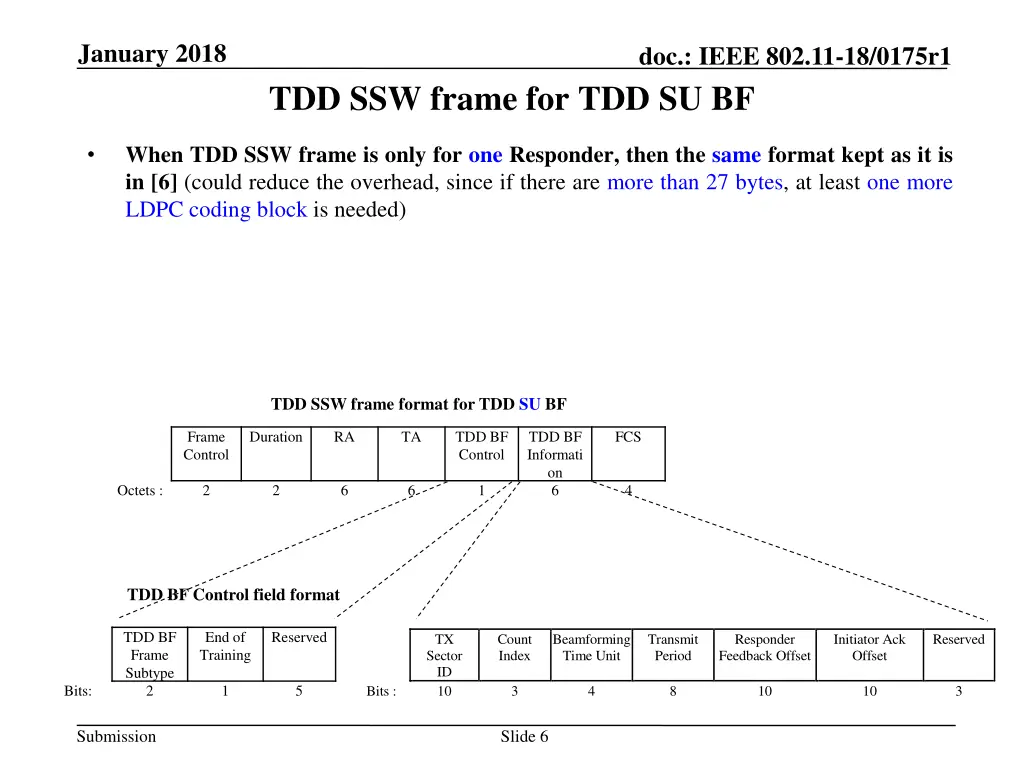
January 2018 doc.: IEEE 802.11-18/0175r1 TDD SSW frame for TDD SU BF When TDD SSW frame is only for one Responder, then the same format kept as it is in [6] (could reduce the overhead, since if there are more than 27 bytes, at least one more LDPC coding block is needed) TDD SSW frame format for TDD SU BF Frame Control Duration RA TA TDD BF Control TDD BF Informati on 6 FCS Octets : 2 2 6 6 1 4 TDD BF Control field format TDD BF Frame Subtype 2 End of Training Reserved TX Sector ID 10 Count Index Beamforming Time Unit Transmit Period Responder Feedback Offset Initiator Ack Offset Reserved Bits: 1 5 Bits : 3 4 8 10 10 3 Submission Slide 6
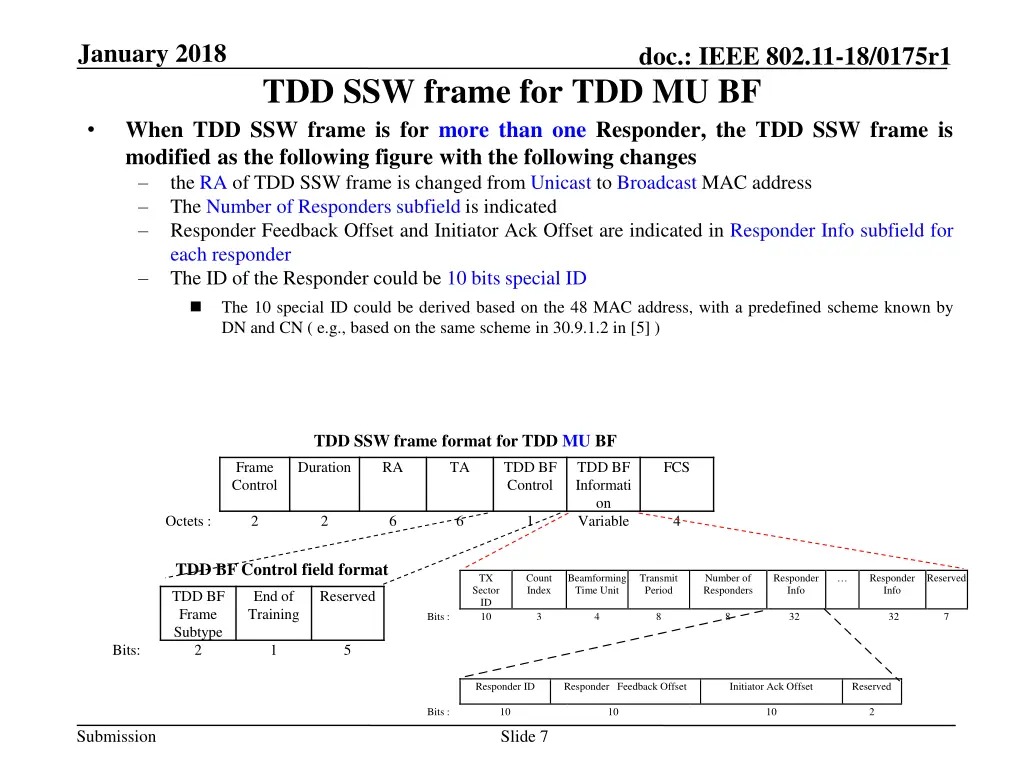
January 2018 doc.: IEEE 802.11-18/0175r1 TDD SSW frame for TDD MU BF When TDD SSW frame is for more than one Responder, the TDD SSW frame is modified as the following figure with the following changes the RA of TDD SSW frame is changed from Unicast to Broadcast MAC address The Number of Responders subfield is indicated Responder Feedback Offset and Initiator Ack Offset are indicated in Responder Info subfield for each responder The ID of the Responder could be 10 bits special ID The 10 special ID could be derived based on the 48 MAC address, with a predefined scheme known by DN and CN ( e.g., based on the same scheme in 30.9.1.2 in [5] ) TDD SSW frame format for TDD MU BF Frame Control Duration RA TA TDD BF Control TDD BF Informati on Variable FCS Octets : 2 2 6 6 1 4 TDD BF Control field format TX Sector ID 10 Count Index Beamforming Time Unit Transmit Period Number of Responders Responder Info Responder Info Reserved TDD BF Frame Subtype 2 End of Training Reserved Bits : 3 4 8 8 32 32 7 Bits: 1 5 Responder ID Responder Feedback Offset Initiator Ack Offset Reserved Bits : 10 10 10 2 Submission Slide 7
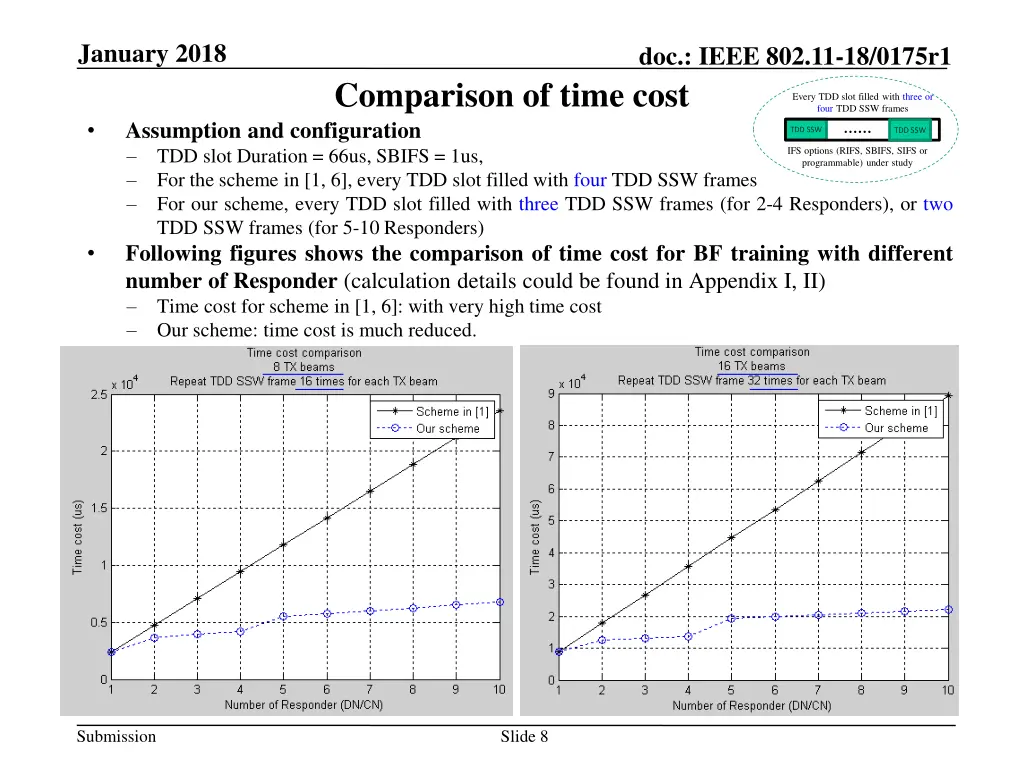
January 2018 doc.: IEEE 802.11-18/0175r1 Comparison of time cost Every TDD slot filled with three or four TDD SSW frames Assumption and configuration TDD slot Duration = 66us, SBIFS = 1us, For the scheme in [1, 6], every TDD slot filled with four TDD SSW frames For our scheme, every TDD slot filled with three TDD SSW frames (for 2-4 Responders), or two TDD SSW frames (for 5-10 Responders) Following figures shows the comparison of time cost for BF training with different number of Responder (calculation details could be found in Appendix I, II) Time cost for scheme in [1, 6]: with very high time cost Our scheme: time cost is much reduced. TDD SSW TDD SSW IFS options (RIFS, SBIFS, SIFS or programmable) under study Submission Slide 8
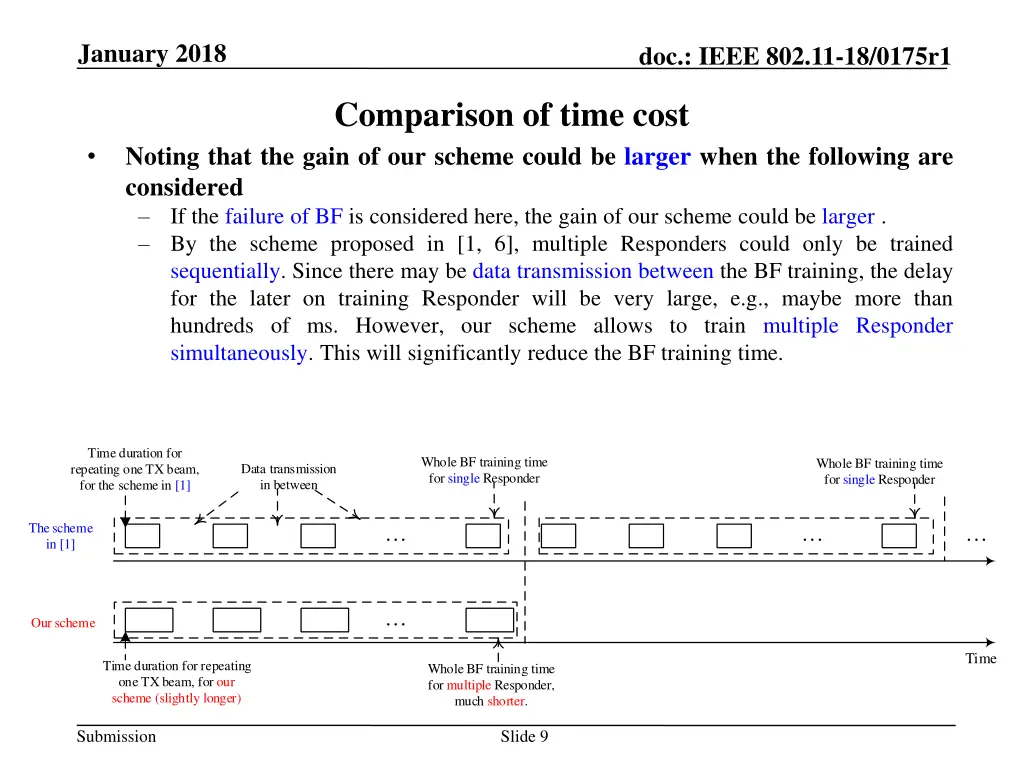
January 2018 doc.: IEEE 802.11-18/0175r1 Comparison of time cost Noting that the gain of our scheme could be larger when the following are considered If the failure of BF is considered here, the gain of our scheme could be larger . By the scheme proposed in [1, 6], multiple Responders could only be trained sequentially. Since there may be data transmission between the BF training, the delay for the later on training Responder will be very large, e.g., maybe more than hundreds of ms. However, our scheme allows to train multiple Responder simultaneously. This will significantly reduce the BF training time. Time duration for repeating one TX beam, for the scheme in [1] Whole BF training time for single Responder Whole BF training time for single Responder Data transmission in between The scheme in [1] . . . . . . . . . . . . Our scheme Time Time duration for repeating one TX beam, for our scheme (slightly longer) Whole BF training time for multiple Responder, much shorter. Submission Slide 9
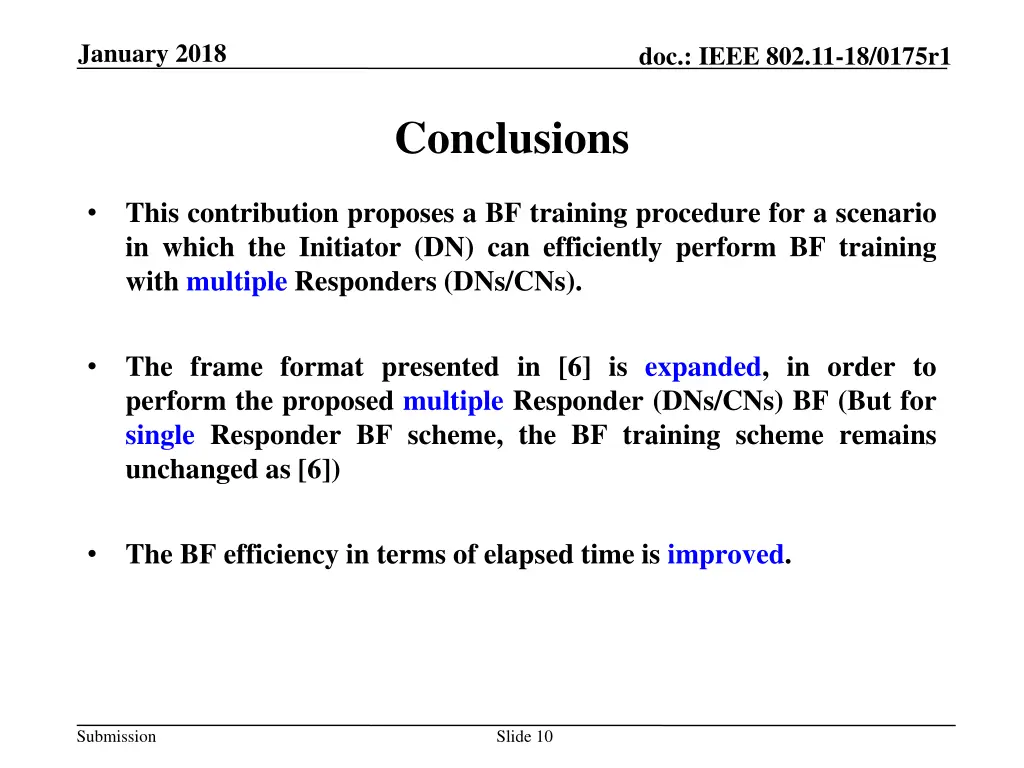
January 2018 doc.: IEEE 802.11-18/0175r1 Conclusions This contribution proposes a BF training procedure for a scenario in which the Initiator (DN) can efficiently perform BF training with multiple Responders (DNs/CNs). The frame format presented in [6] is expanded, in order to perform the proposed multiple Responder (DNs/CNs) BF (But for single Responder BF scheme, the BF training scheme remains unchanged as [6]) The BF efficiency in terms of elapsed time is improved. Submission Slide 10
January 2018 doc.: IEEE 802.11-18/0175r1 Straw Poll/Motion 1 Do you think a TDD MU Beamforming is needed for distributed network, by which the Initiator (DN) can efficiently perform BF Responders (DNs/CNs)? training with multiple Yes No Abstain Submission Slide 11
January 2018 doc.: IEEE 802.11-18/0175r1 Straw Poll/Motion 2 Do you agree to adopt the scheme described in slides 5- 7 into the spec? (This is just for SP, and the draft text will be provided in the near future for Motion) Yes No Abstain Submission Slide 12
January 2018 doc.: IEEE 802.11-18/0175r1 References [1] 802.11-17/1646r1-00ay-beamforming-for-mmwave-distribution-networks [2] 802.11-17/1019r2 mmWave Mesh Network Usage Model [3] 802.11-17/1321r0 Features for mmW Distribution Network Use Case [4] 802.11-2016.pdf [5] Draft P802.11ay_D1.0.pdf [6] 11-18-0179-02-00ay-beamforming-for-mmwave-distributed-network Submission Slide 13
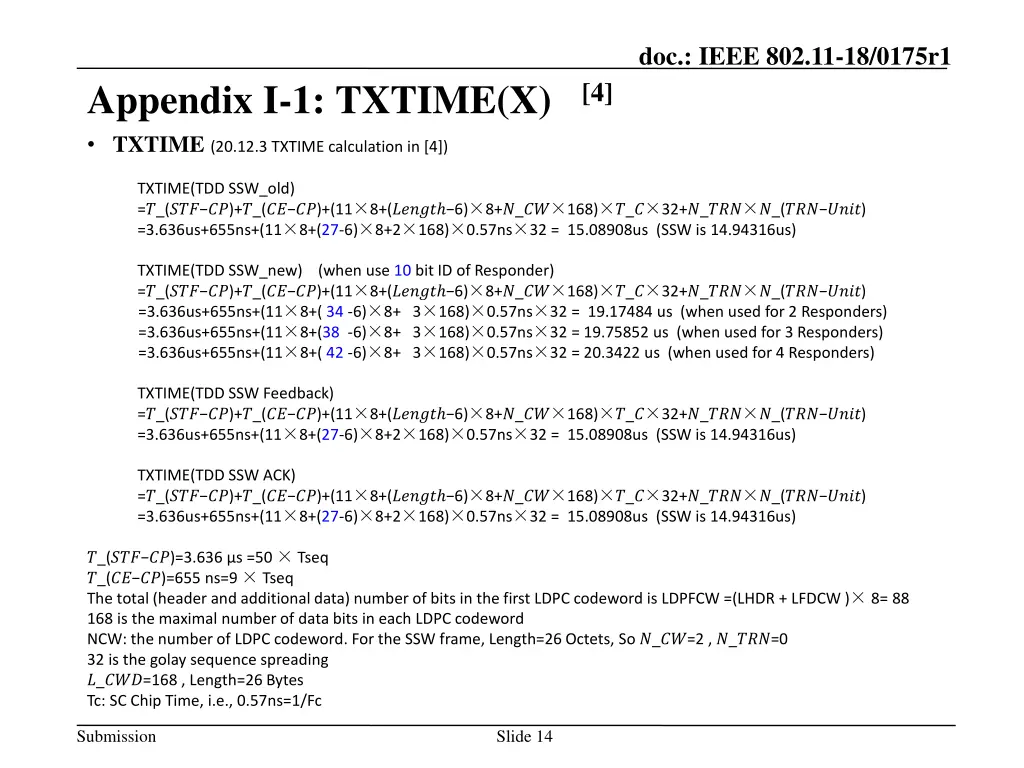
doc.: IEEE 802.11-18/0175r1 Appendix I-1: TXTIME(X) [4] TXTIME (20.12.3 TXTIME calculation in [4]) TXTIME(TDD SSW_old) =?_(??? ??)+?_(?? ??)+(11 8+(????? 6) 8+?_?? 168) ?_? 32+?_??? ?_(??? ????) =3.636us+655ns+(11 8+(27-6) 8+2 168) 0.57ns 32 = 15.08908us (SSW is 14.94316us) TXTIME(TDD SSW_new) (when use 10 bit ID of Responder) =?_(??? ??)+?_(?? ??)+(11 8+(????? 6) 8+?_?? 168) ?_? 32+?_??? ?_(??? ????) =3.636us+655ns+(11 8+( 34 -6) 8+ 3 168) 0.57ns 32 = 19.17484 us (when used for 2 Responders) =3.636us+655ns+(11 8+(38 -6) 8+ 3 168) 0.57ns 32 = 19.75852 us (when used for 3 Responders) =3.636us+655ns+(11 8+( 42 -6) 8+ 3 168) 0.57ns 32 = 20.3422 us (when used for 4 Responders) TXTIME(TDD SSW Feedback) =?_(??? ??)+?_(?? ??)+(11 8+(????? 6) 8+?_?? 168) ?_? 32+?_??? ?_(??? ????) =3.636us+655ns+(11 8+(27-6) 8+2 168) 0.57ns 32 = 15.08908us (SSW is 14.94316us) TXTIME(TDD SSW ACK) =?_(??? ??)+?_(?? ??)+(11 8+(????? 6) 8+?_?? 168) ?_? 32+?_??? ?_(??? ????) =3.636us+655ns+(11 8+(27-6) 8+2 168) 0.57ns 32 = 15.08908us (SSW is 14.94316us) ?_(??? ??)=3.636 s =50 Tseq ?_(?? ??)=655 ns=9 Tseq The total (header and additional data) number of bits in the first LDPC codeword is LDPFCW =(LHDR + LFDCW ) 8= 88 168 is the maximal number of data bits in each LDPC codeword NCW: the number of LDPC codeword. For the SSW frame, Length=26 Octets, So ?_??=2 , ?_???=0 32 is the golay sequence spreading ?_???=168 , Length=26 Bytes Tc: SC Chip Time, i.e., 0.57ns=1/Fc Submission Slide 14
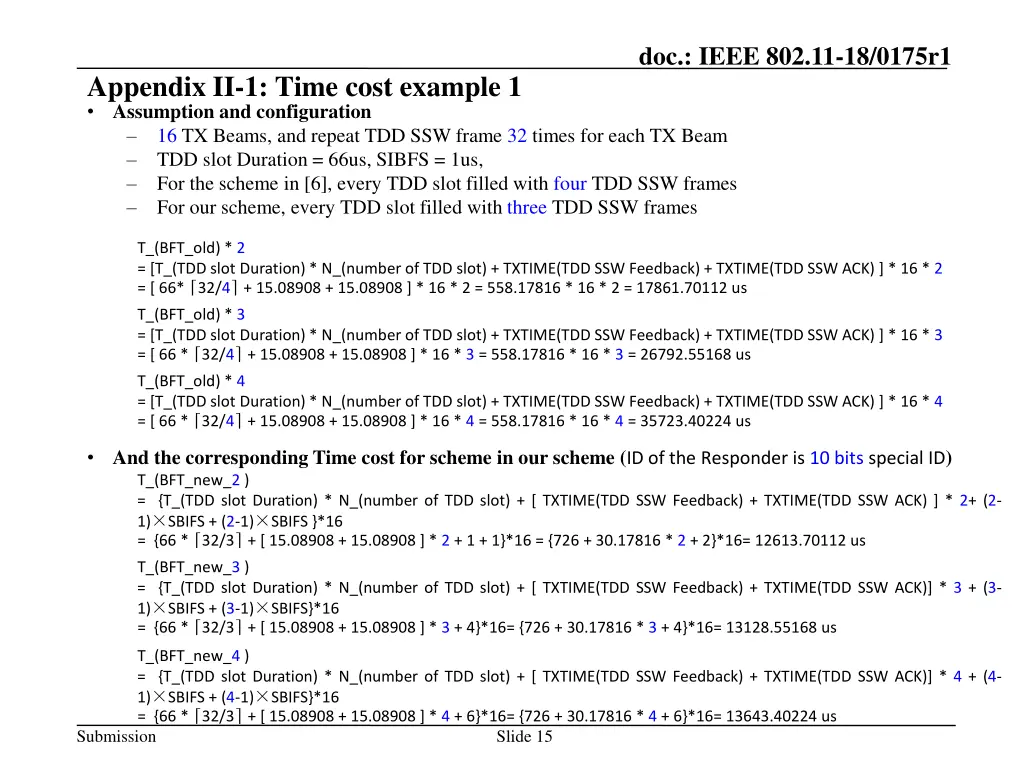
doc.: IEEE 802.11-18/0175r1 Appendix II-1: Time cost example 1 Assumption and configuration 16 TX Beams, and repeat TDD SSW frame 32 times for each TX Beam TDD slot Duration = 66us, SIBFS = 1us, For the scheme in [6], every TDD slot filled with four TDD SSW frames For our scheme, every TDD slot filled with three TDD SSW frames T_(BFT_old) * 2 = [T_(TDD slot Duration) * N_(number of TDD slot) + TXTIME(TDD SSW Feedback) + TXTIME(TDD SSW ACK) ] * 16 * 2 = [ 66* 32/4 + 15.08908 + 15.08908 ] * 16 * 2 = 558.17816 * 16 * 2 = 17861.70112 us T_(BFT_old) * 3 = [T_(TDD slot Duration) * N_(number of TDD slot) + TXTIME(TDD SSW Feedback) + TXTIME(TDD SSW ACK) ] * 16 * 3 = [ 66 * 32/4 + 15.08908 + 15.08908 ] * 16 * 3 = 558.17816 * 16 * 3 = 26792.55168 us T_(BFT_old) * 4 = [T_(TDD slot Duration) * N_(number of TDD slot) + TXTIME(TDD SSW Feedback) + TXTIME(TDD SSW ACK) ] * 16 * 4 = [ 66 * 32/4 + 15.08908 + 15.08908 ] * 16 * 4 = 558.17816 * 16 * 4 = 35723.40224 us And the corresponding Time cost for scheme in our scheme (ID of the Responder is 10 bits special ID) T_(BFT_new_2 ) = {T_(TDD slot Duration) * N_(number of TDD slot) + [ TXTIME(TDD SSW Feedback) + TXTIME(TDD SSW ACK) ] * 2+ (2- 1) SBIFS + (2-1) SBIFS }*16 = {66 * 32/3 + [ 15.08908 + 15.08908 ] * 2 + 1 + 1}*16 = {726 + 30.17816 * 2 + 2}*16= 12613.70112 us T_(BFT_new_3 ) = {T_(TDD slot Duration) * N_(number of TDD slot) + [ TXTIME(TDD SSW Feedback) + TXTIME(TDD SSW ACK)] * 3 + (3- 1) SBIFS + (3-1) SBIFS}*16 = {66 * 32/3 + [ 15.08908 + 15.08908 ] * 3 + 4}*16= {726 + 30.17816 * 3 + 4}*16= 13128.55168 us T_(BFT_new_4 ) = {T_(TDD slot Duration) * N_(number of TDD slot) + [ TXTIME(TDD SSW Feedback) + TXTIME(TDD SSW ACK)] * 4 + (4- 1) SBIFS + (4-1) SBIFS}*16 = {66 * 32/3 + [ 15.08908 + 15.08908 ] * 4 + 6}*16= {726 + 30.17816 * 4 + 6}*16= 13643.40224 us Submission Slide 15