Explore the key features, strengths, weaknesses, and research directions in the context of value chains in agriculture. Understand the importance of focusing on access to food for the poor, lower-value markets, and demand-driven interventions. Discover opportunities for partnerships, inter-disciplinarity, and addressing gender and vulnerable groups' impacts. Consider trade-offs, externalities, market dynamics, and researchable issues in value chain development.
Please find below an Image/Link to download the presentation.
The content on the website is provided AS IS for your information and personal use only. It may not be sold, licensed, or shared on other websites without obtaining consent from the author. If you encounter any issues during the download, it is possible that the publisher has removed the file from their server.
You are allowed to download the files provided on this website for personal or commercial use, subject to the condition that they are used lawfully. All files are the property of their respective owners.
The content on the website is provided AS IS for your information and personal use only. It may not be sold, licensed, or shared on other websites without obtaining consent from the author.
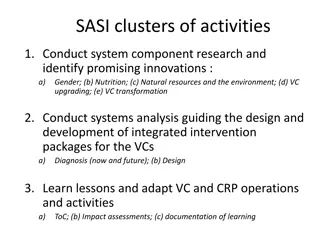
Key features Focus on access to food for the poor Focus on lower value markets Understanding that development interventions should be more demand-driven: not just productivity increase but also the market for it
Strengths New / better partnerships especially with the private sector being the knowledge partner Inter-disciplinarity: having better answers to stakeholders problems Explicit recognition for understanding of macro- context (component 2.1) Development of common approaches, comparable data across species / systems / regions Understanding of impacts on sub-groups (gender / vulnerable)
Weaknesses Value chain assessment itself not very well described in component 2.2 is recognized how data intensive this may be, especially with gender-disaggregated data? Researchable issues in value chain cases still have major technical focus (fish esp.), much less real value chain issues in the case descriptions Focus may still be on specific segments of the chain
Weaknesses Trade-offs and externalities (in rationale but not in researchable issues) Terminology used: value chain, supply chain value chain strand, node, segment
Questions Integration of the 3 teams, challenge to build new ways of working together Interactions with CRP2 How to achieve new ways of working with new partners?: demand for faster responses to demands for knowledge vs. doing good science
Research directions? Employment creation vs. cheap food Trade-offs, externalities, implications for other sectors Improving access to affordable food vs. more income to buy food: may move in opposite directions Employment trade-offs (e.g. rice vs. aquaculture in Asia) Market dynamics: production , prices , what is the impact on producers? Downgrading as upgrading Enabling environment