Enhancing Wireless Network Performance with TDM Multi-link Operation
Explore the benefits of Time Division Multiplexed multi-link operation in improving wireless network performance. Learn about the operating principles, requirements, and architectures for implementing TDM ML. Compare simulations of Single-link, TDM ML, and conventional ML to understand the advantages of TDM ML in enhancing data transmission on multiple links simultaneously.

Download Presentation

Please find below an Image/Link to download the presentation.
The content on the website is provided AS IS for your information and personal use only. It may not be sold, licensed, or shared on other websites without obtaining consent from the author. If you encounter any issues during the download, it is possible that the publisher has removed the file from their server.
You are allowed to download the files provided on this website for personal or commercial use, subject to the condition that they are used lawfully. All files are the property of their respective owners.
The content on the website is provided AS IS for your information and personal use only. It may not be sold, licensed, or shared on other websites without obtaining consent from the author.
E N D
Presentation Transcript
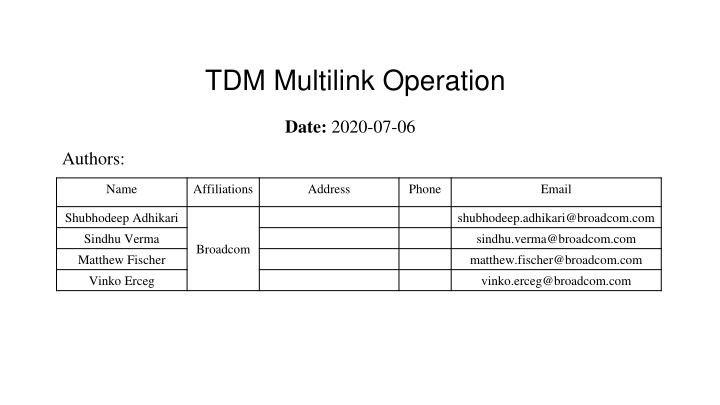
TDM Multilink Operation Date: 2020-07-06 Authors: Name Affiliations Address Phone Email Shubhodeep Adhikari Sindhu Verma Matthew Fischer Vinko Erceg shubhodeep.adhikari@broadcom.com sindhu.verma@broadcom.com matthew.fischer@broadcom.com vinko.erceg@broadcom.com Broadcom
July 2020 doc.: IEEE 802.11-20/0659r2 Introduction This presentation discusses the following: A variation of multi-link, which we call Time Division Multiplexed multi-link or TDM ML. Reasons why TDM ML can enhance the performance of conventional ML. Operating principles of TDM ML. Requirements at the non-AP and AP to support TDM ML. Architectures to implement TDM ML. Simulations to compare Single-link, TDM ML and conventional ML. Straw poll on TDM ML.
July 2020 Conventional ML and TDM ML (1) doc.: IEEE 802.11-20/0659r2 In conventional M-link ML, a STA is capable of Tx/Rx on M links. Such a STA utilizes M radios for this purpose. In order to access the M-links, the AP or non-AP STA performs CCA on the M-links. However, unless all the M links are free of congestion, such CCA on M links leads to Tx/Rx of data only on a smaller subset of M links. With TDM ML it is possible to perform CCA at either the AP or non-AP on more than M links. This increases the chance of obtaining a larger set of links for Tx/Rx of data, even if such Tx/Rx is limited to M links at a time. Doing so thus will enhance the performance of M-link ML.
July 2020 doc.: IEEE 802.11-20/0659r2 Conventional ML and TDM ML (2) Definition of TDM ML: If there are M radios at a non-AP STA, Tx/Rx of data is limited to M links at a time as in conventional M-link ML. Additionally, each radio can perform CCA or listen for the start of data transmission on either 1 or 2 links at a time. The start of data transmission can be through an RTS/MU-RTS. This enables an M-radio STA to perform CCA or listen up to 2M links at a time. The following are the benefits of TDM ML: Significantly improves the performance of M-radio M-link ML without needing any additional hardware over what is needed to support M-link ML. Needs only small changes to the 11be specifications over what is needed to support M-link ML.
July 2020 doc.: IEEE 802.11-20/0659r2 Operating principles of TDM ML Each radio has up to 2 associated links. It can do data Tx/Rx on one operating link , while it can be in listen-only mode on up to 2 links. The radio can switch the operating link either dynamically or semi-statically. Dynamic: The operating link can be whichever wins channel access earlier. The AP/non-AP can exchange data for a given TXOP on one link and subsequently exchange data on another TXOP on a different link. Semi-static: The operating link can be switched from a worse to a better one, based on channel quality parameters (estimated data rate, observed error, load balancing, interference etc).
July 2020 doc.: IEEE 802.11-20/0659r2 Requirements to support TDM ML At the non-AP: A radio at the non-AP should support data Tx/Rx on 1 link and listen on up to 2 links, where listen includes CCA as well as reception of initial control messages (e.g. RTS/MU-RTS) At the AP: The start of data Tx/Rx from the AP to a TDM ML non-AP within a TXOP should be preceded by an RTS/MU-RTS to the non-AP. Optionally, the non-AP and AP can negotiate a configurable delay that is required for a listen-only link at the non-AP to become an operating link.
July 2020 doc.: IEEE 802.11-20/0659r2 TDM ML architectures: Tx/Rx on 1 link at a time and listen on 2 links The principle of TDM ML is independent of the architecture used to implement it and architectures other than the ones described below are also possible. Common architecture: Support for 2x2 MIMO on 1 link, implemented via 1 11be baseband in 2x2 mode and 2 RF chains. Variation 1: Listen capability on 2 links is enabled by configuring the 11be baseband as 2 1x1 basebands and connecting each of them to 1 RF chain. This requires no additional component over what is required to support 1-link 2x2 MIMO. Variation 2: Listen capability on 2 links is enabled by adding 1 limited capability baseband in addition to the existing 11be baseband and connecting each of them to 1 RF chain. This requires 1 additional limited capability baseband. A similar scheme has been discussed in [1].
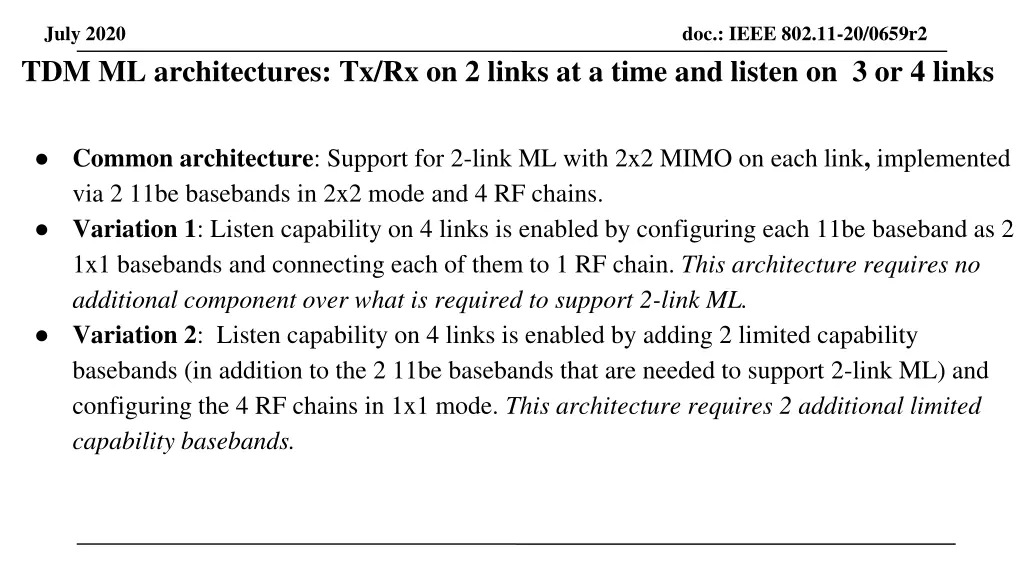
July 2020 TDM ML architectures: Tx/Rx on 2 links at a time and listen on 3 or 4 links doc.: IEEE 802.11-20/0659r2 Common architecture: Support for 2-link ML with 2x2 MIMO on each link, implemented via 2 11be basebands in 2x2 mode and 4 RF chains. Variation 1: Listen capability on 4 links is enabled by configuring each 11be baseband as 2 1x1 basebands and connecting each of them to 1 RF chain. This architecture requires no additional component over what is required to support 2-link ML. Variation 2: Listen capability on 4 links is enabled by adding 2 limited capability basebands (in addition to the 2 11be basebands that are needed to support 2-link ML) and configuring the 4 RF chains in 1x1 mode. This architecture requires 2 additional limited capability basebands.
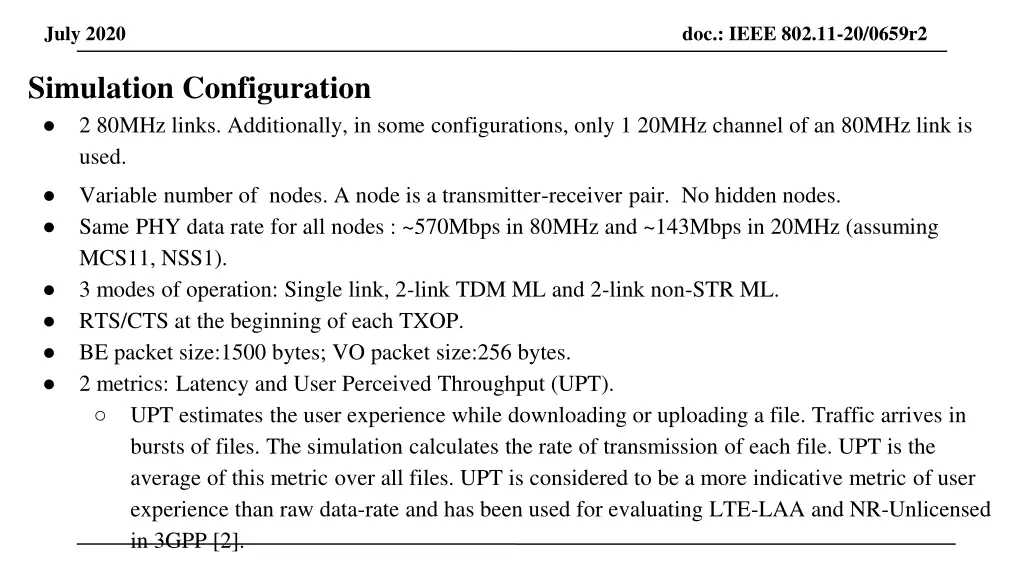
July 2020 doc.: IEEE 802.11-20/0659r2 Simulation Configuration 2 80MHz links. Additionally, in some configurations, only 1 20MHz channel of an 80MHz link is used. Variable number of nodes. A node is a transmitter-receiver pair. No hidden nodes. Same PHY data rate for all nodes : ~570Mbps in 80MHz and ~143Mbps in 20MHz (assuming MCS11, NSS1). 3 modes of operation: Single link, 2-link TDM ML and 2-link non-STR ML. RTS/CTS at the beginning of each TXOP. BE packet size:1500 bytes; VO packet size:256 bytes. 2 metrics: Latency and User Perceived Throughput (UPT). UPT estimates the user experience while downloading or uploading a file. Traffic arrives in bursts of files. The simulation calculates the rate of transmission of each file. UPT is the average of this metric over all files. UPT is considered to be a more indicative metric of user experience than raw data-rate and has been used for evaluating LTE-LAA and NR-Unlicensed in 3GPP [2].
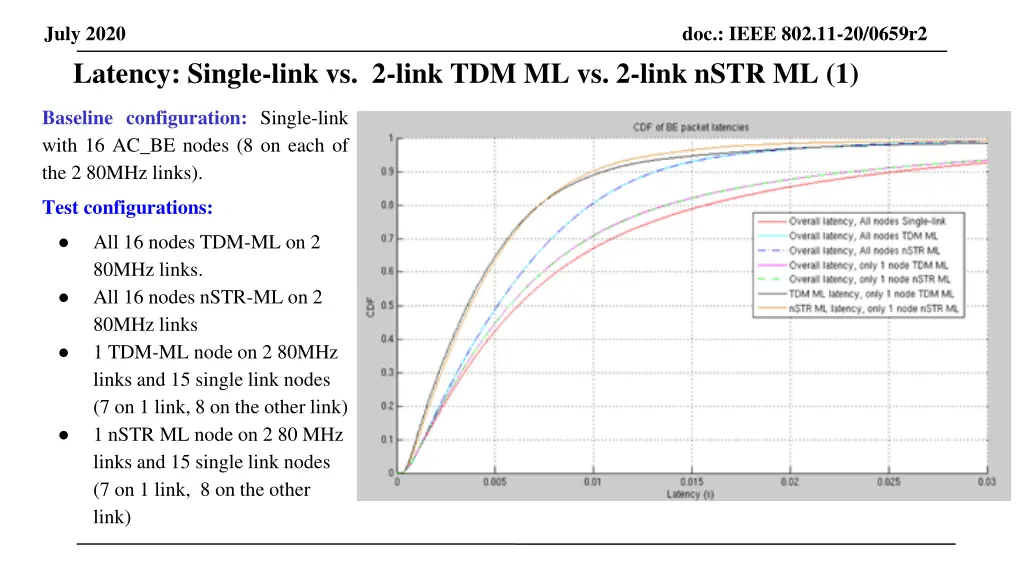
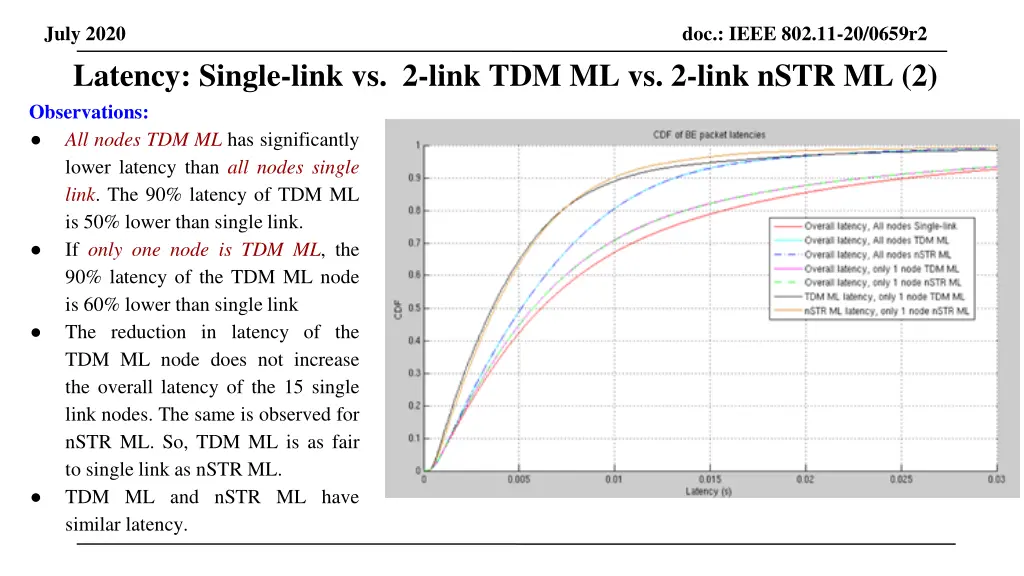
July 2020 Latency: Single-link vs. 2-link TDM ML vs. 2-link nSTR ML (1) doc.: IEEE 802.11-20/0659r2 Baseline configuration: Single-link with 16 AC_BE nodes (8 on each of the 2 80MHz links). Test configurations: All 16 nodes TDM-ML on 2 80MHz links. All 16 nodes nSTR-ML on 2 80MHz links 1 TDM-ML node on 2 80MHz links and 15 single link nodes (7 on 1 link, 8 on the other link) 1 nSTR ML node on 2 80 MHz links and 15 single link nodes (7 on 1 link, 8 on the other link)
July 2020 Latency: Single-link vs. 2-link TDM ML vs. 2-link nSTR ML (2) doc.: IEEE 802.11-20/0659r2 Observations: All nodes TDM ML has significantly lower latency than all nodes single link. The 90% latency of TDM ML is 50% lower than single link. If only one node is TDM ML, the 90% latency of the TDM ML node is 60% lower than single link The reduction in latency of the TDM ML node does not increase the overall latency of the 15 single link nodes. The same is observed for nSTR ML. So, TDM ML is as fair to single link as nSTR ML. TDM ML and nSTR ML have similar latency.
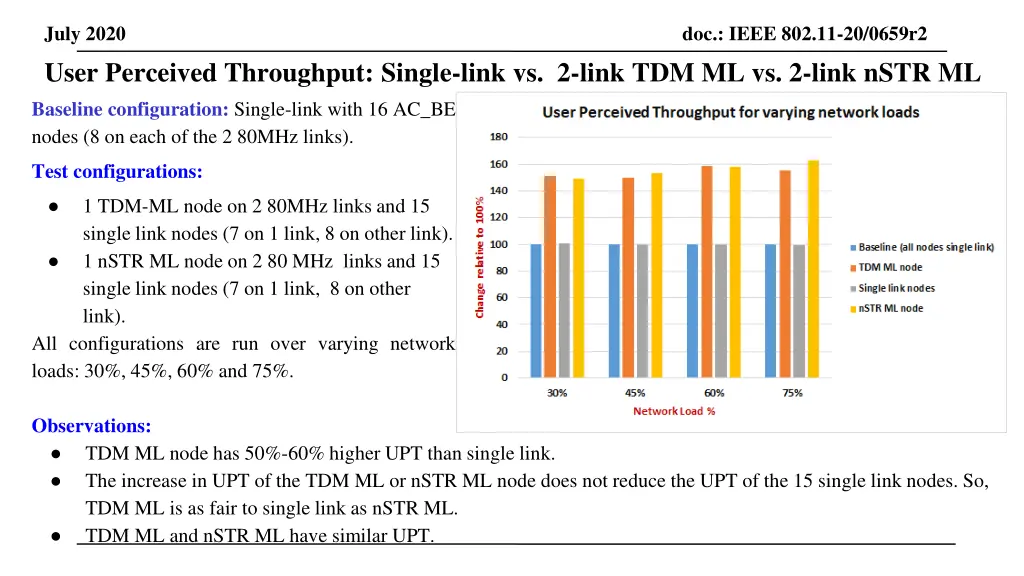
July 2020 User Perceived Throughput: Single-link vs. 2-link TDM ML vs. 2-link nSTR ML doc.: IEEE 802.11-20/0659r2 Baseline configuration: Single-link with 16 AC_BE nodes (8 on each of the 2 80MHz links). Test configurations: 1 TDM-ML node on 2 80MHz links and 15 single link nodes (7 on 1 link, 8 on other link). 1 nSTR ML node on 2 80 MHz links and 15 single link nodes (7 on 1 link, 8 on other link). All configurations are run over varying network loads: 30%, 45%, 60% and 75%. Observations: TDM ML node has 50%-60% higher UPT than single link. The increase in UPT of the TDM ML or nSTR ML node does not reduce the UPT of the 15 single link nodes. So, TDM ML is as fair to single link as nSTR ML. TDM ML and nSTR ML have similar UPT.
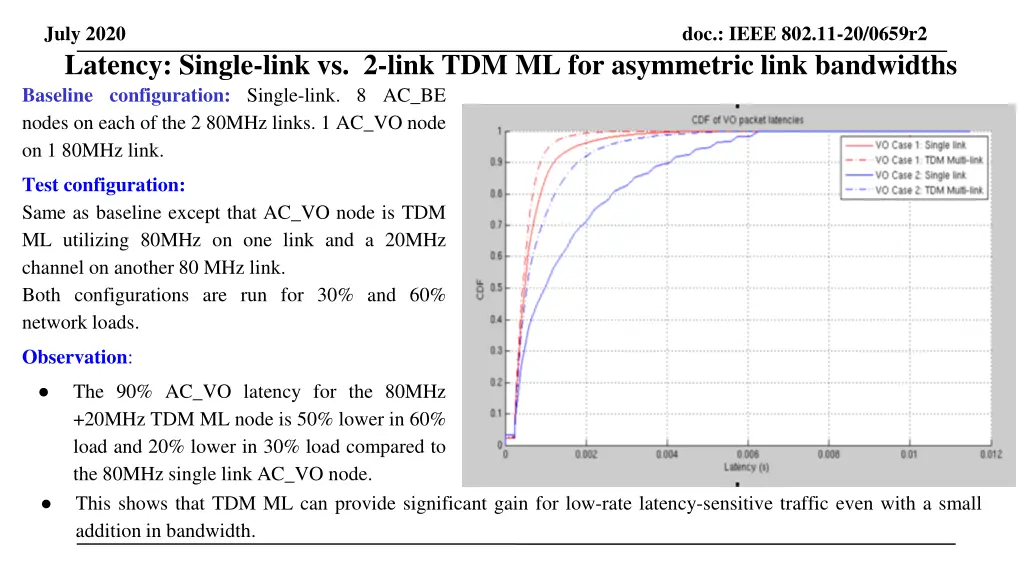
July 2020 Latency: Single-link vs. 2-link TDM ML for asymmetric link bandwidths doc.: IEEE 802.11-20/0659r2 Baseline configuration: Single-link. 8 AC_BE nodes on each of the 2 80MHz links. 1 AC_VO node on 1 80MHz link. Test configuration: Same as baseline except that AC_VO node is TDM ML utilizing 80MHz on one link and a 20MHz channel on another 80 MHz link. Both configurations are run for 30% and 60% network loads. Observation: The 90% AC_VO latency for the 80MHz +20MHz TDM ML node is 50% lower in 60% load and 20% lower in 30% load compared to the 80MHz single link AC_VO node. This shows that TDM ML can provide significant gain for low-rate latency-sensitive traffic even with a small addition in bandwidth.
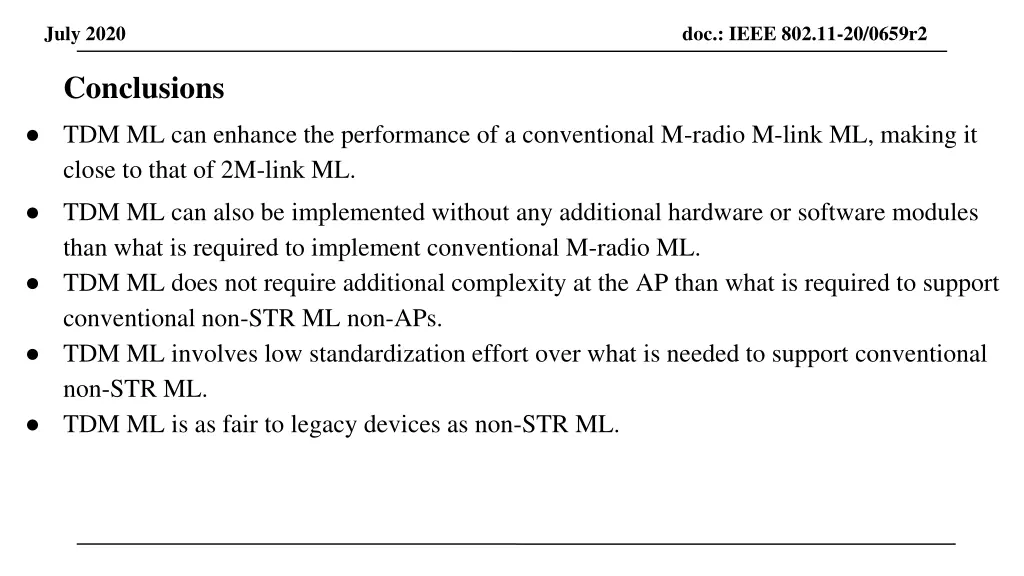
July 2020 doc.: IEEE 802.11-20/0659r2 Conclusions TDM ML can enhance the performance of a conventional M-radio M-link ML, making it close to that of 2M-link ML. TDM ML can also be implemented without any additional hardware or software modules than what is required to implement conventional M-radio ML. TDM ML does not require additional complexity at the AP than what is required to support conventional non-STR ML non-APs. TDM ML involves low standardization effort over what is needed to support conventional non-STR ML. TDM ML is as fair to legacy devices as non-STR ML.
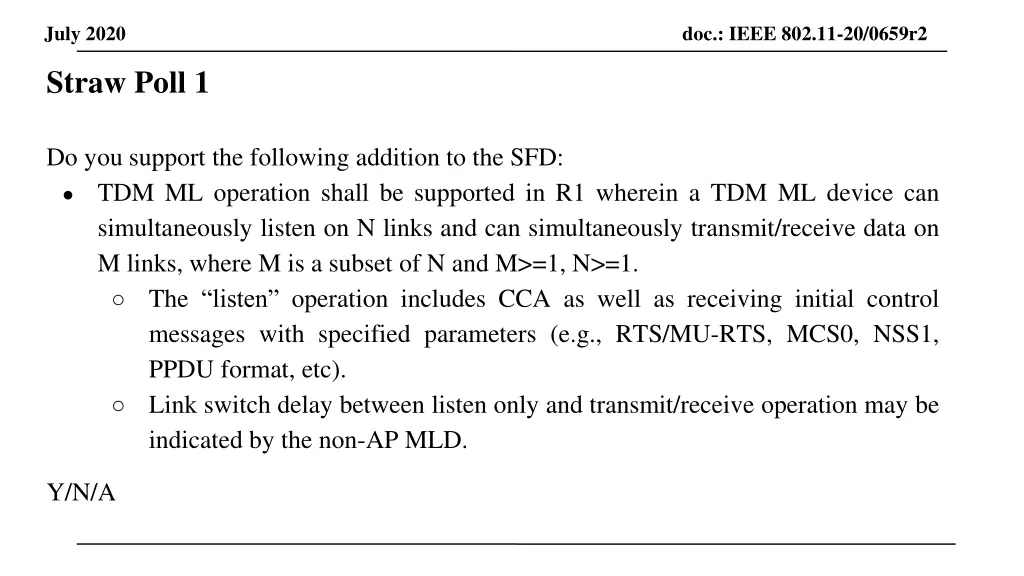
July 2020 doc.: IEEE 802.11-20/0659r2 Straw Poll 1 Do you support the following addition to the SFD: TDM ML operation shall be supported in R1 wherein a TDM ML device can simultaneously listen on N links and can simultaneously transmit/receive data on M links, where M is a subset of N and M>=1, N>=1. The listen operation includes CCA as well as receiving initial control messages with specified parameters (e.g., RTS/MU-RTS, MCS0, NSS1, PPDU format, etc). Link switch delay between listen only and transmit/receive operation may be indicated by the non-AP MLD. Y/N/A
July 2020 doc.: IEEE 802.11-20/0659r2 References [1] IEEE 802.11-20/0562r4 Enhanced Multi-Link Single Radio Operation [2] 3GPP TR 36.889. Section A.1.1, performance metrics
![❤Book⚡[PDF]✔ The Apollo Guidance Computer: Architecture and Operation (Springer](/thumb/21611/book-pdf-the-apollo-guidance-computer-architecture-and-operation-springer.jpg)