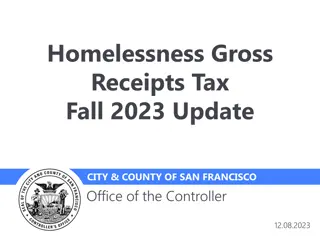
Ensuring Affordable Utility Service - Revisiting Disconnection and Revenue Collection Policies
This presentation by Karen Lusson discusses the challenges of affordability in utility services, the obligations of public utilities, and the impact of collection policies on access, affordability, and public health.

Download Presentation

Please find below an Image/Link to download the presentation.
The content on the website is provided AS IS for your information and personal use only. It may not be sold, licensed, or shared on other websites without obtaining consent from the author.If you encounter any issues during the download, it is possible that the publisher has removed the file from their server.
You are allowed to download the files provided on this website for personal or commercial use, subject to the condition that they are used lawfully. All files are the property of their respective owners.
The content on the website is provided AS IS for your information and personal use only. It may not be sold, licensed, or shared on other websites without obtaining consent from the author.
E N D
Presentation Transcript
Ensuring Affordable Utility Service Revisiting Utility Disconnection and Revenue Collection Policies Presented by: Karen Lusson Asst. Bureau Chief, Public Utilities Bureau Illinois Attorney General s Office NASUCA, November 2018 1
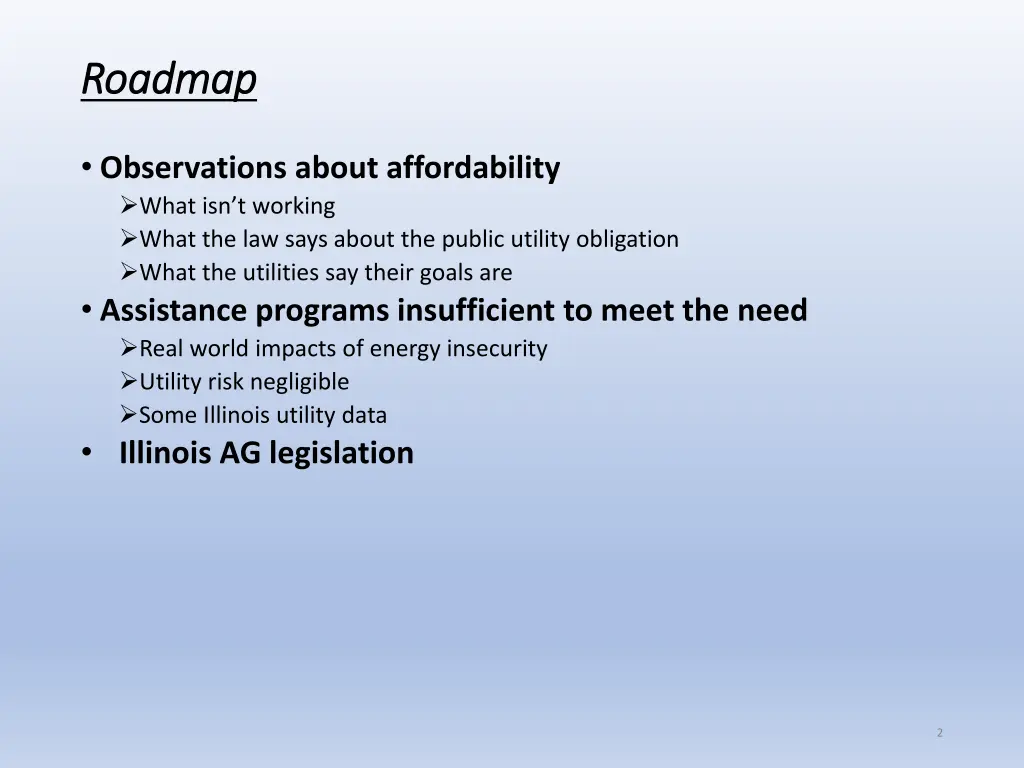
Roadmap Roadmap Observations about affordability What isn t working What the law says about the public utility obligation What the utilities say their goals are Assistance programs insufficient to meet the need Real world impacts of energy insecurity Utility risk negligible Some Illinois utility data Illinois AG legislation 2
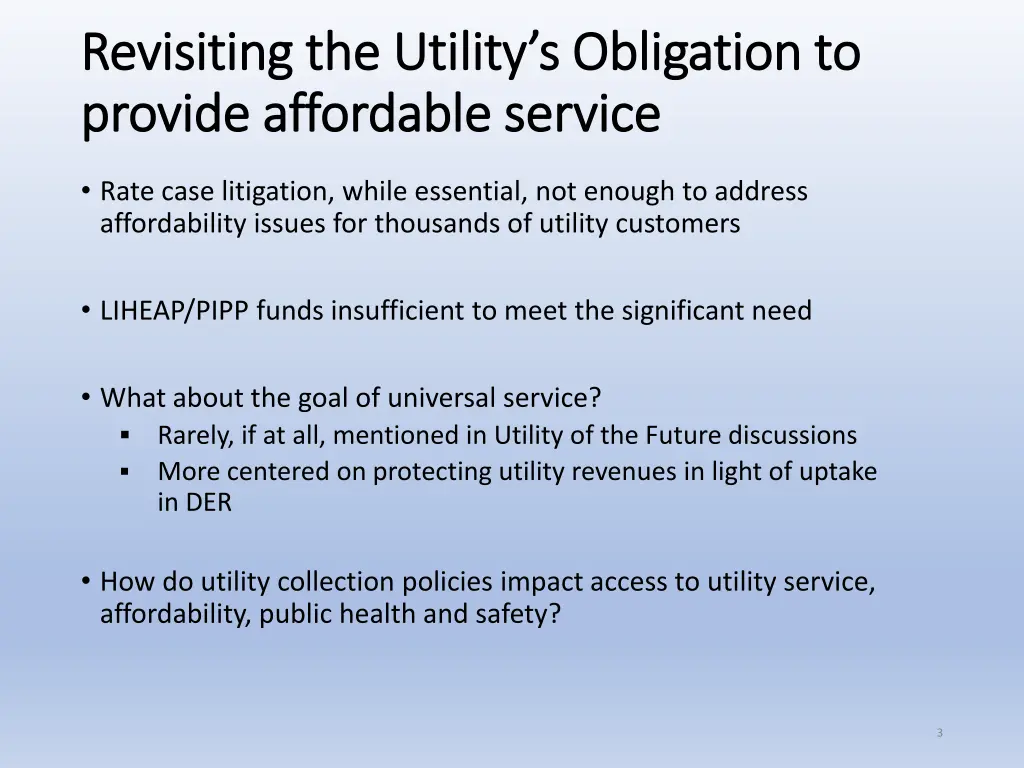
Revisiting the Utilitys Obligation to Revisiting the Utility s Obligation to provide affordable service provide affordable service Rate case litigation, while essential, not enough to address affordability issues for thousands of utility customers LIHEAP/PIPP funds insufficient to meet the significant need What about the goal of universal service? Rarely, if at all, mentioned in Utility of the Future discussions More centered on protecting utility revenues in light of uptake in DER How do utility collection policies impact access to utility service, affordability, public health and safety? 3
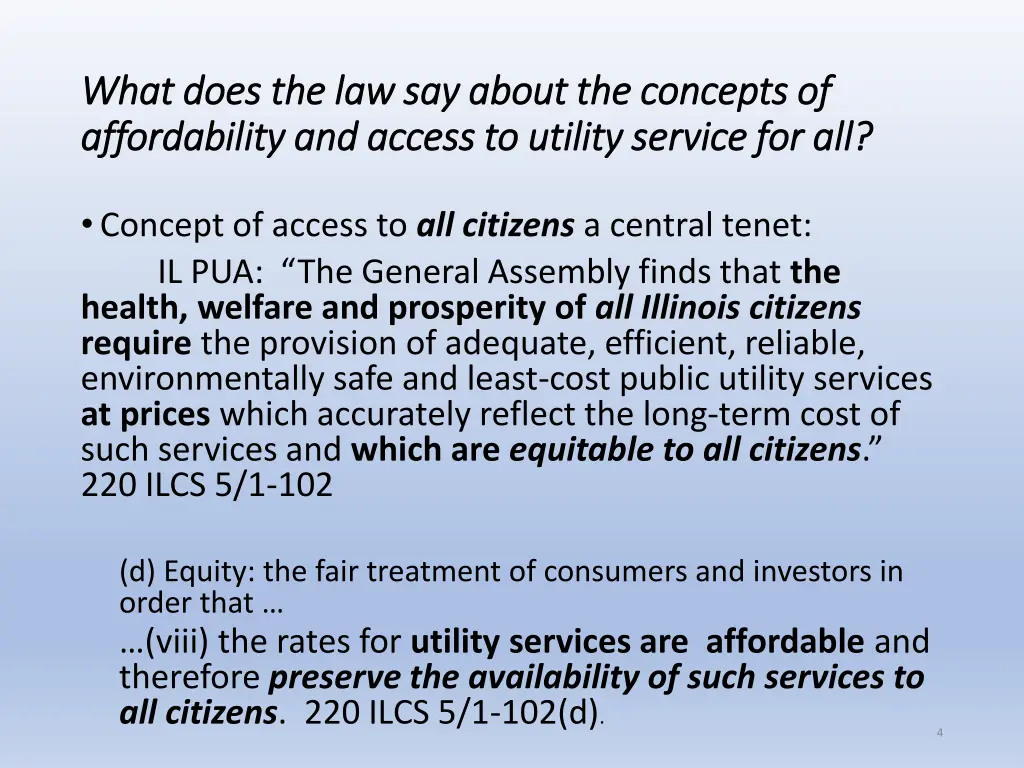
What does the law say about the concepts of What does the law say about the concepts of affordability and access to utility service for all? affordability and access to utility service for all? Concept of access to all citizens a central tenet: IL PUA: The General Assembly finds that the health, welfare and prosperity of all Illinois citizens require the provision of adequate, efficient, reliable, environmentally safe and least-cost public utility services at prices which accurately reflect the long-term cost of such services and which are equitable to all citizens. 220 ILCS 5/1-102 (d) Equity: the fair treatment of consumers and investors in order that (viii) the rates for utility services are affordable and therefore preserve the availability of such services to all citizens. 220 ILCS 5/1-102(d). 4
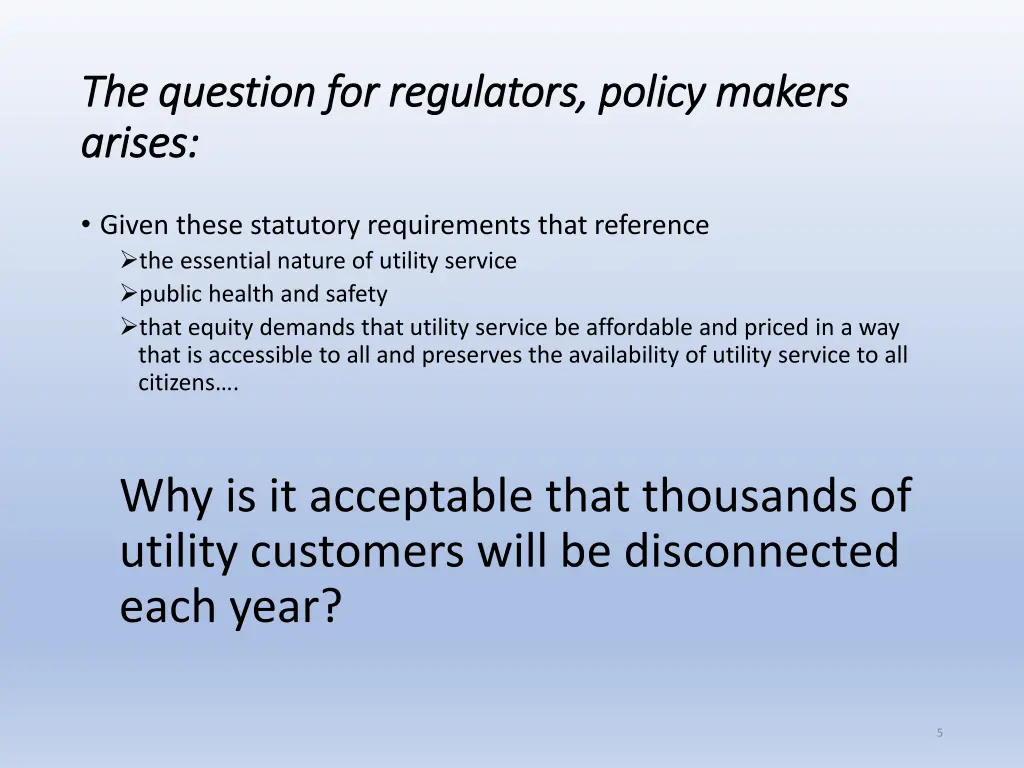
The question for regulators, policy makers The question for regulators, policy makers arises: arises: Given these statutory requirements that reference the essential nature of utility service public health and safety that equity demands that utility service be affordable and priced in a way that is accessible to all and preserves the availability of utility service to all citizens . Why is it acceptable that thousands of utility customers will be disconnected each year? 5
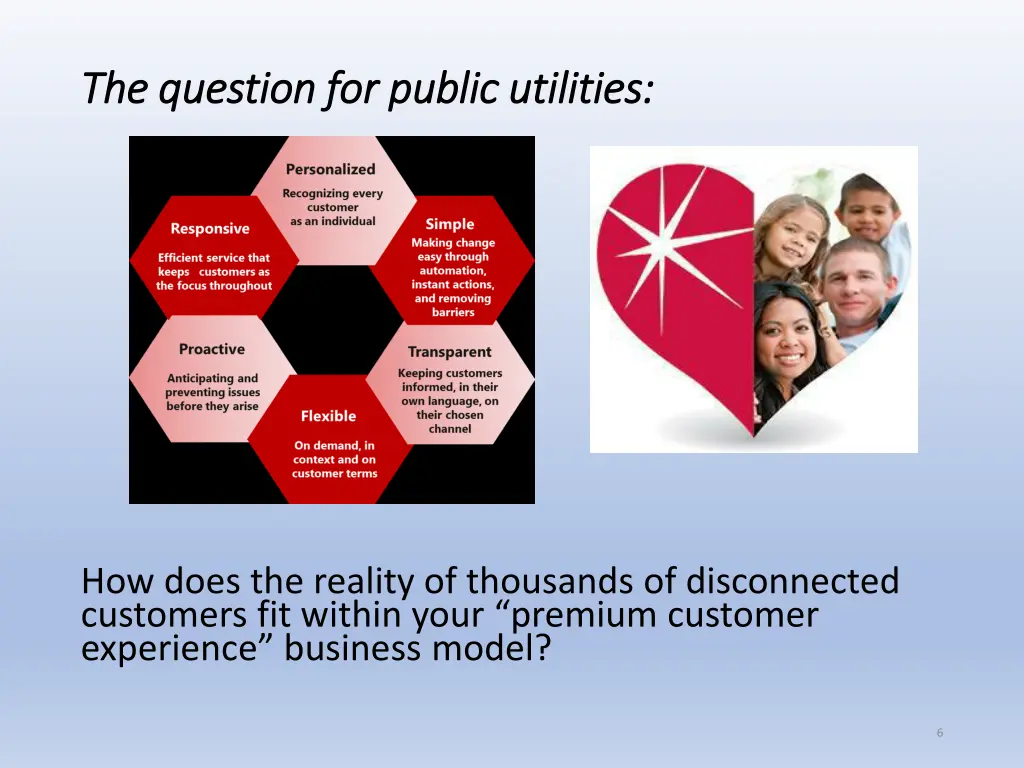
The question for public utilities: The question for public utilities: How does the reality of thousands of disconnected customers fit within your premium customer experience business model? 6
LIHEAP/PIPP Funding Insufficient to Meet the LIHEAP/PIPP Funding Insufficient to Meet the Need Need Only 35% of Illinois total eligible population served by LIHEAP/PIPP 1,092,303 eligible for LIHEAP in 2017 258,317 households received a LIHEAP/PIPP benefit in 2018 Applications down about 7% from last year. Unclear why. A total of $182.1 million available during 2018 program year Only $40 million allocated to PIPP this year. How funds are distributed determined by individual agency management. CEDA (serves Chicago/Cook County) not accepting new PIPP enrollees due to program management costs. ComEd Only 4.7% of ComEd s customers received LIHEAP (170,945 / 3,608,354 = 0.0474) in 2016/2017 program year. In contrast, nearly 30% of ComEd s Chicago service territory had income at or below 150% of FPL in 2016. Fewer than one-of-six eligible customers received federal LIHEAP assistance. Sources: Illinois Department of Commerce and Economic Opportunity, Roger Colton s 2017 Energy Affordability Gap, 2017 Illinois Fact Sheet; ICC Docket NO. 17-0837, AG Exhibit 2.0, p. 58. 7
LIHEAP/PIPP not enough to address need LIHEAP/PIPP not enough to address need 2011 National Energy Assistance Directors 2011 National Energy Assistance Directors Association (NEADA) study findings: Association (NEADA) study findings: 23% of LIHEAP recipients kept their homes at what they believed to be unsafe or unhealthy temperatures in the past year due to not having enough money for their energy bills (page 24). 33% of LIHEAP recipients used their kitchen stove or oven to provide heat in the past year due to not have enough money for their energy bill (page 27); 7% of LIHEAP recipients were unable to use their main source of heat in the past year because their gas or electric service was discontinued for nonpayment (page 38); 6% of LIHEAP recipients were evicted from their home or apartment in the past five years due to unpaid utility bills, while 4% had their home mortgage foreclosed for this reason (page 38); 8
2011 NEADA study findings: 2011 NEADA study findings: 25% of LIHEAP recipients went without food for at least one day in the past five years due to energy bills (page 42); 41% of LIHEAP recipients went without medical care or dental care in the past year due to energy bills (page 42); 34% of LIHEAP recipients did not fill a prescription, or took less than their full dose, within the past five years due to energy bills (page 42). 19% of LIHEAP recipients had someone in the home become sick because the home was kept too cold in the past five years (page 43). Source: 2011 NEADA Study: http://neada.org/program-policy-reports/liheapsurvey/ 9
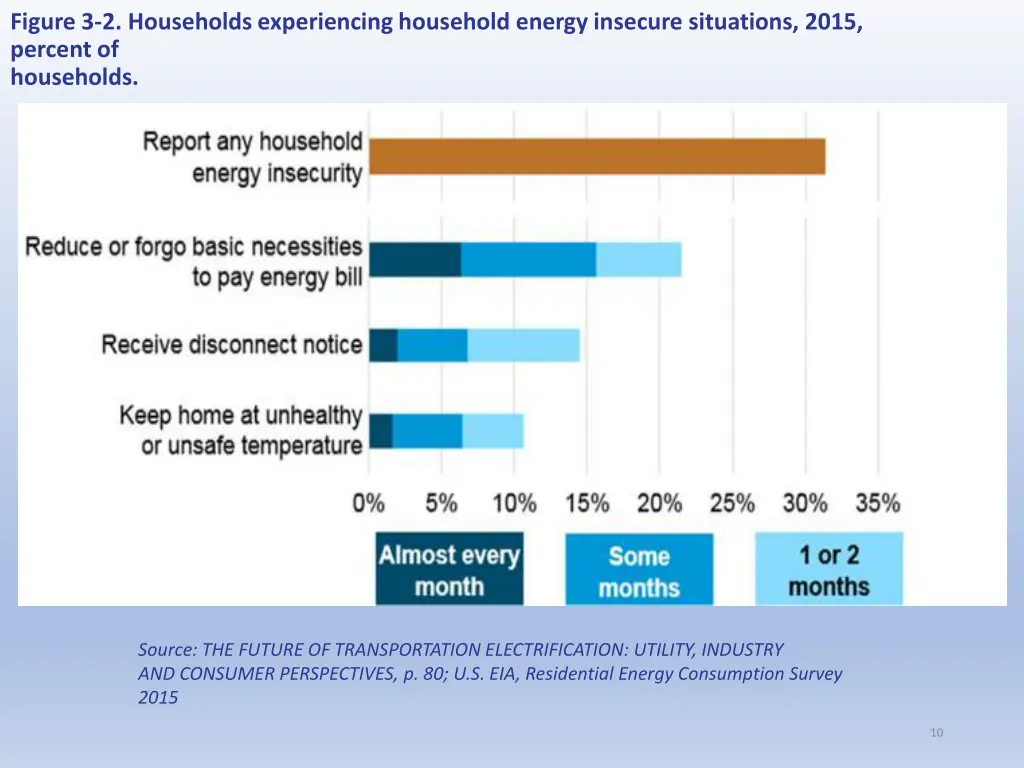
Figure 3-2. Households experiencing household energy insecure situations, 2015, percent of households. Source: THE FUTURE OF TRANSPORTATION ELECTRIFICATION: UTILITY, INDUSTRY AND CONSUMER PERSPECTIVES, p. 80; U.S. EIA, Residential Energy Consumption Survey 2015 10
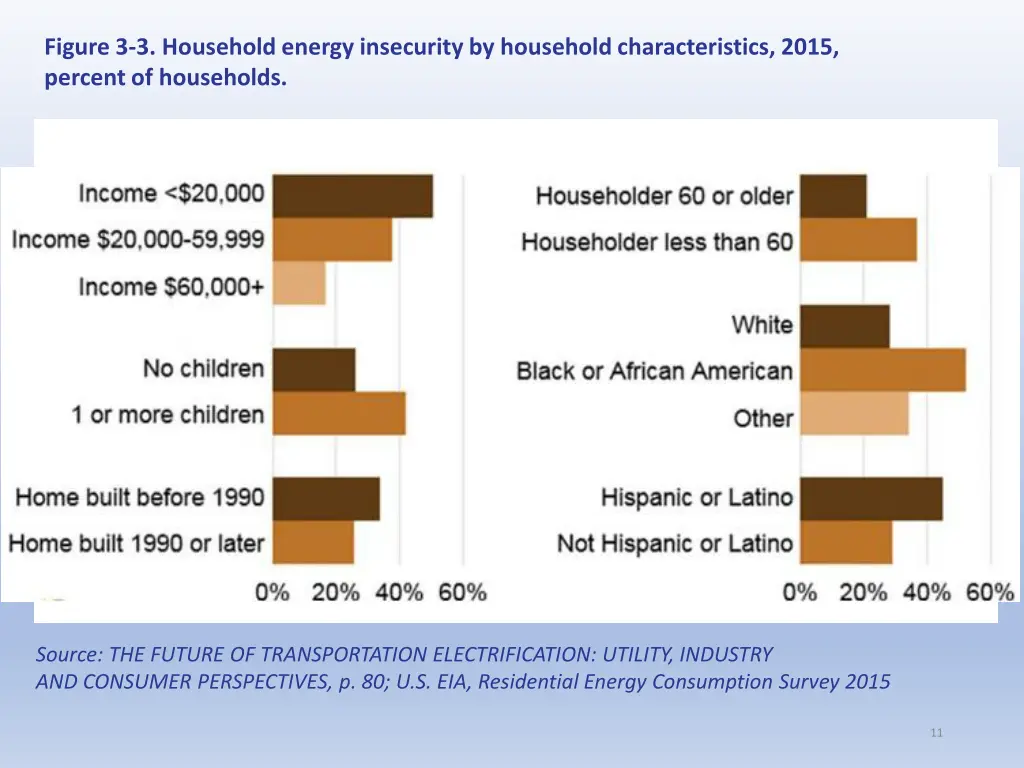
Figure 3-3. Household energy insecurity by household characteristics, 2015, percent of households. Source: THE FUTURE OF TRANSPORTATION ELECTRIFICATION: UTILITY, INDUSTRY AND CONSUMER PERSPECTIVES, p. 80; U.S. EIA, Residential Energy Consumption Survey 2015 11
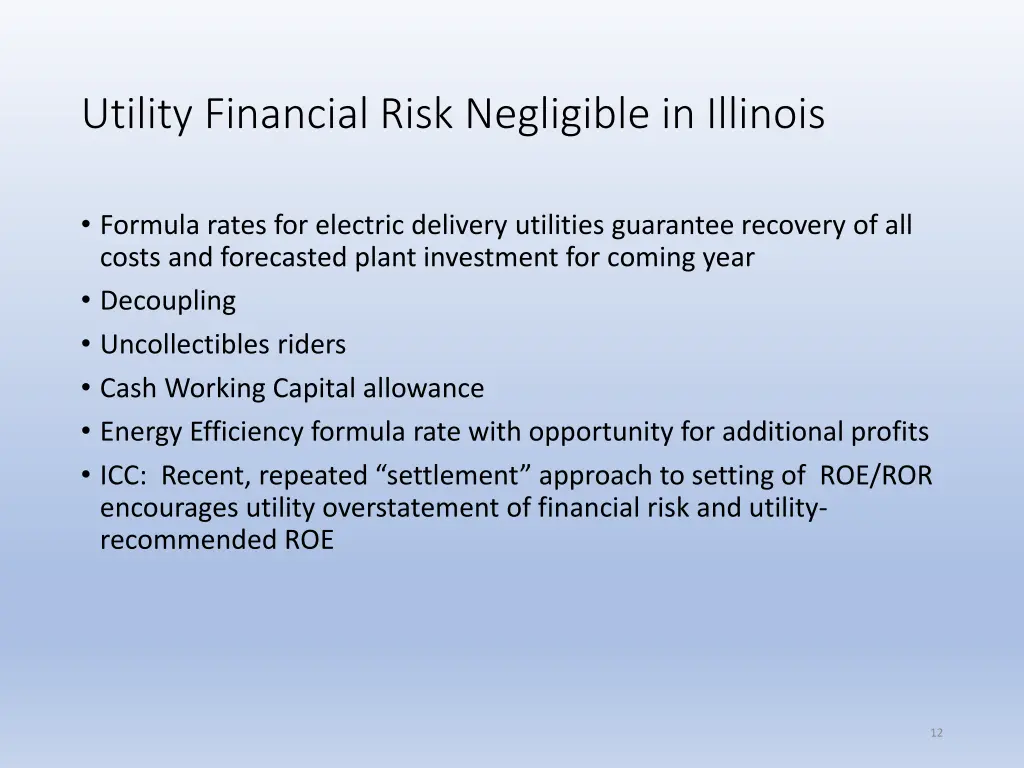
Utility Financial Risk Negligible in Illinois Formula rates for electric delivery utilities guarantee recovery of all costs and forecasted plant investment for coming year Decoupling Uncollectibles riders Cash Working Capital allowance Energy Efficiency formula rate with opportunity for additional profits ICC: Recent, repeated settlement approach to setting of ROE/ROR encourages utility overstatement of financial risk and utility- recommended ROE 12
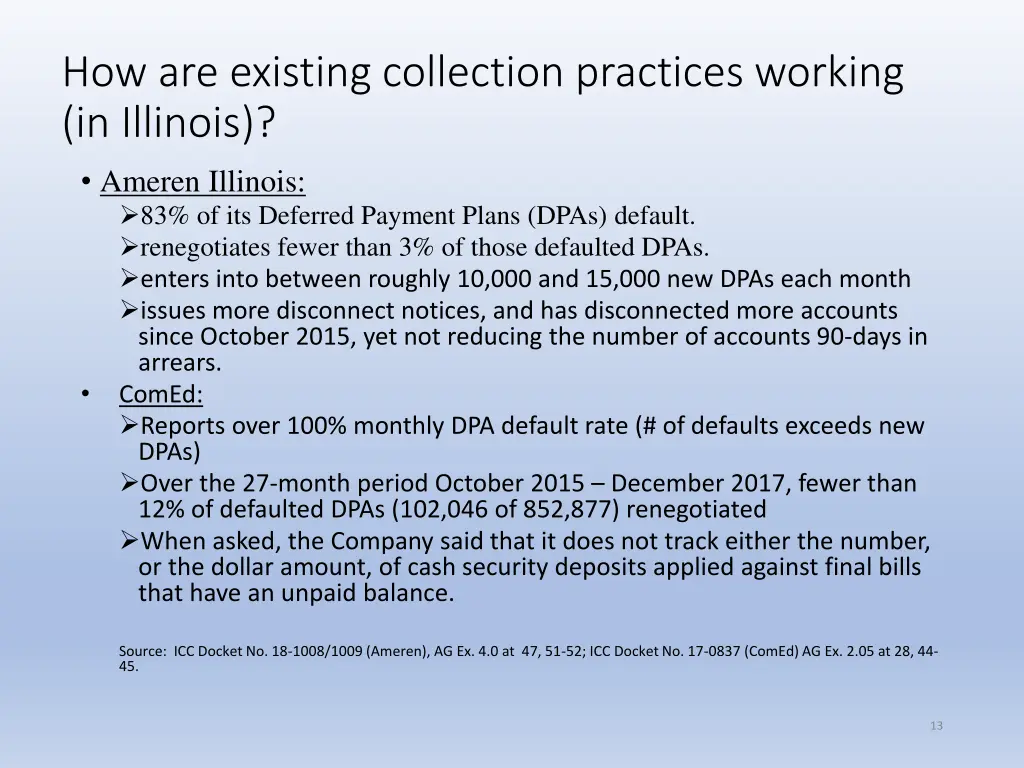
How are existing collection practices working (in Illinois)? Ameren Illinois: 83% of its Deferred Payment Plans (DPAs) default. renegotiates fewer than 3% of those defaulted DPAs. enters into between roughly 10,000 and 15,000 new DPAs each month issues more disconnect notices, and has disconnected more accounts since October 2015, yet not reducing the number of accounts 90-days in arrears. ComEd: Reports over 100% monthly DPA default rate (# of defaults exceeds new DPAs) Over the 27-month period October 2015 December 2017, fewer than 12% of defaulted DPAs (102,046 of 852,877) renegotiated When asked, the Company said that it does not track either the number, or the dollar amount, of cash security deposits applied against final bills that have an unpaid balance. Source: ICC Docket No. 18-1008/1009 (Ameren), AG Ex. 4.0 at 47, 51-52; ICC Docket No. 17-0837 (ComEd) AG Ex. 2.05 at 28, 44- 45. 13
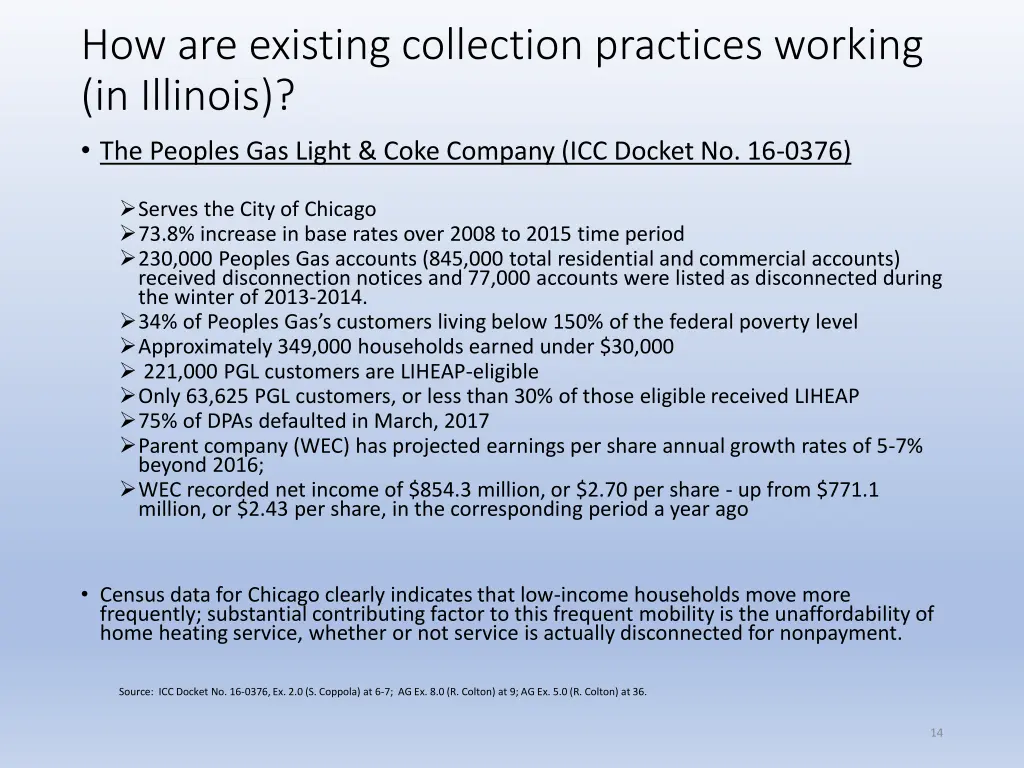
How are existing collection practices working (in Illinois)? The Peoples Gas Light & Coke Company (ICC Docket No. 16-0376) Serves the City of Chicago 73.8% increase in base rates over 2008 to 2015 time period 230,000 Peoples Gas accounts (845,000 total residential and commercial accounts) received disconnection notices and 77,000 accounts were listed as disconnected during the winter of 2013-2014. 34% of Peoples Gas s customers living below 150% of the federal poverty level Approximately 349,000 households earned under $30,000 221,000 PGL customers are LIHEAP-eligible Only 63,625 PGL customers, or less than 30% of those eligible received LIHEAP 75% of DPAs defaulted in March, 2017 Parent company (WEC) has projected earnings per share annual growth rates of 5-7% beyond 2016; WEC recorded net income of $854.3 million, or $2.70 per share - up from $771.1 million, or $2.43 per share, in the corresponding period a year ago Census data for Chicago clearly indicates that low-income households move more frequently; substantial contributing factor to this frequent mobility is the unaffordability of home heating service, whether or not service is actually disconnected for nonpayment. Source: ICC Docket No. 16-0376, Ex. 2.0 (S. Coppola) at 6-7; AG Ex. 8.0 (R. Colton) at 9; AG Ex. 5.0 (R. Colton) at 36. 14
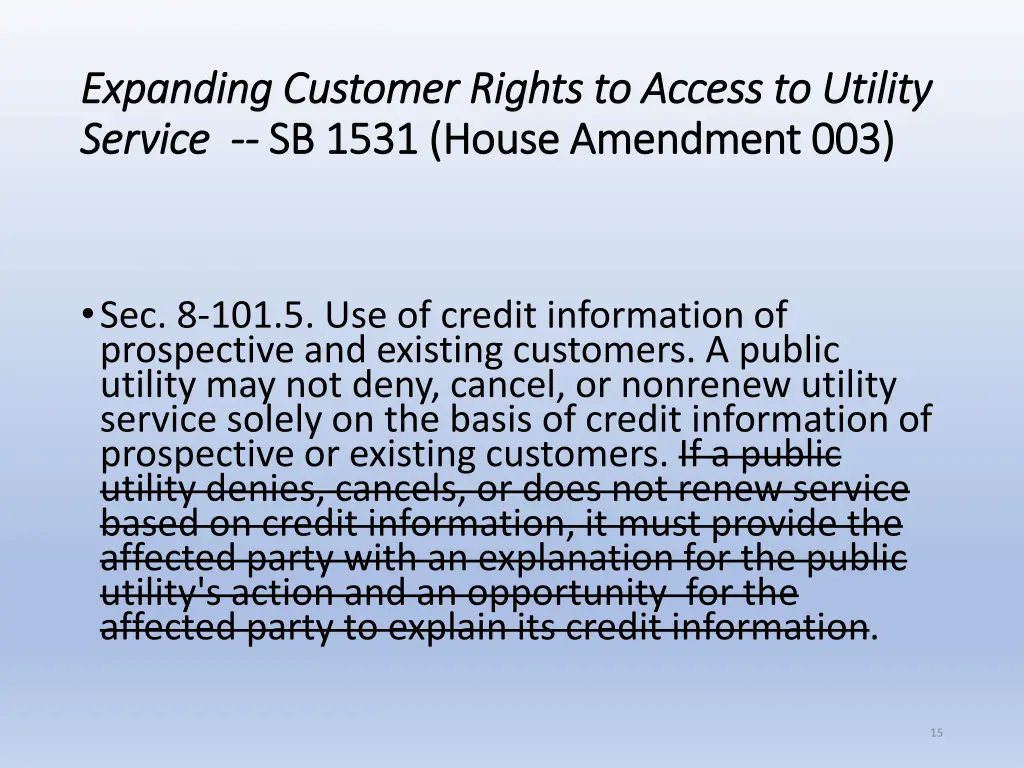
Expanding Customer Rights to Access to Utility Expanding Customer Rights to Access to Utility Service Service -- -- SB 1531 (House Amendment 003) SB 1531 (House Amendment 003) Sec. 8-101.5. Use of credit information of prospective and existing customers. A public utility may not deny, cancel, or nonrenew utility service solely on the basis of credit information of prospective or existing customers. If a public utility denies, cancels, or does not renew service based on credit information, it must provide the affected party with an explanation for the public utility's action and an opportunity for the affected party to explain its credit information. 15
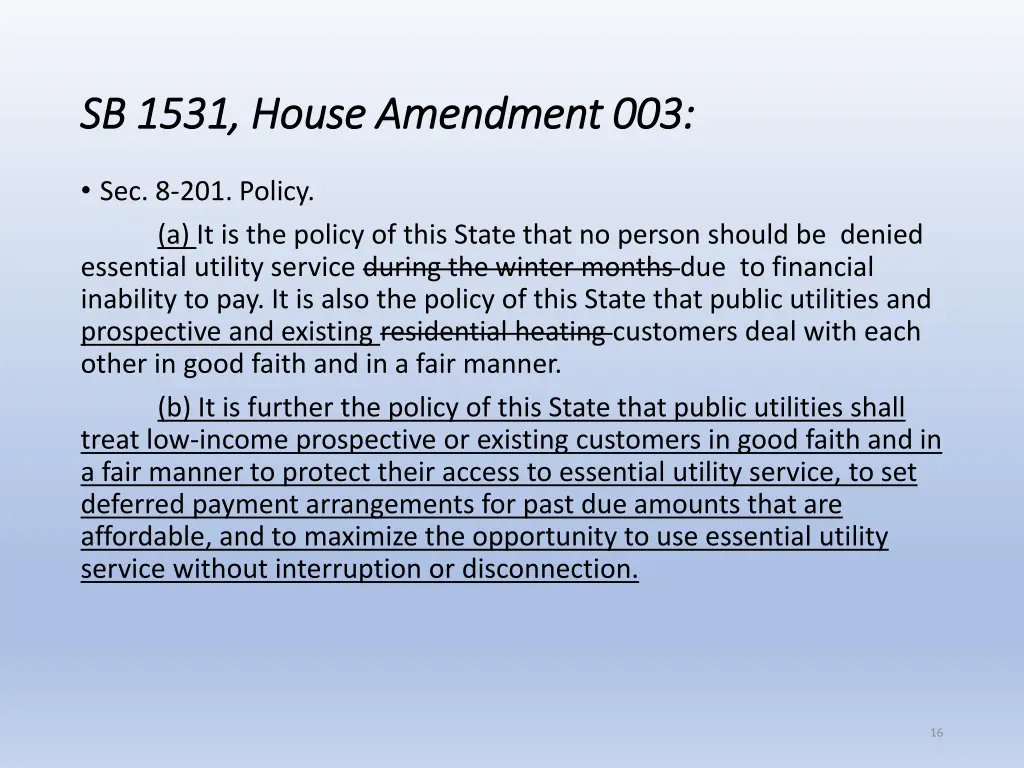
SB 1531, House Amendment 003: SB 1531, House Amendment 003: Sec. 8-201. Policy. (a) It is the policy of this State that no person should be denied essential utility service during the winter months due to financial inability to pay. It is also the policy of this State that public utilities and prospective and existing residential heating customers deal with each other in good faith and in a fair manner. (b) It is further the policy of this State that public utilities shall treat low-income prospective or existing customers in good faith and in a fair manner to protect their access to essential utility service, to set deferred payment arrangements for past due amounts that are affordable, and to maximize the opportunity to use essential utility service without interruption or disconnection. 16
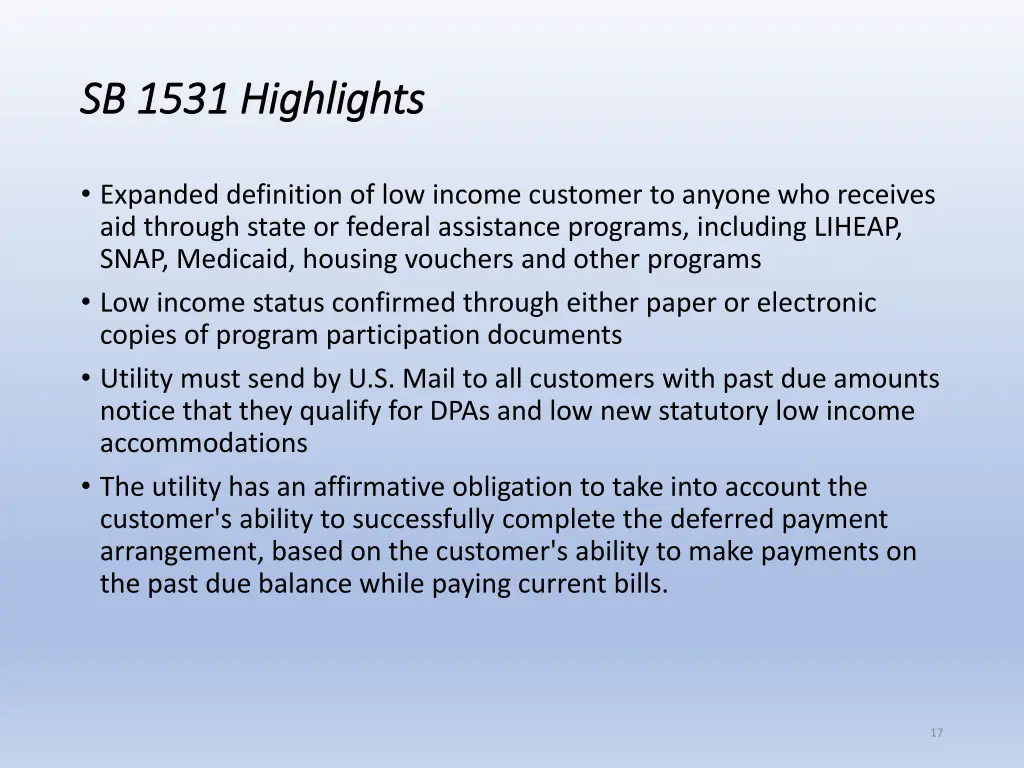
SB 1531 Highlights SB 1531 Highlights Expanded definition of low income customer to anyone who receives aid through state or federal assistance programs, including LIHEAP, SNAP, Medicaid, housing vouchers and other programs Low income status confirmed through either paper or electronic copies of program participation documents Utility must send by U.S. Mail to all customers with past due amounts notice that they qualify for DPAs and low new statutory low income accommodations The utility has an affirmative obligation to take into account the customer's ability to successfully complete the deferred payment arrangement, based on the customer's ability to make payments on the past due balance while paying current bills. 17
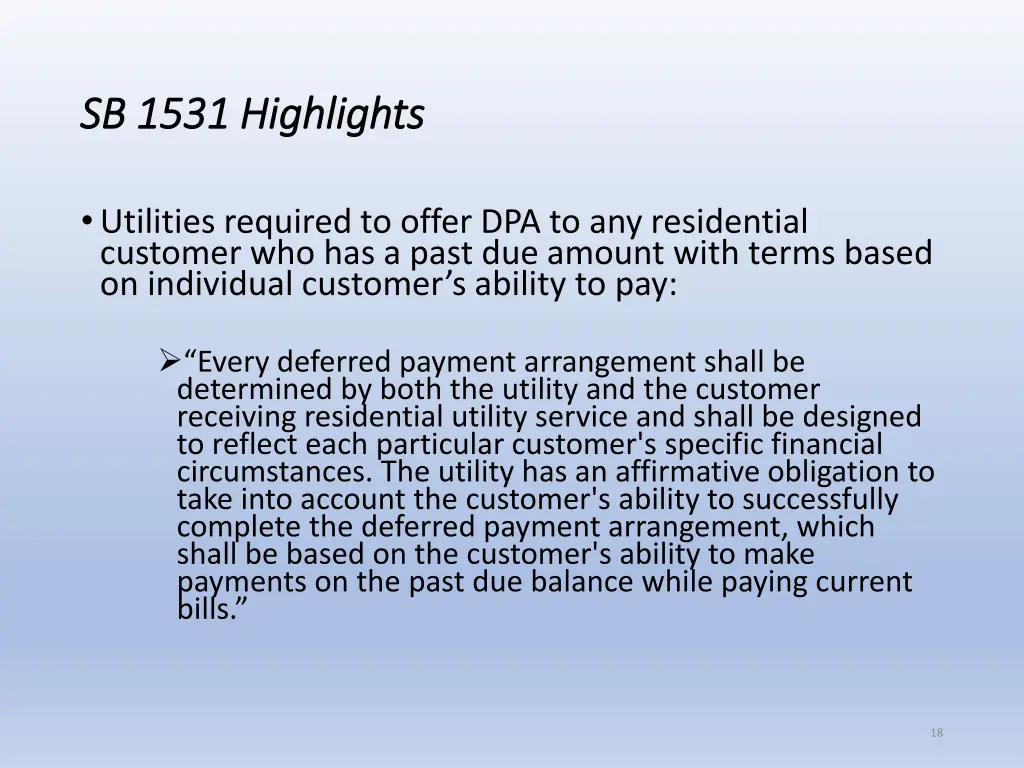
SB 1531 Highlights SB 1531 Highlights Utilities required to offer DPA to any residential customer who has a past due amount with terms based on individual customer s ability to pay: Every deferred payment arrangement shall be determined by both the utility and the customer receiving residential utility service and shall be designed to reflect each particular customer's specific financial circumstances. The utility has an affirmative obligation to take into account the customer's ability to successfully complete the deferred payment arrangement, which shall be based on the customer's ability to make payments on the past due balance while paying current bills. 18
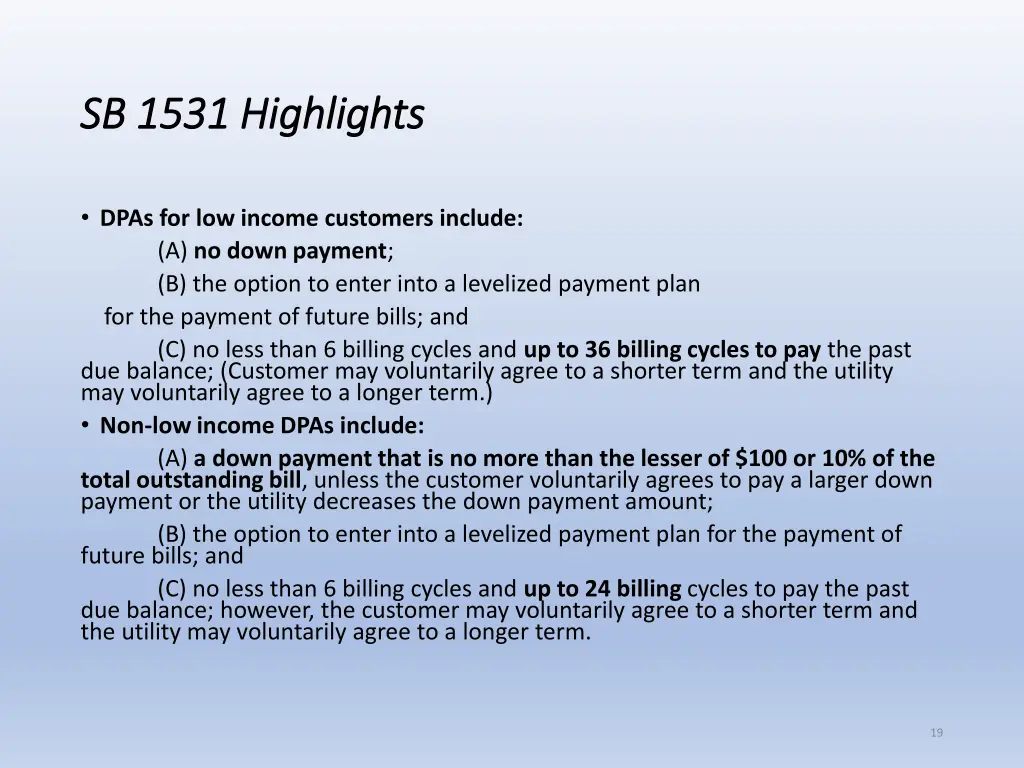
SB 1531 Highlights SB 1531 Highlights DPAs for low income customers include: (A) no down payment; (B) the option to enter into a levelized payment plan for the payment of future bills; and (C) no less than 6 billing cycles and up to 36 billing cycles to pay the past due balance; (Customer may voluntarily agree to a shorter term and the utility may voluntarily agree to a longer term.) Non-low income DPAs include: (A) a down payment that is no more than the lesser of $100 or 10% of the total outstanding bill, unless the customer voluntarily agrees to pay a larger down payment or the utility decreases the down payment amount; (B) the option to enter into a levelized payment plan for the payment of future bills; and (C) no less than 6 billing cycles and up to 24 billing cycles to pay the past due balance; however, the customer may voluntarily agree to a shorter term and the utility may voluntarily agree to a longer term. 19
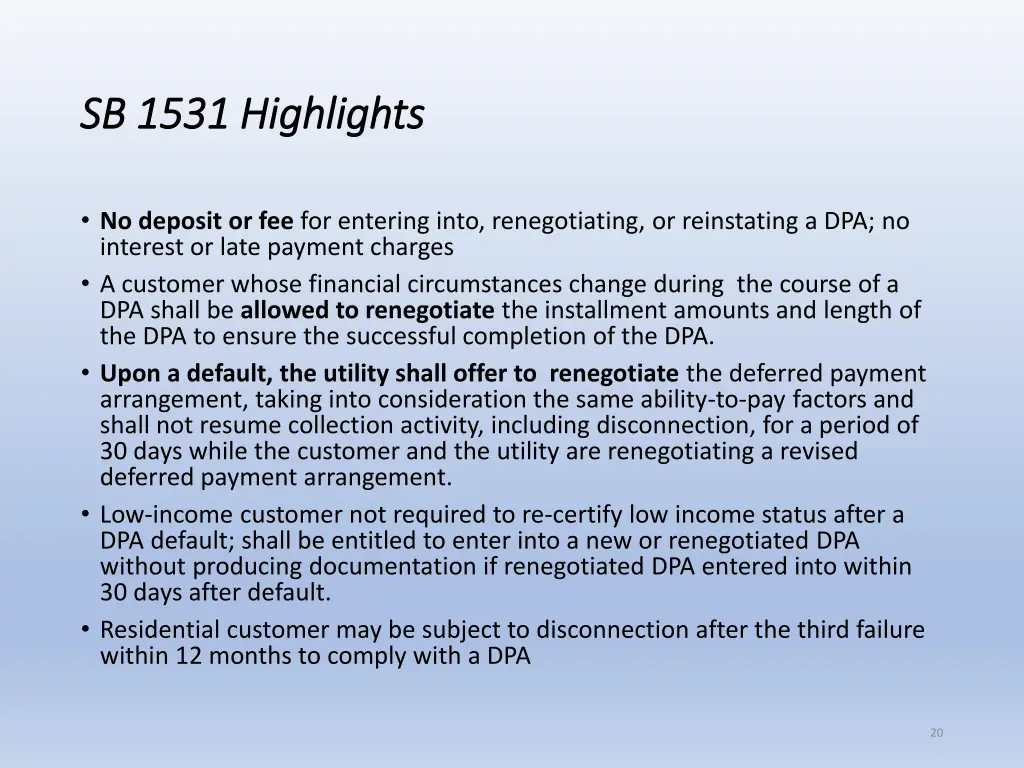
SB 1531 Highlights SB 1531 Highlights No deposit or fee for entering into, renegotiating, or reinstating a DPA; no interest or late payment charges A customer whose financial circumstances change during the course of a DPA shall be allowed to renegotiate the installment amounts and length of the DPA to ensure the successful completion of the DPA. Upon a default, the utility shall offer to renegotiate the deferred payment arrangement, taking into consideration the same ability-to-pay factors and shall not resume collection activity, including disconnection, for a period of 30 days while the customer and the utility are renegotiating a revised deferred payment arrangement. Low-income customer not required to re-certify low income status after a DPA default; shall be entitled to enter into a new or renegotiated DPA without producing documentation if renegotiated DPA entered into within 30 days after default. Residential customer may be subject to disconnection after the third failure within 12 months to comply with a DPA 20
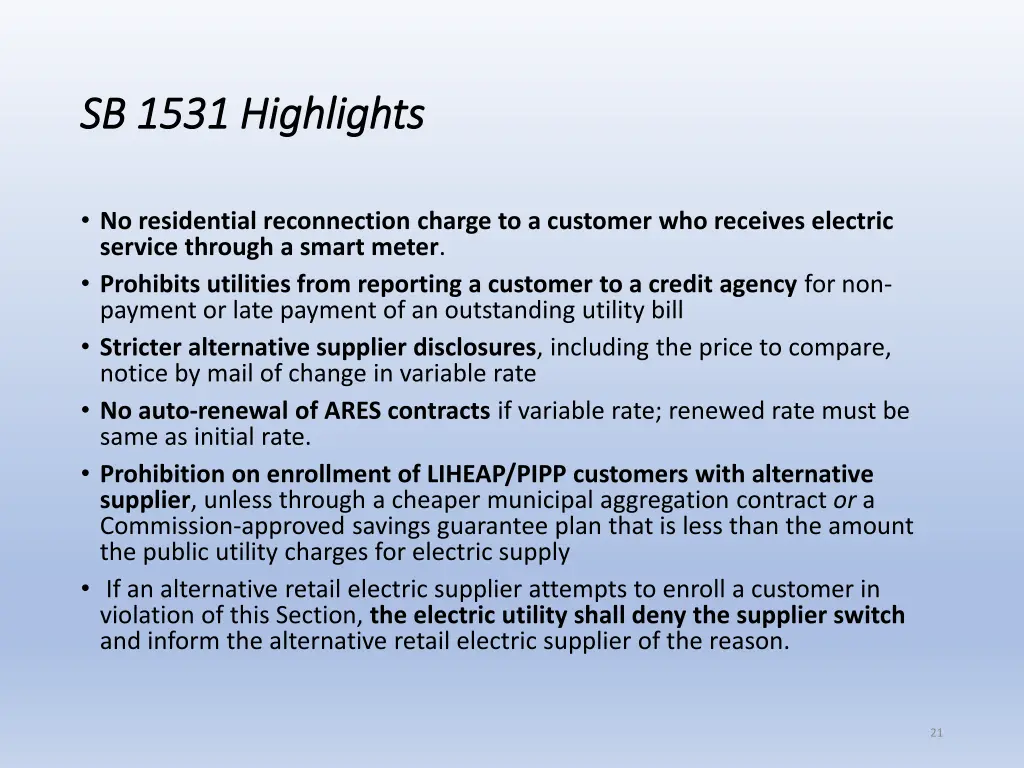
SB 1531 Highlights SB 1531 Highlights No residential reconnection charge to a customer who receives electric service through a smart meter. Prohibits utilities from reporting a customer to a credit agency for non- payment or late payment of an outstanding utility bill Stricter alternative supplier disclosures, including the price to compare, notice by mail of change in variable rate No auto-renewal of ARES contracts if variable rate; renewed rate must be same as initial rate. Prohibition on enrollment of LIHEAP/PIPP customers with alternative supplier, unless through a cheaper municipal aggregation contract or a Commission-approved savings guarantee plan that is less than the amount the public utility charges for electric supply If an alternative retail electric supplier attempts to enroll a customer in violation of this Section, the electric utility shall deny the supplier switch and inform the alternative retail electric supplier of the reason. 21
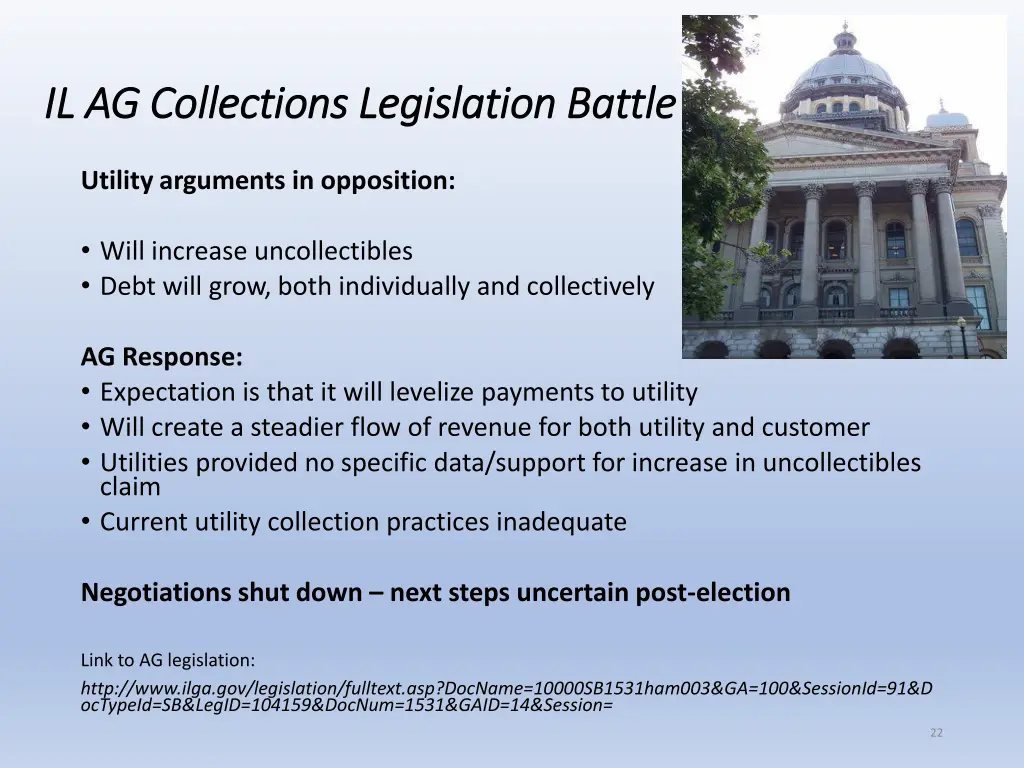
IL AG Collections Legislation Battle IL AG Collections Legislation Battle Utility arguments in opposition: Will increase uncollectibles Debt will grow, both individually and collectively AG Response: Expectation is that it will levelize payments to utility Will create a steadier flow of revenue for both utility and customer Utilities provided no specific data/support for increase in uncollectibles claim Current utility collection practices inadequate Negotiations shut down next steps uncertain post-election Link to AG legislation: http://www.ilga.gov/legislation/fulltext.asp?DocName=10000SB1531ham003&GA=100&SessionId=91&D ocTypeId=SB&LegID=104159&DocNum=1531&GAID=14&Session= 22
If new legislation isnt an option, consider other If new legislation isn t an option, consider other ways to push affordability fixes ways to push affordability fixes Merger proceeding negotiations Prepay tariff filings R. Colton testimony filed in ComEd, Ameren Illinois prepay pilot dockets urged rejection of prepay tariff unless accompanied by revenue collection change pilots that mirror AG legislation, including elimination of deposit requirement, DPA flexibility,and arrearage reduction component that rewards regular monthly payments. Petition filings based on data collected in rate cases about deposits, DPA default rate, disconnections PSC rules are minimum standards Data reported by utilities point to need for revised procedures in order to reduce disconnections and improve affordability for all 23
Thank you! Contact info: Karen Lusson 312-814-1136 klusson@atg.state.il.us 24