Equality, Diversity & Inclusion

Implementing the Workforce Race Equality Standard (WRES) is essential for NHS providers to ensure fair treatment and equal opportunities for employees from diverse backgrounds. The WRES report outlines key indicators to track progress and address workforce equality issues, enhancing patient care and safety. The data presented in the report sheds light on staff composition and experiences, aiming to promote inclusivity and diversity within healthcare organizations.

Download Presentation

Please find below an Image/Link to download the presentation.
The content on the website is provided AS IS for your information and personal use only. It may not be sold, licensed, or shared on other websites without obtaining consent from the author.If you encounter any issues during the download, it is possible that the publisher has removed the file from their server.
You are allowed to download the files provided on this website for personal or commercial use, subject to the condition that they are used lawfully. All files are the property of their respective owners.
The content on the website is provided AS IS for your information and personal use only. It may not be sold, licensed, or shared on other websites without obtaining consent from the author.
E N D
Presentation Transcript
Oxford Health NHS FT Equality, Diversity & Inclusion Workforce Race Equality Standard (WRES) 2023 To find out more about what Oxford Health NHS FT is doing to be a fair and equal employer and care provider, please contact: EqualityandInclusion@oxfordhealth.nhs.uk
WRES Report 2023 | Introduction Implementing the Workforce Race Equality Standard (WRES) is a requirement for NHS commissioners and NHS healthcare providers including independent organisations, through the NHS standard contract. The NHS Equality and Diversity Council announced on 31 July 2014 that it had agreed action to ensure employees from black and minority ethnic (BME) backgrounds have equal access to career opportunities and receive fair treatment in the workplace. This is important because studies shows that a motivated, included and valued workforce helps deliver high quality patient care, increased patient satisfaction and better patient safety. In April 2015, after engaging and consulting with key stakeholders including other NHS organisations across England, the WRES was mandated through the NHS standard contract, starting in 2015/16. From 2017, independent healthcare providers are required to publish their WRES data. The first WRES report, was published in June 2016, followed by the 2016 WRES report on 19 April 2017. NHS providers are expected to show progress against a number of indicators of workforce equality, including a specific indicator to address the low numbers of BME board members across the organisation. NHS England NHS Workforce Race Equality Standard
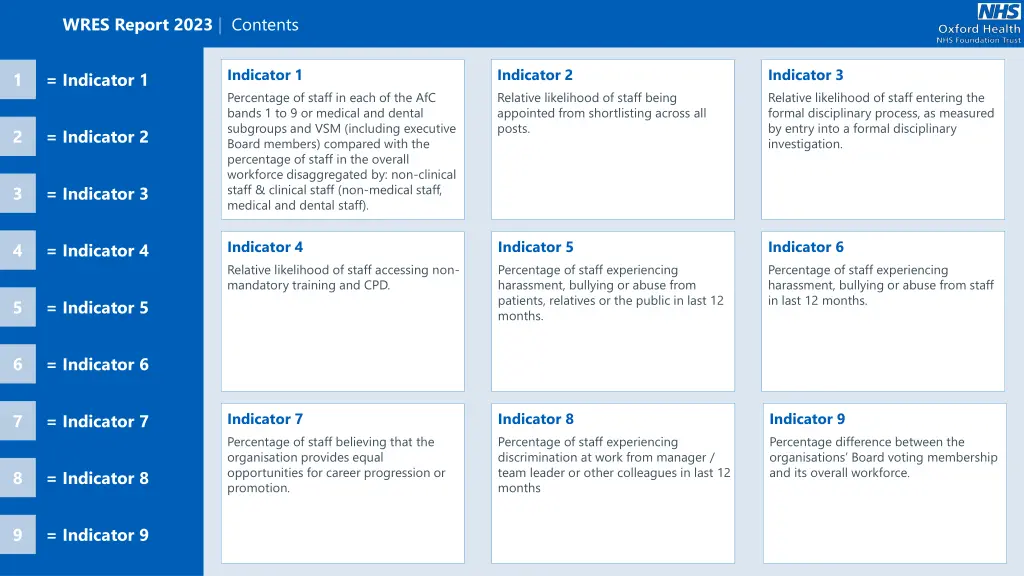
WRES Report 2023 | Contents Indicator 1 Percentage of staff in each of the AfC bands 1 to 9 or medical and dental subgroups and VSM (including executive Board members) compared with the percentage of staff in the overall workforce disaggregated by: non-clinical staff & clinical staff (non-medical staff, medical and dental staff). Indicator 2 Relative likelihood of staff being appointed from shortlisting across all posts. Indicator 3 Relative likelihood of staff entering the formal disciplinary process, as measured by entry into a formal disciplinary investigation. 1 1 = Indicator 1 2 = Indicator 2 3 = Indicator 3 Indicator 4 Relative likelihood of staff accessing non- mandatory training and CPD. Indicator 5 Percentage of staff experiencing harassment, bullying or abuse from patients, relatives or the public in last 12 months. Indicator 6 Percentage of staff experiencing harassment, bullying or abuse from staff in last 12 months. 4 = Indicator 4 5 = Indicator 5 6 = Indicator 6 Indicator 7 Percentage of staff believing that the organisation provides equal opportunities for career progression or promotion. Indicator 8 Percentage of staff experiencing discrimination at work from manager / team leader or other colleagues in last 12 months Indicator 9 Percentage difference between the organisations Board voting membership and its overall workforce. 7 = Indicator 7 8 = Indicator 8 9 = Indicator 9
WRES Indicator 1 | Staff Data Non-Clinical Workforce: Headcount Non Clinical Workforce Band 1 Band 2 Band 3 Band 4 Band 5 Band 6 Band 7 Band 8A Band 8B Band 8C Band 8D Band 9 VSM BME 2021 0 55 41 42 32 19 8 16 5 1 0 0 2 BME 2022 BME 2023 White 2021 6 187 313 309 144 107 87 93 41 35 11 1 10 White 2022 White 2023 Unknown 2021 0 9 6 8 10 5 3 1 2 0 0 0 1 Unknown 2022 Unknown 2023 1 1 0 0 1 1 0 0 51 50 182 153 10 15 2 42 37 316 309 7 13 58 59 313 317 10 8 3 45 46 142 153 8 12 21 28 122 135 11 16 13 17 107 117 5 11 4 17 17 97 96 2 3 4 9 49 57 2 3 2 2 41 35 1 1 5 0 1 10 15 0 0 0 1 4 5 0 0 6 3 1 10 8 3 2 70 BME Non-Clinical Workforce 7 Number of Workforce There are BME staff at Bands 8D and 9 for the first time 60 50 2021 40 8 2022 30 20 2023 10 9 0 Band 1 Band 2 Band 3 Band 4 Band 5 Band 6 Band 7 Band 8A Band 8B Band 8C Band 8D Band 9 VSM
WRES Indicator 1 | Staff Data Non-Clinical Workforce: % Non Clinical Workforce Band 1 Band 2 Band 3 Band 4 Band 5 Band 6 Band 7 Band 8A Band 8B Band 8C Band 8D Band 9 VSM BME 2021 0.0% 21.9% 11.4% 11.7% 17.2% 14.5% 8.2% 14.5% 10.4% 2.8% 0.0% 0.0% 15.4% BME 2022 0.0% 21.0% 11.5% 15.2% 23.1% 13.6% 10.4% 14.7% 7.3% 4.5% 0.0% 0.0% 18.8% BME 2023 0.0% 22.9% 10.3% 15.4% 21.8% 15.6% 11.7% 14.7% 13.0% 5.3% 6.3% 16.7% 9.1% White 2021 100.0% 74.5% 86.9% 86.1% 77.4% 81.7% 88.8% 84.5% 85.4% 97.2% 100.0% 100.0% 76.9% White 2022 100.0% 74.9% 86.6% 82.2% 72.8% 79.2% 85.6% 83.6% 89.1% 93.2% 100.0% 100.0% 62.5% White 2023 100.0% 70.2% 86.1% 82.6% 72.5% 75.4% 80.7% 82.8% 82.6% 92.1% 93.8% 83.3% 72.7% Unknown 2021 0.0% 3.6% 1.7% 2.2% 5.4% 3.8% 3.1% 0.9% 4.2% 0.0% 0.0% 0.0% 7.7% Unknown 2022 0.0% 4.1% 1.9% 2.6% 4.1% 7.1% 4.0% 1.7% 3.6% 2.3% 0.0% 0.0% 18.8% Unknown 2023 0.0% 6.9% 3.6% 2.1% 5.7% 8.9% 7.6% 2.6% 4.3% 2.6% 0.0% 0.0% 18.2% 1 1 2 3 4 5 6 25% BME Non-Clinical Workforce (%) 7 20% % of Workforce 15% 2021 8 2022 10% 2023 5% 9 0% Band 1 Band 2 Band 3 Band 4 Band 5 Band 6 Band 7 Band 8A Band 8B Band 8C Band 8D Band 9 VSM
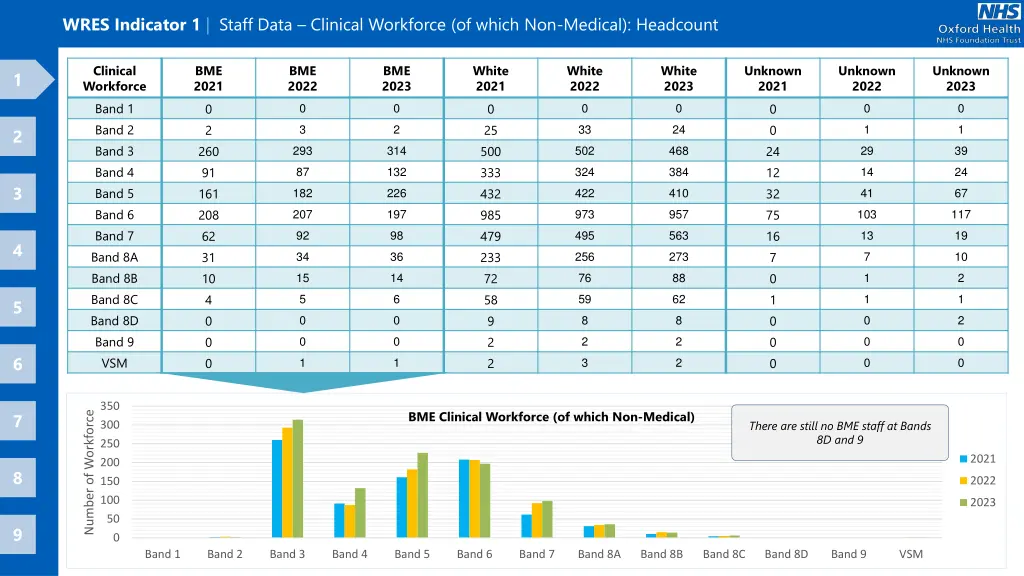
WRES Indicator 1 | Staff Data Clinical Workforce (of which Non-Medical): Headcount Clinical Workforce Band 1 Band 2 Band 3 Band 4 Band 5 Band 6 Band 7 Band 8A Band 8B Band 8C Band 8D Band 9 VSM BME 2021 0 2 260 91 161 208 62 31 10 4 0 0 0 BME 2022 BME 2023 White 2021 0 25 500 333 432 985 479 233 72 58 9 2 2 White 2022 White 2023 Unknown 2021 0 0 24 12 32 75 16 7 0 1 0 0 0 Unknown 2022 Unknown 2023 1 1 0 0 0 0 0 0 3 2 33 24 1 1 2 293 314 502 468 29 39 87 132 324 384 14 24 3 182 226 422 410 41 67 207 197 973 957 103 117 92 98 495 563 13 19 4 34 36 256 273 7 10 15 14 76 88 1 2 5 6 59 62 1 1 5 0 0 8 8 0 2 0 0 2 2 0 0 6 1 1 3 2 0 0 350 BME Clinical Workforce (of which Non-Medical) 7 Number of Workforce There are still no BME staff at Bands 8D and 9 300 250 2021 200 8 2022 150 100 2023 50 9 0 Band 1 Band 2 Band 3 Band 4 Band 5 Band 6 Band 7 Band 8A Band 8B Band 8C Band 8D Band 9 VSM
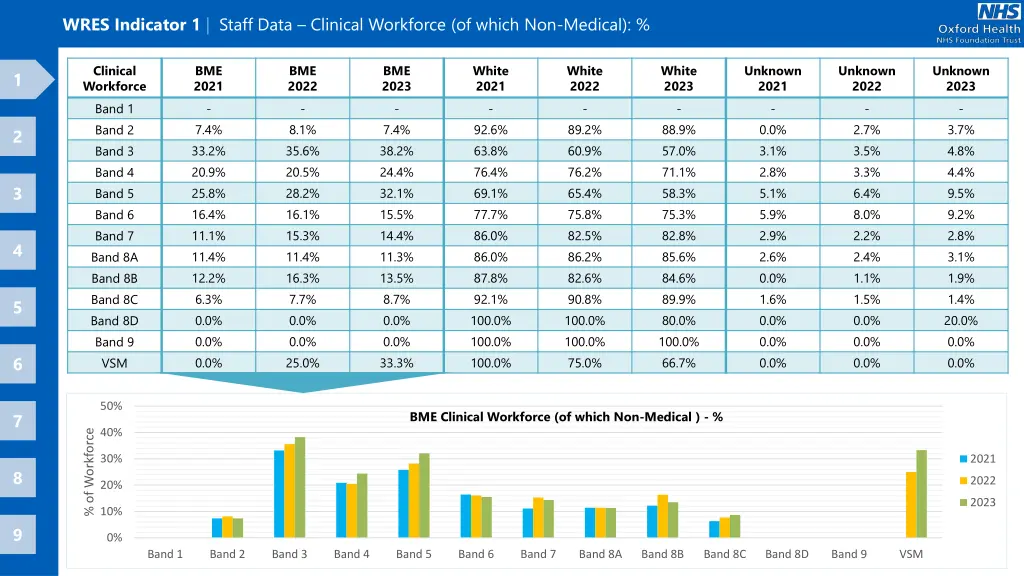
WRES Indicator 1 | Staff Data Clinical Workforce (of which Non-Medical): % Clinical Workforce Band 1 Band 2 Band 3 Band 4 Band 5 Band 6 Band 7 Band 8A Band 8B Band 8C Band 8D Band 9 VSM BME 2021 - 7.4% 33.2% 20.9% 25.8% 16.4% 11.1% 11.4% 12.2% 6.3% 0.0% 0.0% 0.0% BME 2022 - 8.1% 35.6% 20.5% 28.2% 16.1% 15.3% 11.4% 16.3% 7.7% 0.0% 0.0% 25.0% BME 2023 - 7.4% 38.2% 24.4% 32.1% 15.5% 14.4% 11.3% 13.5% 8.7% 0.0% 0.0% 33.3% White 2021 - 92.6% 63.8% 76.4% 69.1% 77.7% 86.0% 86.0% 87.8% 92.1% 100.0% 100.0% 100.0% White 2022 - 89.2% 60.9% 76.2% 65.4% 75.8% 82.5% 86.2% 82.6% 90.8% 100.0% 100.0% 75.0% White 2023 - 88.9% 57.0% 71.1% 58.3% 75.3% 82.8% 85.6% 84.6% 89.9% 80.0% 100.0% 66.7% Unknown 2021 - 0.0% 3.1% 2.8% 5.1% 5.9% 2.9% 2.6% 0.0% 1.6% 0.0% 0.0% 0.0% Unknown 2022 - 2.7% 3.5% 3.3% 6.4% 8.0% 2.2% 2.4% 1.1% 1.5% 0.0% 0.0% 0.0% Unknown 2023 - 3.7% 4.8% 4.4% 9.5% 9.2% 2.8% 3.1% 1.9% 1.4% 20.0% 0.0% 0.0% 1 1 2 3 4 5 6 50% BME Clinical Workforce (of which Non-Medical ) - % 7 40% % of Workforce 30% 2021 8 2022 20% 2023 10% 9 0% Band 1 Band 2 Band 3 Band 4 Band 5 Band 6 Band 7 Band 8A Band 8B Band 8C Band 8D Band 9 VSM
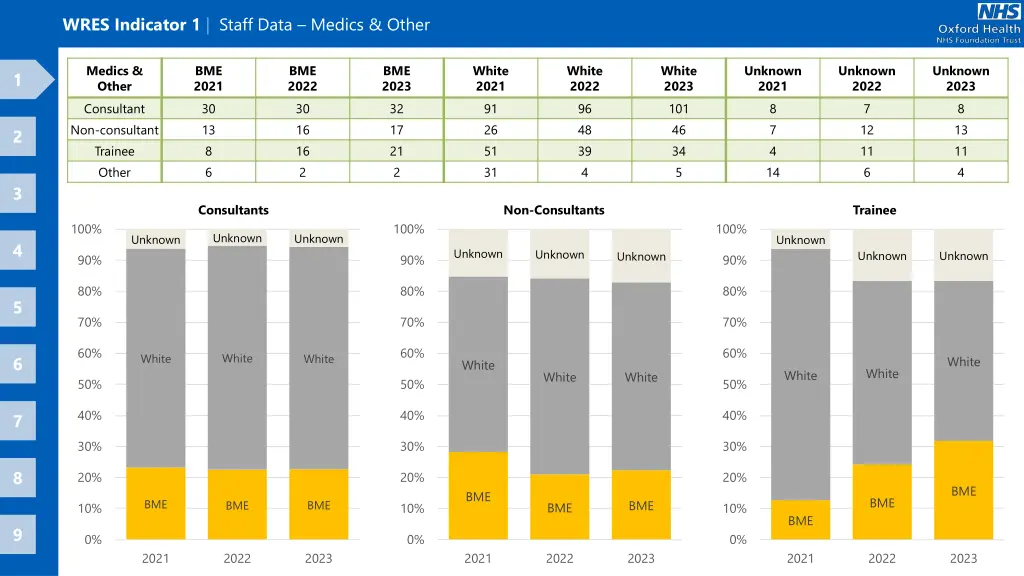
WRES Indicator 1 | Staff Data Medics & Other Medics & Other Consultant Non-consultant Trainee Other BME 2021 30 13 8 6 BME 2022 30 16 16 2 BME 2023 32 17 21 2 White 2021 91 26 51 31 White 2022 96 48 39 4 White 2023 101 46 34 5 Unknown 2021 8 7 4 14 Unknown 2022 7 12 11 6 Unknown 2023 8 13 11 4 1 1 2 3 Consultants Non-Consultants Trainee 100% 100% 100% Unknown Unknown Unknown Unknown 4 Unknown Unknown Unknown Unknown Unknown 90% 90% 90% 80% 80% 80% 5 70% 70% 70% 60% 60% 60% White White White 6 White White White White White White 50% 50% 50% 40% 40% 40% 7 30% 30% 30% 8 20% 20% 20% BME BME BME BME BME BME BME BME 10% 10% 10% BME 9 0% 0% 0% 2021 2022 2023 2021 2022 2023 2021 2022 2023
WRES Indicator 2 | Appointed from shortlisting 1 1 Relative likelihood of white staff being appointed from shortlisting compared to BME staff 2 2013/14 2014/15 2.01 times more likely - 2015/16 1.05 times more likely -0.96 2016/17 1.51 times more likely +0.46 2017/18 1.14 times more likely -0.37 2018/19 1.05 times more likely -0.09 2019/20 1.21 times more likely +0.16 2020/21 0.78 times more likely -0.43 2021/22 0.78 times more likely 0.00 2022/23 0.72 times more likely -0.06 3 No data - 4 2.5 5 There is almost equal parity between BME and white applicants for the Trust as a whole EDI QI Project 1 is underway to ensure this trend is represented at directorate and service team levels 2.01 2 6 1.51 1.5 1.21 1.14 1.05 1.05 7 1 0.78 0.78 0.72 A figure below 1.00 indicates that BME staff are more likely than white staff to be appointed from shortlisting 8 0.5 0 9 2013/14 2014/15 2015/16 2016/17 2017/18 2018/19 2019/20 2020/21 2021/22 2022/23
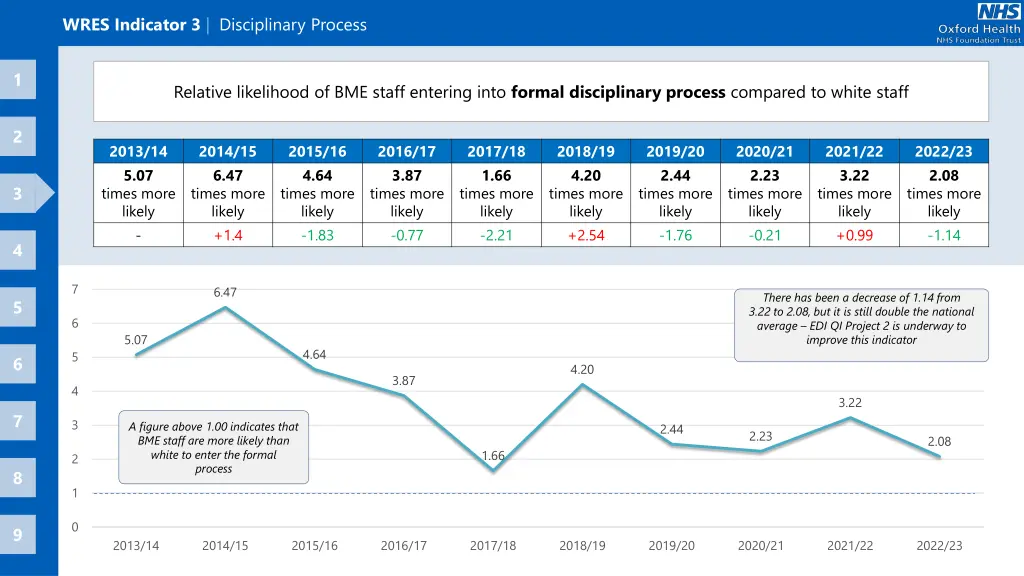
WRES Indicator 3 | Disciplinary Process 1 1 Relative likelihood of BME staff entering into formal disciplinary process compared to white staff 2 2013/14 5.07 times more likely - 2014/15 6.47 times more likely +1.4 2015/16 4.64 times more likely -1.83 2016/17 3.87 times more likely -0.77 2017/18 1.66 times more likely -2.21 2018/19 4.20 times more likely +2.54 2019/20 2.44 times more likely -1.76 2020/21 2.23 times more likely -0.21 2021/22 3.22 times more likely +0.99 2022/23 2.08 times more likely -1.14 3 4 7 6.47 There has been a decrease of 1.14 from 3.22 to 2.08, but it is still double the national average EDI QI Project 2 is underway to improve this indicator 5 6 5.07 4.64 5 6 4.20 3.87 4 3.22 7 3 A figure above 1.00 indicates that BME staff are more likely than white to enter the formal process 2.44 2.23 2.08 1.66 2 8 1 0 9 2013/14 2014/15 2015/16 2016/17 2017/18 2018/19 2019/20 2020/21 2021/22 2022/23
WRES Indicator 4 | Non-Mandatory Training & CPD 1 1 Relative likelihood of white staff accessing non-mandatory training & CPD compared to BME staff 2 2013/14 1.09 times more likely - 2014/15 1.18 times more likely +0.09 2015/16 1.28 times more likely +0.10 2016/17 0.88 times more likely -0.40 2017/18 0.80 times more likely -0.08 2018/19 0.84 times more likely +0.04 2019/20 0.87 times more likely +0.03 2020/21 0.82 times more likely -0.05 2021/22 0.91 times more likely +0.09 2022/23 0.90 times more likely -0.01 3 4 1.40 1.28 5 1.18 1.20 1.09 1.00 0.91 0.90 6 0.88 0.87 0.84 0.82 0.80 A figure below 1.00 indicates that BME staff are more likely to access non-mandatory training & CPD than white staff 0.80 7 0.60 There is almost equal parity between white staff and BME staff accessing non-mandatory training & CPD this is not an area of concern 0.40 8 0.20 0.00 9 2013/14 2014/15 2015/16 2016/17 2017/18 2018/19 2019/20 2020/21 2021/22 2022/23
WRES Indicator 5 | Harassment, Bullying or Abuse from Patients, Relatives or the Public 1 1 Percentage of staff experiencing harassment, bullying or abuse from patients, relatives or the public in last 12 months 2 2013/14 43.1% - 2014/15 46.4% +3.3% 2015/16 27.4% -19.0% 2016/17 33.3% +5.9% 2017/18 27.4% -5.9% 2018/19 31.3% +3.9 2019/20 33.9% +2.6% 2020/21 30.2% -3.7% 2021/22 26.9% -3.3% 2022/23 30.0% +3.1% BME Staff 3 White Staff 27.7% - 27.8% +0.1% 26.6% -1.2% 24.7% -1.9% 23.4% -1.3% 24.7% +1.3% 4 50% 46.4% 5 43.1% 45% 40% 33.9% 33.3% 6 35% 31.3% 30.2% 30.0% 27.4% 27.4% BME Staff 26.9% 30% 25% White Staff 27.8% 27.7% 7 26.6% 24.7% 24.7% 20% 23.4% There has been an increase of 3.1% for BME staff and 1.3% for white staff Civility and Respect work will be used to address and improve this indicator 15% 8 10% 5% 0% 9 2013/14 2014/15 2015/16 2016/17 2017/18 2018/19 2019/20 2020/21 2021/22 2022/23
WRES Indicator 6 | Harassment, Bullying or Abuse from Staff 1 1 Percentage ofstaff experiencing harassment, bullying or abuse from staff in last 12 months 2 2013/14 2014/15 33.3% +9.3% 2015/16 26.9% -6.4% 2016/17 27.2% +0.3% 2017/18 24.7% -2.5% 2018/19 32.2% +7.5% 2019/20 26.7% -5.5% 2020/21 26.8% +0.1% 2021/22 20.3% -6.5% 2022/23 20.0% -0.3% BME Staff 24.0% 3 White Staff 21.5% - 22.9% +1.4% 20.6% -2.3% 19.0% -1.6% 16.3% -2.7% 15.0% -1.3% - 4 33.3% 35% 32.2% 5 30% 27.2% 26.9% 26.8% 26.7% 24.7% 24.0% 25% 6 20.3% 20.0% 22.9% 20% BME Staff 21.5% 20.6% 19.0% 7 White Staff 15% 16.3% 15.0% 10% There has been an decrease of 0.3% for BME staff and 1.3% for white staff Civility and Respect work will be used to address and improve this indicator 8 5% 0% 9 2013/14 2014/15 2015/16 2016/17 2017/18 2018/19 2019/20 2020/21 2021/22 2022/23
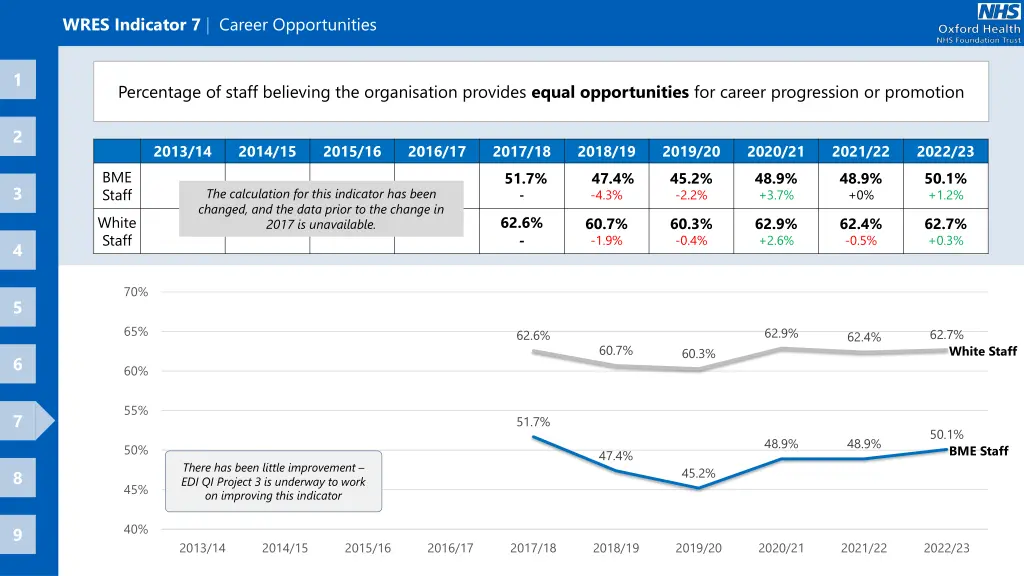
WRES Indicator 7 | Career Opportunities 1 1 Percentage of staffbelieving the organisation provides equal opportunities for career progression or promotion 2 2013/14 2014/15 2015/16 2016/17 2017/18 51.7% - 2018/19 47.4% -4.3% 2019/20 45.2% -2.2% 2020/21 48.9% +3.7% 2021/22 48.9% +0% 2022/23 50.1% +1.2% BME Staff 3 The calculation for this indicator has been changed, and the data prior to the change in 2017 is unavailable. White Staff 62.6% - 60.7% -1.9% 60.3% -0.4% 62.9% +2.6% 62.4% -0.5% 62.7% +0.3% 4 70% 5 65% 62.9% 62.7% 62.6% 62.4% 60.7% White Staff 60.3% 6 60% 55% 7 51.7% 50.1% 48.9% 48.9% 50% BME Staff 47.4% There has been little improvement EDI QI Project 3 is underway to work on improving this indicator 45.2% 8 45% 40% 9 2013/14 2014/15 2015/16 2016/17 2017/18 2018/19 2019/20 2020/21 2021/22 2022/23
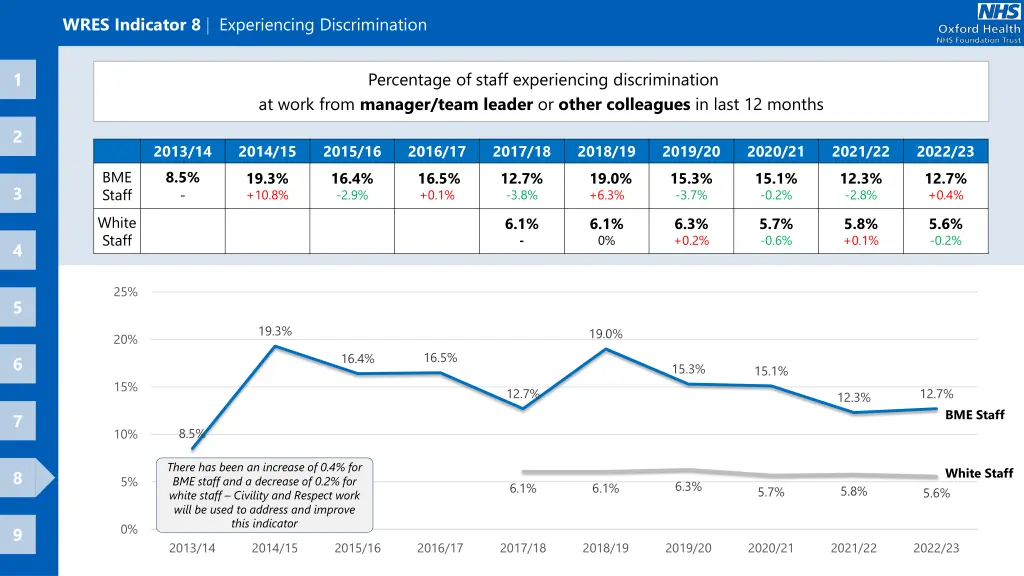
WRES Indicator 8 | Experiencing Discrimination 1 1 Percentage of staff experiencing discrimination at work from manager/team leader or other colleagues in last 12 months 2 2013/14 8.5% - 2014/15 19.3% +10.8% 2015/16 16.4% -2.9% 2016/17 16.5% +0.1% 2017/18 12.7% -3.8% 2018/19 19.0% +6.3% 2019/20 15.3% -3.7% 2020/21 15.1% -0.2% 2021/22 12.3% -2.8% 2022/23 12.7% +0.4% BME Staff 3 White Staff 6.1% - 6.1% 0% 6.3% +0.2% 5.7% -0.6% 5.8% +0.1% 5.6% -0.2% 4 25% 5 19.3% 19.0% 20% 16.5% 16.4% 6 15.3% 15.1% 15% 12.7% 12.7% 12.3% BME Staff 7 8.5% 10% There has been an increase of 0.4% for BME staff and a decrease of 0.2% for white staff Civility and Respect work will be used to address and improve this indicator White Staff 8 5% 6.3% 6.1% 6.1% 5.8% 5.7% 5.6% 0% 9 2013/14 2014/15 2015/16 2016/17 2017/18 2018/19 2019/20 2020/21 2021/22 2022/23
WRES Indicator 9 | Board 1 1 Percentage difference between the organisation s Board voting membership and its overall workforce (BME representation) 2 2015/16 2016/17 2017/18 2018/19 2019/20 2020/21 2021/22 2022/23 Percentage difference between the organisations Board voting membership and its overall workforce (BME representation) 3 -14.3% -14.9% -10.0% -10.1% -10.8% -5.9% -2.1% -0.7% 4 Percentage of BME members on the Board 0% 0% 5.9% 6.3% 6.3% 12.5% 17.6% 20.0% 5 Percentage of BME Staff in Overall Workforce 14.3% 14.9% 15.9% 16.4% 17.1% 18.4% 19.7% 20.7% 6 -0.7% 2022/23 -2.1% 2021/22 0% 2015/16 2016/17 2017/18 2018/19 2019/20 2020/21 7 -5% There is almost equal parity in the between the BME Board voting membership and the Trust s overall BME workforce -5.9% -10% 8 -10.0% -10.1% -10.8% -15% -14.3% -14.9% 9 -20%
WRES | Benchmarking Workforce Race Equality Standard 2023: Benchmarking
WRES Indicator 5 | Harassment, Bullying or Abuse from Patients, Relatives or the Public Percentage of staff experiencing harassment, bullying or abuse from patients, relatives or the public in last 12 months 35% BME average* (30.4%) 31.5% 30% 30.1% 30.0% 29.4% 28.8% White average* (26.8%) 26.7% 27.9% 25% 24.7% 23.6% 20% 18.5% 15% 10% 5% 0% White (2660) BME (573) White (2222) BME (762) White (2504) BME (940) White (4959) BME (1894) White (2120) BME (1224) Oxford Health NHS Foundation Trust Berkshire Healthcare NHS Foundation Trust Buckinghamshire Healthcare NHS Trust Oxford University Hospitals NHS Trust Royal Berkshire NHS Foundation Trust *National benchmarking averages
WRES Indicator 6 | Harassment, Bullying or Abuse from Staff Percentage ofstaff experiencing harassment, bullying or abuse from staff in last 12 months 30% BME average* (27.7%) 27.1% 25% 26.0% 24.0% White average* (22.0%) 23.0% 21.3% 20% 20.8% 20.2% 20.0% 15% 15.4% 15.0% 10% 5% 0% White (2660) BME (570) White (2225) BME (758) White (2502) BME (940) White (4957) BME (1888) White (2115) BME (1219) Oxford Health NHS Foundation Trust Berkshire Healthcare NHS Foundation Trust Buckinghamshire Healthcare NHS Trust Oxford University Hospitals NHS Trust Royal Berkshire NHS Foundation Trust *National benchmarking averages
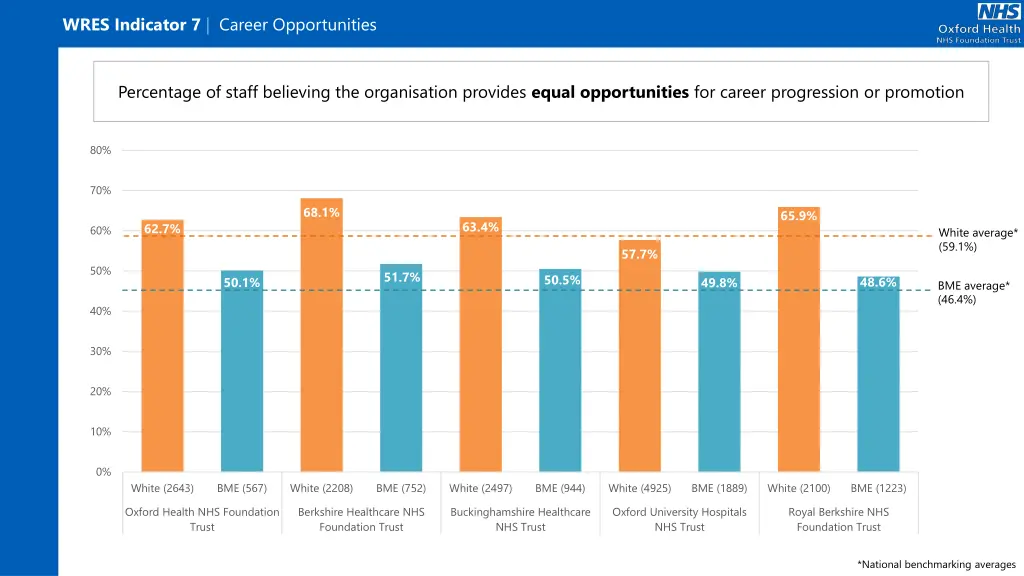
WRES Indicator 7 | Career Opportunities Percentage of staffbelieving the organisation provides equal opportunities for career progression or promotion 80% 70% 68.1% 65.9% 63.4% 62.7% 60% White average* (59.1%) 57.7% 50% 51.7% 50.5% 48.6% 50.1% 49.8% BME average* (46.4%) 40% 30% 20% 10% 0% White (2643) BME (567) White (2208) BME (752) White (2497) BME (944) White (4925) BME (1889) White (2100) BME (1223) Oxford Health NHS Foundation Trust Berkshire Healthcare NHS Foundation Trust Buckinghamshire Healthcare NHS Trust Oxford University Hospitals NHS Trust Royal Berkshire NHS Foundation Trust *National benchmarking averages
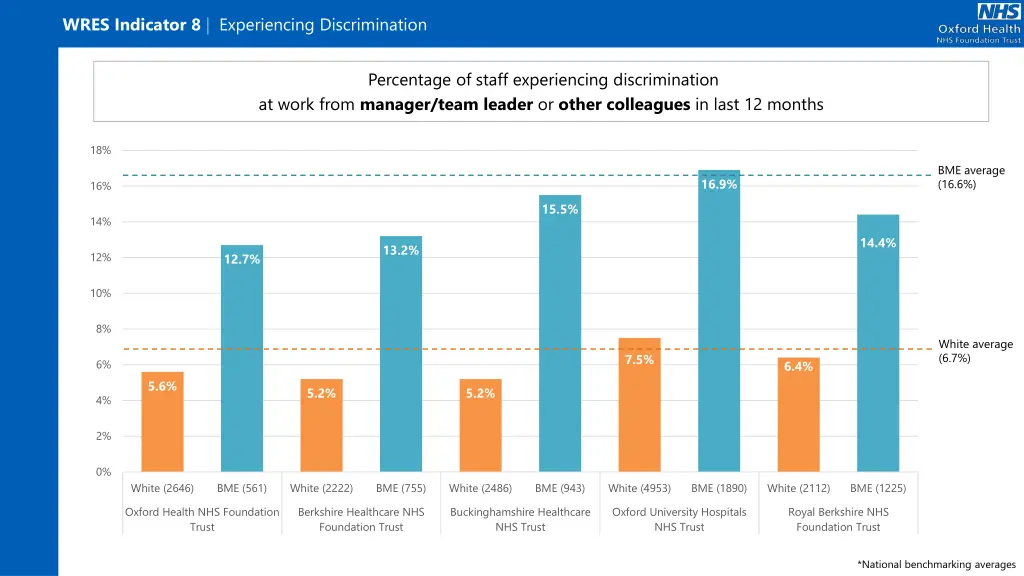
WRES Indicator 8 | Experiencing Discrimination Percentage of staff experiencing discrimination at work from manager/team leader or other colleagues in last 12 months 18% BME average (16.6%) 16.9% 16% 15.5% 14% 14.4% 13.2% 12% 12.7% 10% 8% White average (6.7%) 7.5% 6% 6.4% 5.6% 5.2% 5.2% 4% 2% 0% White (2646) BME (561) White (2222) BME (755) White (2486) BME (943) White (4953) BME (1890) White (2112) BME (1225) Oxford Health NHS Foundation Trust Berkshire Healthcare NHS Foundation Trust Buckinghamshire Healthcare NHS Trust Oxford University Hospitals NHS Trust Royal Berkshire NHS Foundation Trust *National benchmarking averages