ERCOT Inverter-Based Resource Ride-Through Requirements Overview
"Learn about ERCOT's efforts to enhance ride-through requirements for Inverter-Based Resources (IBRs) to prevent failures during disturbances. Follow the progress in aligning with IEEE 2800 and NERC guidelines for improved reliability and performance."

Download Presentation

Please find below an Image/Link to download the presentation.
The content on the website is provided AS IS for your information and personal use only. It may not be sold, licensed, or shared on other websites without obtaining consent from the author. If you encounter any issues during the download, it is possible that the publisher has removed the file from their server.
You are allowed to download the files provided on this website for personal or commercial use, subject to the condition that they are used lawfully. All files are the property of their respective owners.
The content on the website is provided AS IS for your information and personal use only. It may not be sold, licensed, or shared on other websites without obtaining consent from the author.
E N D
Presentation Transcript
IBRTF - NOGRR245 - Inverter- Based Resource (IBR) Ride- Through Requirements Stephen Solis Principal, System Operations Improvement April 14, 2023
Overview ERCOT has experienced multiple events where Inverter Based Resources (IBRs) have failed to ride-through the disturbance. The magnitude of these events have increased as the levels of IBRs synchronized to the ERCOT System have increased. ERCOT received a recommendation as part of the 2021 Odessa Disturbance Report. ERCOT should ensure that the recommendations contained within the NERC reliability guidelines are comprehensively reviewed and adopted to ensure mitigating actions are put in place to prevent these types of issues in the future. Many of the performance issues in this event could have been mitigated if appropriate performance requirements were established for these resources and interconnection studies were performed to ensure conformance with those requirements EPRI gap assessment of IEEE 2800 vs ERCOT Protocols and Guides recommended that ERCOT improve Inverter Based Resource (IBR) Ride- Through requirements to align with IEEE 2800 ride-through requirements which could mitigate some recent failure mode causes. Feedback at ERCOT IBRTF was to prioritize ride through requirement changes over other changes. NOGRR enhances clarity and specificity of frequency and voltage ride through requirement sections for IBRs while aligning with most relevant IEEE 2800 standard and NERC Reliability Guidelines. 2 PUBLIC
Summary of ERCOT comments on NOGRR 245 ERCOT made clarifying edits based on feedback to frequency ride-through requirements (FRT). ERCOT made clarifying edits based on feedback to voltage ride-through requirements. ERCOT reduced the phase angle jump requirement from 45 degrees to 25 degrees while clarifying the time frame to be sub cycle to cycle. ERCOT extended implementation deadlines out an additional 12 months from what was originally proposed to balance feedback that more time was needed to implement changes and the IBR performance failure risk that remains on the ERCOT system. ERCOT clarified that any equipment limitation that fails to meet the ride- through performance requirements would be subject to restrictions after the implementation date. 3 PUBLIC
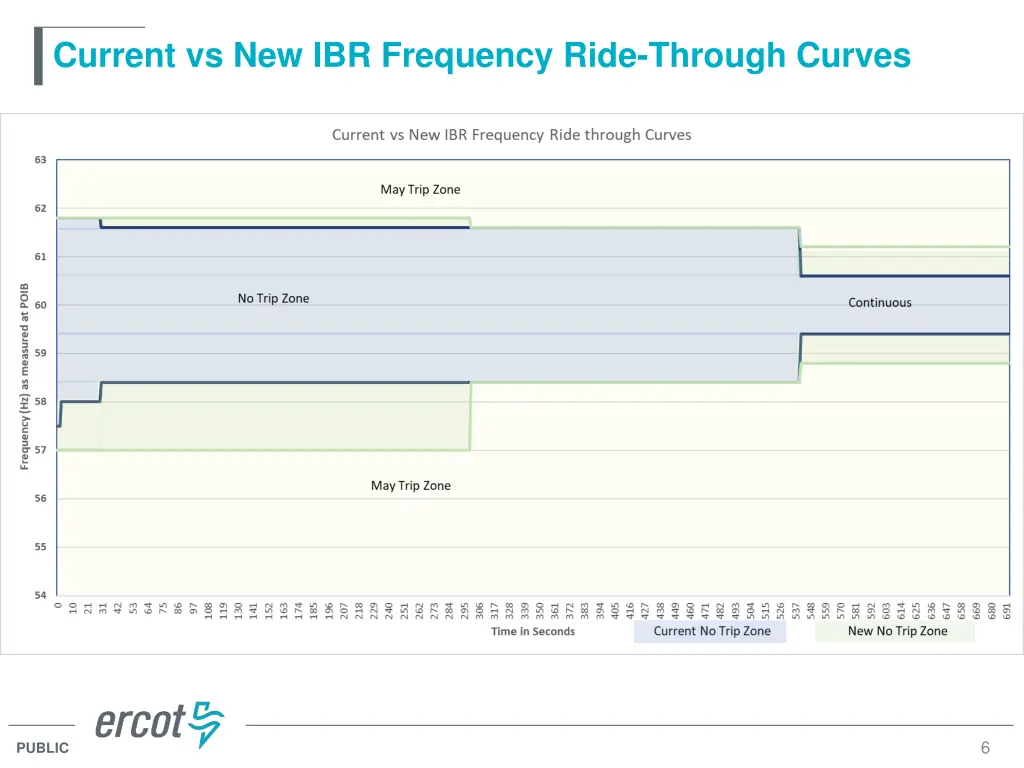
IBR FRT and VRT requirements Proposed changes address the following: Clarified in tables that No ride through requirement meant may ride-through or trip Further segregated paragraph (3) protection systems and paragraph (5) plant control or inverter controls requirements Provided additional time to install DFRs if needed as soon as practicable but no later than 18 months after notification . Maintained ONCOR comment concept with slight modifications. Clarified that for some requirements that they only applied If installed and activated to trip the IBR . Included ESR as appropriate. Extended overall timelines out 12 months 4 PUBLIC
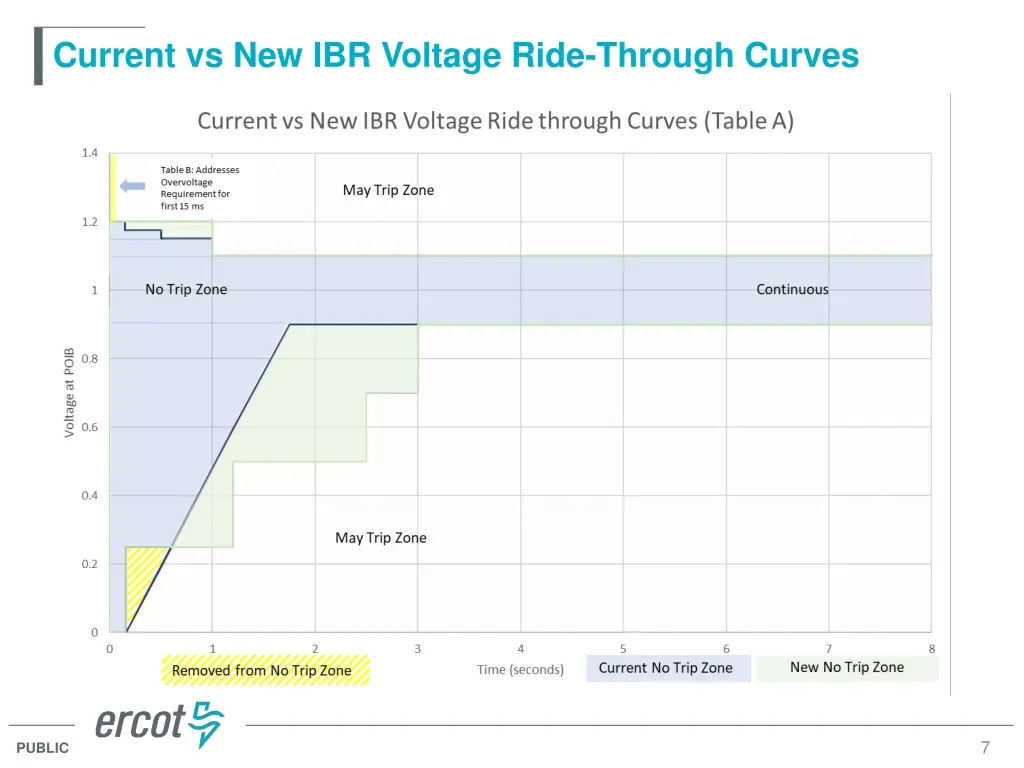
IBR Voltage ride-through requirements Proposed changes address the following: Clarified usage of current instead of power where appropriate. Clarified cumulative times for the VRT tables. Provided additional clarity by including clarifications offered in IEEE 2800 requirements and or footnotes. 5 PUBLIC
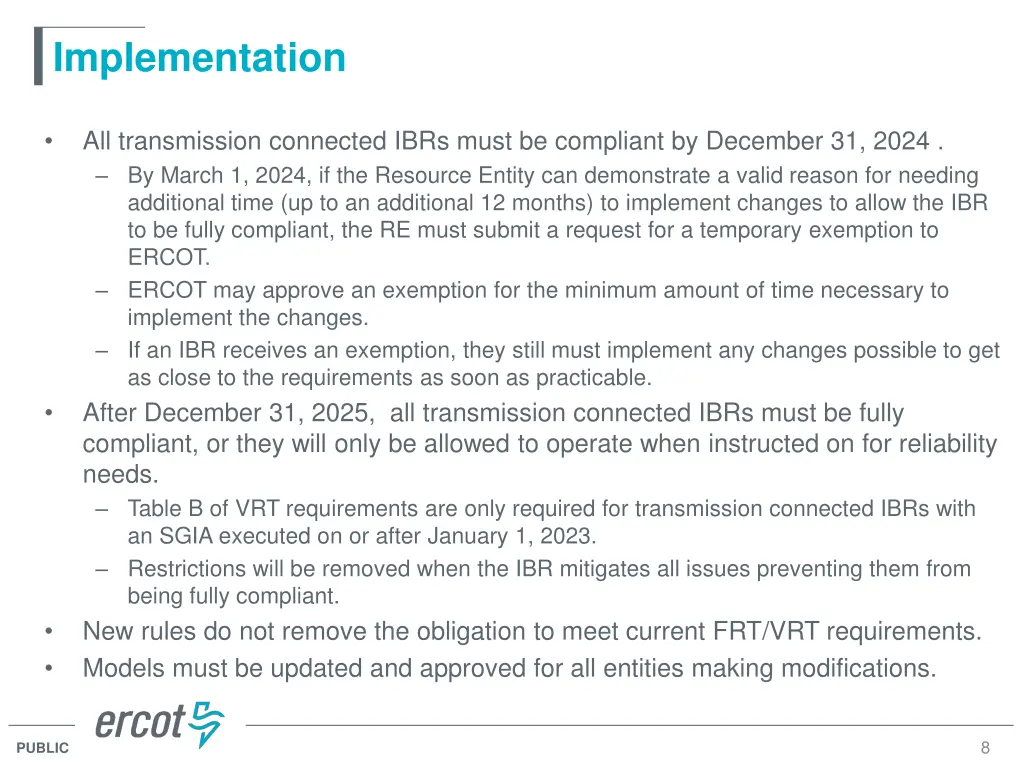
Implementation All transmission connected IBRs must be compliant by December 31, 2024 . By March 1, 2024, if the Resource Entity can demonstrate a valid reason for needing additional time (up to an additional 12 months) to implement changes to allow the IBR to be fully compliant, the RE must submit a request for a temporary exemption to ERCOT. ERCOT may approve an exemption for the minimum amount of time necessary to implement the changes. If an IBR receives an exemption, they still must implement any changes possible to get as close to the requirements as soon as practicable. After December 31, 2025, all transmission connected IBRs must be fully compliant, or they will only be allowed to operate when instructed on for reliability needs. Table B of VRT requirements are only required for transmission connected IBRs with an SGIA executed on or after January 1, 2023. Restrictions will be removed when the IBR mitigates all issues preventing them from being fully compliant. New rules do not remove the obligation to meet current FRT/VRT requirements. Models must be updated and approved for all entities making modifications. 8 PUBLIC
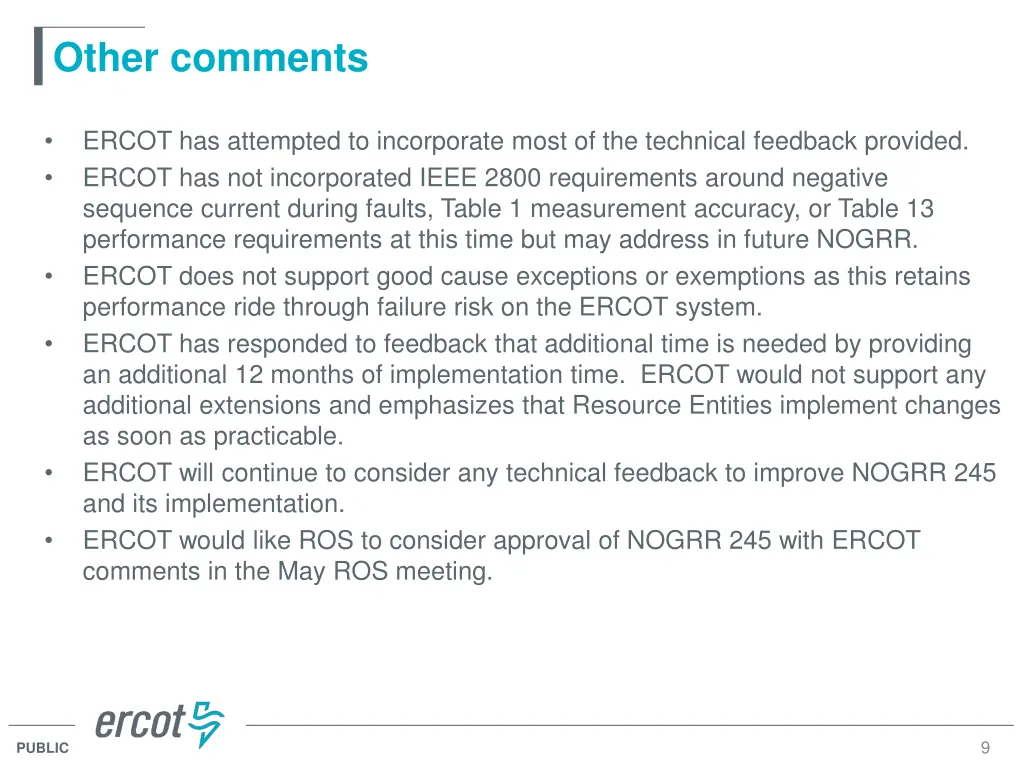
Other comments ERCOT has attempted to incorporate most of the technical feedback provided. ERCOT has not incorporated IEEE 2800 requirements around negative sequence current during faults, Table 1 measurement accuracy, or Table 13 performance requirements at this time but may address in future NOGRR. ERCOT does not support good cause exceptions or exemptions as this retains performance ride through failure risk on the ERCOT system. ERCOT has responded to feedback that additional time is needed by providing an additional 12 months of implementation time. ERCOT would not support any additional extensions and emphasizes that Resource Entities implement changes as soon as practicable. ERCOT will continue to consider any technical feedback to improve NOGRR 245 and its implementation. ERCOT would like ROS to consider approval of NOGRR 245 with ERCOT comments in the May ROS meeting. 9 PUBLIC
Questions? PUBLIC