Essential Newborn Care Practices in Mothers of Babies Born Before Arrival to Hospital
This research project focuses on the knowledge and practices of essential newborn care among mothers whose babies were born before arrival at Wewak General Hospital. It explores the impact of early intervention on reducing neonatal infections and mortality rates. The study aims to assess mothers' understanding of cord care, breastfeeding, thermal care, immunization, and recognizing danger signs in newborns.

Download Presentation

Please find below an Image/Link to download the presentation.
The content on the website is provided AS IS for your information and personal use only. It may not be sold, licensed, or shared on other websites without obtaining consent from the author.If you encounter any issues during the download, it is possible that the publisher has removed the file from their server.
You are allowed to download the files provided on this website for personal or commercial use, subject to the condition that they are used lawfully. All files are the property of their respective owners.
The content on the website is provided AS IS for your information and personal use only. It may not be sold, licensed, or shared on other websites without obtaining consent from the author.
E N D
Presentation Transcript
Diploma in Child Health Research Project Title: Knowledge and Practice of Essential Newborn Care in Mothers of Babies Born Before arrival to Wewak General Hospital. Dr. Natalie Kapari Paediatric Registrar- ESPHA
Outline Introduction Literature review Methodology Results Discussion Conclusion Recommendation Acknowledgement
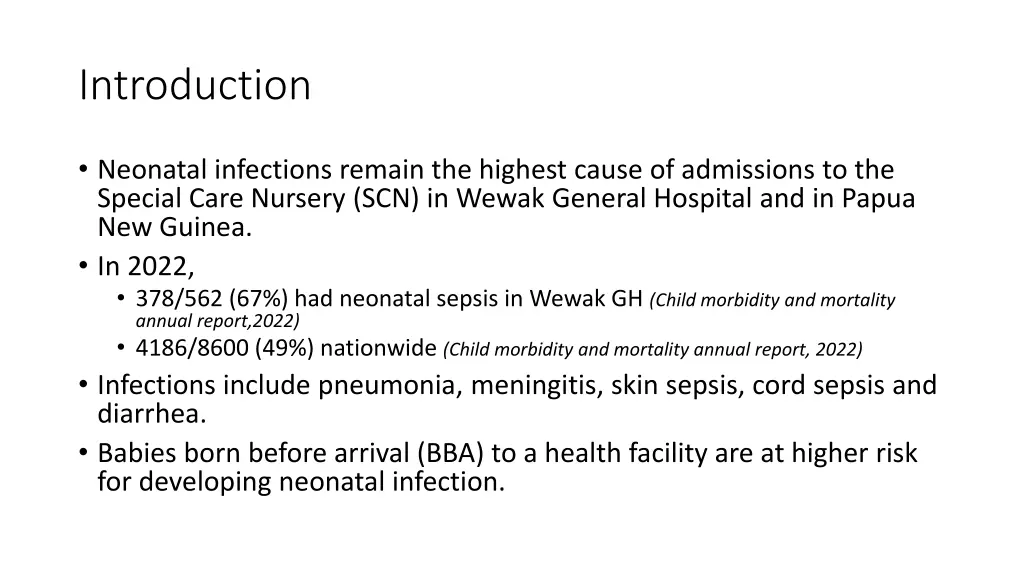
Introduction Neonatal infections remain the highest cause of admissions to the Special Care Nursery (SCN) in Wewak General Hospital and in Papua New Guinea. In 2022, 378/562 (67%) had neonatal sepsis in Wewak GH (Child morbidity and mortality annual report,2022) 4186/8600 (49%) nationwide (Child morbidity and mortality annual report, 2022) Infections include pneumonia, meningitis, skin sepsis, cord sepsis and diarrhea. Babies born before arrival (BBA) to a health facility are at higher risk for developing neonatal infection.
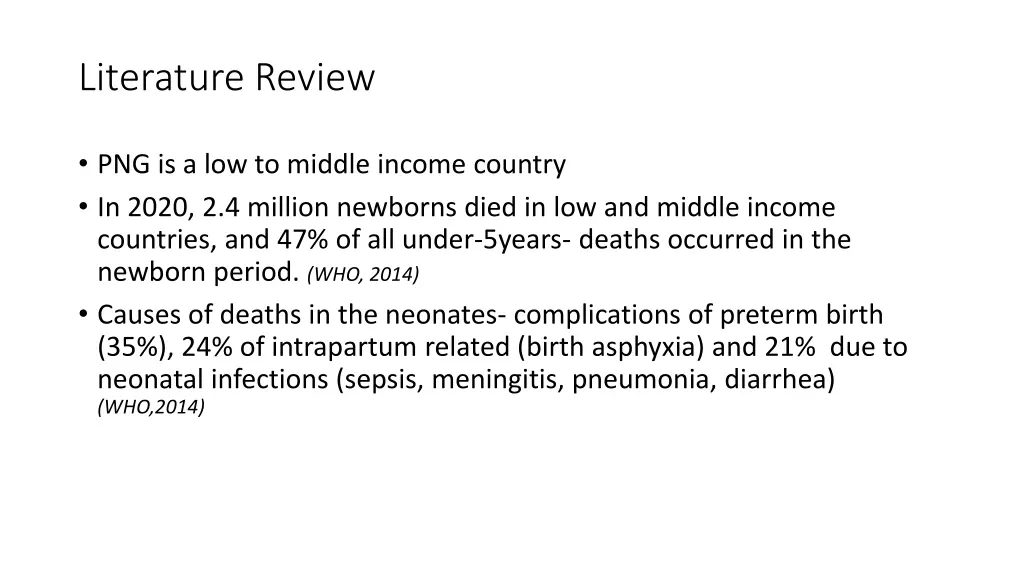
Literature Review PNG is a low to middle income country In 2020, 2.4 million newborns died in low and middle income countries, and 47% of all under-5years- deaths occurred in the newborn period. (WHO, 2014) Causes of deaths in the neonates- complications of preterm birth (35%), 24% of intrapartum related (birth asphyxia) and 21% due to neonatal infections (sepsis, meningitis, pneumonia, diarrhea) (WHO,2014)
Socio-demographic association with knowledge and practice of essential newborn care There is significant association between the mother s knowledge of essential newborn care and level of education and marital status (Misgna, H., Gebru, H. and Birhanu, M. 2016) . However, there is conflicting evidence on socioeconomic status and practice of essential newborn care (Waiswa, P. et al. 2010).
Knowledge and practice of essential newborn care Babies are at the greatest risk of morbidity and mortality during perinatal period. Early intervention during this period prevent deaths in neonates. 71% of mothers who gave birth at home were not practicing essential newborn care (Agonafir, M. et al. 2021).
This study describes mothers knowledge and practice of: cord care breastfeeding thermal care immunization (birth vaccines) recognizing danger signs that a newborn may have.
Methodology Descriptive observational study conducted on mothers who gave birth outside a health facility and arrived in the labour ward and special care nursery of Wewak General hospital. Ethics approval: obtained from the Director of Curative Health Services of East Sepik Provincial Health Authority. Verbal consent was obtained before each mother was interviewed
Inclusion criteria: all babies < 1 month of age All neonates born at home or on the way to a health facility, whose birth was not assisted by a skilled health worker. Exclusion criteria: All babies > 1 month old All neonates born before arrival whose birth was attended to by a health worker
A structured questionnaire was used to collect data The questions were written in English but when interviewing the mothers, it was translated to Tokpisin The data were tallied and entered into a Microsoft Excel. Data collection started in February 2023, and ended in July 2023
Results A total of 43 mothers and 50 babies were enrolled in the study There were 7 sets of twins
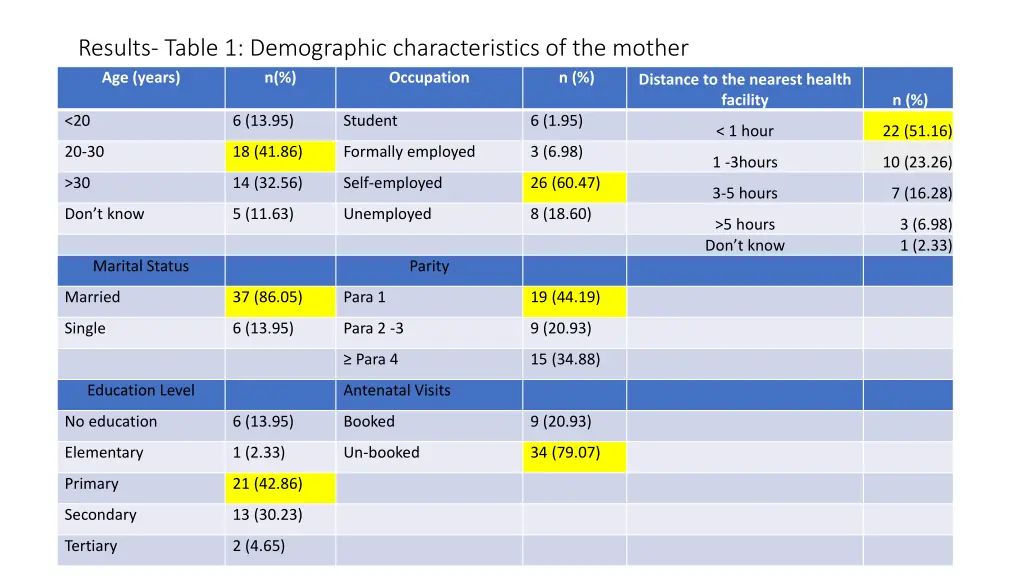
Results- Table 1: Demographic characteristics of the mother Age (years) n(%) Occupation n (%) Distance to the nearest health facility n (%) <20 6 (13.95) Student 6 (1.95) < 1 hour 22 (51.16) 20-30 18 (41.86) Formally employed 3 (6.98) 1 -3hours 10 (23.26) >30 14 (32.56) Self-employed 26 (60.47) 3-5 hours 7 (16.28) Don t know 5 (11.63) Unemployed 8 (18.60) >5 hours Don t know 3 (6.98) 1 (2.33) Marital Status Parity Married 37 (86.05) Para 1 19 (44.19) Single 6 (13.95) Para 2 -3 9 (20.93) Para 4 15 (34.88) Education Level Antenatal Visits No education 6 (13.95) Booked 9 (20.93) Elementary 1 (2.33) Un-booked 34 (79.07) Primary 21 (42.86) Secondary 13 (30.23) Tertiary 2 (4.65)
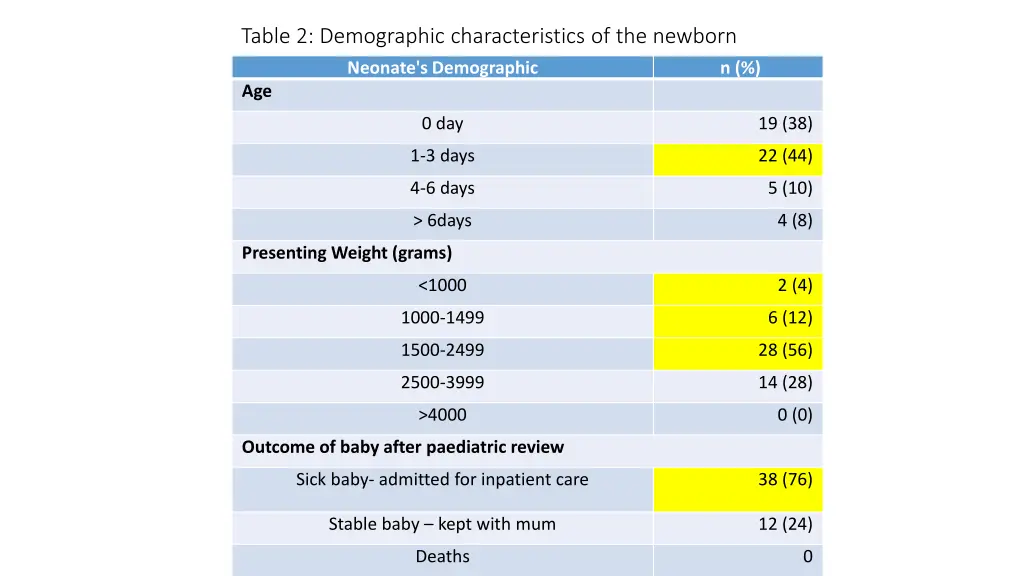
Table 2: Demographic characteristics of the newborn Neonate's Demographic n (%) Age 0 day 19 (38) 1-3 days 22 (44) 4-6 days 5 (10) > 6days 4 (8) Presenting Weight (grams) <1000 2 (4) 1000-1499 6 (12) 1500-2499 28 (56) 2500-3999 14 (28) >4000 0 (0) Outcome of baby after paediatric review Sick baby- admitted for inpatient care 38 (76) Stable baby kept with mum 12 (24) Deaths 0
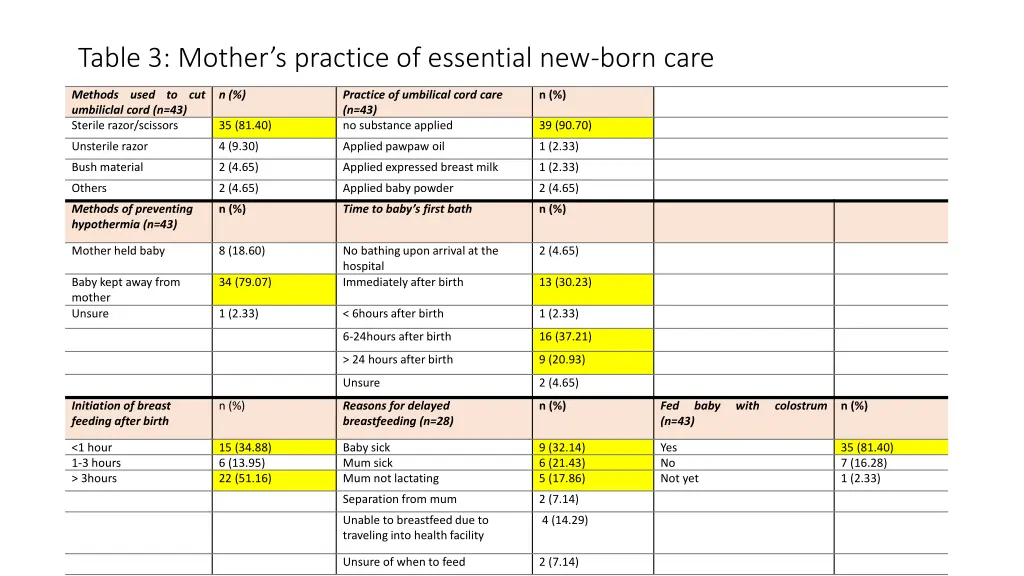
Table 3: Mothers practice of essential new-born care Methods used to cut umbiliclal cord (n=43) Sterile razor/scissors n (%) Practice of umbilical cord care (n=43) no substance applied n (%) 35 (81.40) 39 (90.70) Unsterile razor 4 (9.30) Applied pawpaw oil 1 (2.33) Bush material 2 (4.65) Applied expressed breast milk 1 (2.33) Others 2 (4.65) Applied baby powder 2 (4.65) Methods of preventing hypothermia (n=43) n (%) Time to baby s first bath n (%) Mother held baby 8 (18.60) No bathing upon arrival at the hospital Immediately after birth 2 (4.65) Baby kept away from mother Unsure 34 (79.07) 13 (30.23) 1 (2.33) < 6hours after birth 1 (2.33) 6-24hours after birth 16 (37.21) > 24 hours after birth 9 (20.93) Unsure 2 (4.65) Initiation of breast feeding after birth n (%) Reasons for delayed breastfeeding (n=28) n (%) Fed (n=43) baby with colostrum n (%) <1 hour 1-3 hours > 3hours 15 (34.88) 6 (13.95) 22 (51.16) Baby sick Mum sick Mum not lactating 9 (32.14) 6 (21.43) 5 (17.86) Yes No Not yet 35 (81.40) 7 (16.28) 1 (2.33) Separation from mum 2 (7.14) Unable to breastfeed due to traveling into health facility 4 (14.29) Unsure of when to feed 2 (7.14)
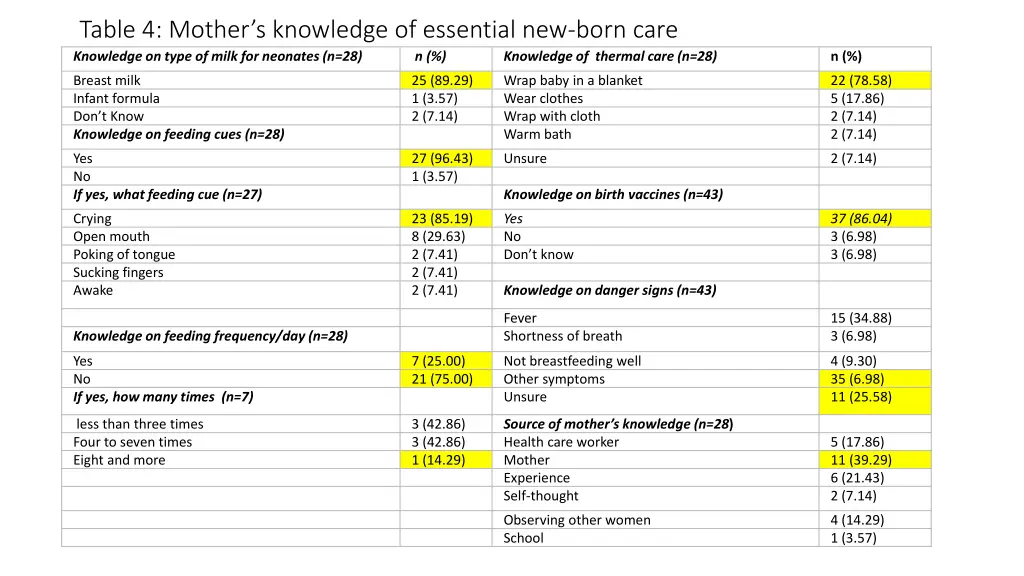
Table 4: Mothers knowledge of essential new-born care Knowledge on type of milk for neonates (n=28) n (%) Knowledge of thermal care (n=28) n (%) Breast milk Infant formula Don t Know Knowledge on feeding cues (n=28) 25 (89.29) 1 (3.57) 2 (7.14) Wrap baby in a blanket Wear clothes Wrap with cloth Warm bath 22 (78.58) 5 (17.86) 2 (7.14) 2 (7.14) Yes No If yes, what feeding cue (n=27) 27 (96.43) 1 (3.57) Unsure 2 (7.14) Knowledge on birth vaccines (n=43) Crying Open mouth Poking of tongue Sucking fingers Awake 23 (85.19) 8 (29.63) 2 (7.41) 2 (7.41) 2 (7.41) Yes No Don t know 37 (86.04) 3 (6.98) 3 (6.98) Knowledge on danger signs (n=43) Fever Shortness of breath 15 (34.88) 3 (6.98) Knowledge on feeding frequency/day (n=28) Yes No If yes, how many times (n=7) 7 (25.00) 21 (75.00) Not breastfeeding well Other symptoms Unsure 4 (9.30) 35 (6.98) 11 (25.58) less than three times Four to seven times Eight and more 3 (42.86) 3 (42.86) 1 (14.29) Source of mother s knowledge (n=28) Health care worker Mother Experience Self-thought 5 (17.86) 11 (39.29) 6 (21.43) 2 (7.14) Observing other women School 4 (14.29) 1 (3.57)
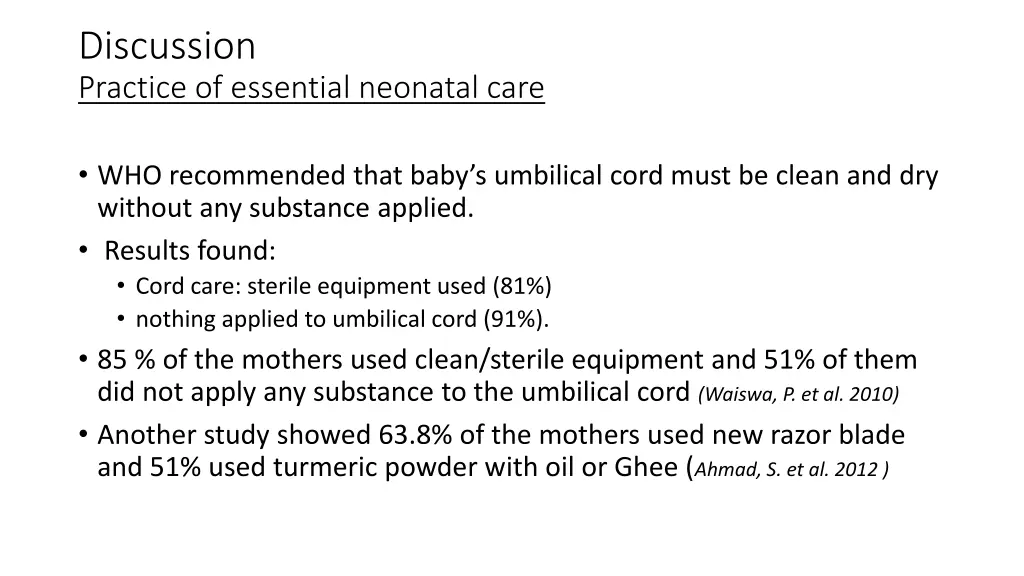
Discussion Practice of essential neonatal care WHO recommended that baby s umbilical cord must be clean and dry without any substance applied. Results found: Cord care: sterile equipment used (81%) nothing applied to umbilical cord (91%). 85 % of the mothers used clean/sterile equipment and 51% of them did not apply any substance to the umbilical cord (Waiswa, P. et al. 2010) Another study showed 63.8% of the mothers used new razor blade and 51% used turmeric powder with oil or Ghee (Ahmad, S. et al. 2012 )
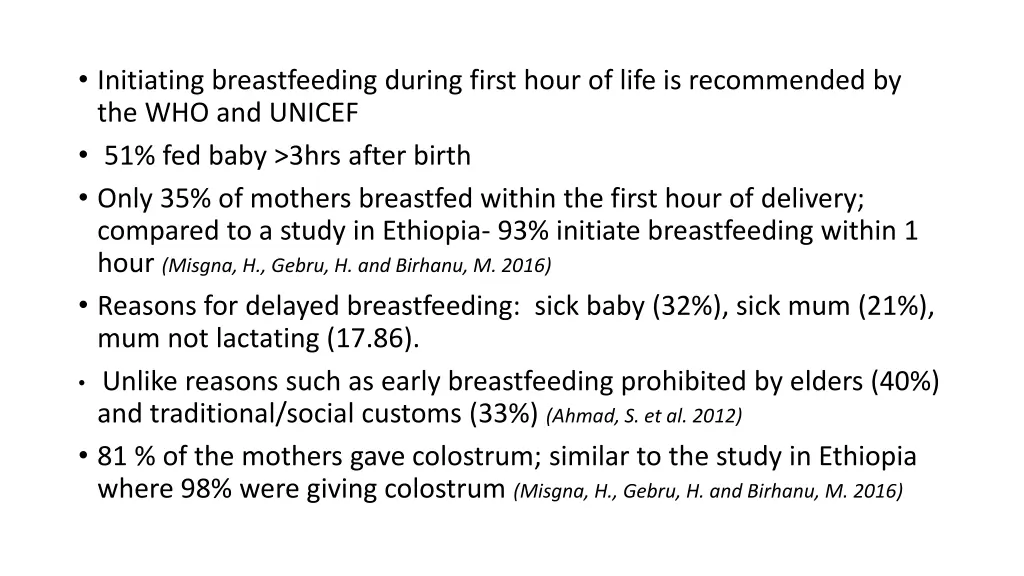
Initiating breastfeeding during first hour of life is recommended by the WHO and UNICEF 51% fed baby >3hrs after birth Only 35% of mothers breastfed within the first hour of delivery; compared to a study in Ethiopia- 93% initiate breastfeeding within 1 hour (Misgna, H., Gebru, H. and Birhanu, M. 2016) Reasons for delayed breastfeeding: sick baby (32%), sick mum (21%), mum not lactating (17.86). Unlike reasons such as early breastfeeding prohibited by elders (40%) and traditional/social customs (33%) (Ahmad, S. et al. 2012) 81 % of the mothers gave colostrum; similar to the study in Ethiopia where 98% were giving colostrum (Misgna, H., Gebru, H. and Birhanu, M. 2016)
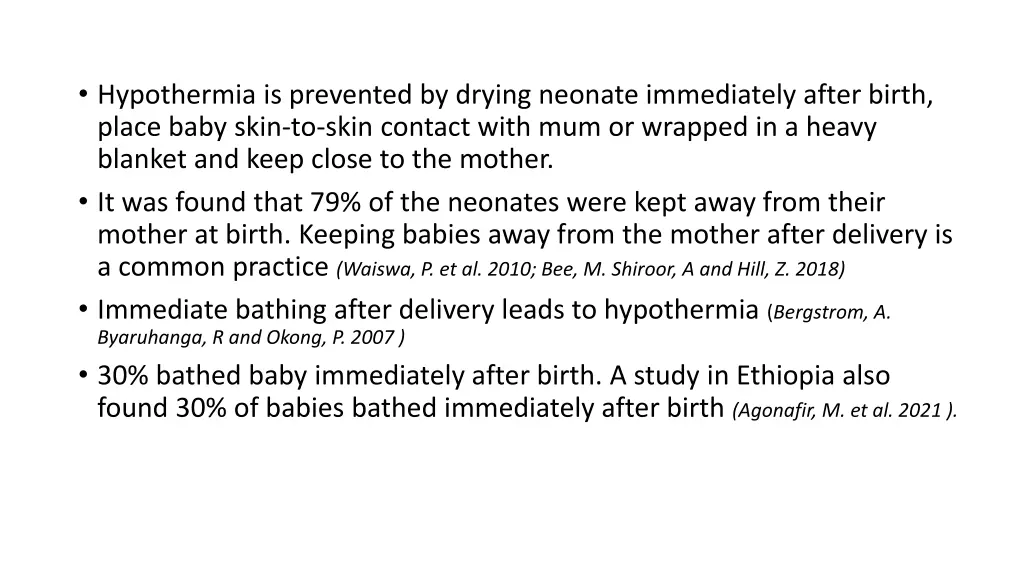
Hypothermia is prevented by drying neonate immediately after birth, place baby skin-to-skin contact with mum or wrapped in a heavy blanket and keep close to the mother. It was found that 79% of the neonates were kept away from their mother at birth. Keeping babies away from the mother after delivery is a common practice (Waiswa, P. et al. 2010; Bee, M. Shiroor, A and Hill, Z. 2018) Immediate bathing after delivery leads to hypothermia (Bergstrom, A. Byaruhanga, R and Okong, P. 2007 ) 30% bathed baby immediately after birth. A study in Ethiopia also found 30% of babies bathed immediately after birth (Agonafir, M. et al. 2021 ).
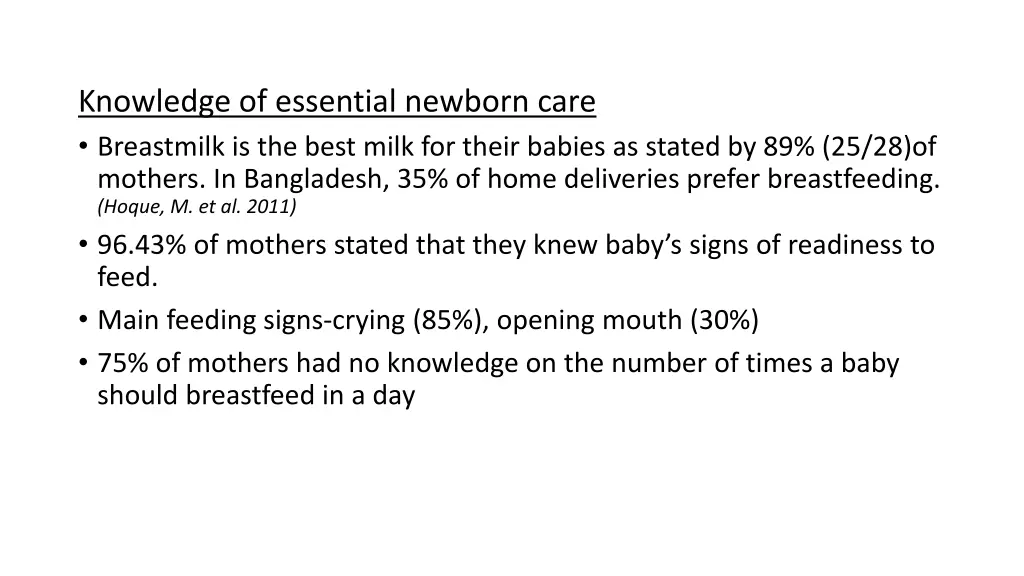
Knowledge of essential newborn care Breastmilk is the best milk for their babies as stated by 89% (25/28)of mothers. In Bangladesh, 35% of home deliveries prefer breastfeeding. (Hoque, M. et al. 2011) 96.43% of mothers stated that they knew baby s signs of readiness to feed. Main feeding signs-crying (85%), opening mouth (30%) 75% of mothers had no knowledge on the number of times a baby should breastfeed in a day
Knowledge of danger signs in a newborn baby is vital for early presentation to a health facility 51% of the mothers stated the danger signs: fever (35%), shortness of breath (7%) and not breastfeeding well (9%). The study in Ethiopia also showed 50% of the mothers have knowledge about the danger signs in a newborn. (Misgna, H., Gebru, H. and Birhanu, M. 2016) 86% of the mothers stated that newborns must be vaccinated at birth agreeing with 98% of mothers in Ethiopia. (Misgna, H., Gebru, H. and Birhanu, M. 2016)
Limitation Small sample size 7 sets of twins can be a bias Single centre study
Conclusion Mothers have poor knowledge on essential new-born care at birth Practice of thermal care and breastfeeding among mothers who delivered at home is suboptimal Babies born before arrival in East Sepik have higher risk of neonatal morbidity and mortality because of poor new-born care by mothers and birth attendants
Recommendation Antenatal clinics must educate mothers on the essential new-born care There should be awareness and education on essential new-born care in the community Strengthening the training of village birth attendants
Reference Child morbidity and mortality 13thannual report, 2022. Available at https://pngpaediatric society.org/reports/annual-child-morbidity-and mortality-reports/ (Accessed: 12 June 2023) WHO. (2014) Every newborn: an action plan to end preventable deaths. Switzerland: World Health Organization Misgna, H., Gebru, H. and Birhanu, M. (2016) Knowledge, practice and associated factors of essential newborn care at home among mothers in Gulomekada district, Eastern Tigray, Ethiopia, 2014) , BMC Pregnancy and Childbirth, 16 (144), doi:10.1186/s12884-016-0931 Waiswa, P. et al. (2010) Poor newborn care practices a population based survey in eastern Uganda , BMC Pregnancy and Childbirth, 10 (9), Available at: http://www.biomedcentral.com/1471-2393/10/9 (Accessed: July 2023) Agonafir, M. et al. (2021) Community based essential newborn care practices and associated factors among women who gave birth at home in last 12months in Amaro Woreda, Southern Ethiopia, 2019 , Sage, 8, pp. 1-8. doi:10.1177/2333794X211016151 Ahmad, S. et al. (2012) Assessment of the newborn care practices in home deliveries among urban slums of Meerut, UP India , Community Medicine & Health Education, 2 (8), pp. 2-4. Available at: http://dx.doi.org/10.4172/2161 -0711.1000171 (Accessed: July 2023) Bee, M. Shiroor, A and Hill, Z. (2018) Neonatal care practices in sub-Saharan Africa: a systemic review of quantitative and qualitative data , Journal of Health, Population and Nutrition, 37 (9), pp. 1-12. Available at: https://doi.org/10.1186/s41043-018-0141-5 Bergstrom, A. Byaruhanga, R and Okong, P. (2007) The impact of newborn bathing on the prevalence of neonatal hypothermia in Uganda: A randomized control trial , Wiley, 94 (10), pp. 1462-1467. Available at: https://doi.org/10.1111/j.1651-2227.2005.tb01821.x Hoque, M. et al. (2011) Newborn care practices by the mother/care givers and their knowledge about signs of sickness of neonates , Bangladesh J Child Health, 35 (3), pp. 90-96. pdf
Acknowledgement Professor Trevor Duke Dr A Zamunu Paediatrian, East Sepik Provincial Health Authority Paediatric Medical Team, Wewak General Hospital Special Care Nursery, Wewak General Hospital Labour ward Medical and Nursing team, Wewak General Hospital Study participants My family