Essential Witness Testimony Guidelines

Guidelines for effective witness testimony in legal proceedings including background questions, relevance focus, pronoun usage, respectfulness, non-leading questions, and storytelling approach. Learn these rules to conduct thorough and impactful interrogations.

Download Presentation

Please find below an Image/Link to download the presentation.
The content on the website is provided AS IS for your information and personal use only. It may not be sold, licensed, or shared on other websites without obtaining consent from the author.If you encounter any issues during the download, it is possible that the publisher has removed the file from their server.
You are allowed to download the files provided on this website for personal or commercial use, subject to the condition that they are used lawfully. All files are the property of their respective owners.
The content on the website is provided AS IS for your information and personal use only. It may not be sold, licensed, or shared on other websites without obtaining consent from the author.
E N D
Presentation Transcript
RULE #1 (Attorney) For the record, please state your name and where you live Means that you are verifying we have the correct witness testifying
RULE #2 Go through some background questions Ex) Tell me about yourself, what do you do, do you know _____ (Plaintiff/Defendant), how do you know _______ In other words, get them Connected to the case in a clear way
RULE #3 After going through the background, get the person connected to the case in question In other words, were they a part of the case and how
RULE #4 Focus on what the witness saw (Witnesses can testify to anything they saw connected to the case and some of what they heard) If its not connected to the case, its Irrelevant And you CANNOT repeat a question
RULE #5 Eliminate (Or strongly limit) pronouns He, she, it Call people by their names, titles, etc
RULE #6 Be respectful Call people Mr./Mrs, not by their first name if possible Plaintiff, call the defendant That defendant Defense, call the defendant Mr/Mrs
RULE #7 ALL questions must NOT be leading Start every questions with Who, What, Where, When, Why, How or explain/describe BUT, you can put the witnesses last answer into a follow-up question Ex) You just said the bank robber pulled out driving a Ford Bronco, why do you believe this?
RULE #8 TELL A STORY In other words, be descriptive as you can by telling the story in a chronological order, of the events as they took place Not always in order within the witness statement
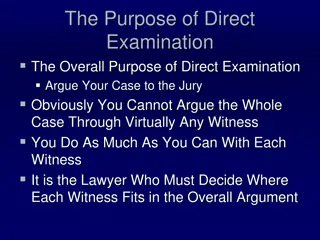
RULE #9 In a real world, there are no time limits, but for this assignment, you cannot have a direct examination less than 2 and a minutes or more than 3 and minutes. So, GET TO THE STORY as quick as you can (Relevance)- Part of the rule is based on wasting the courts time, so focus on things connected to the case
RULE #10 Each team will decide who will play the role of the attorney and which the witness When you are done, I will cross examine the witness to introduce you to cross examination DO NOT ASK how many questions you need to ask, focus on the timing Witnesses need to know their statements and each answer
QUESTIONS?? 1. You will have approximately 6 classes to prepare 2. Presentations will be like first ones (Bullpen) 3. Anything else?