Ethical Challenges in Autonomous Vehicles and Robotics
Explore the ethical dilemmas faced by autonomous vehicles and robots in scenarios where harm distribution becomes a critical issue. Delve into Isaac Asimov's Three Laws of Robotics, the Moral Machine Experiment, accident scenarios, and global preferences in making moral decisions. Understand the complexities of decision-making processes when lives are at stake in technological advancements.

Download Presentation

Please find below an Image/Link to download the presentation.
The content on the website is provided AS IS for your information and personal use only. It may not be sold, licensed, or shared on other websites without obtaining consent from the author. If you encounter any issues during the download, it is possible that the publisher has removed the file from their server.
You are allowed to download the files provided on this website for personal or commercial use, subject to the condition that they are used lawfully. All files are the property of their respective owners.
The content on the website is provided AS IS for your information and personal use only. It may not be sold, licensed, or shared on other websites without obtaining consent from the author.
E N D
Presentation Transcript
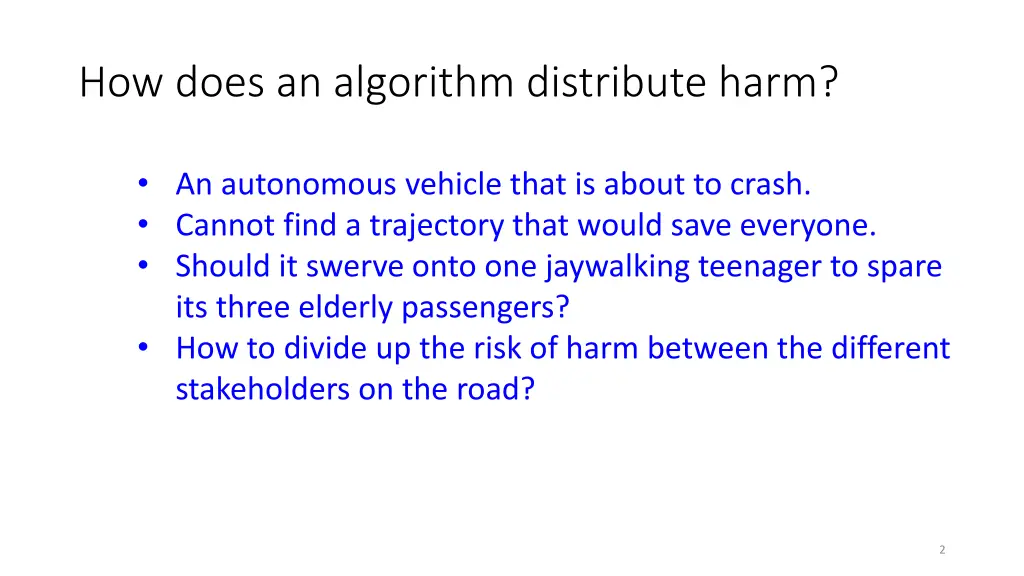
How does an algorithm distribute harm? An autonomous vehicle that is about to crash. Cannot find a trajectory that would save everyone. Should it swerve onto one jaywalking teenager to spare its three elderly passengers? How to divide up the risk of harm between the different stakeholders on the road? 2
Isaac Asimov's "Three Laws of Robotics" A robot may not injure a human being or, through inaction, allow a human being to come to harm. A robot must obey the orders given to it by human beings except where such orders would conflict with the First Law. A robot must protect its own existence as long as such protection does not conflict with the First or Second Laws. Not designed to let machines distribute harm between humans when harm is inevitable
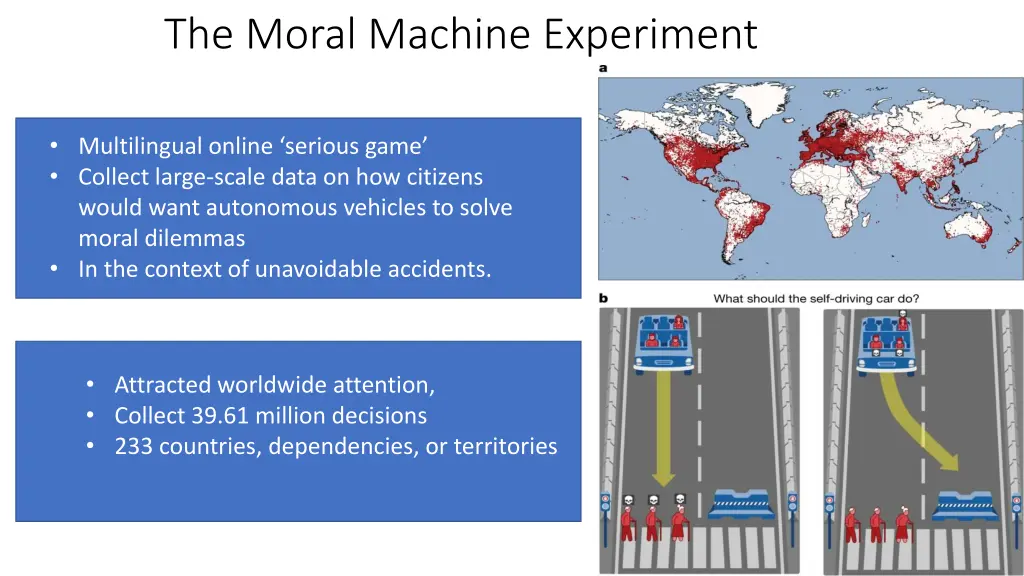
The Moral Machine Experiment Multilingual online serious game Collect large-scale data on how citizens would want autonomous vehicles to solve moral dilemmas In the context of unavoidable accidents. Attracted worldwide attention, Collect 39.61 million decisions 233 countries, dependencies, or territories
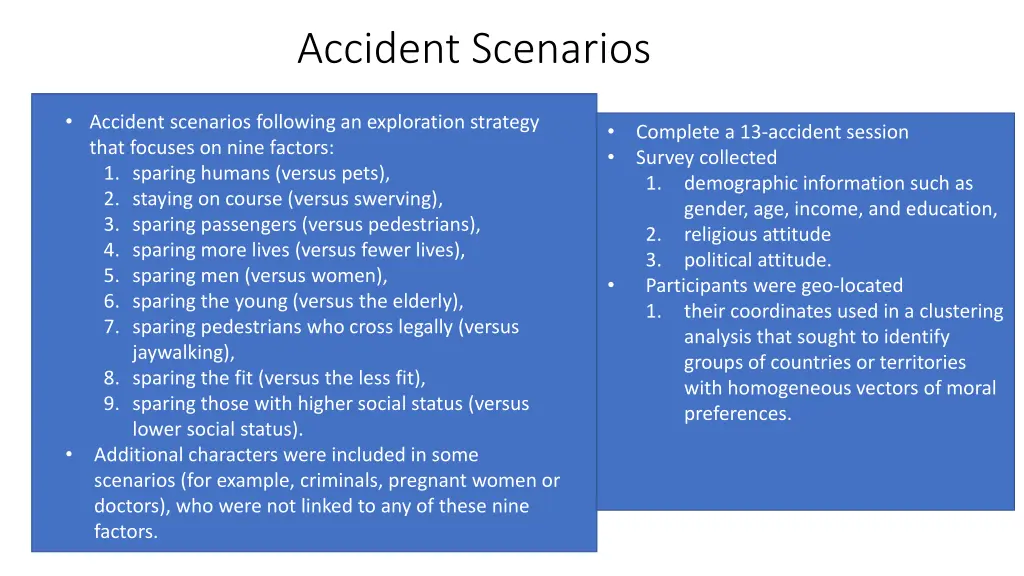
Accident Scenarios Accident scenarios following an exploration strategy that focuses on nine factors: 1. sparing humans (versus pets), 2. staying on course (versus swerving), 3. sparing passengers (versus pedestrians), 4. sparing more lives (versus fewer lives), 5. sparing men (versus women), 6. sparing the young (versus the elderly), 7. sparing pedestrians who cross legally (versus jaywalking), 8. sparing the fit (versus the less fit), 9. sparing those with higher social status (versus lower social status). Additional characters were included in some scenarios (for example, criminals, pregnant women or doctors), who were not linked to any of these nine factors. Complete a 13-accident session Survey collected 1. demographic information such as gender, age, income, and education, 2. religious attitude 3. political attitude. Participants were geo-located 1. their coordinates used in a clustering analysis that sought to identify groups of countries or territories with homogeneous vectors of moral preferences.
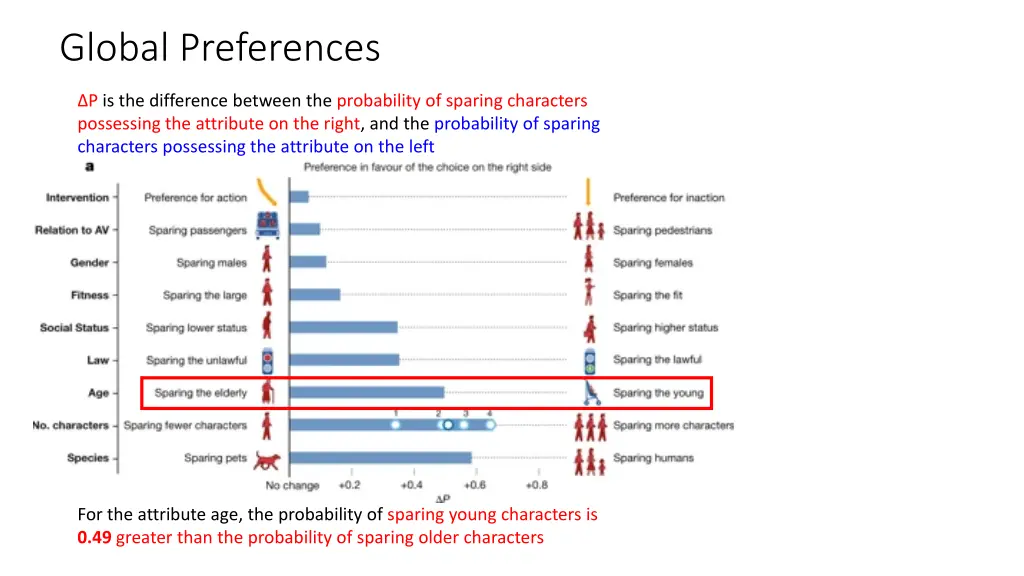
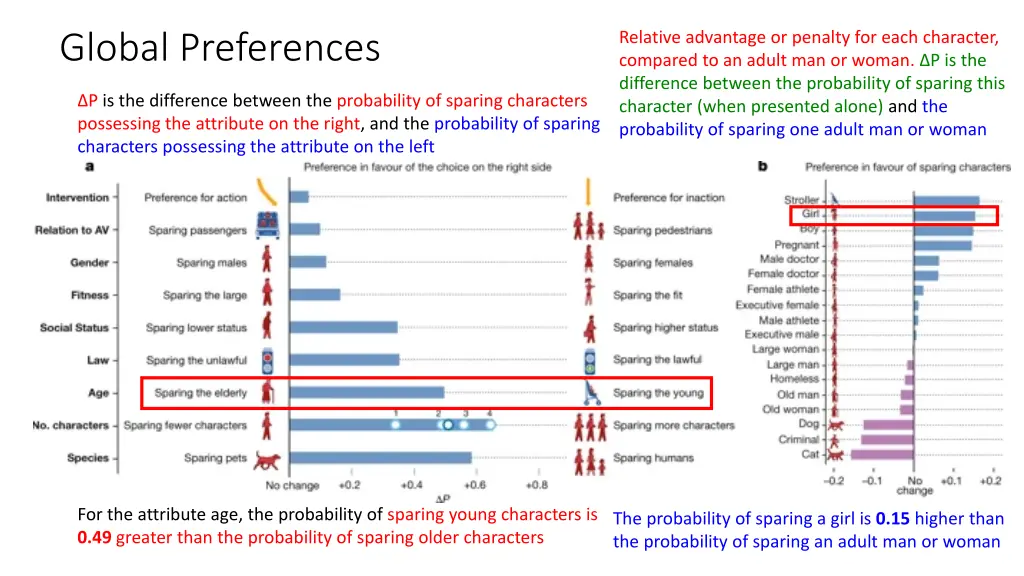
Global Preferences P is the difference between the probability of sparing characters possessing the attribute on the right, and the probability of sparing characters possessing the attribute on the left For the attribute age, the probability of sparing young characters is 0.49 greater than the probability of sparing older characters
Relative advantage or penalty for each character, compared to an adult man or woman. P is the difference between the probability of sparing this character (when presented alone) and the probability of sparing one adult man or woman Global Preferences P is the difference between the probability of sparing characters possessing the attribute on the right, and the probability of sparing characters possessing the attribute on the left For the attribute age, the probability of sparing young characters is 0.49 greater than the probability of sparing older characters The probability of sparing a girl is 0.15 higher than the probability of sparing an adult man or woman
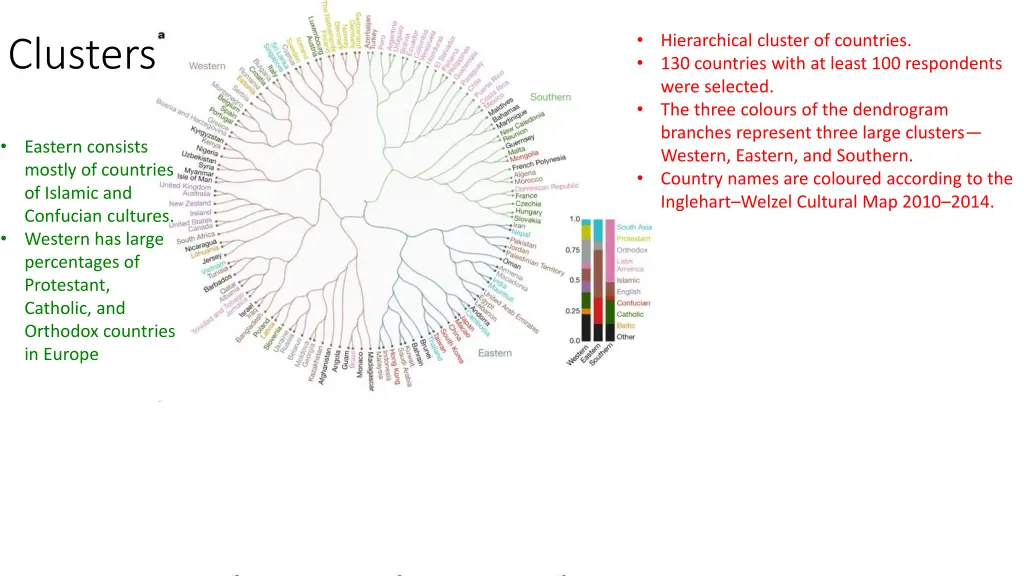
Hierarchical cluster of countries. 130 countries with at least 100 respondents were selected. The three colours of the dendrogram branches represent three large clusters Western, Eastern, and Southern. Country names are coloured according to the Inglehart Welzel Cultural Map 2010 2014. Clusters Eastern consists mostly of countries of Islamic and Confucian cultures. Western has large percentages of Protestant, Catholic, and Orthodox countries in Europe
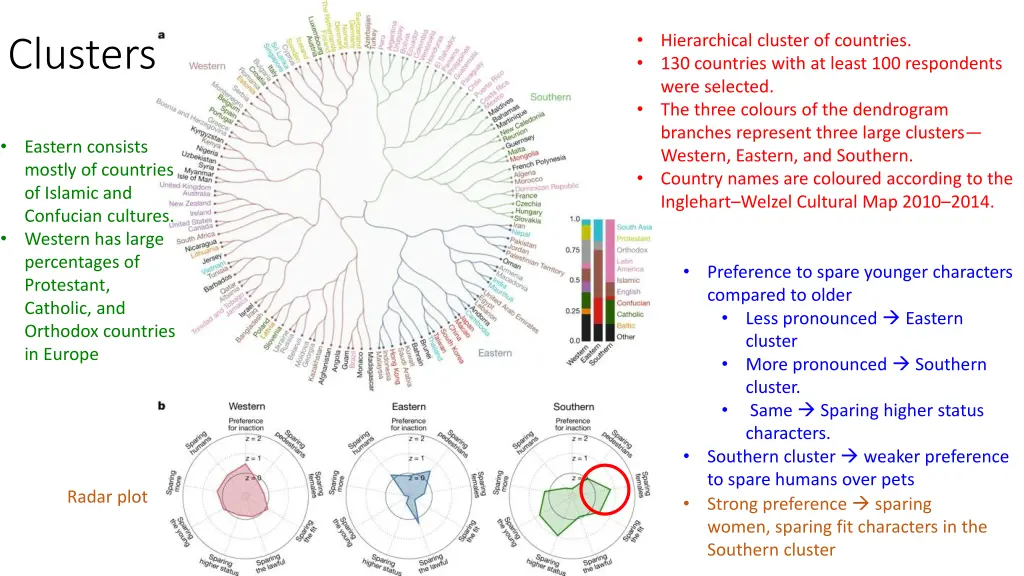
Hierarchical cluster of countries. 130 countries with at least 100 respondents were selected. The three colours of the dendrogram branches represent three large clusters Western, Eastern, and Southern. Country names are coloured according to the Inglehart Welzel Cultural Map 2010 2014. Clusters Eastern consists mostly of countries of Islamic and Confucian cultures. Western has large percentages of Protestant, Catholic, and Orthodox countries in Europe Preference to spare younger characters compared to older Less pronounced Eastern cluster More pronounced Southern cluster. Same Sparing higher status characters. Southern cluster weaker preference to spare humans over pets Strong preference sparing women, sparing fit characters in the Southern cluster Radar plot
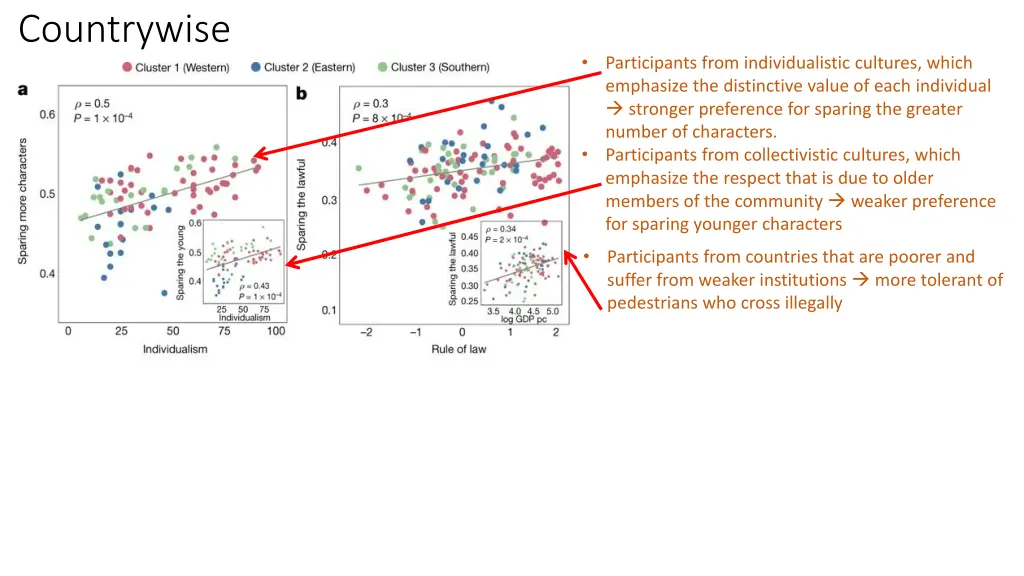
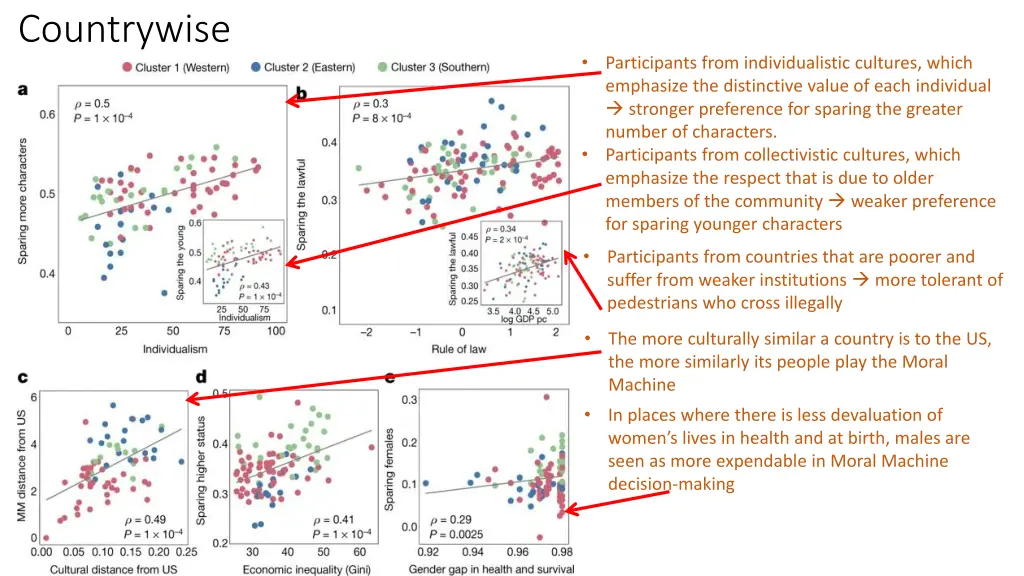
Countrywise Participants from individualistic cultures, which emphasize the distinctive value of each individual stronger preference for sparing the greater number of characters. Participants from collectivistic cultures, which emphasize the respect that is due to older members of the community weaker preference for sparing younger characters Participants from countries that are poorer and suffer from weaker institutions more tolerant of pedestrians who cross illegally
Countrywise Participants from individualistic cultures, which emphasize the distinctive value of each individual stronger preference for sparing the greater number of characters. Participants from collectivistic cultures, which emphasize the respect that is due to older members of the community weaker preference for sparing younger characters Participants from countries that are poorer and suffer from weaker institutions more tolerant of pedestrians who cross illegally The more culturally similar a country is to the US, the more similarly its people play the Moral Machine In places where there is less devaluation of women s lives in health and at birth, males are seen as more expendable in Moral Machine decision-making