Ethnography of speaking
Framework and method for conducting language study proposed by Hymes emphasizes the systematic link between language use and context. It focuses on communicative events as central units of analysis, exploring the components and relationships within them to understand participants' engagement and interpretation of their social worlds. The approach, now also known as ethnography of communication, considers a broad range of resources beyond language in communication studies. Various literacy activities in different communities have been studied, revealing diverse practices influenced by social identities and values. Despite differences, literacy is viewed as a set of practices tied to specific contexts rather than just transferable skills.

Download Presentation

Please find below an Image/Link to download the presentation.
The content on the website is provided AS IS for your information and personal use only. It may not be sold, licensed, or shared on other websites without obtaining consent from the author.If you encounter any issues during the download, it is possible that the publisher has removed the file from their server.
You are allowed to download the files provided on this website for personal or commercial use, subject to the condition that they are used lawfully. All files are the property of their respective owners.
The content on the website is provided AS IS for your information and personal use only. It may not be sold, licensed, or shared on other websites without obtaining consent from the author.
E N D
Presentation Transcript
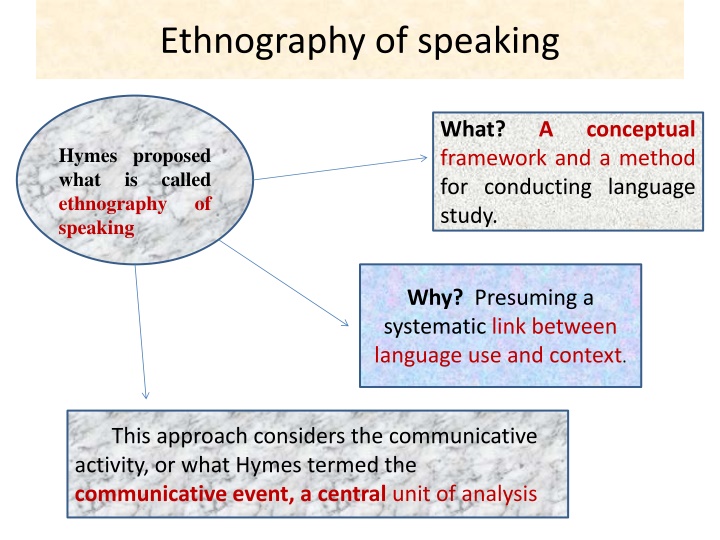
Ethnography of speaking What? framework and a method for conducting language study. A conceptual Hymes proposed what is ethnography speaking called of Why? Presuming a systematic link between language use and context. This approach considers the communicative activity, or what Hymes termed the communicative event, a central unit of analysis
Analytic attention is given to describing the components of communicative events and the relations among them that participants make use of to engage in and make sense of their social worlds and, in turn, to link their use to the larger social, cultural, political and other institutional forces giving shape to them.
More recent formulations of this approach to the study of language refer to it as ethnography of communication to capture a more encompassing understanding of the variety of resources, in addition to language, that is used in communication.
Literacy activities of various groups and communities have also been the subject communication. - Ahearn (2000), for example, studied the literacy practices of young Nepali women, focusing in particular on their use of love letters in courtship. - Taking more of a wide-angle ethnographic approach, McCarty and Watahomigie (1998) studied both home and school literacy activities in American Indian and Alaskan native communities. - Barton and Hamilton (1998) explored the activities constituted in the everyday lives of a group of adults in England. of ethnographies of
- Findings from these and other studies have shown that literacy activities do indeed vary, in some cases considerably, community. - As these groups differ and as the social identities of the readers and writers differ within the groups so does the value that is placed on literacy activities and conventions used to engage in them. from community to the communicative
The differences in literacy practices notwithstanding, literacy underlying the various strand of literacy studies remains the same. the principal assumption of Literacy is defined not as a technology made up of a set of transferable cognitive skills, but [as] a constellation of practices , each made up of particular arrangements of skills and ways of reading and writing that are tied to their contexts of use.
. Likewise, the ethnographies share the goal of making visible the linguistic resources and communicative plans shared by group members and used to engage in their socio-culturally important communicative activities. In addition to adding to our knowledge of cultural groups, studies taking an ethnography of communication approach language and culture have contributed a great deal to current educational practices. to the study of
The recent turn in studies of communicative activities In the past decade or so, applied linguistic studies of communicative events, particularly those realised through face-to-face interaction, have moved beyond general descriptions of the linguistic resources needed to engage in them to more detailed descriptions that show the moment-to-moment interactional coordination by which the communicative context is created.
This move has come about in part by the incorporation of methods conversation developed by the discipline of conversation analysis (CA). for analysing
CA began in the field of sociology over forty years ago as an offshoot of ethnomethodology. An approach to the study of social life that considers the nature and source of social order to be grounded in real-world activity rather than regulated by universal rationality. standards of
Social Order A local achievement, mutually produced by participants as they engage in activity with each other. Asserting a fundamental role for interaction as the primordial site of human sociality . CA takes as its main concern the study of talk- in interaction, and more particularly, the analysis of competence which underlies ordinary social activities .
It is sufficient to note that findings from C A inspired studies have been useful in revealing interactional methods such as turn-taking patterns and repair strategies that we have at our disposal for sense-making in our communicative activities. the multitude of
In addition to drawing out the shared understandings that members rely on to make sense of each other s actions in talk-in-interaction activities, interest has developed in uncovering the variability of resource use. A criticism of early ethnographies that ethnographic of communication descriptions of communicative events often gave the impression that participation was always consensual, always orderly.. noted individual members
Assuming a more dynamic understanding of community and language use, more recent studies have examined members use the communicative activities to challenge the status quo or to reinforce particular ideologies how individual of resources their
In terms of challenging existing conditions of language use, Hall s study (1993c) revealed how one Dominican manipulate the conventional opening to the activity of gossiping as practised among her peers in such a way as to positively transform the nature of her involvement in the activity. woman was able to
Typically, the opening of the gossiping event was signalled with the utterance tengo una bomba (I have a bomb), the purpose of which was to inform the others that a story about the scandalous behaviour of another was about to be told. When this particular woman used it, however, what often followed was not a story impropriety, but a humorous anecdote in which she was the central figure. about someone s Her unconventional use of the utterance to take the stage, so to speak, generated a great deal of humour among the other participants, and thus helped to raise her status within the group.
At he same time, it solidified her identity as a knowledgeable insider to her peers. In terms of reinforcing ideologies, Blommaert et al. (2006) of three Belgian classrooms for newly revealed how teachers instructional activities served to disqualify rather than to capitalise on students uses of linguistic resources that the teachers non-standard. the study by settled immigrants and literary perceived to be
Also included research in are this studies strand of ethnographic multimodal literacy practices engendered by the continuing expansion communication technologies. interest are the skills and strategies by which individuals use these technologies to make sense of and participate in their communities both within and across geographical boundaries. of the of information Of and particular
The study by Lam and Rosario-Ramos (2009) is one such example. They examined how teenaged immigrants in the United States used digital media to engage in social networking and to design and share information on local, national, and transnational events with peers and others living in their countries of origin.
They found that these digitally based, multilingual literacy practices situated the youths in a transnational circuit of news and ideas that exposed them to narratives, experiences, values, and expectations from different social communities.
As for literacy practices, the term New Literacies Studies has been coined to refer to studies that take a more critical stance towards practices constituted not only in educational settings but also in social and professional groups and communities outside of schools across a range of geographical contexts.
The studies go beyond Hymess basic ethnographic approach in that they seek to make visible the power relations embedded in and across the various practices, by asking whose literacies are dominant and whose are marginalized or resistant .