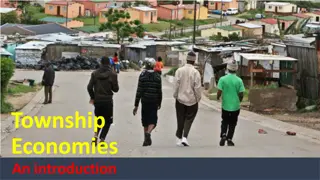
Explore the intricacies of European economies, types of economies, and the basic principles of economics, including market and command economies. Learn about the Euro and its impact on trade within the European Union.
Please find below an Image/Link to download the presentation.
The content on the website is provided AS IS for your information and personal use only. It may not be sold, licensed, or shared on other websites without obtaining consent from the author. If you encounter any issues during the download, it is possible that the publisher has removed the file from their server.
You are allowed to download the files provided on this website for personal or commercial use, subject to the condition that they are used lawfully. All files are the property of their respective owners.
The content on the website is provided AS IS for your information and personal use only. It may not be sold, licensed, or shared on other websites without obtaining consent from the author.
Economic Basics SS6E5 Economics is the study of how a market makes, distributes, and consumes products and services. It is how these markets answer the basic economic questions of: What to produce? How to produce? For whom to produce?
Economic Basics: Types of Economies SS6E5 Traditional Economy: social roles and culture determine how goods and services are produced, what prices and individual incomes are, and which consumers are allowed to buy certain goods. Command Economy: a system in which the government decides what goods will be produced, how they will be produced, and how they will be distributed.
Economic Basics: Types of Economies SS6E5 Market Economy: this system is based on individual choices and voluntary trade; individuals answer the basic questions of what to produce, for whom to produce, and how to produce. Mixed Economy: this system has features of traditional, command, and market systems; all modern economies are mixed economies, but the mix is different in each nation.
Economic Basics: Types of Economies SS6E5, SS6E7d Entrepreneurs are individuals who take risks in an economy by starting new businesses and organizing productive resources. In a command economy it is more difficult for entrepreneurs to act in the economy because the government makes all economic decisions. In a market economy, entrepreneurs play an important role.
Europes Economy SS6E6 Europe s extensive river systems have helped trade between nations. The many mountains between nations have been barriers to trade in the past. The many currencies used throughout Europe made it difficult to trade between nations, until the introduction of the Euro, the unit of currency for all member nations of the European Union, has made trade easier between those nations Those nations that do not belong to the EU still have to exchange currency to trade with each other.
monetary_euro_symbol_01 Currencies of Europe SS6E6d France, Italy, Germany, and Greece use the Euro. The Euro has pictures representing each of it s member nations, much like our quarters for each state, here in the U.S.A. Below are Euro coins. These are some of the back designs for the 1euro piece representing different EU nations. All coins have the same front design 0.05 euro France Italy Germany 0.02 euro 0.1 euro 0.01 euro 0.2 euro 0.5 euro 1 euro 2 euro
monetary_euro_symbol_01 Currencies of Europe SS6E6d Here are pictures of the Euro paper currency. 5 euro 10 euro 20 euro 50 euro 100 euro 200 euro 500 euro
Currencies of Europe SS6E6d Original Ruble Symbol Unofficial Ruble Symbol Image:Rouble-signs.gif Russia s currency is the Ruble. 5 Rubles 50 Rubles 1 Ruble
Currencies of Europe SS6E6d Zloty Symbol z Poland s currency is the zloty. 10 zloty 20 zloty 100 zloty 200 zloty 5 zloty
United Kingdoms Economy SS6E5, SS6E7 The UK has a mixed market economy The government controls some economic activity while private companies control others. The UK has a welfare system, socialized medicine, and the government is involved in overseeing fair business practices, banking, and the supply of money. The UK has a limited amount of resources and land, yet they use what they have efficiently. Service Industries (banking, insurance, etc) make up the largest part of their GDP. The discovery of oil in the North Sea has helped the UK be less dependent on other nations. The people of the UK have a high standard of living, and the literacy rate is among the highest in Europe.
Germanys Economy SS6E5, SS6E7 The reunification of East and West Germany has caused economic difficulty in Germany. Germany had to combine two very different economic systems. East Germany had a command economy, while West Germany had a mixed economy. They have combined a free market, some governmental control, and social welfare (to help the poor) to create a new mixed economy called a social market economy. Germany s combined industrialized economy has become one of the strongest in Europe. Germany has a high literacy rate that reflects the high quality education required of Germany s children, this investment in it s people helps the economy.
Russias Economy SS6E5, SS6E7 Russia did have a command econ. As they were communist now they have moved more towards Mixed Market. During this shift Russia has struggled with high unemployment, a fall in value of the Russian currency (the Ruble), and inflation being high. Russia has oil and sells it to other countries, so now their econ. is growing. Russia has a skilled labor force, and it s gross domestic product* (or GDP) has been on the rise for the past few years, this gives hope that their economy will be strong soon. *GDP is the value of the goods and services produced in a nation within a year.
United Kingdom 79% Germany 71% Russia 51% Pure Market Pure Command