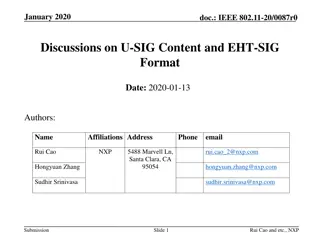
Investigate signaling overhead in IEEE 802.11-20/0738 for EHT-SIG with two configuration options discussed - RU allocation subfield and self-contained user field. Details on U-SIG content and EHT-SIG composition provided. Explore the implications of each option on signaling efficiency.
Please find below an Image/Link to download the presentation.
The content on the website is provided AS IS for your information and personal use only. It may not be sold, licensed, or shared on other websites without obtaining consent from the author. If you encounter any issues during the download, it is possible that the publisher has removed the file from their server.
You are allowed to download the files provided on this website for personal or commercial use, subject to the condition that they are used lawfully. All files are the property of their respective owners.
The content on the website is provided AS IS for your information and personal use only. It may not be sold, licensed, or shared on other websites without obtaining consent from the author.
E N D
Presentation Transcript
May2020 doc.: IEEE 802.11-20/0738 Evaluation of signaling overhead for EHT-SIG Date: 2020-05-xx Authors: Name Affiliation Address Phone Email Dongguk Lim dongguk.lim@lge.com Eunsung Park Ensung.park@lge.com 19, Yangjae-daero 11gil, Seocho-gu, Seoul 137- 130, Korea LG Electronics Jinyoung Chun jiny.chun@lge.com Jinsoo Choi js.choi@lge.com Submission Slide 1 Dongguk Lim, LG Electronics
May 2020 doc.: IEEE 802.11-20/0738 Introduction For the signaling of RU allocation, two options for configuration of EHT-SIG have been suggested in previous meeting. Option 1 : based on the RU allocation subfield (i.e., similar to 11ax HE-SIGB) [1,2,3] Option 2 : based on the self-contained user field [4] In this contribution, we investigated the signaling overhead according to each option. Submission Slide 2 Dongguk Lim, LG Electronics
May 2020 doc.: IEEE 802.11-20/0738 U-SIG content Based on the 11be SFD, in the OFDMA transmission, the U-SIG can be composed as below. The details for bits of each content and some fields need to further discuss. Index 1 2 contents bits 3 1 Index 9 10 contents Spatial reuse bits 4 3 PHY version identifier UL/DL flag EHT-SIG MCS (including DCM) Number of EHT-SIG Symbols/ Number of users for MU-MIMO 3 TXOP 7 11 5 LDPC Extra Symbol Segment Pre-FEC Padding Factor PE Disambiguity CRC Tail 4 BSS Color 6 12 1 5 BW 4 13 2 6 7 8 PPDU type Compression mode GI+EHT-LTF Size 2 1 2 14 15 16 1 4 6 Submission Slide 3 Dongguk Lim, LG Electronics
May 2020 doc.: IEEE 802.11-20/0738 EHT-SIG content (1/2) Option1 : Based on the RU allocation field. EHT-SIG consists of common field and user-specific field as defined in 11be SFD We assume that the common fields include the overflowed information from U- SIG. For example, as shown in below table, 7 bits are considered as the information overflowed from U-SIG. For example, the common field and the user-specific field can be composed as follows. Total bits for the common field : 10 x N + 19 bits Total bits for the User specific field : 32 bits The Common field The User-specific field Index 1 contents Doppler* bits 1 Index 1 2 3 4 5 6 7 8 contents STA-ID NSTS beamfored MCS DCM Coding CRC Tail bits 11 4 1 4 1 1 4 6 Number of HE-LTF Symbols And Midamble Periodicity* STBC* RU allocation center 26 RU CRC tail 2 5 3 4 5 6 7 1 10 x N 2 4 6 * : information overflowed from U-SIG, N : 1/2/4/8 per 20 and 40/80/160/320MHz, respectively. Submission Slide 4 Dongguk Lim, LG Electronics
May 2020 doc.: IEEE 802.11-20/0738 EHT-SIG content (2/2) Option 2 : Based on the self-contained user field. We assume that the information overflowed from U-SIG are included in self- contained user field. For example, the self-contained user field can be configured as below. The total number of bits : 49 bits Index 1 2 3 contents STA-ID RU allocation Doppler* Number of HE-LTF Symbols And Midamble Periodicity* STBC* NSTS beamfored MCS DCM Coding CRC tail bits 12 9 1 4 5 5 6 7 8 9 10 11 12 1 4 1 4 1 1 4 6 * : information overflowed from U-SIG Submission Slide 5 Dongguk Lim, LG Electronics
May 2020 doc.: IEEE 802.11-20/0738 Assumption We consider the following assumptions BW : 80MHz/160MHz/320MHz # of EHT-SIG content channel : 2 The size of Allocation information Opt.1 : 10bits, Opt.2 : 9bits # of user in user block : 2 (i.e., equal to configuration of 11ax user block) MCS : MCS0/MCS1/MCS3 Perfect load balancing Configuration of EHT-SIG content channel We considered the following structure as the configuration of EHT-SIG content channel 1 2 1 2 1 2 1 2 1 2 1 2 1 2 1 2 40MHz 320MHz Submission Slide 6 Dongguk Lim, LG Electronics
May 2020 doc.: IEEE 802.11-20/0738 Overhead comparison 80 and 160MHz For both bandwidth, the overhead of option 1 (i.e., based on RU allocation subfield) is smaller than option 2. In 80MHz, regardless of MCS level, opt.1 has a small overhead. In 160MHz, except for the case that a few users exist, generally, opt.1 has a small overhead. # of EHT-SIG symbol in 80MHz # of EHT-SIG symbol in 160MHz 50 Number of symbols in EHT-SIG (CC) 50 45 Number of symbols in EHT-SIG (CC) 40 40 opt.1, MCS0 35 Opt.1, MCS0 30 Opt.2, MCS0 30 Opt.2, MCS0 25 Opt.1, MCS1 20 Opt.1, MCS1 20 15 Opt.2, MCS1 Opt.2, MCS1 10 10 Opt.1, MCS3 Opt.1, MCS3 5 Opt.2, MCS3 0 0 Opt.2, MCS3 4 8 12 16 20 24 28 32 36 40 44 48 52 56 60 4 8 12 16 20 24 28 32 36 40 44 48 52 56 60 Number of users in the PPDU Number of users in the PPDU Submission Slide 7 Dongguk Lim, LG Electronics
May 2020 doc.: IEEE 802.11-20/0738 Overhead comparison 320MHz In wideband width, generally, option 1 has a small overhead, despite a large number of RU allocation bits, except when there are few users. When fewer users exist, opt.1 has a slight high overhead than opt.2. However, this difference is very small and if we consider the high MCS level, the overhead of both option are the same. # of EHT-SIG symbol in 320MHz 50 Number of symbols in EHT-SIG (CC) 45 40 35 Opt.1, MCS0 30 Opt.2, MCS0 25 Opt.1, MCS1 20 Opt.2, MCS1 15 10 Opt.1, MCS3 5 Opt.2, MCS3 0 4 8 12 16 20 24 28 32 36 40 44 48 52 56 60 Number of users in the PPDU Submission Slide 8 Dongguk Lim, LG Electronics
May 2020 doc.: IEEE 802.11-20/0738 Consideration for MU-MIMO For MU-MIMO, we can consider the following two cases. Case 1 - Full bandwidth MU-MIMO Case 2 - MU-MIMO in OFDMA If compressed mode (i.e., Full bandwidth MU-MIMO) is used, since the common field including RU allocation subfield can be omitted in the EHT-SIG field, the overhead of opt.1 can be more reduced. And, opt.2 can also reduce the overhead by excluding RU allocation information from the user field, but it causes the problem that results in change of sizes of the user field. So, for opt.2, two sizes of user field should be defined in 11be and it can increase the complexity. In case 2, since opt.2 should include a RU information per user field whereas opt.1 has same RU allocation field regardless of MU-MIMO, the overhead of opt.2 is larger than opt.1 Submission Slide 9 Dongguk Lim, LG Electronics
May 2020 doc.: IEEE 802.11-20/0738 Summary We evaluated the overhead of signaling for EHT-SIG according to each option. Opt.1 - based on the RU allocation subfield Opt.2 - based on the self-contained user field We have confirmed the results that the overhead of opt.1 is smaller than that of opt.2 considering BW, MCS. Opt.1 can also use a fixed size of the user field, whether or not using compression mode.. Submission Slide 10 Dongguk Lim, LG Electronics
May 2020 doc.: IEEE 802.11-20/0738 Straw poll #1 Do you agree that the assigned RU information should be signaled using the RU allocation subfield of common field in EHT-SIG defined in 11be SFD like as in HE- SIGB? The compressed modes are TBD. Submission Slide 11 Dongguk Lim, LG Electronics
May 2020 doc.: IEEE 802.11-20/0738 Reference [1] 11-20/0370r0, RU Allocation Subfield Design for Multi-RU Support [2] 11-20/0400r0, Multi-RU Combination and Signaling [3] 11-20/652r0, Signaling of RU allocation in 11be [4] 11-20/575r0. Self Contained Signaling for E-SIG Submission Slide 12 Dongguk Lim, LG Electronics