Evolution of Contractual Provisions in IT Services Contracts
Explore the empirical study on the complementarity and evolution of contractual provisions in IT services contracts, focusing on learning processes, contingency planning, and task description. The research investigates how contract structures adapt under environmental uncertainty and complexity, examining the relationship between different provisions.

Download Presentation

Please find below an Image/Link to download the presentation.
The content on the website is provided AS IS for your information and personal use only. It may not be sold, licensed, or shared on other websites without obtaining consent from the author. If you encounter any issues during the download, it is possible that the publisher has removed the file from their server.
You are allowed to download the files provided on this website for personal or commercial use, subject to the condition that they are used lawfully. All files are the property of their respective owners.
The content on the website is provided AS IS for your information and personal use only. It may not be sold, licensed, or shared on other websites without obtaining consent from the author.
E N D
Presentation Transcript
Complementarity and Evolution of Contractual Provisions: An Empirical Study of IT Services Contracts Argyres, Bercovitz, and Mayer (2007) Presenter: Xin
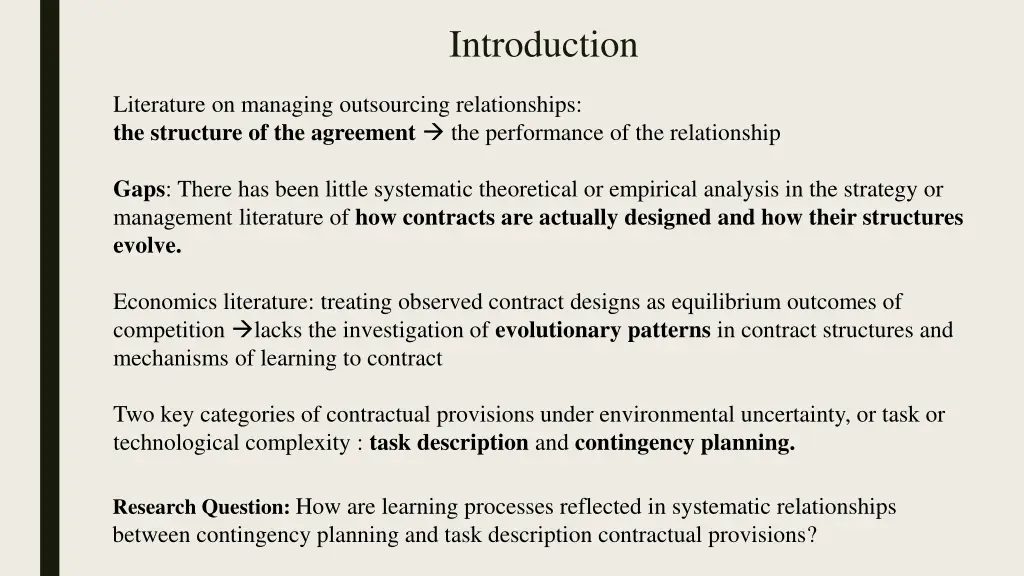
Introduction Literature on managing outsourcing relationships: the structure of the agreement the performance of the relationship Gaps: There has been little systematic theoretical or empirical analysis in the strategy or management literature of how contracts are actually designed and how their structures evolve. Economics literature: treating observed contract designs as equilibrium outcomes of competition lacks the investigation of evolutionary patterns in contract structures and mechanisms of learning to contract Two key categories of contractual provisions under environmental uncertainty, or task or technological complexity : task description and contingency planning. Research Question: How are learning processes reflected in systematic relationships between contingency planning and task description contractual provisions?
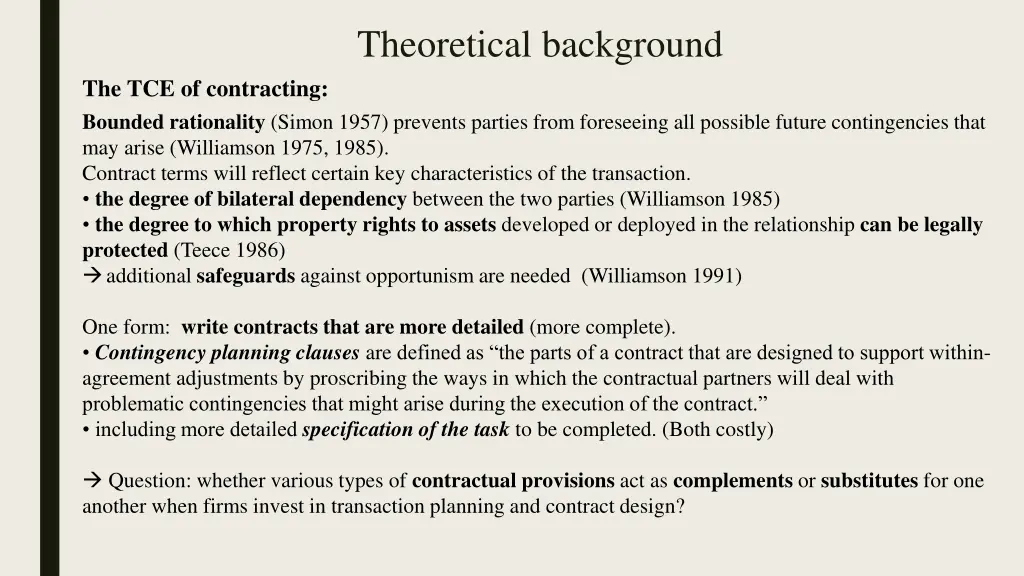
Theoretical background The TCE of contracting: Bounded rationality (Simon 1957) prevents parties from foreseeing all possible future contingencies that may arise (Williamson 1975, 1985). Contract terms will reflect certain key characteristics of the transaction. the degree of bilateral dependency between the two parties (Williamson 1985) the degree to which property rights to assets developed or deployed in the relationship can be legally protected (Teece 1986) additional safeguards against opportunism are needed (Williamson 1991) One form: write contracts that are more detailed (more complete). Contingency planning clauses are defined as the parts of a contract that are designed to support within- agreement adjustments by proscribing the ways in which the contractual partners will deal with problematic contingencies that might arise during the execution of the contract. including more detailed specification of the task to be completed. (Both costly) Question: whether various types of contractual provisions act as complements or substitutes for one another when firms invest in transaction planning and contract design?
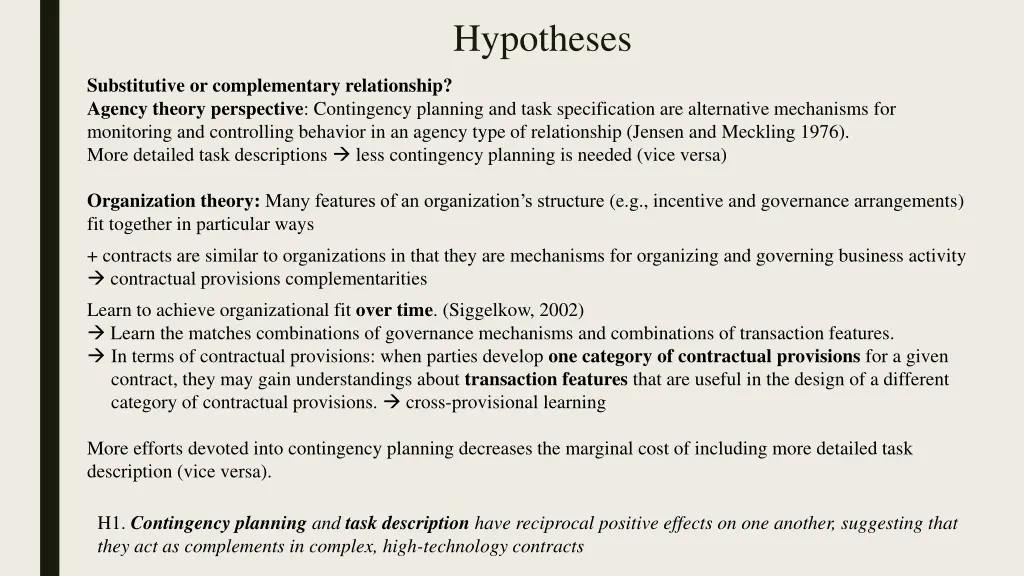
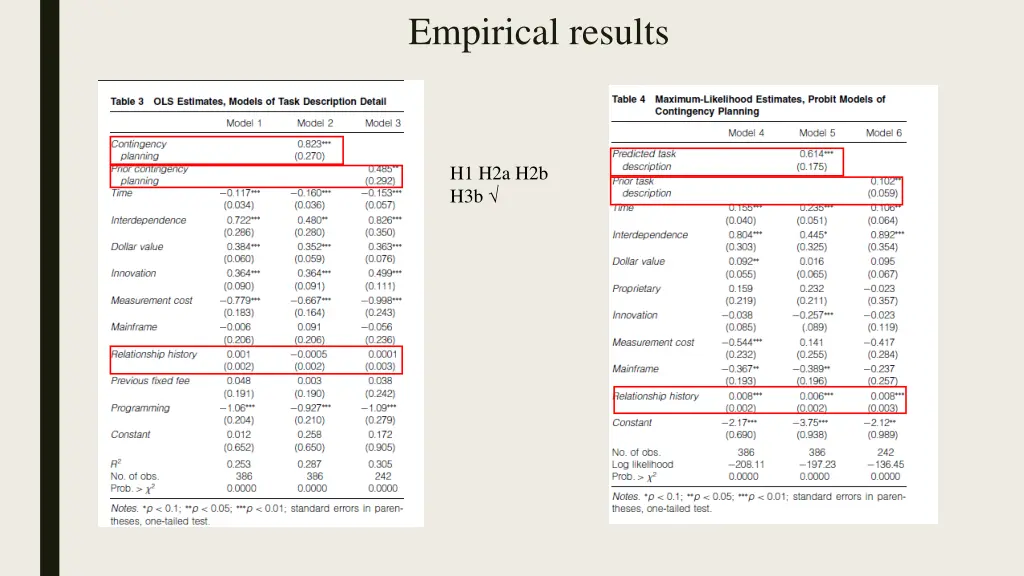
Hypotheses Substitutive or complementary relationship? Agency theory perspective: Contingency planning and task specification are alternative mechanisms for monitoring and controlling behavior in an agency type of relationship (Jensen and Meckling 1976). More detailed task descriptions less contingency planning is needed (vice versa) Organization theory: Many features of an organization s structure (e.g., incentive and governance arrangements) fit together in particular ways + contracts are similar to organizations in that they are mechanisms for organizing and governing business activity contractual provisions complementarities Learn to achieve organizational fit over time. (Siggelkow, 2002) Learn the matches combinations of governance mechanisms and combinations of transaction features. In terms of contractual provisions: when parties develop one category of contractual provisions for a given contract, they may gain understandings about transaction features that are useful in the design of a different category of contractual provisions. cross-provisional learning More efforts devoted into contingency planning decreases the marginal cost of including more detailed task description (vice versa). H1. Contingency planning and task description have reciprocal positive effects on one another, suggesting that they act as complements in complex, high-technology contracts
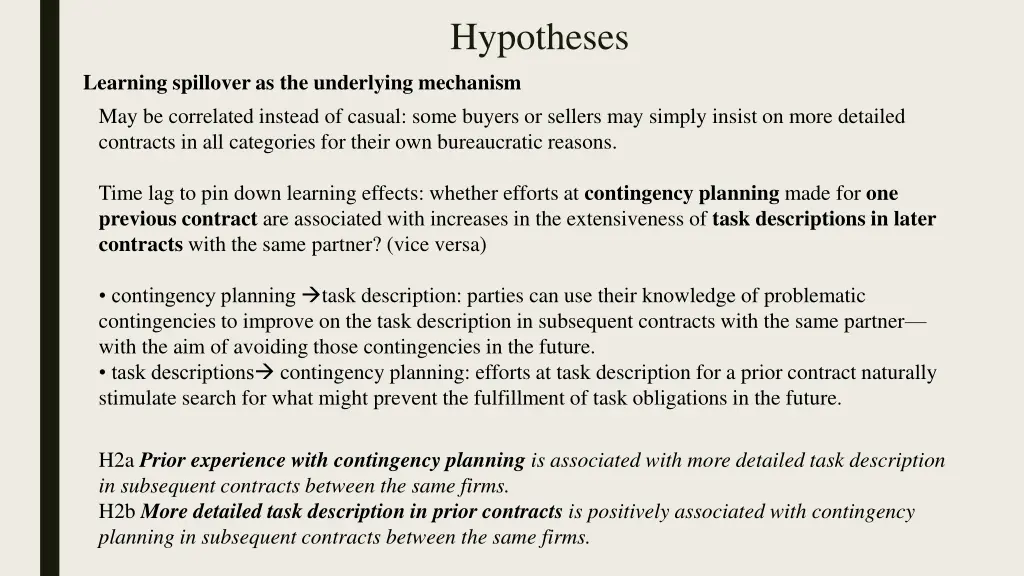
Hypotheses Learning spillover as the underlying mechanism May be correlated instead of casual: some buyers or sellers may simply insist on more detailed contracts in all categories for their own bureaucratic reasons. Time lag to pin down learning effects: whether efforts at contingency planning made for one previous contract are associated with increases in the extensiveness of task descriptions in later contracts with the same partner? (vice versa) contingency planning task description: parties can use their knowledge of problematic contingencies to improve on the task description in subsequent contracts with the same partner with the aim of avoiding those contingencies in the future. task descriptions contingency planning: efforts at task description for a prior contract naturally stimulate search for what might prevent the fulfillment of task obligations in the future. H2a Prior experience with contingency planning is associated with more detailed task description in subsequent contracts between the same firms. H2b More detailed task description in prior contracts is positively associated with contingency planning in subsequent contracts between the same firms.
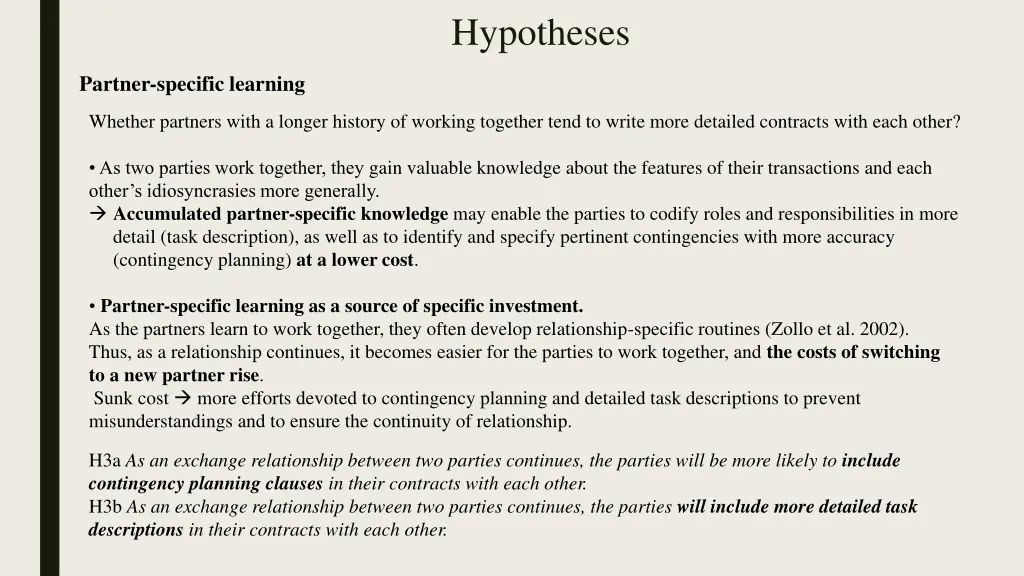
Hypotheses Partner-specific learning Whether partners with a longer history of working together tend to write more detailed contracts with each other? As two parties work together, they gain valuable knowledge about the features of their transactions and each other s idiosyncrasies more generally. Accumulated partner-specific knowledge may enable the parties to codify roles and responsibilities in more detail (task description), as well as to identify and specify pertinent contingencies with more accuracy (contingency planning) at a lower cost. Partner-specific learning as a source of specific investment. As the partners learn to work together, they often develop relationship-specific routines (Zollo et al. 2002). Thus, as a relationship continues, it becomes easier for the parties to work together, and the costs of switching to a new partner rise. Sunk cost more efforts devoted to contingency planning and detailed task descriptions to prevent misunderstandings and to ensure the continuity of relationship. H3a As an exchange relationship between two parties continues, the parties will be more likely to include contingency planning clauses in their contracts with each other. H3b As an exchange relationship between two parties continues, the parties will include more detailed task descriptions in their contracts with each other.
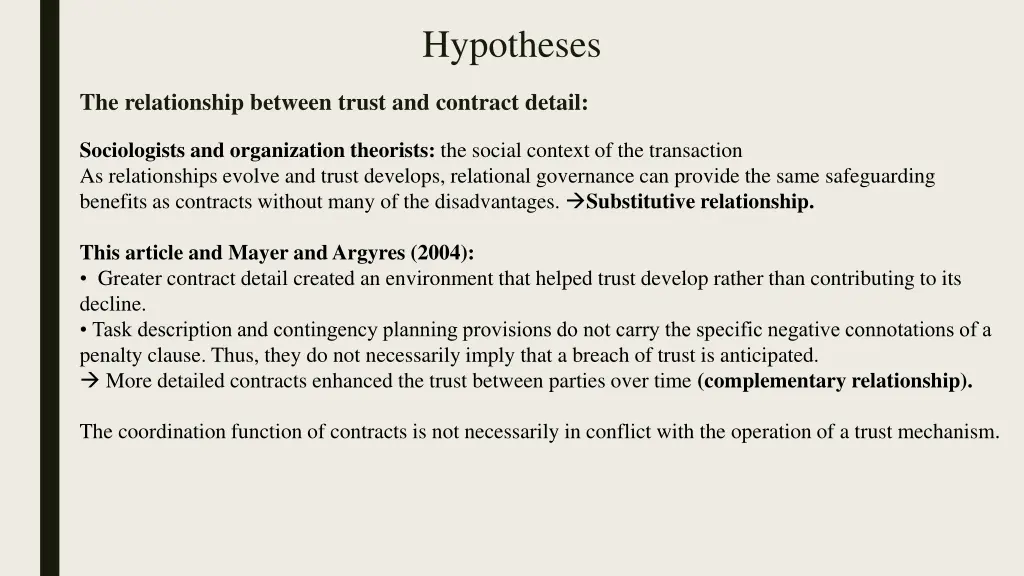
Hypotheses The relationship between trust and contract detail: Sociologists and organization theorists: the social context of the transaction As relationships evolve and trust develops, relational governance can provide the same safeguarding benefits as contracts without many of the disadvantages. Substitutive relationship. This article and Mayer and Argyres (2004): Greater contract detail created an environment that helped trust develop rather than contributing to its decline. Task description and contingency planning provisions do not carry the specific negative connotations of a penalty clause. Thus, they do not necessarily imply that a breach of trust is anticipated. More detailed contracts enhanced the trust between parties over time (complementary relationship). The coordination function of contracts is not necessarily in conflict with the operation of a trust mechanism.
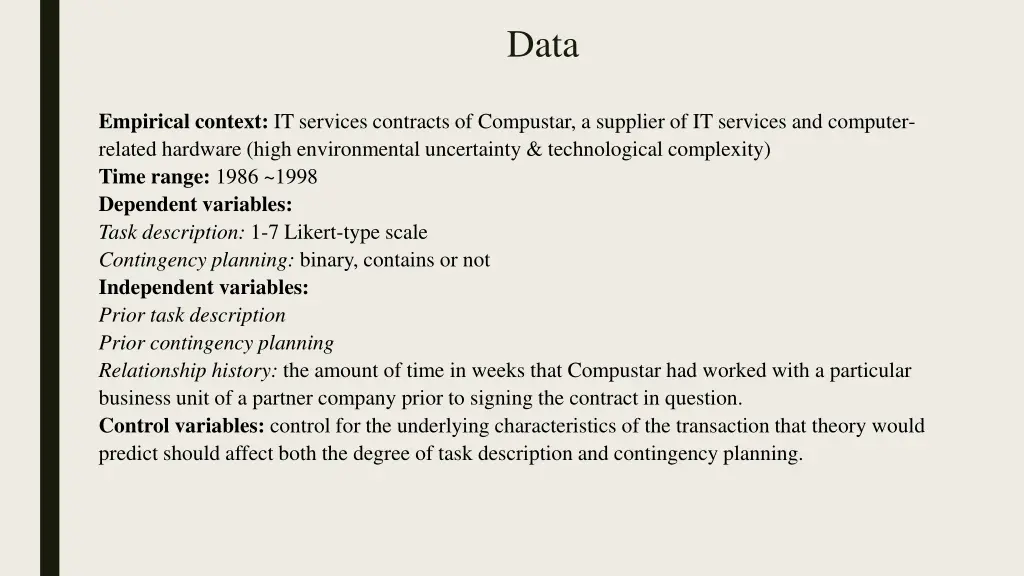
Data Empirical context: IT services contracts of Compustar, a supplier of IT services and computer- related hardware (high environmental uncertainty & technological complexity) Time range: 1986 ~1998 Dependent variables: Task description: 1-7 Likert-type scale Contingency planning: binary, contains or not Independent variables: Prior task description Prior contingency planning Relationship history: the amount of time in weeks that Compustar had worked with a particular business unit of a partner company prior to signing the contract in question. Control variables: control for the underlying characteristics of the transaction that theory would predict should affect both the degree of task description and contingency planning.
Empirical results H1 H2a H2b H3b
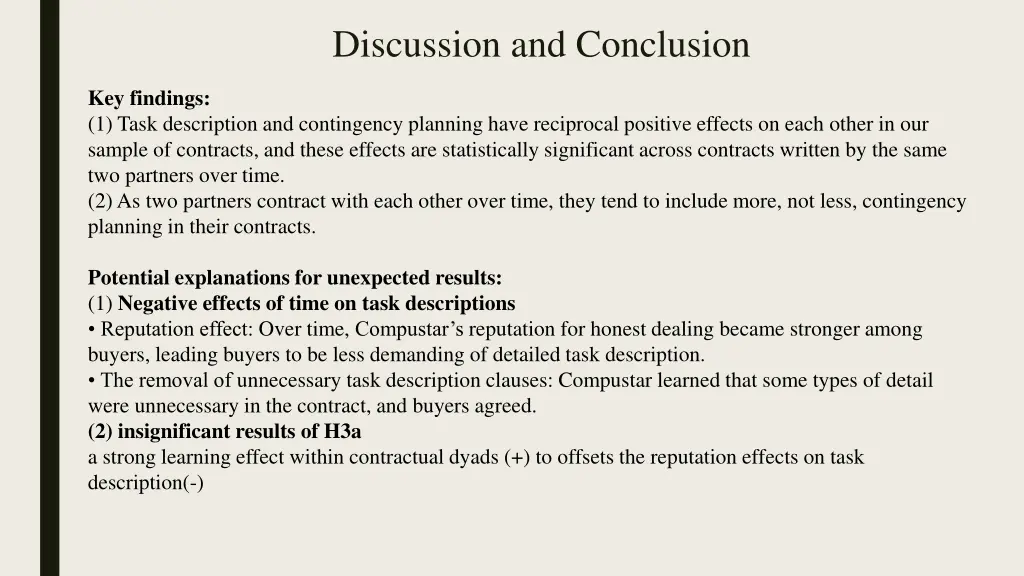
Discussion and Conclusion Key findings: (1) Task description and contingency planning have reciprocal positive effects on each other in our sample of contracts, and these effects are statistically significant across contracts written by the same two partners over time. (2) As two partners contract with each other over time, they tend to include more, not less, contingency planning in their contracts. Potential explanations for unexpected results: (1) Negative effects of time on task descriptions Reputation effect: Over time, Compustar s reputation for honest dealing became stronger among buyers, leading buyers to be less demanding of detailed task description. The removal of unnecessary task description clauses: Compustar learned that some types of detail were unnecessary in the contract, and buyers agreed. (2) insignificant results of H3a a strong learning effect within contractual dyads (+) to offsets the reputation effects on task description(-)
Questions Maybe there is cognitive side of the contractual design? In discussing the relationship between trust and contractual details, this article suggests that task description and contingency planning provisions do not carry the specific negative connotations of a penalty clause. In this way, they may create a better environment to yield trust. Thus, I wonder whether different types of contractual divisions can yield different cognitive perceptions to the parties, thus varying in their effect on trust development and relationship performance.

![❤[PDF]⚡ Space Exploration 2007 (Springer Praxis Books)](/thumb/21607/pdf-space-exploration-2007-springer-praxis-books.jpg)