Evolution of Elementary and Secondary Education Acts
The Elementary and Secondary Education Acts have evolved over time, starting from ESEA in 1965 providing aid for local schools to the latest ESSA in 2015, which emphasizes flexibility in testing and accountability. The Acts have gone through various amendments and changes, including the introduction of accountability measures, setting goals for student achievement levels, and shifting responsibilities between states and the federal government. Programs under ESSA aim to improve basic education, provide assessments, support migrant children, neglected or at-risk youth, and ensure equitable funding. The Acts reflect ongoing efforts to enhance educational opportunities and outcomes for students across the United States.

Uploaded on Apr 09, 2025 | 2 Views
Download Presentation

Please find below an Image/Link to download the presentation.
The content on the website is provided AS IS for your information and personal use only. It may not be sold, licensed, or shared on other websites without obtaining consent from the author.If you encounter any issues during the download, it is possible that the publisher has removed the file from their server.
You are allowed to download the files provided on this website for personal or commercial use, subject to the condition that they are used lawfully. All files are the property of their respective owners.
The content on the website is provided AS IS for your information and personal use only. It may not be sold, licensed, or shared on other websites without obtaining consent from the author.
E N D
Presentation Transcript
Elementary and Secondary Education Act Presenter: Paul Coleman District Accountability Advisory Committee Falcon D49 September 27, 2016 The Best Choice to Learn, Work and Lead
ESEA 1965: ESEA provides first substantial aid for local schools. Part of President Johnson s War on Poverty 1981: Education Consolidation and Improvement Act (ECIA) block grants many programs. Renames Title I as Chapter 1 . Part of President Reagan s budget cuts for education. The Best Choice to Learn, Work and Lead
ESEA (Cont.) 1988: Amendments to ECIA introduce accountability into Chapter 1 programs. 1994: President Clinton signs into law the Improving America s Schools Act (IASA) that broadens the accountability under Chapter 1 (now renamed Title I). The Best Choice to Learn, Work and Lead
ESEA (Cont.) 2002: No Child Left Behind Act (NCLB) signed into law by President George W. Bush. Establishes minimum qualifications for teachers and paraprofessionals and sets goal of all children achieving at state- defined proficient level by 2013-2014. The Best Choice to Learn, Work and Lead
ESEA (Cont.) 2011: President Barack Obama uses statutory waiver authority to eliminate much of the NCLB school improvement apparatus in exchange for states adopting college- and career-ready standards , focusing more resources on the lowest-performing schools, and implementing a teacher and principal evaluation system employing student achievement growth. The Best Choice to Learn, Work and Lead
ESEA (Cont.) 2015: President Barack Obama signs the Every Student Succeeds Act (ESSA) into law. This creates a more flexible approach to student testing and school accountability once again making states responsible for fixing under-performing schools. ESSA also limits the US Department of Ed. s oversight role. The Best Choice to Learn, Work and Lead
Programs Under ESSA Title I Part A: Improving Basic Programs Operated by State and Local Educational Agencies Part B: State Assessment Grants Part C: Education of Migratory Children Part D: Children and Youth Who Are Neglected, Delinquent, or at-risk. Part E: Flexibility for Equitable Per-Pupil Funding The Best Choice to Learn, Work and Lead
Programs Under ESSA Title II: Preparing, Training, and Recruiting High-Quality Teacher, Principals, or Other School Leaders Title III: Language Instruction for English Learners and Immigrant Students The Best Choice to Learn, Work and Lead
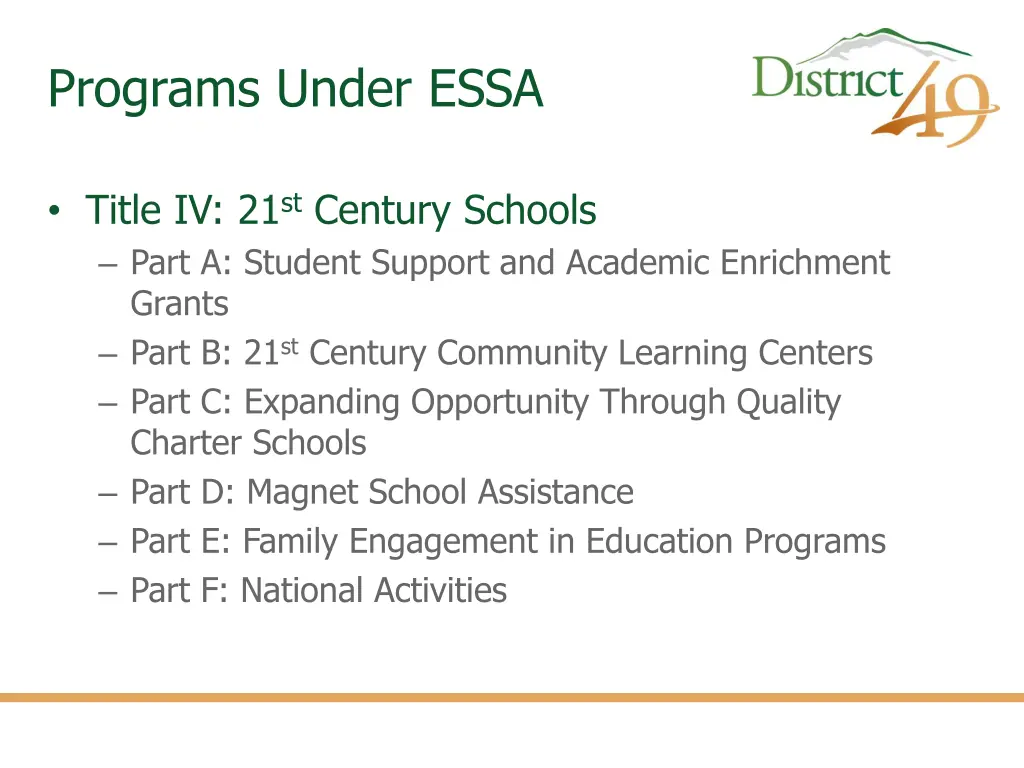
Programs Under ESSA Title IV: 21stCentury Schools Part A: Student Support and Academic Enrichment Grants Part B: 21stCentury Community Learning Centers Part C: Expanding Opportunity Through Quality Charter Schools Part D: Magnet School Assistance Part E: Family Engagement in Education Programs Part F: National Activities The Best Choice to Learn, Work and Lead
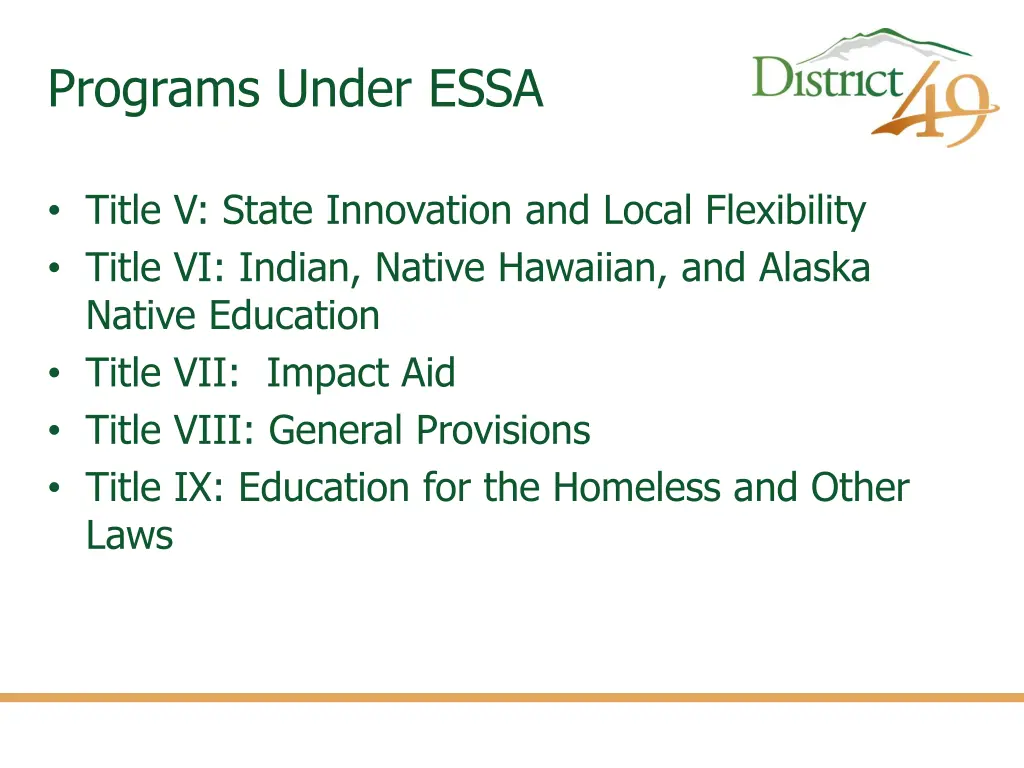
Programs Under ESSA Title V: State Innovation and Local Flexibility Title VI: Indian, Native Hawaiian, and Alaska Native Education Title VII: Impact Aid Title VIII: General Provisions Title IX: Education for the Homeless and Other Laws The Best Choice to Learn, Work and Lead
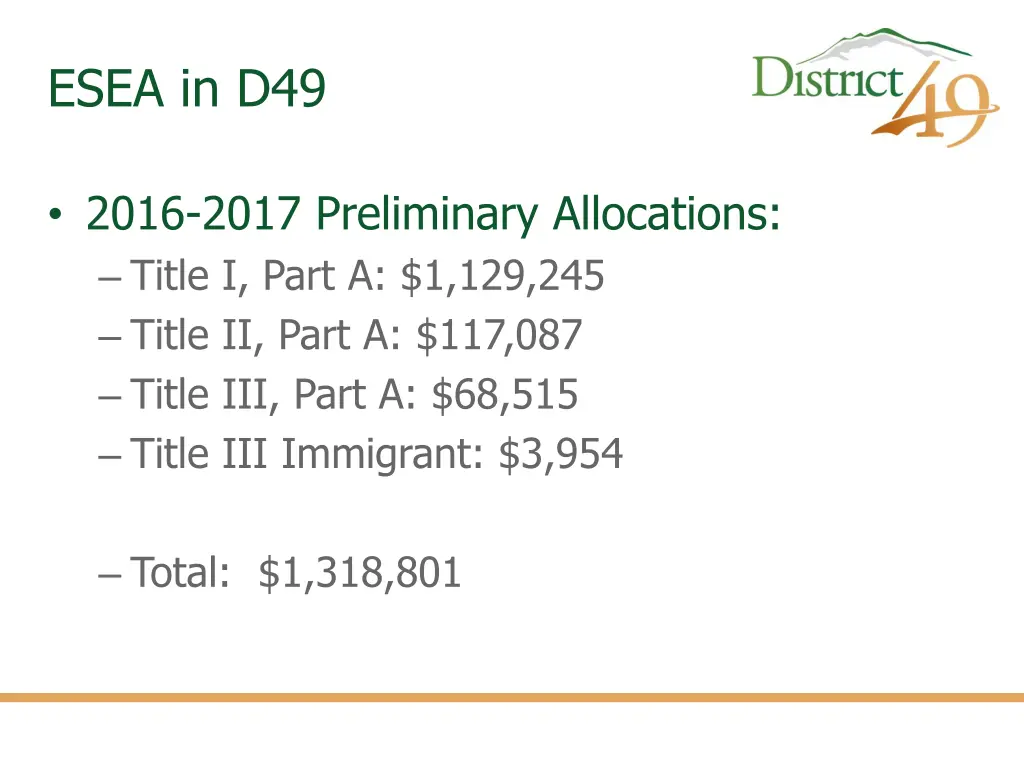
ESEA in D49 2016-2017 Preliminary Allocations: Title I, Part A: $1,129,245 Title II, Part A: $117,087 Title III, Part A: $68,515 Title III Immigrant: $3,954 Total: $1,318,801 The Best Choice to Learn, Work and Lead
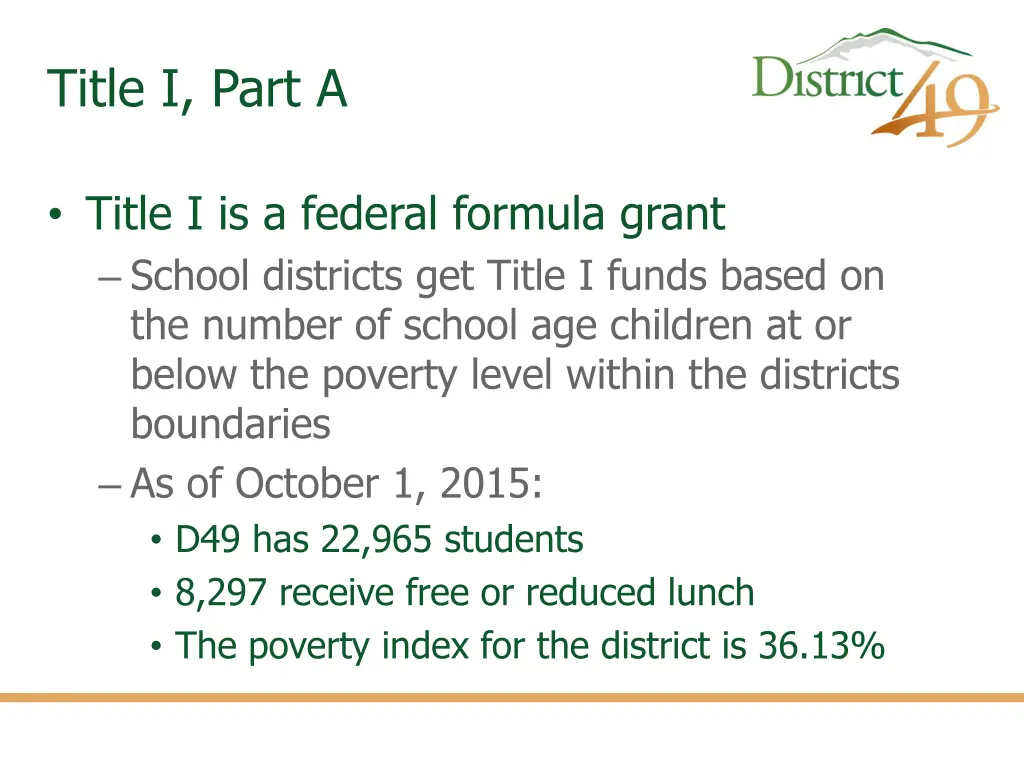
Title I, Part A Title I is a federal formula grant School districts get Title I funds based on the number of school age children at or below the poverty level within the districts boundaries As of October 1, 2015: D49 has 22,965 students 8,297 receive free or reduced lunch The poverty index for the district is 36.13% The Best Choice to Learn, Work and Lead
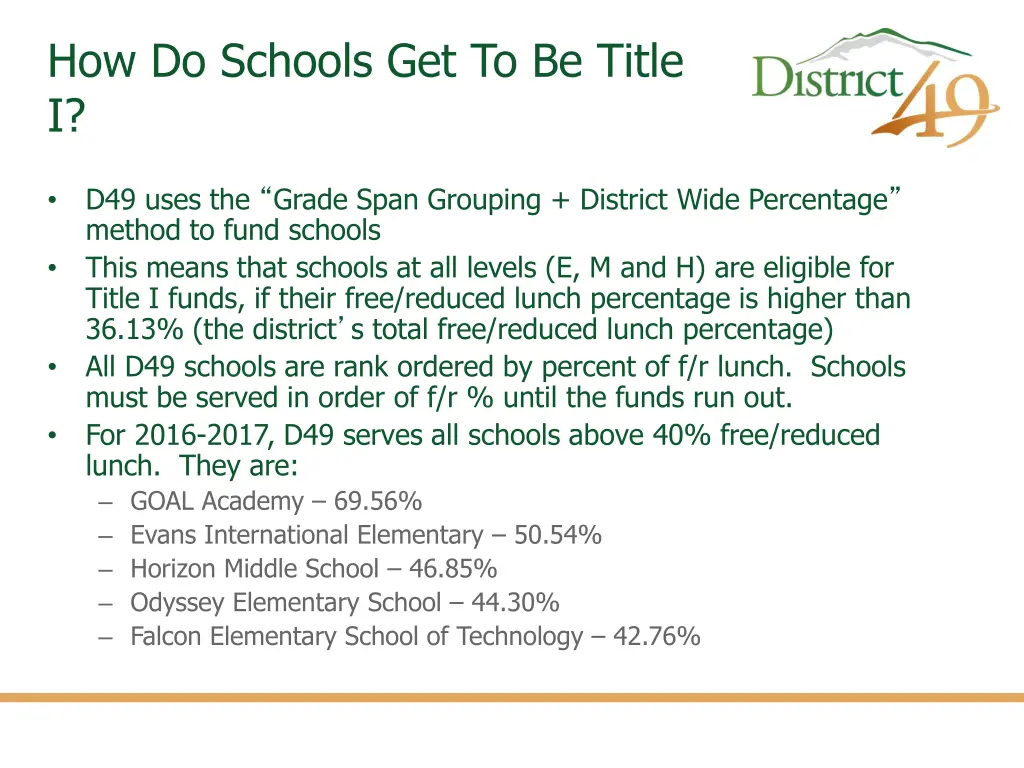
How Do Schools Get To Be Title I? D49 uses the Grade Span Grouping + District Wide Percentage method to fund schools This means that schools at all levels (E, M and H) are eligible for Title I funds, if their free/reduced lunch percentage is higher than 36.13% (the district s total free/reduced lunch percentage) All D49 schools are rank ordered by percent of f/r lunch. Schools must be served in order of f/r % until the funds run out. For 2016-2017, D49 serves all schools above 40% free/reduced lunch. They are: GOAL Academy 69.56% Evans International Elementary 50.54% Horizon Middle School 46.85% Odyssey Elementary School 44.30% Falcon Elementary School of Technology 42.76% The Best Choice to Learn, Work and Lead
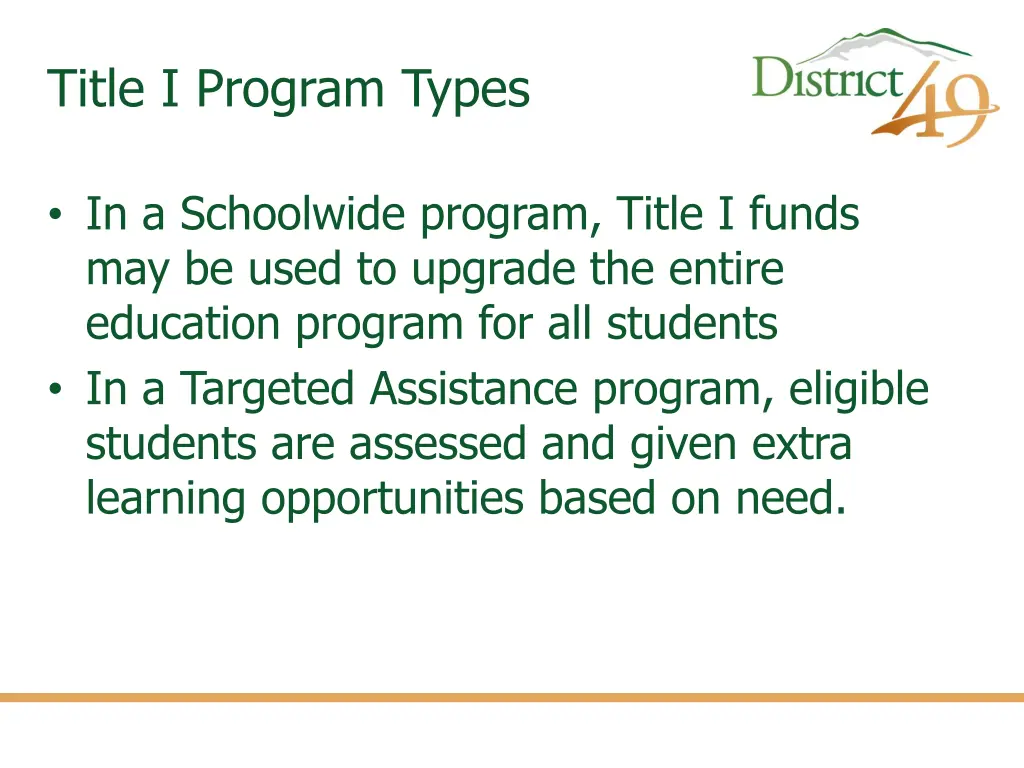
Title I Program Types In a Schoolwide program, Title I funds may be used to upgrade the entire education program for all students In a Targeted Assistance program, eligible students are assessed and given extra learning opportunities based on need. The Best Choice to Learn, Work and Lead
Uses of Funds School Level Over 90% of Title I funds are directed to support students and families Must supplement, not supplant state and local funds To increase reading and math achievement Hiring additional teachers, instructional coaches and paraprofessionals Paying for tutoring for students who need extra support Supplemental materials and supplies for above Staff development opportunities for teachers and principals The Best Choice to Learn, Work and Lead
Uses of Funds School Level Promote parent and family engagement in schools 1% of allocation must be used for family engagement activities The Best Choice to Learn, Work and Lead
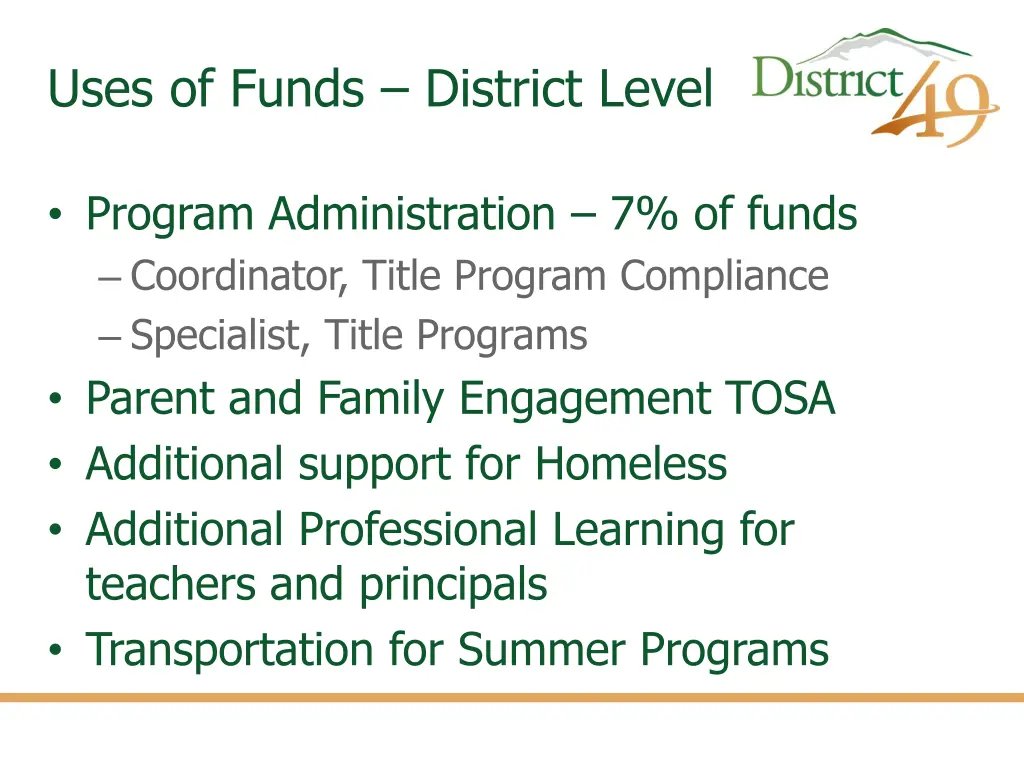
Uses of Funds District Level Program Administration 7% of funds Coordinator, Title Program Compliance Specialist, Title Programs Parent and Family Engagement TOSA Additional support for Homeless Additional Professional Learning for teachers and principals Transportation for Summer Programs The Best Choice to Learn, Work and Lead
Opportunities for Parent Involvement Title I School-Parent Compacts Title I Parent Involvement Policy PTA/PTSA/PTO School Accountability Committee Parent/Teacher Conferences Family activity nights The Best Choice to Learn, Work and Lead
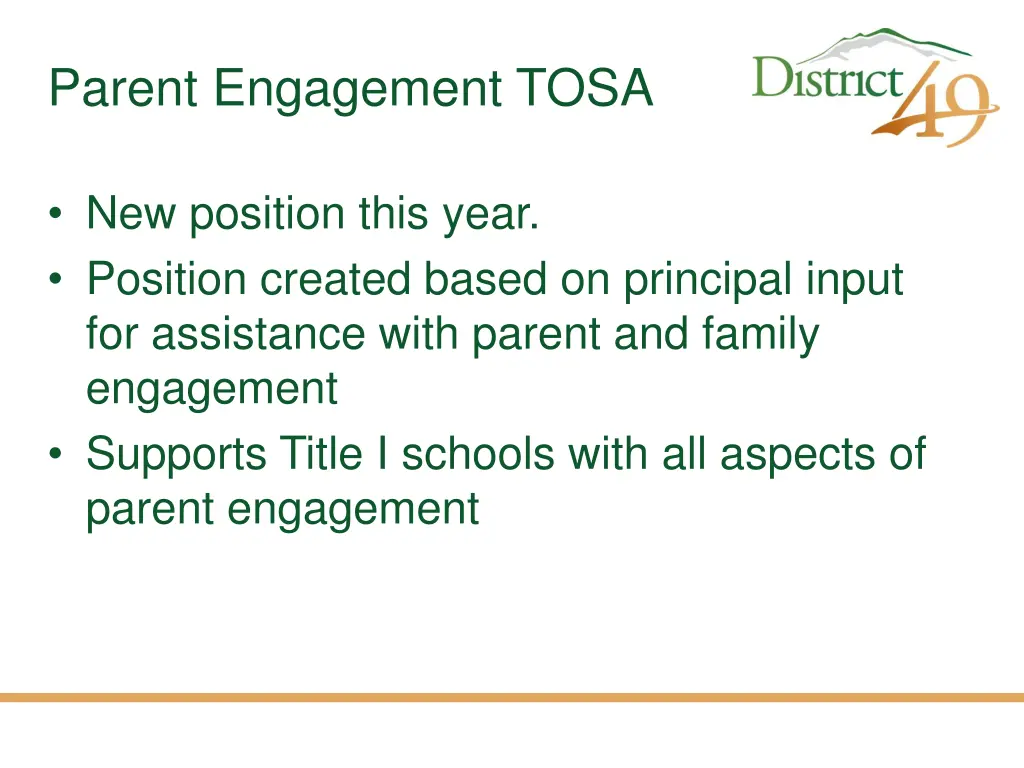
Parent Engagement TOSA New position this year. Position created based on principal input for assistance with parent and family engagement Supports Title I schools with all aspects of parent engagement The Best Choice to Learn, Work and Lead
Parent Engagement TOSA Acts a liaison between Title I schools and families Provides assistance to Title I principals in planning and facilitating Title I parent engagement events Provides support to families needing assistance, particularly homeless families The Best Choice to Learn, Work and Lead
Title II, Part A The purpose of Title II Part A of the ESEA is to increase student achievement by improving teacher and principal quality. This includes: increasing the number of Highly effective teachers in classrooms, improving skills of principals and assistant principals in schools, and increasing the effectiveness of teachers and principals. The Best Choice to Learn, Work and Lead
Title II Requirements Each district must develop a professional development plan that addresses the needs of teachers and principals Must ensure that poor and minority children are not taught at higher rates than other children by inexperienced, unqualified, or out-of-field teachers The Best Choice to Learn, Work and Lead
District Uses of Funds Provide professional learning activities for teachers and principals. Instructional coach training Instructional Leadership New Teacher Support Instructional Technology Provide funds for the recruitment of hard to fill positions The Best Choice to Learn, Work and Lead
Title III, Part A The Purpose of Title III is to help ensure that children who are limited English proficient, including immigrant children and youth, attain English proficiency, develop high levels of academic attainment in English, and meet the same challenging State academic content and student academic achievement standards as all children are expected to meet. The Best Choice to Learn, Work and Lead
District Use of Funds Adult ESL classes Interpreting/Translation Services Supplemental materials for classrooms Assessments for English Language Proficiency Professional Learning Activities for ELD teachers Love and Logic Training for parents of ELLs. Technology The Best Choice to Learn, Work and Lead
Title III Immigrant Set Aside Designed to support school districts that have experienced a significant increase in immigrant students over the past two years. The Best Choice to Learn, Work and Lead
Requirements Districts must submit a plan describing how they will serve immigrant children and youth. Immigrant children are: Age 3 through 21 Were not born in the U.S., and Have not attended U.S. schools for more than three full academic years. The Best Choice to Learn, Work and Lead
District Use of Funds Tutoring services for identified immigrant students The Best Choice to Learn, Work and Lead
Questions? Please send any feedback to Paul Coleman at pcoleman@d49.org The Best Choice to Learn, Work and Lead