Explore the pivotal moments in life insurance regulation history, from the enactment of TEFRA in 1982 to the introduction of AG49 in 2015, shaping the industry's landscape and ensuring consumer protection.
Please find below an Image/Link to download the presentation.
The content on the website is provided AS IS for your information and personal use only. It may not be sold, licensed, or shared on other websites without obtaining consent from the author. If you encounter any issues during the download, it is possible that the publisher has removed the file from their server.
You are allowed to download the files provided on this website for personal or commercial use, subject to the condition that they are used lawfully. All files are the property of their respective owners.
The content on the website is provided AS IS for your information and personal use only. It may not be sold, licensed, or shared on other websites without obtaining consent from the author.
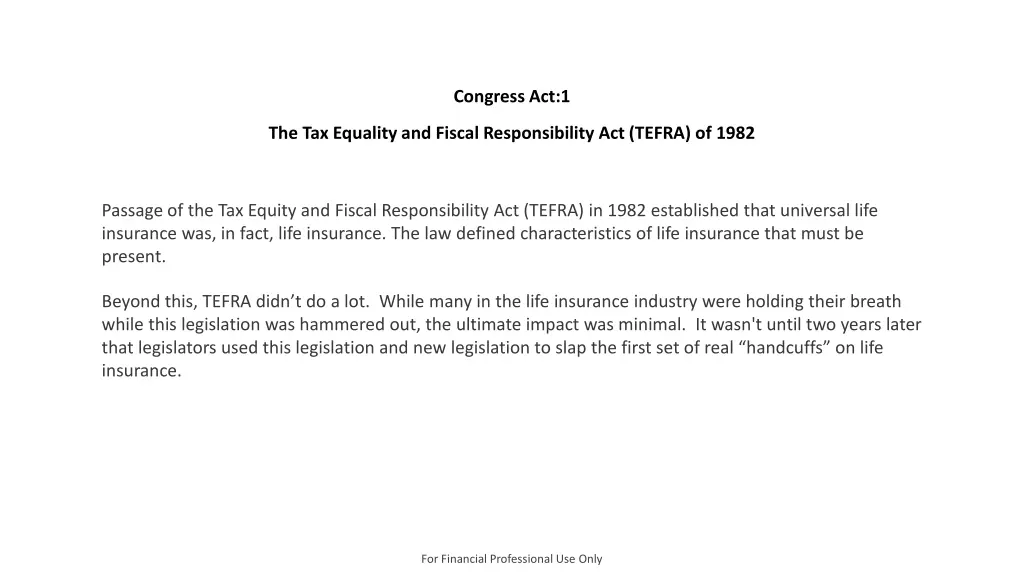
Congress Act:1 The Tax Equality and Fiscal Responsibility Act (TEFRA) of 1982 Passage of the Tax Equity and Fiscal Responsibility Act (TEFRA) in 1982 established that universal life insurance was, in fact, life insurance. The law defined characteristics of life insurance that must be present. Beyond this, TEFRA didn t do a lot. While many in the life insurance industry were holding their breath while this legislation was hammered out, the ultimate impact was minimal. It wasn't until two years later that legislators used this legislation and new legislation to slap the first set of real handcuffs on life insurance. For Financial Professional Use Only
Congress Act:2 The Deficit Reduction Act (DEFRA) of 1984 The Deficit Reduction Act (DEFRA) of 1984 coordinated with language laid out in TEFRA from two years before to establish specific rules about what life insurance was and what life insurance was not. More specifically, upon DEFRA's passage, we now had specific limitations on premium size relative to an outstanding death benefit. That Premium to Death Benefit ratio was now the deciding factor as to what qualified or disqualified a life insurance contract as life insurance. DEFRA included the creation of two tests that would be the guideline moving forward for life insurance qualification & created the inception of the 7702 tax code. The Cash Value Accumulation Test (CVAT) Guideline Premium Test (GPT) For Financial Professional Use Only
2015 Introduction of AG49 by the NAIC Prior to 2015: -Life insurance illustrations could be presented in the same manner as annuities, using a cherry picked sequence of returns. -Using these cherry picked sequence of returns combined with a low loan rate(in a low interest environment), allowed the carriers to show very large arbitrage numbers. -Deceptive illustrations. Using returns from a timeframe when interest rates were high (meaning higher caps and pars), and putting them against loans from a more current, lower interest rate environment. For Financial Professional Use Only
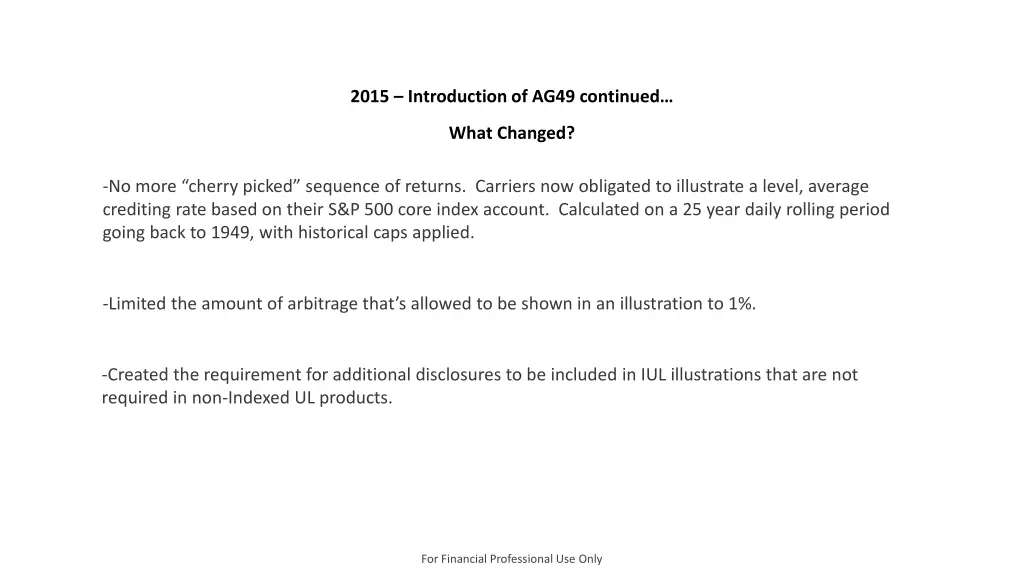
2015 Introduction of AG49 continued What Changed? -No more cherry picked sequence of returns. Carriers now obligated to illustrate a level, average crediting rate based on their S&P 500 core index account. Calculated on a 25 year daily rolling period going back to 1949, with historical caps applied. -Limited the amount of arbitrage that s allowed to be shown in an illustration to 1%. -Created the requirement for additional disclosures to be included in IUL illustrations that are not required in non-Indexed UL products. For Financial Professional Use Only
The Illustration Game Begins In response to the new AG49 regulations, carriers created index accounts with multipliers . The multipliers were percentage-based bonuses to index crediting. By using these multipliers, the carrier could then add the additional crediting from the multiplier into the life insurance illustration. The additional crediting from the multiplier was being used to prop up the arbitrage numbers to the max 1% that could be shown. The multipliers were NOT guaranteed elements of the life insurance contract. For Financial Professional Use Only
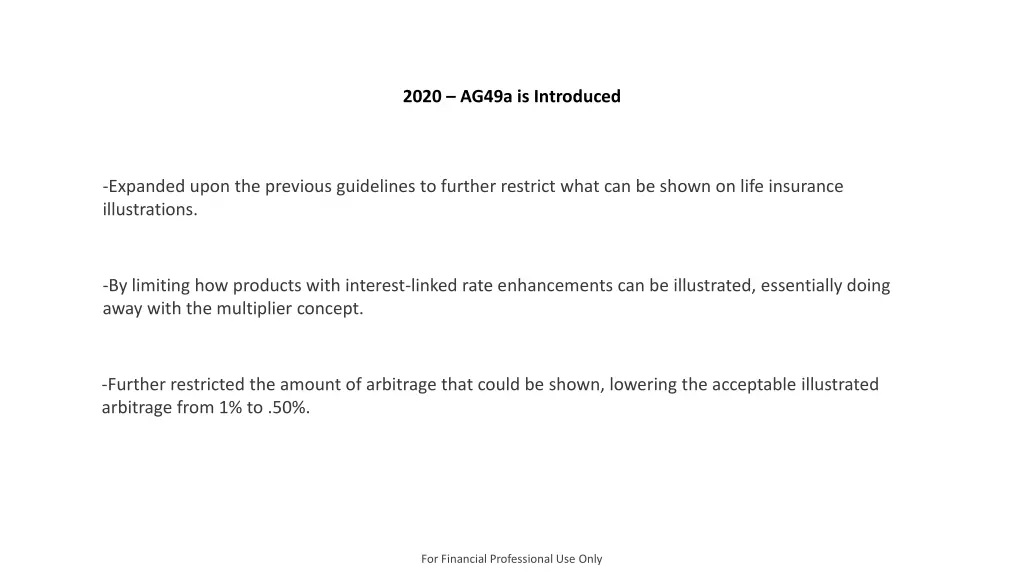
2020 AG49a is Introduced -Expanded upon the previous guidelines to further restrict what can be shown on life insurance illustrations. -By limiting how products with interest-linked rate enhancements can be illustrated, essentially doing away with the multiplier concept. -Further restricted the amount of arbitrage that could be shown, lowering the acceptable illustrated arbitrage from 1% to .50%. For Financial Professional Use Only
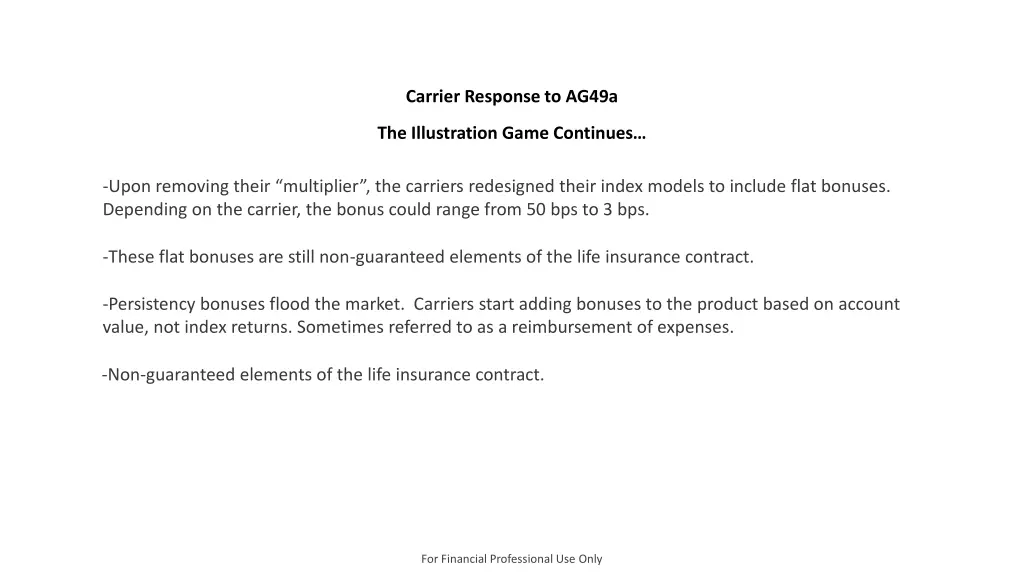
Carrier Response to AG49a The Illustration Game Continues -Upon removing their multiplier , the carriers redesigned their index models to include flat bonuses. Depending on the carrier, the bonus could range from 50 bps to 3 bps. -These flat bonuses are still non-guaranteed elements of the life insurance contract. -Persistency bonuses flood the market. Carriers start adding bonuses to the product based on account value, not index returns. Sometimes referred to as a reimbursement of expenses. -Non-guaranteed elements of the life insurance contract. For Financial Professional Use Only
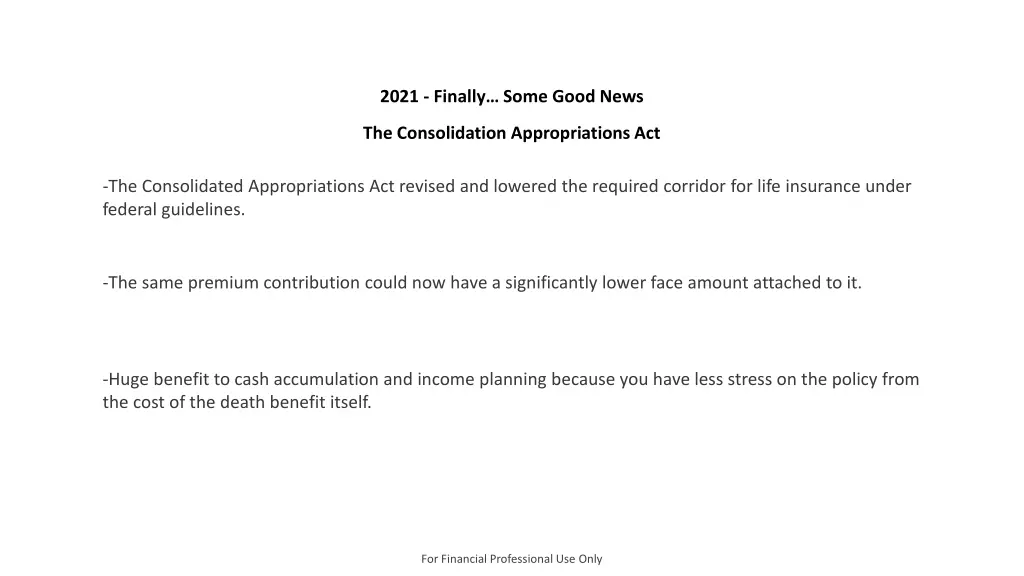
2021 - Finally Some Good News The Consolidation Appropriations Act -The Consolidated Appropriations Act revised and lowered the required corridor for life insurance under federal guidelines. -The same premium contribution could now have a significantly lower face amount attached to it. -Huge benefit to cash accumulation and income planning because you have less stress on the policy from the cost of the death benefit itself. For Financial Professional Use Only
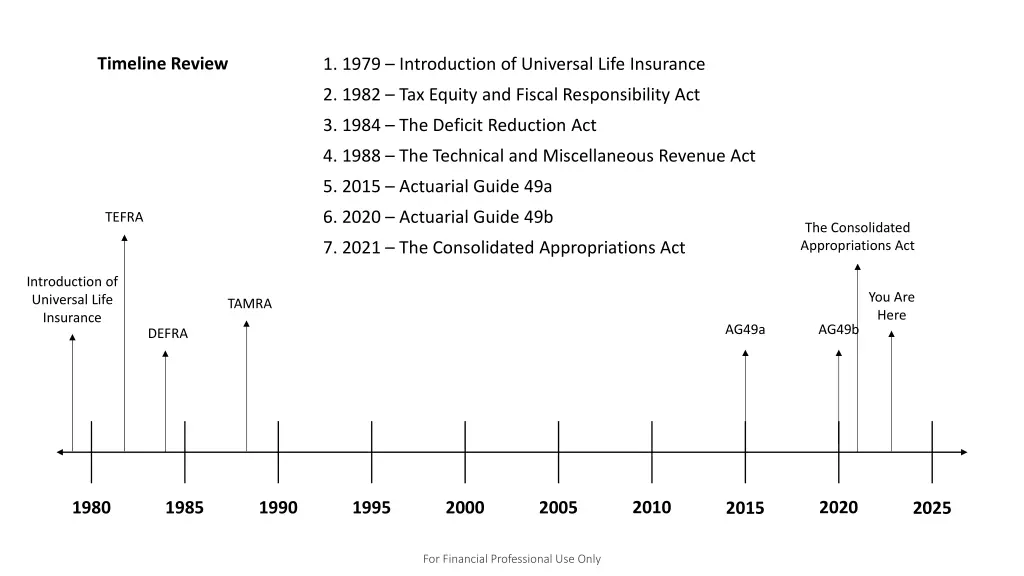
Timeline Review 1. 1979 Introduction of Universal Life Insurance 2. 1982 Tax Equity and Fiscal Responsibility Act 3. 1984 The Deficit Reduction Act 4. 1988 The Technical and Miscellaneous Revenue Act 5. 2015 Actuarial Guide 49a 6. 2020 Actuarial Guide 49b TEFRA The Consolidated Appropriations Act 7. 2021 The Consolidated Appropriations Act Introduction of Universal Life Insurance You Are Here TAMRA AG49a AG49b DEFRA 2010 2020 1980 1985 1990 1995 2000 2005 2015 2025 For Financial Professional Use Only
Life Insurance Regulation is Constantly Changing Stay Informed! Either take the time to follow regulatory changes, or make sure you have the right FMO behind you! Be Malleable & Innovative! Based on regulatory changes, the way you design a life insurance policy tomorrow may be different than the way you design a life insurance policy today! The Bright Side? Life Insurance regulations are grandfathered into a policy when it is issued. Meaning that new regulations DO NOT have an effect on policies previously sold. Whatever the regulations were at the time of sale will govern for the life of the policy. So, while the rules may change again moving forward, you can feel free to sell with confidence now! For Financial Professional Use Only