Evolution of Livestock-Based Livelihoods & Intensive Farming Practices
Explore the evolution of livestock-based livelihoods and the intensification of farming practices, emphasizing the benefits and environmental concerns associated with intensive farming. Learn about high crop yields, affordable food prices, and sustainable food supply achieved through intensive farming techniques.

Download Presentation

Please find below an Image/Link to download the presentation.
The content on the website is provided AS IS for your information and personal use only. It may not be sold, licensed, or shared on other websites without obtaining consent from the author. If you encounter any issues during the download, it is possible that the publisher has removed the file from their server.
You are allowed to download the files provided on this website for personal or commercial use, subject to the condition that they are used lawfully. All files are the property of their respective owners.
The content on the website is provided AS IS for your information and personal use only. It may not be sold, licensed, or shared on other websites without obtaining consent from the author.
E N D
Presentation Transcript
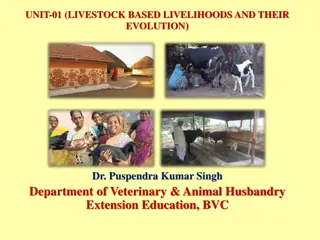
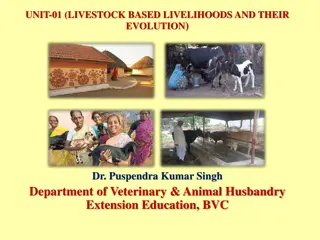
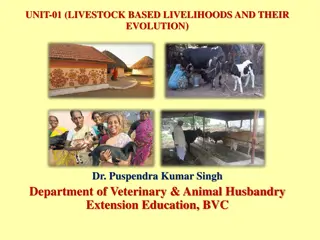
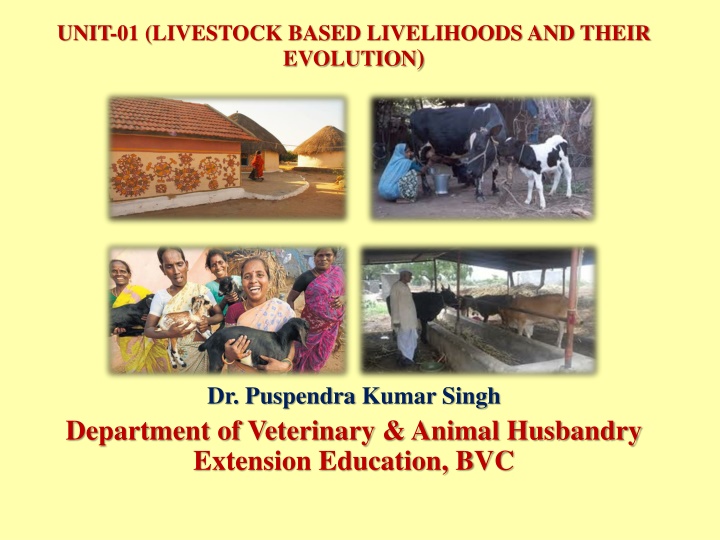
UNIT-01 (LIVESTOCK BASED LIVELIHOODS AND THEIR EVOLUTION) Dr. Puspendra Kumar Singh Department of Veterinary & Animal Husbandry Extension Education, BVC
Intensive farming or intensive agriculture involves higher levels of input and output per unit of agricultural land area. It is characterised by a low fallow ratio, higher use of inputs such as capital and labour, and higher crop yields per unit land area.
Intensive Farming Intensive farming (also intensive agriculture) is the practice where a lot of labor and capital is employed to maximize agricultural produce or yields. It is characterized with the intensive use of pesticides, fertilizer and other production inputs for crops and medication as well as concentrated feeding for the animal stock. The practice concentrates more on getting the most output per area by using high input strategies.
It means the amount of inputs and work required for production goes up and this has witnessed the use of chemical fertilizers, pesticides, mechanical ploughing, plant and animal growth hormones, medications (antibiotics and vaccines) for animals, and plant growth regulators. Intensive farming has helped improve agricultural production. On the contrary, it has also lead to increased pollution and several other environmental concerns.
High crop yield: One of the main rewards of intensive farming is the production of high crop yields. It means more variety of food can be produced: it leads to more variety of food for human consumption. It is more efficient: Because intensive farmers utilize less farm inputs and less land per unit of the foodstuff yielded, it is more efficient.
Affordable food prices: Intensive farming requires less space and produces more than the invested inputs. The common people can hence afford to enjoy a nutritious and balanced diet. Helps in ensuring regulated farming: The agencies and agricultural research institutes have set certain rules and regulations on the use of farm inputs such as fertilizers, pesticides, growth hormones, herbicides, and have even stated clear measures on how to maintain and manage livestock. Sustainable supply of food: Intensive farming offers the advantage of high crop productivity with the possibility of meeting the food market demands. Besides, it requires less amount of land which means that it significantly contributes to economies of scale in meeting the ever-escalating demand for food supplies.
Poor living conditions and hygiene for livestock: Intensive farming is highly criticized and thought to be cruel to the animals. Because it involves the use of various chemicals, growth hormones and excess crowding on a small space, the outcome is usually poor living conditions and hygiene for the livestock. Keeping livestock above their capacity is associated with pollution and poor hygiene which results in infections and various diseases. Excessive use of agro-chemicals: When these chemicals are used they not only destroy their intended targets such as pests, weeds and parasites but also contaminate the food products. The insecticides and pesticides also kill beneficial insects which contribute to biodiversity loss.
Deforestation and alteration of the natural environment: The removal of trees, slush and burn techniques, and the clearing of forest areas to create room for agriculture has led to massive deforestation and soil erosion beside this habitat loss and eutrophication are of concern. Risks on human health: The vegetables and fruits sourced from areas that practice intensive farming and full of invisible pesticides. Possibility of poor quality food products: Since intensive farming primarily on mass production of nice looking food products, the production strategies overlook the need for quality and nutritious food products.