Evolution of Pacific HIES Methodology
The Pacific HIES method has evolved over the years, transitioning from diverse methodologies to standardized approaches. Before 2011, countries utilized varied structures and collection levels for their HIES, but post-2011, a standardized questionnaire was endorsed, leading to improved consistency and comparability across Pacific Island Countries. The standardization efforts included the establishment of a uniform questionnaire structure, classification systems for income and expenditure, and field operation plans. These developments aimed to enhance the quality and effectiveness of Household Income and Expenditure Surveys in the Pacific region.

Uploaded on Apr 29, 2025 | 2 Views
Download Presentation

Please find below an Image/Link to download the presentation.
The content on the website is provided AS IS for your information and personal use only. It may not be sold, licensed, or shared on other websites without obtaining consent from the author.If you encounter any issues during the download, it is possible that the publisher has removed the file from their server.
You are allowed to download the files provided on this website for personal or commercial use, subject to the condition that they are used lawfully. All files are the property of their respective owners.
The content on the website is provided AS IS for your information and personal use only. It may not be sold, licensed, or shared on other websites without obtaining consent from the author.
E N D
Presentation Transcript
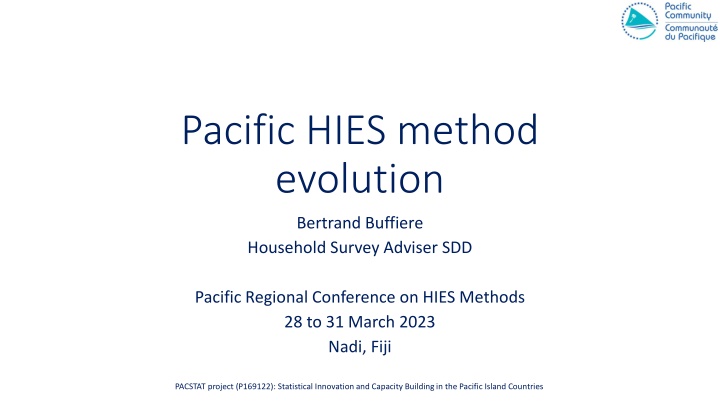
Pacific HIES method evolution Bertrand Buffiere Household Survey Adviser SDD Pacific Regional Conference on HIES Methods 28 to 31 March 2023 Nadi, Fiji PACSTAT project (P169122): Statistical Innovation and Capacity Building in the Pacific Island Countries
Contents Before 2011: countries used their own HIES methodology (eg Kiribati 2006, Tonga, Tuvalu 2010 ) 2011: HIES Pacific Technical Working Group decided to standardised (Vanuatu Hybrid survey 2011, Solomon Isl 2012, Nauru 2012, Samoa 2013, FSM 2013, Palau 2014, Niue 2015, Cook Isl 2015, Tonga 2016, Tuvalu 2016, Tokelau 2016) 2018: Pacific Statistics Method Board endorsed the new HIES questionnaire following the outcomes of the RMI HIES experiment (RMI 2019, Kiribati 2019, Tonga 2020, Vanuatu 2020, Samoa 2023, Tuvalu 2022, palau 2023)
Before 2011 Each country conducted HIES using different materials HIES questionnaire Different structure (level of collection: individual and household) Eg, mobile phone related expenses collected at the household level or individual level Length of recall period (1 to 12 months) Eg agriculture section from 3 to 6 months Different sections: some countries did not include any clothing section as those items were collected from the diary
Before 2011 But they were all using a 2 weeks diary HIES diary All collected daily expenditure and home production Gift were collected given away or received or both HIES classifications Different classifications of income & expenditure used
Before 2011 Different field operation plan HIES schedule Field work spread over 1 to 3 months (no seasonality) Or field work divided in 4 quarters with 1 round per quarter HIES questionnaire entered in the office by a data entry team HIES report Income & expenditure aggregates were presented using different format and definitions
2011 - Standardisation HIES materials Standard questionnaire structure: 4 modules Reference period (recall) Diary: all acquisition (items purchased, home produced and received as a gift) Standard classification or income and expenditure PACCOI: Pacific Classification of Income PACCOICOP: Pacific Classification of Individual Consumption by purposes
2011 - Standardisation HIES Field Plan 12 months of data collection Data entered as close as possible to the field (during round) Interactive keying HIES Definitions & concepts Household Expenditure (consumption, non consumption, hh investment)
2011 - Standardisation HIES diary vs recall Due to issues in the diary (under reporting) some items were collected through 7 days recall questionnaire New sections on communication expenditure (cell phone top up) and alcohol, tobacco, kava, bettle nuts expenditure last 7 days
2011 - Standardisation HIES diary vs recall Comparison of HIES aggregates by source (7 days recall vs diary) Solomon Is (SBD) 169,736,280 61,185,570 Tokelau (NZD) Tonga (TOP) Tuvalu (AUD) Recall Diary Diff (%) 339,980 209,030 -39% 7,939,160 2,244,940 -72% 640,710 158,770 -75% Alcohol -64% Recall Diary Diff (%) 160,267,180 56,284,180 245,480 164,590 -33% 3,609,860 1,154,590 -68% 341,890 93,460 -73% Beer -65% Recall Diary Diff (%) 265,488,310 188,778,140 492,370 511,740 16,682,900 9,543,900 844,990 428,310 -49% Tobacco -29% 4% -43%
2011 - Standardisation HIES diary vs recall Comparison of HIES aggregates by source (7 days recall vs diary) Source Country Solomon Is Tonga Tuvalu Nauru FSM Palau Currency SBD TOP AUD AUD USD USD 7 days recall 181,950,940 18,023,650 Diary 95,721,260 12,024,280 241,110 796,930 1,983,350 2,004,990 Cell phone top up 449,290 1,444,670 3,244,490 2,465,000
2011 - Standardisation HIES Data processing Standard questionnaire & method helped a lot data processing & dissemination From 2015 SDD was promoting the use of Stata to process and report HIES data HIES outputs Standard HIES aggregated tables available in the HIES report (COICOP based for expenditure and PACCOI based for income)
2011 - Standardisation HIES Outputs Expenditure aggregates Cash Home produced Received as gift TOTAL CONSUMPTION EXPENDITURE 1 Food & non alcoholic bev. 2 Alcohol, tobacco & narcotics 3 Clothing 12 COICOP divisions 4 Housing, utilities 5 Furnishing 6 Health Cash Home produced Received as gift TOTAL NON CONSUMPTION EXPENDITURE 1 Donations 2 taxes 3 Hh investment
2011 - Standardisation HIES Outputs Income aggregates Cash Home produced In kind TOTAL Employment income 1 Wages & salaries 2 Business income 3 Subsistence income 4 Home production consumed Property income PACCOI classification 5 Rents & Imputed rents 6 Land lease Transfer income 7 Pension 8 Social security benefits 9 Private transfers (remittances) Casual income
2018 RMI HIES experiment Introduction of digital collection New questionnaire design in line with international recommendations switching from acquisition to consumption Big focus on food consumption (in house, away from home) Etc ..