Evolution of Turkish Code of Obligations from Swiss OR: Key Changes and New Rules
Discover the historical background and essential differences between the Turkish Code of Obligations and the Swiss OR. Explore new rules such as unsolicited goods provisions and form requirements in Article 13, 14, and 15.

Download Presentation

Please find below an Image/Link to download the presentation.
The content on the website is provided AS IS for your information and personal use only. It may not be sold, licensed, or shared on other websites without obtaining consent from the author. If you encounter any issues during the download, it is possible that the publisher has removed the file from their server.
You are allowed to download the files provided on this website for personal or commercial use, subject to the condition that they are used lawfully. All files are the property of their respective owners.
The content on the website is provided AS IS for your information and personal use only. It may not be sold, licensed, or shared on other websites without obtaining consent from the author.
E N D
Presentation Transcript
Turkish Code of Obligations Samim Unan
Historical background Turkish Code of Obligation (Turkish CO) is adopted in 1926 from the Swiss OR dated 1912 (translation from the French text). Until 2011 very few changes were made to this Code. (The same legal rules were in force during 85 years without any important modification). In 2011 a new Code is promulgated.
Essential difference between Turkish CO and Swiss OR The new Turkish CO is still in line with the Swiss OR: The drafters of the Turkish Code wanted to keep the acquis and thought that the new legislation should follow the current Swiss OR. There is a fundamental difference between the Swiss OR and Turkish CO: In Turkey a special law regulates the commerce (as this is the case in Germany- HGB). Therefore the rules about commercial companies don t form a part of the Turkish CO.
New rules We will focus below to some interesting new rules. As the rules transferred from the previous CO are of pure Swiss origin, no need to repeat them.
Article 7 (unsollicited goods) The sending of an unbestellte Sache (unordered consignment of goods): This shall not constitute an offer. The new rule is taken also from Swiss OR (Article 6a). Although the explanatory memoranda states that the three subsections were all taken from the Swiss text, the third subsection is lacking in the Turkish text (no rule in Turkish CO providing the duty to inform the sender when the error in sending is manifest).
Article 13, 14 and 15 (Form requirements) Article 13 Turkish CO: Subsection 1 corresponds to Article 12 OR (Ist f r einen Vertrag die schriftliche Form gesetzlich vorgeschrieben, so gilt diese Vorschrift auch f r jede Ab nderung, mit Ausnahme von erg nzenden Nebenbestimmungen, die mit der Urkunde nicht im Widerspruche stehen). Subsection 2: This rule applies also to other form requirements (no equivalent in Swiss OR) Therefore the modification of a contract that the law requires to be done in official form, shall be valid only if made in official form.
Form requirements Article 14(2): If not otherwise provided by the law, a signed letter a telegraph of which the original is signed by the person assuming an obligation a confirmed fax message or similar (distant) communication means a text sent via secured electronic signature shall be equivalent to written from.
Form requirements Article 15(3): For signatures by a person visually impaired, witnessing is necessary if that person so requests. OR 14(3): F r den Blinden ist die Unterschrift nur dann verbindlich, wenn sie beglaubigt ist, oder wenn nachgewiesen wird, dass er zur Zeit der Unterzeichnung den Inhalt der Urkunde gekannt hat.
Articles 20-25 (Unfair contract terms) An important benchmark of the new Turkish CO are the rules about unfair contract terms. Although the Turkish Consumer Protection Act contained rules on unfair contract terms in consumer transactions, Turkish legislator preferred inserting similar rules in the Turkish CO. Thus not only b2c contracts but also b2b or p2b contracts shall be subject to judicial control.
Unfair contract terms Explanatory memoranda: In Articles 1 et seq. Turkish CO provides the so- called individual contract model . Individual contract model means that the contract is concluded by mutual consent after the parties have negotiated all the contract stipulations through the offer, eventual counter offer and acceptance. Modern life gave rise to a new model called standard contract model (or mass contract model ).
Unfair contract terms Explanatory memoranda (continued): Banks, insurance undertakings, travel agencies, carriage companies use pre-formulated contract terms Those pre-formulated contracts terms are unilaterally prepared abstract texts . They are destined to be used in the future in an indefinite large number of (similar) contracts. It is no question of negotiation: The strong party imposes to the weak party the choice between yes or no . There is not a third alternative ( yes, but alternative is lacking).
Unfair contract terms Explanatory memoranda (continued) As it is not conceivable to be deprived of goods or services, the weak party (in need of buying goods or services) must be protected The explanatory memoranda does not say why the protection is not limited to consumers (as it is the case under the Turkish Consumer Protection Act) and expanded (via the CO) to business or professionals
Unfair contract terms Under the Turkish CO, the weak party may be an enterprise which is financially very strong. For example a bank will be protected against a carrier who uses a standard contract, because the bank is considered the weak party (not very familiar with the carriage of goods and to be able to understand and comment the standard contract offered by the carrier, the bank will spend time and eventually money)
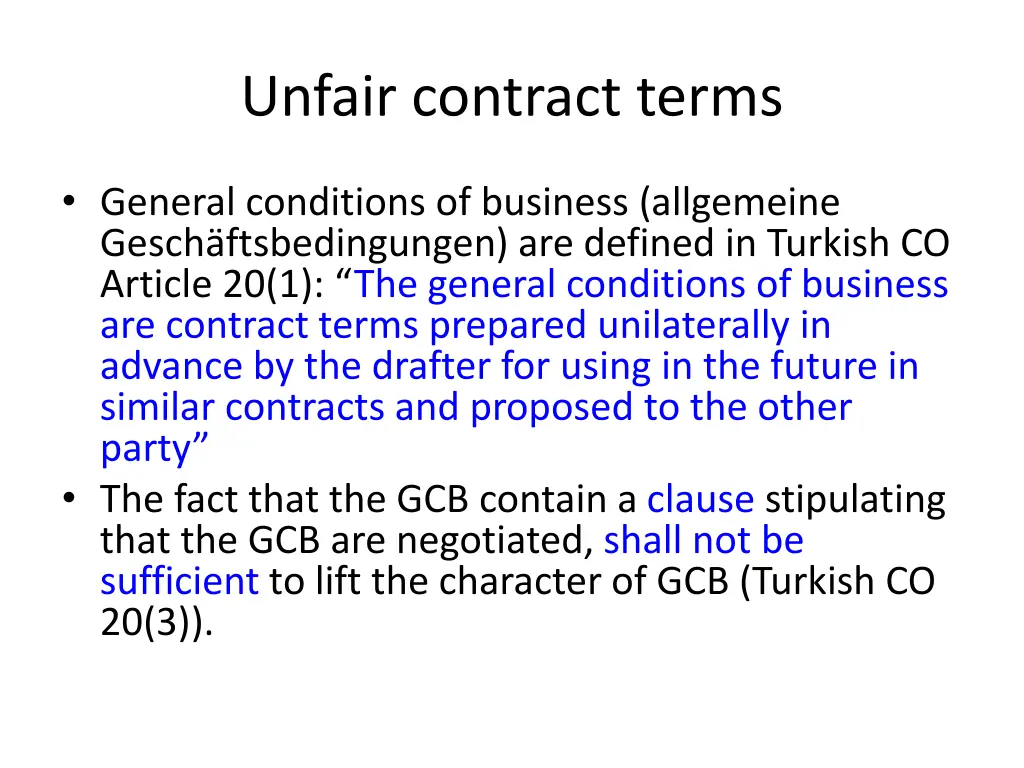
Unfair contract terms General conditions of business (allgemeine Gesch ftsbedingungen) are defined in Turkish CO Article 20(1): The general conditions of business are contract terms prepared unilaterally in advance by the drafter for using in the future in similar contracts and proposed to the other party The fact that the GCB contain a clause stipulating that the GCB are negotiated, shall not be sufficient to lift the character of GCB (Turkish CO 20(3)).
Unfair contract terms Rules about GCB shall also apply to contract terms prepared by enterprises providing services or selling goods on the basis of a license granted by law or competent authorities (Turkish CO 20(4)).
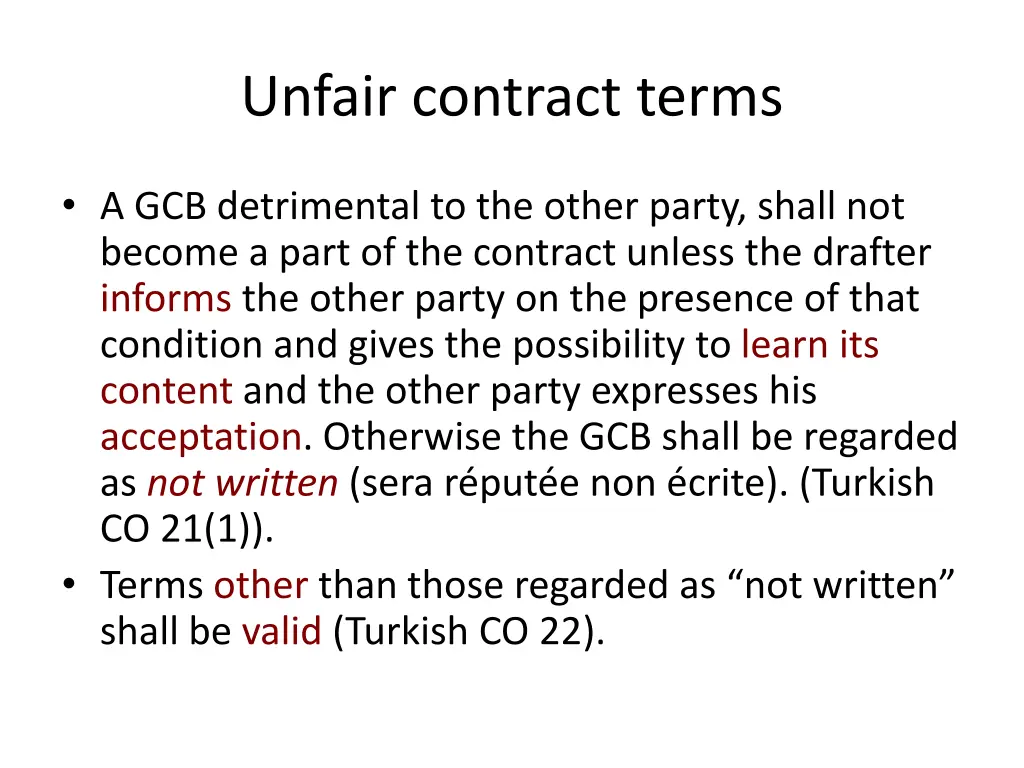
Unfair contract terms A GCB detrimental to the other party, shall not become a part of the contract unless the drafter informs the other party on the presence of that condition and gives the possibility to learn its content and the other party expresses his acceptation. Otherwise the GCB shall be regarded as not written (sera r put e non crite). (Turkish CO 21(1)). Terms other than those regarded as not written shall be valid (Turkish CO 22).
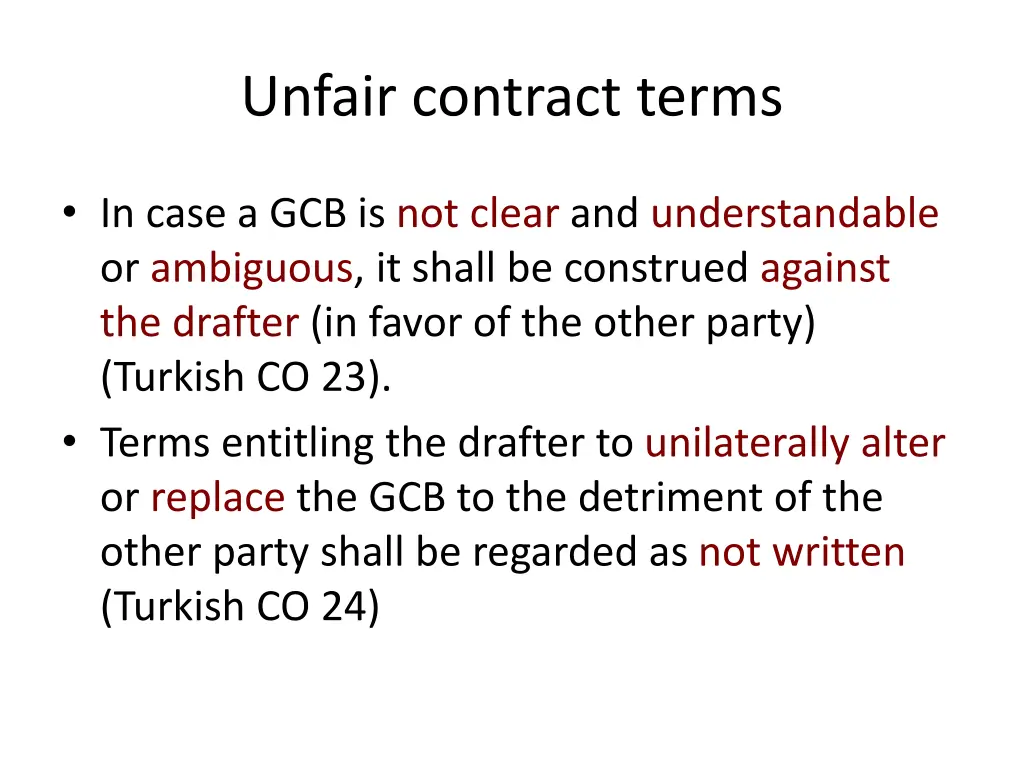
Unfair contract terms In case a GCB is not clear and understandable or ambiguous, it shall be construed against the drafter (in favor of the other party) (Turkish CO 23). Terms entitling the drafter to unilaterally alter or replace the GCB to the detriment of the other party shall be regarded as not written (Turkish CO 24)
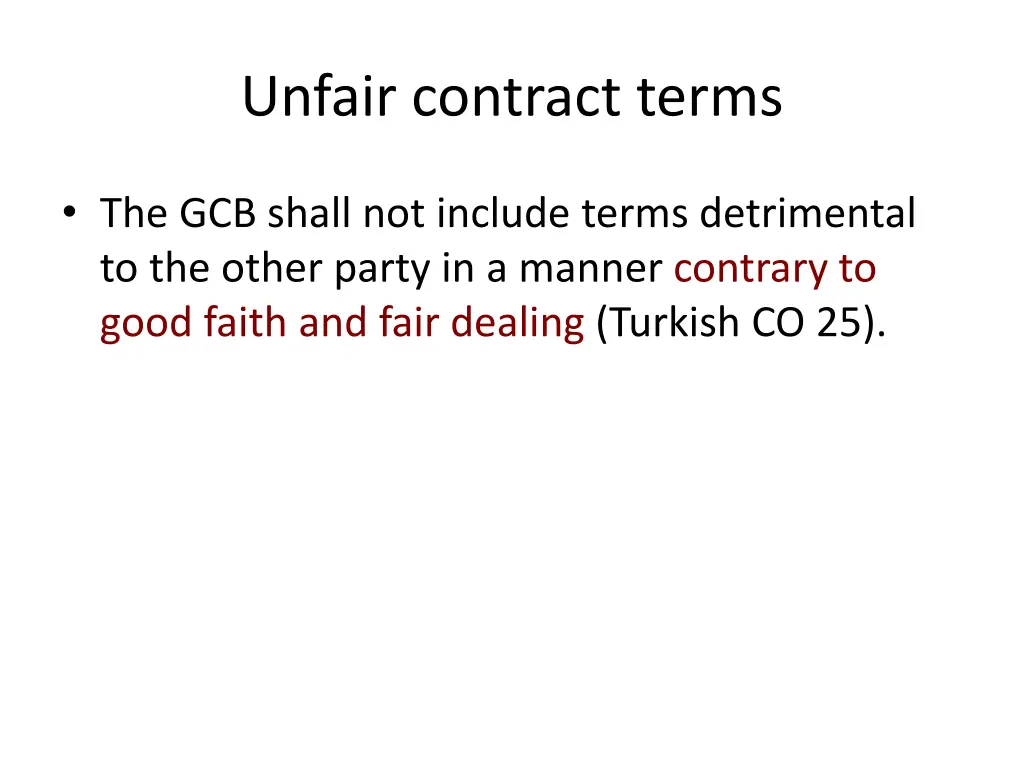
Unfair contract terms The GCB shall not include terms detrimental to the other party in a manner contrary to good faith and fair dealing (Turkish CO 25).
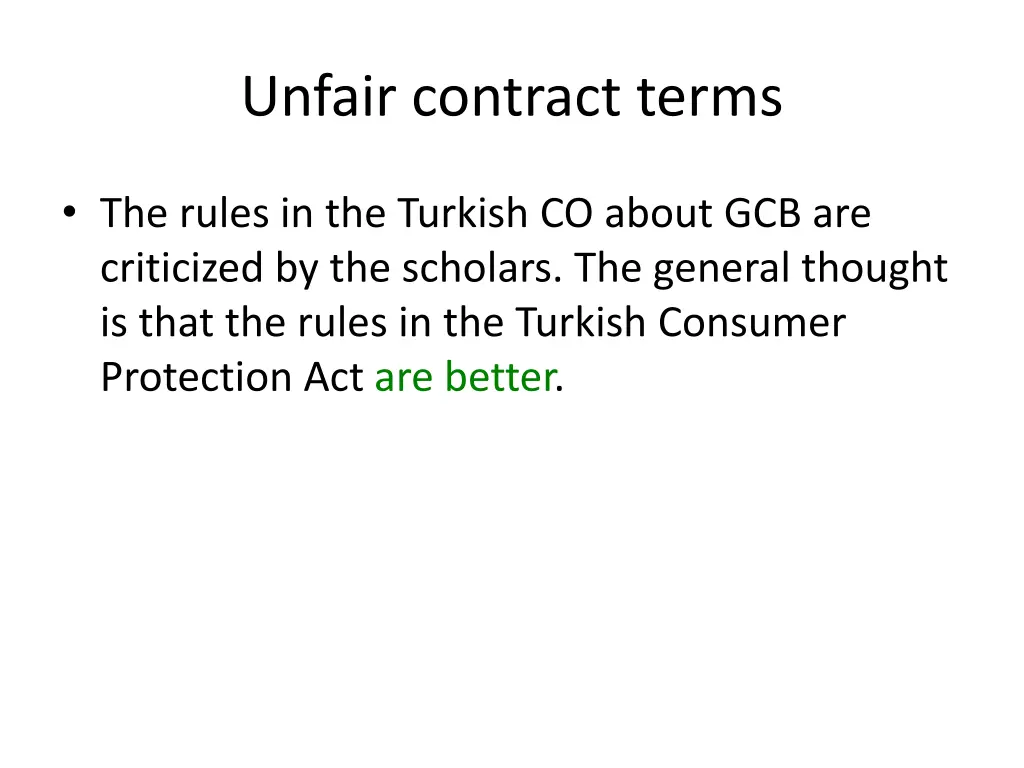
Unfair contract terms The rules in the Turkish CO about GCB are criticized by the scholars. The general thought is that the rules in the Turkish Consumer Protection Act are better.
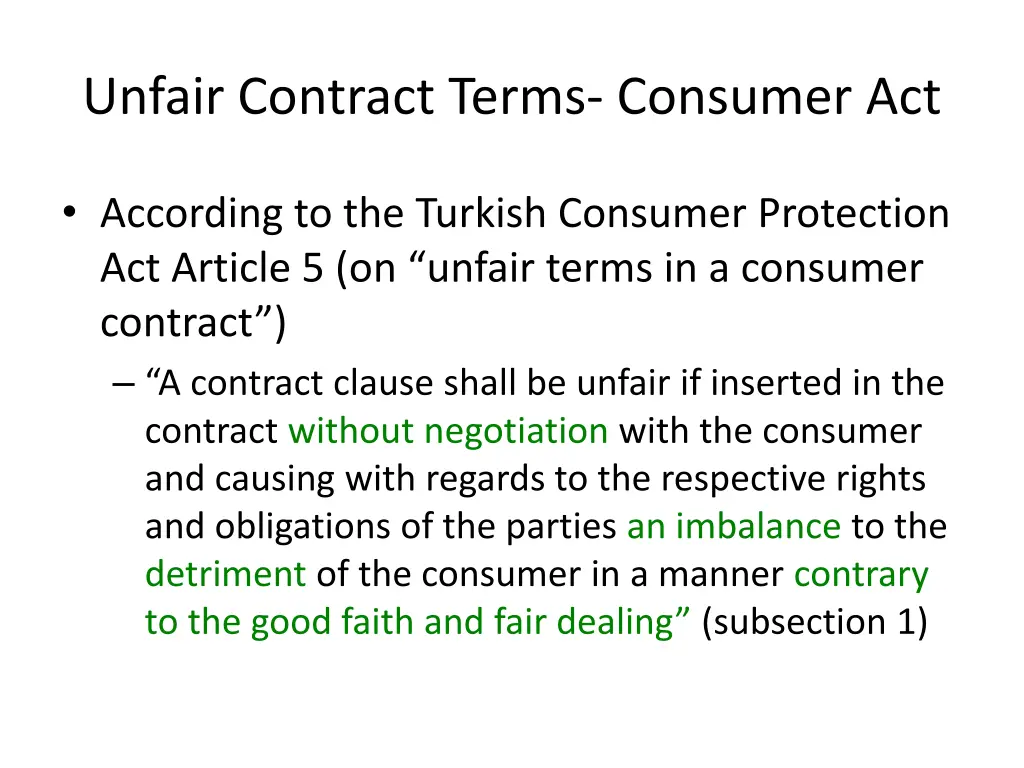
Unfair Contract Terms- Consumer Act According to the Turkish Consumer Protection Act Article 5 (on unfair terms in a consumer contract ) A contract clause shall be unfair if inserted in the contract without negotiation with the consumer and causing with regards to the respective rights and obligations of the parties an imbalance to the detriment of the consumer in a manner contrary to the good faith and fair dealing (subsection 1)
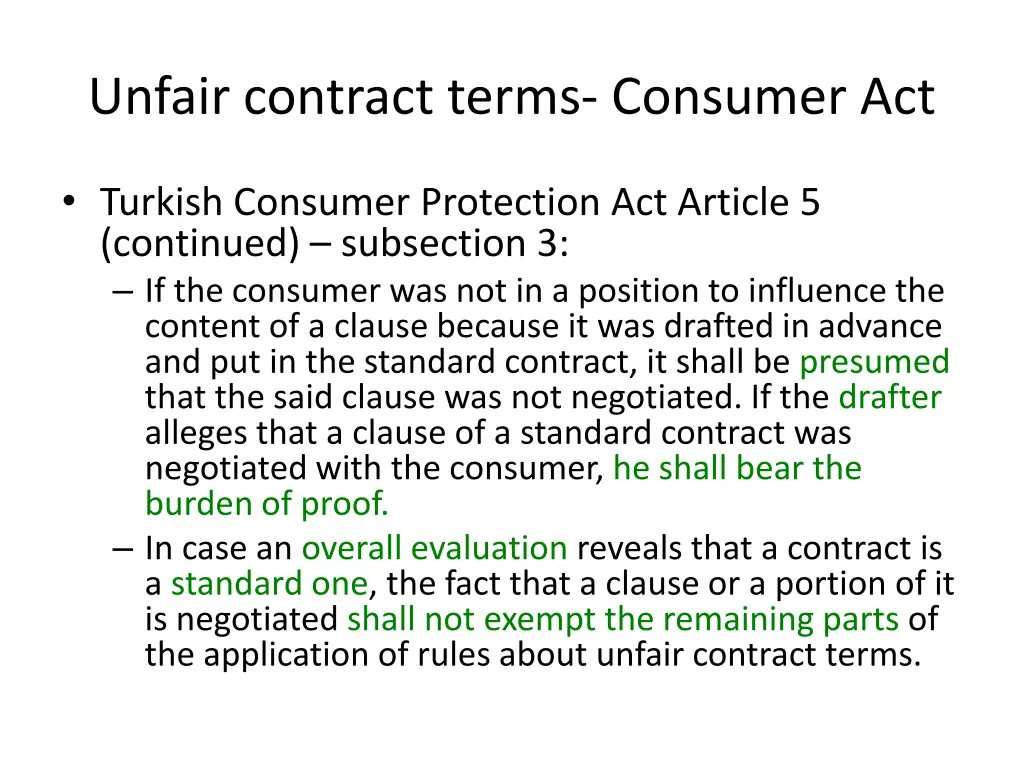
Unfair contract terms- Consumer Act Turkish Consumer Protection Act Article 5 (continued) subsection 3: If the consumer was not in a position to influence the content of a clause because it was drafted in advance and put in the standard contract, it shall be presumed that the said clause was not negotiated. If the drafter alleges that a clause of a standard contract was negotiated with the consumer, he shall bear the burden of proof. In case an overall evaluation reveals that a contract is a standard one, the fact that a clause or a portion of it is negotiated shall not exempt the remaining parts of the application of rules about unfair contract terms.
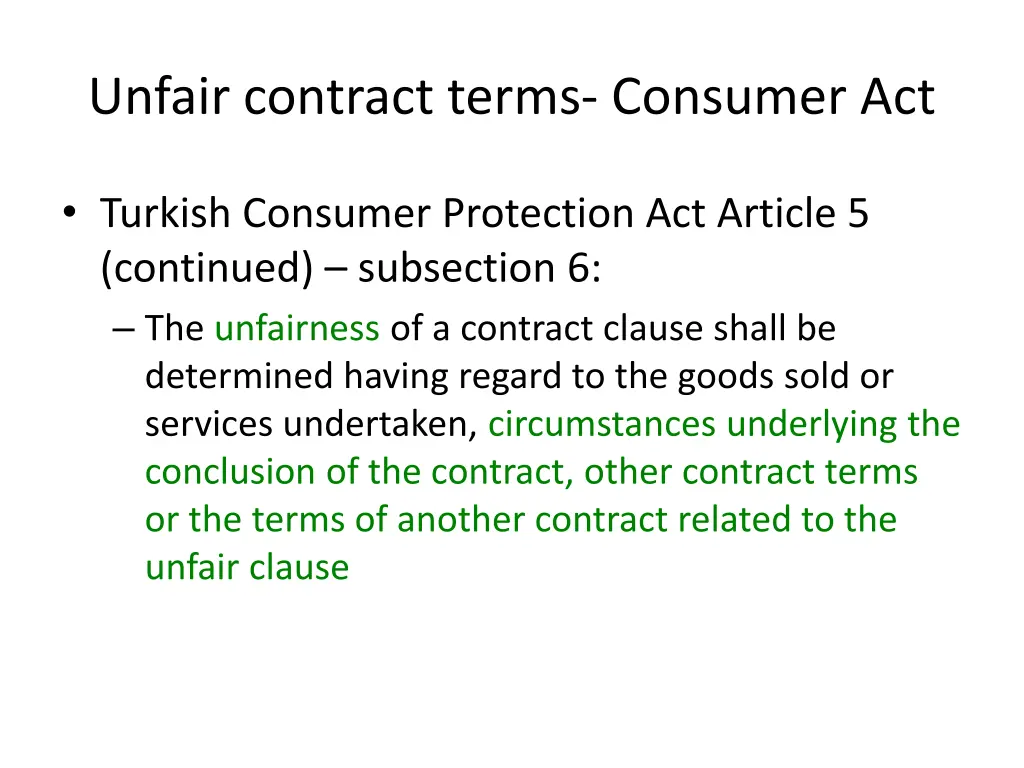
Unfair contract terms- Consumer Act Turkish Consumer Protection Act Article 5 (continued) subsection 6: The unfairness of a contract clause shall be determined having regard to the goods sold or services undertaken, circumstances underlying the conclusion of the contract, other contract terms or the terms of another contract related to the unfair clause
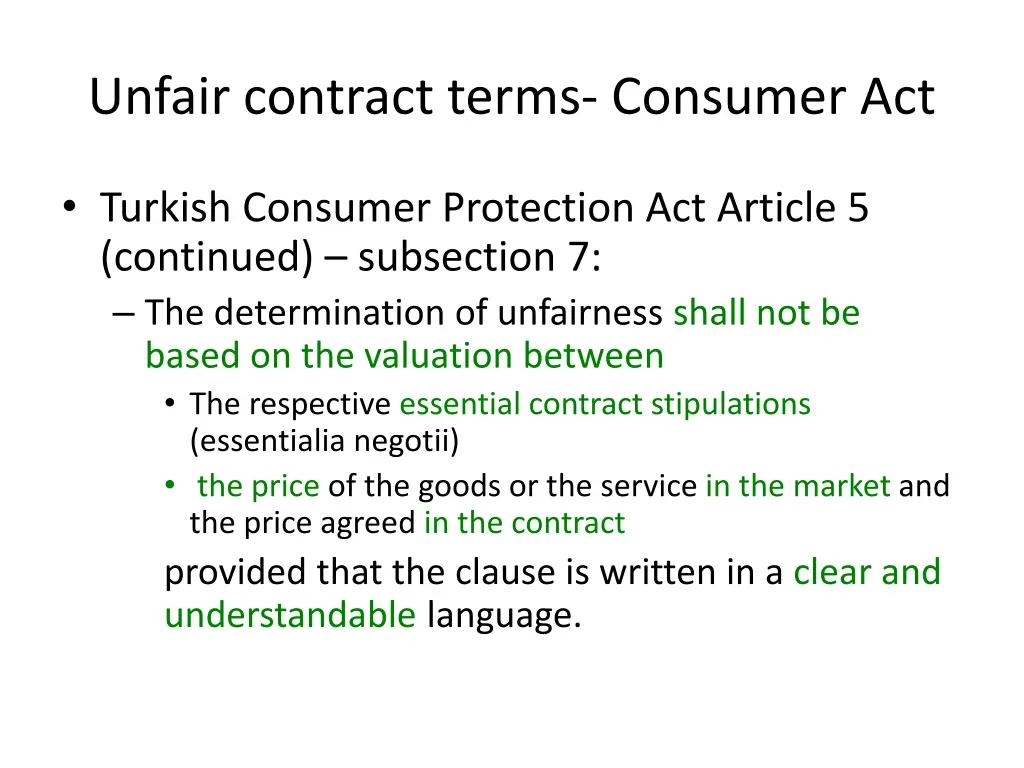
Unfair contract terms- Consumer Act Turkish Consumer Protection Act Article 5 (continued) subsection 7: The determination of unfairness shall not be based on the valuation between The respective essential contract stipulations (essentialia negotii) the price of the goods or the service in the market and the price agreed in the contract provided that the clause is written in a clear and understandable language.
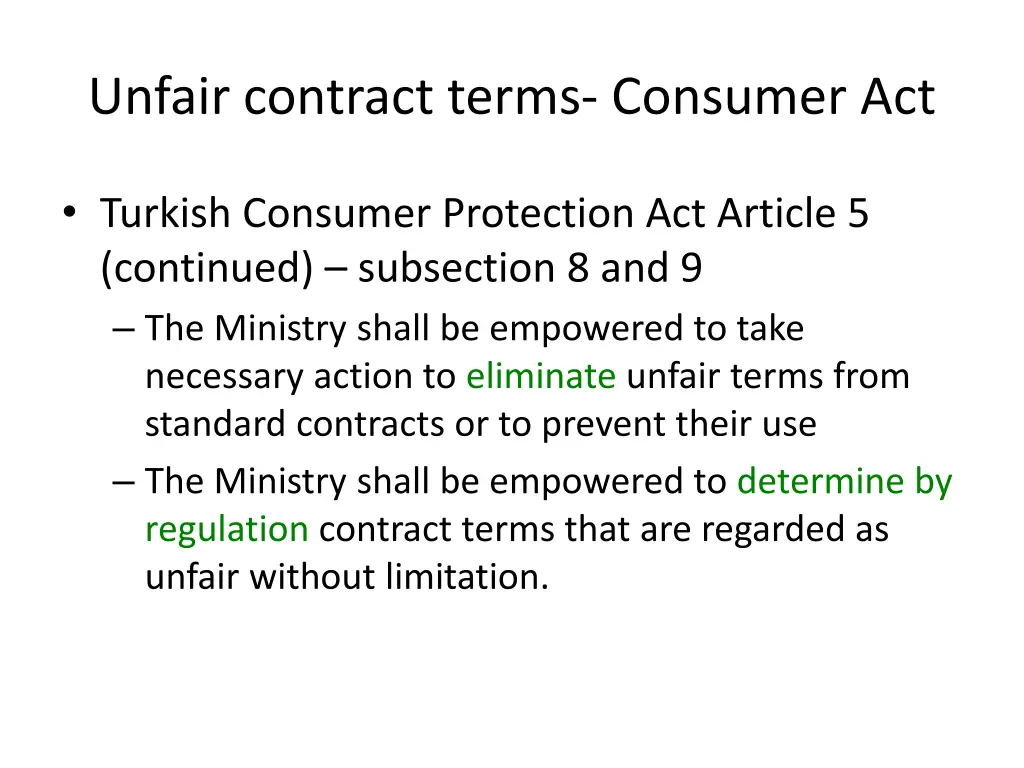
Unfair contract terms- Consumer Act Turkish Consumer Protection Act Article 5 (continued) subsection 8 and 9 The Ministry shall be empowered to take necessary action to eliminate unfair terms from standard contracts or to prevent their use The Ministry shall be empowered to determine by regulation contract terms that are regarded as unfair without limitation.
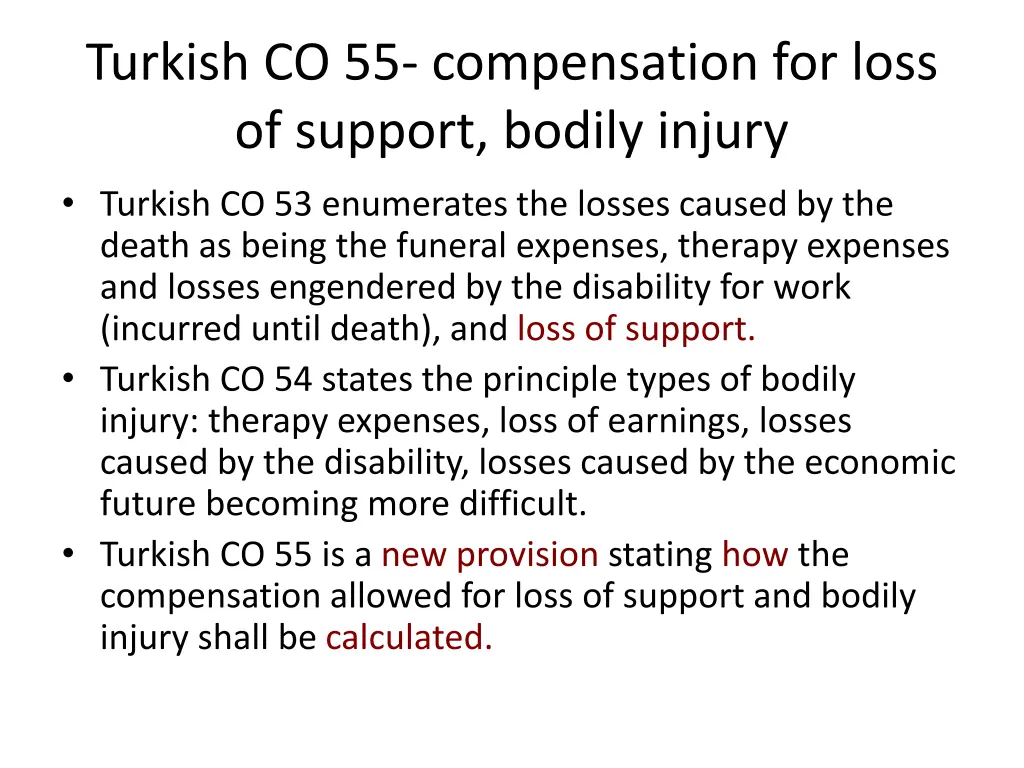
Turkish CO 55- compensation for loss of support, bodily injury Turkish CO 53 enumerates the losses caused by the death as being the funeral expenses, therapy expenses and losses engendered by the disability for work (incurred until death), and loss of support. Turkish CO 54 states the principle types of bodily injury: therapy expenses, loss of earnings, losses caused by the disability, losses caused by the economic future becoming more difficult. Turkish CO 55 is a new provision stating how the compensation allowed for loss of support and bodily injury shall be calculated.
Turkish CO 55- compensation for loss of support, bodily injury Subsection 1: The amount of compensation for loss of support and bodily injury, shall be calculated in accordance with the legal provisions of the CO and pursuant to the principles of tort law. Payments effected by the social security institution for which total or partial recourse is excluded and payments not aimed at performance shall not be taken into account when calculating those losses (they cannot be deducted). The calculated amount of indemnity cannot be decreased on the ground of equity.
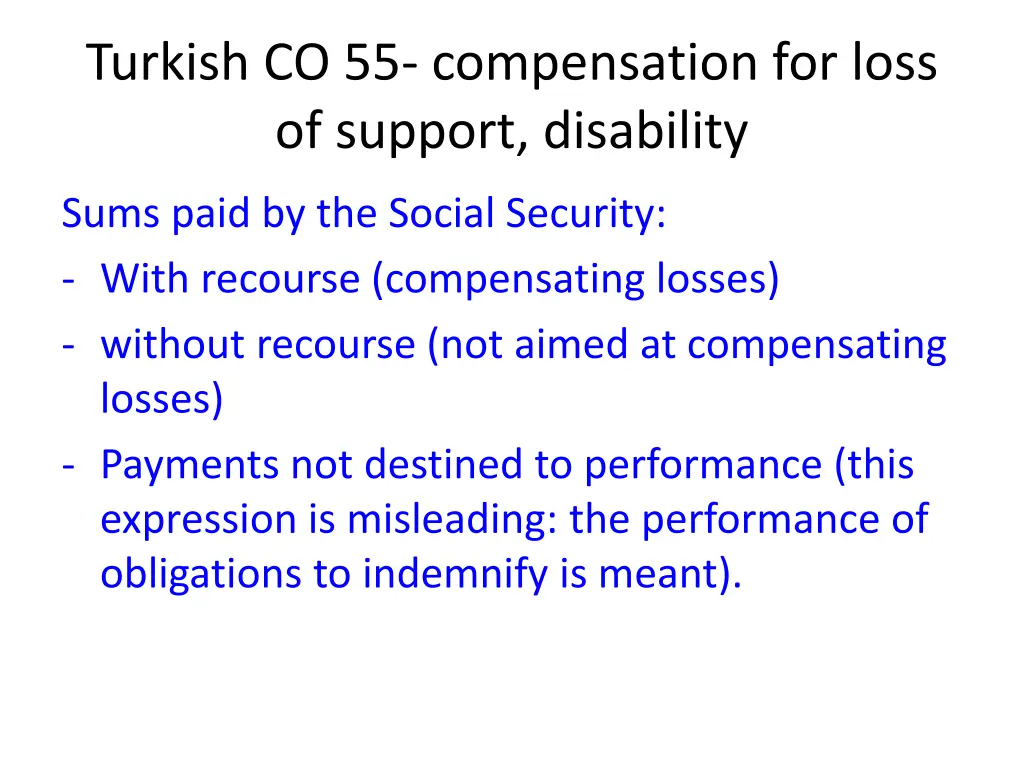
Turkish CO 55- compensation for loss of support, disability Sums paid by the Social Security: - With recourse (compensating losses) - without recourse (not aimed at compensating losses) - Payments not destined to performance (this expression is misleading: the performance of obligations to indemnify is meant).
Turkish Court of Cassation on loss of support claims as a result of motor vehicle accidents Turkish Court of Cassation (Chambers dealing with insurance cases) has developed a series of interesting ruling with regards to loss of support claims. The Court of Cassation says: The indemnity claimed for loss of support is an independent claim and is not a claim inherited from the deceased. The person benefiting from the support can sue directly the insurer Defenses that may be raised against the deceased cannot be raised against the person supported
Turkish Court of Cassation on loss of support claims as a result of motor vehicle accidents First case: Driver being another person than the Halter (operator of the motor vehicle) Fault of the deceased driver constitutes a defense against the persons supported (by the deceased driver) The BGB says it very clearly (BGB 846) The Turkish CO (and the Swiss OR) are silent; but the scholars accept the German solution
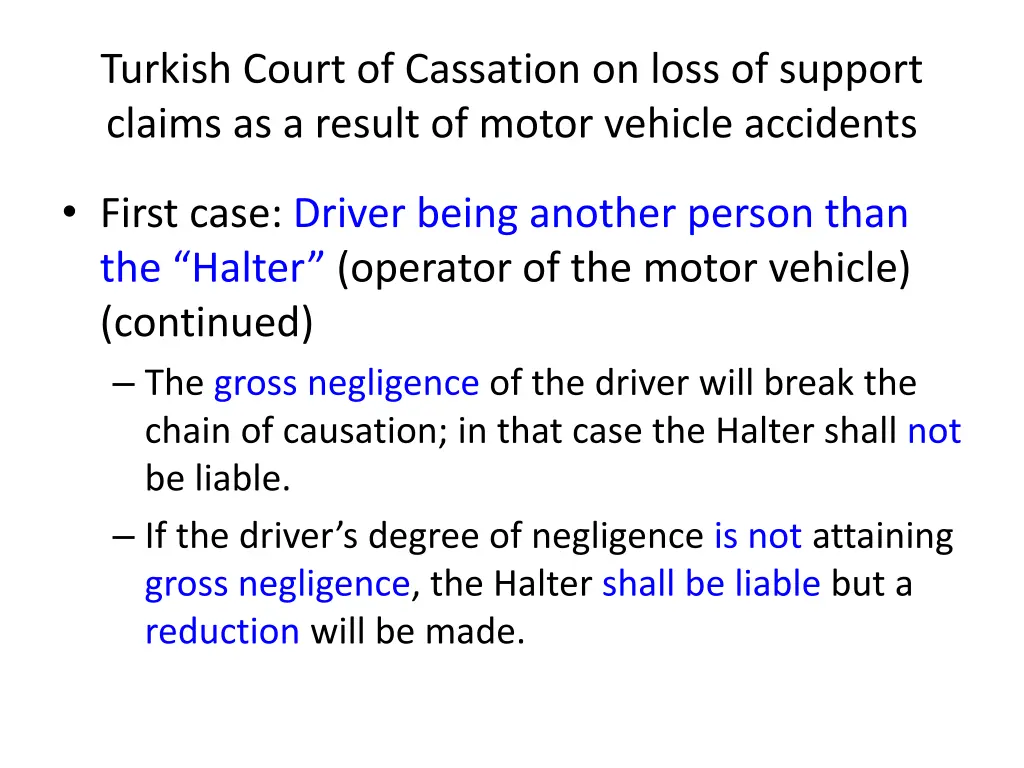
Turkish Court of Cassation on loss of support claims as a result of motor vehicle accidents First case: Driver being another person than the Halter (operator of the motor vehicle) (continued) The gross negligence of the driver will break the chain of causation; in that case the Halter shall not be liable. If the driver s degree of negligence is not attaining gross negligence, the Halter shall be liable but a reduction will be made.
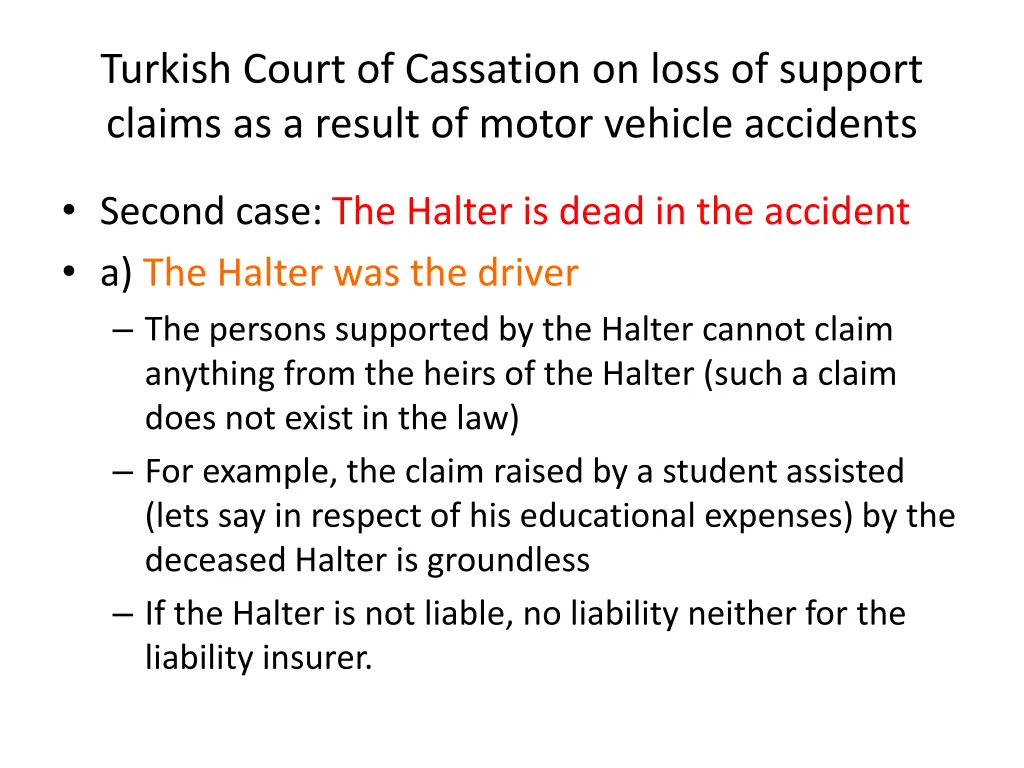
Turkish Court of Cassation on loss of support claims as a result of motor vehicle accidents Second case: The Halter is dead in the accident a) The Halter was the driver The persons supported by the Halter cannot claim anything from the heirs of the Halter (such a claim does not exist in the law) For example, the claim raised by a student assisted (lets say in respect of his educational expenses) by the deceased Halter is groundless If the Halter is not liable, no liability neither for the liability insurer.
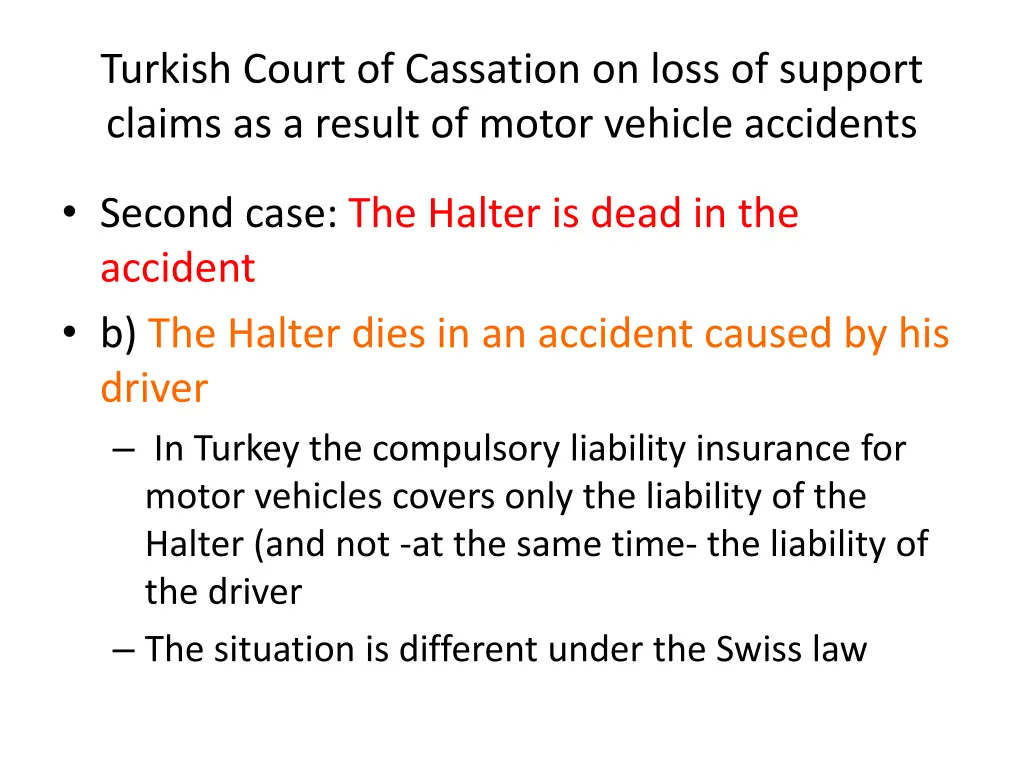
Turkish Court of Cassation on loss of support claims as a result of motor vehicle accidents Second case: The Halter is dead in the accident b) The Halter dies in an accident caused by his driver In Turkey the compulsory liability insurance for motor vehicles covers only the liability of the Halter (and not -at the same time- the liability of the driver The situation is different under the Swiss law
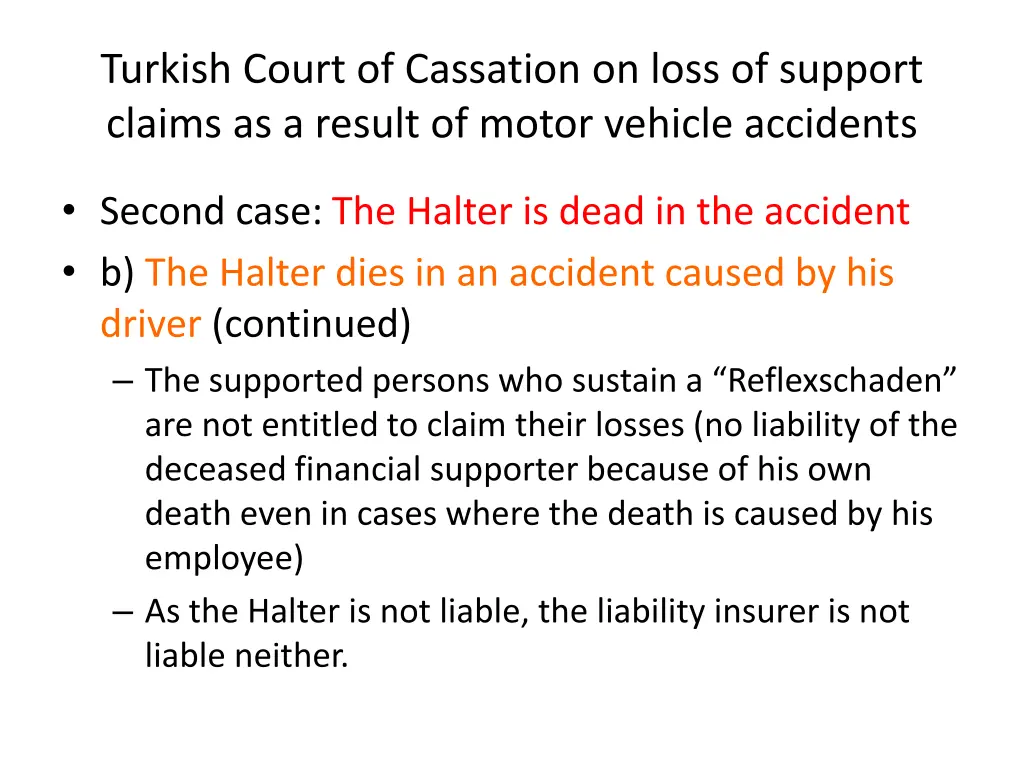
Turkish Court of Cassation on loss of support claims as a result of motor vehicle accidents Second case: The Halter is dead in the accident b) The Halter dies in an accident caused by his driver (continued) The supported persons who sustain a Reflexschaden are not entitled to claim their losses (no liability of the deceased financial supporter because of his own death even in cases where the death is caused by his employee) As the Halter is not liable, the liability insurer is not liable neither.
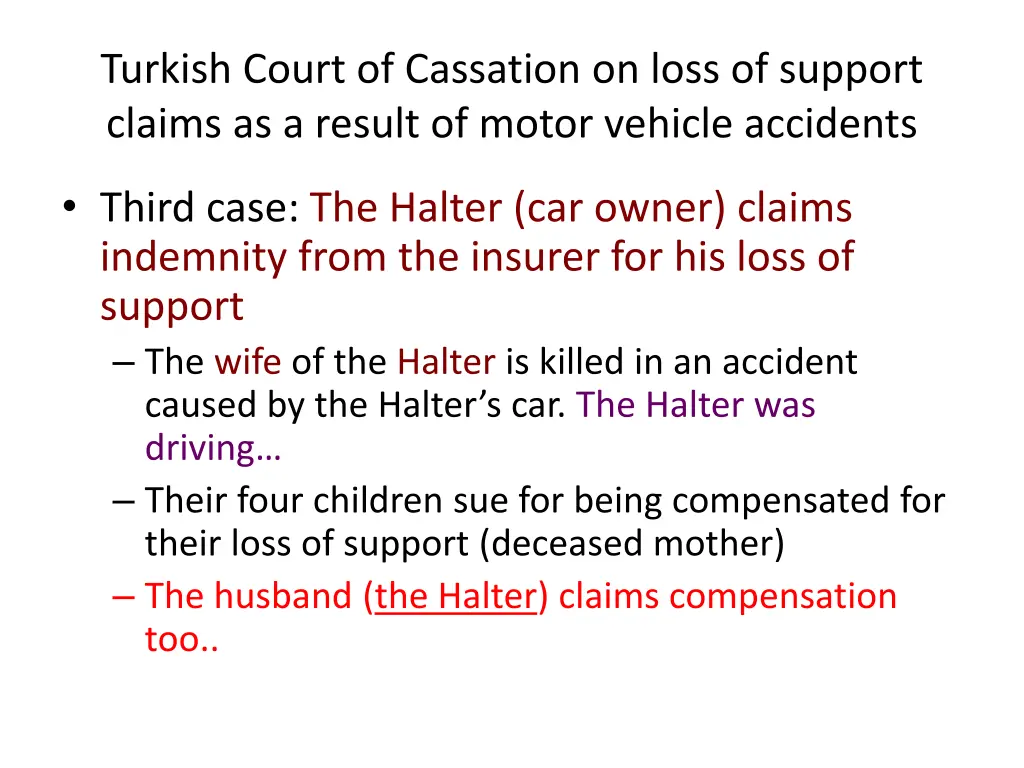
Turkish Court of Cassation on loss of support claims as a result of motor vehicle accidents Third case: The Halter (car owner) claims indemnity from the insurer for his loss of support The wife of the Halter is killed in an accident caused by the Halter s car. The Halter was driving Their four children sue for being compensated for their loss of support (deceased mother) The husband (the Halter) claims compensation too..
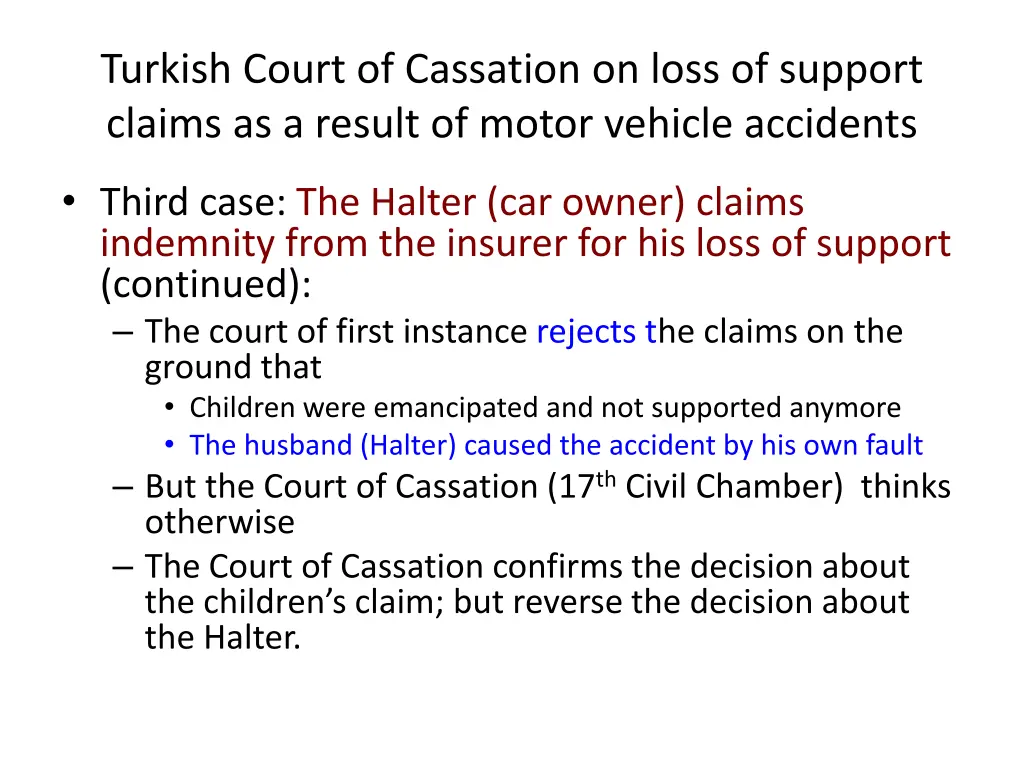
Turkish Court of Cassation on loss of support claims as a result of motor vehicle accidents Third case: The Halter (car owner) claims indemnity from the insurer for his loss of support (continued): The court of first instance rejects the claims on the ground that Children were emancipated and not supported anymore The husband (Halter) caused the accident by his own fault But the Court of Cassation (17th Civil Chamber) thinks otherwise The Court of Cassation confirms the decision about the children s claim; but reverse the decision about the Halter.
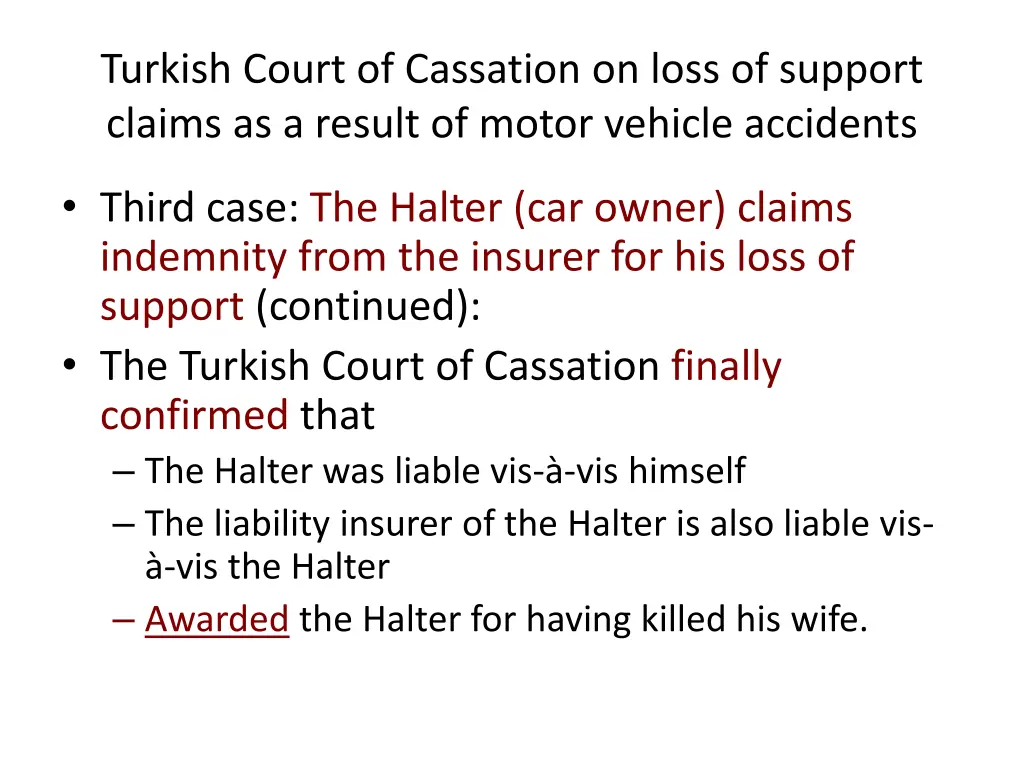
Turkish Court of Cassation on loss of support claims as a result of motor vehicle accidents Third case: The Halter (car owner) claims indemnity from the insurer for his loss of support (continued): The Turkish Court of Cassation finally confirmed that The Halter was liable vis- -vis himself The liability insurer of the Halter is also liable vis- -vis the Halter Awarded the Halter for having killed his wife.
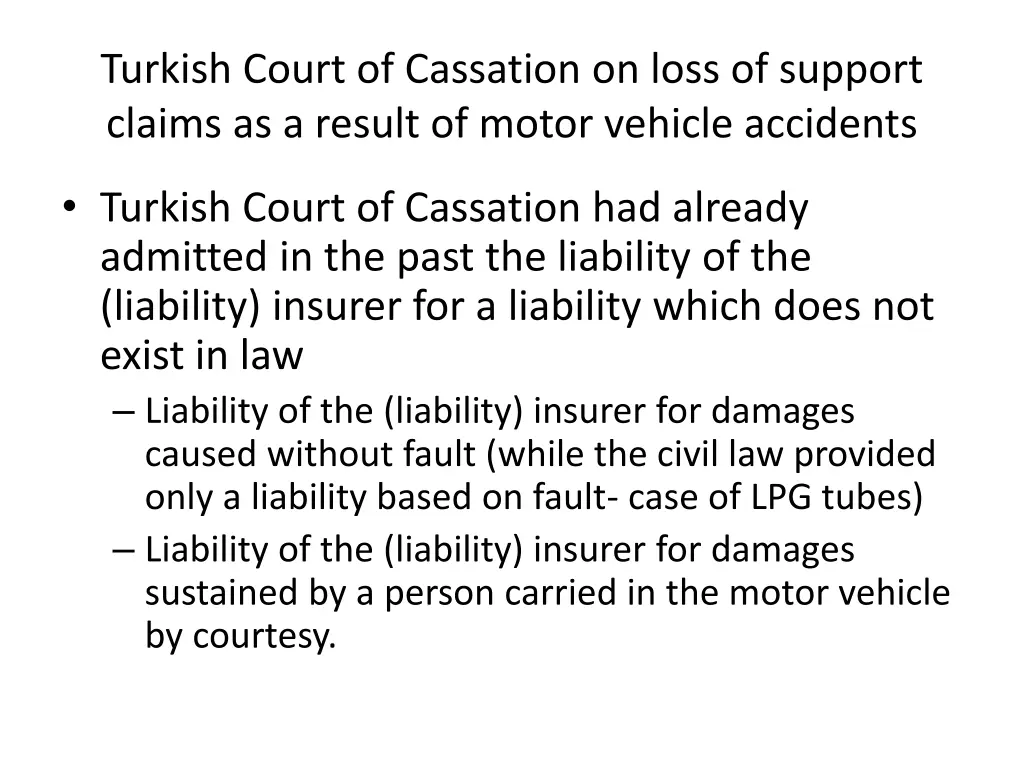
Turkish Court of Cassation on loss of support claims as a result of motor vehicle accidents Turkish Court of Cassation had already admitted in the past the liability of the (liability) insurer for a liability which does not exist in law Liability of the (liability) insurer for damages caused without fault (while the civil law provided only a liability based on fault- case of LPG tubes) Liability of the (liability) insurer for damages sustained by a person carried in the motor vehicle by courtesy.
Turkish Court of Cassation on loss of support claims as a result of motor vehicle accidents Compulsory liability insurance is not a magic solution Liability insurance should not be confused with charity When the liability of the insured is not established, there will be no difference in compelling the liability insurer or UNICEF or the Red Cross to pay ..
Several grounds for liability Competing causes (Turkish CO 60): If someone s liability can be attributed to more than one cause, the Judge shall, unless the victim has required or the law has provided otherwise, decide in reliance on the cause most favorable to the victim.
More than one ground for liability Joint liability (Turkish Co 61 and 62) External relation (Turkish CO 61) If more than one person caused loss or damage together or are liable for the same loss or damage, their liability shall be subjected to rules about joint liability.
More than one ground for liability Joint liability (Turkish Co 61 and 62) Internal relation (Turkish CO 62) The burden of the compensation shall be divided amongst the jointly liable persons having regard to all the circumstances of the case, and in particular to the degree of fault that can be attributed to each and to the intensity of the danger created by each. The jointly liable person who has paid as compensation more than his share, shall be entitled to have recourse against others and shall be subrogated to that effect to the rights of the victim.
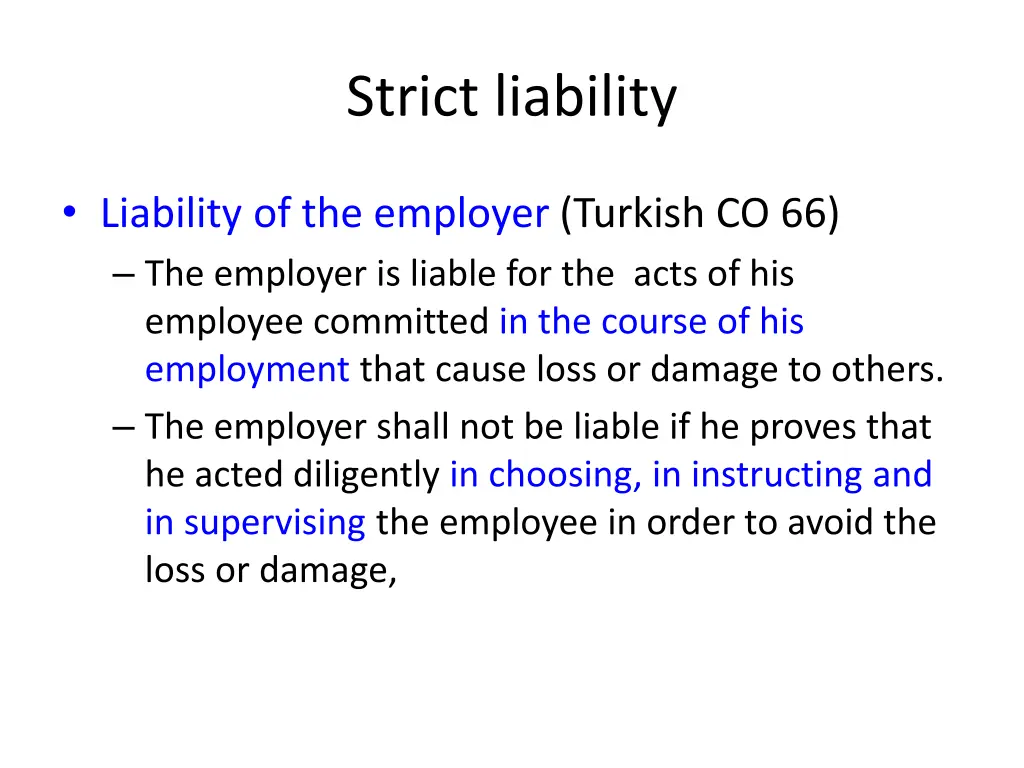
Strict liability Liability of the employer (Turkish CO 66) The employer is liable for the acts of his employee committed in the course of his employment that cause loss or damage to others. The employer shall not be liable if he proves that he acted diligently in choosing, in instructing and in supervising the employee in order to avoid the loss or damage,
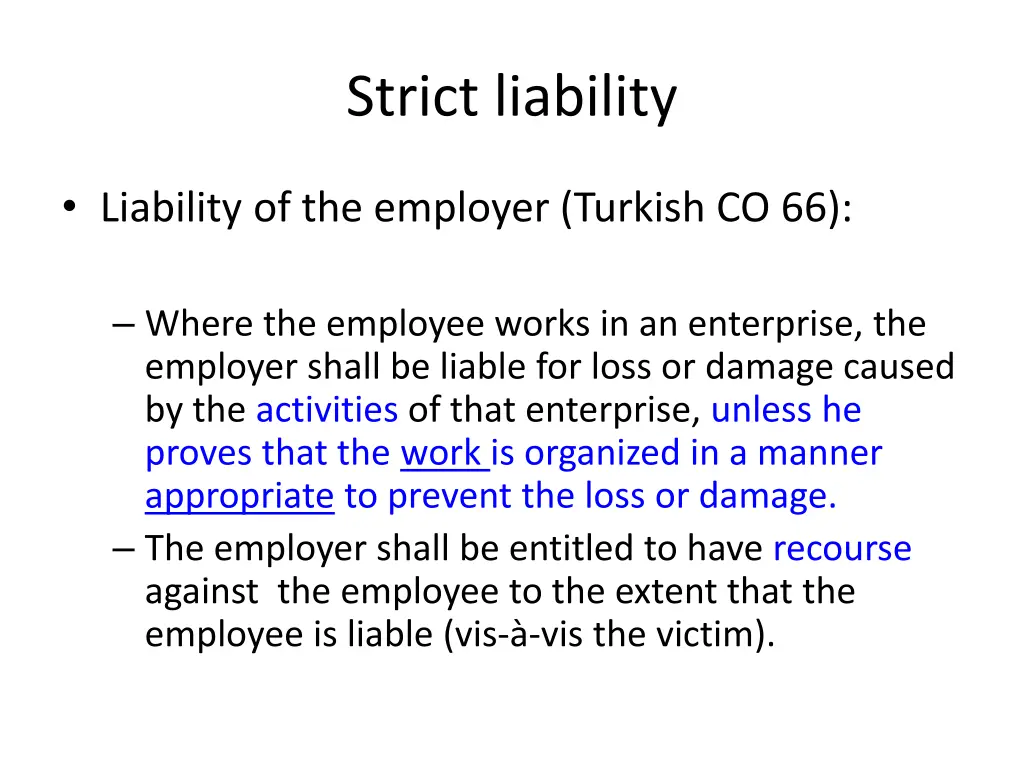
Strict liability Liability of the employer (Turkish CO 66): Where the employee works in an enterprise, the employer shall be liable for loss or damage caused by the activities of that enterprise, unless he proves that the work is organized in a manner appropriate to prevent the loss or damage. The employer shall be entitled to have recourse against the employee to the extent that the employee is liable (vis- -vis the victim).
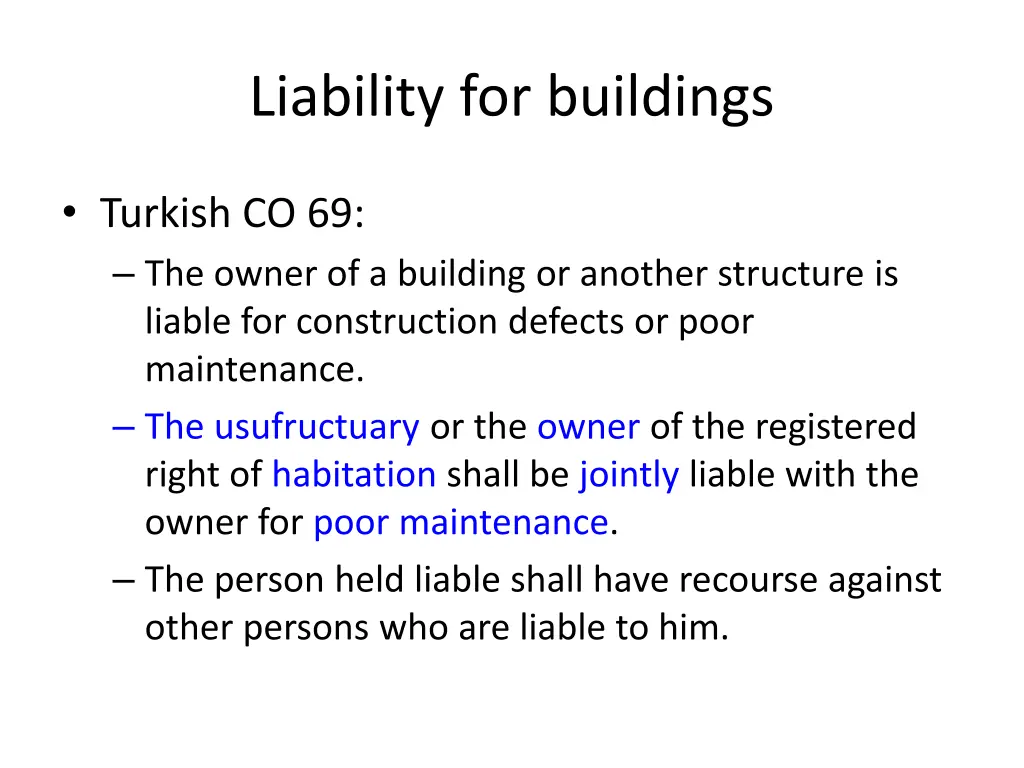
Liability for buildings Turkish CO 69: The owner of a building or another structure is liable for construction defects or poor maintenance. The usufructuary or the owner of the registered right of habitation shall be jointly liable with the owner for poor maintenance. The person held liable shall have recourse against other persons who are liable to him.
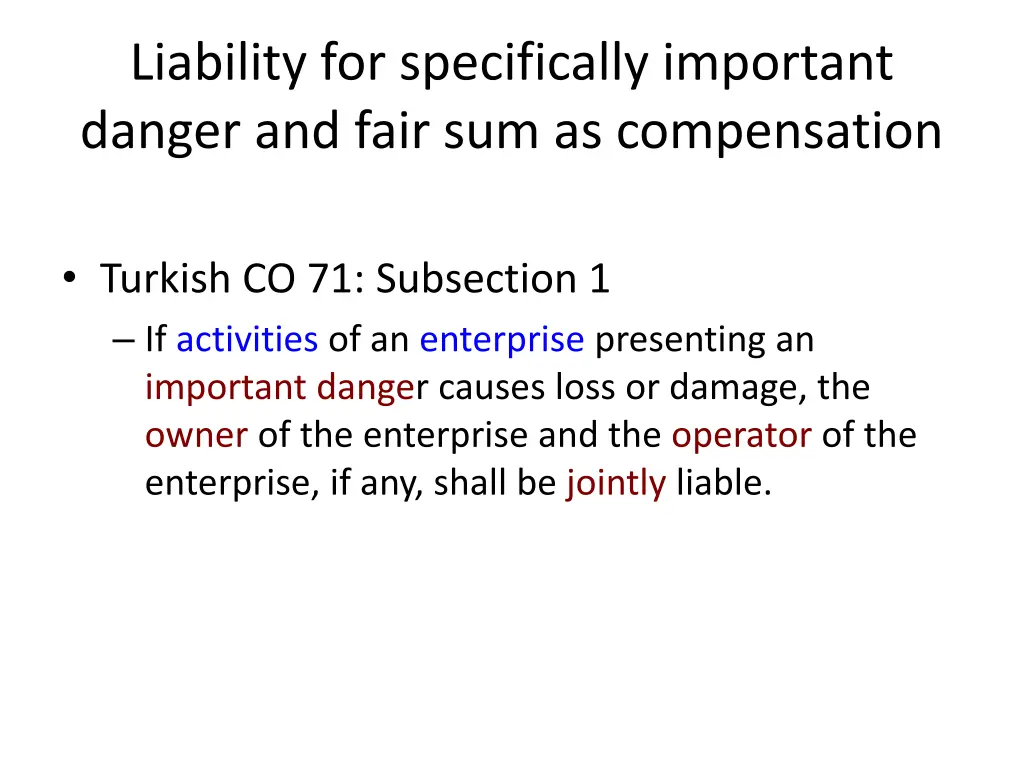
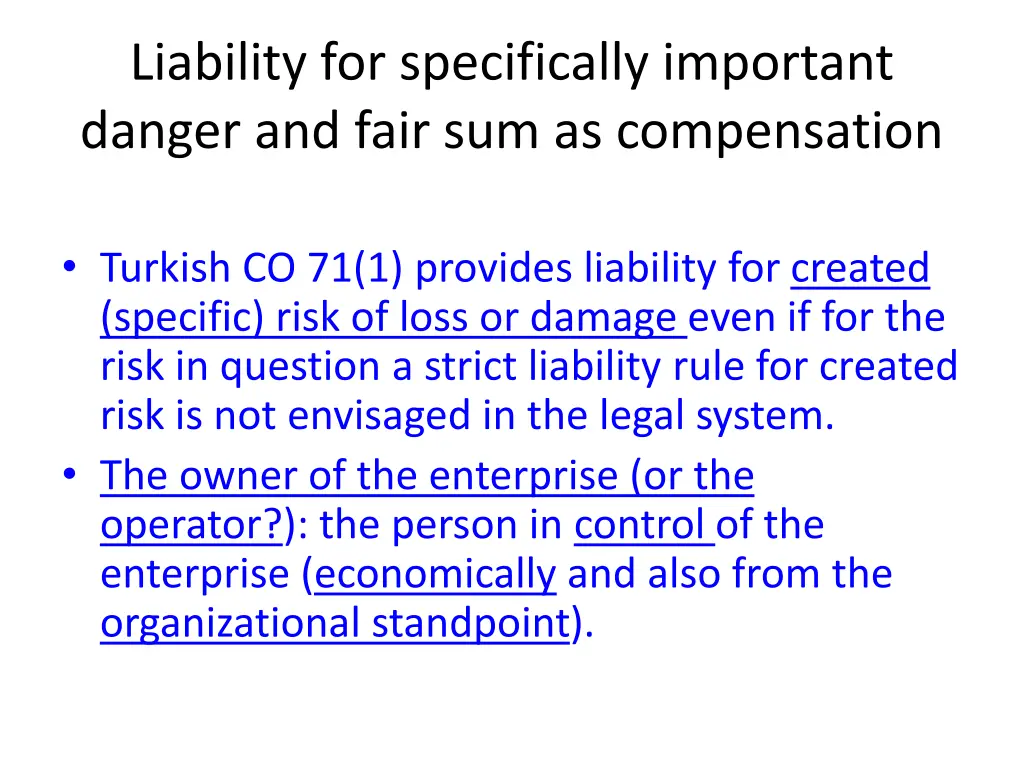
Liability for specifically important danger and fair sum as compensation Turkish CO 71: Subsection 1 If activities of an enterprise presenting an important danger causes loss or damage, the owner of the enterprise and the operator of the enterprise, if any, shall be jointly liable.
Liability for specifically important danger and fair sum as compensation Turkish CO 71(1) provides liability for created (specific) risk of loss or damage even if for the risk in question a strict liability rule for created risk is not envisaged in the legal system. The owner of the enterprise (or the operator?): the person in control of the enterprise (economically and also from the organizational standpoint).
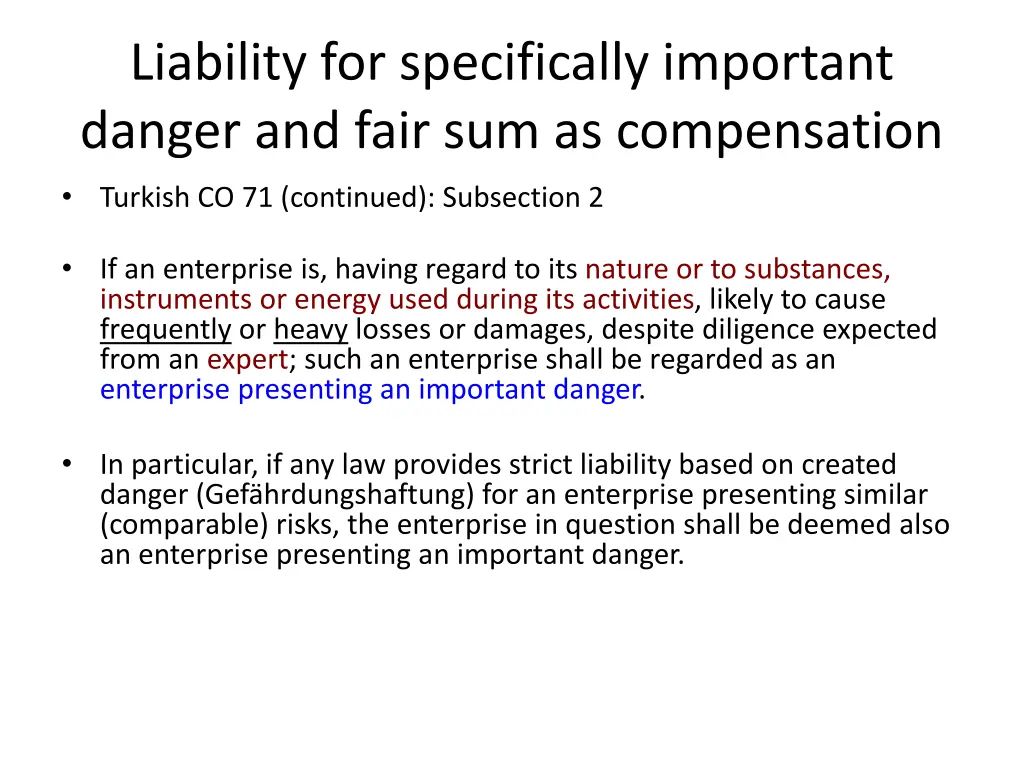
Liability for specifically important danger and fair sum as compensation Turkish CO 71 (continued): Subsection 2 If an enterprise is, having regard to its nature or to substances, instruments or energy used during its activities, likely to cause frequently or heavy losses or damages, despite diligence expected from an expert; such an enterprise shall be regarded as an enterprise presenting an important danger. In particular, if any law provides strict liability based on created danger (Gef hrdungshaftung) for an enterprise presenting similar (comparable) risks, the enterprise in question shall be deemed also an enterprise presenting an important danger.
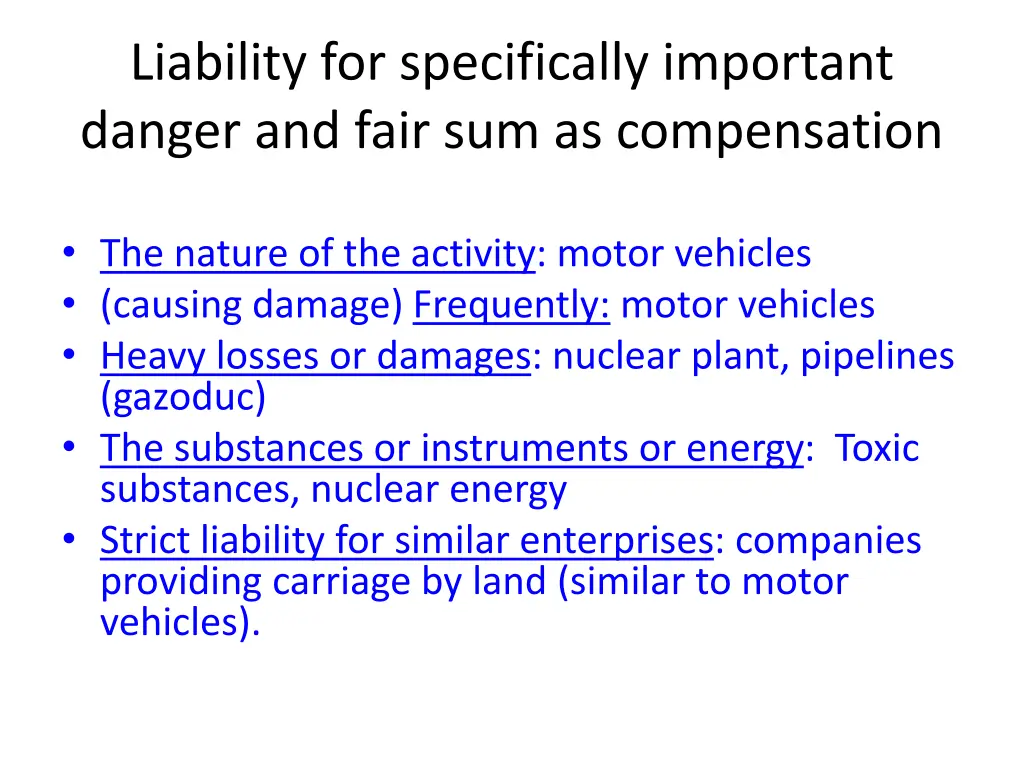
Liability for specifically important danger and fair sum as compensation The nature of the activity: motor vehicles (causing damage) Frequently: motor vehicles Heavy losses or damages: nuclear plant, pipelines (gazoduc) The substances or instruments or energy: Toxic substances, nuclear energy Strict liability for similar enterprises: companies providing carriage by land (similar to motor vehicles).
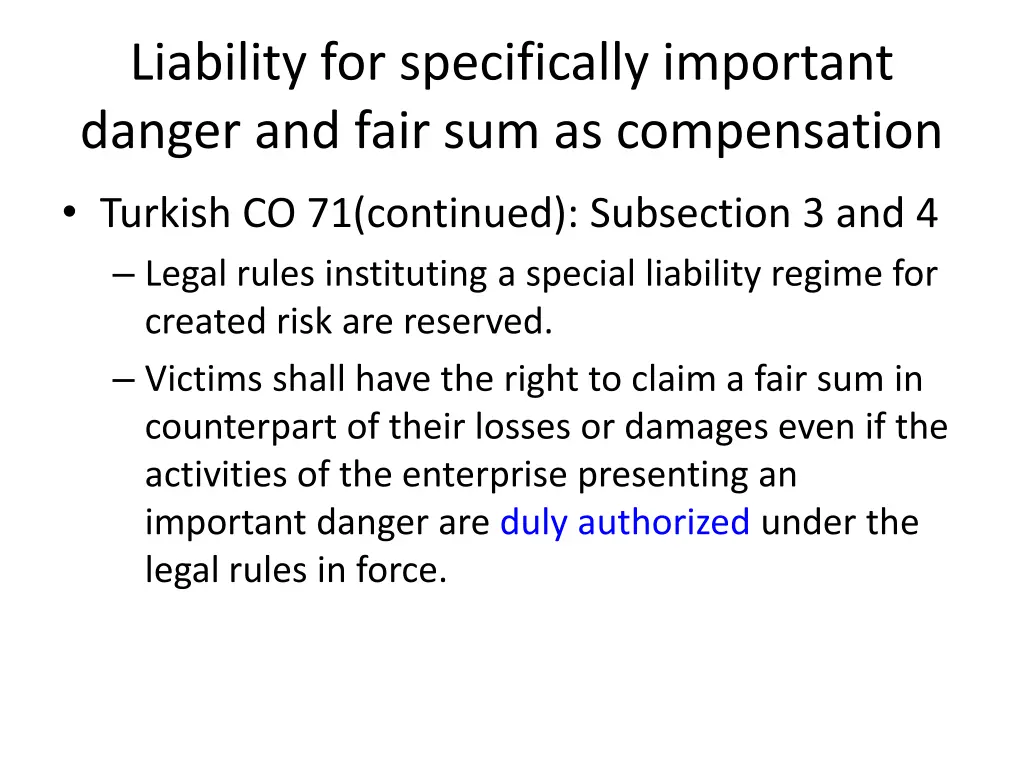
Liability for specifically important danger and fair sum as compensation Turkish CO 71(continued): Subsection 3 and 4 Legal rules instituting a special liability regime for created risk are reserved. Victims shall have the right to claim a fair sum in counterpart of their losses or damages even if the activities of the enterprise presenting an important danger are duly authorized under the legal rules in force.
Liability for specifically important danger and fair sum as compensation Where special rules exist: lex specialis derogat legi generali The fact that an activity is tolerated by the legal system shall not relieve from liability linked to that activity (creating specific danger)