Exchange Rate Forecasting Techniques: Why MNCs Need Reliable Forecasts

Exchange rate forecasting is crucial for Multinational Corporations (MNCs) to make informed decisions regarding hedging, financing, and investing. Techniques such as Fundamental Approach and Technical Approach are commonly used to predict currency movements. Implementing effective forecasting strategies can help organizations mitigate risks and capitalize on opportunities in the volatile foreign exchange market.

Download Presentation

Please find below an Image/Link to download the presentation.
The content on the website is provided AS IS for your information and personal use only. It may not be sold, licensed, or shared on other websites without obtaining consent from the author.If you encounter any issues during the download, it is possible that the publisher has removed the file from their server.
You are allowed to download the files provided on this website for personal or commercial use, subject to the condition that they are used lawfully. All files are the property of their respective owners.
The content on the website is provided AS IS for your information and personal use only. It may not be sold, licensed, or shared on other websites without obtaining consent from the author.
E N D
Presentation Transcript
Forecasting Techniques Dr. Pravin Kumar Agrawal Assistant Professor Department of Business Management CSJMU
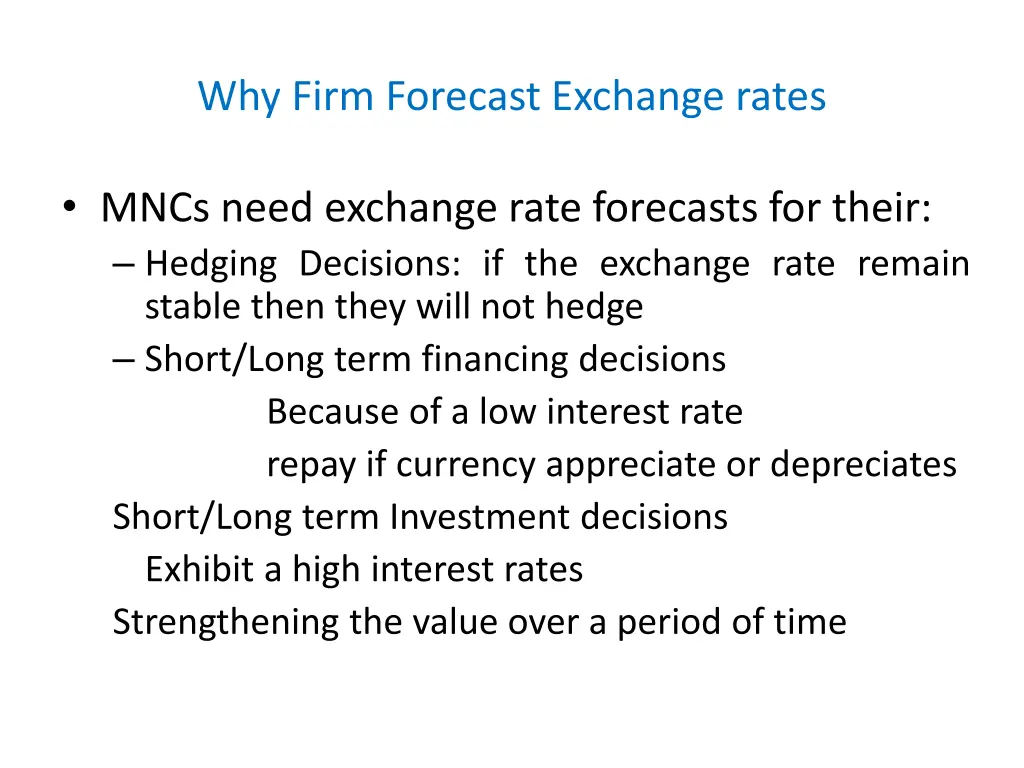
Why Firm Forecast Exchange rates MNCs need exchange rate forecasts for their: Hedging Decisions: if the exchange rate remain stable then they will not hedge Short/Long term financing decisions Because of a low interest rate repay if currency appreciate or depreciates Short/Long term Investment decisions Exhibit a high interest rates Strengthening the value over a period of time
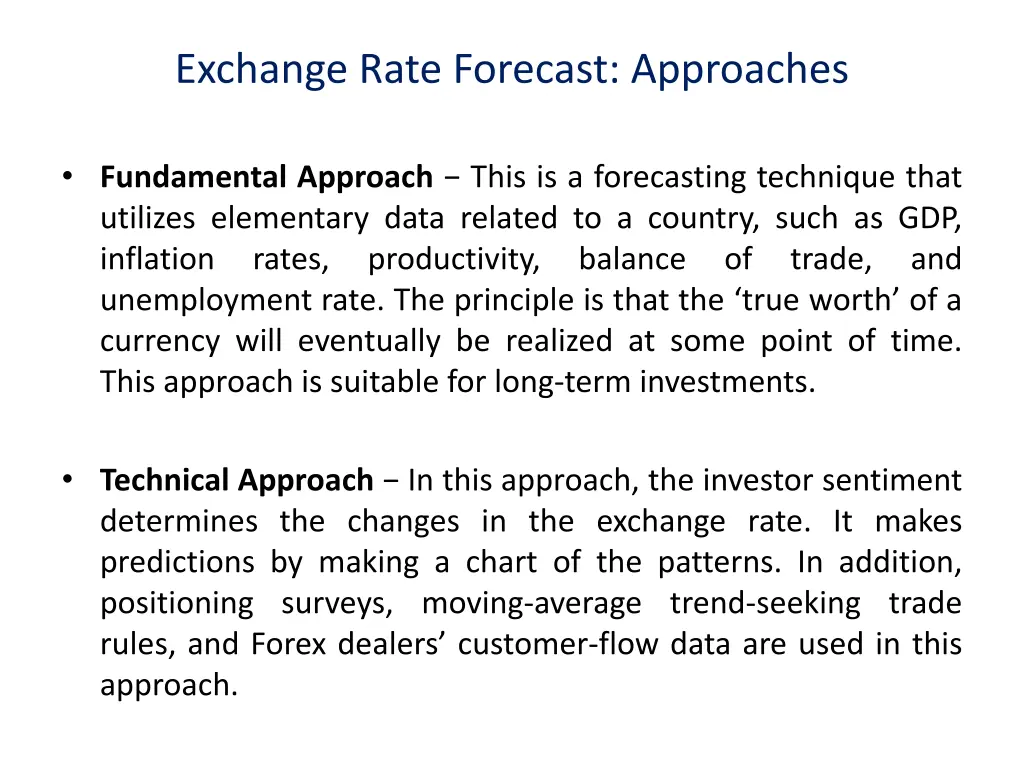
Exchange Rate Forecast: Approaches Fundamental Approach This is a forecasting technique that utilizes elementary data related to a country, such as GDP, inflation rates, productivity, unemployment rate. The principle is that the true worth of a currency will eventually be realized at some point of time. This approach is suitable for long-term investments. balance of trade, and Technical Approach In this approach, the investor sentiment determines the changes in the exchange rate. It makes predictions by making a chart of the patterns. In addition, positioning surveys, moving-average trend-seeking trade rules, and Forex dealers customer-flow data are used in this approach.
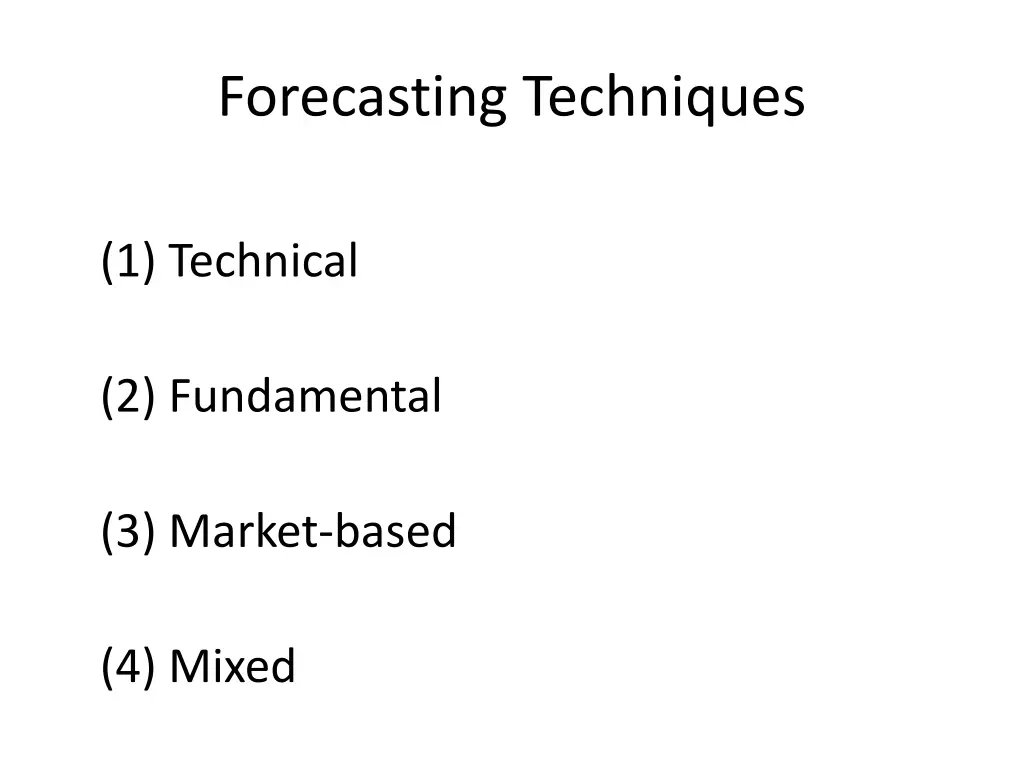
Forecasting Techniques (1) Technical (2) Fundamental (3) Market-based (4) Mixed
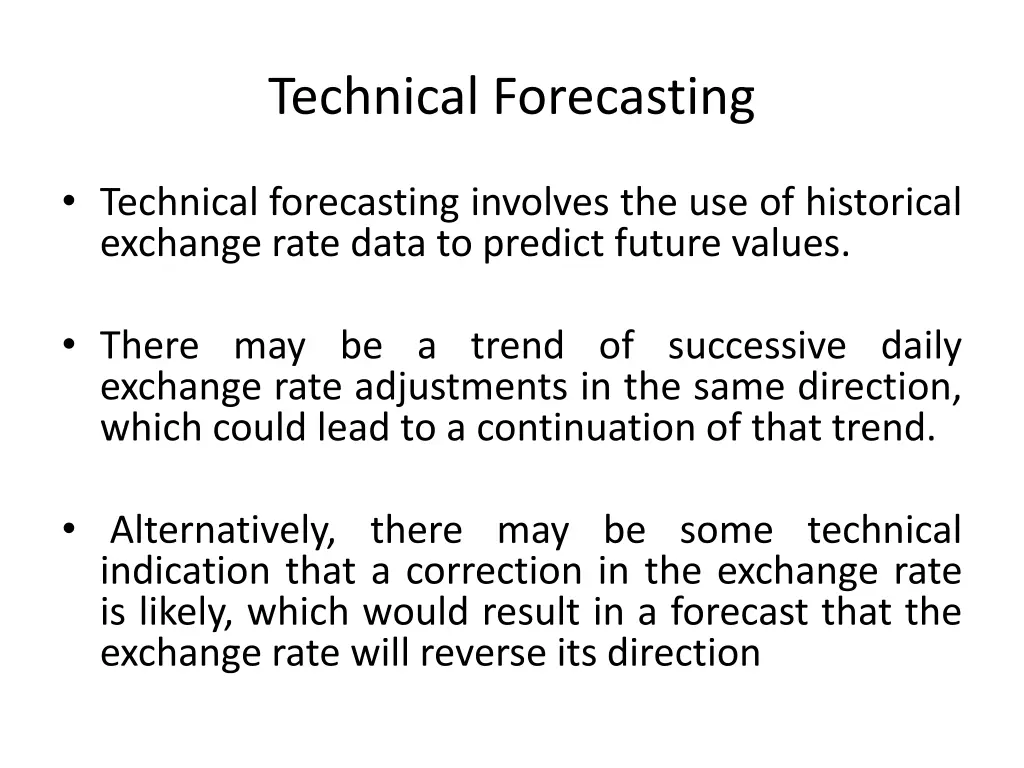
Technical Forecasting Technical forecasting involves the use of historical exchange rate data to predict future values. There may be a trend of successive daily exchange rate adjustments in the same direction, which could lead to a continuation of that trend. Alternatively, there may be some technical indication that a correction in the exchange rate is likely, which would result in a forecast that the exchange rate will reverse its direction
Example Tomorrow ABC Co. must pay 10 million USD for supplies that it recently received from USA. Today, the USD has appreciated by 3 percent against the INR. Based on an analysis of historical time series, ABC Co. has determined that whenever the USD appreciates against the INR by more than 1 percent, it experiences a reversal of about 60 percent of that change on the following day. Given this forecast, ABC Co. decides that it will make its payment tomorrow instead of today so that it can benefit from the expected depreciation of the USD.
Technical Forecasting Technical forecasting is sometimes cited as the main technique used speculate in the foreign exchange market, especially when their investment is for a very short time period. by investors who
Limitations of Technical Forecasting Multinational corporations make only limited use of technical forecasting because it typically focuses on the near future, which is not that helpful for developing corporate policies. Most technical forecasts apply to very short-term periods (e.g., one day) because patterns in exchange rate movements may be more predictable over such periods. Because such patterns are likely less reliable for forecasting long-term movements (e.g., over a quarter, a year, or five years), technical forecasts are less useful for forecasting exchange rates in the distant future. Thus technical forecasting may not be suitable for firms that require a long-range forecast of exchange rates.
Technical Forecasting Furthermore, a technical forecasting model that has worked well in one particular period may not work well in another period. Unless historical trends in exchange rate movements can be identified, examination of past movements will not be useful for indicating future movements.
Fundamental Forecasting Fundamental fundamental relationships between economic variables (such as inflation, income level, and interest rates) and exchange rates. forecasting is based on
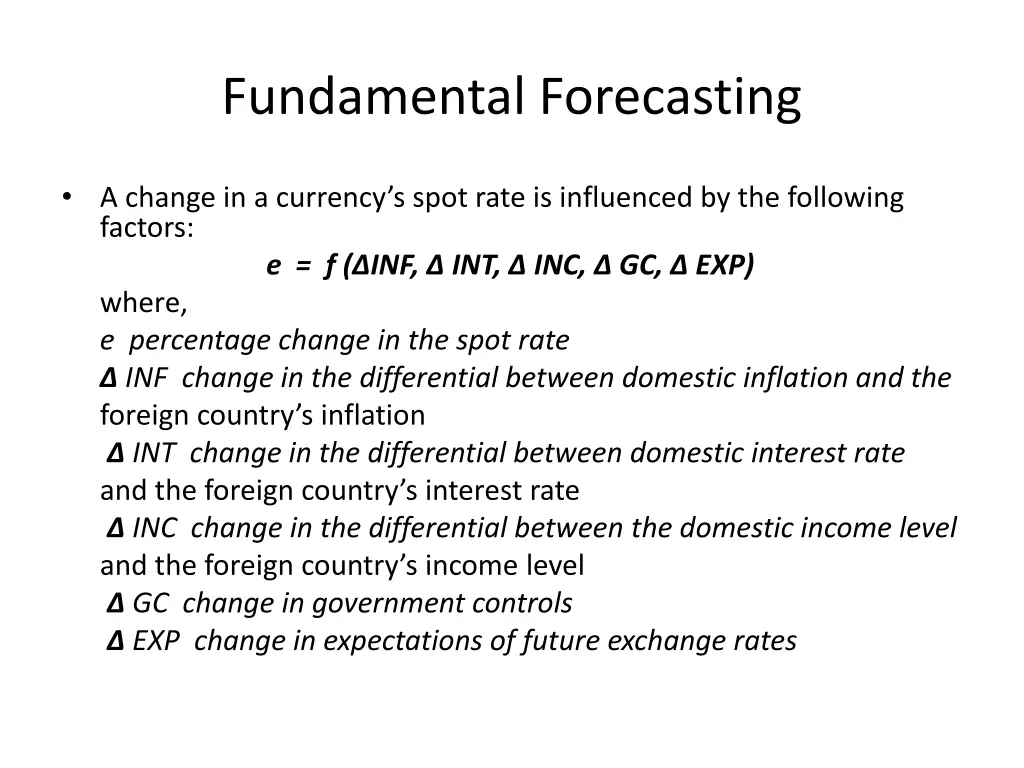
Fundamental Forecasting A change in a currency s spot rate is influenced by the following factors: e = f ( INF, INT, INC, GC, EXP) where, e percentage change in the spot rate INF change in the differential between domestic inflation and the foreign country s inflation INT change in the differential between domestic interest rate and the foreign country s interest rate INC change in the differential between the domestic income level and the foreign country s income level GC change in government controls EXP change in expectations of future exchange rates
Fundamental Forecasting Given current values of these variables along with their historical impact on a currency s value, corporations can develop exchange rate projections.
Use of purchasing power parity (PPP) for Fundamental Forecasting
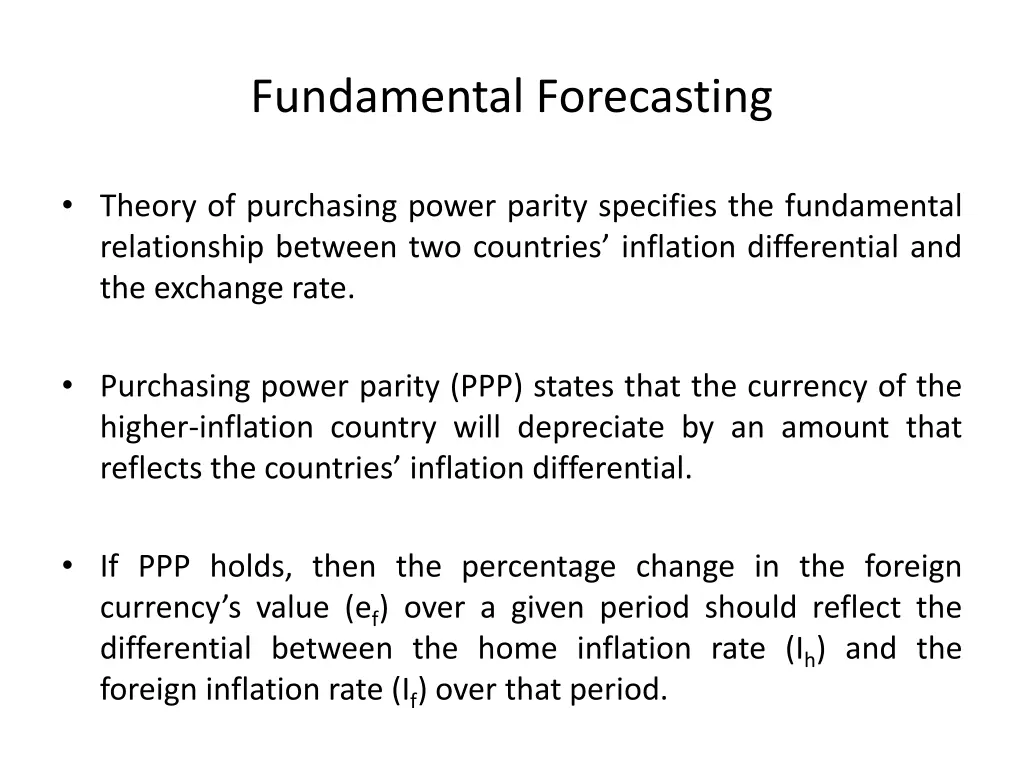
Fundamental Forecasting Theory of purchasing power parity specifies the fundamental relationship between two countries inflation differential and the exchange rate. Purchasing power parity (PPP) states that the currency of the higher-inflation country will depreciate by an amount that reflects the countries inflation differential. If PPP holds, then the percentage change in the foreign currency s value (ef) over a given period should reflect the differential between the home inflation rate (Ih) and the foreign inflation rate (If) over that period.
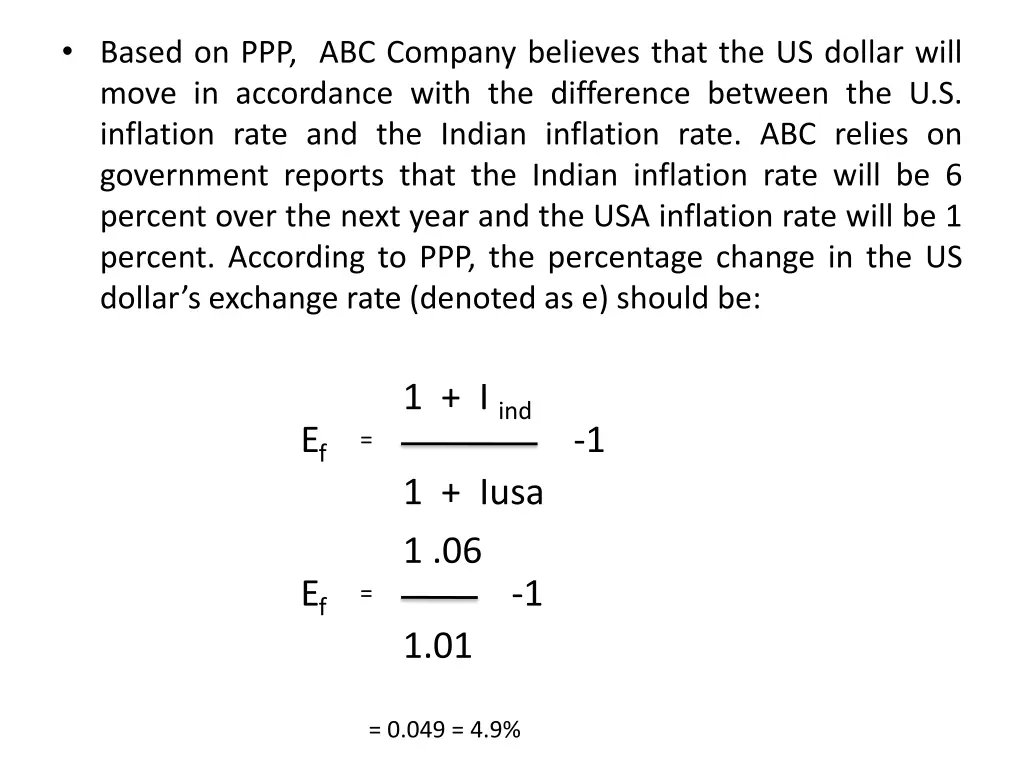
Based on PPP, ABC Company believes that the US dollar will move in accordance with the difference between the U.S. inflation rate and the Indian inflation rate. ABC relies on government reports that the Indian inflation rate will be 6 percent over the next year and the USA inflation rate will be 1 percent. According to PPP, the percentage change in the US dollar s exchange rate (denoted as e) should be: 1 + I ind Ef = -1 1 + Iusa 1 .06 Ef = -1 1.01 = 0.049 = 4.9%
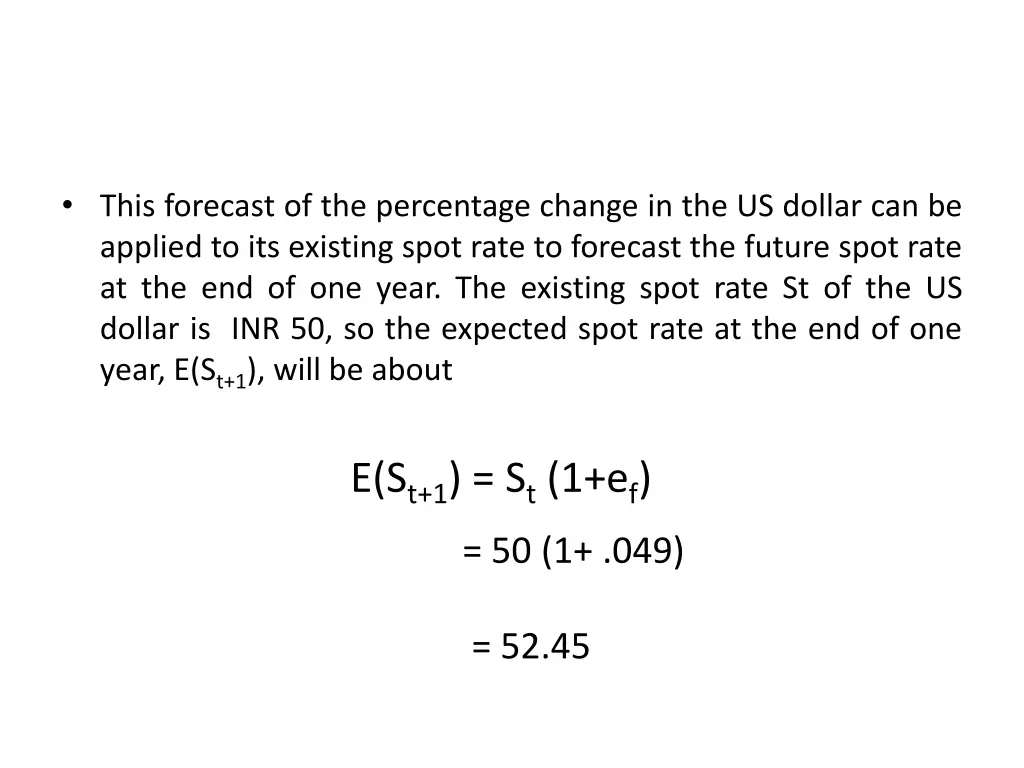
This forecast of the percentage change in the US dollar can be applied to its existing spot rate to forecast the future spot rate at the end of one year. The existing spot rate St of the US dollar is INR 50, so the expected spot rate at the end of one year, E(St+1), will be about E(St+1) = St (1+ef) = 50 (1+ .049) = 52.45
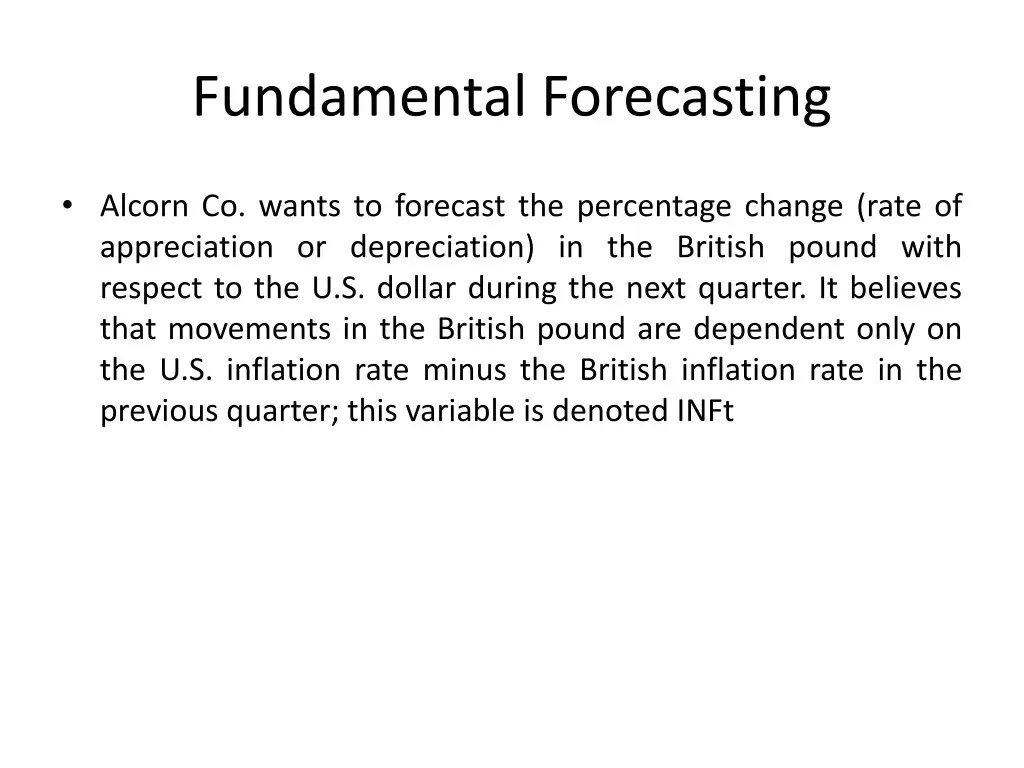
Fundamental Forecasting Alcorn Co. wants to forecast the percentage change (rate of appreciation or depreciation) in the British pound with respect to the U.S. dollar during the next quarter. It believes that movements in the British pound are dependent only on the U.S. inflation rate minus the British inflation rate in the previous quarter; this variable is denoted INFt
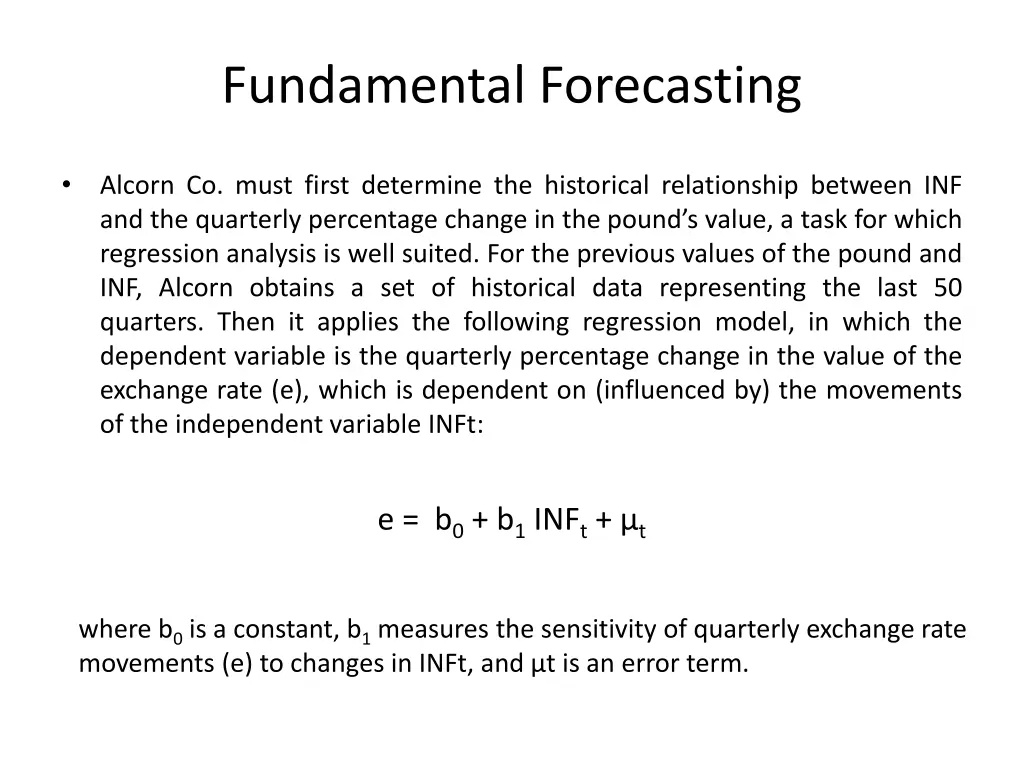
Fundamental Forecasting Alcorn Co. must first determine the historical relationship between INF and the quarterly percentage change in the pound s value, a task for which regression analysis is well suited. For the previous values of the pound and INF, Alcorn obtains a set of historical data representing the last 50 quarters. Then it applies the following regression model, in which the dependent variable is the quarterly percentage change in the value of the exchange rate (e), which is dependent on (influenced by) the movements of the independent variable INFt: e = b0 + b1 INFt + t where b0 is a constant, b1 measures the sensitivity of quarterly exchange rate movements (e) to changes in INFt, and t is an error term.
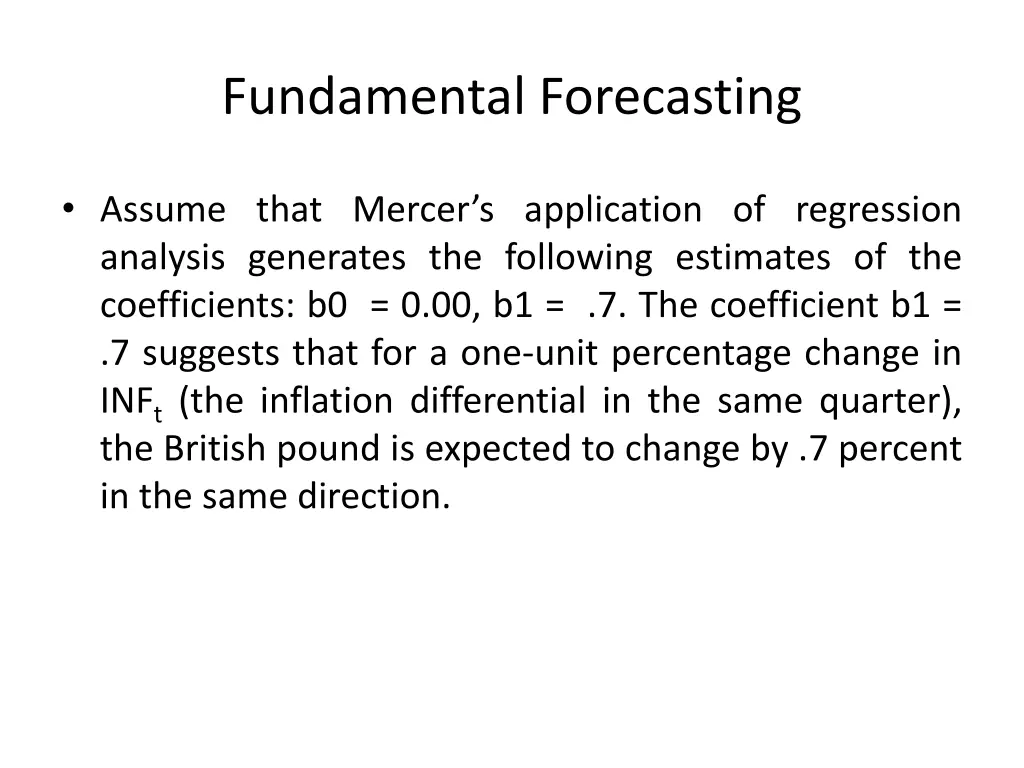
Fundamental Forecasting Assume that Mercer s application of regression analysis generates the following estimates of the coefficients: b0 = 0.00, b1 = .7. The coefficient b1 = .7 suggests that for a one-unit percentage change in INFt (the inflation differential in the same quarter), the British pound is expected to change by .7 percent in the same direction.
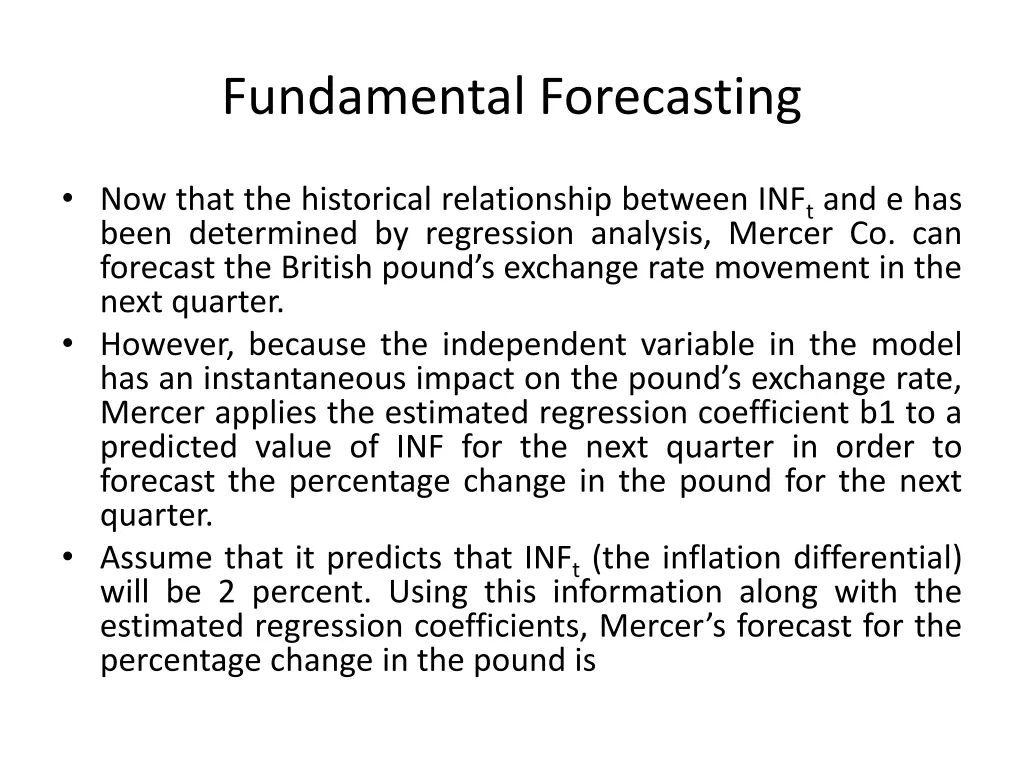
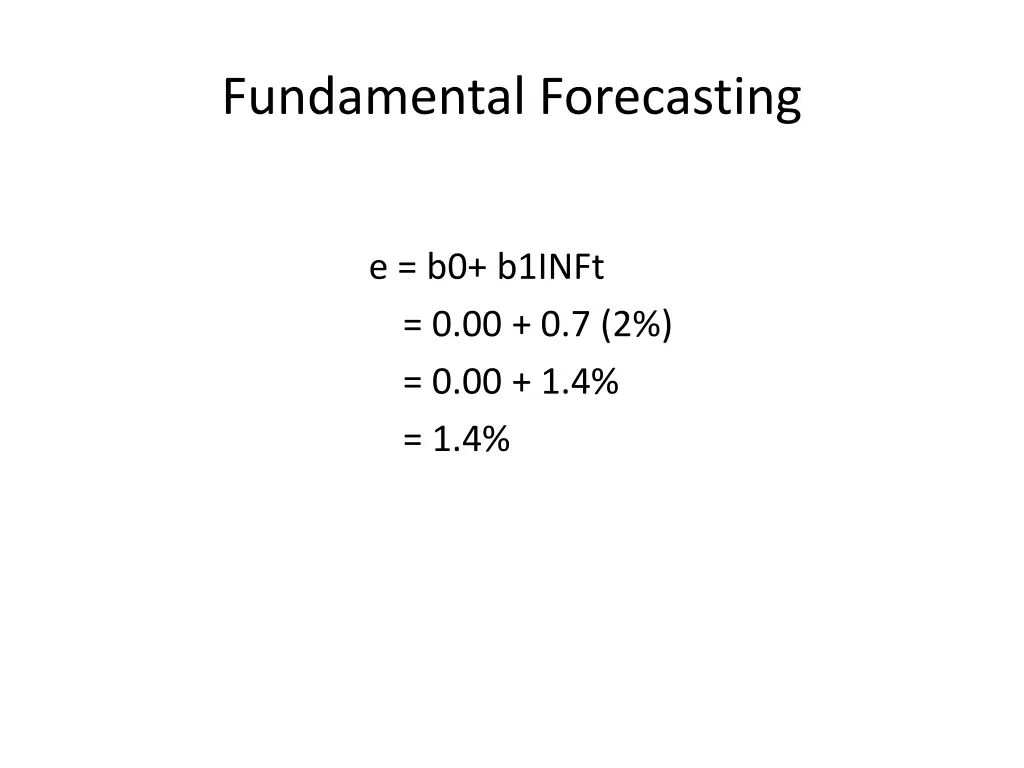
Fundamental Forecasting Now that the historical relationship between INFt and e has been determined by regression analysis, Mercer Co. can forecast the British pound s exchange rate movement in the next quarter. However, because the independent variable in the model has an instantaneous impact on the pound s exchange rate, Mercer applies the estimated regression coefficient b1 to a predicted value of INF for the next quarter in order to forecast the percentage change in the pound for the next quarter. Assume that it predicts that INFt (the inflation differential) will be 2 percent. Using this information along with the estimated regression coefficients, Mercer s forecast for the percentage change in the pound is
Fundamental Forecasting = 0.00 + 0.7 (2%) = 0.00 + 1.4% = 1.4% e = b0+ b1INFt
Mixed Forecasting No single forecasting technique has been found to be consistently superior to the others, some MNCs prefer to use a combination of forecasting techniques. This method is referred to as mixed forecasting. Various forecasts for a particular currency value are developed using several forecasting techniques. The techniques used are assigned relative weights that total 100 percent, with the techniques considered more reliable being assigned higher weights. The actual forecast of the currency is a weighted average of the various forecasts developed.
Mixed Forecasting College Station, Inc., needs to assess the value of the Mexican peso because it is considering expanding its business in that country. The conclusions that would be drawn from each forecasting technique which reveals that the forecasted direction of the peso s value depends on the technique used. The fundamental forecast predicts the peso will appreciate, whereas the technical and market-based forecasts predict it will depreciate. It is noteworthy that, even though the fundamental and market-based forecasts are both driven by the same factor (interest rates), the results are distinctly different.
Mixed Forecasting An MNC might decide that only the technical and market-based forecasts are relevant when forecasting in one period but that, in some other period, only the fundamental forecast is relevant. The selection of a forecasting technique may also vary with the particular currency involved. At any given time the MNC may decide, for instance, that a market-based forecast provides the best prediction for the pound whereas fundamental forecasting generates the best prediction for the New Zealand dollar and technical forecasting the best prediction for the Mexican peso.
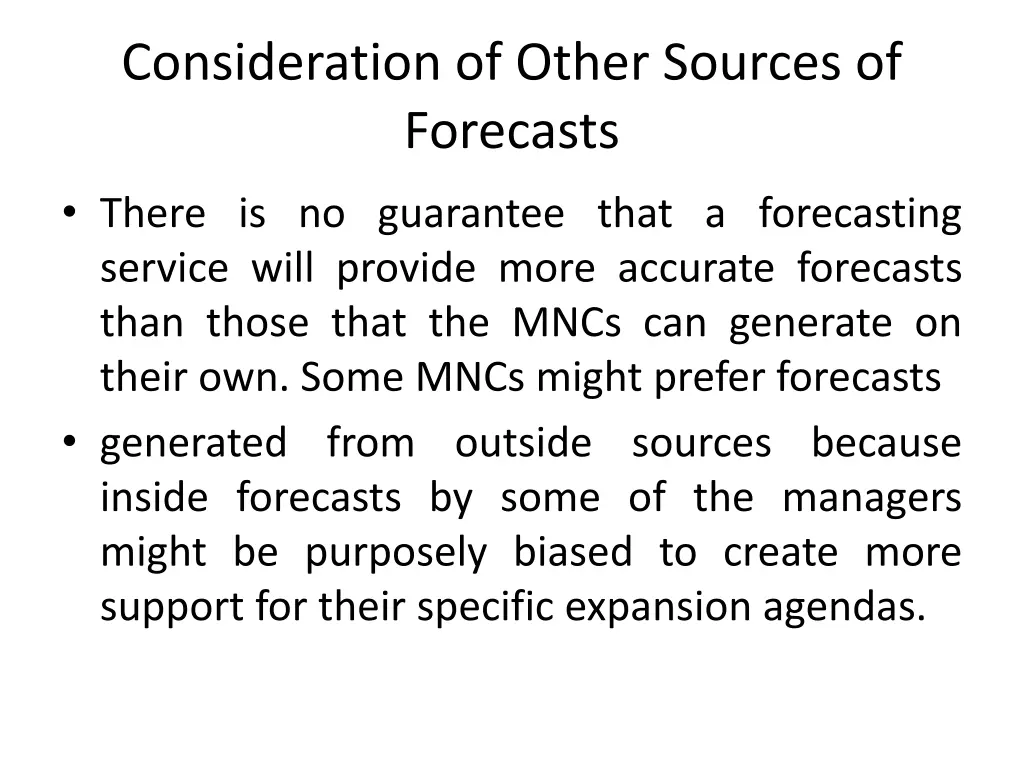
Consideration of Other Sources of Forecasts Because forecasting exchange rates is subject to considerable error, MNCs may complement their forecast with forecasts from outside sources, such as a bank or securities firm that provides forecasting services. Some forecasting services specialize in technical forecasts while others specialize in fundamental forecasts. These services can accommodate a wide range of forecast horizons ranging from one month to ten years.
Consideration of Other Sources of Forecasts There is no guarantee that a forecasting service will provide more accurate forecasts than those that the MNCs can generate on their own. Some MNCs might prefer forecasts generated from outside sources because inside forecasts by some of the managers might be purposely biased to create more support for their specific expansion agendas.
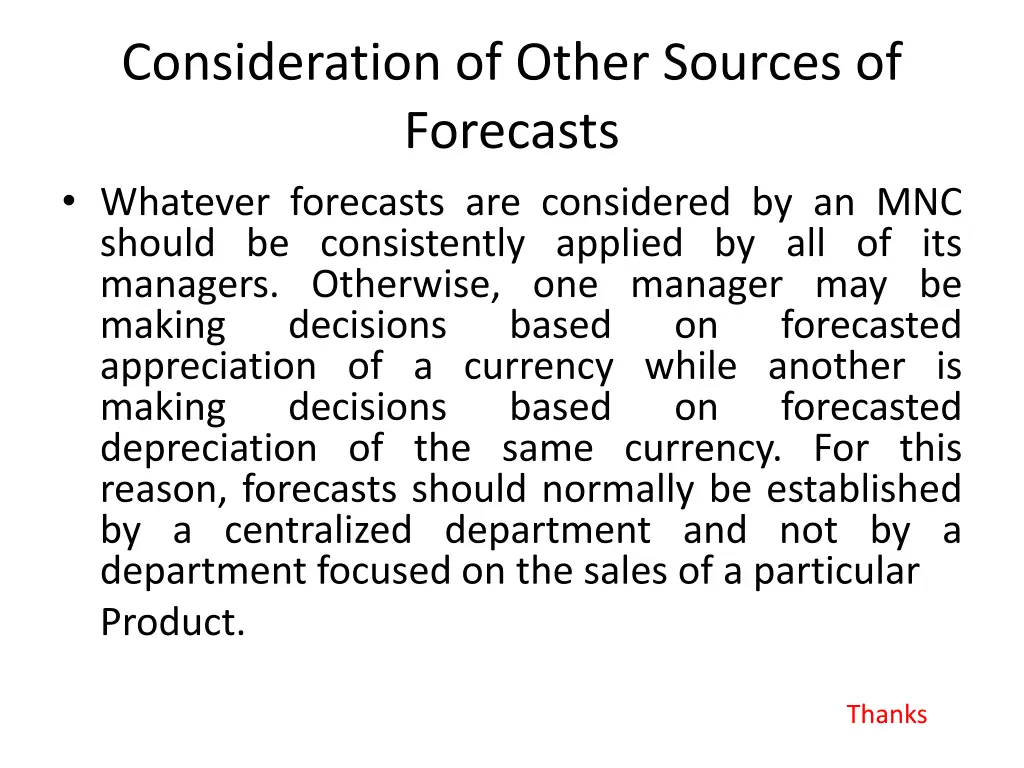
Consideration of Other Sources of Forecasts Whatever forecasts are considered by an MNC should be consistently applied by all of its managers. Otherwise, one manager may be making decisions based appreciation of a currency while another is making decisions based depreciation of the same currency. For this reason, forecasts should normally be established by a centralized department and not by a department focused on the sales of a particular Product. on forecasted on forecasted Thanks
Source: International bekaert and robert hodrick International Financial Management by Jeff Madura 9th Edition Financial Management by