Exclusion of Intelligence and Scientific Organizations from RTI Act
Section 24 of the RTI Act, 2005 discusses the exclusion of intelligence and scientific organizations from the provisions of the Act, contemplating between larger public interest and possible evasions of responsibilities. The Act aims to promote accountability in public authorities by enhancing transparency and combating corruption effectively, with a focus on the fundamental right to freedom of speech and expression as enshrined in Article 19(1)(a) of the Indian Constitution.

Download Presentation

Please find below an Image/Link to download the presentation.
The content on the website is provided AS IS for your information and personal use only. It may not be sold, licensed, or shared on other websites without obtaining consent from the author.If you encounter any issues during the download, it is possible that the publisher has removed the file from their server.
You are allowed to download the files provided on this website for personal or commercial use, subject to the condition that they are used lawfully. All files are the property of their respective owners.
The content on the website is provided AS IS for your information and personal use only. It may not be sold, licensed, or shared on other websites without obtaining consent from the author.
E N D
Presentation Transcript
Exclusion of Intelligence and Scientific Organizations from Provisions of RTI Act, 2005 DEEPAK SINGH JEENA HPT-42, SAROJINI NAGAR, NEW DELHI-110023
Section 24 of RTI Act, 2005 Larger public interest OR Turning into tool to evade responsibility and natural duties
Discussion Article 19(1)(a) of the Constitution of India (Fundamental right) Freedom of Speech and expression Article 19(2): Reasonable restrictions ..sovereignty & integrity of India, Security of the State, friendly relations with foreign States, public order, decency or morality, or in relation to contempt of court, defamation or incitement to an offence
Right to Information Act, 2005 OBJECTIVE:- Promote accountability Public Authorities ; Reducing manner by means of promoting Transparency and accountability transparency in functioning and of corruption in effective
Observations of Honble High Court of Delhi (Secretary General, Supreme Court V/s S.C. Agarwal) The source of right to information does not emanate from the Right to Information Act. It is a right that constitutional guarantees 19(1)(a) as held by the Supreme Court in a catena of decisions. emerges from the under Article
Observations of Honble High Court of Delhi (contd..) The Right to Information Act is not repository of the right to information. Its repository is the constitutional rights guaranteed under Article 19((1)(a). The Act is merely an instrument that lays down statutory procedure in the exercise of this right
Important aspect of RTI Act, 2005 Information unless exempted under Section 8(1) and 9 may be provided either in Suo motu manner so that public have minimum provisions of RTI Act, 2005 OR on application under stipulated time frame. resort to RTI within
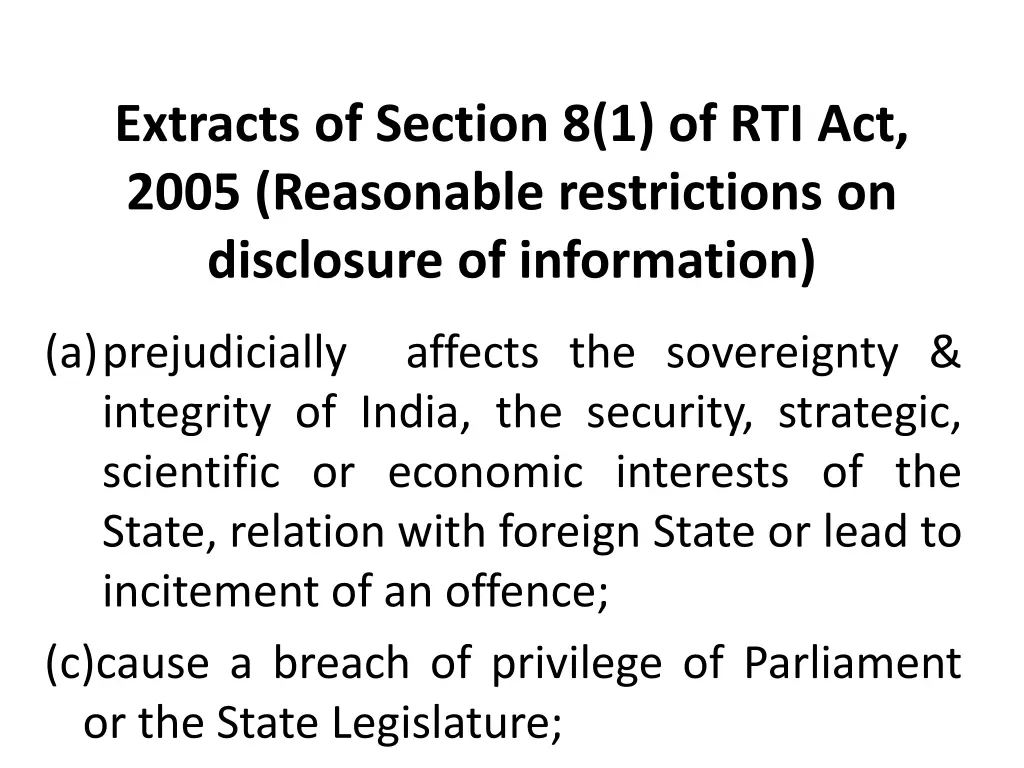
Extracts of Section 8(1) of RTI Act, 2005 (Reasonable restrictions on disclosure of information) (a)prejudicially integrity of India, the security, strategic, scientific or economic interests of the State, relation with foreign State or lead to incitement of an offence; (c)cause a breach of privilege of Parliament or the State Legislature; affects the sovereignty &
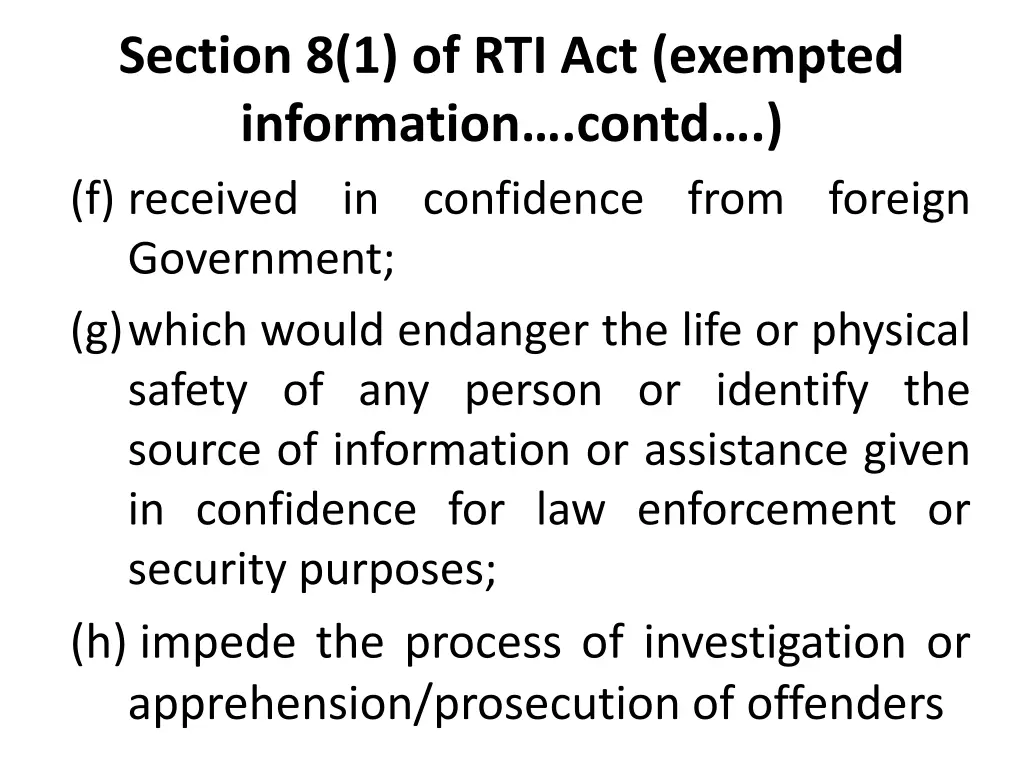
Section 8(1) of RTI Act (exempted information .contd .) (f) received in confidence from foreign Government; (g)which would endanger the life or physical safety of any person or identify the source of information or assistance given in confidence for law enforcement or security purposes; (h) impede the process of investigation or apprehension/prosecution of offenders
Section 24 of the RTI Act, 2005 Additional safeguard to Intelligence and Scientific Organizations in the larger public interest; Provisions of RTI Act, 2005 would not apply to certain Intelligence Organizations, second schedule of RTI Act, 2005 by Government. Scientific and placed in
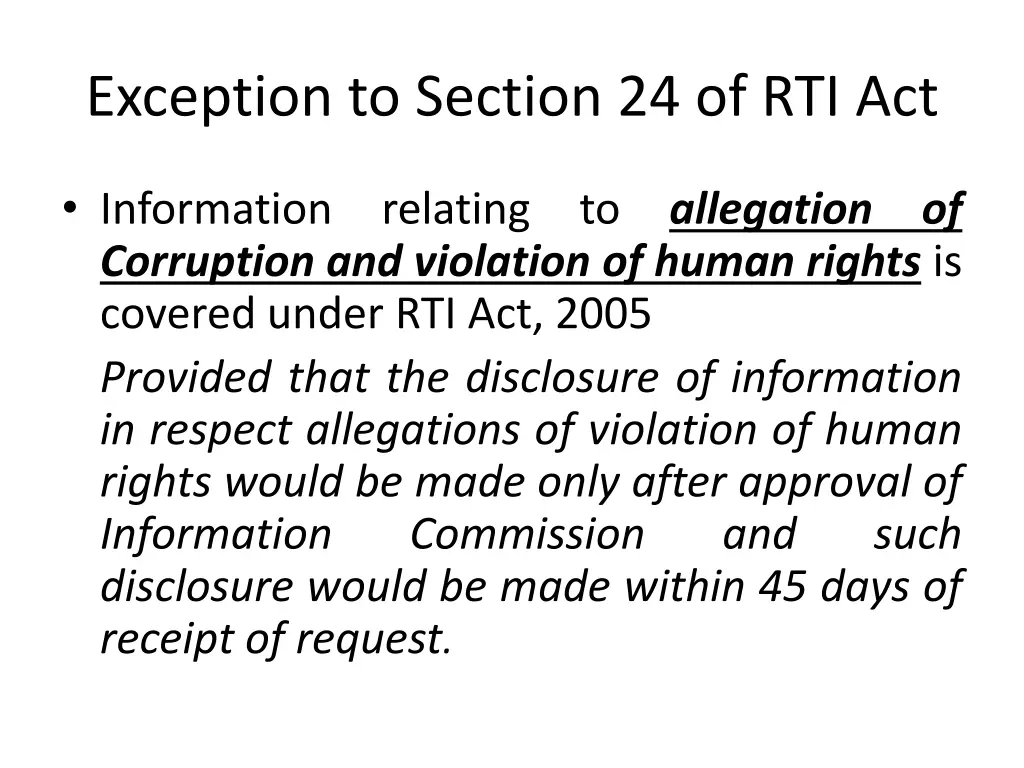
Exception to Section 24 of RTI Act Information Corruption and violation of human rights is covered under RTI Act, 2005 Provided that the disclosure of information in respect allegations of violation of human rights would be made only after approval of Information Commission disclosure would be made within 45 days of receipt of request. relating to allegation of and such
Insoluble Dilemma of Section 24 of RTI Act, 2005:- Time administrative/quasi judicial functions; bound disclosure vis a vis Lack of transparency and responsibility Lack of understanding of human rights by Public Authorities
Time bound disclosure vis a vis administrative/quasi judicial functions Certain functions etc are performed by Public Authorities, which have no relation with work relating to intelligence and security or strategy but which are concerned with rights of employees/people. administrative, quasi judicial
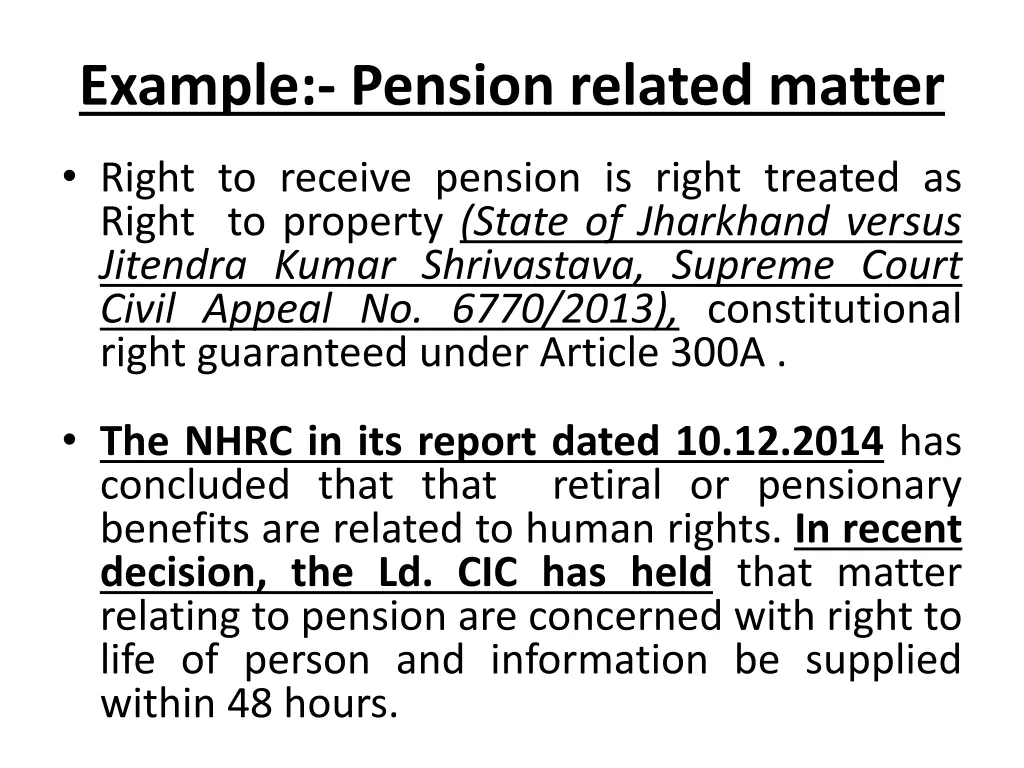
Example:- Pension related matter Right to receive pension is right treated as Right to property (State of Jharkhand versus Jitendra Kumar Shrivastava, Supreme Court Civil Appeal No. 6770/2013), constitutional right guaranteed under Article 300A . The NHRC in its report dated 10.12.2014 has concluded that that benefits are related to human rights. In recent decision, the Ld. CIC has held that matter relating to pension are concerned with right to life of person and information be supplied within 48 hours. retiral or pensionary
FAA, Addl DGP CID of Haryana v CIC CWP No. 12904/2009 The Hon ble High Court of Punjab and Haryana explained that all information sought not concerned with security and intelligence shall be given. A combined reading of these provisions would reveal, only that information is exempted, which is directly effecting and corelated to the Intelligence and Security of that organization of the State and not otherwise.
Contrary view of the Honble High Court in Directorate General of Security and Anr. Vs. Harender ..Provisions of the RTI Act would not apply to the Aviation Research Centre except in the matters relating to allegations of corruption and human rights violation .No violation of human rights is involved in service matters, such as promotion, disciplinary actions, pay increments, retiral gratuity, etc benefits, pension,
Pensioner case (Contd.) A retired employee, retired on superannuation from any Intelligence & Scientific Organization (eg. DRDO, CBI etc) may not ask information for delay etc. in releasing pensionary benefits to him/her as a matter of right under RTI Act, 2005 in view of the contrary judgement of Hon ble Delhi High Court. Atleast 30 (application)+ 30 (first appeal) + 90 (second appeal) =150 days required for final decision under RTI Act with consent of Information Commission.
Consequences of delay in disclosure: Reckless authorities would be protected by non disclosure; Time bound disclosure under RTI would defeat Undue delay in disclosure of information may result in harassment and mental torture of applicant/pensioner (Violation of right to life).
LACK OF TRANSPARENCY AND RESPONSIBILITY Transparency is important tool to combat corruption and to promote accountability in functioning of Public Authority. Section 24 of RTI Act, 2005 is always prone to misuse /exploitation Authorities to conceal infringement. by wrong Public or
Example: Case of sexual harassment Violation of fundamental rights of woman guaranteed by the Constitution of India especially Article 21 (Right to Life). Domestic harassment against women are human right issues as explained by Hon ble Supreme Court of India in Criminal Appeal No. 2009/2013 Indra Sarma v. V.K.V. Sarma violence, Cruelty or Sexual
Duty of Employer on receipt of complaints The fair and time bound investigation on the complaint of cruelty/sexual harassment is the integral component of natural justice and component of right guaranteed by Article 21 of the Constitution of India. Preliminary investigation to be completed in period not more than 90 days. Suo motu disclosure of investigation reports to the Complainant/victim .
Real problems faced by victim who files complaint against employee of any Intelligence and Scientific organization Delay in initiation of proceedings without any reasons ; Non disclosure of investigation report in suo motu manner to victim; Denial of information u/s 24 of RTI Act, 2005;
Consequence of claiming exemption u/s Section 24 in case of complaints Non disclosure, either in suo moto manner or on receipt of application under RTI Act, 2005 may lead to dilemma where the wrongdoer person would be protected by non disclosure while general public would start loosing faith in functioning of public authority. The complainant or victim may be subjected to undue harassment, mental torture etc on pretext of Section 24 of RTI Act, 2005
Lack of understanding of human rights by Public Authorities:- The PIOs and First Appellate Authorities of Intelligence and Scientific Organization may not be aware of the human rights involved in the matter. The RTI Act does not say that citizen has to approach the Information Commission seeking consent for disclosure of information. Rare to see any CPIO or First Appellate Authority of afore-said organization has sought consent for disclosure of information from Commission.
Conclusion:- The Right to Information is fundamental right and may not be unreasonably restricted in routine & casual manner by any public authority. If the information is not covered under scientific, strategic or intelligence category or safety of nation, the same may not be denied in casual and mechanical manner under Section 8(1) of RTI Act, 2005. unless exempted
Conclusion (Contd..) The Section 24 of RTI Act, 2005 may not be enforced in negative manner. The Section 24 may not be exploited as tool to aid wrongs i.e lack of transparency and responsibility in the functioning of Public Authority . It may not be exploited by any Public Authority to evade their responsibility and legal and natural duties
Possible Solution to present dilemma:- Section 24 of RTI Act, 2005 may be amended by Parliament and the information pertaining to intelligence, strategy, scientific work and safety of nation may be absolutely excluded from the provisions of RTI Act, 2005, while the other information may be dealt as per provisions of RTI Act, 2005.
Possible Solution to present dilemma (Contd ) The CPIOs and the First Appellate Authority of Intelligence and Scientific Organization should be vested with similar powers, which have been vested with CPIOs and First Appellate Authorities of other public authorities in relation to all type of information except scientific, intelligence, strategic information or information relating to safety of nation.
Possible Solution to present dilemma (Contd ) The PIOs and First Appellate Authorities are required to pass speaking orders with regard to disclosure of information, which is not related to strategy, scientific, intelligence or safety of nation. The use of standard proforma information should be condemned. to deny every
References: RTI Act, 2005 Secretary General, Supreme Court V/s S.C. Agarwal (Delhi High Court) State of Jharkhand versus Jitendra Kumar Shrivastava, Supreme Court Civil Appeal No. 6770/2013 NHRC Report dated 10.12.2014 CIC order- V. Balaraman Pillai v. PIO, EPFO, Thiruvananthapuram
References (Contd..) Directorate General of Security and Anr. Vs. Harender (Delhi High Court) FAA, Addl DGP CID of Haryana v CIC CWP No. 12904/2009 (High Court of Punjab & Haryana) Criminal Appeal No. 2009/2013 Indra Sarma v. V.K.V. Sarma(Supreme Court of India) High Court of Guwahati- Writ Appeal No. 20 of 2010 (Regarding fair investigation)