Expert Lead in Literacy: Early Literacy Support Block Grant Details
Learn about the Early Literacy Support Block Grant Request for Applications in California, focusing on expert leadership in literacy implementation and support for local educational agencies. Find out how the grant aims to improve early literacy through targeted strategies and programs, with a special emphasis on building professional learning networks and enhancing literacy instruction statewide.

Download Presentation

Please find below an Image/Link to download the presentation.
The content on the website is provided AS IS for your information and personal use only. It may not be sold, licensed, or shared on other websites without obtaining consent from the author. If you encounter any issues during the download, it is possible that the publisher has removed the file from their server.
You are allowed to download the files provided on this website for personal or commercial use, subject to the condition that they are used lawfully. All files are the property of their respective owners.
The content on the website is provided AS IS for your information and personal use only. It may not be sold, licensed, or shared on other websites without obtaining consent from the author.
E N D
Presentation Transcript
Early Literacy Support Block Grant Request for Applications: Expert Lead in Literacy October 2, 2020 CALIFORNIA DEPARTMENT OF EDUCATION Tony Thurmond, State Superintendent of Public Instruction
Welcome (1) Jennifer Howerter and Julia Agostinelli Education Programs Consultants Educator Excellence and Equity Division California Department of Education 2
Welcome (2) Karla Estrada, Ed.D. Deputy Executive Director, Systems Improvement and Innovation California Collaborative for Educational Change H ctor Rico, Ed.D. Director, Systems Improvement and Innovation California Collaborative for Educational Change 3
Housekeeping Participants have been placed on mute Question/Answer session toward the end of the webinar PowerPoint with the notes will be available on the California Department of Education (CDE) Early Literacy Support Block (ELSB) Grant web page. 4
Early Literacy Support Block Grant: Local Educational Agencies Senate Bill 98 provides $50 million to fund eligible local educational agencies (LEAs) to improve early literacy using a variety of strategies, programs, and/or services. Identified LEAs are the 75 schools with the highest percentage of students in grade three scoring at level 1 on the 2018 and 2019 English Language Arts summative assessment. LEA grantees have already been identified and are posted on the ELSB grant web page. 5
Early Literacy Support Block Grant Section 114 of SB 98 (Education Omnibus Trailer Bill of 2020) appropriates $3 million from the General Fund to establish an expert lead in literacy within the Statewide System of Support (SoS). The expert lead in literacy will be a county office of education (COE), selected by the CDE, in partnership with the California Collaborative for Educational Excellence (CCEE). The expert lead in literacy will support grantees to build statewide professional learning (PL) networks and provide technical assistance to increase statewide capacity in implementing effective literacy instruction. 6
Early Literacy Support Block Grant: Local Educational Agencies The expert lead in literacy will support LEA grantees by providing help with: Culturally-responsive curriculum and instruction Evidence-based PL pertaining to the implementation of the English Language Arts/English Language Development Framework (ELA/ELD Framework) Expanded learning programs Research-based social and emotional learning approaches Multi-tiered Systems of Support Parent/guardian and community engagement 7
Early Literacy Support Block Grant: Expert Lead in Literacy Qualifications Demonstrate abilities and expertise developing, implementing, and supporting other LEAs and their schools with literacy instruction and support programs, particularly focused on literacy in early grades (kindergarten, which includes transitional kindergarten, and grades one through three) Demonstrate expertise in the four categories of programs and services specified in SB 98, Section 113(e): access to high- quality literacy teaching, support for literacy learning, pupil supports, and family and community supports 8
Early Literacy Support Block Grant: Expert Lead in Literacy Key Responsibilities Assist LEAs with eligible schools with the development of root cause analyses, needs assessments, and local literacy plans Assist LEAs with eligible schools, and the COEs that work with those LEAs, build capacity around literacy instruction and support programs As part of the SoS, and in coordination with the CDE and the CCEE, create PL networks to help build statewide capacity among LEAs in implementing effective literacy instruction and support programs at their schools 9
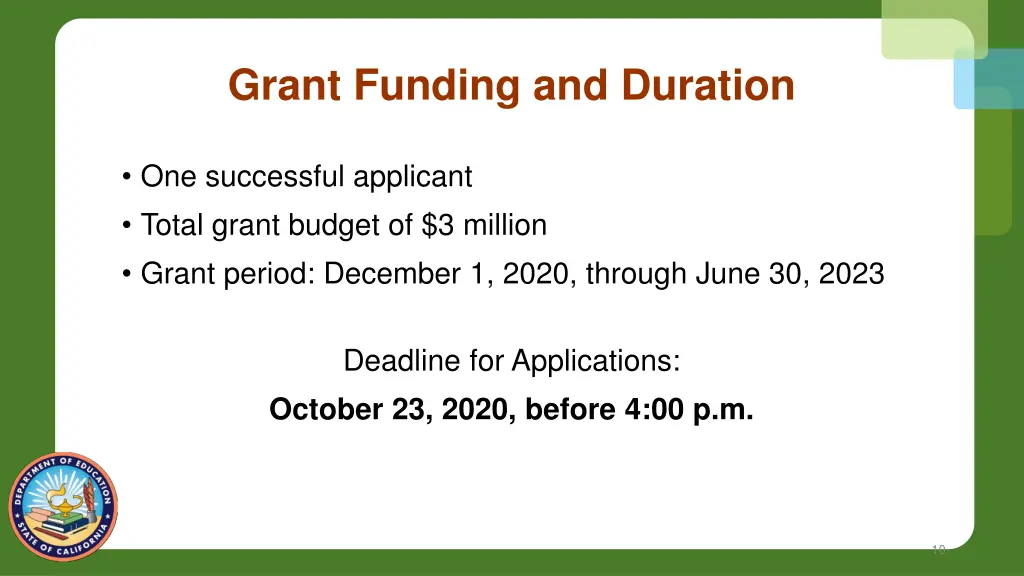
Grant Funding and Duration One successful applicant Total grant budget of $3 million Grant period: December 1, 2020, through June 30, 2023 Deadline for Applications: October 23, 2020, before 4:00 p.m. 10
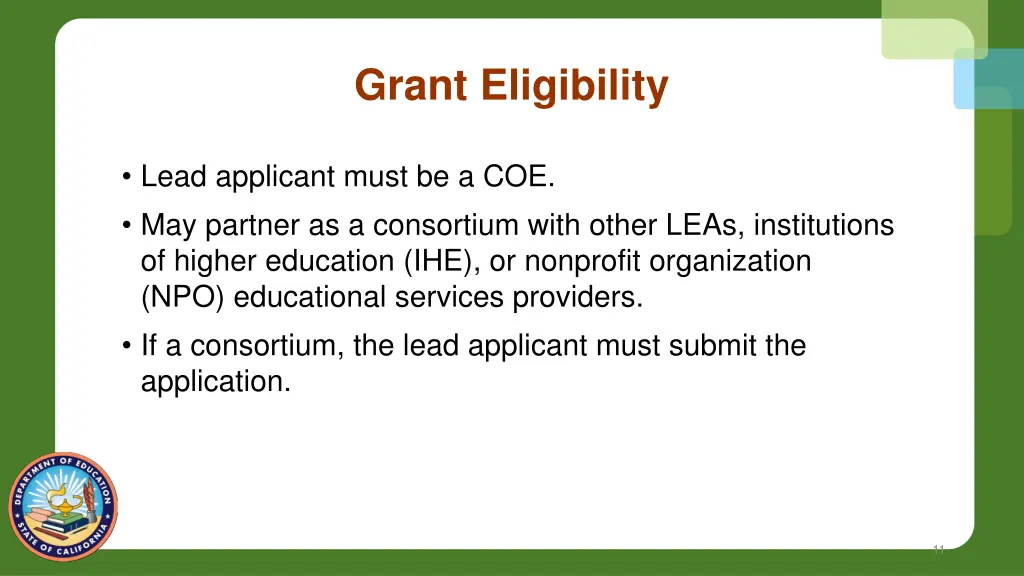
Grant Eligibility Lead applicant must be a COE. May partner as a consortium with other LEAs, institutions of higher education (IHE), or nonprofit organization (NPO) educational services providers. If a consortium, the lead applicant must submit the application. 11
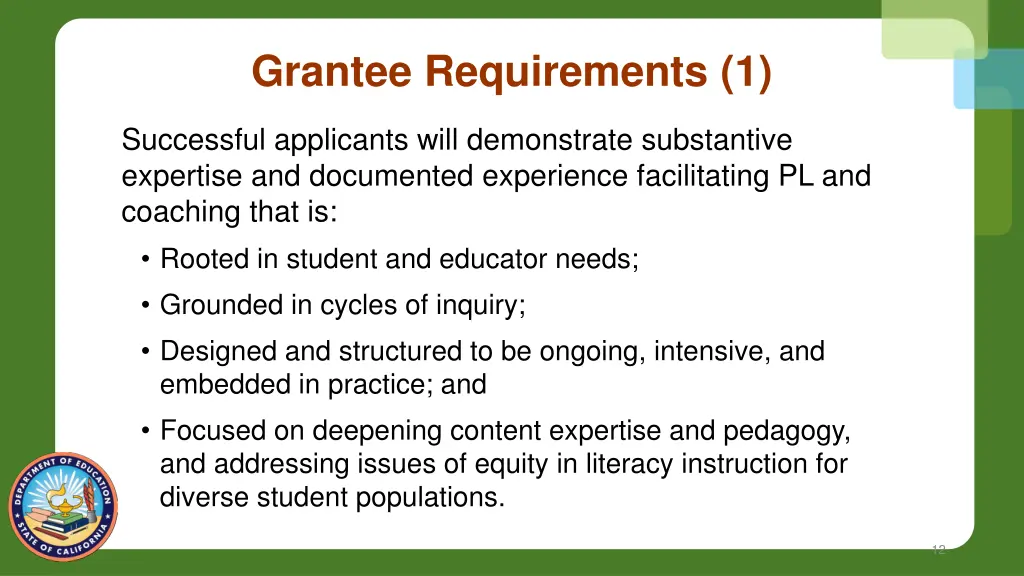
Grantee Requirements (1) Successful applicants will demonstrate substantive expertise and documented experience facilitating PL and coaching that is: Rooted in student and educator needs; Grounded in cycles of inquiry; Designed and structured to be ongoing, intensive, and embedded in practice; and Focused on deepening content expertise and pedagogy, and addressing issues of equity in literacy instruction for diverse student populations. 12
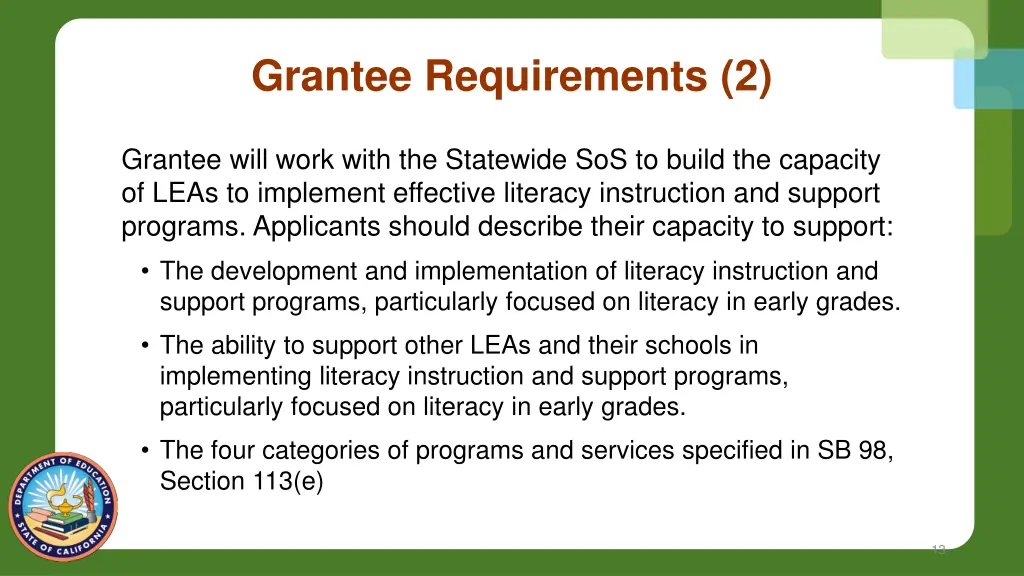
Grantee Requirements (2) Grantee will work with the Statewide SoS to build the capacity of LEAs to implement effective literacy instruction and support programs. Applicants should describe their capacity to support: The development and implementation of literacy instruction and support programs, particularly focused on literacy in early grades. The ability to support other LEAs and their schools in implementing literacy instruction and support programs, particularly focused on literacy in early grades. The four categories of programs and services specified in SB 98, Section 113(e) 13
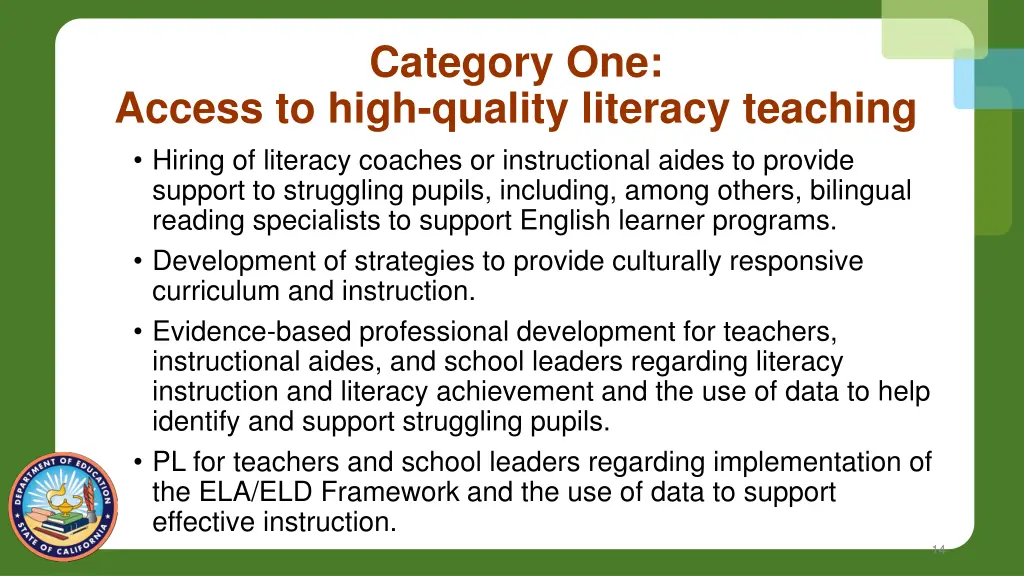
Category One: Access to high-quality literacy teaching Hiring of literacy coaches or instructional aides to provide support to struggling pupils, including, among others, bilingual reading specialists to support English learner programs. Development of strategies to provide culturally responsive curriculum and instruction. Evidence-based professional development for teachers, instructional aides, and school leaders regarding literacy instruction and literacy achievement and the use of data to help identify and support struggling pupils. PL for teachers and school leaders regarding implementation of the ELA/ELD Framework and the use of data to support effective instruction. 14
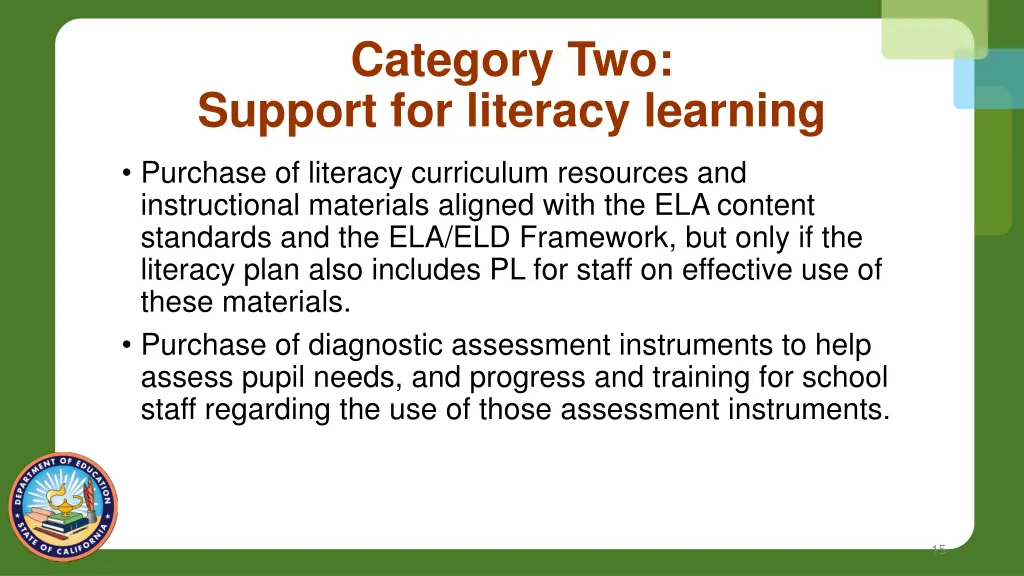
Category Two: Support for literacy learning Purchase of literacy curriculum resources and instructional materials aligned with the ELA content standards and the ELA/ELD Framework, but only if the literacy plan also includes PL for staff on effective use of these materials. Purchase of diagnostic assessment instruments to help assess pupil needs, and progress and training for school staff regarding the use of those assessment instruments. 15
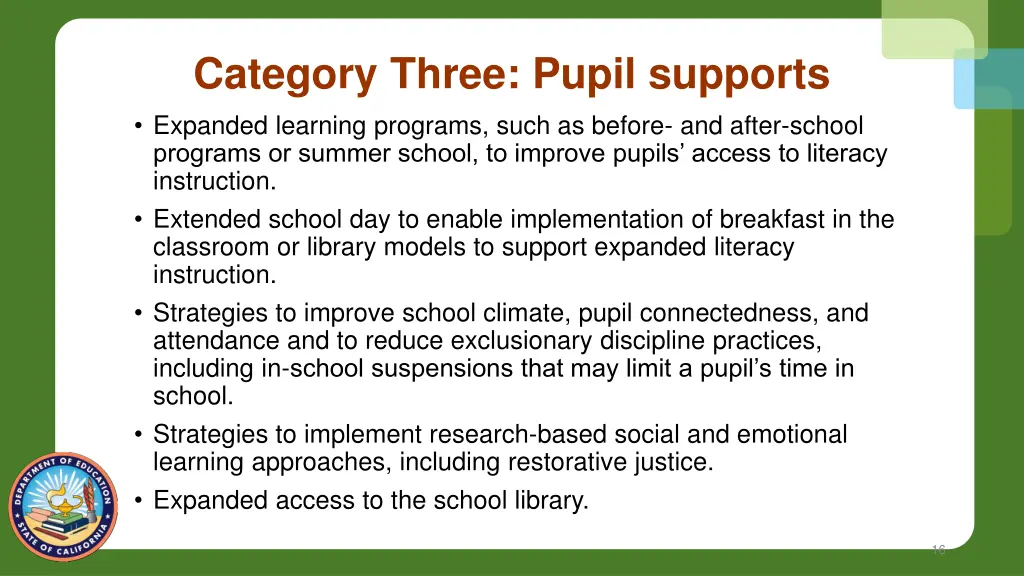
Category Three: Pupil supports Expanded learning programs, such as before- and after-school programs or summer school, to improve pupils access to literacy instruction. Extended school day to enable implementation of breakfast in the classroom or library models to support expanded literacy instruction. Strategies to improve school climate, pupil connectedness, and attendance and to reduce exclusionary discipline practices, including in-school suspensions that may limit a pupil s time in school. Strategies to implement research-based social and emotional learning approaches, including restorative justice. Expanded access to the school library. 16
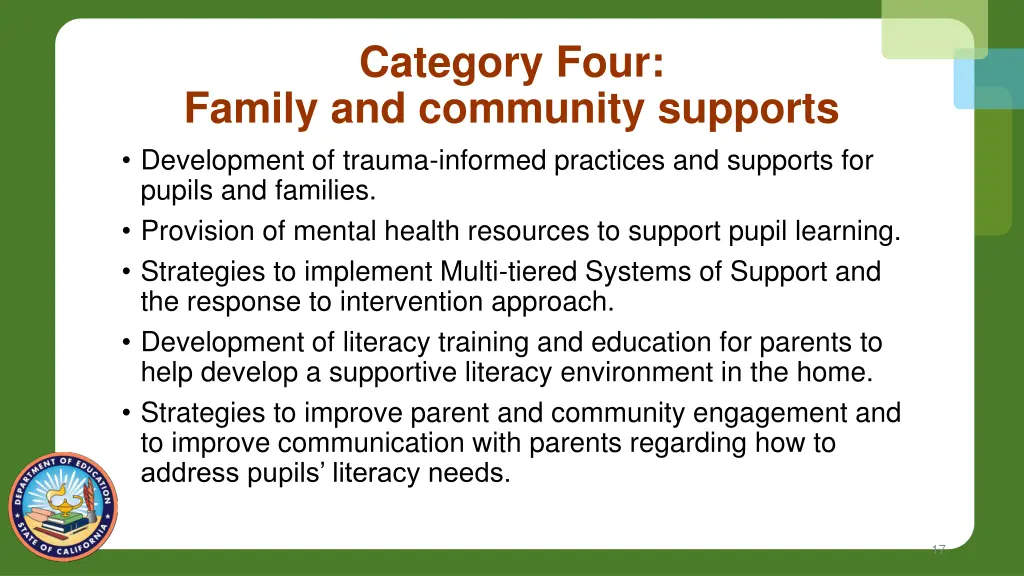
Category Four: Family and community supports Development of trauma-informed practices and supports for pupils and families. Provision of mental health resources to support pupil learning. Strategies to implement Multi-tiered Systems of Support and the response to intervention approach. Development of literacy training and education for parents to help develop a supportive literacy environment in the home. Strategies to improve parent and community engagement and to improve communication with parents regarding how to address pupils literacy needs. 17
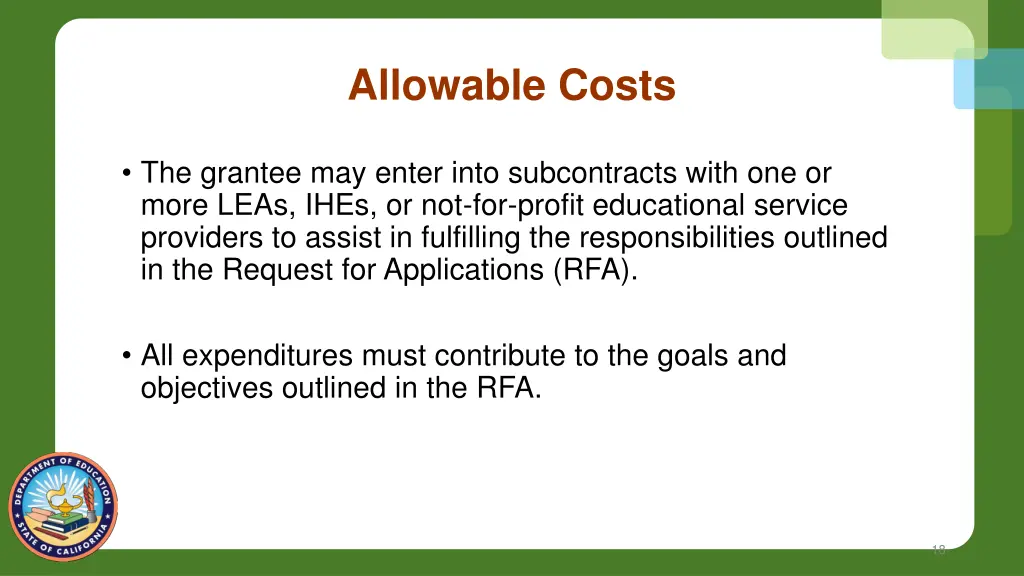
Allowable Costs The grantee may enter into subcontracts with one or more LEAs, IHEs, or not-for-profit educational service providers to assist in fulfilling the responsibilities outlined in the Request for Applications (RFA). All expenditures must contribute to the goals and objectives outlined in the RFA. 18
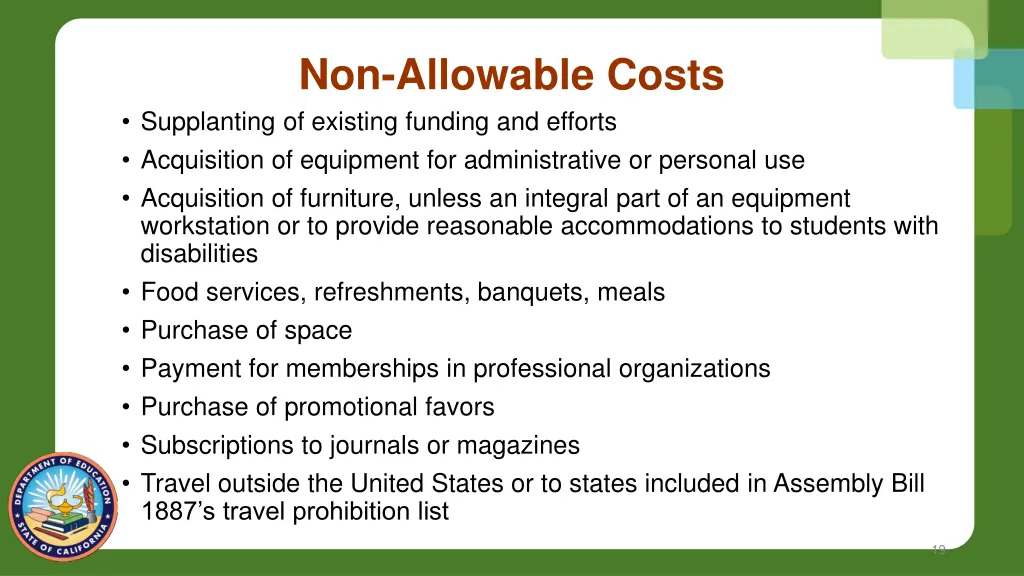
Non-Allowable Costs Supplanting of existing funding and efforts Acquisition of equipment for administrative or personal use Acquisition of furniture, unless an integral part of an equipment workstation or to provide reasonable accommodations to students with disabilities Food services, refreshments, banquets, meals Purchase of space Payment for memberships in professional organizations Purchase of promotional favors Subscriptions to journals or magazines Travel outside the United States or to states included in Assembly Bill 1887 s travel prohibition list 19
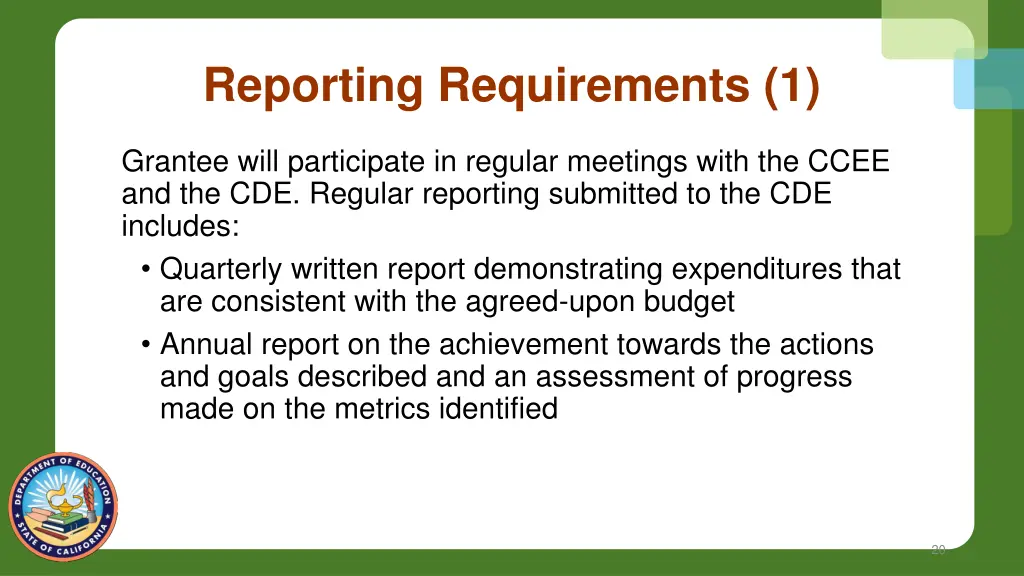
Reporting Requirements (1) Grantee will participate in regular meetings with the CCEE and the CDE. Regular reporting submitted to the CDE includes: Quarterly written report demonstrating expenditures that are consistent with the agreed-upon budget Annual report on the achievement towards the actions and goals described and an assessment of progress made on the metrics identified 20
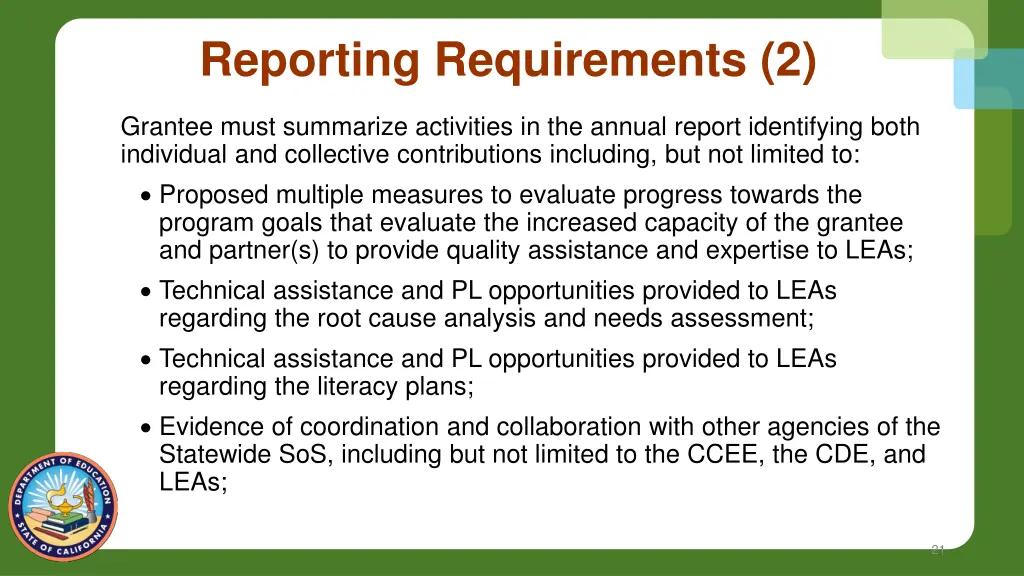
Reporting Requirements (2) Grantee must summarize activities in the annual report identifying both individual and collective contributions including, but not limited to: Proposed multiple measures to evaluate progress towards the program goals that evaluate the increased capacity of the grantee and partner(s) to provide quality assistance and expertise to LEAs; Technical assistance and PL opportunities provided to LEAs regarding the root cause analysis and needs assessment; Technical assistance and PL opportunities provided to LEAs regarding the literacy plans; Evidence of coordination and collaboration with other agencies of the Statewide SoS, including but not limited to the CCEE, the CDE, and LEAs; 21
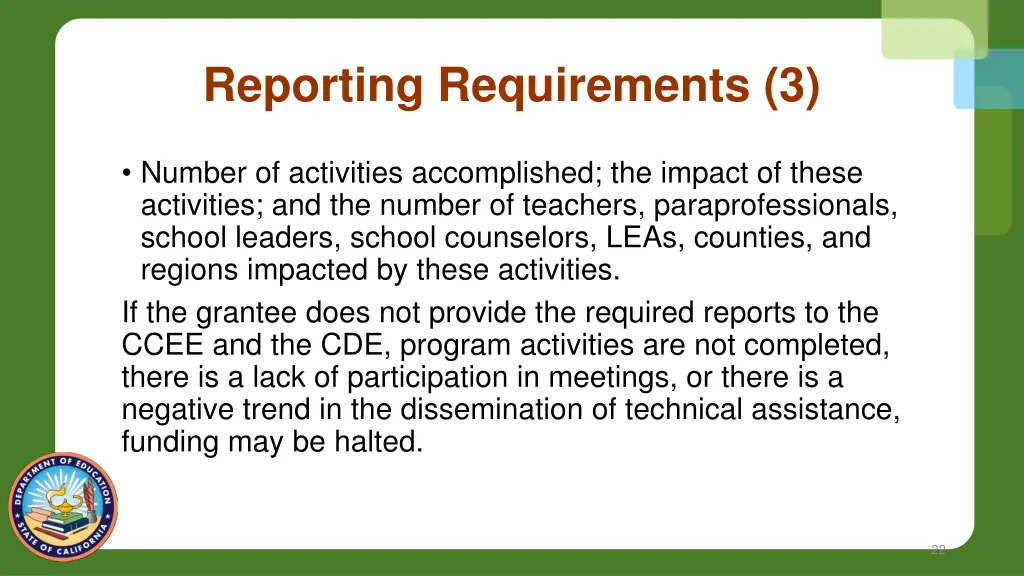
Reporting Requirements (3) Number of activities accomplished; the impact of these activities; and the number of teachers, paraprofessionals, school leaders, school counselors, LEAs, counties, and regions impacted by these activities. If the grantee does not provide the required reports to the CCEE and the CDE, program activities are not completed, there is a lack of participation in meetings, or there is a negative trend in the dissemination of technical assistance, funding may be halted. 22
Requirements of the Expert Lead in Literacy Application 23
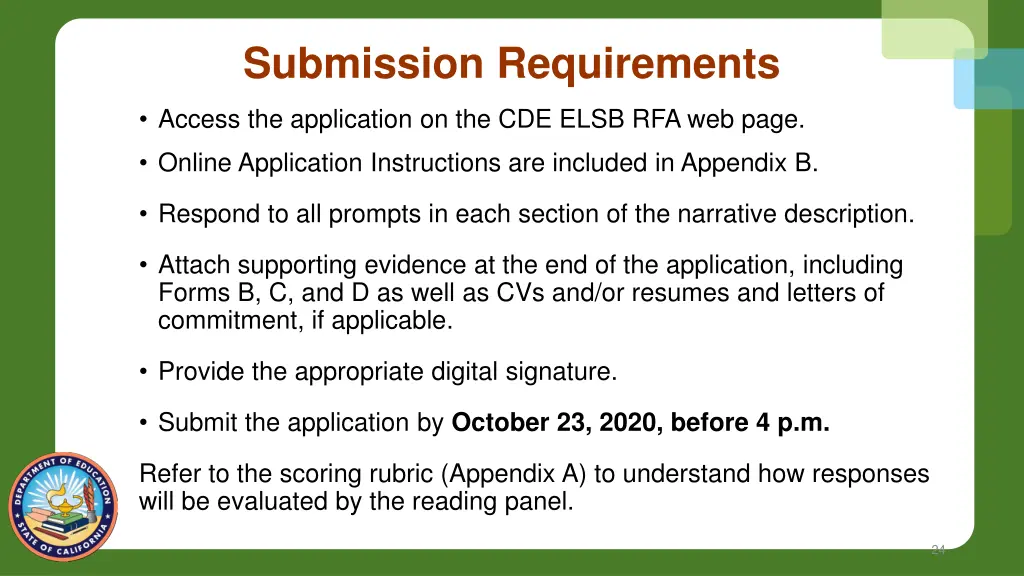
Submission Requirements Access the application on the CDE ELSB RFA web page. Online Application Instructions are included in Appendix B. Respond to all prompts in each section of the narrative description. Attach supporting evidence at the end of the application, including Forms B, C, and D as well as CVs and/or resumes and letters of commitment, if applicable. Provide the appropriate digital signature. Submit the application by October 23, 2020, before 4 p.m. Refer to the scoring rubric (Appendix A) to understand how responses will be evaluated by the reading panel. 24
Saving Responses Select the Save Responses button on the first page of the online application if you do not intend to complete the application in one session. Ensure the email address you provide is accurate. Copy the unique URL (web address) for entrance back into the application. 25
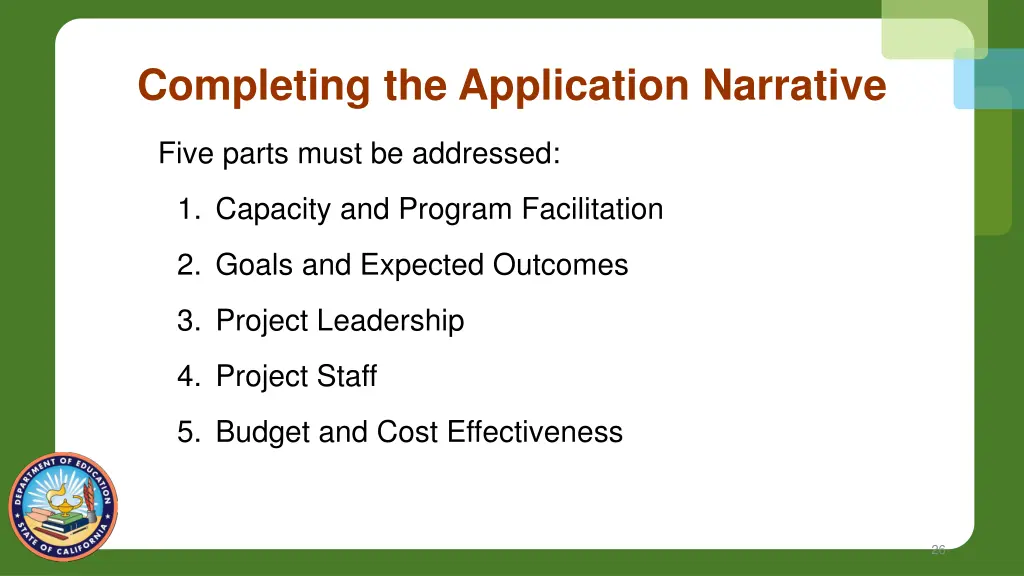
Completing the Application Narrative Five parts must be addressed: 1. Capacity and Program Facilitation 2. Goals and Expected Outcomes 3. Project Leadership 4. Project Staff 5. Budget and Cost Effectiveness 26
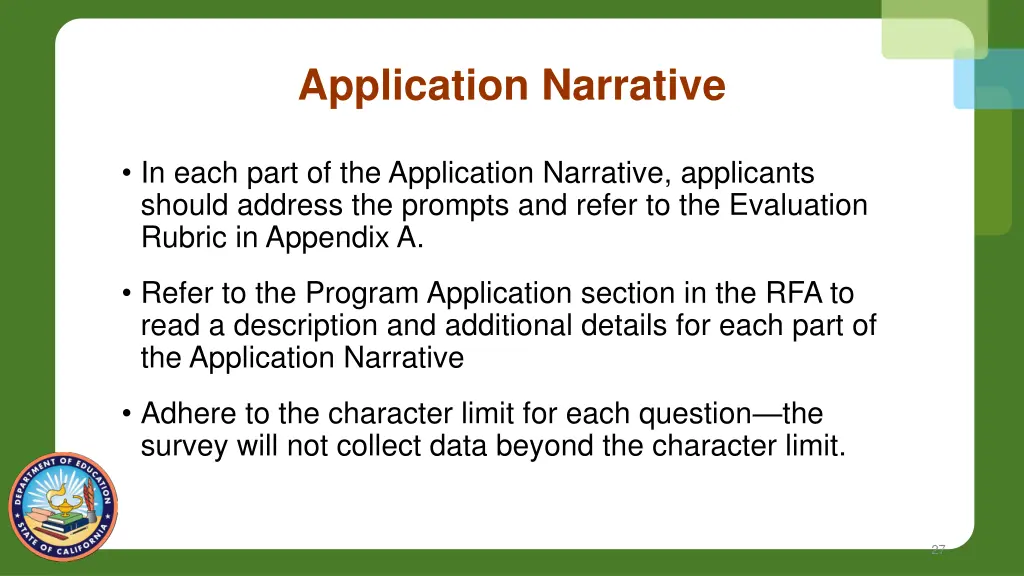
Application Narrative In each part of the Application Narrative, applicants should address the prompts and refer to the Evaluation Rubric in Appendix A. Refer to the Program Application section in the RFA to read a description and additional details for each part of the Application Narrative Adhere to the character limit for each question the survey will not collect data beyond the character limit. 27
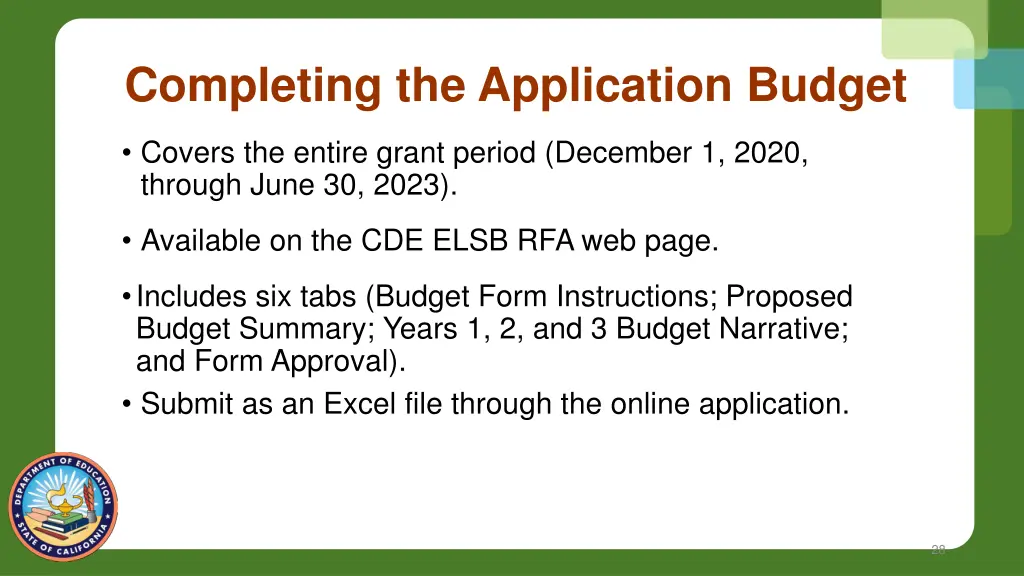
Completing the Application Budget Covers the entire grant period (December 1, 2020, through June 30, 2023). Available on the CDE ELSB RFA web page. Includes six tabs (Budget Form Instructions; Proposed Budget Summary; Years 1, 2, and 3 Budget Narrative; and Form Approval). Submit as an Excel file through the online application. 28
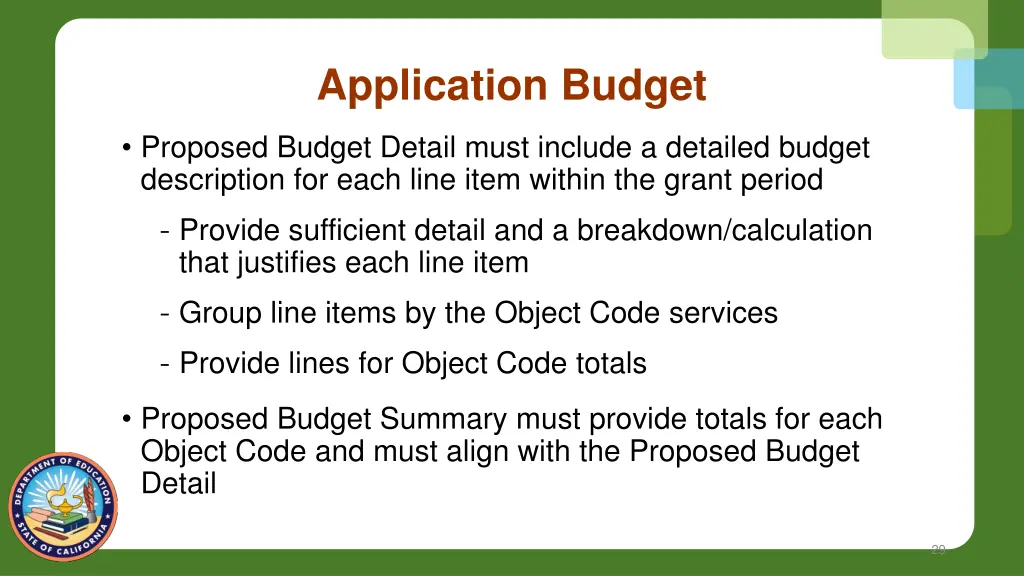
Application Budget Proposed Budget Detail must include a detailed budget description for each line item within the grant period - Provide sufficient detail and a breakdown/calculation that justifies each line item - Group line items by the Object Code services - Provide lines for Object Code totals Proposed Budget Summary must provide totals for each Object Code and must align with the Proposed Budget Detail 29
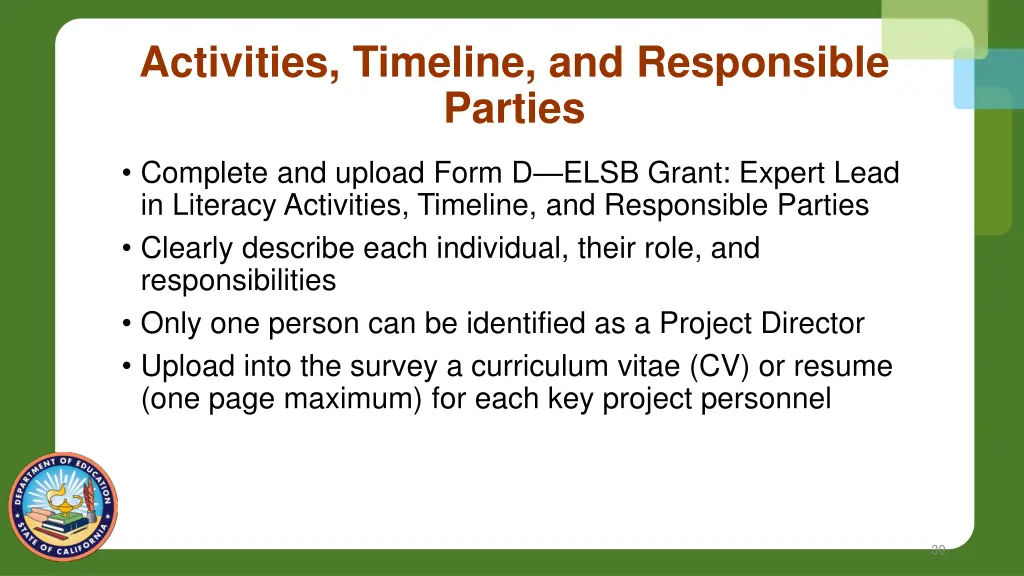
Activities, Timeline, and Responsible Parties Complete and upload Form D ELSB Grant: Expert Lead in Literacy Activities, Timeline, and Responsible Parties Clearly describe each individual, their role, and responsibilities Only one person can be identified as a Project Director Upload into the survey a curriculum vitae (CV) or resume (one page maximum) for each key project personnel 30
Letters of CommitmentOptional Upload into the survey any formal agreements or letters of commitment that demonstrate high levels of cooperation, coordination, and formalized relationships between the partners, if applicable. 31
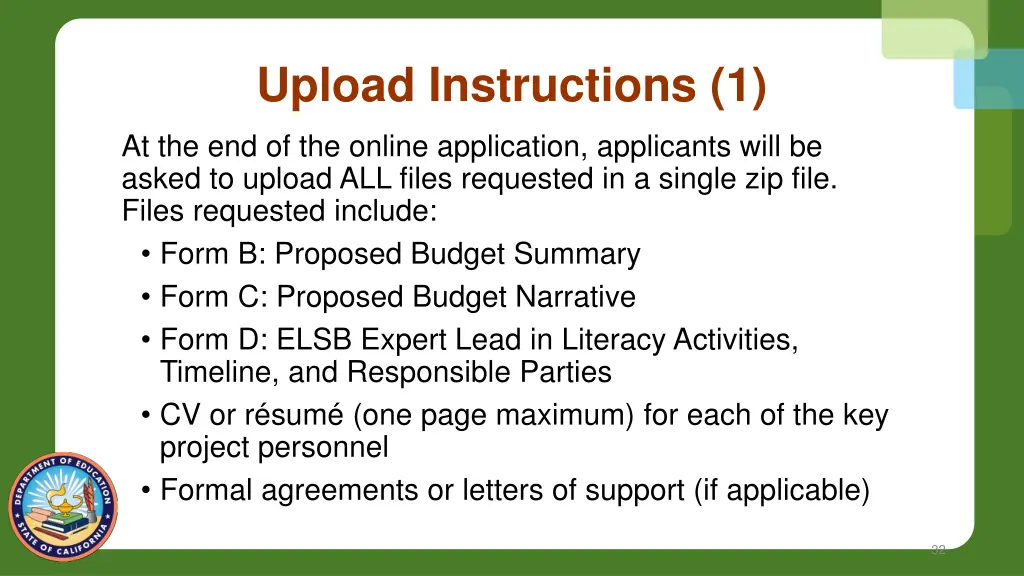
Upload Instructions (1) At the end of the online application, applicants will be asked to upload ALL files requested in a single zip file. Files requested include: Form B: Proposed Budget Summary Form C: Proposed Budget Narrative Form D: ELSB Expert Lead in Literacy Activities, Timeline, and Responsible Parties CV or r sum (one page maximum) for each of the key project personnel Formal agreements or letters of support (if applicable) 32
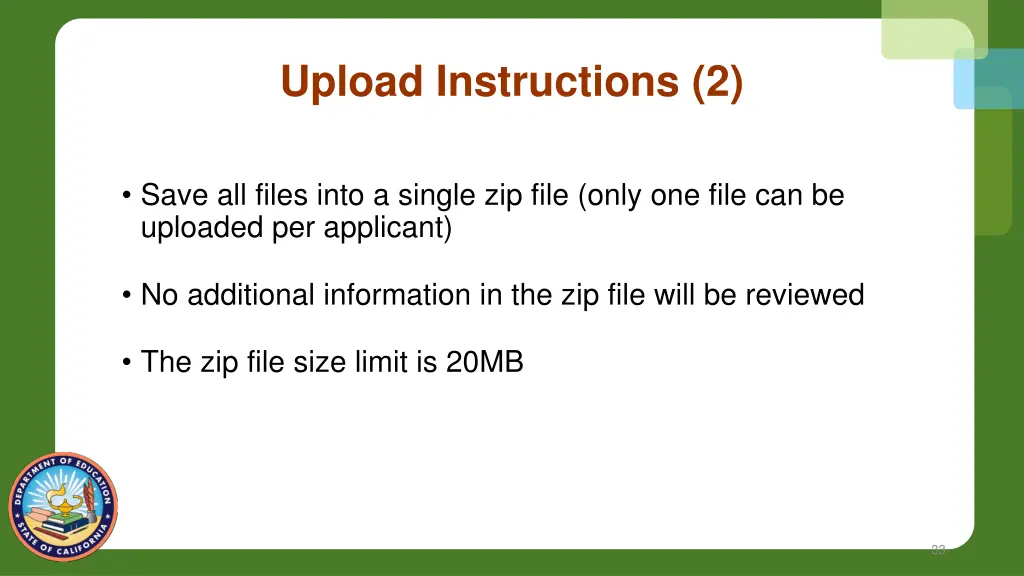
Upload Instructions (2) Save all files into a single zip file (only one file can be uploaded per applicant) No additional information in the zip file will be reviewed The zip file size limit is 20MB 33
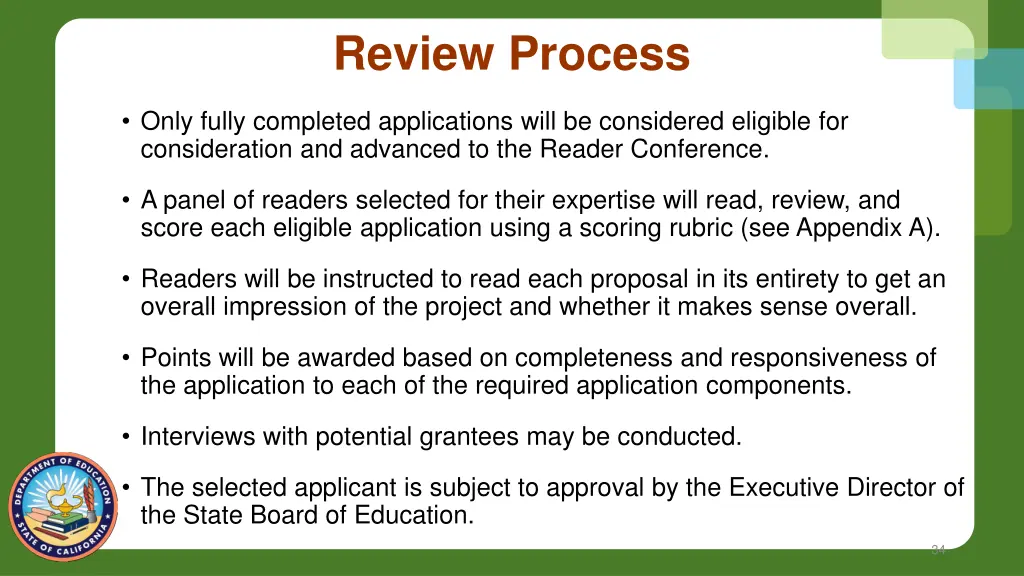
Review Process Only fully completed applications will be considered eligible for consideration and advanced to the Reader Conference. A panel of readers selected for their expertise will read, review, and score each eligible application using a scoring rubric (see Appendix A). Readers will be instructed to read each proposal in its entirety to get an overall impression of the project and whether it makes sense overall. Points will be awarded based on completeness and responsiveness of the application to each of the required application components. Interviews with potential grantees may be conducted. The selected applicant is subject to approval by the Executive Director of the State Board of Education. 34
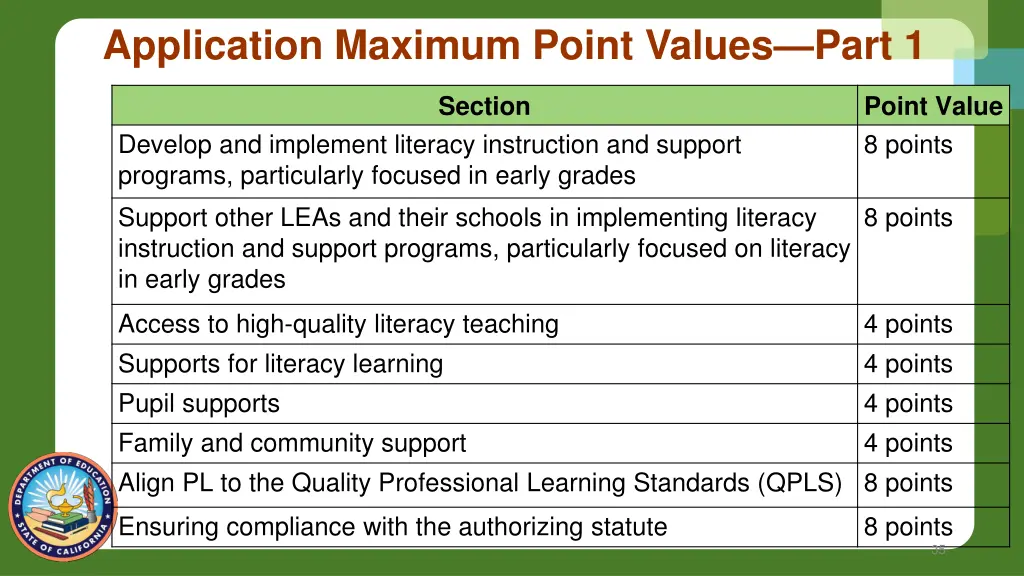
Application Maximum Point ValuesPart 1 Section Point Value 8 points Develop and implement literacy instruction and support programs, particularly focused in early grades Support other LEAs and their schools in implementing literacy instruction and support programs, particularly focused on literacy in early grades 8 points Access to high-quality literacy teaching Supports for literacy learning Pupil supports Family and community support Align PL to the Quality Professional Learning Standards (QPLS) 8 points 4 points 4 points 4 points 4 points Ensuring compliance with the authorizing statute 8 points 35
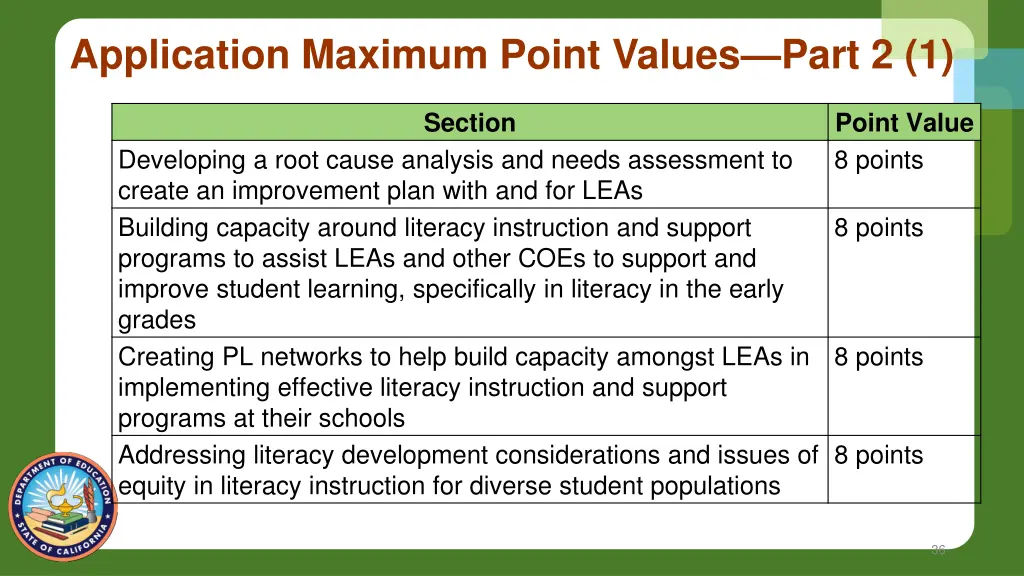
Application Maximum Point ValuesPart 2 (1) Section Point Value 8 points Developing a root cause analysis and needs assessment to create an improvement plan with and for LEAs Building capacity around literacy instruction and support programs to assist LEAs and other COEs to support and improve student learning, specifically in literacy in the early grades Creating PL networks to help build capacity amongst LEAs in implementing effective literacy instruction and support programs at their schools Addressing literacy development considerations and issues of equity in literacy instruction for diverse student populations 8 points 8 points 8 points 36
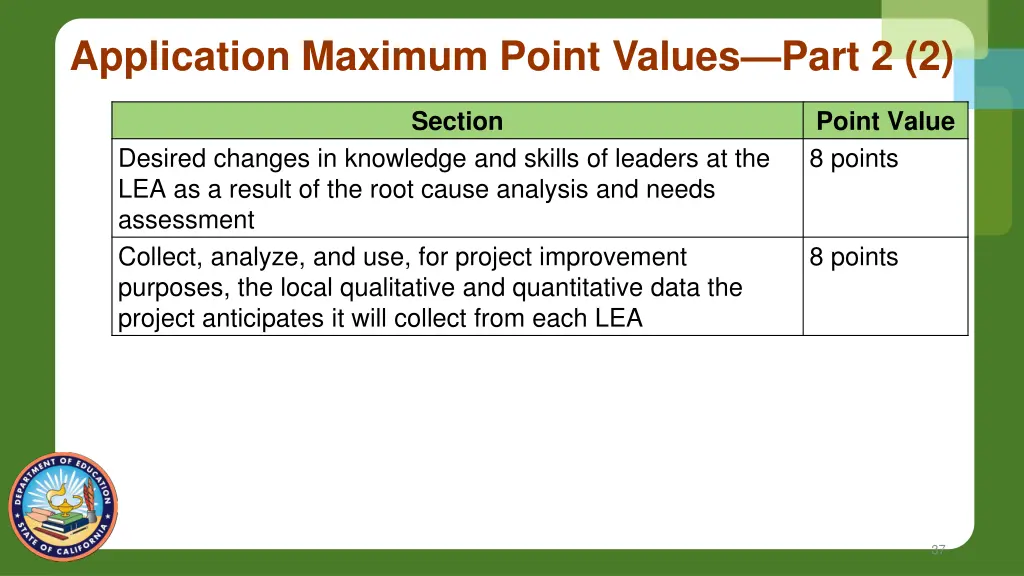
Application Maximum Point ValuesPart 2 (2) Section Point Value 8 points Desired changes in knowledge and skills of leaders at the LEA as a result of the root cause analysis and needs assessment Collect, analyze, and use, for project improvement purposes, the local qualitative and quantitative data the project anticipates it will collect from each LEA 8 points 37
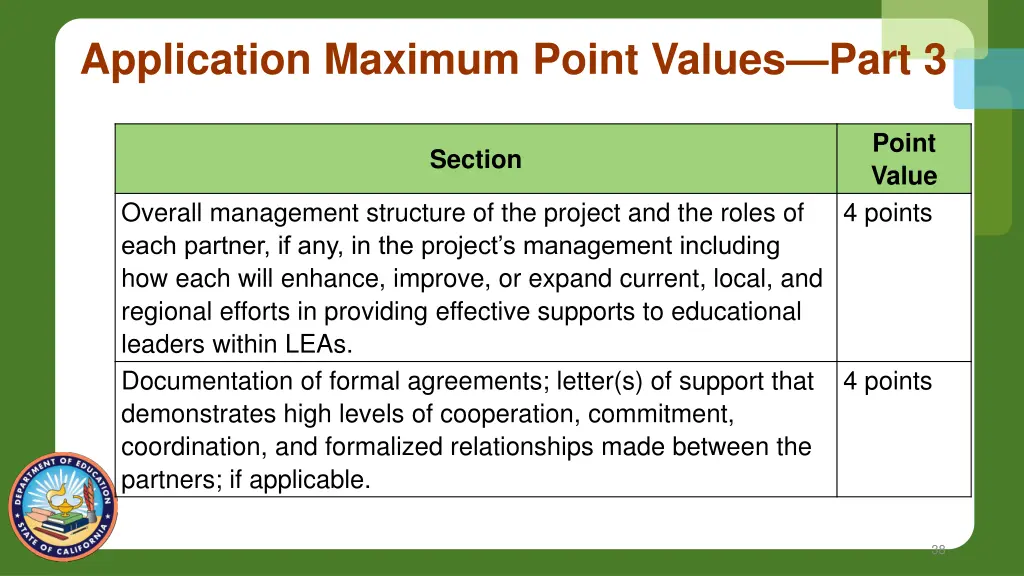
Application Maximum Point ValuesPart 3 Point Value 4 points Section Overall management structure of the project and the roles of each partner, if any, in the project s management including how each will enhance, improve, or expand current, local, and regional efforts in providing effective supports to educational leaders within LEAs. Documentation of formal agreements; letter(s) of support that demonstrates high levels of cooperation, commitment, coordination, and formalized relationships made between the partners; if applicable. 4 points 38
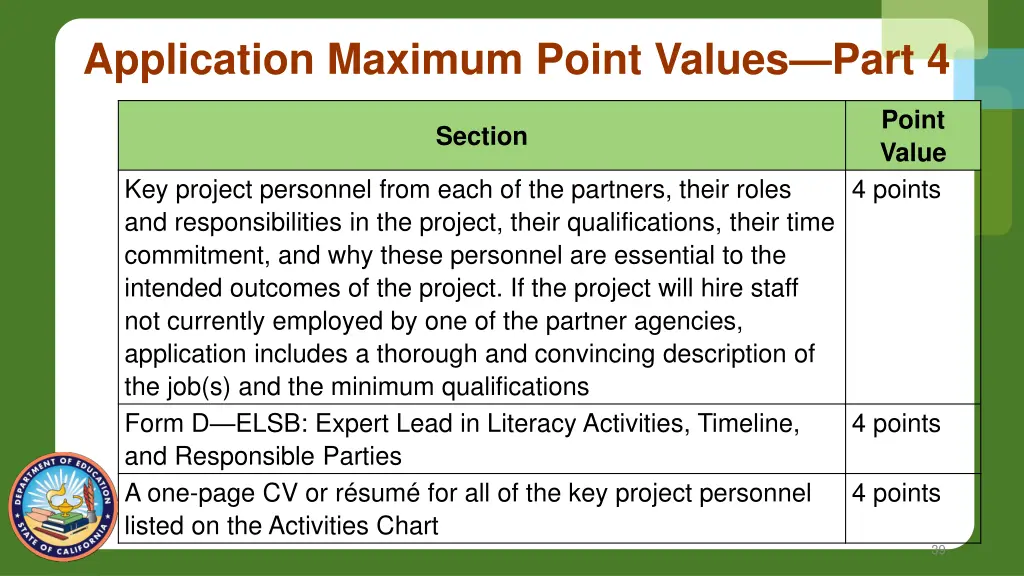
Application Maximum Point ValuesPart 4 Point Value 4 points Section Key project personnel from each of the partners, their roles and responsibilities in the project, their qualifications, their time commitment, and why these personnel are essential to the intended outcomes of the project. If the project will hire staff not currently employed by one of the partner agencies, application includes a thorough and convincing description of the job(s) and the minimum qualifications Form D ELSB: Expert Lead in Literacy Activities, Timeline, and Responsible Parties A one-page CV or r sum for all of the key project personnel listed on the Activities Chart 4 points 4 points 39
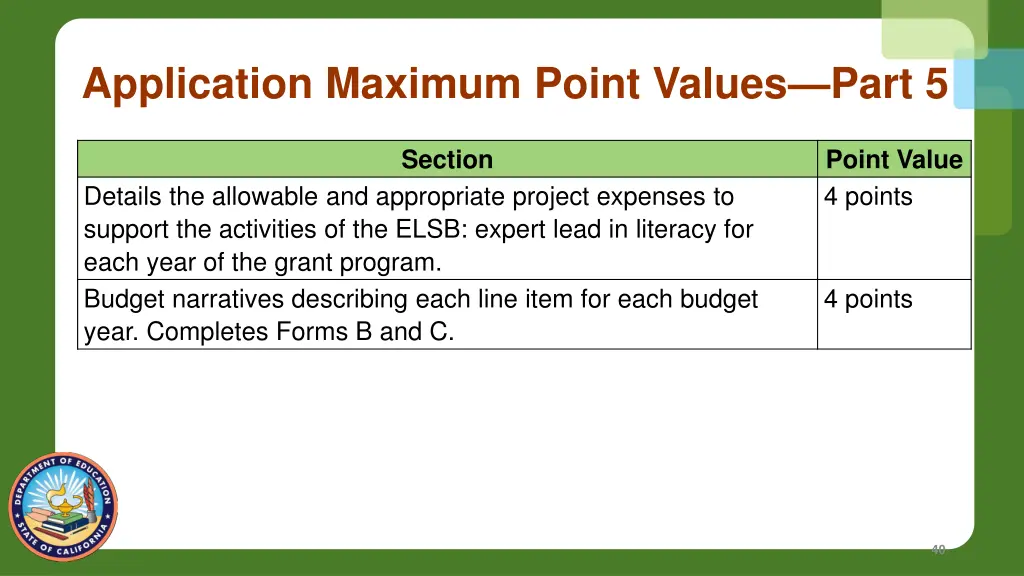
Application Maximum Point ValuesPart 5 Section Point Value 4 points Details the allowable and appropriate project expenses to support the activities of the ELSB: expert lead in literacy for each year of the grant program. Budget narratives describing each line item for each budget year. Completes Forms B and C. 4 points 40
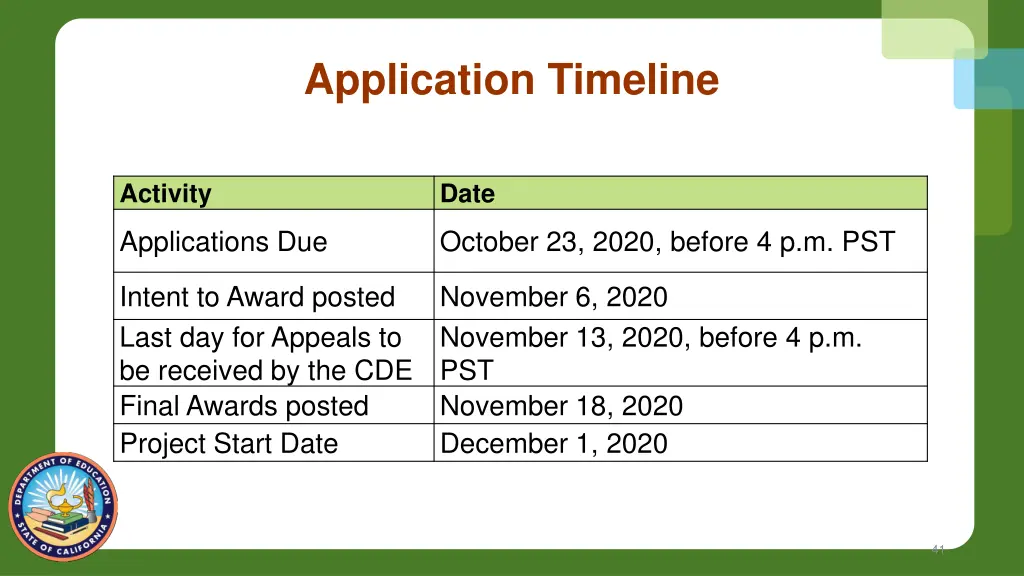
Application Timeline Activity Date Applications Due October 23, 2020, before 4 p.m. PST Intent to Award posted Last day for Appeals to be received by the CDE Final Awards posted Project Start Date November 6, 2020 November 13, 2020, before 4 p.m. PST November 18, 2020 December 1, 2020 41
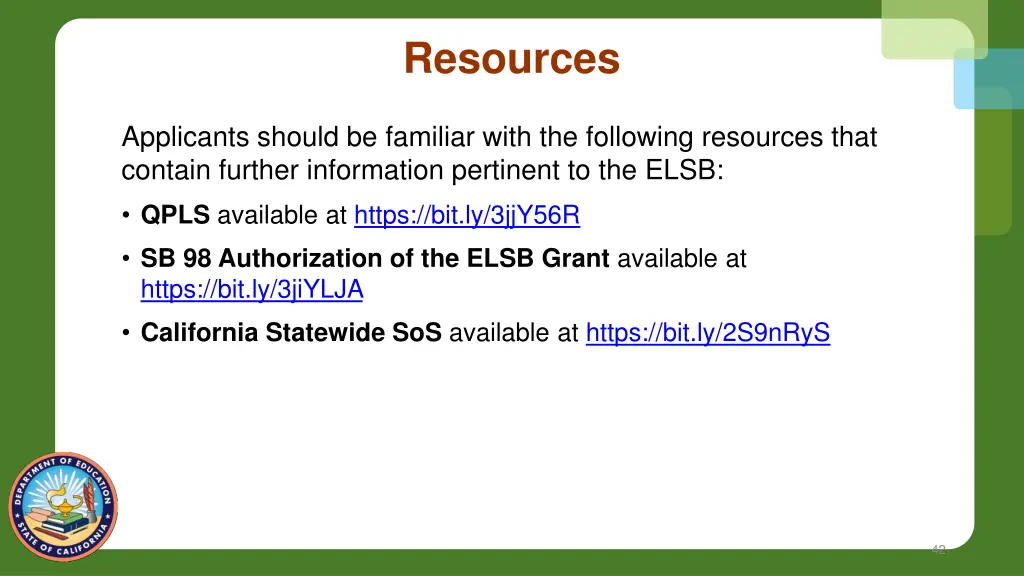
Resources Applicants should be familiar with the following resources that contain further information pertinent to the ELSB: QPLS available at https://bit.ly/3jjY56R SB 98 Authorization of the ELSB Grant available at https://bit.ly/3jiYLJA California Statewide SoS available at https://bit.ly/2S9nRyS 42
Questions? 43
Contact Information For additional information, contact: Email: ELSBgrant@cde.ca.gov 44