European explorers in the Americas sought New World plants to enhance medical practices, diet, and fashion. Challenges arose in integrating these plants into existing frameworks, despite their potential economic and medicinal benefits. French explorers like Cartier and Champlain played key roles in introducing New World plants to Europe, influencing European diet and medicine. The exchange of botanical knowledge between the Old and New Worlds had a profound impact on European society.
Please find below an Image/Link to download the presentation.
The content on the website is provided AS IS for your information and personal use only. It may not be sold, licensed, or shared on other websites without obtaining consent from the author. If you encounter any issues during the download, it is possible that the publisher has removed the file from their server.
You are allowed to download the files provided on this website for personal or commercial use, subject to the condition that they are used lawfully. All files are the property of their respective owners.
The content on the website is provided AS IS for your information and personal use only. It may not be sold, licensed, or shared on other websites without obtaining consent from the author.
Overview In the exploration of the Americas, European explorers were in search for New World treasures that would advance their medical practices, diet, and fashion. However, the introduction of new crop into the Old World was proved no easy feat as there were numerous issues surrounding the ecology of New World plants, the rejection of indigenous practices, and the acceptance of these plants into the existing Galenic-Christian European medical framework. 2
Andrew Wear: Cartier, Champlain, and the Fruits of the New World: Botanical Exchange in the 16th and 17th Centuries There was some French romanticism regarding Cartier s views on the American climate being compared to the garden of Eden, and the plants within it having outlandish cure-all properties. Although there were issues surrounding the survival of certain plants in the voyage from the Americas, French explorers Cartier and Champlain remained instrumental in transporting New World plants to Europe, tending the plants in nurseries. Gardeners played an important role in the cultivation and preservation of plants in the Old World, often inquiring those who had been to the New World about the climate. There were many comparisons drawn between Old and New World plants in order for the Europeans to make sense of, understand, and categorise the new plants. New World plants became fashionable in that they were transforming the European diet with many new recipes borne from an abundance of American plants. Cartier surely thought he had found a New World panacea to rival the rarities of the Indies, and his new conifer became known as the 'Arbre de vie' or Tree of Life. [p.36]
Teresa Huguet-Termes: New World Materia Medica in Spanish Renaissance Medicine: From Scholarly Reception to Practical Impact Much of the motivation regarding exploration was economic gain from both the medicinal qualities of New World plants but also the culinary that could be traded in the Old World. There were a few issues regarding the integration of American drugs into European Galenic medicine such as the cynicism of physicians and the reluctance to accept indigenous practices. Despite the scepticism of some physicians, American drugs were imported into Spain in large quantities and theorised to be used by the non-elite, mentioning the role of women as healers. Whereas other physicians such as Monardes promoted American drugs for economic gain- his contributions (alongside that of merchants and apothecaries) in the promotion of these drugs allowed for widespread knowledge and translations of information to spread throughout Europe. As the underground use of New World drugs became more popular amongst the lower classes, both the elite and non-elite normalised and quickly accepted the use of these drugs. "Many of the species were soon introduced, but acceptance there was another story." [p.361]
Victoria Dickenson: The early modern debate about foreign drugs: localism versus universalism in medicine Religion played an important role in medicine with a firm and prevailing belief in God s intervention when it came down to succumbing to a disease and in the recovery of a disease. Religion and the four humors complemented one another, and this contributed to the search for God-given therapeutic plants that would acceptably remedy disease. There are criticisms regarding the historical focus of how New World medicine has impacted Europeans but ignores the impact on native populations hence, the voices of indigenous people are left unheard and marginalised. There were many arguments against the use of New World remedies such as; the belief that medicines were only effective in their native climates, the drugs becoming a threat to national identity, the cost of the drugs, and the rejection of indigenous practices. Merchants and apothecaries utilised the fashionable and commercial appeal of labelling foreign drugs as exotic to sell them and make a financial profit. "merchants and medical men were creating a demand among patients, however poor, for expensive foreign drugs [p.151]
Cook, Harold J. Physicians and Natural History. (1996). pp. 91- 105 "Through the lens of observation and inquiry, physicians transformed their practice by intertwining the study of nature with medicine, laying the groundwork for both empirical science and modern botany. - Harold J. Cook (1996). Empirical Shift in Medical Knowledge: Early modern European physicians shifted from philosophical reasoning to empirical observation, influenced by Bacon and Galileo, focusing on the study of plants, animals, and minerals for effective disease treatment. Professionalization of Medicine: Physicians with MD degrees spearheaded the shift toward empirical inquiry in natural history. Their rigorous training in natural sciences set them apart from other practitioners and enhanced their authority, facilitating a deeper integration of natural philosophy into medical practice. Role of Physicians as Naturalists: Physicians like Christopher Merrett integrated medical practice with natural history, reclaiming ancient medicinal knowledge. His debates on remedies like theriac and true rhubarb laid the foundation for modern botany and the classification of medicinal plants. Interdisciplinary Integration and Education: The mid-17th century saw a pivotal change in medical education, with anatomy and chemistry becoming key subjects. Pioneers like Andreas Vesalius promoted empirical studies of the human body, moving away from ancient texts and improving the understanding of health and disease Formation of Scientific Societies and Impact on Knowledge: The formation of scientific societies like the Royal Society of London highlighted the link between medicine and natural philosophy. Physicians were key to these societies, advancing empirical science and the scientific method, which enhanced natural history and improved medical practice.
Gmez, Pablo F. The experiential Caribbean: creating knowledge and healing in the early modern Atlantic . (2017). pp.118-144. "Caribbean healing practices represent a complex interplay of local knowledge, cultural exchange, and the materiality of objects used in health and illness. Pablo F. Gomez (2017) Material Culture and Social Power: Objects used by Caribbean healers, like Antonio de Salinas, are not just tools; they symbolize authority and success within the healing community. These materials reflect social relationships and convey meaning in their specific contexts. Cultural Intersections in Healing: The practices of Caribbean healers blend elements from African, European, and indigenous cultures. This fusion creates unique healing methods that adapt to local needs, highlighting complexities of cultural exchanges in the region. Healing as Protection: Many healing items, such as protective bags, are designed to ward off illnesses and other dangers, illustrating how communities address health threats. These bags functioned as both therapeutic and protective tools, indicating a deep understanding of the risks posed by epidemics. Evolving Knowledge and Practices: Healers like Alejandro Matamba showcase the adaptability of Caribbean healing practices. Their work reflects a rich dialogue between different medical traditions and the local context, demonstrating how knowledge is shaped by experience and interaction. Rethinking Historical Narratives: The history of Caribbean healing substances challenges traditional categorizations as instead of viewing these practices through a narrow lens of European or African origins, we should recognize the diverse influences and innovations that define Caribbean healing.
Similarities: Cultural and Knowledge Integration: Cook and Gomez both emphasize the blending of different knowledge systems. Cook discusses the integration of natural philosophy into medical practice, while Gomez highlights the fusion of African, European, and indigenous healing practices in the Caribbean. Role of Practitioners: They both also underline the significant role of practitioners (physicians in Europe, healers in the Caribbean) in shaping and advancing medical or healing knowledge. Both groups adapt and evolve practices in response to their environments. Differences: Focus on Material Culture vs. Empirical Science: Gomez focuses on the symbolic and social importance of objects in Caribbean healing practices, such as protective bags, which convey authority and function as protective tools. In contrast, Cook emphasizes the rise of empirical science and professionalization in European medicine, with less focus on the symbolic or cultural value of medical tools. Historical Narratives: Gomez challenges traditional historical views, asking for a broader understanding of Caribbean healing as shaped by multiple cultural influences. Cook, however, is more concerned with detailing the development of empirical methodologies and professional societies in European medical history.
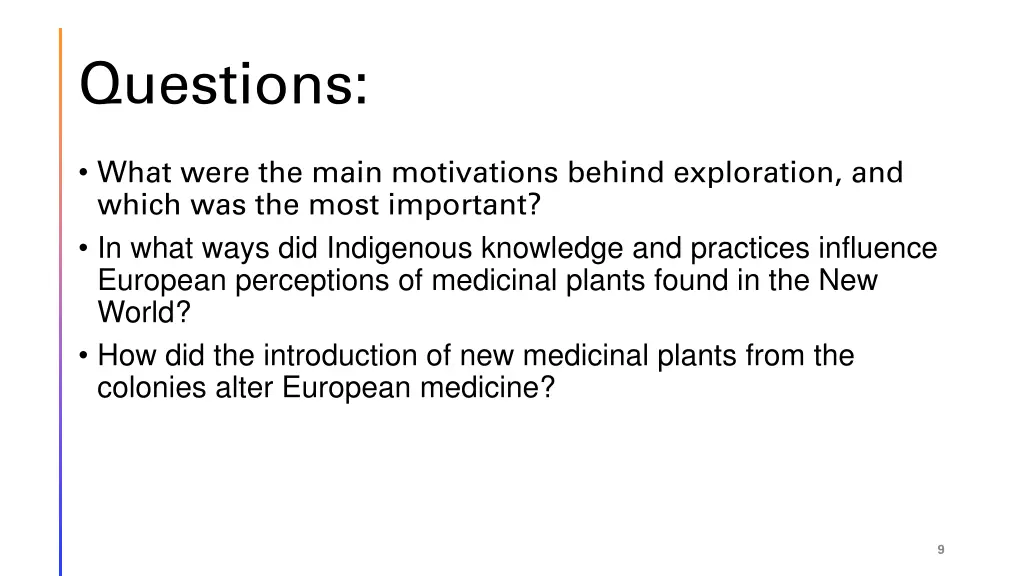
Questions: What were the main motivations behind exploration, and which was the most important? In what ways did Indigenous knowledge and practices influence European perceptions of medicinal plants found in the New World? How did the introduction of new medicinal plants from the colonies alter European medicine? 9