Discover the impact of denoising on particle physics analysis through comparing runs with and without denoising across different categories. Analyze momentum and missing mass squared distributions to understand the differences in signal yields.
Please find below an Image/Link to download the presentation.
The content on the website is provided AS IS for your information and personal use only. It may not be sold, licensed, or shared on other websites without obtaining consent from the author. If you encounter any issues during the download, it is possible that the publisher has removed the file from their server.
You are allowed to download the files provided on this website for personal or commercial use, subject to the condition that they are used lawfully. All files are the property of their respective owners.
The content on the website is provided AS IS for your information and personal use only. It may not be sold, licensed, or shared on other websites without obtaining consent from the author.
E N D
Presentation Transcript
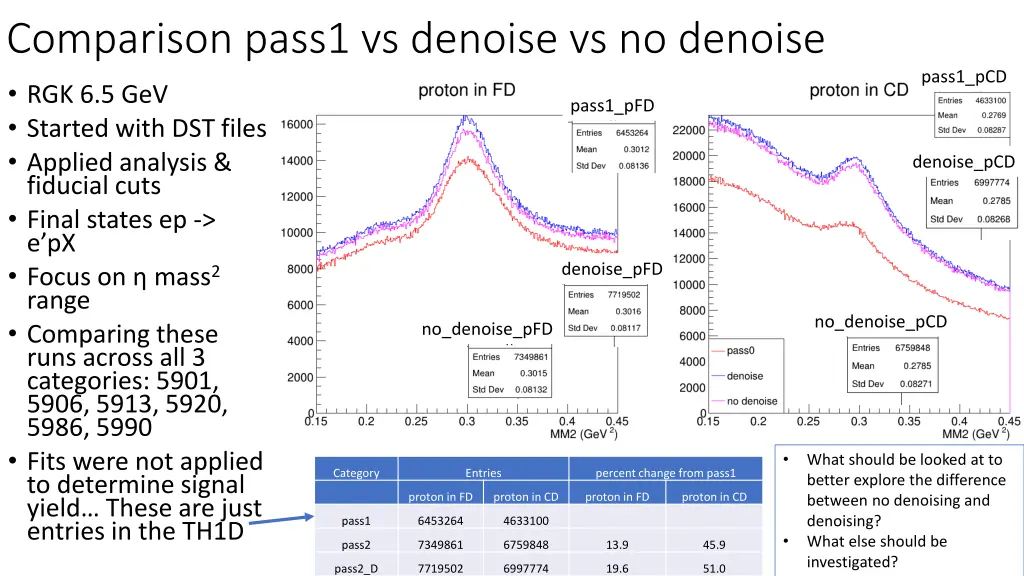
Comparison pass1 vs denoise vs no denoise RGK 6.5 GeV Started with DST files Applied analysis & fiducial cuts Final states ep -> e pX Focus on mass2 range Comparing these runs across all 3 categories: 5901, 5906, 5913, 5920, 5986, 5990 Fits were not applied to determine signal yield These are just entries in the TH1D pass2 pass1_pCD pass1_pFD denoise_pCD denoise_pFD no_denoise_pCD no_denoise_pFD What should be looked at to better explore the difference between no denoising and denoising? What else should be investigated? Category Entries percent change from pass1 proton in FD proton in CD proton in FD proton in CD pass1 6453264 4633100 7349861 6759848 13.9 45.9 pass2_D 7719502 6997774 19.6 51.0
Ratio of missing mass squared distributions Final states where ep -> epX Top row: proton in FD Bottom row: proton in CD Columns left to right: ratio of pass 2 with denoising to pass1, ratio of pass2 without denoising to pass1, ratio of pass 2 with denoising to no denoising
Momentum distributions Final states where ep -> epX Proton in FD Top row: electron momentum Bottom row: proton momentum Columns left to right: pass1, pass2 with denoising, pass2 without denoising
Ratio of momentum distributions Final states where ep -> epX Proton in FD Top row: electron momentum Bottom row: proton momentum Took distributions from previous slide and divided them
Momentum distributions Final states where ep -> epX Proton in CD Top row: electron momentum Bottom row: proton momentum Columns left to right: pass1, pass2 with denoising, pass2 without denoising
Ratio of momentum distributions Final states where ep -> epX Proton in CD Top row: electron momentum Bottom row: proton momentum Took distributions from previous slide and divided them