Explore Nested Lists and Matrices in Programming
Learn about the concept of nested lists in programming, how to access elements in inner lists, create 2-D lists (matrices), and work with N-dimensional nested lists. Discover examples and exercises to deepen your understanding of this important data structure.

Download Presentation

Please find below an Image/Link to download the presentation.
The content on the website is provided AS IS for your information and personal use only. It may not be sold, licensed, or shared on other websites without obtaining consent from the author. If you encounter any issues during the download, it is possible that the publisher has removed the file from their server.
You are allowed to download the files provided on this website for personal or commercial use, subject to the condition that they are used lawfully. All files are the property of their respective owners.
The content on the website is provided AS IS for your information and personal use only. It may not be sold, licensed, or shared on other websites without obtaining consent from the author.
E N D
Presentation Transcript
Lecture 15: Nested Lists CS 51P November 1, 2023
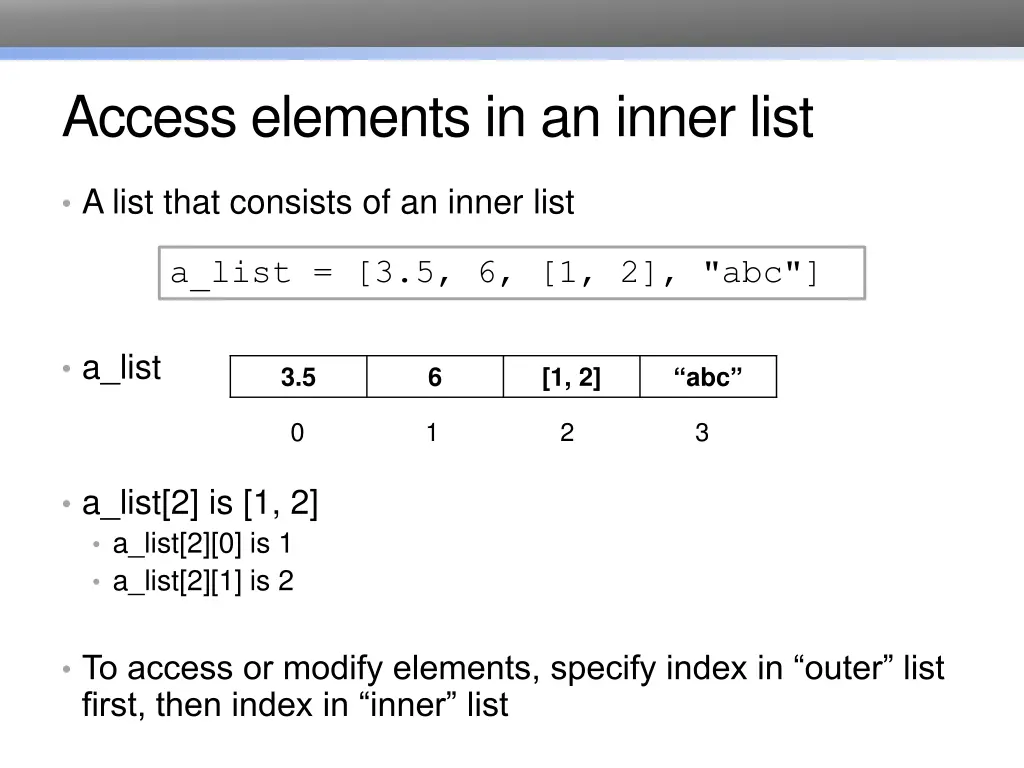
Access elements in an inner list A list that consists of an inner list a_list = [3.5, 6, [1, 2], "abc"] a_list 3.5 6 [1, 2] abc 0 1 2 3 a_list[2] is [1, 2] a_list[2][0] is 1 a_list[2][1] is 2 To access or modify elements, specify index in outer list first, then index in inner list
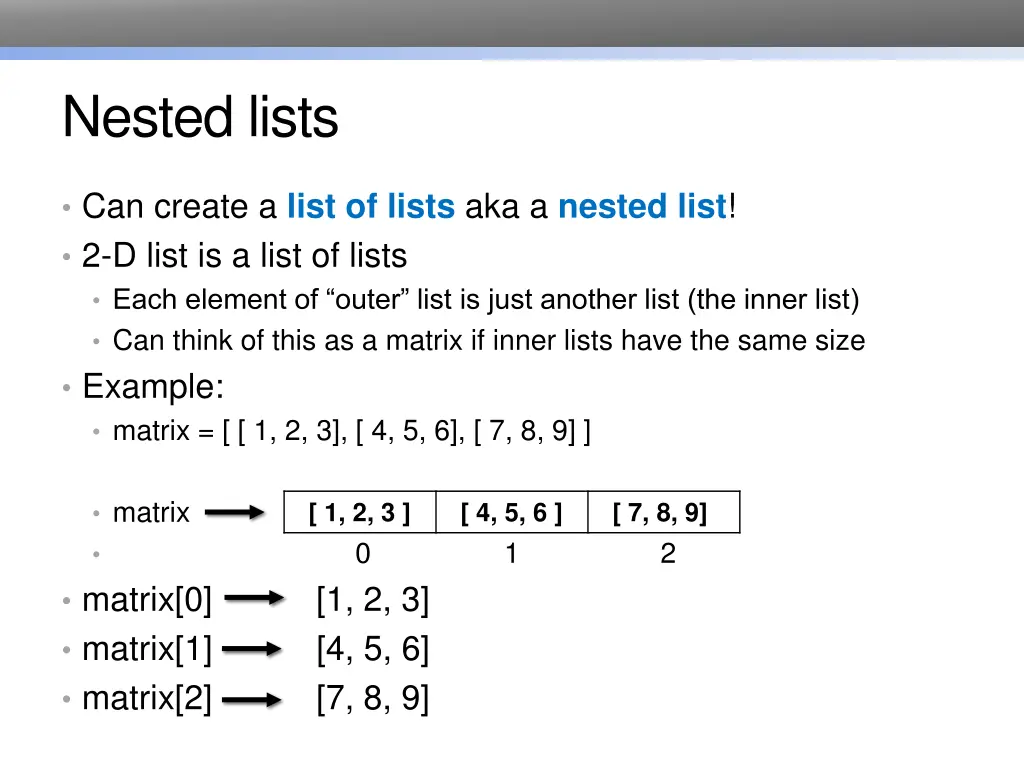
Nested lists Can create a list of lists aka a nested list! 2-D list is a list of lists Each element of outer list is just another list (the inner list) Can think of this as a matrix if inner lists have the same size Example: matrix = [ [ 1, 2, 3], [ 4, 5, 6], [ 7, 8, 9] ] matrix 0 1 2 matrix[0] [1, 2, 3] matrix[1] [4, 5, 6] matrix[2] [7, 8, 9] [ 1, 2, 3 ] [ 4, 5, 6 ] [ 7, 8, 9]
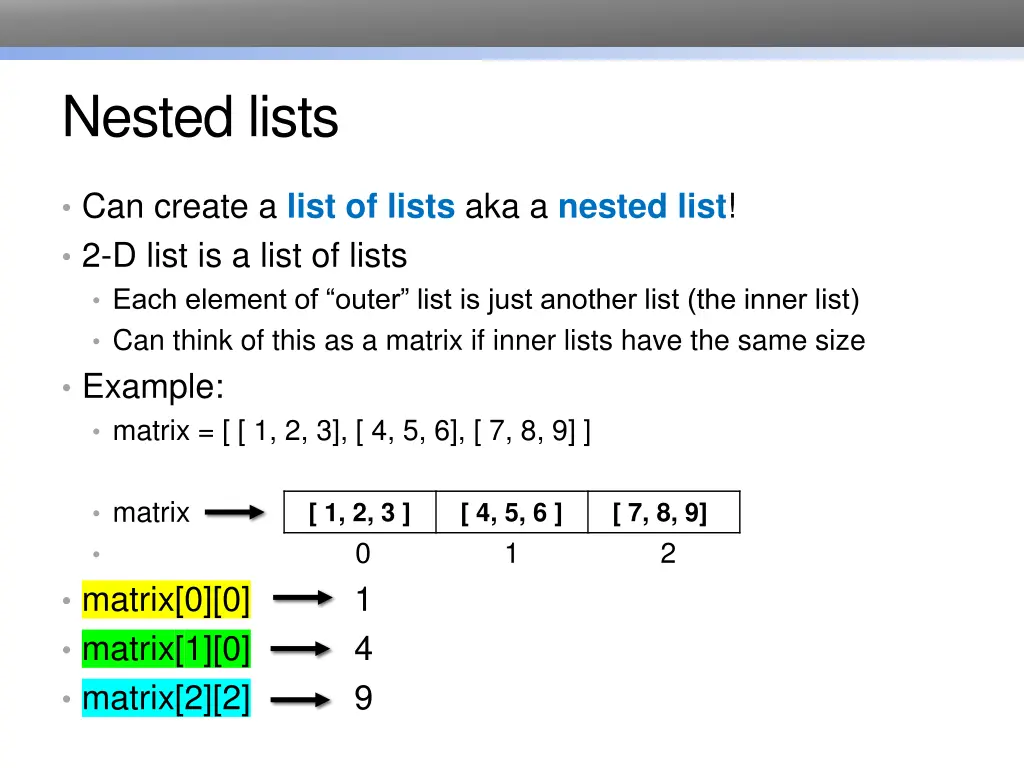
Nested lists Can create a list of lists aka a nested list! 2-D list is a list of lists Each element of outer list is just another list (the inner list) Can think of this as a matrix if inner lists have the same size Example: matrix = [ [ 1, 2, 3], [ 4, 5, 6], [ 7, 8, 9] ] matrix 0 1 2 matrix[0][0] 1 matrix[1][0] 4 matrix[2][2] 9 [ 1, 2, 3 ] [ 4, 5, 6 ] [ 7, 8, 9]
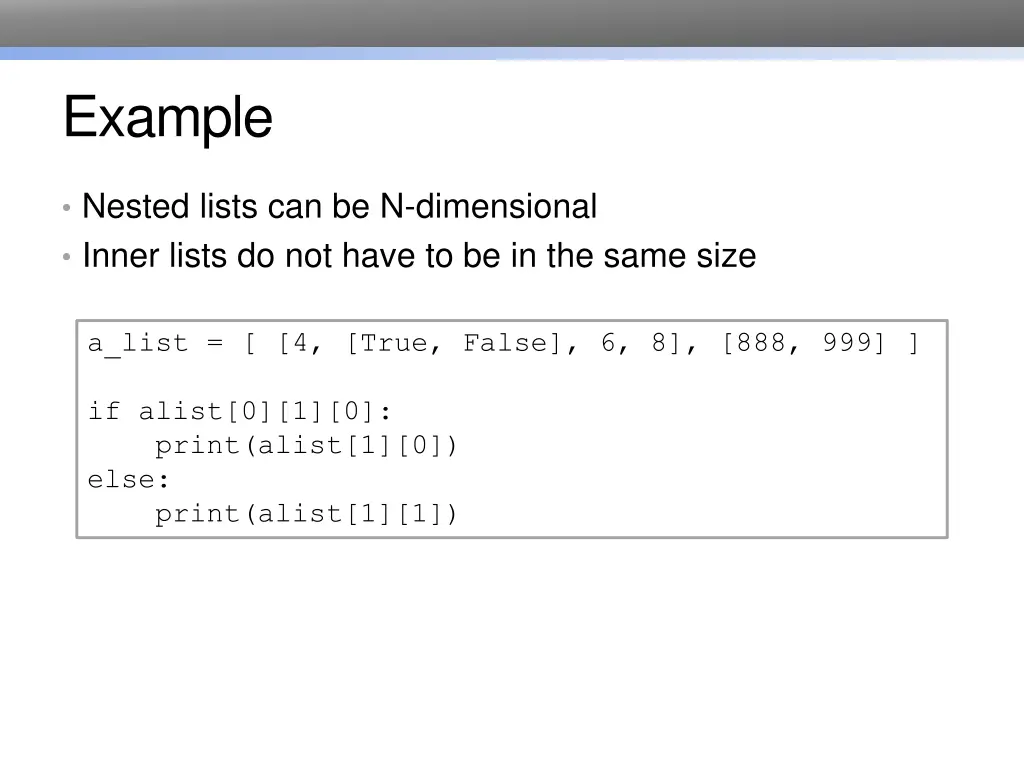
Example Nested lists can be N-dimensional Inner lists do not have to be in the same size a_list = [ [4, [True, False], 6, 8], [888, 999] ] if alist[0][1][0]: print(alist[1][0]) else: print(alist[1][1])
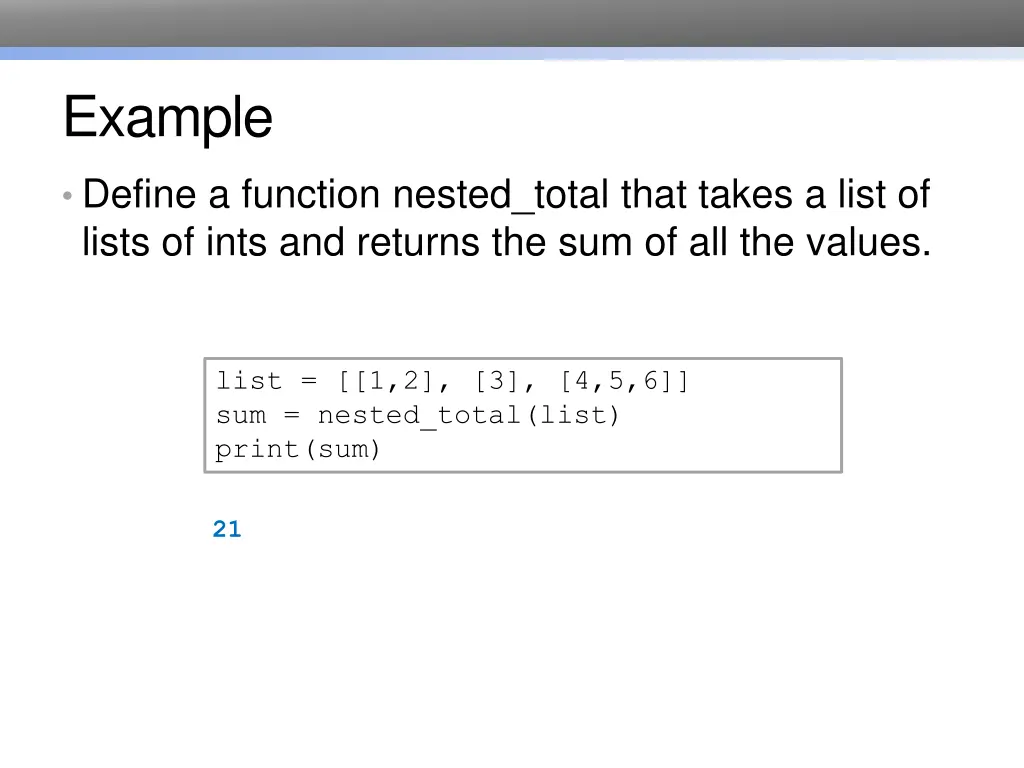
Example Define a function nested_total that takes a list of lists of ints and returns the sum of all the values. list = [[1,2], [3], [4,5,6]] sum = nested_total(list) print(sum) 21
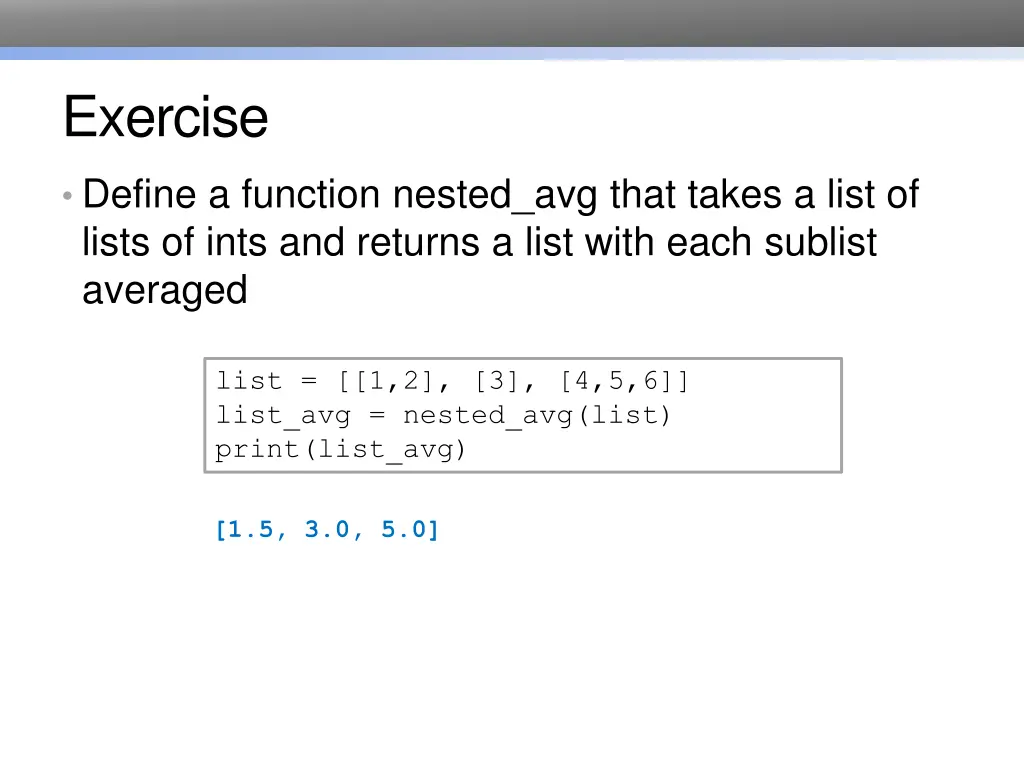
Exercise Define a function nested_avg that takes a list of lists of ints and returns a list with each sublist averaged list = [[1,2], [3], [4,5,6]] list_avg = nested_avg(list) print(list_avg) [1.5, 3.0, 5.0]
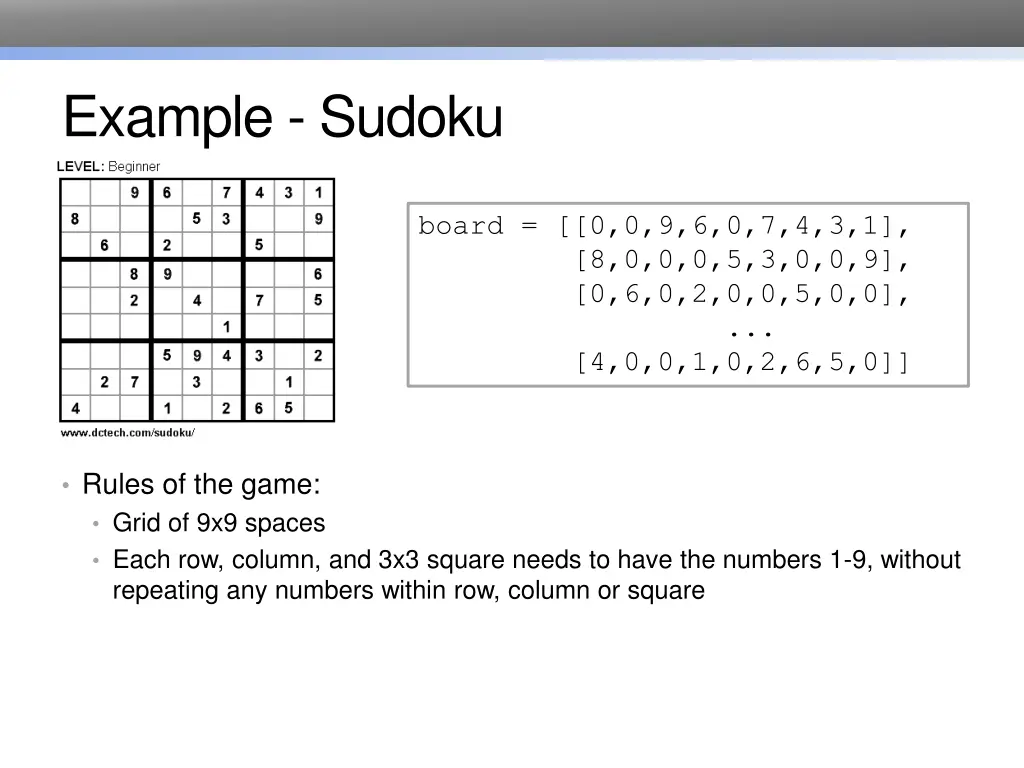
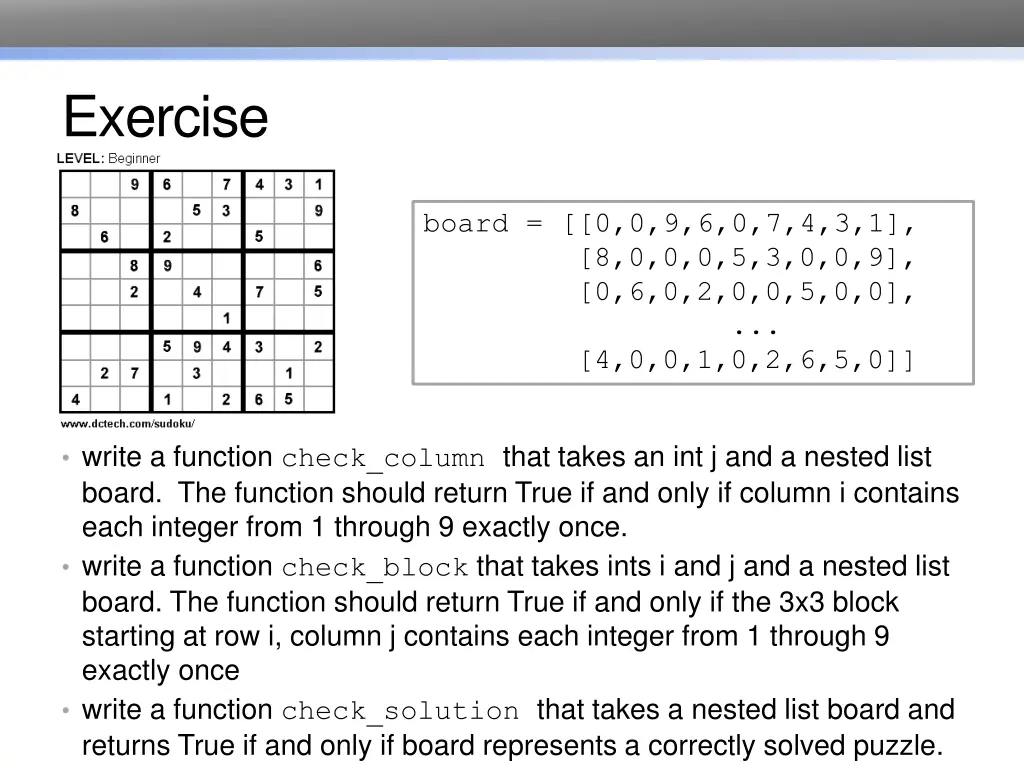
Example - Sudoku board = [[0,0,9,6,0,7,4,3,1], [8,0,0,0,5,3,0,0,9], [0,6,0,2,0,0,5,0,0], ... [4,0,0,1,0,2,6,5,0]] Rules of the game: Grid of 9x9 spaces Each row, column, and 3x3 square needs to have the numbers 1-9, without repeating any numbers within row, column or square
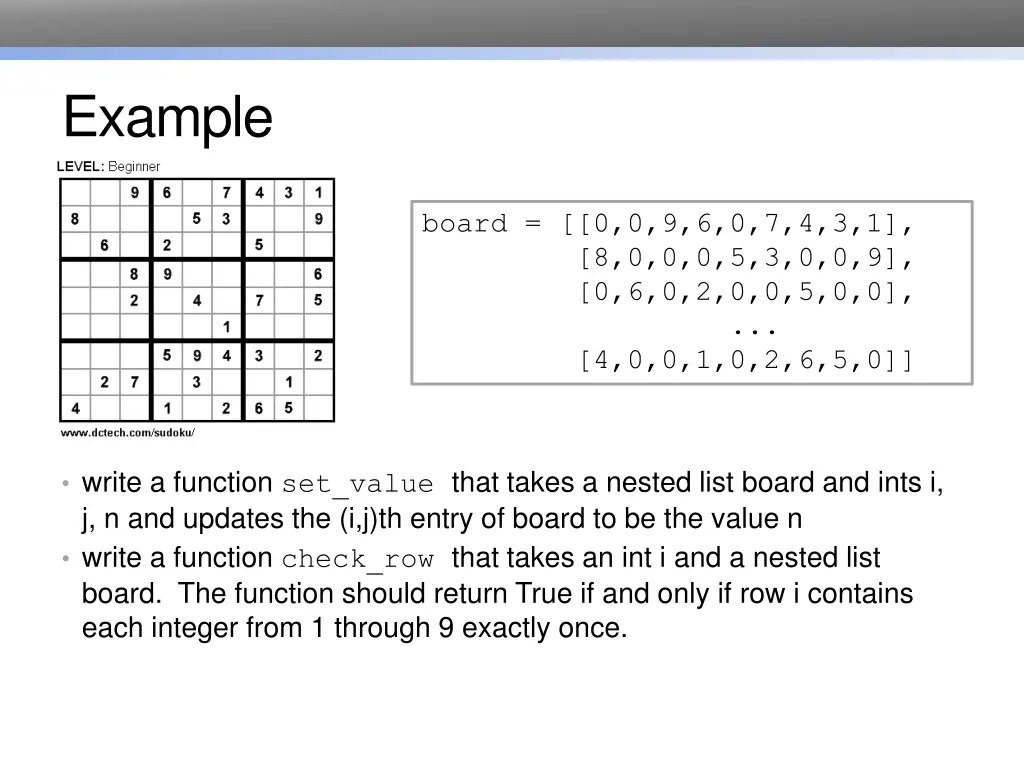
Example board = [[0,0,9,6,0,7,4,3,1], [8,0,0,0,5,3,0,0,9], [0,6,0,2,0,0,5,0,0], ... [4,0,0,1,0,2,6,5,0]] write a function set_value that takes a nested list board and ints i, j, n and updates the (i,j)th entry of board to be the value n write a function check_row that takes an int i and a nested list board. The function should return True if and only if row i contains each integer from 1 through 9 exactly once.
Exercise board = [[0,0,9,6,0,7,4,3,1], [8,0,0,0,5,3,0,0,9], [0,6,0,2,0,0,5,0,0], ... [4,0,0,1,0,2,6,5,0]] write a function check_column that takes an int j and a nested list board. The function should return True if and only if column i contains each integer from 1 through 9 exactly once. write a function check_block that takes ints i and j and a nested list board. The function should return True if and only if the 3x3 block starting at row i, column j contains each integer from 1 through 9 exactly once write a function check_solution that takes a nested list board and returns True if and only if board represents a correctly solved puzzle.