Exploring Backreaction and Dark Energy Interactions in the Universe
Delve into the concept of backreaction and dark energy interactions in the universe, challenging the traditional models of homogeneity and isotropy. Discover how clumpy spacetime impacts expansion rates, light propagation, and the overall evolution of our universe. Explore the Buchert equations, understand acceleration mechanisms, and unravel the scales of acceleration in the cosmos. This insightful discussion, presented at Nordita, sheds light on the complexities of our ever-changing universe.

Download Presentation

Please find below an Image/Link to download the presentation.
The content on the website is provided AS IS for your information and personal use only. It may not be sold, licensed, or shared on other websites without obtaining consent from the author. If you encounter any issues during the download, it is possible that the publisher has removed the file from their server.
You are allowed to download the files provided on this website for personal or commercial use, subject to the condition that they are used lawfully. All files are the property of their respective owners.
The content on the website is provided AS IS for your information and personal use only. It may not be sold, licensed, or shared on other websites without obtaining consent from the author.
E N D
Presentation Transcript
Backreaction status report Syksy R s nen University of Helsinki Department of Physics and Helsinki Institute of Physics Dark Energy Interactions, Nordita, October 3, 2014 1
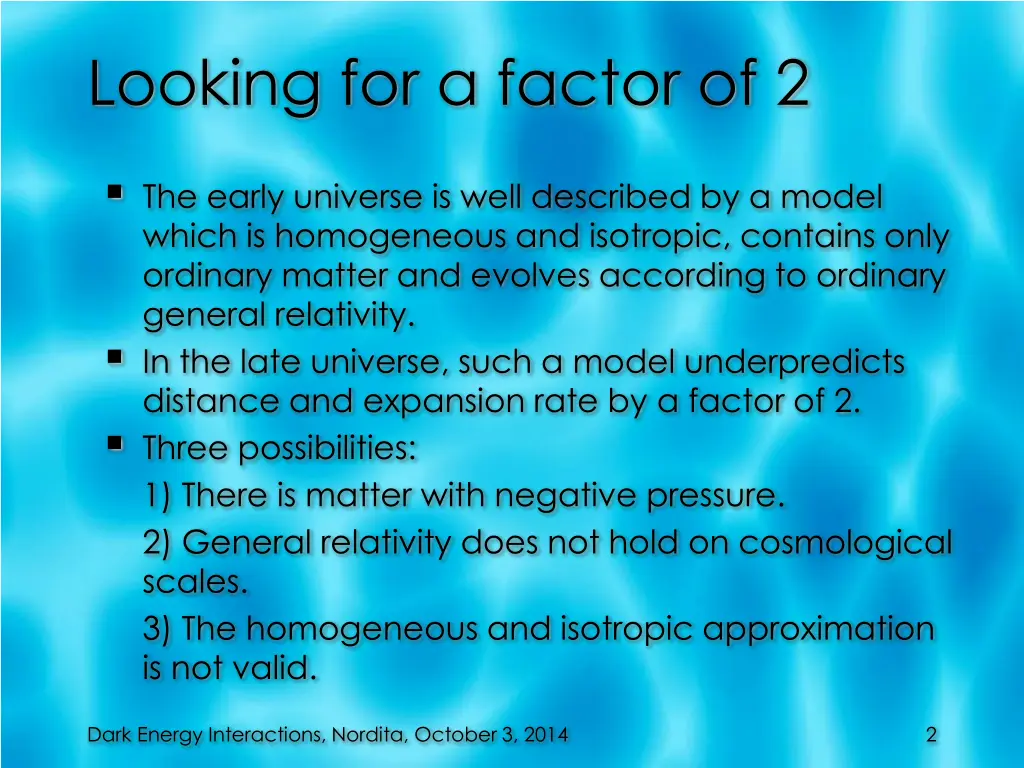
Looking for a factor of 2 The early universe is well described by a model which is homogeneous and isotropic, contains only ordinary matter and evolves according to ordinary general relativity. In the late universe, such a model underpredicts distance and expansion rate by a factor of 2. Three possibilities: 1) There is matter with negative pressure. 2) General relativity does not hold on cosmological scales. 3) The homogeneous and isotropic approximation is not valid. Dark Energy Interactions, Nordita, October 3, 2014 2
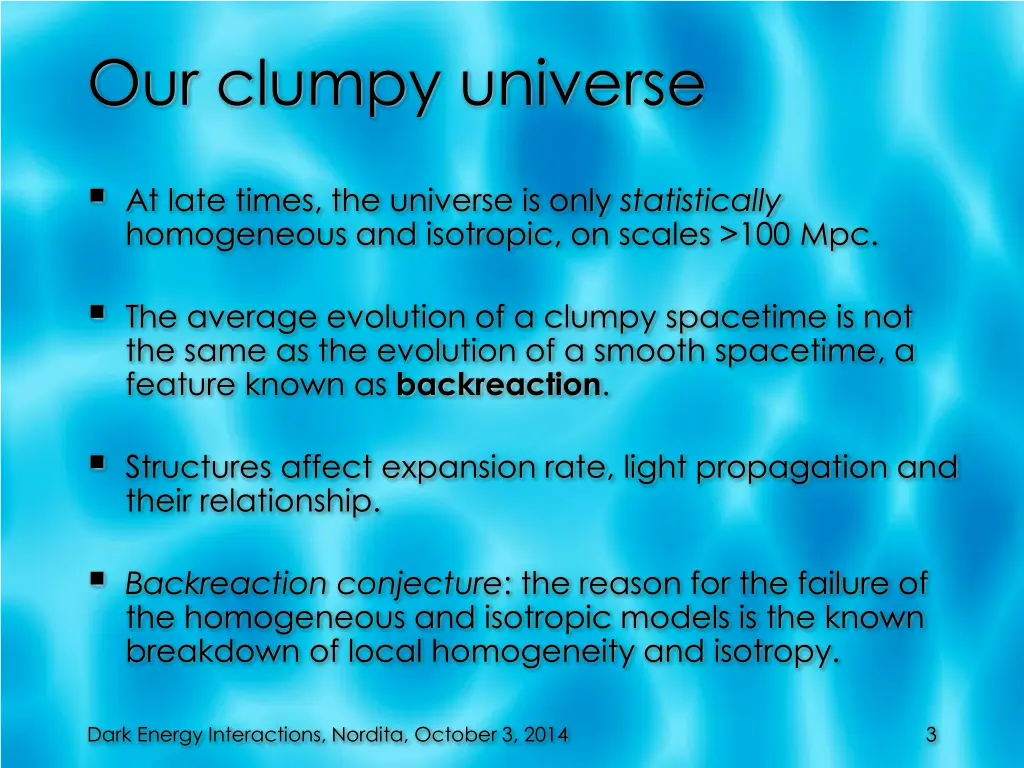
Our clumpy universe At late times, the universe is only statistically homogeneous and isotropic, on scales >100 Mpc. The average evolution of a clumpy spacetime is not the same as the evolution of a smooth spacetime, a feature known as backreaction. Structures affect expansion rate, light propagation and their relationship. Backreaction conjecture: the reason for the failure of the homogeneous and isotropic models is the known breakdown of local homogeneity and isotropy. Dark Energy Interactions, Nordita, October 3, 2014 3
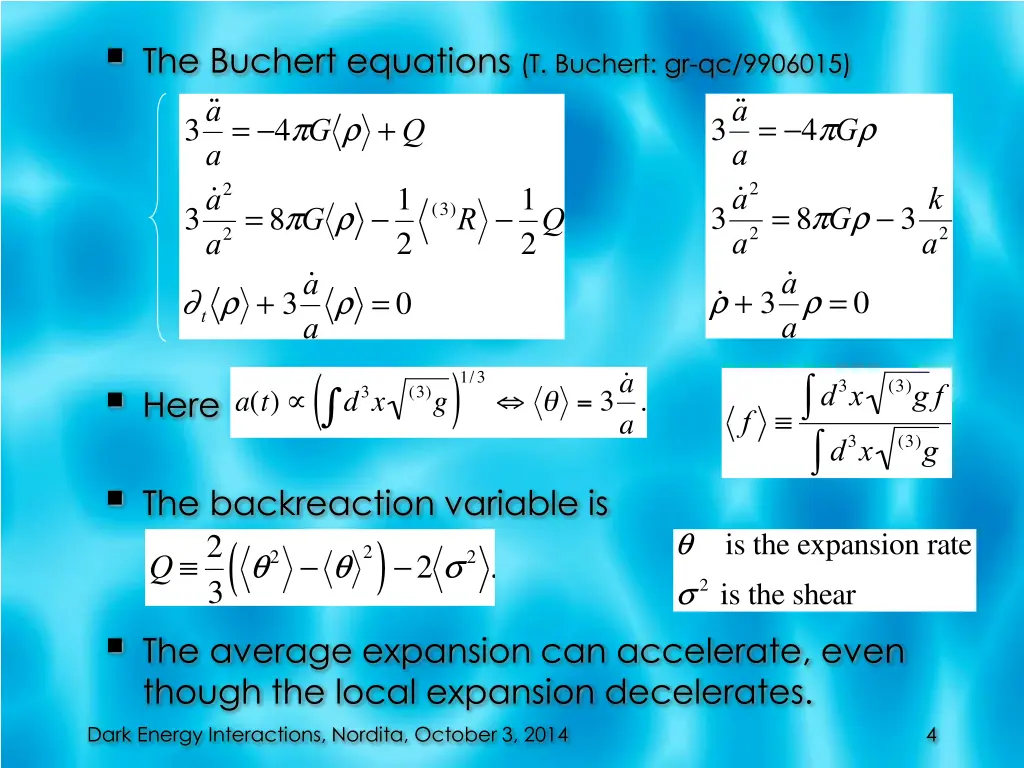
The Buchert equations (T. Buchert: gr-qc/9906015) 3 a a= -4pGr 3 a 2 3 a a= -4pG r +Q 3 a 2 a2=8pG r -1 tr + 3 a (3)R -1 a2= 8pGr - 3k r + 3 a ar = 0 2Q a2 2 r =0 a Here d3x (3)g f f d3x (3)g The backreaction variable is Q 2 3 )-2 s2. ( q is the expansion rate s2 is the shear 2 q2- q The average expansion can accelerate, even though the local expansion decelerates. Dark Energy Interactions, Nordita, October 3, 2014 4
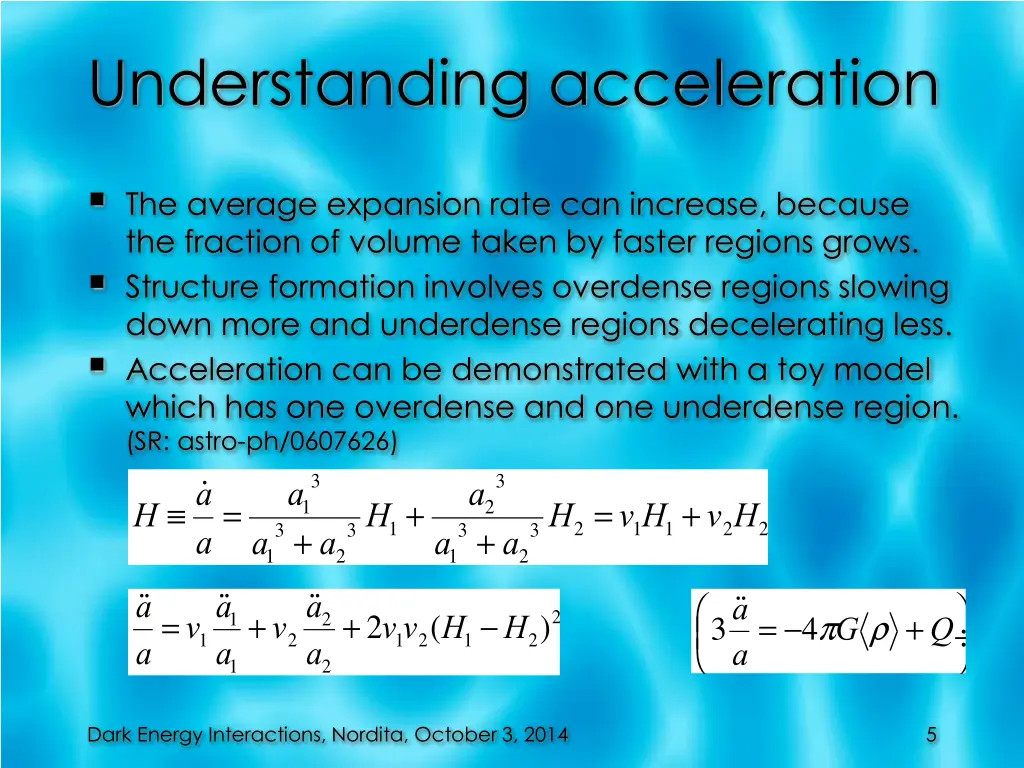
Understanding acceleration The average expansion rate can increase, because the fraction of volume taken by faster regions grows. Structure formation involves overdense regions slowing down more and underdense regions decelerating less. Acceleration can be demonstrated with a toy model which has one overdense and one underdense region. (SR: astro-ph/0607626) 3 3 H a a1 a2 3+ a2 a= 3H1+ 3H2=v1H1+v2H2 3+ a2 a1 a1 a a=v1 a 1 a1 a 2 a2 3 a a= -4pG r +Q +v2 +2v1v2(H1-H2)2 Dark Energy Interactions, Nordita, October 3, 2014 5
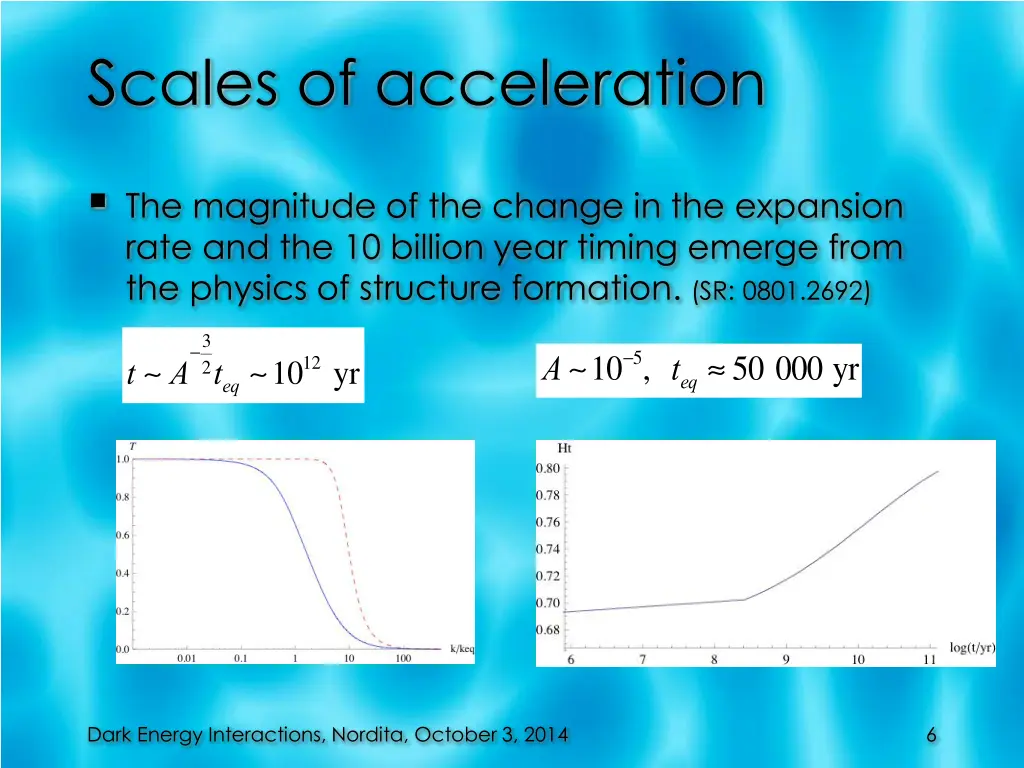
Scales of acceleration The magnitude of the change in the expansion rate and the 10 billion year timing emerge from the physics of structure formation. (SR: 0801.2692) -3 A~10-5, teq 50 000 yr t ~ A 2teq~1012 yr Dark Energy Interactions, Nordita, October 3, 2014 6
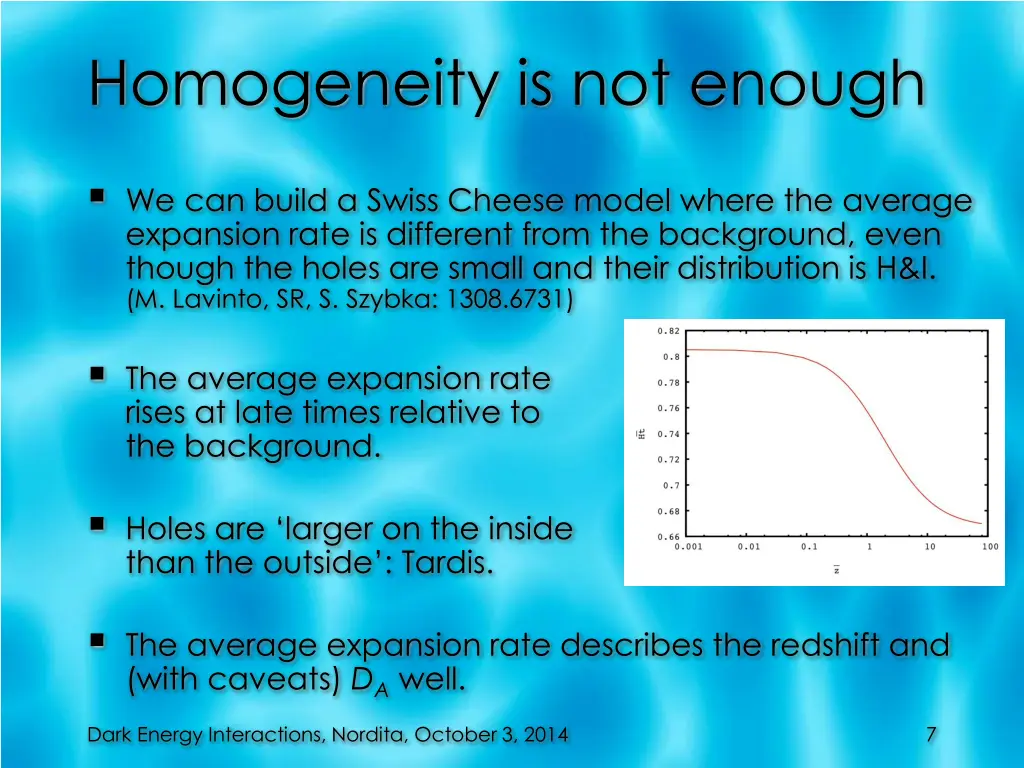
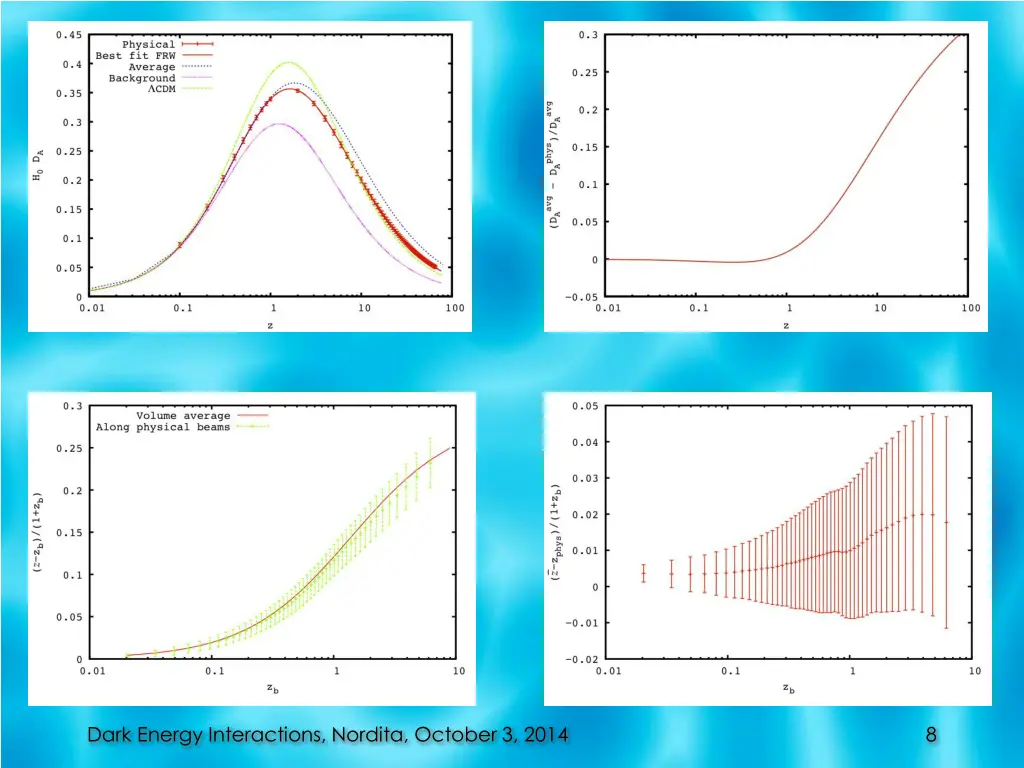
Homogeneity is not enough We can build a Swiss Cheese model where the average expansion rate is different from the background, even though the holes are small and their distribution is H&I. (M. Lavinto, SR, S. Szybka: 1308.6731) The average expansion rate rises at late times relative to the background. Holes are larger on the inside than the outside : Tardis. The average expansion rate describes the redshift and (with caveats) DA well. Dark Energy Interactions, Nordita, October 3, 2014 7
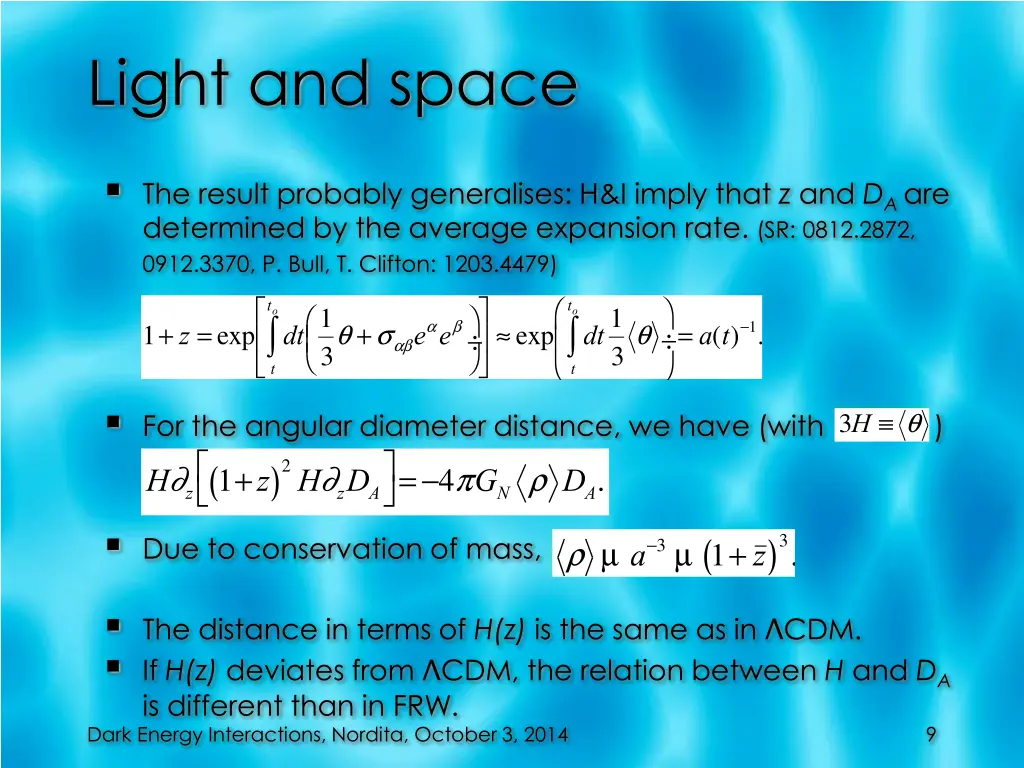
Light and space The result probably generalises: H&I imply that z and DA are determined by the average expansion rate. (SR: 0812.2872, 0912.3370, P. Bull, T. Clifton: 1203.4479) exp = a(t)-1. to to dt1 1 3q 3q +sabeaeb 1+ z =exp dt t t For the angular diameter distance, we have (with ) H z 1+z ( 3H q =-4pGNr DA. ) 2H zDA Due to conservation of mass, ( ) 3. r a-3 1+ z The distance in terms of H(z) is the same as in CDM. If H(z) deviates from CDM, the relation between H and DA is different than in FRW. Dark Energy Interactions, Nordita, October 3, 2014 9
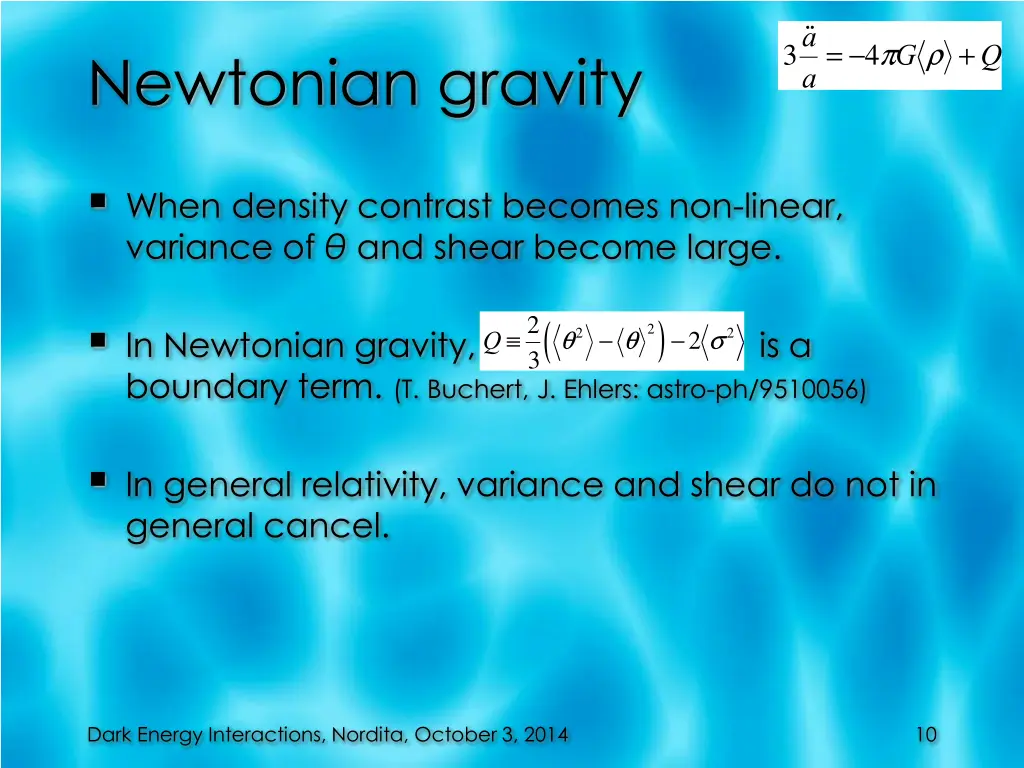
3 a a= -4pG r +Q Newtonian gravity When density contrast becomes non-linear, variance of and shear become large. )-2 s2 ( Q 2 In Newtonian gravity, boundary term. (T. Buchert, J. Ehlers: astro-ph/9510056) 2 is a q2- q 3 In general relativity, variance and shear do not in general cancel. Dark Energy Interactions, Nordita, October 3, 2014 10
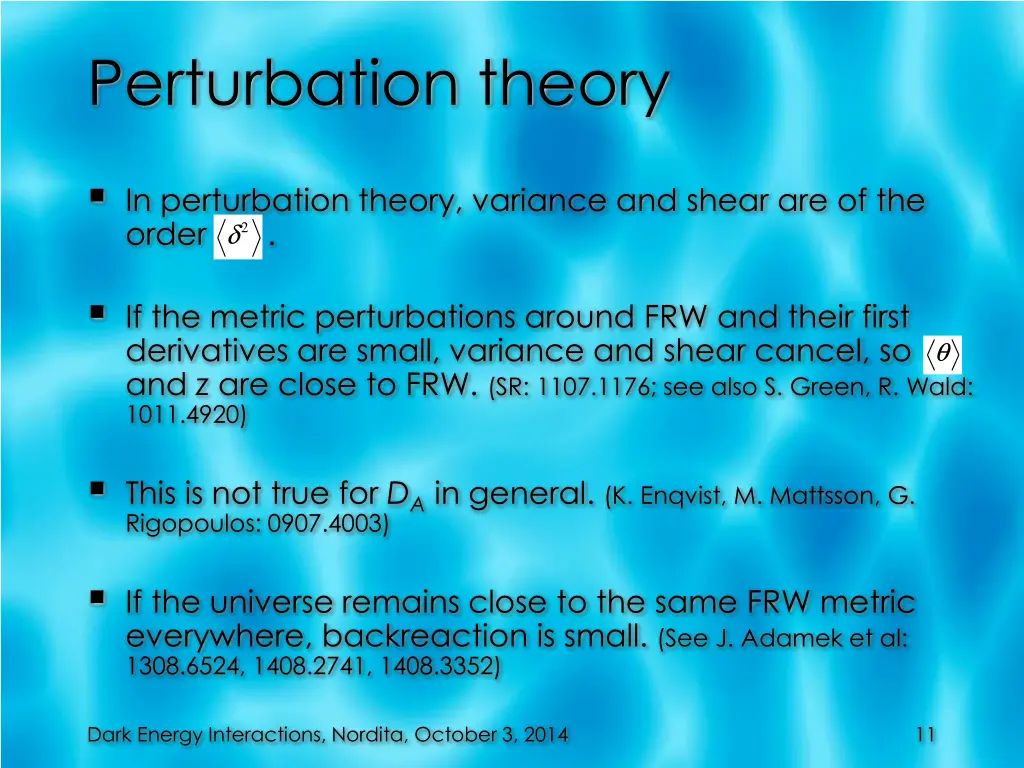
Perturbation theory In perturbation theory, variance and shear are of the order . d2 If the metric perturbations around FRW and their first derivatives are small, variance and shear cancel, so and z are close to FRW. (SR: 1107.1176; see also S. Green, R. Wald: 1011.4920) q This is not true for DA in general. (K. Enqvist, M. Mattsson, G. Rigopoulos: 0907.4003) If the universe remains close to the same FRW metric everywhere, backreaction is small. (See J. Adamek et al: 1308.6524, 1408.2741, 1408.3352) Dark Energy Interactions, Nordita, October 3, 2014 11
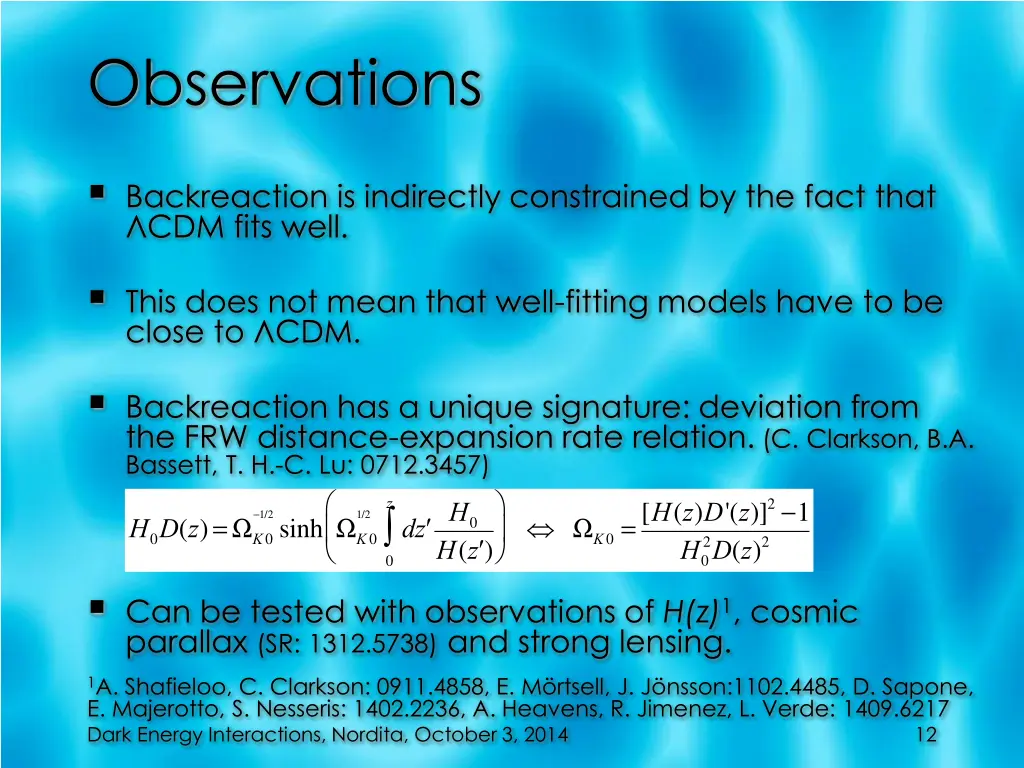
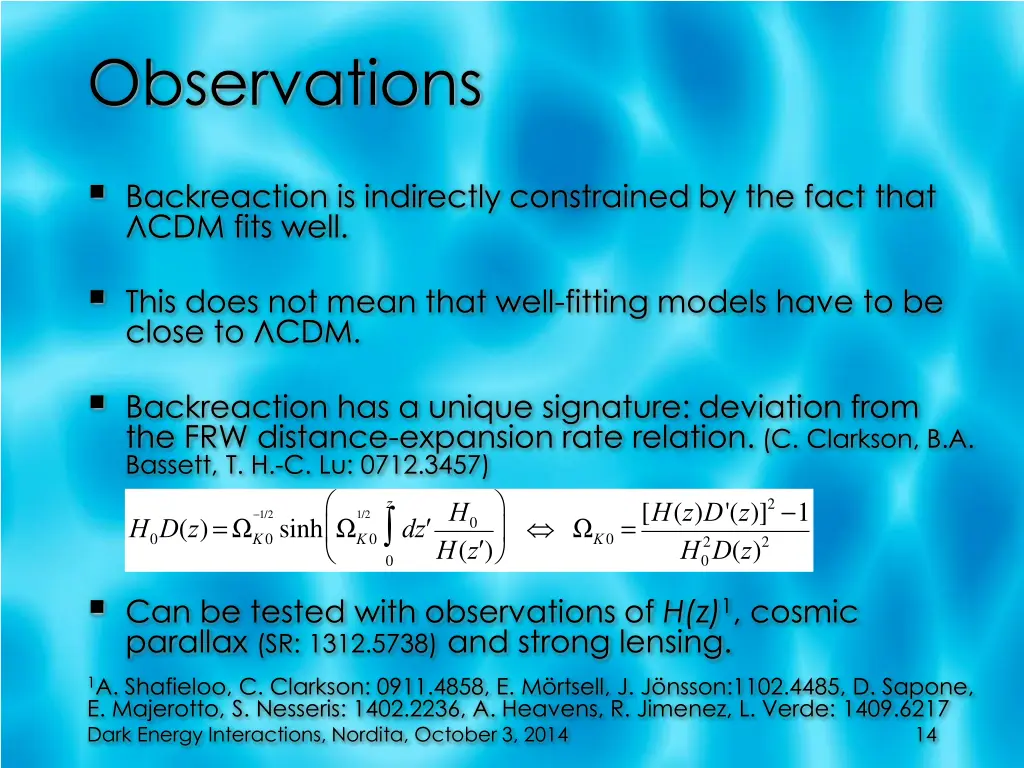
Observations Backreaction is indirectly constrained by the fact that CDM fits well. This does not mean that well-fitting models have to be close to CDM. Backreaction has a unique signature: deviation from the FRW distance-expansion rate relation. (C. Clarkson, B.A. Bassett, T. H.-C. Lu: 0712.3457) WK0=[H(z)D'(z)]2-1 z H0 H( z ) -1/2sinh WK0 1/2 d z H0D(z)=WK0 2D(z)2 H0 0 Can be tested with observations of H(z)1, cosmic parallax (SR: 1312.5738) and strong lensing. 1A. Shafieloo, C. Clarkson: 0911.4858, E. M rtsell, J. J nsson:1102.4485, D. Sapone, E. Majerotto, S. Nesseris: 1402.2236, A. Heavens, R. Jimenez, L. Verde: 1409.6217 Dark Energy Interactions, Nordita, October 3, 2014 12
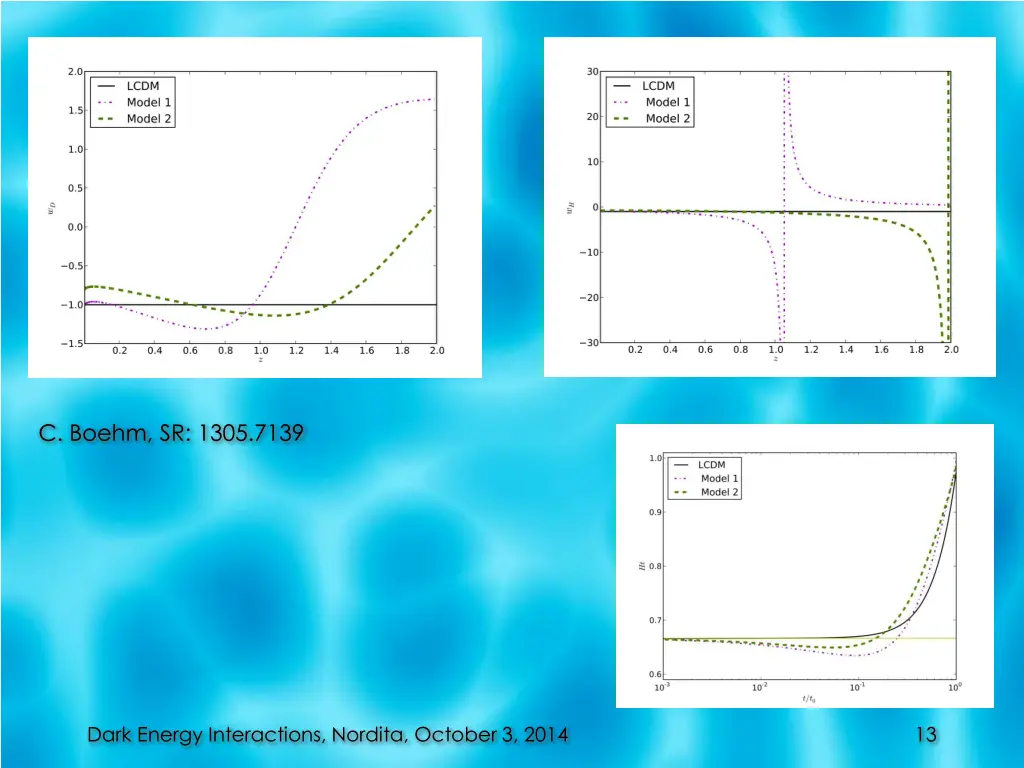
C. Boehm, SR: 1305.7139 Dark Energy Interactions, Nordita, October 3, 2014 13
Observations Backreaction is indirectly constrained by the fact that CDM fits well. This does not mean that well-fitting models have to be close to CDM. Backreaction has a unique signature: deviation from the FRW distance-expansion rate relation. (C. Clarkson, B.A. Bassett, T. H.-C. Lu: 0712.3457) WK0=[H(z)D'(z)]2-1 z H0 H( z ) -1/2sinh WK0 1/2 d z H0D(z)=WK0 2D(z)2 H0 0 Can be tested with observations of H(z)1, cosmic parallax (SR: 1312.5738) and strong lensing. 1A. Shafieloo, C. Clarkson: 0911.4858, E. M rtsell, J. J nsson:1102.4485, D. Sapone, E. Majerotto, S. Nesseris: 1402.2236, A. Heavens, R. Jimenez, L. Verde: 1409.6217 Dark Energy Interactions, Nordita, October 3, 2014 14
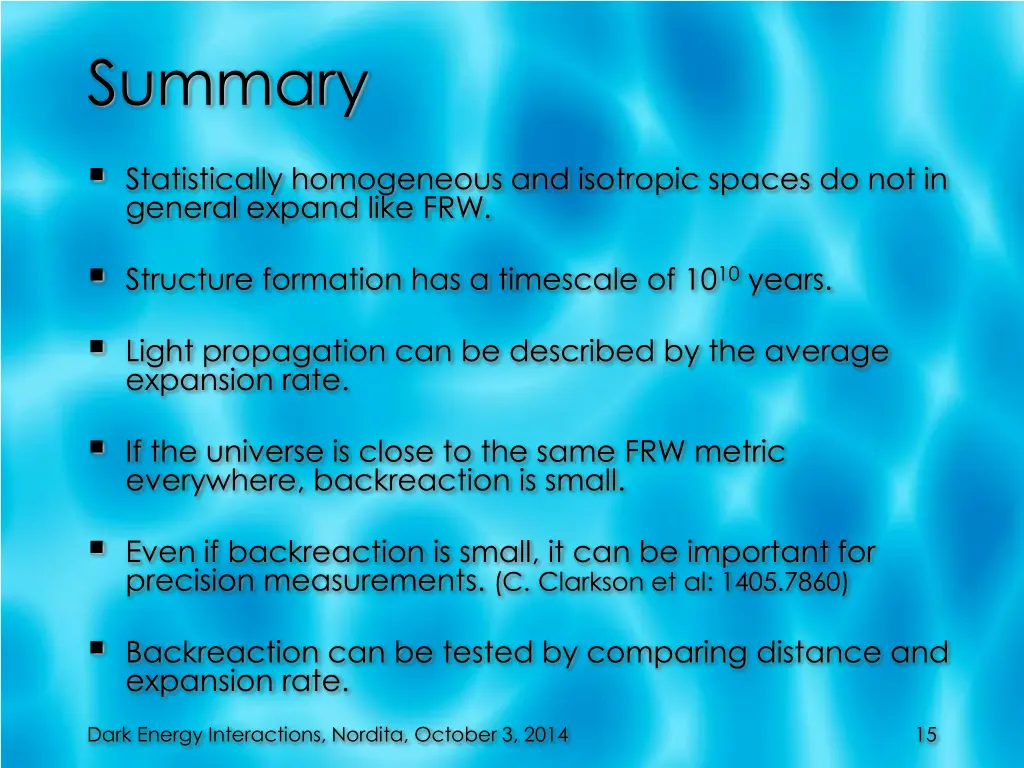
Summary Statistically homogeneous and isotropic spaces do not in general expand like FRW. Structure formation has a timescale of 1010 years. Light propagation can be described by the average expansion rate. If the universe is close to the same FRW metric everywhere, backreaction is small. Even if backreaction is small, it can be important for precision measurements. (C. Clarkson et al: 1405.7860) Backreaction can be tested by comparing distance and expansion rate. Dark Energy Interactions, Nordita, October 3, 2014 15