This educational project focuses on teaching children about childhood in the 1950s compared to modern times. It includes activities on timelines, family trees, significant events, and comparisons of daily life. Children learn about historical contexts, such as the coronation of Queen Elizabeth II in 1953, and reflect on the differences and similarities between past and present. The project aims to enhance students' understanding of historical perspectives and societal changes over time.
Please find below an Image/Link to download the presentation.
The content on the website is provided AS IS for your information and personal use only. It may not be sold, licensed, or shared on other websites without obtaining consent from the author. If you encounter any issues during the download, it is possible that the publisher has removed the file from their server.
You are allowed to download the files provided on this website for personal or commercial use, subject to the condition that they are used lawfully. All files are the property of their respective owners.
The content on the website is provided AS IS for your information and personal use only. It may not be sold, licensed, or shared on other websites without obtaining consent from the author.
E N D
Presentation Transcript
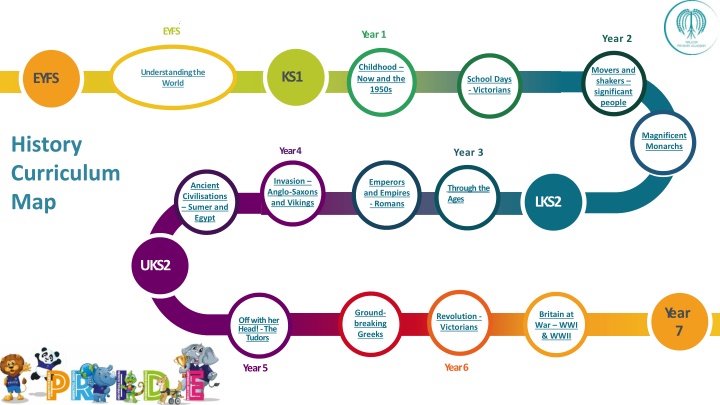
; EYF S Y ear1 Year 2 Childhood Now and the 1950s Movers and shakers significant people Understandingthe World KS1 EYFS School Days - Victorians Magnificent Monarchs History Curriculum Map Year 4 Year 3 Invasion Anglo-Saxons and Vikings Emperors and Empires - Romans Ancient Civilisations Sumer and Egypt Through the Ages LKS2 UKS2 Y ear 7 Ground- breaking Greeks Britain at War WWI & WWII Revolution - Victorians Off with her Head! - The Tudors Year 6 Year 5
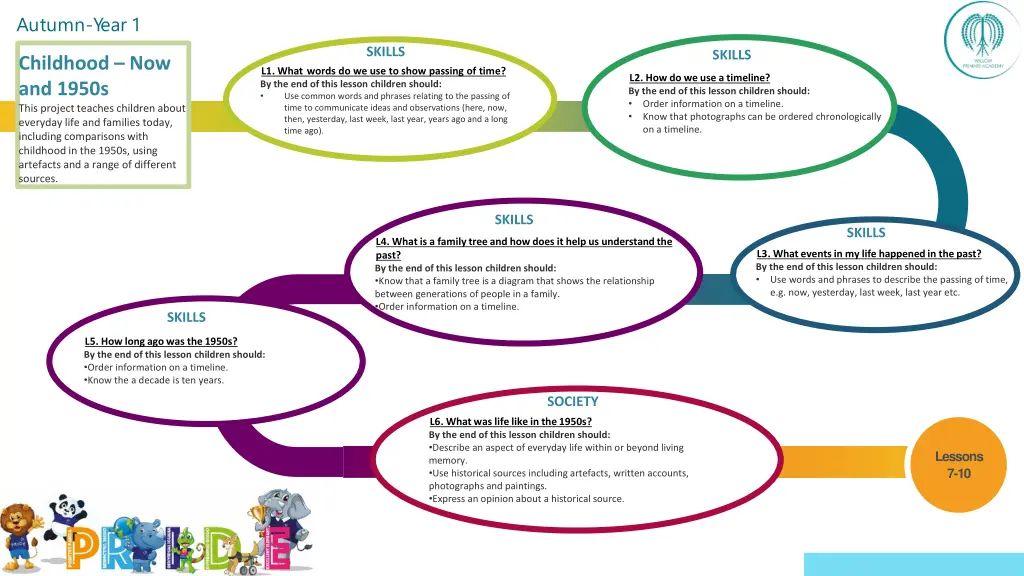
Autumn-Year 1 SKILLS SKILLS Childhood Now and 1950s This project teaches children about everyday life and families today, including comparisons with childhood in the 1950s, using artefacts and a range of different sources. L1. What words do we use to show passing of time? By the end of this lesson children should: Use common words and phrases relating to the passing of time to communicate ideas and observations (here, now, then, yesterday, last week, last year, years ago and a long time ago). L2. How do we use a timeline? By the end of this lesson children should: Order information on a timeline. Know that photographs can be ordered chronologically on a timeline. SKILLS SKILLS L4. What is a family tree and how does it help us understand the past? By the end of this lesson children should: Know that a family tree is a diagram that shows the relationship between generations of people in a family. Order information on a timeline. L3. What events in my life happened in the past? By the end of this lesson children should: Use words and phrases to describe the passing of time, e.g. now, yesterday, last week, last year etc. SKILLS L5. How long ago was the 1950s? By the end of this lesson children should: Order information on a timeline. Know the a decade is ten years. SOCIETY L6. What was life like in the 1950s? By the end of this lesson children should: Describe an aspect of everyday life within or beyond living memory. Use historical sources including artefacts, written accounts, photographs and paintings. Express an opinion about a historical source. Lessons 7-10
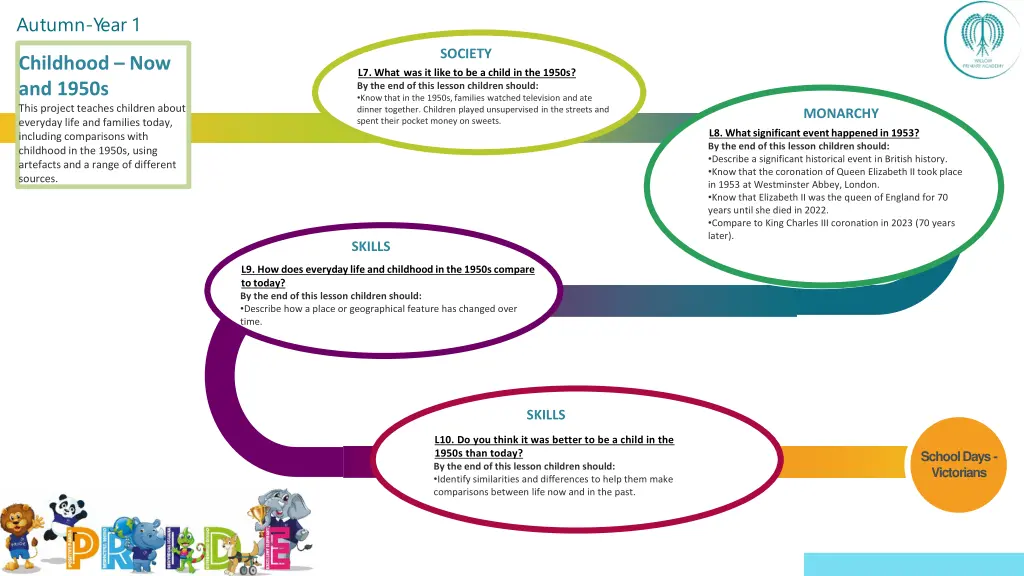
Autumn-Year 1 SOCIETY Childhood Now and 1950s This project teaches children about everyday life and families today, including comparisons with childhood in the 1950s, using artefacts and a range of different sources. L7. What was it like to be a child in the 1950s? By the end of this lesson children should: Know that in the 1950s, families watched television and ate dinner together. Children played unsupervised in the streets and spent their pocket money on sweets. MONARCHY L8. What significant event happened in 1953? By the end of this lesson children should: Describe a significant historical event in British history. Know that the coronation of Queen Elizabeth II took place in 1953 at Westminster Abbey, London. Know that Elizabeth II was the queen of England for 70 years until she died in 2022. Compare to King Charles III coronation in 2023 (70 years later). SKILLS L9. How does everyday life and childhood in the 1950s compare to today? By the end of this lesson children should: Describe how a place or geographical feature has changed over time. SKILLS L10. Do you think it was better to be a child in the 1950s than today? By the end of this lesson children should: Identify similarities and differences to help them make comparisons between life now and in the past. School Days - Victorians
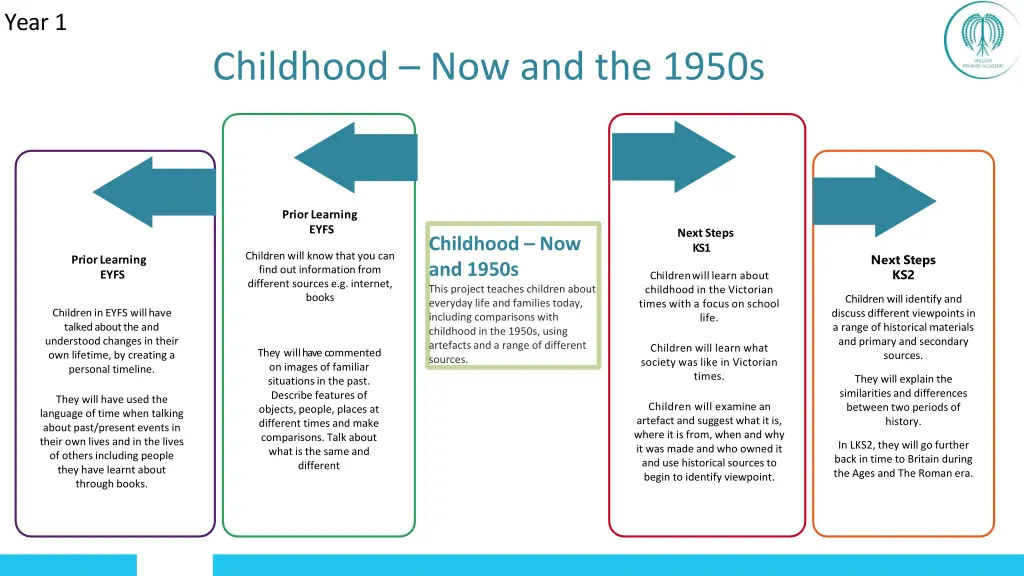
Year 1 Childhood Now and the 1950s PriorLearning EYFS NextSteps KS1 Childhood Now and 1950s This project teaches children about everyday life and families today, including comparisons with childhood in the 1950s, using artefacts and a range of different sources. Next Steps KS2 Childrenwill know that you can find out information from different sources e.g. internet, books PriorLearning EYFS Childrenwilllearn about childhood in the Victorian times with a focus on school life. Children will identify and discuss different viewpoints in a range of historical materials and primary and secondary sources. ChildreninEYFS willhave talked about the and understood changes in their own lifetime, by creating a personal timeline. Children will learn what society was like in Victorian times. They willhave commented on images of familiar situations in the past. Describe features of objects, people, places at different times and make comparisons. Talk about what is the same and different They will explain the similarities and differences between two periods of history. They will have used the language of time when talking about past/present events in their own lives and in the lives of others including people they have learnt about through books. Children will examine an artefact and suggest what it is, where it is from, when and why it was made and who owned it and use historical sources to begin to identify viewpoint. In LKS2, they will go further back in time to Britain during the Ages and The Roman era.
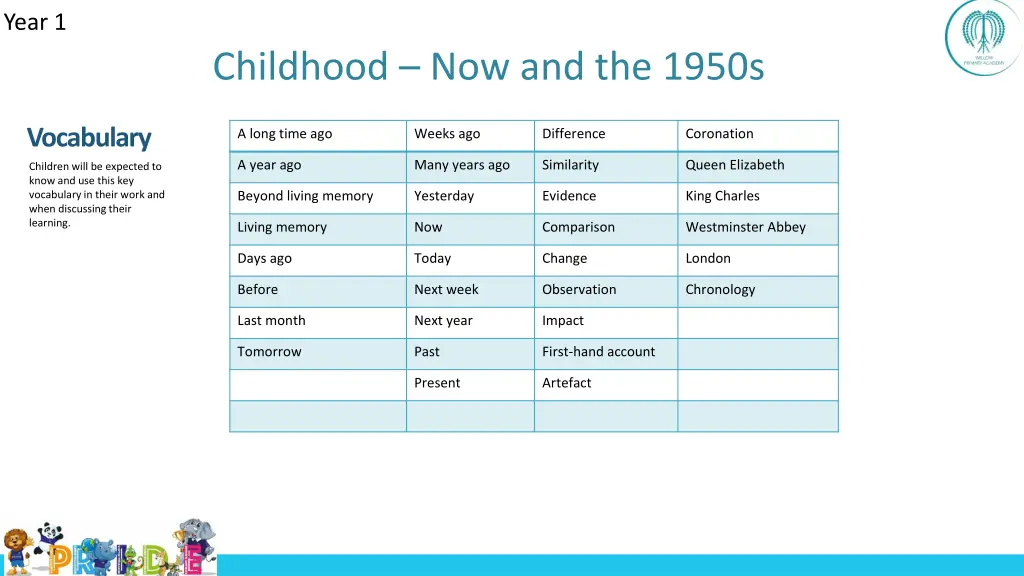
Year 1 Childhood Now and the 1950s Vocabulary A long time ago Weeks ago Difference Coronation A year ago Many years ago Similarity Queen Elizabeth Children will be expected to know and use this key vocabulary in their work and when discussing their learning. Beyond living memory Yesterday Evidence King Charles Living memory Now Comparison Westminster Abbey Days ago Today Change London Before Next week Observation Chronology Last month Next year Impact Tomorrow Past First-hand account Present Artefact
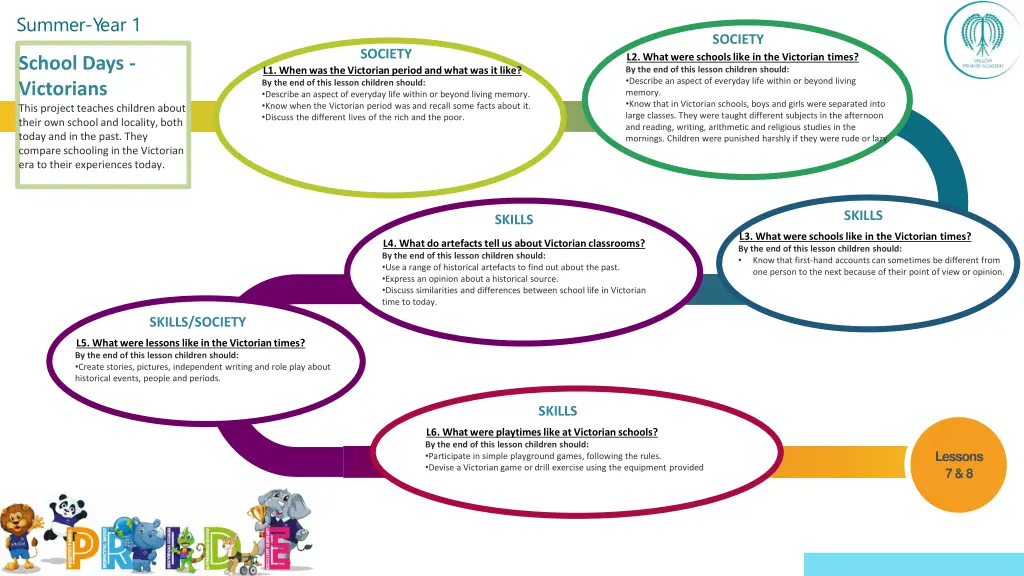
Summer-Year 1 SOCIETY SOCIETY L2. What were schools like in the Victorian times? By the end of this lesson children should: Describe an aspect of everyday life within or beyond living memory. Know that in Victorian schools, boys and girls were separated into large classes. They were taught different subjects in the afternoon and reading, writing, arithmetic and religious studies in the mornings. Children were punished harshly if they were rude or lazy. School Days - Victorians This project teaches children about their own school and locality, both today and in the past. They compare schooling in the Victorian era to their experiences today. L1. When was the Victorian period and what was it like? By the end of this lesson children should: Describe an aspect of everyday life within or beyond living memory. Know when the Victorian period was and recall some facts about it. Discuss the different lives of the rich and the poor. SKILLS SKILLS L3. What were schools like in the Victorian times? By the end of this lesson children should: Know that first-hand accounts can sometimes be different from one person to the next because of their point of view or opinion. L4. What do artefacts tell us about Victorian classrooms? By the end of this lesson children should: Use a range of historical artefacts to find out about the past. Express an opinion about a historical source. Discuss similarities and differences between school life in Victorian time to today. SKILLS/SOCIETY L5. What were lessons like in the Victorian times? By the end of this lesson children should: Create stories, pictures, independent writing and role play about historical events, people and periods. SKILLS L6. What were playtimes like at Victorian schools? By the end of this lesson children should: Participate in simple playground games, following the rules. Devise a Victorian game or drill exercise using the equipment provided Lessons 7 & 8
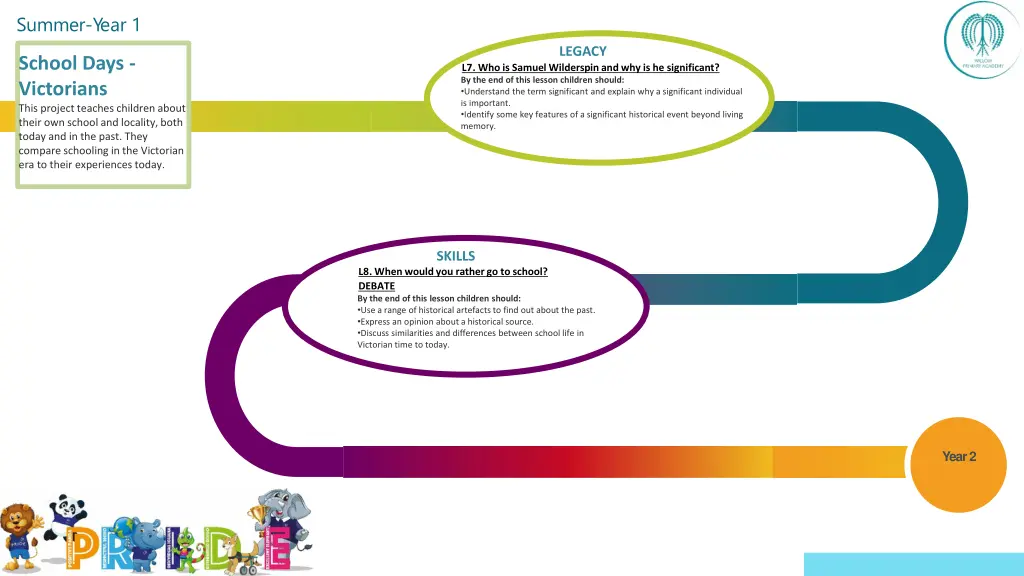
Summer-Year 1 LEGACY School Days - Victorians This project teaches children about their own school and locality, both today and in the past. They compare schooling in the Victorian era to their experiences today. L7. Who is Samuel Wilderspin and why is he significant? By the end of this lesson children should: Understand the term significant and explain why a significant individual is important. Identify some key features of a significant historical event beyond living memory. SKILLS L8. When would you rather go to school? DEBATE By the end of this lesson children should: Use a range of historical artefacts to find out about the past. Express an opinion about a historical source. Discuss similarities and differences between school life in Victorian time to today. Year 2
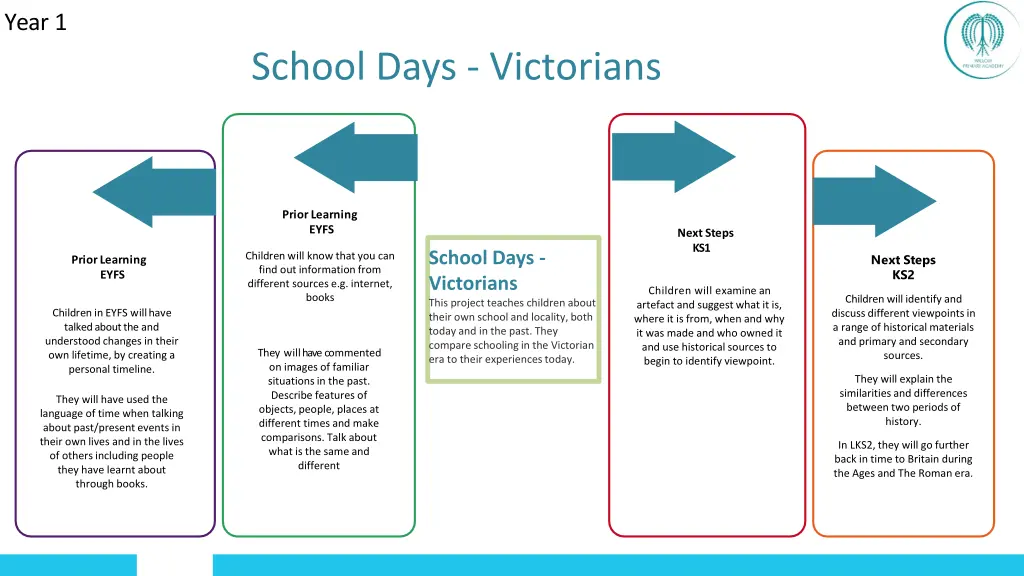
Year 1 School Days - Victorians PriorLearning EYFS NextSteps KS1 School Days - Victorians This project teaches children about their own school and locality, both today and in the past. They compare schooling in the Victorian era to their experiences today. Next Steps KS2 Childrenwill know that you can find out information from different sources e.g. internet, books PriorLearning EYFS Children will examine an artefact and suggest what it is, where it is from, when and why it was made and who owned it and use historical sources to begin to identify viewpoint. Children will identify and discuss different viewpoints in a range of historical materials and primary and secondary sources. ChildreninEYFS willhave talked about the and understood changes in their own lifetime, by creating a personal timeline. They willhave commented on images of familiar situations in the past. Describe features of objects, people, places at different times and make comparisons. Talk about what is the same and different They will explain the similarities and differences between two periods of history. They will have used the language of time when talking about past/present events in their own lives and in the lives of others including people they have learnt about through books. In LKS2, they will go further back in time to Britain during the Ages and The Roman era.
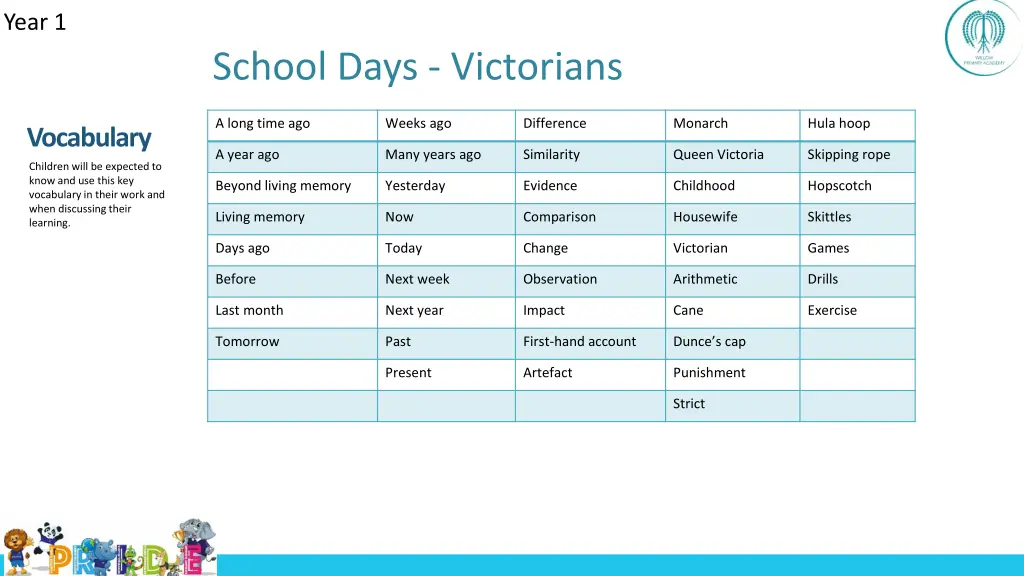
Year 1 School Days - Victorians A long time ago Weeks ago Difference Monarch Hula hoop Vocabulary A year ago Many years ago Similarity Queen Victoria Skipping rope Children will be expected to know and use this key vocabulary in their work and when discussing their learning. Beyond living memory Yesterday Evidence Childhood Hopscotch Living memory Now Comparison Housewife Skittles Days ago Today Change Victorian Games Before Next week Observation Arithmetic Drills Last month Next year Impact Cane Exercise Tomorrow Past First-hand account Dunce s cap Present Artefact Punishment Strict
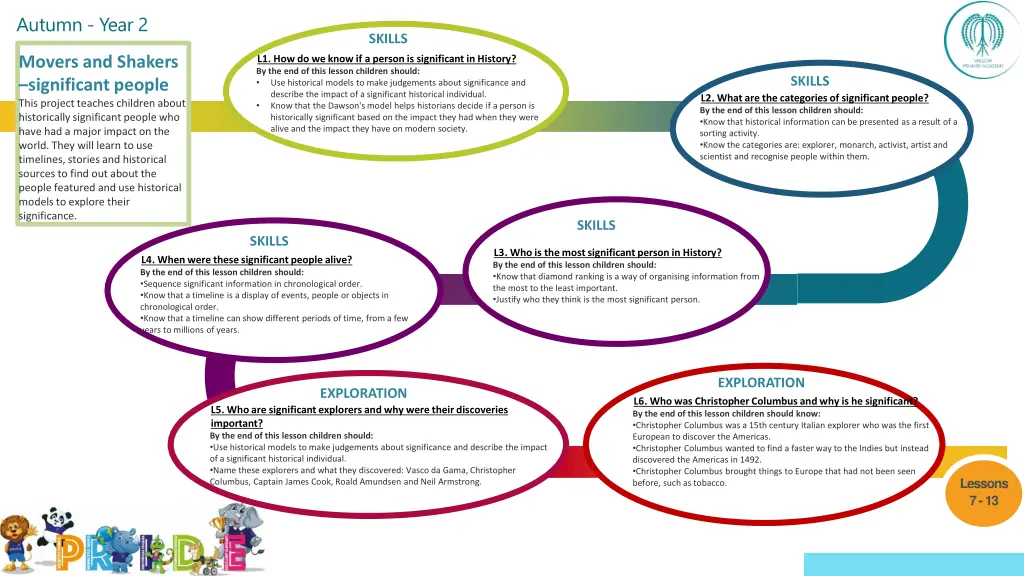
Autumn - Year 2 SKILLS Movers and Shakers significant people This project teaches children about historically significant people who have had a major impact on the world. They will learn to use timelines, stories and historical sources to find out about the people featured and use historical models to explore their significance. L1. How do we know if a person is significant in History? By the end of this lesson children should: Use historical models to make judgements about significance and describe the impact of a significant historical individual. Know that the Dawson's model helps historians decide if a person is historically significant based on the impact they had when they were alive and the impact they have on modern society. SKILLS L2. What are the categories of significant people? By the end of this lesson children should: Know that historical information can be presented as a result of a sorting activity. Know the categories are: explorer, monarch, activist, artist and scientist and recognise people within them. SKILLS SKILLS L3. Who is the most significant person in History? By the end of this lesson children should: Know that diamond ranking is a way of organising information from the most to the least important. Justify who they think is the most significant person. L4. When were these significant people alive? By the end of this lesson children should: Sequence significant information in chronological order. Know that a timeline is a display of events, people or objects in chronological order. Know that a timeline can show different periods of time, from a few years to millions of years. EXPLORATION EXPLORATION L6. Who was Christopher Columbus and why is he significant? By the end of this lesson children should know: Christopher Columbus was a 15th century Italian explorer who was the first European to discover the Americas. Christopher Columbus wanted to find a faster way to the Indies but instead discovered the Americas in 1492. Christopher Columbus brought things to Europe that had not been seen before, such as tobacco. L5. Who are significant explorers and why were their discoveries important? By the end of this lesson children should: Use historical models to make judgements about significance and describe the impact of a significant historical individual. Name these explorers and what they discovered: Vasco da Gama, Christopher Columbus, Captain James Cook, Roald Amundsen and Neil Armstrong. Lessons 7 - 13
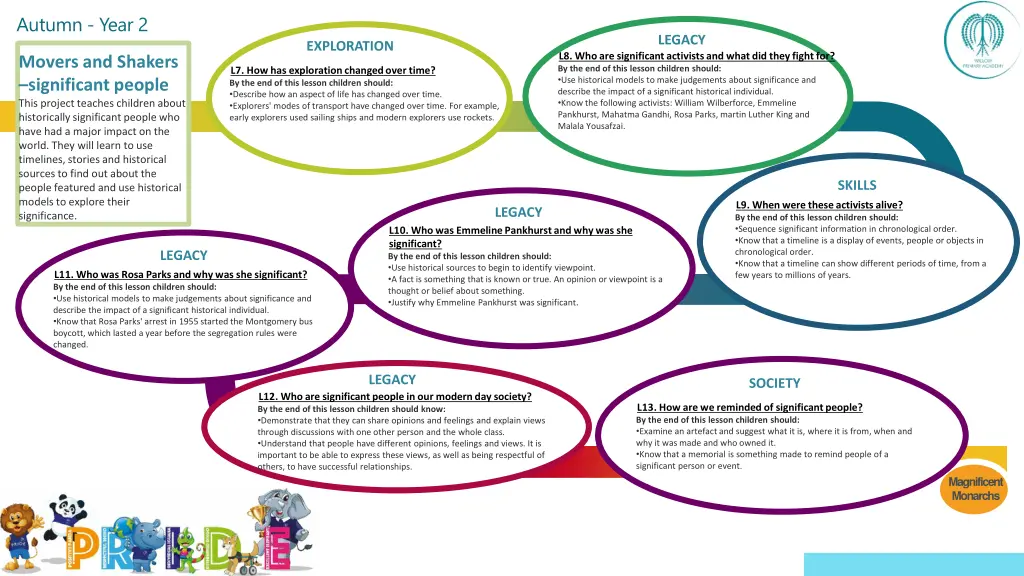
Autumn - Year 2 LEGACY EXPLORATION L8. Who are significant activists and what did they fight for? By the end of this lesson children should: Use historical models to make judgements about significance and describe the impact of a significant historical individual. Know the following activists: William Wilberforce, Emmeline Pankhurst, Mahatma Gandhi, Rosa Parks, martin Luther King and Malala Yousafzai. Movers and Shakers significant people This project teaches children about historically significant people who have had a major impact on the world. They will learn to use timelines, stories and historical sources to find out about the people featured and use historical models to explore their significance. L7. How has exploration changed over time? By the end of this lesson children should: Describe how an aspect of life has changed over time. Explorers' modes of transport have changed over time. For example, early explorers used sailing ships and modern explorers use rockets. SKILLS L9. When were these activists alive? By the end of this lesson children should: Sequence significant information in chronological order. Know that a timeline is a display of events, people or objects in chronological order. Know that a timeline can show different periods of time, from a few years to millions of years. LEGACY L10. Who was Emmeline Pankhurst and why was she significant? By the end of this lesson children should: Use historical sources to begin to identify viewpoint. A fact is something that is known or true. An opinion or viewpoint is a thought or belief about something. Justify why Emmeline Pankhurst was significant. LEGACY L11. Who was Rosa Parks and why was she significant? By the end of this lesson children should: Use historical models to make judgements about significance and describe the impact of a significant historical individual. Know that Rosa Parks' arrest in 1955 started the Montgomery bus boycott, which lasted a year before the segregation rules were changed. LEGACY SOCIETY L12. Who are significant people in our modern day society? By the end of this lesson children should know: Demonstrate that they can share opinions and feelings and explain views through discussions with one other person and the whole class. Understand that people have different opinions, feelings and views. It is important to be able to express these views, as well as being respectful of others, to have successful relationships. L13. How are we reminded of significant people? By the end of this lesson children should: Examine an artefact and suggest what it is, where it is from, when and why it was made and who owned it. Know that a memorial is something made to remind people of a significant person or event. Magnificent Monarchs
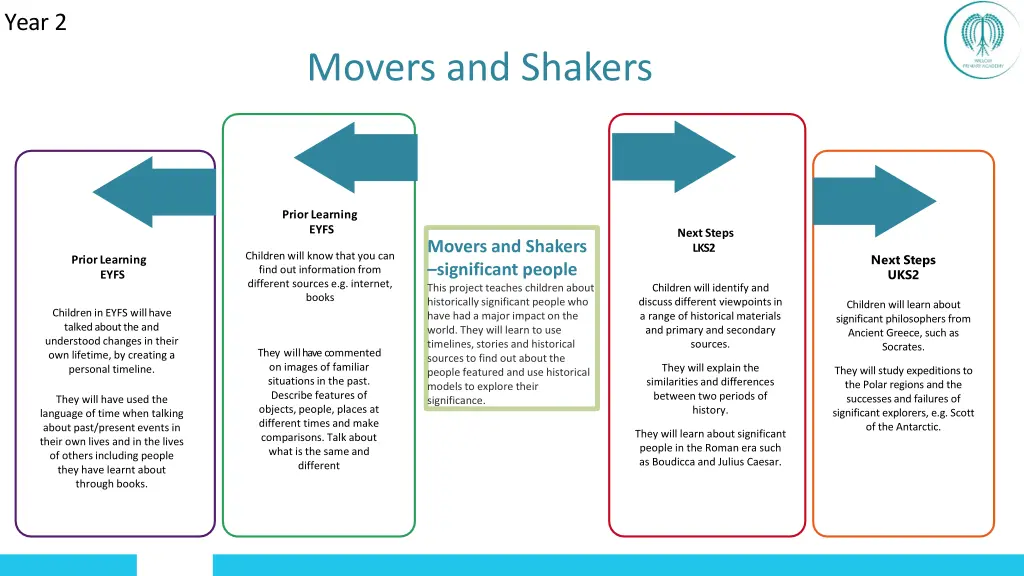
Year 2 Movers and Shakers PriorLearning EYFS NextSteps LKS2 Movers and Shakers significant people This project teaches children about historically significant people who have had a major impact on the world. They will learn to use timelines, stories and historical sources to find out about the people featured and use historical models to explore their significance. Next Steps UKS2 Childrenwill know that you can find out information from different sources e.g. internet, books PriorLearning EYFS Children will identify and discuss different viewpoints in a range of historical materials and primary and secondary sources. Children will learn about significant philosophers from Ancient Greece, such as Socrates. ChildreninEYFS willhave talked about the and understood changes in their own lifetime, by creating a personal timeline. They willhave commented on images of familiar situations in the past. Describe features of objects, people, places at different times and make comparisons. Talk about what is the same and different They will explain the similarities and differences between two periods of history. They will study expeditions to the Polar regions and the successes and failures of significant explorers, e.g. Scott of the Antarctic. They will have used the language of time when talking about past/present events in their own lives and in the lives of others including people they have learnt about through books. They will learn about significant people in the Roman era such as Boudicca and Julius Caesar.
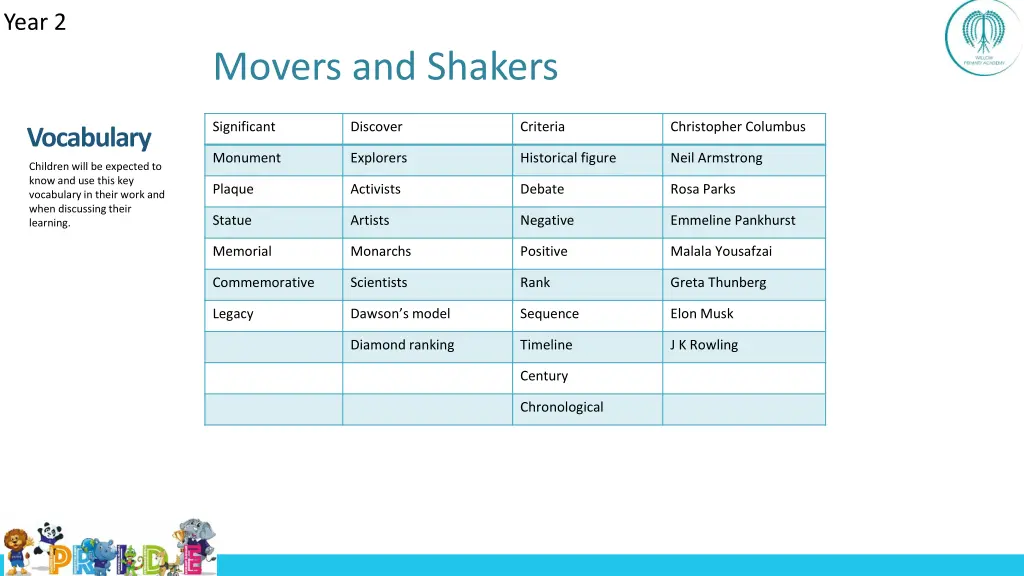
Year 2 Movers and Shakers Significant Discover Criteria Christopher Columbus Vocabulary Monument Explorers Historical figure Neil Armstrong Children will be expected to know and use this key vocabulary in their work and when discussing their learning. Plaque Activists Debate Rosa Parks Statue Artists Negative Emmeline Pankhurst Memorial Monarchs Positive Malala Yousafzai Commemorative Scientists Rank Greta Thunberg Legacy Dawson s model Sequence Elon Musk Diamond ranking Timeline J K Rowling Century Chronological
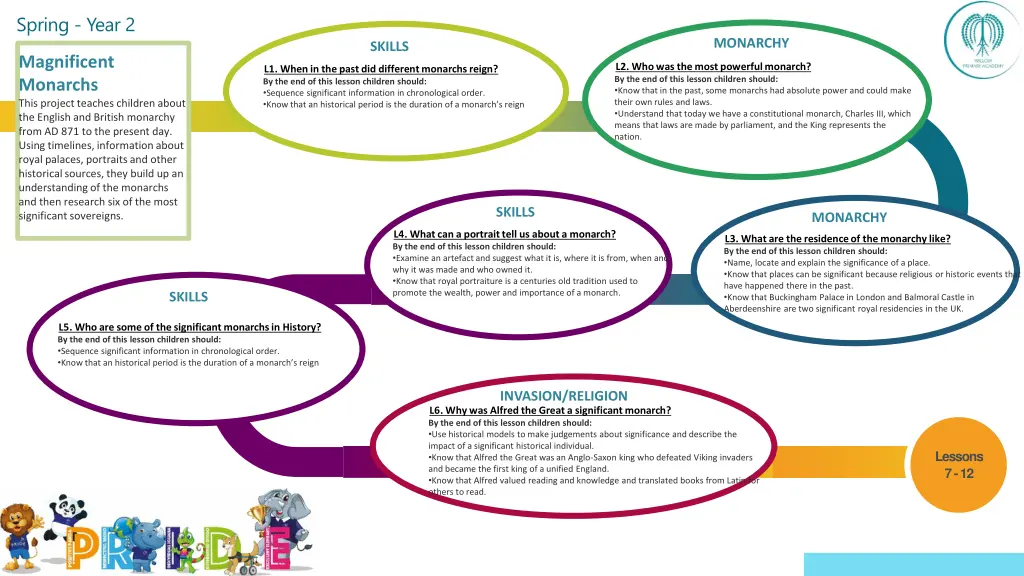
Spring - Year 2 MONARCHY SKILLS Magnificent Monarchs This project teaches children about the English and British monarchy from AD 871 to the present day. Using timelines, information about royal palaces, portraits and other historical sources, they build up an understanding of the monarchs and then research six of the most significant sovereigns. L2. Who was the most powerful monarch? By the end of this lesson children should: Know that in the past, some monarchs had absolute power and could make their own rules and laws. Understand that today we have a constitutional monarch, Charles III, which means that laws are made by parliament, and the King represents the nation. L1. When in the past did different monarchs reign? By the end of this lesson children should: Sequence significant information in chronological order. Know that an historical period is the duration of a monarch s reign SKILLS MONARCHY L4. What can a portrait tell us about a monarch? By the end of this lesson children should: Examine an artefact and suggest what it is, where it is from, when and why it was made and who owned it. Know that royal portraiture is a centuries old tradition used to promote the wealth, power and importance of a monarch. L3. What are the residence of the monarchy like? By the end of this lesson children should: Name, locate and explain the significance of a place. Know that places can be significant because religious or historic events that have happened there in the past. Know that Buckingham Palace in London and Balmoral Castle in Aberdeenshire are two significant royal residencies in the UK. SKILLS L5. Who are some of the significant monarchs in History? By the end of this lesson children should: Sequence significant information in chronological order. Know that an historical period is the duration of a monarch s reign INVASION/RELIGION L6. Why was Alfred the Great a significant monarch? By the end of this lesson children should: Use historical models to make judgements about significance and describe the impact of a significant historical individual. Know that Alfred the Great was an Anglo-Saxon king who defeated Viking invaders and became the first king of a unified England. Know that Alfred valued reading and knowledge and translated books from Latin for others to read. Lessons 7 - 12
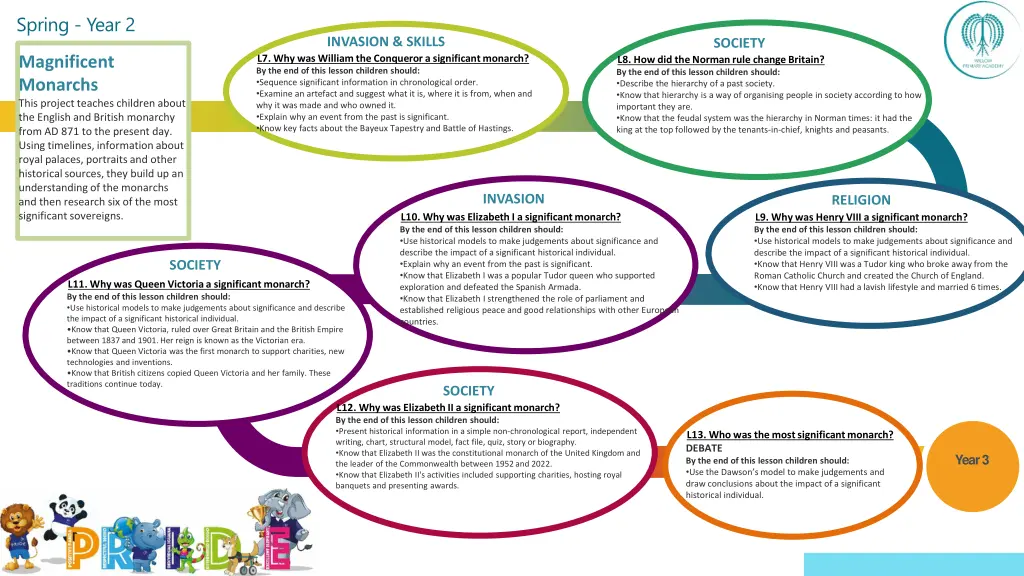
Spring - Year 2 INVASION & SKILLS SOCIETY Magnificent Monarchs This project teaches children about the English and British monarchy from AD 871 to the present day. Using timelines, information about royal palaces, portraits and other historical sources, they build up an understanding of the monarchs and then research six of the most significant sovereigns. L7. Why was William the Conqueror a significant monarch? By the end of this lesson children should: Sequence significant information in chronological order. Examine an artefact and suggest what it is, where it is from, when and why it was made and who owned it. Explain why an event from the past is significant. Know key facts about the Bayeux Tapestry and Battle of Hastings. L8. How did the Norman rule change Britain? By the end of this lesson children should: Describe the hierarchy of a past society. Know that hierarchy is a way of organising people in society according to how important they are. Know that the feudal system was the hierarchy in Norman times: it had the king at the top followed by the tenants-in-chief, knights and peasants. INVASION RELIGION L10. Why was Elizabeth I a significant monarch? By the end of this lesson children should: Use historical models to make judgements about significance and describe the impact of a significant historical individual. Explain why an event from the past is significant. Know that Elizabeth I was a popular Tudor queen who supported exploration and defeated the Spanish Armada. Know that Elizabeth I strengthened the role of parliament and established religious peace and good relationships with other European countries. L9. Why was Henry VIII a significant monarch? By the end of this lesson children should: Use historical models to make judgements about significance and describe the impact of a significant historical individual. Know that Henry VIII was a Tudor king who broke away from the Roman Catholic Church and created the Church of England. Know that Henry VIII had a lavish lifestyle and married 6 times. SOCIETY L11. Why was Queen Victoria a significant monarch? By the end of this lesson children should: Use historical models to make judgements about significance and describe the impact of a significant historical individual. Know that Queen Victoria, ruled over Great Britain and the British Empire between 1837 and 1901. Her reign is known as the Victorian era. Know that Queen Victoria was the first monarch to support charities, new technologies and inventions. Know that British citizens copied Queen Victoria and her family. These traditions continue today. SOCIETY L12. Why was Elizabeth II a significant monarch? By the end of this lesson children should: Present historical information in a simple non-chronological report, independent writing, chart, structural model, fact file, quiz, story or biography. Know that Elizabeth II was the constitutional monarch of the United Kingdom and the leader of the Commonwealth between 1952 and 2022. Know that Elizabeth II's activities included supporting charities, hosting royal banquets and presenting awards. L13. Who was the most significant monarch? DEBATE By the end of this lesson children should: Use the Dawson s model to make judgements and draw conclusions about the impact of a significant historical individual. Year 3
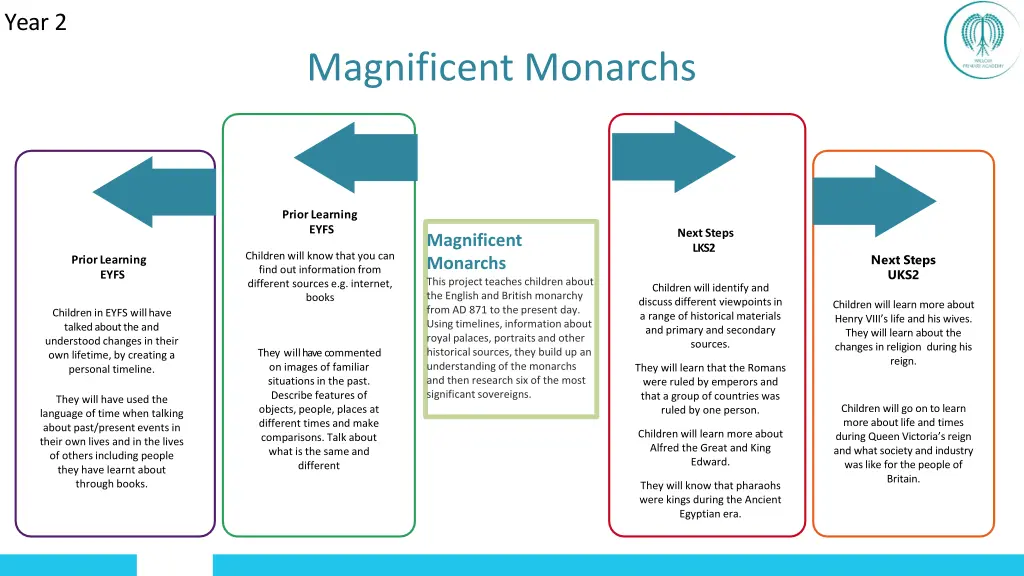
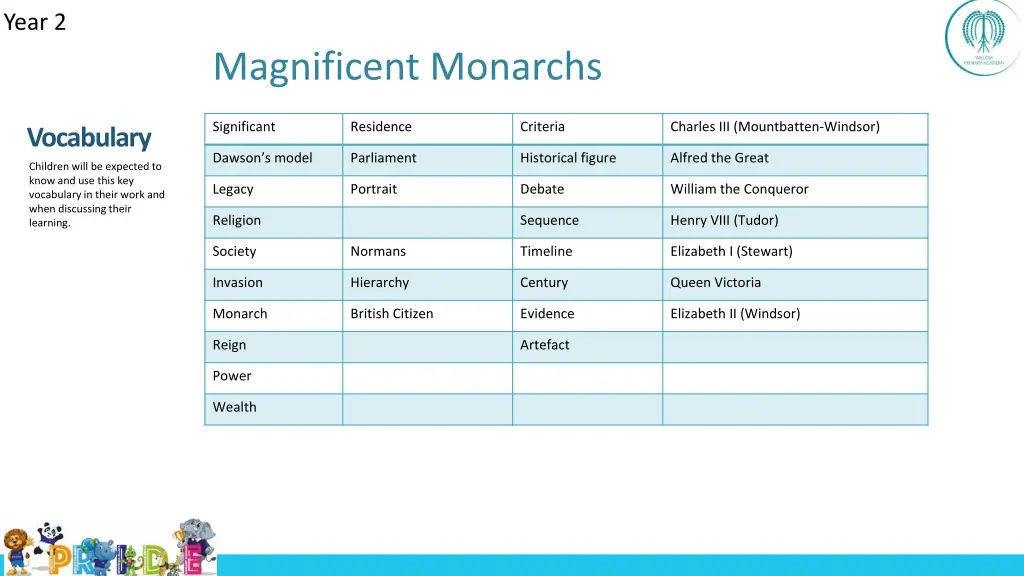
Year 2 Magnificent Monarchs PriorLearning EYFS NextSteps LKS2 Magnificent Monarchs This project teaches children about the English and British monarchy from AD 871 to the present day. Using timelines, information about royal palaces, portraits and other historical sources, they build up an understanding of the monarchs and then research six of the most significant sovereigns. Next Steps UKS2 Childrenwill know that you can find out information from different sources e.g. internet, books PriorLearning EYFS Children will identify and discuss different viewpoints in a range of historical materials and primary and secondary sources. Children will learn more about Henry VIII s life and his wives. They will learn about the changes in religion during his reign. ChildreninEYFS willhave talked about the and understood changes in their own lifetime, by creating a personal timeline. They willhave commented on images of familiar situations in the past. Describe features of objects, people, places at different times and make comparisons. Talk about what is the same and different They will learn that the Romans were ruled by emperors and that a group of countries was ruled by one person. They will have used the language of time when talking about past/present events in their own lives and in the lives of others including people they have learnt about through books. Children will go on to learn more about life and times during Queen Victoria s reign and what society and industry was like for the people of Britain. Children will learn more about Alfred the Great and King Edward. They will know that pharaohs were kings during the Ancient Egyptian era.
Year 2 Magnificent Monarchs Significant Residence Criteria Charles III (Mountbatten-Windsor) Vocabulary Dawson s model Parliament Historical figure Alfred the Great Children will be expected to know and use this key vocabulary in their work and when discussing their learning. Legacy Portrait Debate William the Conqueror Religion Sequence Henry VIII (Tudor) Society Normans Timeline Elizabeth I (Stewart) Invasion Hierarchy Century Queen Victoria Monarch British Citizen Evidence Elizabeth II (Windsor) Reign Artefact Power Wealth
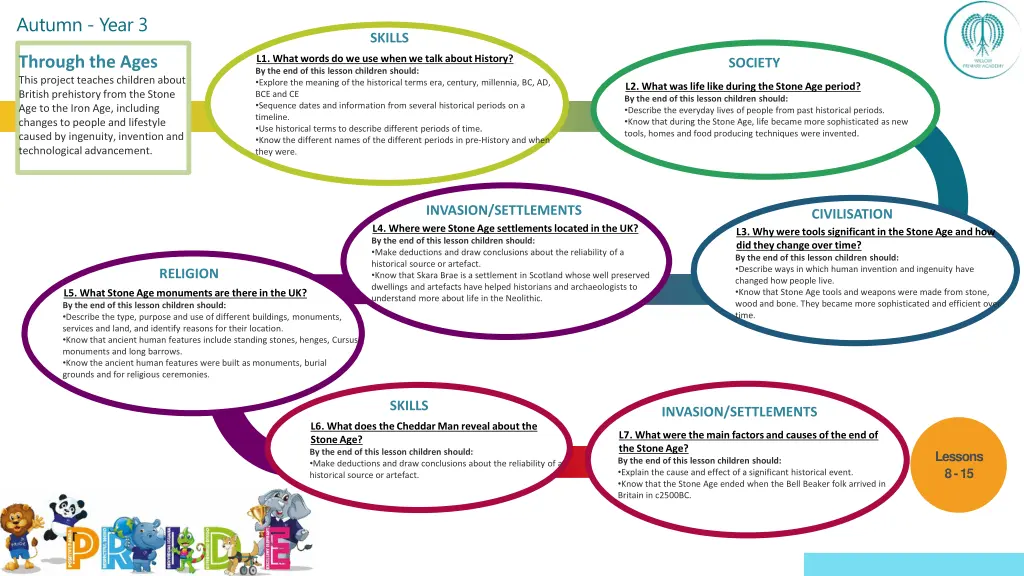
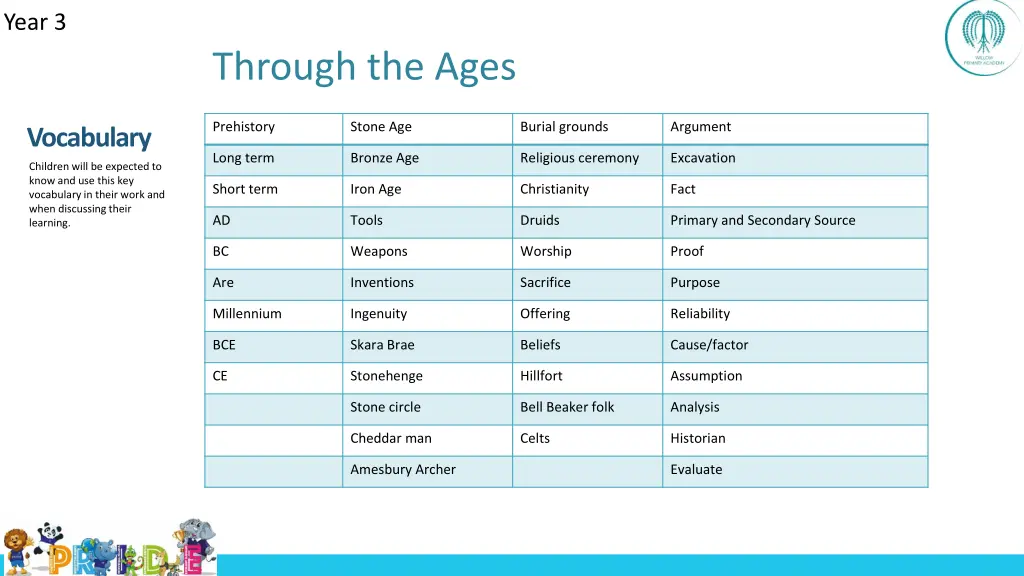
Autumn - Year 3 SKILLS Through the Ages This project teaches children about British prehistory from the Stone Age to the Iron Age, including changes to people and lifestyle caused by ingenuity, invention and technological advancement. L1. What words do we use when we talk about History? By the end of this lesson children should: Explore the meaning of the historical terms era, century, millennia, BC, AD, BCE and CE Sequence dates and information from several historical periods on a timeline. Use historical terms to describe different periods of time. Know the different names of the different periods in pre-History and when they were. SOCIETY L2. What was life like during the Stone Age period? By the end of this lesson children should: Describe the everyday lives of people from past historical periods. Know that during the Stone Age, life became more sophisticated as new tools, homes and food producing techniques were invented. INVASION/SETTLEMENTS L4. Where were Stone Age settlements located in the UK? By the end of this lesson children should: Make deductions and draw conclusions about the reliability of a historical source or artefact. Know that Skara Brae is a settlement in Scotland whose well preserved dwellings and artefacts have helped historians and archaeologists to understand more about life in the Neolithic. CIVILISATION L3. Why were tools significant in the Stone Age and how did they change over time? By the end of this lesson children should: Describe ways in which human invention and ingenuity have changed how people live. Know that Stone Age tools and weapons were made from stone, wood and bone. They became more sophisticated and efficient over time. RELIGION L5. What Stone Age monuments are there in the UK? By the end of this lesson children should: Describe the type, purpose and use of different buildings, monuments, services and land, and identify reasons for their location. Know that ancient human features include standing stones, henges, Cursus monuments and long barrows. Know the ancient human features were built as monuments, burial grounds and for religious ceremonies. SKILLS INVASION/SETTLEMENTS L6. What does the Cheddar Man reveal about the Stone Age? By the end of this lesson children should: Make deductions and draw conclusions about the reliability of a historical source or artefact. L7. What were the main factors and causes of the end of the Stone Age? By the end of this lesson children should: Explain the cause and effect of a significant historical event. Know that the Stone Age ended when the Bell Beaker folk arrived in Britain in c2500BC. Lessons 8 - 15
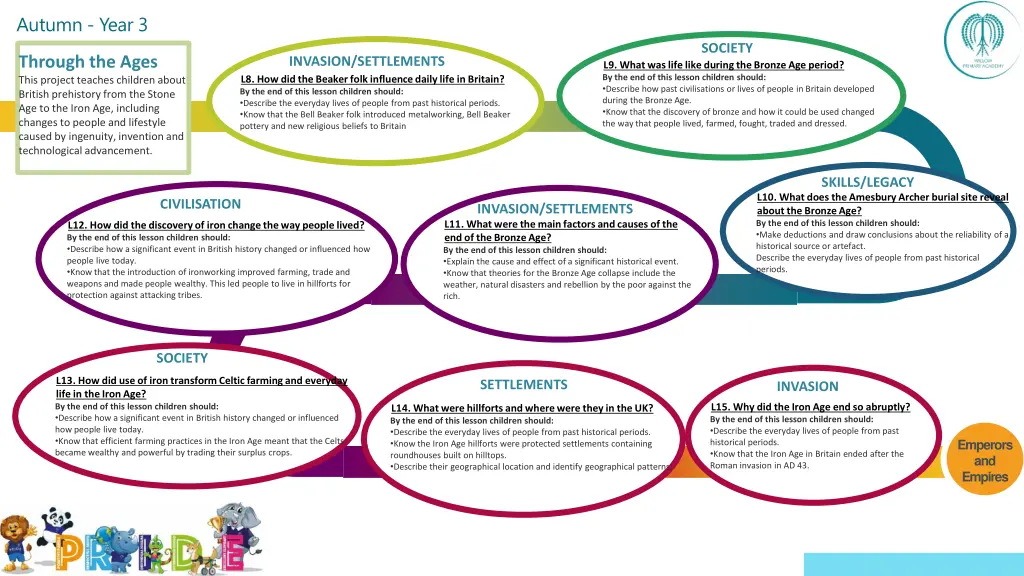
Autumn - Year 3 SOCIETY Through the Ages This project teaches children about British prehistory from the Stone Age to the Iron Age, including changes to people and lifestyle caused by ingenuity, invention and technological advancement. INVASION/SETTLEMENTS L9. What was life like during the Bronze Age period? By the end of this lesson children should: Describe how past civilisations or lives of people in Britain developed during the Bronze Age. Know that the discovery of bronze and how it could be used changed the way that people lived, farmed, fought, traded and dressed. L8. How did the Beaker folk influence daily life in Britain? By the end of this lesson children should: Describe the everyday lives of people from past historical periods. Know that the Bell Beaker folk introduced metalworking, Bell Beaker pottery and new religious beliefs to Britain SKILLS/LEGACY L10. What does the Amesbury Archer burial site reveal about the Bronze Age? By the end of this lesson children should: Make deductions and draw conclusions about the reliability of a historical source or artefact. Describe the everyday lives of people from past historical periods. CIVILISATION INVASION/SETTLEMENTS L11. What were the main factors and causes of the end of the Bronze Age? By the end of this lesson children should: Explain the cause and effect of a significant historical event. Know that theories for the Bronze Age collapse include the weather, natural disasters and rebellion by the poor against the rich. L12. How did the discovery of iron change the way people lived? By the end of this lesson children should: Describe how a significant event in British history changed or influenced how people live today. Know that the introduction of ironworking improved farming, trade and weapons and made people wealthy. This led people to live in hillforts for protection against attacking tribes. SOCIETY L13. How did use of iron transform Celtic farming and everyday life in the Iron Age? By the end of this lesson children should: Describe how a significant event in British history changed or influenced how people live today. Know that efficient farming practices in the Iron Age meant that the Celts became wealthy and powerful by trading their surplus crops. SETTLEMENTS INVASION L15. Why did the Iron Age end so abruptly? By the end of this lesson children should: Describe the everyday lives of people from past historical periods. Know that the Iron Age in Britain ended after the Roman invasion in AD 43. L14. What were hillforts and where were they in the UK? By the end of this lesson children should: Describe the everyday lives of people from past historical periods. Know the Iron Age hillforts were protected settlements containing roundhouses built on hilltops. Describe their geographical location and identify geographical patterns. Emperors and Empires
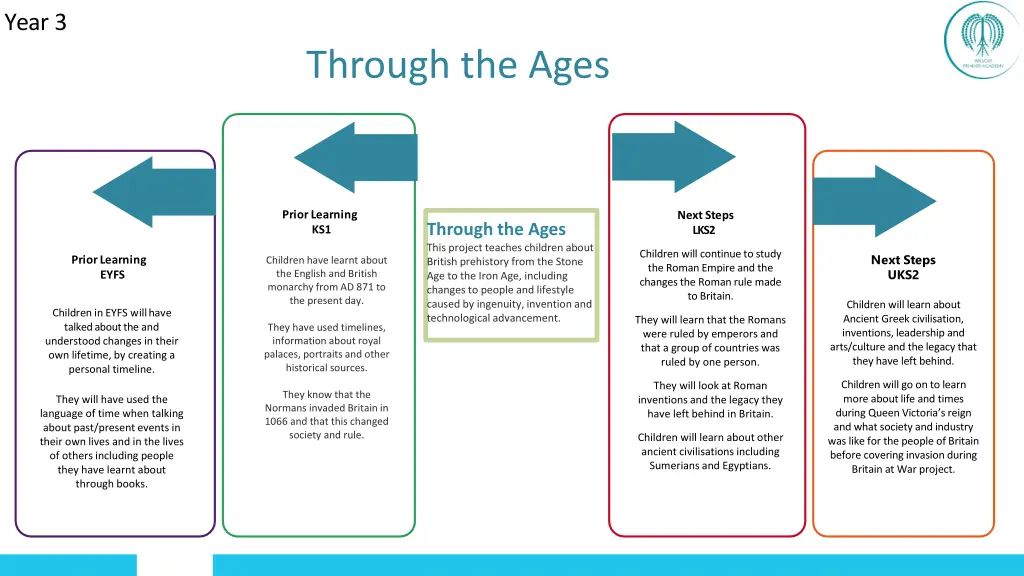
Year 3 Through the Ages PriorLearning KS1 NextSteps LKS2 Through the Ages This project teaches children about British prehistory from the Stone Age to the Iron Age, including changes to people and lifestyle caused by ingenuity, invention and technological advancement. Children will continue to study the Roman Empire and the changes the Roman rule made to Britain. Next Steps UKS2 PriorLearning EYFS Children have learnt about the English and British monarchy from AD 871 to the present day. Children will learn about Ancient Greek civilisation, inventions, leadership and arts/culture and the legacy that they have left behind. ChildreninEYFS willhave talked about the and understood changes in their own lifetime, by creating a personal timeline. They will learn that the Romans were ruled by emperors and that a group of countries was ruled by one person. They have used timelines, information about royal palaces, portraits and other historical sources. Children will go on to learn more about life and times during Queen Victoria s reign and what society and industry was like for the people of Britain before covering invasion during Britain at War project. They will look at Roman inventions and the legacy they have left behind in Britain. They know that the Normans invaded Britain in 1066 and that this changed society and rule. They will have used the language of time when talking about past/present events in their own lives and in the lives of others including people they have learnt about through books. Children will learn about other ancient civilisations including Sumerians and Egyptians.
Year 3 Through the Ages Prehistory Stone Age Burial grounds Argument Vocabulary Long term Bronze Age Religious ceremony Excavation Children will be expected to know and use this key vocabulary in their work and when discussing their learning. Short term Iron Age Christianity Fact AD Tools Druids Primary and Secondary Source BC Weapons Worship Proof Are Inventions Sacrifice Purpose Millennium Ingenuity Offering Reliability BCE Skara Brae Beliefs Cause/factor CE Stonehenge Hillfort Assumption Stone circle Bell Beaker folk Analysis Cheddar man Celts Historian Amesbury Archer Evaluate
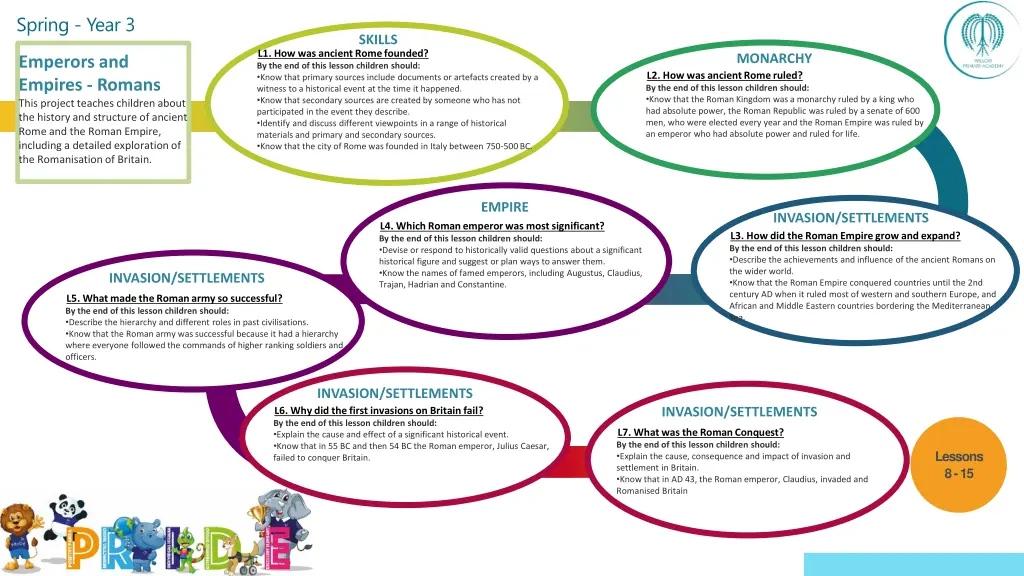
Spring - Year 3 SKILLS L1. How was ancient Rome founded? By the end of this lesson children should: Know that primary sources include documents or artefacts created by a witness to a historical event at the time it happened. Know that secondary sources are created by someone who has not participated in the event they describe. Identify and discuss different viewpoints in a range of historical materials and primary and secondary sources. Know that the city of Rome was founded in Italy between 750-500 BC. MONARCHY Emperors and Empires - Romans This project teaches children about the history and structure of ancient Rome and the Roman Empire, including a detailed exploration of the Romanisation of Britain. L2. How was ancient Rome ruled? By the end of this lesson children should: Know that the Roman Kingdom was a monarchy ruled by a king who had absolute power, the Roman Republic was ruled by a senate of 600 men, who were elected every year and the Roman Empire was ruled by an emperor who had absolute power and ruled for life. EMPIRE INVASION/SETTLEMENTS L3. How did the Roman Empire grow and expand? By the end of this lesson children should: Describe the achievements and influence of the ancient Romans on the wider world. Know that the Roman Empire conquered countries until the 2nd century AD when it ruled most of western and southern Europe, and African and Middle Eastern countries bordering the Mediterranean Sea. L4. Which Roman emperor was most significant? By the end of this lesson children should: Devise or respond to historically valid questions about a significant historical figure and suggest or plan ways to answer them. Know the names of famed emperors, including Augustus, Claudius, Trajan, Hadrian and Constantine. INVASION/SETTLEMENTS L5. What made the Roman army so successful? By the end of this lesson children should: Describe the hierarchy and different roles in past civilisations. Know that the Roman army was successful because it had a hierarchy where everyone followed the commands of higher ranking soldiers and officers. INVASION/SETTLEMENTS INVASION/SETTLEMENTS L6. Why did the first invasions on Britain fail? By the end of this lesson children should: Explain the cause and effect of a significant historical event. Know that in 55 BC and then 54 BC the Roman emperor, Julius Caesar, failed to conquer Britain. L7. What was the Roman Conquest? By the end of this lesson children should: Explain the cause, consequence and impact of invasion and settlement in Britain. Know that in AD 43, the Roman emperor, Claudius, invaded and Romanised Britain Lessons 8 - 15
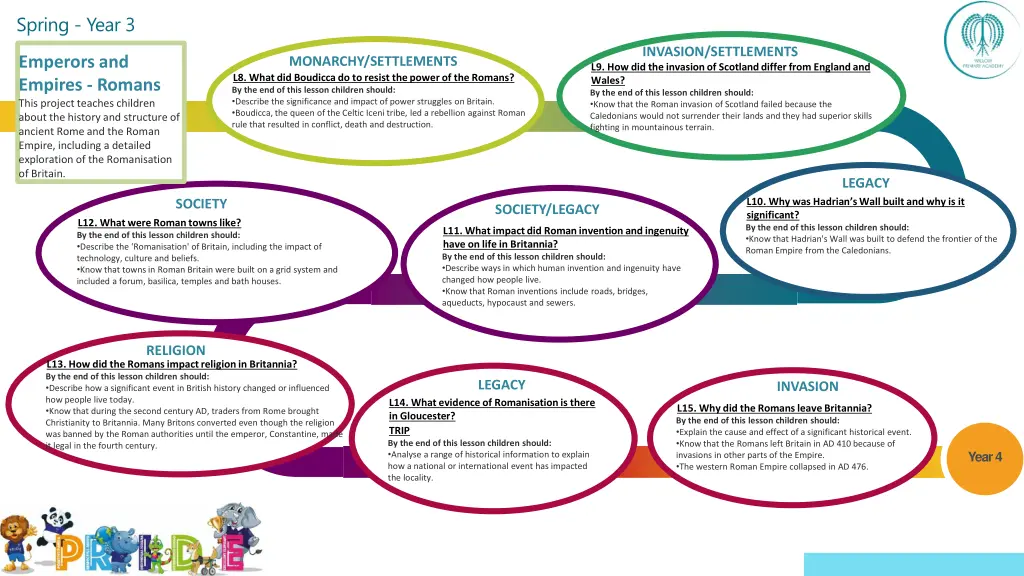
Spring - Year 3 INVASION/SETTLEMENTS Emperors and Empires - Romans This project teaches children about the history and structure of ancient Rome and the Roman Empire, including a detailed exploration of the Romanisation of Britain. MONARCHY/SETTLEMENTS L9. How did the invasion of Scotland differ from England and Wales? By the end of this lesson children should: Know that the Roman invasion of Scotland failed because the Caledonians would not surrender their lands and they had superior skills fighting in mountainous terrain. L8. What did Boudicca do to resist the power of the Romans? By the end of this lesson children should: Describe the significance and impact of power struggles on Britain. Boudicca, the queen of the Celtic Iceni tribe, led a rebellion against Roman rule that resulted in conflict, death and destruction. LEGACY L10. Why was Hadrian s Wall built and why is it significant? By the end of this lesson children should: Know that Hadrian's Wall was built to defend the frontier of the Roman Empire from the Caledonians. SOCIETY SOCIETY/LEGACY L12. What were Roman towns like? By the end of this lesson children should: Describe the 'Romanisation' of Britain, including the impact of technology, culture and beliefs. Know that towns in Roman Britain were built on a grid system and included a forum, basilica, temples and bath houses. L11. What impact did Roman invention and ingenuity have on life in Britannia? By the end of this lesson children should: Describe ways in which human invention and ingenuity have changed how people live. Know that Roman inventions include roads, bridges, aqueducts, hypocaust and sewers. RELIGION L13. How did the Romans impact religion in Britannia? By the end of this lesson children should: Describe how a significant event in British history changed or influenced how people live today. Know that during the second century AD, traders from Rome brought Christianity to Britannia. Many Britons converted even though the religion was banned by the Roman authorities until the emperor, Constantine, made it legal in the fourth century. LEGACY INVASION L14. What evidence of Romanisation is there in Gloucester? TRIP By the end of this lesson children should: Analyse a range of historical information to explain how a national or international event has impacted the locality. L15. Why did the Romans leave Britannia? By the end of this lesson children should: Explain the cause and effect of a significant historical event. Know that the Romans left Britain in AD 410 because of invasions in other parts of the Empire. The western Roman Empire collapsed in AD 476. Year 4
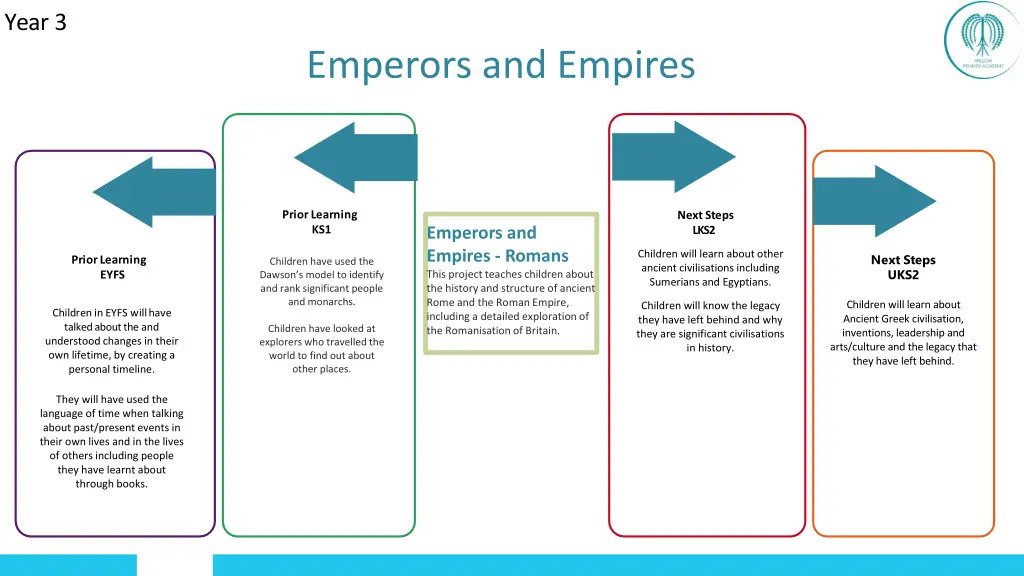
Year 3 Emperors and Empires PriorLearning KS1 NextSteps LKS2 Emperors and Empires - Romans This project teaches children about the history and structure of ancient Rome and the Roman Empire, including a detailed exploration of the Romanisation of Britain. Children will learn about other ancient civilisations including Sumerians and Egyptians. Next Steps UKS2 PriorLearning EYFS Children have used the Dawson s model to identify and rank significant people and monarchs. Children will learn about Ancient Greek civilisation, inventions, leadership and arts/culture and the legacy that they have left behind. Children will know the legacy they have left behind and why they are significant civilisations in history. ChildreninEYFS willhave talked about the and understood changes in their own lifetime, by creating a personal timeline. Children have looked at explorers who travelled the world to find out about other places. They will have used the language of time when talking about past/present events in their own lives and in the lives of others including people they have learnt about through books.
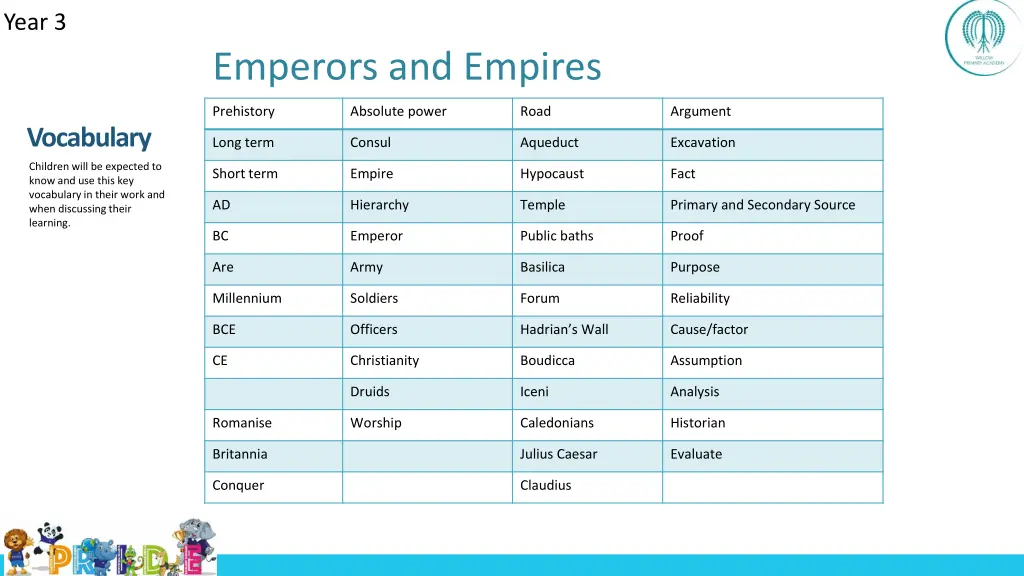
Year 3 Emperors and Empires Prehistory Absolute power Road Argument Vocabulary Long term Consul Aqueduct Excavation Children will be expected to know and use this key vocabulary in their work and when discussing their learning. Short term Empire Hypocaust Fact AD Hierarchy Temple Primary and Secondary Source BC Emperor Public baths Proof Are Army Basilica Purpose Millennium Soldiers Forum Reliability BCE Officers Hadrian s Wall Cause/factor CE Christianity Boudicca Assumption Druids Iceni Analysis Romanise Worship Caledonians Historian Britannia Julius Caesar Evaluate Conquer Claudius
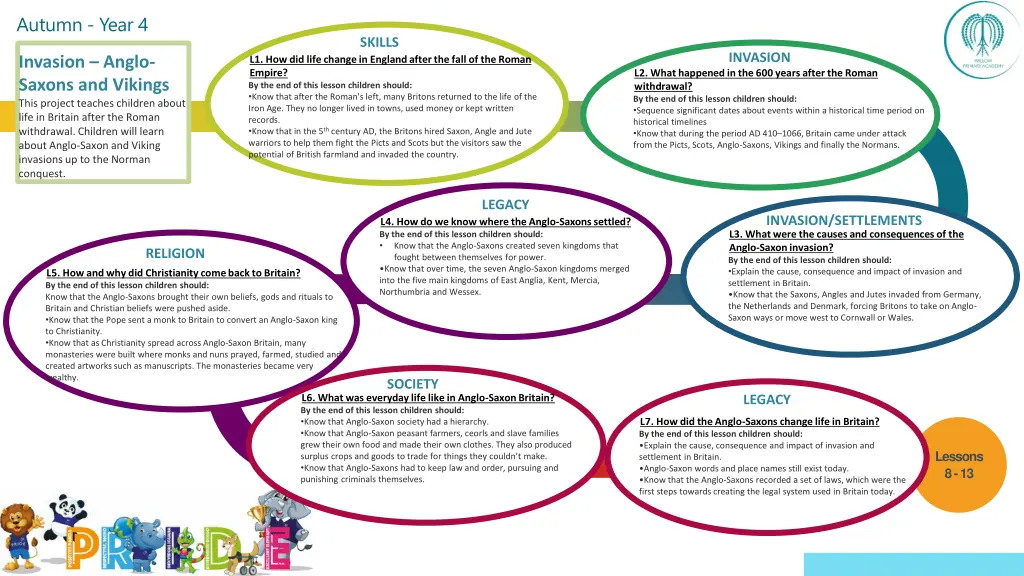
Autumn - Year 4 SKILLS INVASION Invasion Anglo- Saxons and Vikings This project teaches children about life in Britain after the Roman withdrawal. Children will learn about Anglo-Saxon and Viking invasions up to the Norman conquest. L1. How did life change in England after the fall of the Roman Empire? By the end of this lesson children should: Know that after the Roman's left, many Britons returned to the life of the Iron Age. They no longer lived in towns, used money or kept written records. Know that in the 5th century AD, the Britons hired Saxon, Angle and Jute warriors to help them fight the Picts and Scots but the visitors saw the potential of British farmland and invaded the country. L2. What happened in the 600 years after the Roman withdrawal? By the end of this lesson children should: Sequence significant dates about events within a historical time period on historical timelines knowledge Know that during the period AD 410 1066, Britain came under attack from the Picts, Scots, Anglo-Saxons, Vikings and finally the Normans. LEGACY INVASION/SETTLEMENTS L3. What were the causes and consequences of the Anglo-Saxon invasion? By the end of this lesson children should: Explain the cause, consequence and impact of invasion and settlement in Britain. Know that the Saxons, Angles and Jutes invaded from Germany, the Netherlands and Denmark, forcing Britons to take on Anglo- Saxon ways or move west to Cornwall or Wales. L4. How do we know where the Anglo-Saxons settled? By the end of this lesson children should: Know that the Anglo-Saxons created seven kingdoms that fought between themselves for power. Know that over time, the seven Anglo-Saxon kingdoms merged into the five main kingdoms of East Anglia, Kent, Mercia, Northumbria and Wessex. RELIGION L5. How and why did Christianity come back to Britain? By the end of this lesson children should: Know that the Anglo-Saxons brought their own beliefs, gods and rituals to Britain and Christian beliefs were pushed aside. Know that the Pope sent a monk to Britain to convert an Anglo-Saxon king to Christianity. Know that as Christianity spread across Anglo-Saxon Britain, many monasteries were built where monks and nuns prayed, farmed, studied and created artworks such as manuscripts. The monasteries became very wealthy. SOCIETY L6. What was everyday life like in Anglo-Saxon Britain? By the end of this lesson children should: Know that Anglo-Saxon society had a hierarchy. Know that Anglo-Saxon peasant farmers, ceorls and slave families grew their own food and made their own clothes. They also produced surplus crops and goods to trade for things they couldn t make. Know that Anglo-Saxons had to keep law and order, pursuing and punishing criminals themselves. LEGACY L7. How did the Anglo-Saxons change life in Britain? By the end of this lesson children should: Explain the cause, consequence and impact of invasion and settlement in Britain. Anglo-Saxon words and place names still exist today. Know that the Anglo-Saxons recorded a set of laws, which were the first steps towards creating the legal system used in Britain today. Lessons 8 - 13
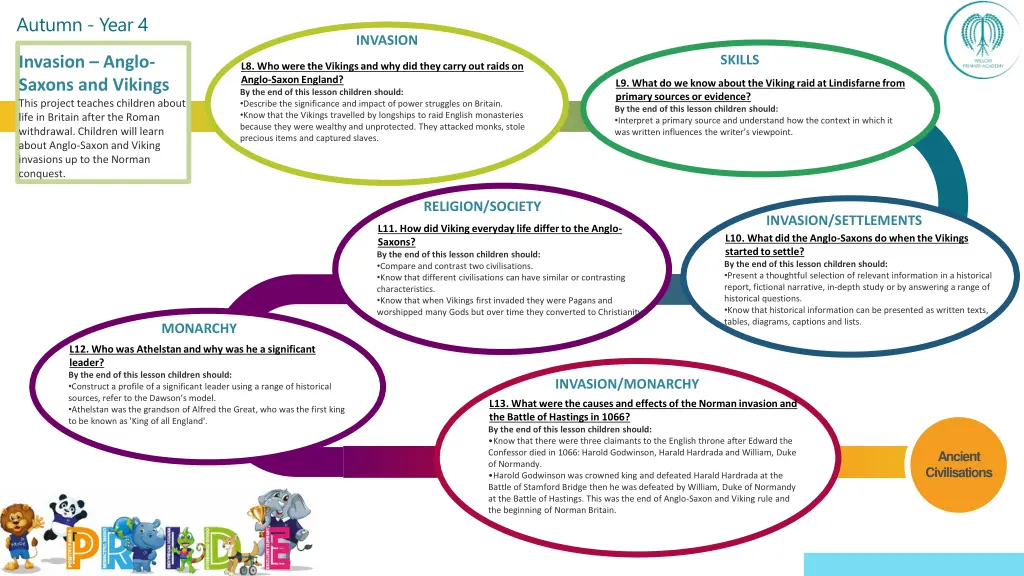
Autumn - Year 4 INVASION Invasion Anglo- Saxons and Vikings This project teaches children about life in Britain after the Roman withdrawal. Children will learn about Anglo-Saxon and Viking invasions up to the Norman conquest. SKILLS L8. Who were the Vikings and why did they carry out raids on Anglo-Saxon England? By the end of this lesson children should: Describe the significance and impact of power struggles on Britain. Know that the Vikings travelled by longships to raid English monasteries because they were wealthy and unprotected. They attacked monks, stole precious items and captured slaves. L9. What do we know about the Viking raid at Lindisfarne from primary sources or evidence? By the end of this lesson children should: Interpret a primary source and understand how the context in which it was written influences the writer s viewpoint. RELIGION/SOCIETY INVASION/SETTLEMENTS L10. What did the Anglo-Saxons do when the Vikings started to settle? By the end of this lesson children should: Present a thoughtful selection of relevant information in a historical report, fictional narrative, in-depth study or by answering a range of historical questions. Know that historical information can be presented as written texts, tables, diagrams, captions and lists. L11. How did Viking everyday life differ to the Anglo- Saxons? By the end of this lesson children should: Compare and contrast two civilisations. Know that different civilisations can have similar or contrasting characteristics. Know that when Vikings first invaded they were Pagans and worshipped many Gods but over time they converted to Christianity. MONARCHY L12. Who was Athelstan and why was he a significant leader? By the end of this lesson children should: Construct a profile of a significant leader using a range of historical sources, refer to the Dawson s model. Athelstan was the grandson of Alfred the Great, who was the first king to be known as 'King of all England'. INVASION/MONARCHY L13. What were the causes and effects of the Norman invasion and the Battle of Hastings in 1066? By the end of this lesson children should: Know that there were three claimants to the English throne after Edward the Confessor died in 1066: Harold Godwinson, Harald Hardrada and William, Duke of Normandy. Harold Godwinson was crowned king and defeated Harald Hardrada at the Battle of Stamford Bridge then he was defeated by William, Duke of Normandy at the Battle of Hastings. This was the end of Anglo-Saxon and Viking rule and the beginning of Norman Britain. Ancient Civilisations
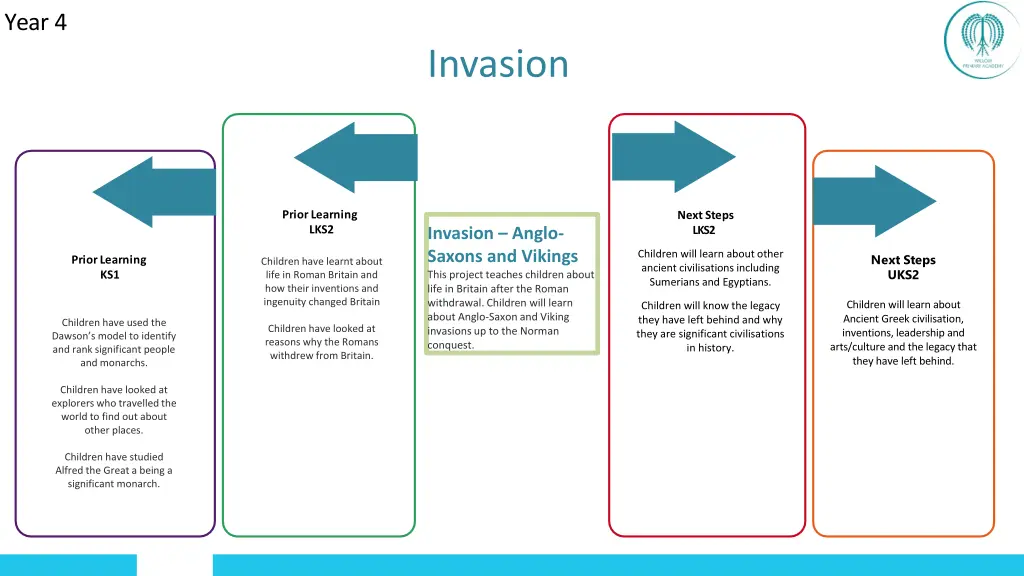
Year 4 Invasion PriorLearning LKS2 NextSteps LKS2 Invasion Anglo- Saxons and Vikings This project teaches children about life in Britain after the Roman withdrawal. Children will learn about Anglo-Saxon and Viking invasions up to the Norman conquest. Children will learn about other ancient civilisations including Sumerians and Egyptians. Next Steps UKS2 PriorLearning KS1 Children have learnt about life in Roman Britain and how their inventions and ingenuity changed Britain Children will learn about Ancient Greek civilisation, inventions, leadership and arts/culture and the legacy that they have left behind. Children will know the legacy they have left behind and why they are significant civilisations in history. Children have used the Dawson s model to identify and rank significant people and monarchs. Children have looked at reasons why the Romans withdrew from Britain. Children have looked at explorers who travelled the world to find out about other places. Children have studied Alfred the Great a being a significant monarch.
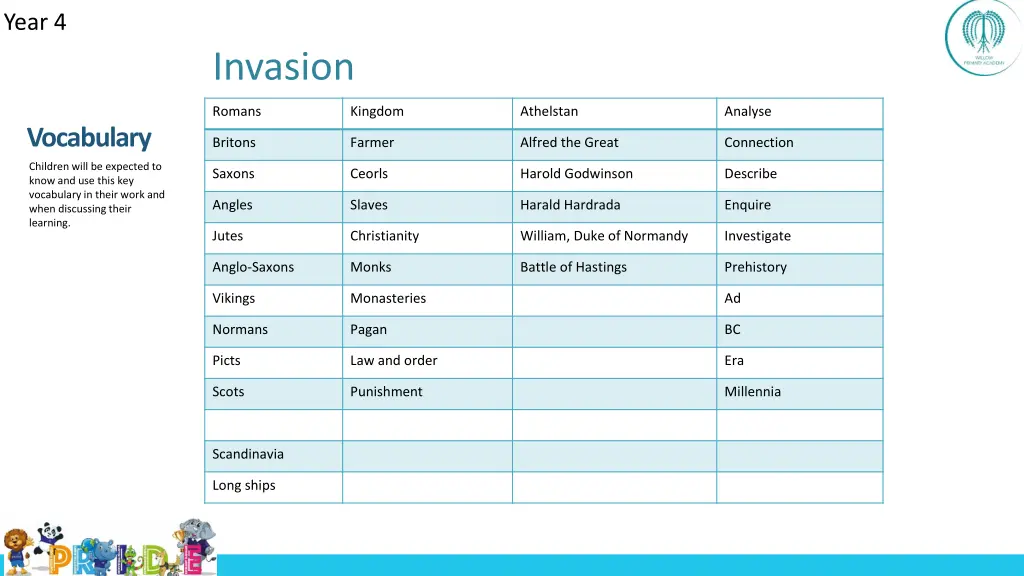
Year 4 Invasion Romans Kingdom Athelstan Analyse Vocabulary Britons Farmer Alfred the Great Connection Children will be expected to know and use this key vocabulary in their work and when discussing their learning. Saxons Ceorls Harold Godwinson Describe Angles Slaves Harald Hardrada Enquire Jutes Christianity William, Duke of Normandy Investigate Anglo-Saxons Monks Battle of Hastings Prehistory Vikings Monasteries Ad Normans Pagan BC Picts Law and order Era Scots Punishment Millennia Scandinavia Long ships
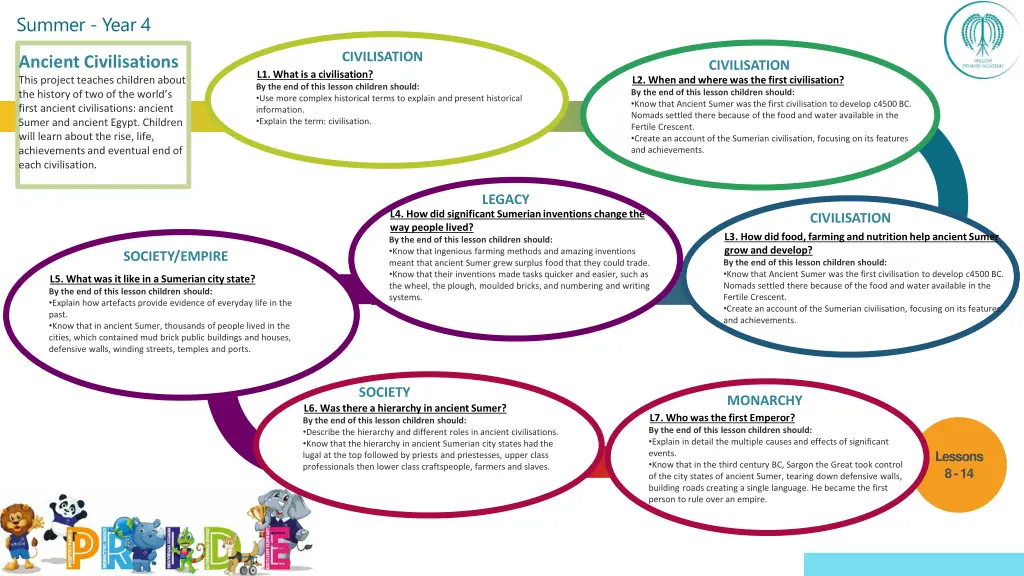
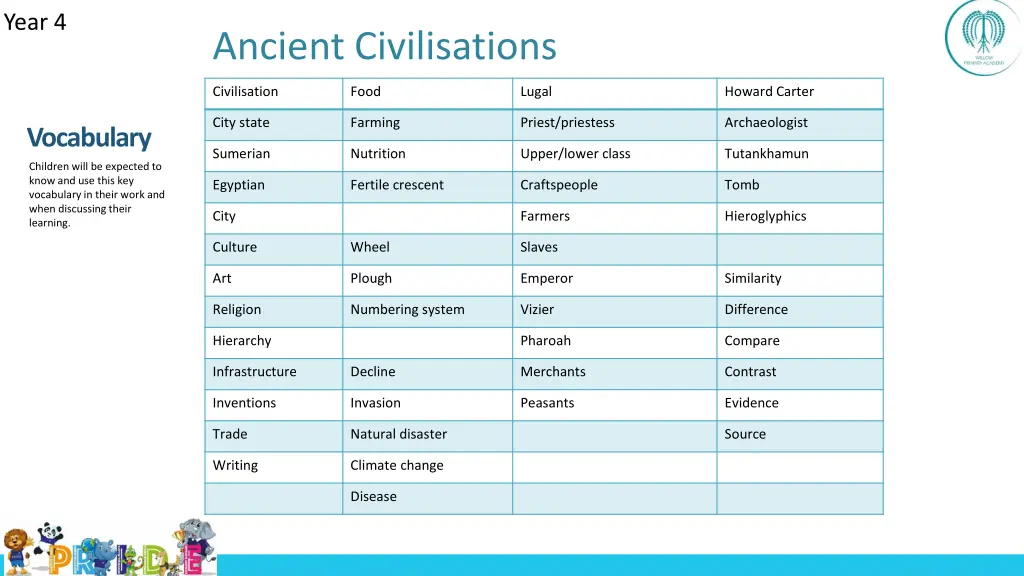
Summer - Year 4 CIVILISATION Ancient Civilisations This project teaches children about the history of two of the world s first ancient civilisations: ancient Sumer and ancient Egypt. Children will learn about the rise, life, achievements and eventual end of each civilisation. CIVILISATION L1. What is a civilisation? By the end of this lesson children should: Use more complex historical terms to explain and present historical information. Explain the term: civilisation. L2. When and where was the first civilisation? By the end of this lesson children should: Know that Ancient Sumer was the first civilisation to develop c4500 BC. Nomads settled there because of the food and water available in the Fertile Crescent. Create an account of the Sumerian civilisation, focusing on its features and achievements. LEGACY L4. How did significant Sumerian inventions change the way people lived? By the end of this lesson children should: Know that ingenious farming methods and amazing inventions meant that ancient Sumer grew surplus food that they could trade. Know that their inventions made tasks quicker and easier, such as the wheel, the plough, moulded bricks, and numbering and writing systems. CIVILISATION L3. How did food, farming and nutrition help ancient Sumer grow and develop? By the end of this lesson children should: Know that Ancient Sumer was the first civilisation to develop c4500 BC. Nomads settled there because of the food and water available in the Fertile Crescent. Create an account of the Sumerian civilisation, focusing on its features and achievements. SOCIETY/EMPIRE L5. What was it like in a Sumerian city state? By the end of this lesson children should: Explain how artefacts provide evidence of everyday life in the past. Know that in ancient Sumer, thousands of people lived in the cities, which contained mud brick public buildings and houses, defensive walls, winding streets, temples and ports. SOCIETY MONARCHY L6. Was there a hierarchy in ancient Sumer? By the end of this lesson children should: Describe the hierarchy and different roles in ancient civilisations. Know that the hierarchy in ancient Sumerian city states had the lugal at the top followed by priests and priestesses, upper class professionals then lower class craftspeople, farmers and slaves. L7. Who was the first Emperor? By the end of this lesson children should: Explain in detail the multiple causes and effects of significant events. Know that in the third century BC, Sargon the Great took control of the city states of ancient Sumer, tearing down defensive walls, building roads creating a single language. He became the first person to rule over an empire. Lessons 8 - 14
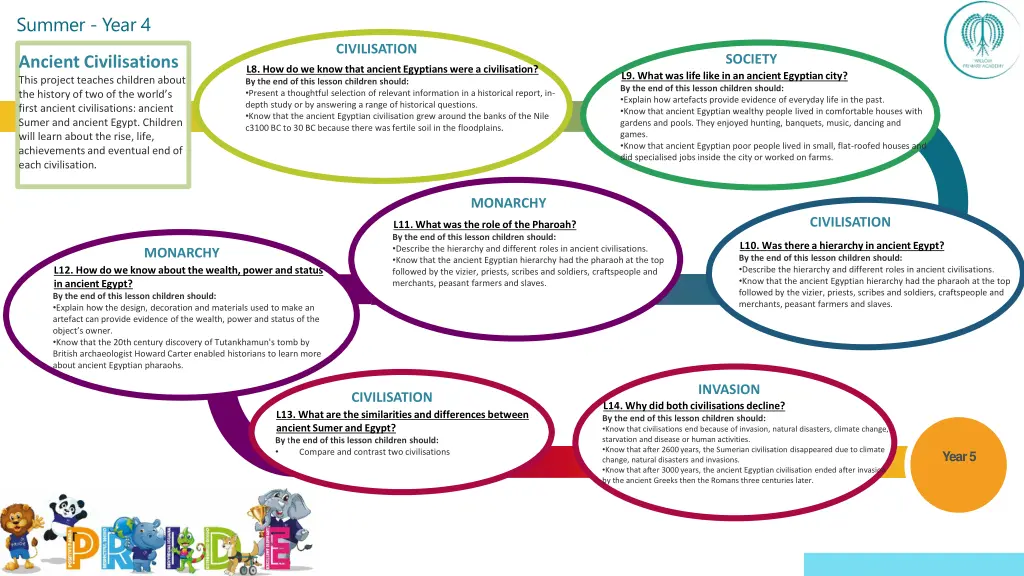
Summer - Year 4 CIVILISATION SOCIETY Ancient Civilisations This project teaches children about the history of two of the world s first ancient civilisations: ancient Sumer and ancient Egypt. Children will learn about the rise, life, achievements and eventual end of each civilisation. L8. How do we know that ancient Egyptians were a civilisation? By the end of this lesson children should: Present a thoughtful selection of relevant information in a historical report, in- depth study or by answering a range of historical questions. Know that the ancient Egyptian civilisation grew around the banks of the Nile c3100 BC to 30 BC because there was fertile soil in the floodplains. L9. What was life like in an ancient Egyptian city? By the end of this lesson children should: Explain how artefacts provide evidence of everyday life in the past. Know that ancient Egyptian wealthy people lived in comfortable houses with gardens and pools. They enjoyed hunting, banquets, music, dancing and games. Know that ancient Egyptian poor people lived in small, flat-roofed houses and did specialised jobs inside the city or worked on farms. MONARCHY CIVILISATION L11. What was the role of the Pharoah? By the end of this lesson children should: Describe the hierarchy and different roles in ancient civilisations. Know that the ancient Egyptian hierarchy had the pharaoh at the top followed by the vizier, priests, scribes and soldiers, craftspeople and merchants, peasant farmers and slaves. L10. Was there a hierarchy in ancient Egypt? By the end of this lesson children should: Describe the hierarchy and different roles in ancient civilisations. Know that the ancient Egyptian hierarchy had the pharaoh at the top followed by the vizier, priests, scribes and soldiers, craftspeople and merchants, peasant farmers and slaves. MONARCHY L12. How do we know about the wealth, power and status in ancient Egypt? By the end of this lesson children should: Explain how the design, decoration and materials used to make an artefact can provide evidence of the wealth, power and status of the object s owner. Know that the 20th century discovery of Tutankhamun's tomb by British archaeologist Howard Carter enabled historians to learn more about ancient Egyptian pharaohs. INVASION CIVILISATION L14. Why did both civilisations decline? By the end of this lesson children should: Know that civilisations end because of invasion, natural disasters, climate change, starvation and disease or human activities. Know that after 2600 years, the Sumerian civilisation disappeared due to climate change, natural disasters and invasions. Know that after 3000 years, the ancient Egyptian civilisation ended after invasion by the ancient Greeks then the Romans three centuries later. L13. What are the similarities and differences between ancient Sumer and Egypt? By the end of this lesson children should: Compare and contrast two civilisations Year 5
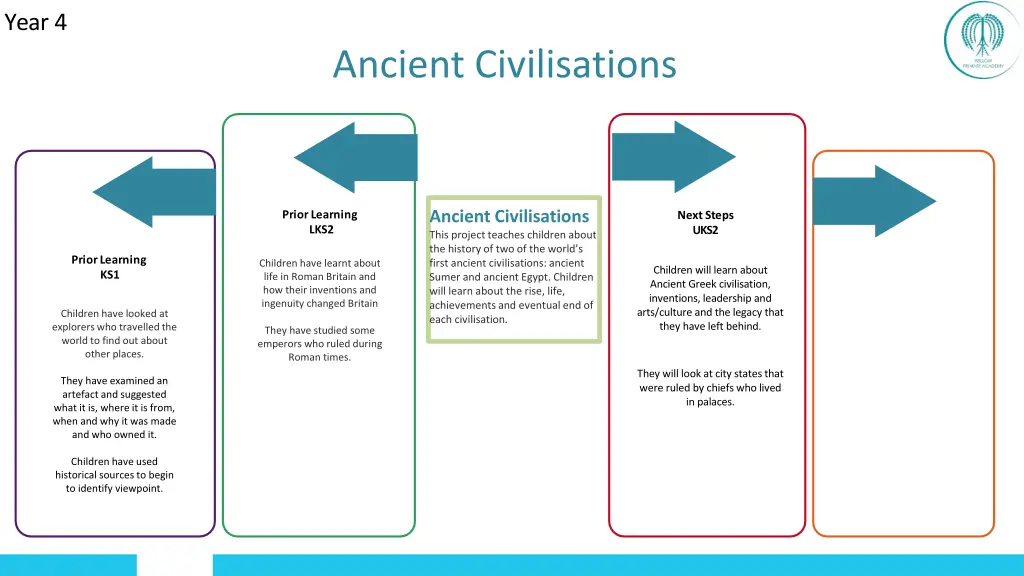
Year 4 Ancient Civilisations Ancient Civilisations This project teaches children about the history of two of the world s first ancient civilisations: ancient Sumer and ancient Egypt. Children will learn about the rise, life, achievements and eventual end of each civilisation. PriorLearning LKS2 NextSteps UKS2 PriorLearning KS1 Children have learnt about life in Roman Britain and how their inventions and ingenuity changed Britain Children will learn about Ancient Greek civilisation, inventions, leadership and arts/culture and the legacy that they have left behind. Children have looked at explorers who travelled the world to find out about other places. They have studied some emperors who ruled during Roman times. They will look at city states that were ruled by chiefs who lived in palaces. They have examined an artefact and suggested what it is, where it is from, when and why it was made and who owned it. Children have used historical sources to begin to identify viewpoint.
Year 4 Ancient Civilisations Civilisation Food Lugal Howard Carter City state Farming Priest/priestess Archaeologist Vocabulary Sumerian Nutrition Upper/lower class Tutankhamun Children will be expected to know and use this key vocabulary in their work and when discussing their learning. Egyptian Fertile crescent Craftspeople Tomb City Farmers Hieroglyphics Culture Wheel Slaves Art Plough Emperor Similarity Religion Numbering system Vizier Difference Hierarchy Pharoah Compare Infrastructure Decline Merchants Contrast Inventions Invasion Peasants Evidence Trade Natural disaster Source Writing Climate change Disease
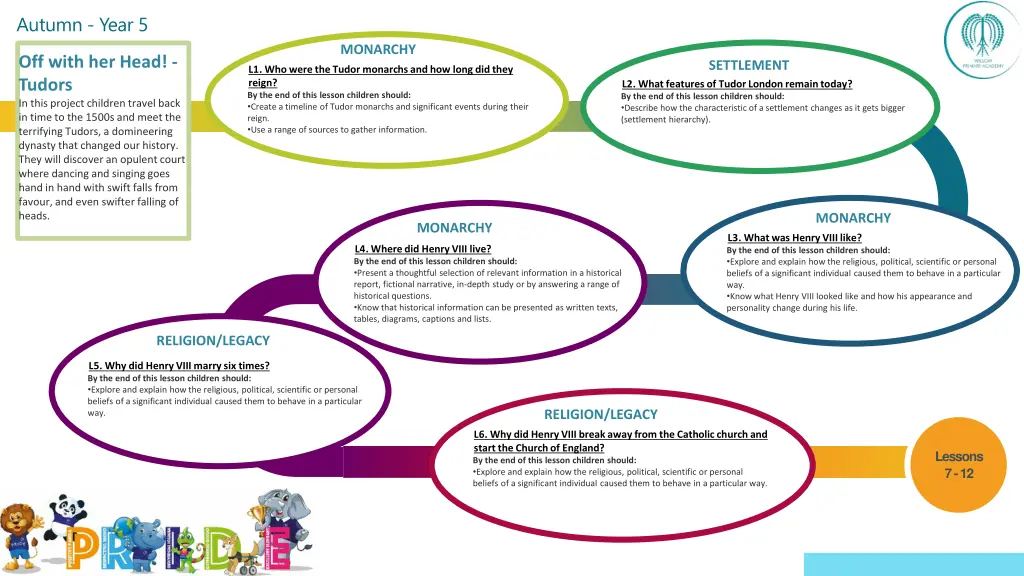
Autumn - Year 5 MONARCHY Off with her Head! - Tudors In this project children travel back in time to the 1500s and meet the terrifying Tudors, a domineering dynasty that changed our history. They will discover an opulent court where dancing and singing goes hand in hand with swift falls from favour, and even swifter falling of heads. SETTLEMENT L1. Who were the Tudor monarchs and how long did they reign? By the end of this lesson children should: Create a timeline of Tudor monarchs and significant events during their reign. Use a range of sources to gather information. L2. What features of Tudor London remain today? By the end of this lesson children should: Describe how the characteristic of a settlement changes as it gets bigger (settlement hierarchy). MONARCHY MONARCHY L3. What was Henry VIII like? By the end of this lesson children should: Explore and explain how the religious, political, scientific or personal beliefs of a significant individual caused them to behave in a particular way. Know what Henry VIII looked like and how his appearance and personality change during his life. L4. Where did Henry VIII live? By the end of this lesson children should: Present a thoughtful selection of relevant information in a historical report, fictional narrative, in-depth study or by answering a range of historical questions. Know that historical information can be presented as written texts, tables, diagrams, captions and lists. RELIGION/LEGACY L5. Why did Henry VIII marry six times? By the end of this lesson children should: Explore and explain how the religious, political, scientific or personal beliefs of a significant individual caused them to behave in a particular way. RELIGION/LEGACY L6. Why did Henry VIII break away from the Catholic church and start the Church of England? By the end of this lesson children should: Explore and explain how the religious, political, scientific or personal beliefs of a significant individual caused them to behave in a particular way. Lessons 7 - 12
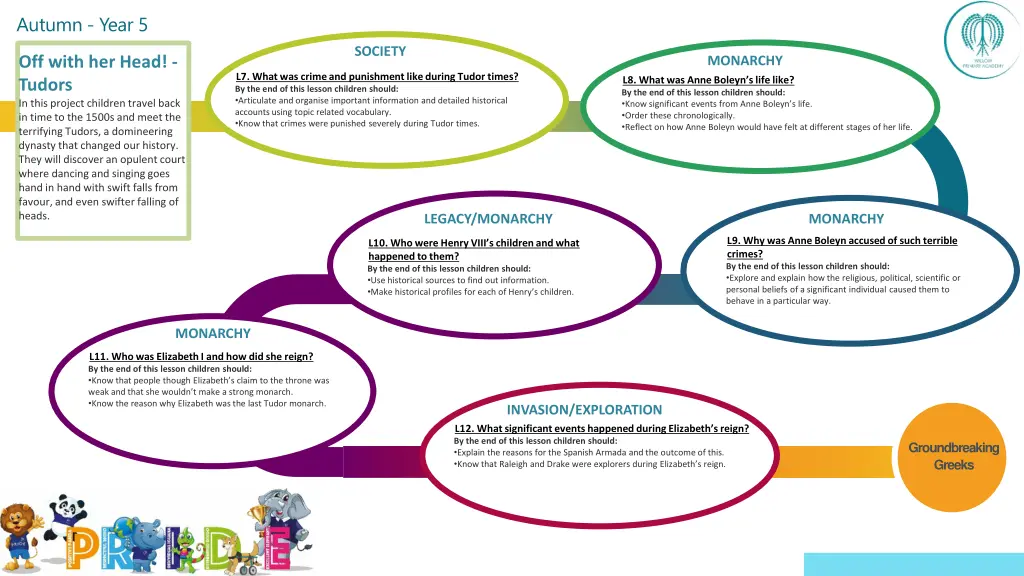
Autumn - Year 5 SOCIETY Off with her Head! - Tudors In this project children travel back in time to the 1500s and meet the terrifying Tudors, a domineering dynasty that changed our history. They will discover an opulent court where dancing and singing goes hand in hand with swift falls from favour, and even swifter falling of heads. MONARCHY L7. What was crime and punishment like during Tudor times? By the end of this lesson children should: Articulate and organise important information and detailed historical accounts using topic related vocabulary. Know that crimes were punished severely during Tudor times. L8. What was Anne Boleyn s life like? By the end of this lesson children should: Know significant events from Anne Boleyn s life. Order these chronologically. Reflect on how Anne Boleyn would have felt at different stages of her life. LEGACY/MONARCHY MONARCHY L9. Why was Anne Boleyn accused of such terrible crimes? By the end of this lesson children should: Explore and explain how the religious, political, scientific or personal beliefs of a significant individual caused them to behave in a particular way. L10. Who were Henry VIII s children and what happened to them? By the end of this lesson children should: Use historical sources to find out information. Make historical profiles for each of Henry s children. MONARCHY L11. Who was Elizabeth I and how did she reign? By the end of this lesson children should: Know that people though Elizabeth s claim to the throne was weak and that she wouldn t make a strong monarch. Know the reason why Elizabeth was the last Tudor monarch. INVASION/EXPLORATION L12. What significant events happened during Elizabeth s reign? By the end of this lesson children should: Explain the reasons for the Spanish Armada and the outcome of this. Know that Raleigh and Drake were explorers during Elizabeth s reign. Groundbreaking Greeks
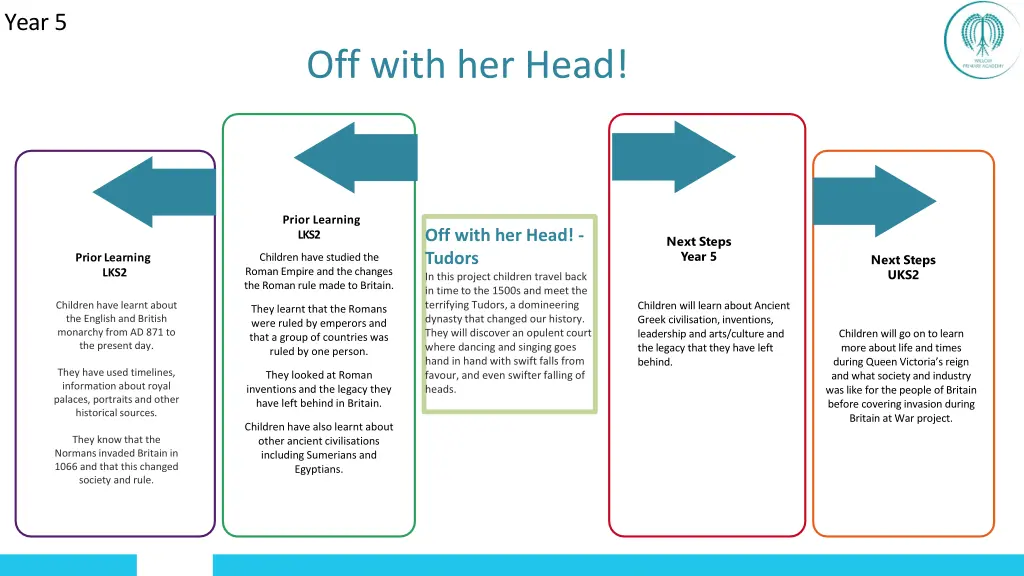
Year 5 Off with her Head! Prior Learning LKS2 Off with her Head! - Tudors In this project children travel back in time to the 1500s and meet the terrifying Tudors, a domineering dynasty that changed our history. They will discover an opulent court where dancing and singing goes hand in hand with swift falls from favour, and even swifter falling of heads. Next Steps Year 5 Next Steps UKS2 PriorLearning LKS2 Children have studied the Roman Empire and the changes the Roman rule made to Britain. Children have learnt about the English and British monarchy from AD 871 to the present day. Children will learn about Ancient Greek civilisation, inventions, leadership and arts/culture and the legacy that they have left behind. They learnt that the Romans were ruled by emperors and that a group of countries was ruled by one person. Children will go on to learn more about life and times during Queen Victoria s reign and what society and industry was like for the people of Britain before covering invasion during Britain at War project. They have used timelines, information about royal palaces, portraits and other historical sources. They looked at Roman inventions and the legacy they have left behind in Britain. Children have also learnt about other ancient civilisations including Sumerians and Egyptians. They know that the Normans invaded Britain in 1066 and that this changed society and rule.
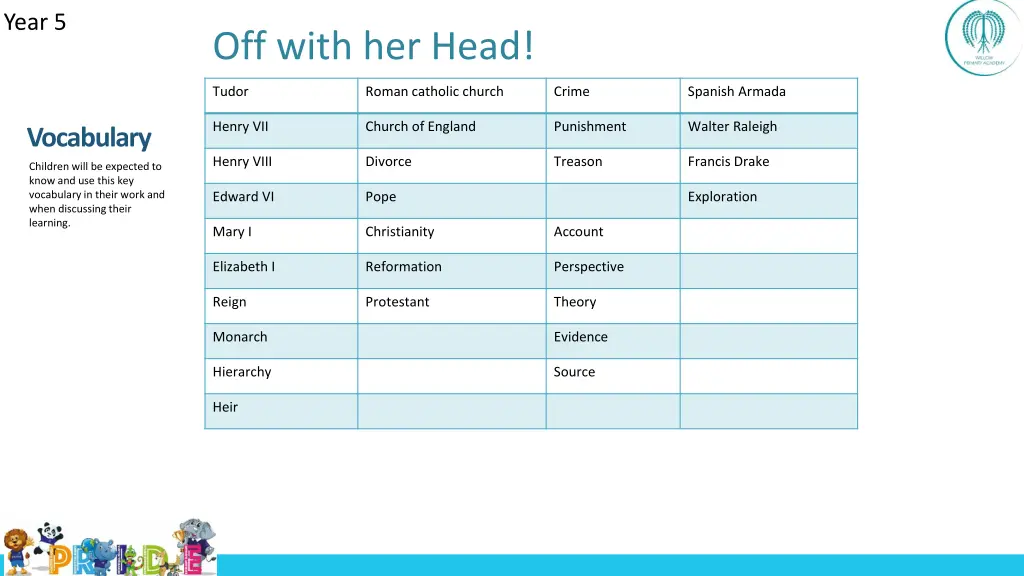
Year 5 Off with her Head! Tudor Roman catholic church Crime Spanish Armada Henry VII Church of England Punishment Walter Raleigh Vocabulary Henry VIII Divorce Treason Francis Drake Children will be expected to know and use this key vocabulary in their work and when discussing their learning. Edward VI Pope Exploration Mary I Christianity Account Elizabeth I Reformation Perspective Reign Protestant Theory Monarch Evidence Hierarchy Source Heir
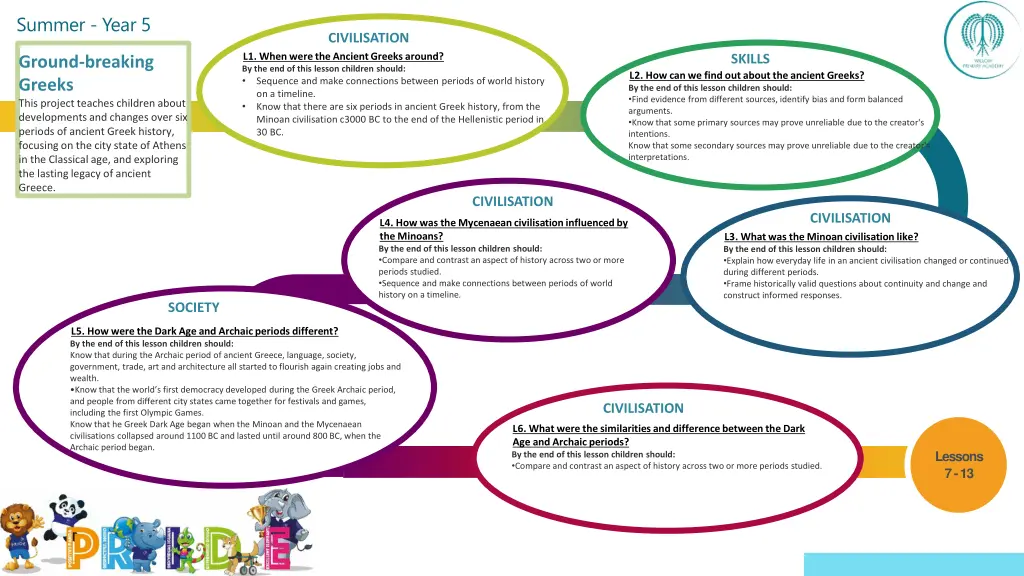
Summer - Year 5 CIVILISATION L1. When were the Ancient Greeks around? By the end of this lesson children should: Sequence and make connections between periods of world history on a timeline. Know that there are six periods in ancient Greek history, from the Minoan civilisation c3000 BC to the end of the Hellenistic period in 30 BC. SKILLS Ground-breaking Greeks This project teaches children about developments and changes over six periods of ancient Greek history, focusing on the city state of Athens in the Classical age, and exploring the lasting legacy of ancient Greece. L2. How can we find out about the ancient Greeks? By the end of this lesson children should: Find evidence from different sources, identify bias and form balanced arguments. Know that some primary sources may prove unreliable due to the creator's intentions. Know that some secondary sources may prove unreliable due to the creator's interpretations. CIVILISATION CIVILISATION L4. How was the Mycenaean civilisation influenced by the Minoans? By the end of this lesson children should: Compare and contrast an aspect of history across two or more periods studied. Sequence and make connections between periods of world history on a timeline. L3. What was the Minoan civilisation like? By the end of this lesson children should: Explain how everyday life in an ancient civilisation changed or continued during different periods. Frame historically valid questions about continuity and change and construct informed responses. SOCIETY L5. How were the Dark Age and Archaic periods different? By the end of this lesson children should: Know that during the Archaic period of ancient Greece, language, society, government, trade, art and architecture all started to flourish again creating jobs and wealth. Know that the world s first democracy developed during the Greek Archaic period, and people from different city states came together for festivals and games, including the first Olympic Games. Know that he Greek Dark Age began when the Minoan and the Mycenaean civilisations collapsed around 1100 BC and lasted until around 800 BC, when the Archaic period began. CIVILISATION L6. What were the similarities and difference between the Dark Age and Archaic periods? By the end of this lesson children should: Compare and contrast an aspect of history across two or more periods studied. Lessons 7 - 13
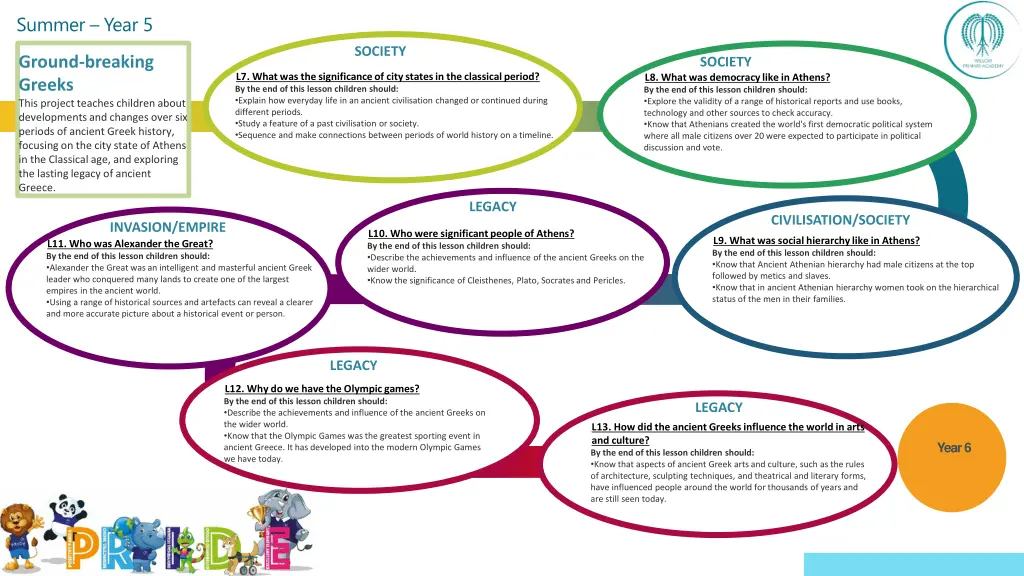
Summer Year 5 SOCIETY Ground-breaking Greeks This project teaches children about developments and changes over six periods of ancient Greek history, focusing on the city state of Athens in the Classical age, and exploring the lasting legacy of ancient Greece. SOCIETY L7. What was the significance of city states in the classical period? By the end of this lesson children should: Explain how everyday life in an ancient civilisation changed or continued during different periods. Study a feature of a past civilisation or society. Sequence and make connections between periods of world history on a timeline. L8. What was democracy like in Athens? By the end of this lesson children should: Explore the validity of a range of historical reports and use books, technology and other sources to check accuracy. Know that Athenians created the world's first democratic political system where all male citizens over 20 were expected to participate in political discussion and vote. LEGACY CIVILISATION/SOCIETY INVASION/EMPIRE L10. Who were significant people of Athens? By the end of this lesson children should: Describe the achievements and influence of the ancient Greeks on the wider world. Know the significance of Cleisthenes, Plato, Socrates and Pericles. L9. What was social hierarchy like in Athens? By the end of this lesson children should: Know that Ancient Athenian hierarchy had male citizens at the top followed by metics and slaves. Know that in ancient Athenian hierarchy women took on the hierarchical status of the men in their families. L11. Who was Alexander the Great? By the end of this lesson children should: Alexander the Great was an intelligent and masterful ancient Greek leader who conquered many lands to create one of the largest empires in the ancient world. Using a range of historical sources and artefacts can reveal a clearer and more accurate picture about a historical event or person. LEGACY L12. Why do we have the Olympic games? By the end of this lesson children should: Describe the achievements and influence of the ancient Greeks on the wider world. Know that the Olympic Games was the greatest sporting event in ancient Greece. It has developed into the modern Olympic Games we have today. LEGACY L13. How did the ancient Greeks influence the world in arts and culture? By the end of this lesson children should: Know that aspects of ancient Greek arts and culture, such as the rules of architecture, sculpting techniques, and theatrical and literary forms, have influenced people around the world for thousands of years and are still seen today. Year 6
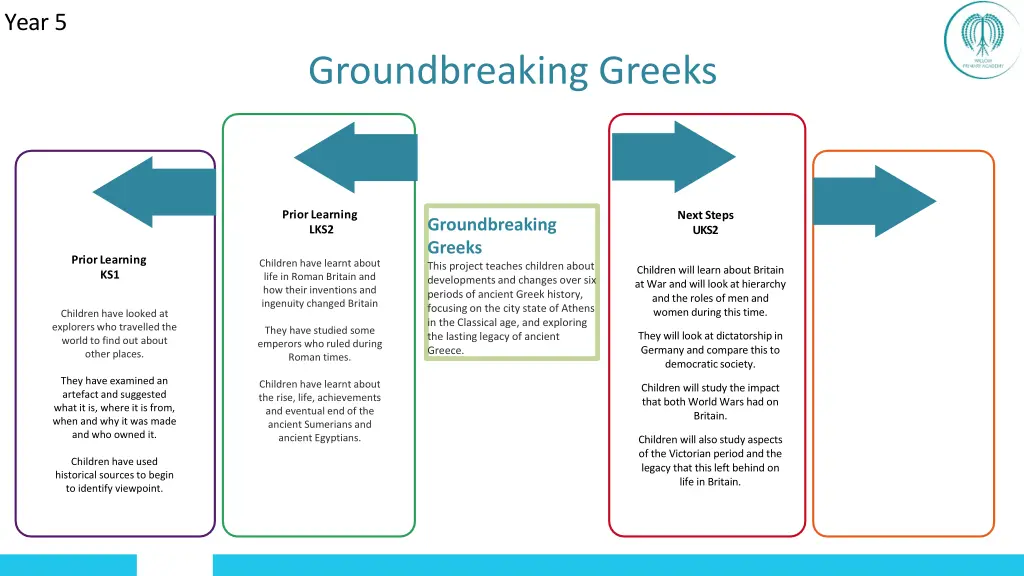
Year 5 Groundbreaking Greeks PriorLearning LKS2 NextSteps UKS2 Groundbreaking Greeks This project teaches children about developments and changes over six periods of ancient Greek history, focusing on the city state of Athens in the Classical age, and exploring the lasting legacy of ancient Greece. PriorLearning KS1 Children have learnt about life in Roman Britain and how their inventions and ingenuity changed Britain Children will learn about Britain at War and will look at hierarchy and the roles of men and women during this time. Children have looked at explorers who travelled the world to find out about other places. They have studied some emperors who ruled during Roman times. They will look at dictatorship in Germany and compare this to democratic society. They have examined an artefact and suggested what it is, where it is from, when and why it was made and who owned it. Children have learnt about the rise, life, achievements and eventual end of the ancient Sumerians and ancient Egyptians. Children will study the impact that both World Wars had on Britain. Children will also study aspects of the Victorian period and the legacy that this left behind on life in Britain. Children have used historical sources to begin to identify viewpoint.
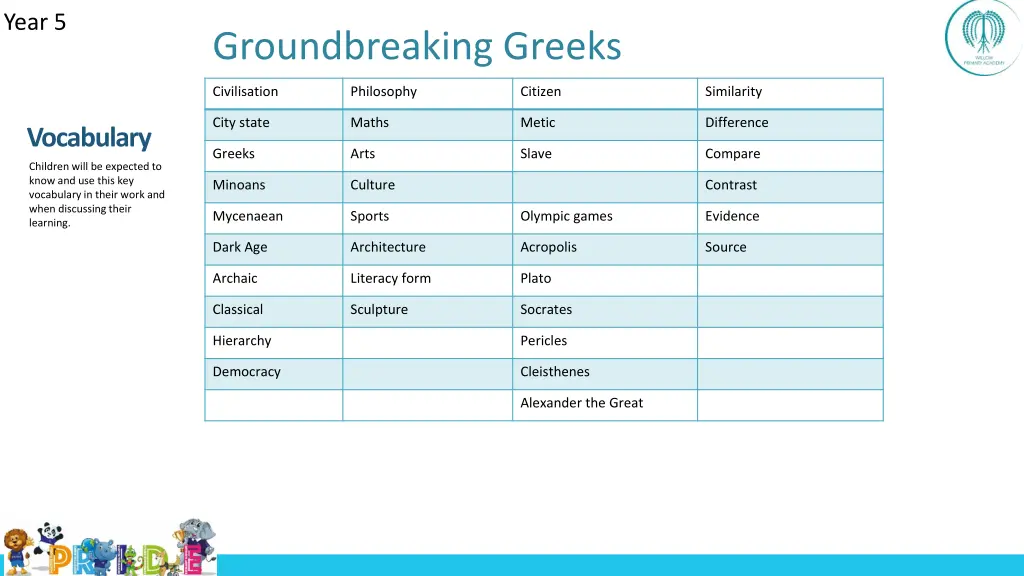
Year 5 Groundbreaking Greeks Civilisation Philosophy Citizen Similarity City state Maths Metic Difference Vocabulary Greeks Arts Slave Compare Children will be expected to know and use this key vocabulary in their work and when discussing their learning. Minoans Culture Contrast Mycenaean Sports Olympic games Evidence Dark Age Architecture Acropolis Source Archaic Literacy form Plato Classical Sculpture Socrates Hierarchy Pericles Democracy Cleisthenes Alexander the Great
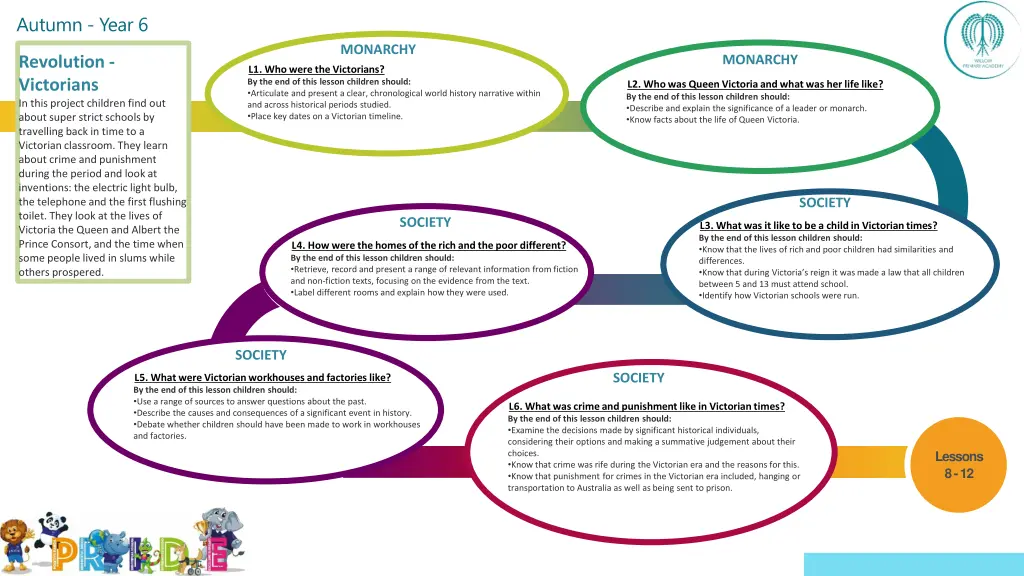
Autumn - Year 6 MONARCHY MONARCHY Revolution - Victorians In this project children find out about super strict schools by travelling back in time to a Victorian classroom. They learn about crime and punishment during the period and look at inventions: the electric light bulb, the telephone and the first flushing toilet. They look at the lives of Victoria the Queen and Albert the Prince Consort, and the time when some people lived in slums while others prospered. L1. Who were the Victorians? By the end of this lesson children should: Articulate and present a clear, chronological world history narrative within and across historical periods studied. Place key dates on a Victorian timeline. L2. Who was Queen Victoria and what was her life like? By the end of this lesson children should: Describe and explain the significance of a leader or monarch. Know facts about the life of Queen Victoria. SOCIETY SOCIETY L3. What was it like to be a child in Victorian times? By the end of this lesson children should: Know that the lives of rich and poor children had similarities and differences. Know that during Victoria s reign it was made a law that all children between 5 and 13 must attend school. Identify how Victorian schools were run. L4. How were the homes of the rich and the poor different? By the end of this lesson children should: Retrieve, record and present a range of relevant information from fiction and non-fiction texts, focusing on the evidence from the text. Label different rooms and explain how they were used. SOCIETY SOCIETY L5. What were Victorian workhouses and factories like? By the end of this lesson children should: Use a range of sources to answer questions about the past. Describe the causes and consequences of a significant event in history. Debate whether children should have been made to work in workhouses and factories. L6. What was crime and punishment like in Victorian times? By the end of this lesson children should: Examine the decisions made by significant historical individuals, considering their options and making a summative judgement about their choices. Know that crime was rife during the Victorian era and the reasons for this. Know that punishment for crimes in the Victorian era included, hanging or transportation to Australia as well as being sent to prison. Lessons 8 - 12
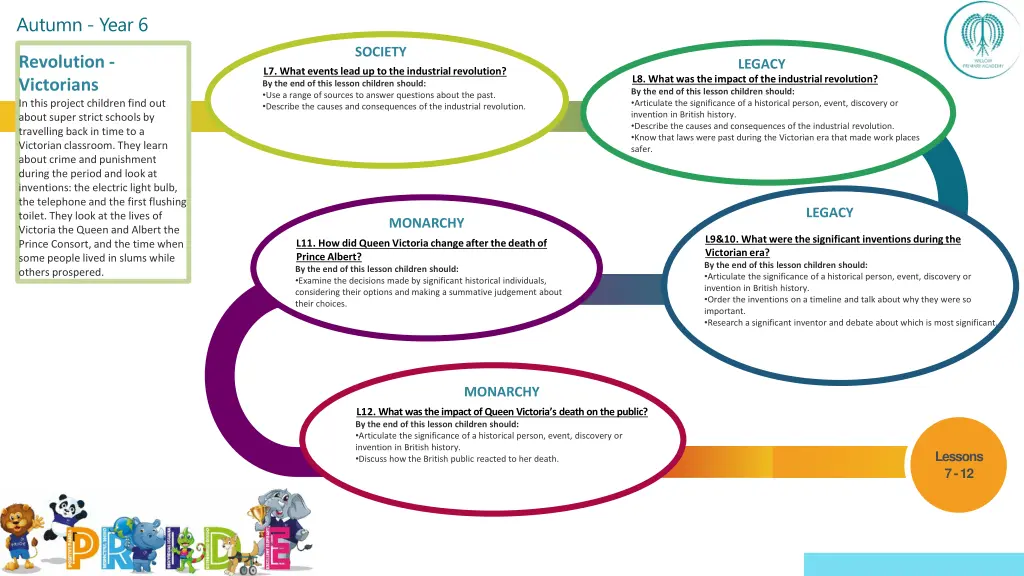
Autumn - Year 6 SOCIETY Revolution - Victorians In this project children find out about super strict schools by travelling back in time to a Victorian classroom. They learn about crime and punishment during the period and look at inventions: the electric light bulb, the telephone and the first flushing toilet. They look at the lives of Victoria the Queen and Albert the Prince Consort, and the time when some people lived in slums while others prospered. LEGACY L7. What events lead up to the industrial revolution? By the end of this lesson children should: Use a range of sources to answer questions about the past. Describe the causes and consequences of the industrial revolution. L8. What was the impact of the industrial revolution? By the end of this lesson children should: Articulate the significance of a historical person, event, discovery or invention in British history. Describe the causes and consequences of the industrial revolution. Know that laws were past during the Victorian era that made work places safer. LEGACY MONARCHY L9&10. What were the significant inventions during the Victorian era? By the end of this lesson children should: Articulate the significance of a historical person, event, discovery or invention in British history. Order the inventions on a timeline and talk about why they were so important. Research a significant inventor and debate about which is most significant. L11. How did Queen Victoria change after the death of Prince Albert? By the end of this lesson children should: Examine the decisions made by significant historical individuals, considering their options and making a summative judgement about their choices. MONARCHY L12. What was the impact of Queen Victoria s death on the public? By the end of this lesson children should: Articulate the significance of a historical person, event, discovery or invention in British history. Discuss how the British public reacted to her death. Lessons 7 - 12
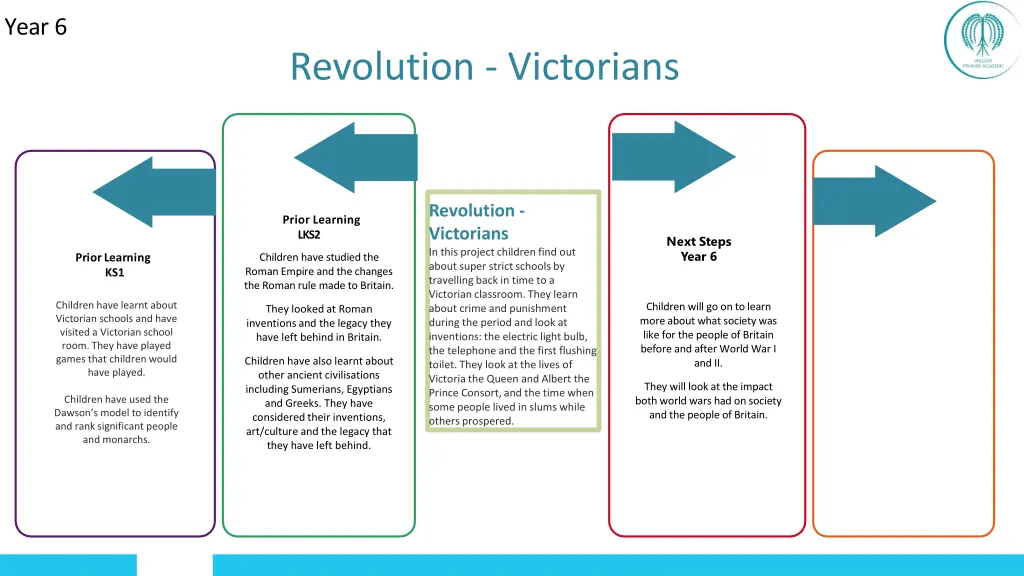
Year 6 Revolution - Victorians Revolution - Victorians In this project children find out about super strict schools by travelling back in time to a Victorian classroom. They learn about crime and punishment during the period and look at inventions: the electric light bulb, the telephone and the first flushing toilet. They look at the lives of Victoria the Queen and Albert the Prince Consort, and the time when some people lived in slums while others prospered. Prior Learning LKS2 Next Steps Year 6 PriorLearning KS1 Children have studied the Roman Empire and the changes the Roman rule made to Britain. Children have learnt about Victorian schools and have visited a Victorian school room. They have played games that children would have played. Children will go on to learn more about what society was like for the people of Britain before and after World War I and II. They looked at Roman inventions and the legacy they have left behind in Britain. Children have also learnt about other ancient civilisations including Sumerians, Egyptians and Greeks. They have considered their inventions, art/culture and the legacy that they have left behind. They will look at the impact both world wars had on society and the people of Britain. Children have used the Dawson s model to identify and rank significant people and monarchs.
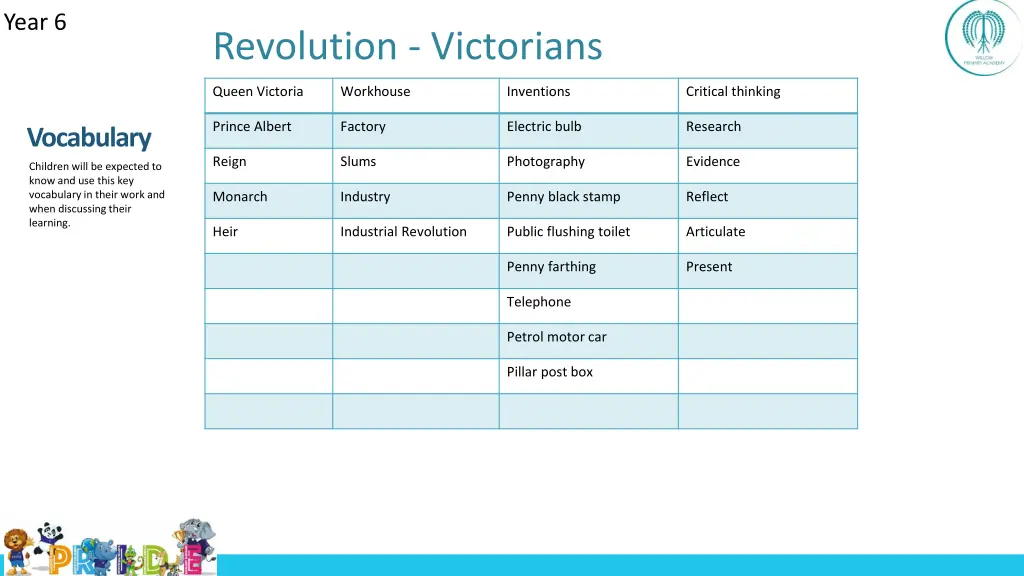
Year 6 Revolution - Victorians Queen Victoria Workhouse Inventions Critical thinking Prince Albert Factory Electric bulb Research Vocabulary Reign Slums Photography Evidence Children will be expected to know and use this key vocabulary in their work and when discussing their learning. Monarch Industry Penny black stamp Reflect Heir Industrial Revolution Public flushing toilet Articulate Penny farthing Present Telephone Petrol motor car Pillar post box
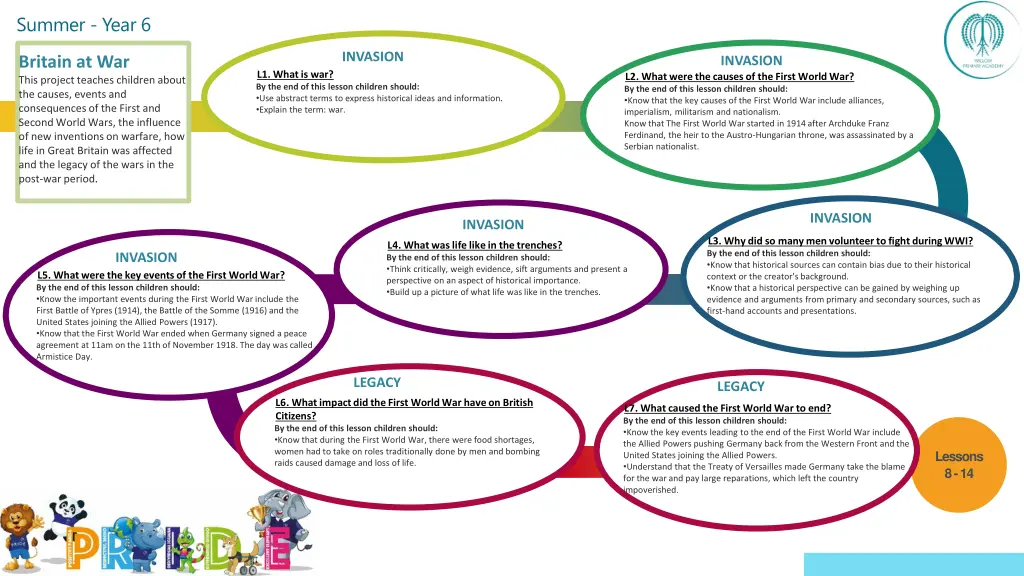
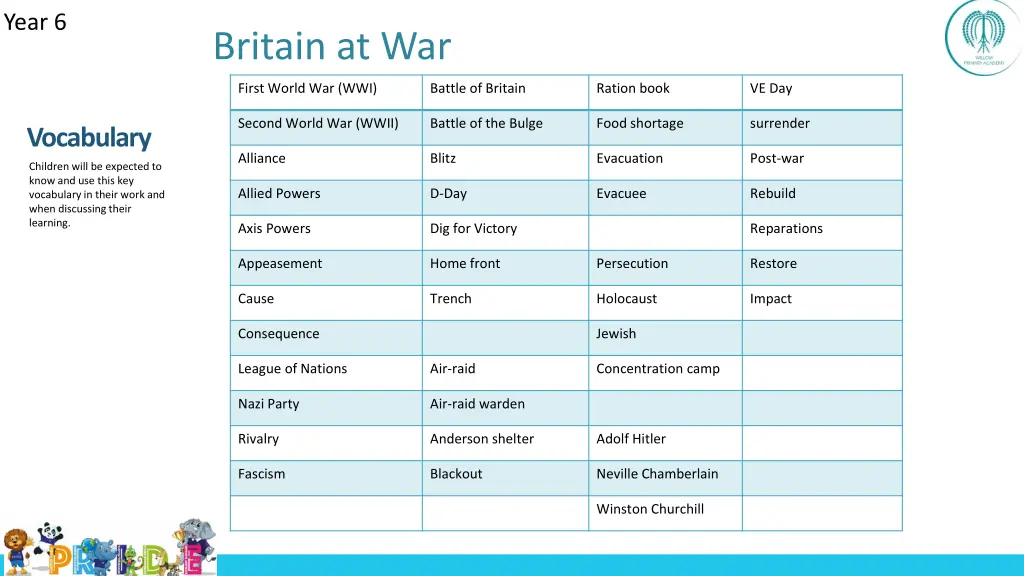
Summer - Year 6 INVASION Britain at War This project teaches children about the causes, events and consequences of the First and Second World Wars, the influence of new inventions on warfare, how life in Great Britain was affected and the legacy of the wars in the post-war period. INVASION L1. What is war? By the end of this lesson children should: Use abstract terms to express historical ideas and information. Explain the term: war. L2. What were the causes of the First World War? By the end of this lesson children should: Know that the key causes of the First World War include alliances, imperialism, militarism and nationalism. Know that The First World War started in 1914 after Archduke Franz Ferdinand, the heir to the Austro-Hungarian throne, was assassinated by a Serbian nationalist. INVASION INVASION L3. Why did so many men volunteer to fight during WWI? By the end of this lesson children should: Know that historical sources can contain bias due to their historical context or the creator's background. Know that a historical perspective can be gained by weighing up evidence and arguments from primary and secondary sources, such as first-hand accounts and presentations. L4. What was life like in the trenches? By the end of this lesson children should: Think critically, weigh evidence, sift arguments and present a perspective on an aspect of historical importance. Build up a picture of what life was like in the trenches. INVASION L5. What were the key events of the First World War? By the end of this lesson children should: Know the important events during the First World War include the First Battle of Ypres (1914), the Battle of the Somme (1916) and the United States joining the Allied Powers (1917). Know that the First World War ended when Germany signed a peace agreement at 11am on the 11th of November 1918. The day was called Armistice Day. LEGACY LEGACY L6. What impact did the First World War have on British Citizens? By the end of this lesson children should: Know that during the First World War, there were food shortages, women had to take on roles traditionally done by men and bombing raids caused damage and loss of life. L7. What caused the First World War to end? By the end of this lesson children should: Know the key events leading to the end of the First World War include the Allied Powers pushing Germany back from the Western Front and the United States joining the Allied Powers. Understand that the Treaty of Versailles made Germany take the blame for the war and pay large reparations, which left the country impoverished. Lessons 8 - 14
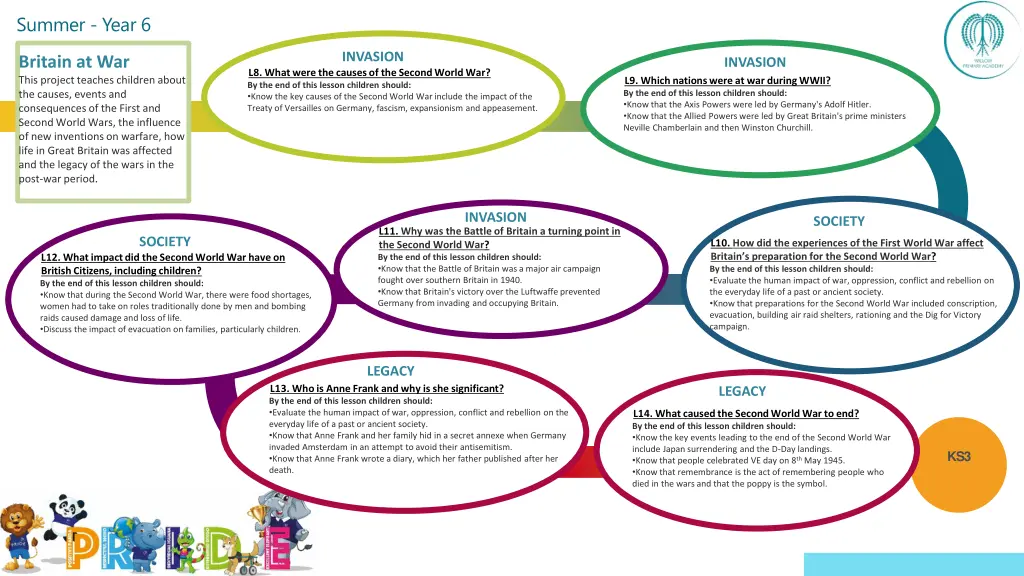
Summer - Year 6 INVASION Britain at War This project teaches children about the causes, events and consequences of the First and Second World Wars, the influence of new inventions on warfare, how life in Great Britain was affected and the legacy of the wars in the post-war period. INVASION L8. What were the causes of the Second World War? By the end of this lesson children should: Know the key causes of the Second World War include the impact of the Treaty of Versailles on Germany, fascism, expansionism and appeasement. L9. Which nations were at war during WWII? By the end of this lesson children should: Know that the Axis Powers were led by Germany's Adolf Hitler. Know that the Allied Powers were led by Great Britain's prime ministers Neville Chamberlain and then Winston Churchill. INVASION SOCIETY L11. Why was the Battle of Britain a turning point in the Second World War? By the end of this lesson children should: Know that the Battle of Britain was a major air campaign fought over southern Britain in 1940. Know that Britain's victory over the Luftwaffe prevented Germany from invading and occupying Britain. SOCIETY L10. How did the experiences of the First World War affect Britain s preparation for the Second World War? By the end of this lesson children should: Evaluate the human impact of war, oppression, conflict and rebellion on the everyday life of a past or ancient society. Know that preparations for the Second World War included conscription, evacuation, building air raid shelters, rationing and the Dig for Victory campaign. L12. What impact did the Second World War have on British Citizens, including children? By the end of this lesson children should: Know that during the Second World War, there were food shortages, women had to take on roles traditionally done by men and bombing raids caused damage and loss of life. Discuss the impact of evacuation on families, particularly children. LEGACY L13. Who is Anne Frank and why is she significant? By the end of this lesson children should: Evaluate the human impact of war, oppression, conflict and rebellion on the everyday life of a past or ancient society. Know that Anne Frank and her family hid in a secret annexe when Germany invaded Amsterdam in an attempt to avoid their antisemitism. Know that Anne Frank wrote a diary, which her father published after her death. LEGACY L14. What caused the Second World War to end? By the end of this lesson children should: Know the key events leading to the end of the Second World War include Japan surrendering and the D-Day landings. Know that people celebrated VE day on 8th May 1945. Know that remembrance is the act of remembering people who died in the wars and that the poppy is the symbol. KS3
Year 6 Britain at War PriorLearning LKS2 NextSteps UKS2 Britain at War This project teaches children about the causes, events and consequences of the First and Second World Wars, the influence of new inventions on warfare, how life in Great Britain was affected and the legacy of the wars in the post-war period. Next Steps KS3 PriorLearning KS1 Children have learnt about the Roman invasion and life in Roman Britain They learnt how their inventions and ingenuity changed Britain Children have learnt about the Tudor monarchs and know the legacy they have left behind. Children have used the Dawson s model to identify and rank significant people. Children have looked at reasons why the Romans withdrew from Britain. They have most recently studied Victorian Britain. This included looking at life for rich and poor people and the impact of the industrial revolution and inventions. Children have looked at explorers who travelled the world to find out about other places. Children went on to learn about why the Vikings invaded Britain and the impact of the Norman conquest on life in Britain.
Year 6 Britain at War First World War (WWI) Battle of Britain Ration book VE Day Second World War (WWII) Battle of the Bulge Food shortage surrender Vocabulary Alliance Blitz Evacuation Post-war Children will be expected to know and use this key vocabulary in their work and when discussing their learning. Allied Powers D-Day Evacuee Rebuild Axis Powers Dig for Victory Reparations Appeasement Home front Persecution Restore Cause Trench Holocaust Impact Consequence Jewish League of Nations Air-raid Concentration camp Nazi Party Air-raid warden Rivalry Anderson shelter Adolf Hitler Fascism Blackout Neville Chamberlain Winston Churchill