Discover the significance of carbonation testing in assessing concrete integrity over time. Learn about pH values, non-destructive testing benefits, real-world applications, and future trends in concrete testing. Enhance your knowledge on concrete maintenance and safety protocols.
Please find below an Image/Link to download the presentation.
The content on the website is provided AS IS for your information and personal use only. It may not be sold, licensed, or shared on other websites without obtaining consent from the author. If you encounter any issues during the download, it is possible that the publisher has removed the file from their server.
You are allowed to download the files provided on this website for personal or commercial use, subject to the condition that they are used lawfully. All files are the property of their respective owners.
The content on the website is provided AS IS for your information and personal use only. It may not be sold, licensed, or shared on other websites without obtaining consent from the author.
E N D
Presentation Transcript
Understanding Carbonation Testing A Deep Dive into Concrete Integrity Photo by Pexels
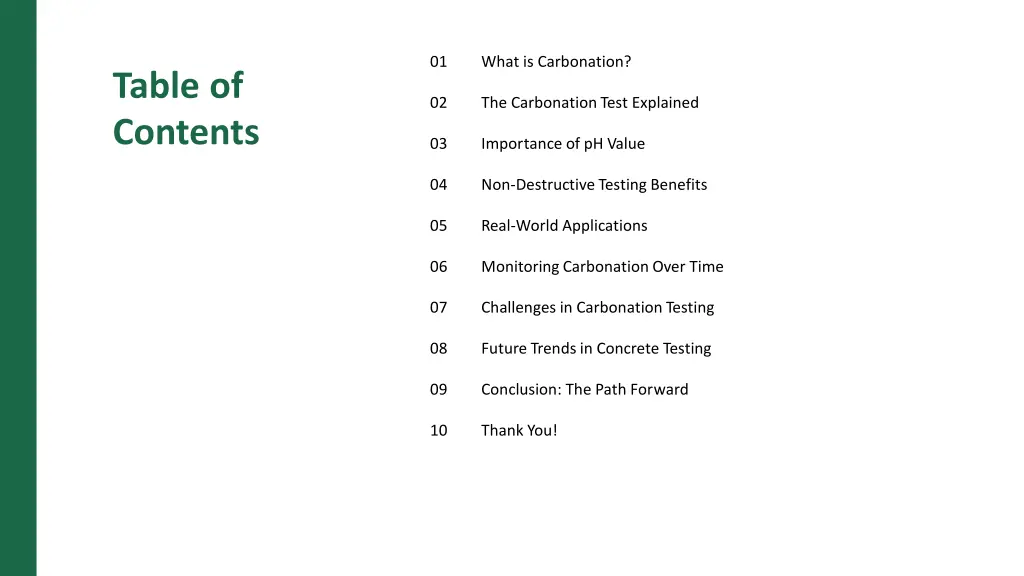
01 What is Carbonation? Table of Contents 02 The Carbonation Test Explained 03 Importance of pH Value 04 Non-Destructive Testing Benefits 05 Real-World Applications 06 Monitoring Carbonation Over Time 07 Challenges in Carbonation Testing 08 Future Trends in Concrete Testing 09 Conclusion: The Path Forward 10 Thank You!
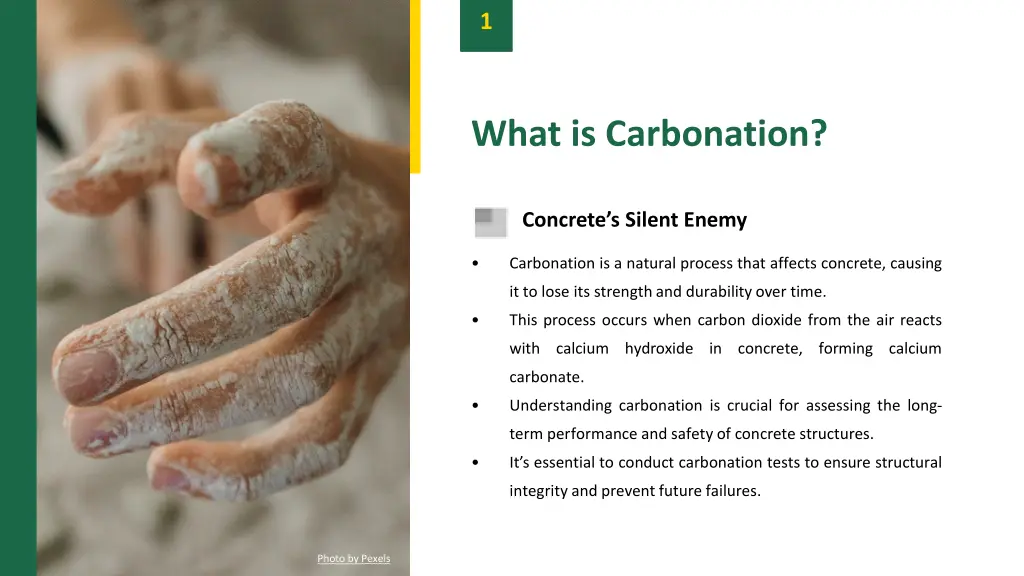
1 What is Carbonation? Concrete s Silent Enemy Carbonation is a natural process that affects concrete, causing it to lose its strengthand durability over time. This process occurs when carbon dioxide from the air reacts with calcium hydroxide in concrete, forming calcium carbonate. Understanding carbonation is crucial for assessing the long- term performance and safety of concrete structures. It s essential to conduct carbonation tests to ensure structural integrity and preventfuture failures. Photo by Pexels
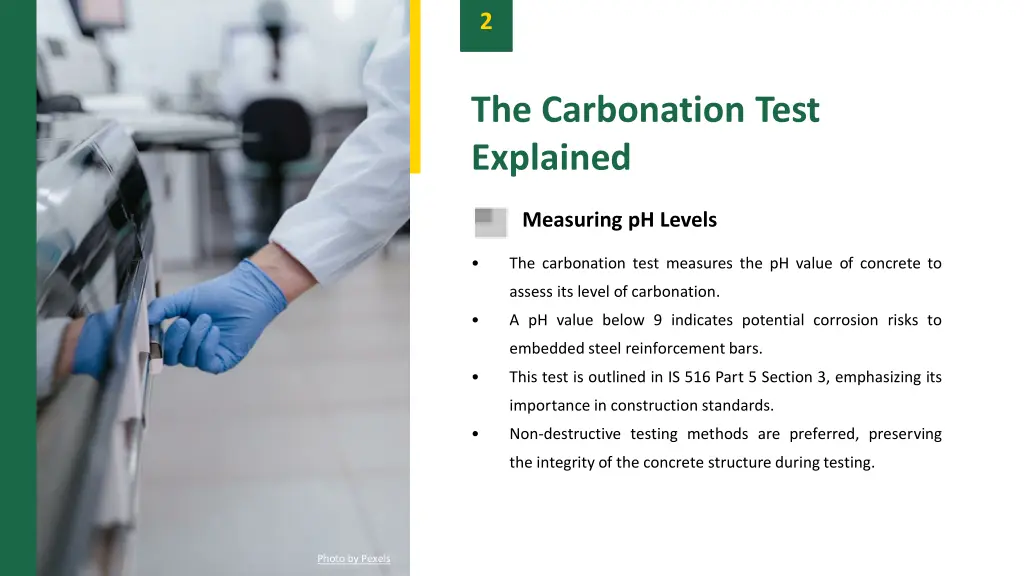
2 The Carbonation Test Explained Measuring pH Levels The carbonation test measures the pH value of concrete to assess its level of carbonation. A pH value below 9 indicates potential corrosion risks to embeddedsteel reinforcementbars. This test is outlined in IS 516 Part 5 Section 3, emphasizing its importance in construction standards. Non-destructive testing methods are preferred, preserving the integrity of the concrete structure duringtesting. Photo by Pexels
3 Importance of pH Value Understanding Concrete Quality The pH value of concrete is crucial as it determines the protective layer aroundthe embeddedsteel. A higher pH (above 12) indicates good protection, while lower values signify a risk of corrosion. Regular monitoring of pH helps in proactive maintenance of concrete structures. This is vital in extending the lifespan of buildings and infrastructure. Photo by Pexels
4 Non-Destructive Testing Benefits Preserve Integrity Non-destructive testing methods like carbonation tests allow engineers to evaluate structures without causing damage. This approach leads to cost savings by avoiding unnecessary repairsor reinforcements. It ensures safety while maintaining the operational integrity of the structure. NDT methods foster better decision-making in maintenance strategies. Photo by Pexels
5 Real-World Applications Safety and Longevity Carbonation testing is vital in various fields including construction, infrastructure, and public safety. Bridges, buildings, and tunnels require regular assessments to prevent catastrophic failures. It plays a key role in the lifecycle management of concrete structures across the world. Successful carbonation testing contributes to the sustainabilityof urbandevelopment. Photo by Pexels
6 Monitoring Carbonation Over Time A Continuous Process Regular monitoring of carbonation is essential for maintaining concrete quality. It helps in understanding the rate of carbonation and adjusting maintenance protocols accordingly. Data gathered through testing can guide future construction practices and material selection. Continuous evaluation leads to safer, more durable built environments. Photo by Pexels
7 Challenges in Carbonation Testing Overcoming Barriers Despite its importance, carbonation testing faces challenges in accurate assessment and data interpretation. Environmental factors can affect carbonation rates, leading to variability in results. Standardizing testing methods and training personnel is crucial for effective implementation. Addressing these challenges enhances the reliability of test outcomes. Photo by Pexels
8 Future Trends in Concrete Testing Innovative Solutions The future of carbonation testing involves integrating technology like AI and IoT for real-time monitoring. Advanced sensors can provide immediate feedback on carbonation levels, enhancing safety. Research into new materials and treatments can help mitigate carbonation effects. Innovation will drive improvements in concrete testing protocols. Photo by Pexels
9 Conclusion: The Path Forward Ensuring Safety Understanding carbonation testing and its implications is essential for engineers and construction professionals. Regular testing ensures the longevity and safety of concrete structures. Investing in proper testing and maintenance practices is critical in today s built environment. Embracing new technologies will revolutionize how we approachconcrete integrity. Photo by Pexels
10 Thank You! Stay Inspired Thank you for exploring carbonation testing with us today! Let s work together to ensure the future of our concrete structures remains strong and safe. Remember, qualitytesting leads to quality building. Stay safe and curious about concrete sustainability! Photo by Pexels