Exploring Disability Service Providers and Education Laws in Baltimore Conference 2024
Delve into the role of disability service providers and the differences between secondary and postsecondary education for students with disabilities at the Baltimore conference in July 2024. Discover the significance of IDEA and Section 504 in providing special education services and ensuring equal opportunities for children with disabilities.

Download Presentation

Please find below an Image/Link to download the presentation.
The content on the website is provided AS IS for your information and personal use only. It may not be sold, licensed, or shared on other websites without obtaining consent from the author. If you encounter any issues during the download, it is possible that the publisher has removed the file from their server.
You are allowed to download the files provided on this website for personal or commercial use, subject to the condition that they are used lawfully. All files are the property of their respective owners.
The content on the website is provided AS IS for your information and personal use only. It may not be sold, licensed, or shared on other websites without obtaining consent from the author.
E N D
Presentation Transcript
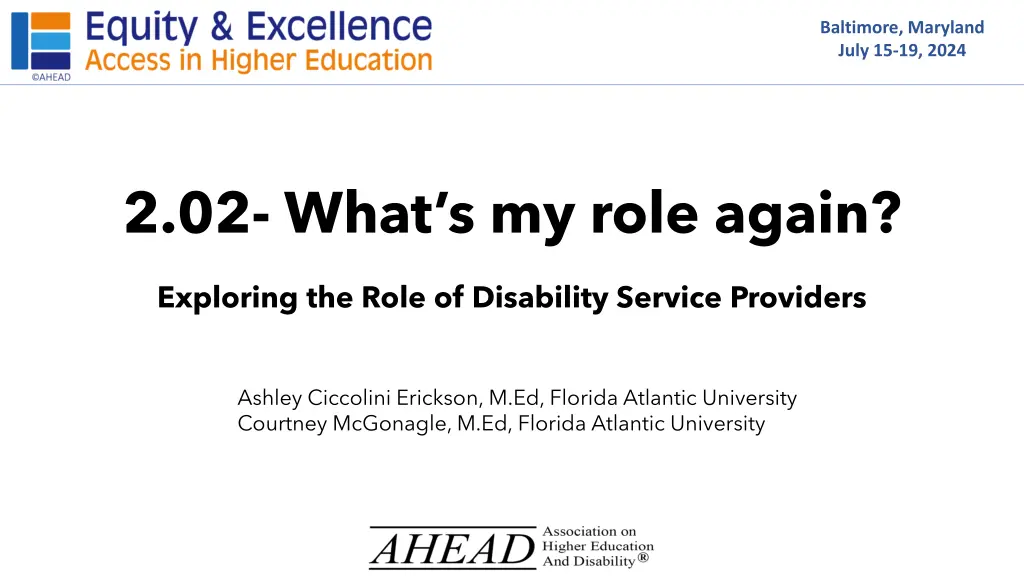
Baltimore, Maryland July 15-19, 2024 2.02- What s my role again? Exploring the Role of Disability Service Providers Ashley Ciccolini Erickson, M.Ed, Florida Atlantic University Courtney McGonagle, M.Ed, Florida Atlantic University
Baltimore, Maryland July 15-19, 2024 Conference Civility Statement We ask you to join us in creating a culture that reflects Access and Inclusion and Civility and Respect this week and in all aspects of our organization.
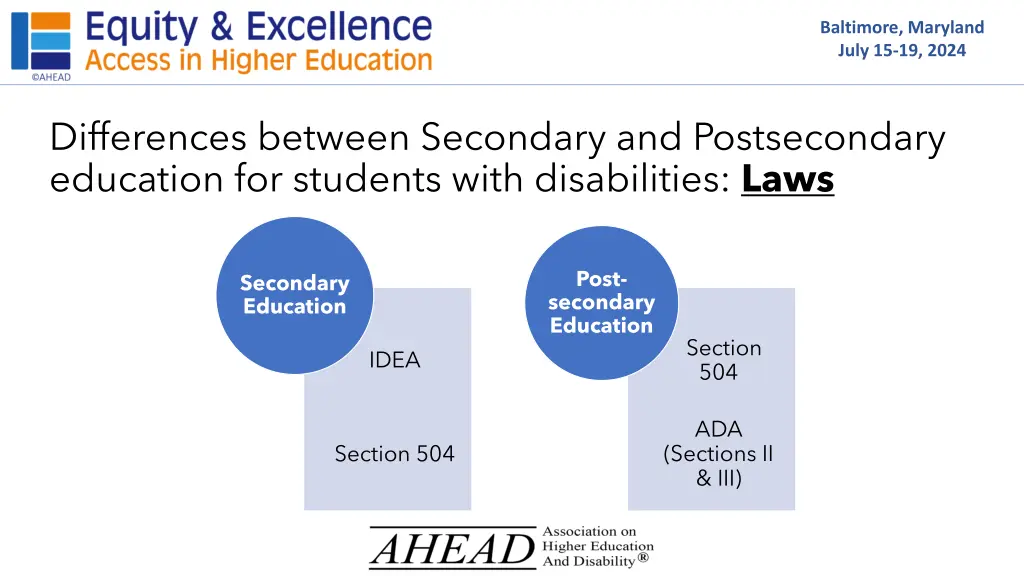
Baltimore, Maryland July 15-19, 2024 Differences between Secondary and Postsecondary education for students with disabilities: Laws Post- secondary Education Secondary Education Section 504 IDEA ADA (Sections II & III) Section 504
Baltimore, Maryland July 15-19, 2024 What is IDEA? The Individuals with Disabilities Education Act is a federal law that governs special education services for children from birth through high school graduation or age 21 (whichever comes first).
Baltimore, Maryland July 15-19, 2024 What is IDEA? (continued) Schools must provide a free appropriate public education (FAPE) to kids with disabilities. Schools must find and evaluate students who may have disabilities at no cost to the family. If a child has a qualifying disability , the school must offer special education and related services to meet the child s needs (through an Individualized Education Plan (IEP)). An IEP (Individualized Education Plan) is developed by an educational team for that specific student and stipulates how that student s education will be individualized for the child to learn and succeed.
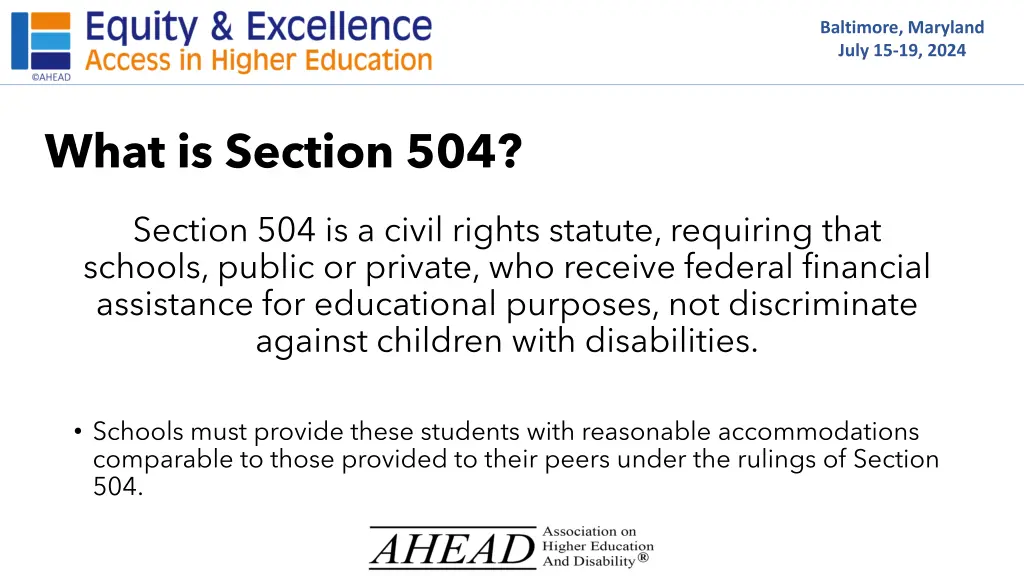
Baltimore, Maryland July 15-19, 2024 What is Section 504? Section 504 is a civil rights statute, requiring that schools, public or private, who receive federal financial assistance for educational purposes, not discriminate against children with disabilities. Schools must provide these students with reasonable accommodations comparable to those provided to their peers under the rulings of Section 504.
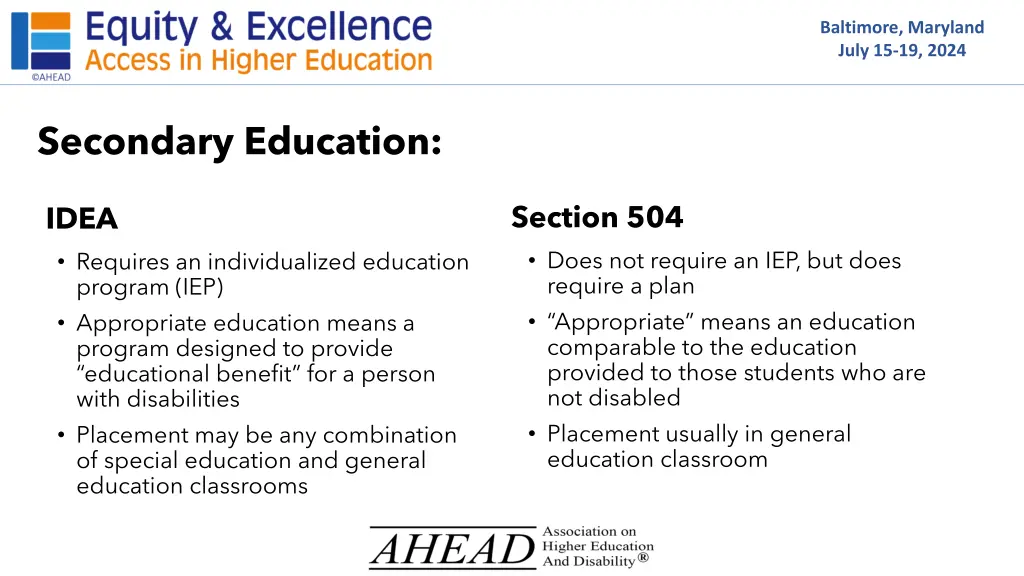
Baltimore, Maryland July 15-19, 2024 Secondary Education: Section 504 Does not require an IEP, but does require a plan Appropriate means an education comparable to the education provided to those students who are not disabled Placement usually in general education classroom IDEA Requires an individualized education program (IEP) Appropriate education means a program designed to provide educational benefit for a person with disabilities Placement may be any combination of special education and general education classrooms
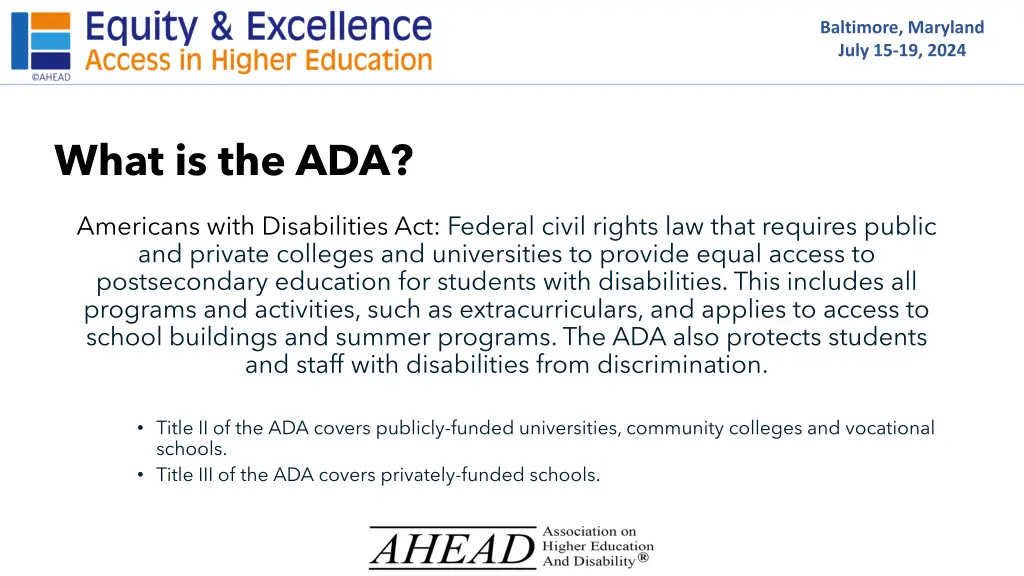
Baltimore, Maryland July 15-19, 2024 What is the ADA? Americans with Disabilities Act: Federal civil rights law that requires public and private colleges and universities to provide equal access to postsecondary education for students with disabilities. This includes all programs and activities, such as extracurriculars, and applies to access to school buildings and summer programs. The ADA also protects students and staff with disabilities from discrimination. Title II of the ADA covers publicly-funded universities, community colleges and vocational schools. Title III of the ADA covers privately-funded schools.
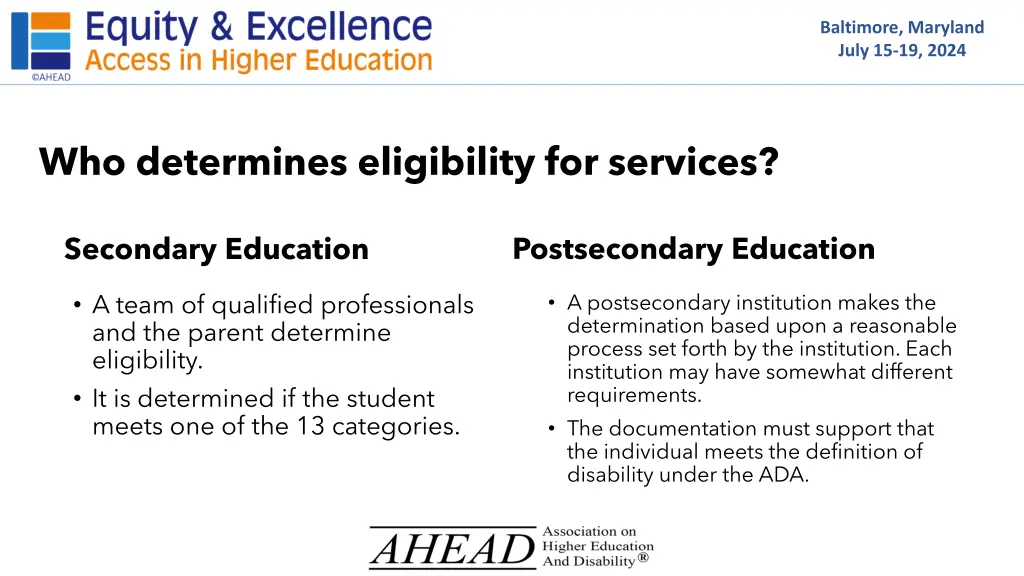
Baltimore, Maryland July 15-19, 2024 Who determines eligibility for services? Postsecondary Education Secondary Education A team of qualified professionals and the parent determine eligibility. It is determined if the student meets one of the 13 categories. A postsecondary institution makes the determination based upon a reasonable process set forth by the institution. Each institution may have somewhat different requirements. The documentation must support that the individual meets the definition of disability under the ADA.
Baltimore, Maryland July 15-19, 2024 What is our role as disability services providers in post-secondary education?
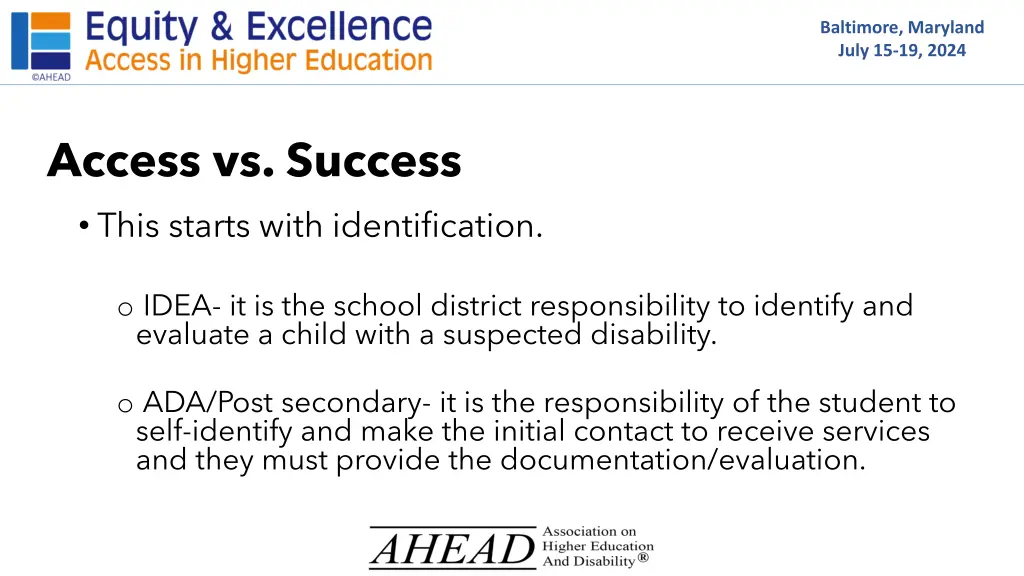
Baltimore, Maryland July 15-19, 2024 Access vs. Success This starts with identification. o IDEA- it is the school district responsibility to identify and evaluate a child with a suspected disability. o ADA/Post secondary- it is the responsibility of the student to self-identify and make the initial contact to receive services and they must provide the documentation/evaluation.
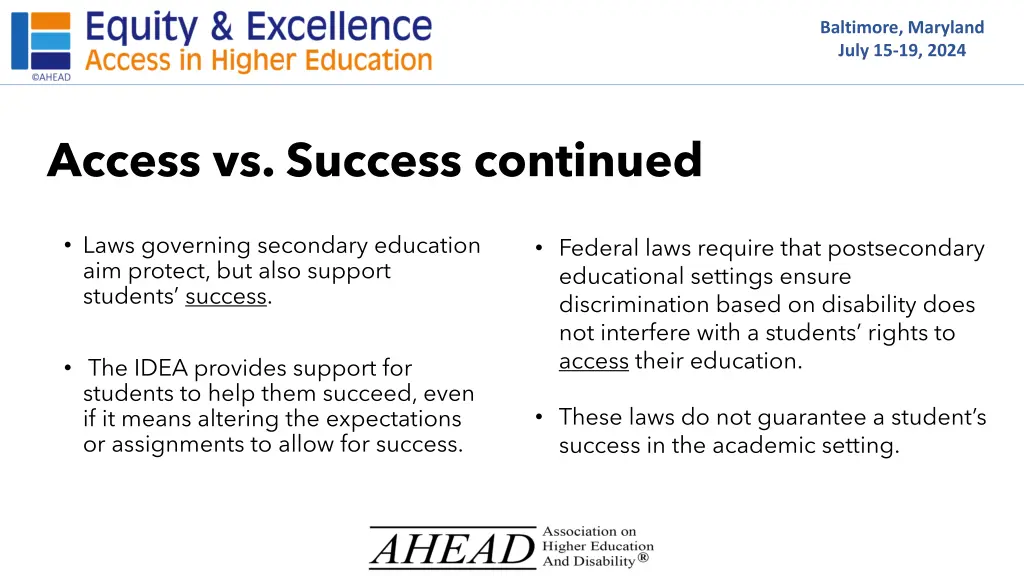
Baltimore, Maryland July 15-19, 2024 Access vs. Success continued Laws governing secondary education aim protect, but also support students success. Federal laws require that postsecondary educational settings ensure discrimination based on disability does not interfere with a students rights to access their education. The IDEA provides support for students to help them succeed, even if it means altering the expectations or assignments to allow for success. These laws do not guarantee a student s success in the academic setting.
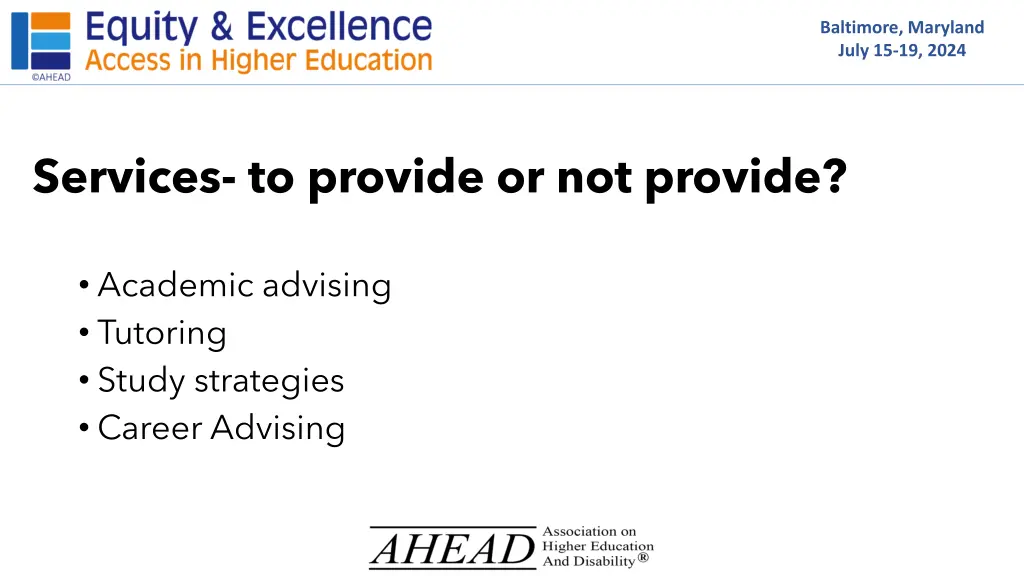
Baltimore, Maryland July 15-19, 2024 Services- to provide or not provide? Academic advising Tutoring Study strategies Career Advising
Baltimore, Maryland July 15-19, 2024 Academic Accommodations Academic accommodations are changes to the learning environment that help students with disabilities access educational opportunities and participate in learning programs. Accommodations can include modifications to the classroom, tasks, policies, procedures, and materials, as well as auxiliary aids and services.
Baltimore, Maryland July 15-19, 2024 Academic Accommodations continued The goal is to reduce or eliminate barriers to learning without altering the essential requirements of a course or program. Accommodations should not compromise academic standards or provide an unfair advantage, and they do not guarantee student success.
Baltimore, Maryland July 15-19, 2024 Accommodation Request Examples Paper-based exams Extension on assignments Notes/formulas during exams Volunteer Notetaking
Baltimore, Maryland July 15-19, 2024 Parent involvement Initial contact Intake (first meeting) Permission to Discuss Form (FERPA) Parent Guide
Baltimore, Maryland July 15-19, 2024 Discussion
Baltimore, Maryland July 15-19, 2024 Presenter Information Ashley Ciccolini Erickson Courtney McGonagle aciccoli@health.fau.edu cmcgonag@health.fau.edu