Exploring Hopf Bifurcations in Differential Equations
Discover the applications and characteristics of Hopf bifurcations in differential equations, including saddle-node bifurcation, limit cycles, and subcritical versus supercritical bifurcations. Learn about nonlinear examples, equilibrium points, linearizing systems, and solving for eigenvalues. Dive into the fascinating world of bifurcation theory with practical insights and visual aids.

Download Presentation

Please find below an Image/Link to download the presentation.
The content on the website is provided AS IS for your information and personal use only. It may not be sold, licensed, or shared on other websites without obtaining consent from the author. If you encounter any issues during the download, it is possible that the publisher has removed the file from their server.
You are allowed to download the files provided on this website for personal or commercial use, subject to the condition that they are used lawfully. All files are the property of their respective owners.
The content on the website is provided AS IS for your information and personal use only. It may not be sold, licensed, or shared on other websites without obtaining consent from the author.
E N D
Presentation Transcript
Various Applications of Hopf Bifurcations Matt Mulvehill, Kaleb Mitchell, Niko Lachman
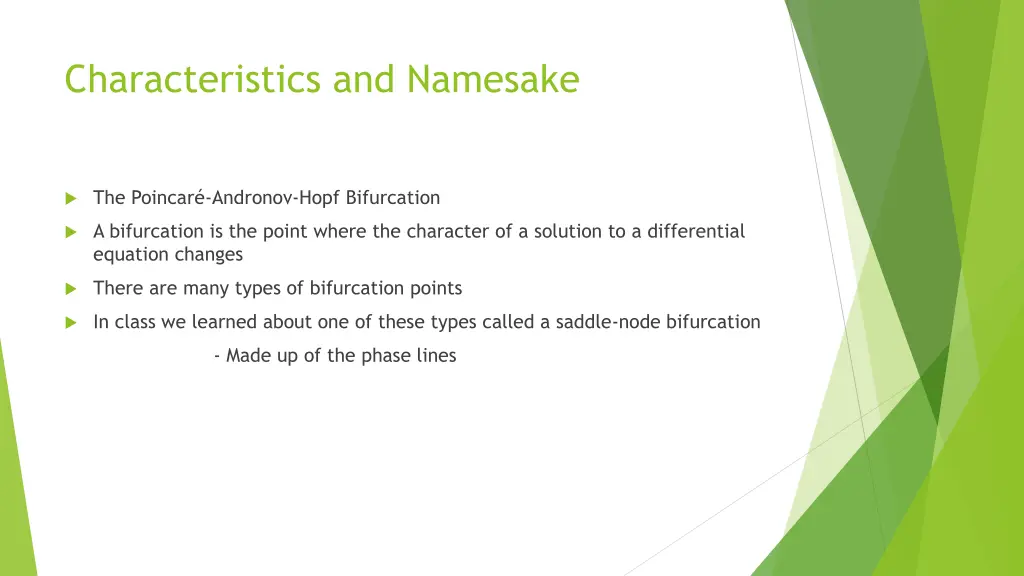
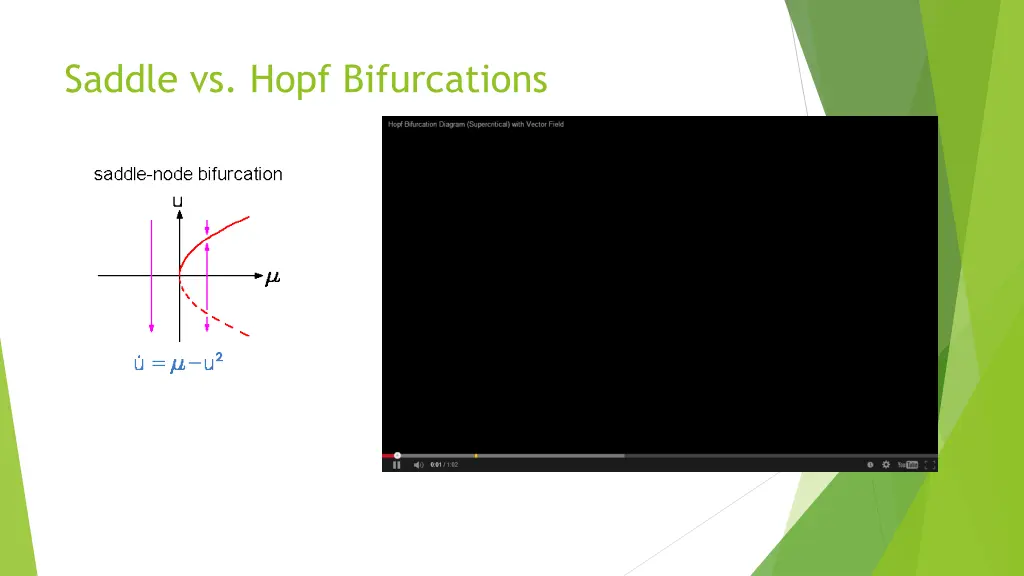
Characteristics and Namesake The Poincar -Andronov-Hopf Bifurcation A bifurcation is the point where the character of a solution to a differential equation changes There are many types of bifurcation points In class we learned about one of these types called a saddle-node bifurcation - Made up of the phase lines
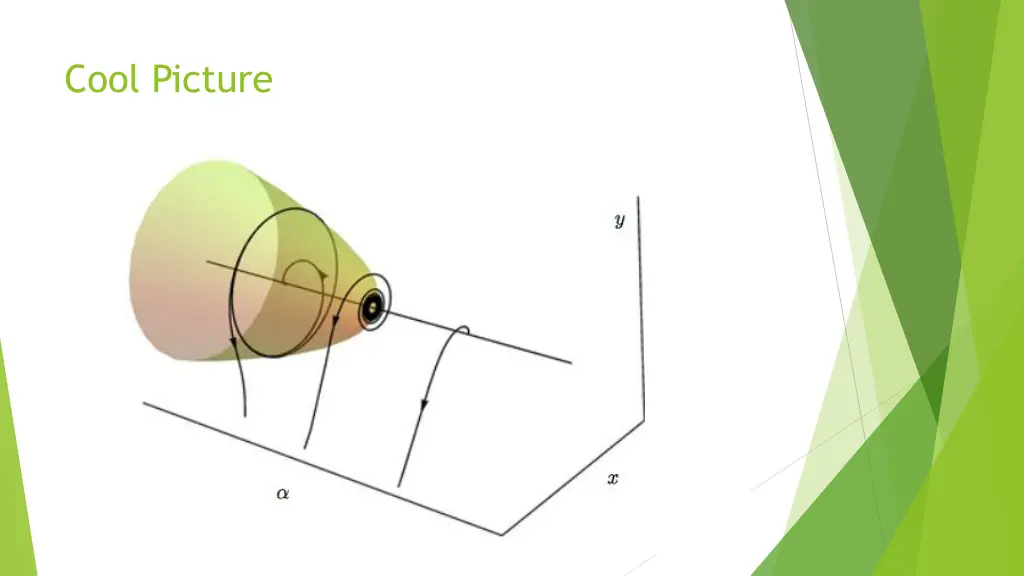
Important Concepts A limit cycle is a closed trajectory that solutions tend towards either as time goes to infinity or towards negative infinity. subcritical bifurcation : limit cycle appears for negative values of the parameter; solutions tend away from the limit cycle supercritical bifurcation : limit cycle appears for positive values of the parameter; solutions tend towards the limit cycle
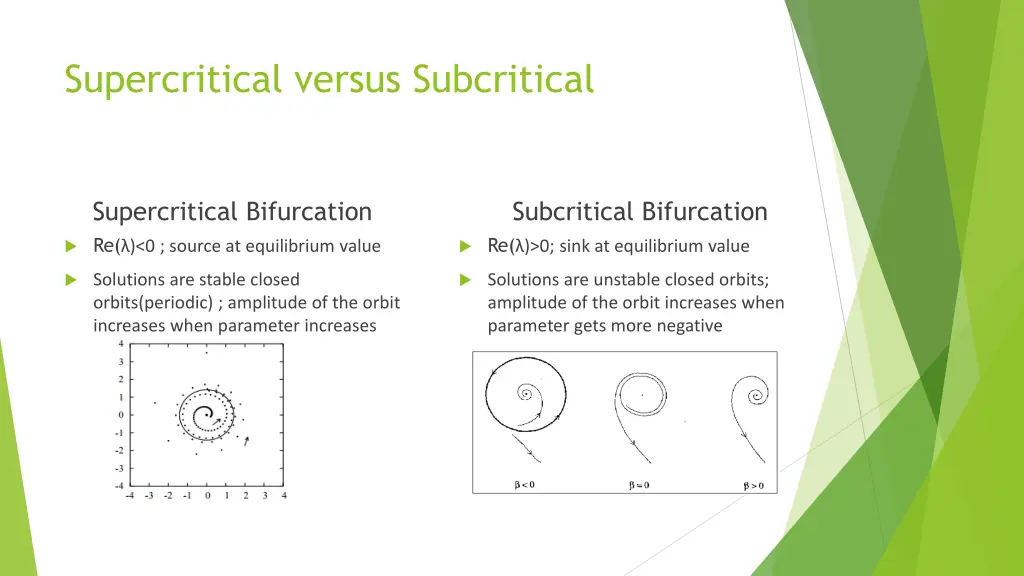
Supercritical versus Subcritical Supercritical Bifurcation Subcritical Bifurcation Re( )<0 ; source at equilibrium value Re( )>0; sink at equilibrium value Solutions are stable closed orbits(periodic) ; amplitude of the orbit increases when parameter increases Solutions are unstable closed orbits; amplitude of the orbit increases when parameter gets more negative
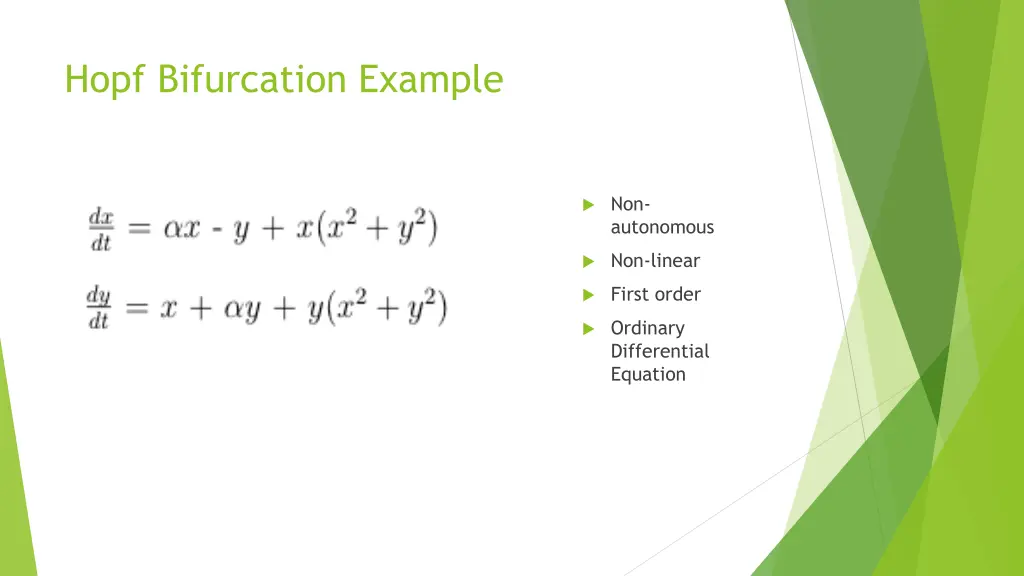
Hopf Bifurcation Example Non- autonomous Non-linear First order Ordinary Differential Equation
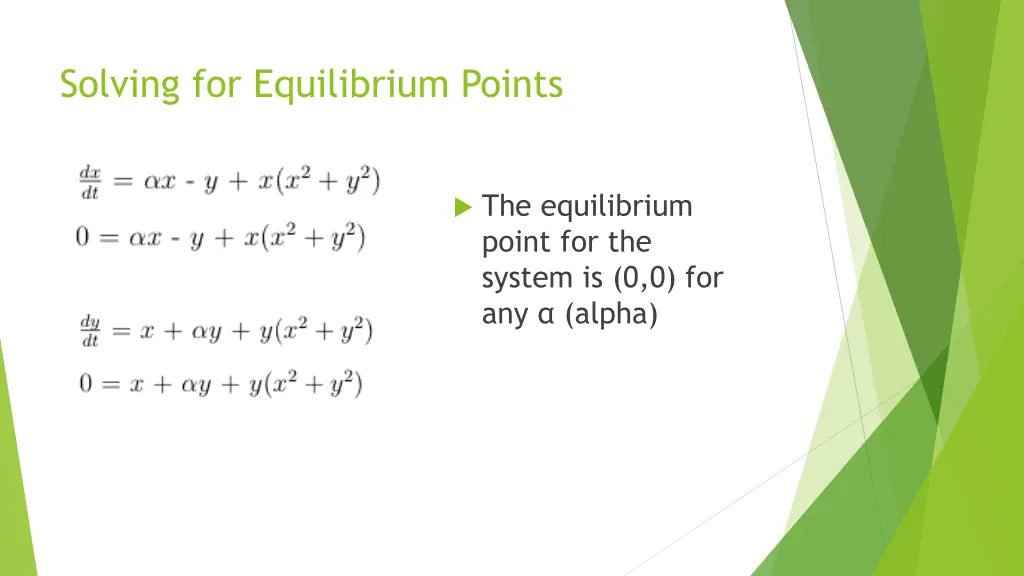
Solving for Equilibrium Points The equilibrium point for the system is (0,0) for any (alpha)
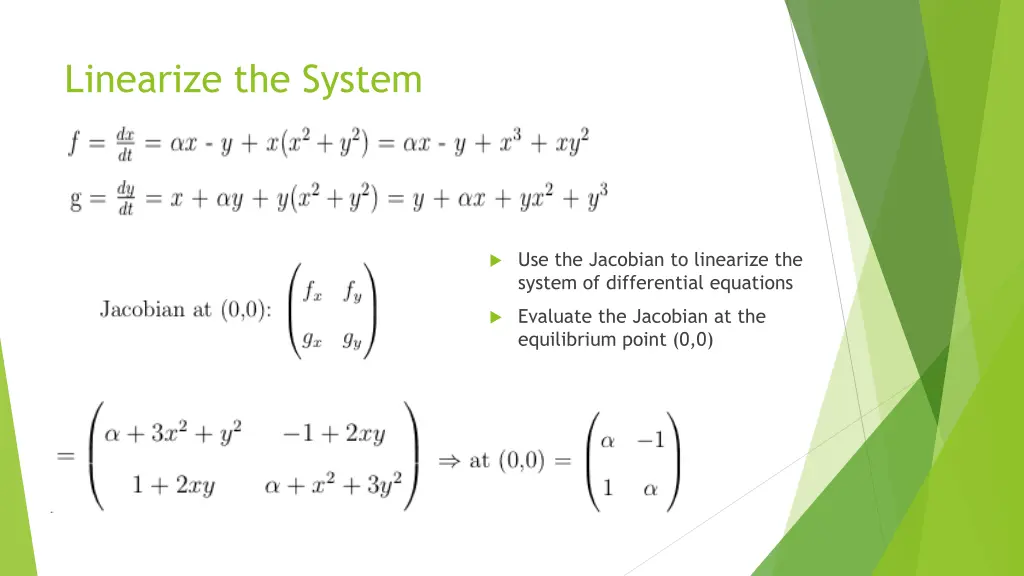
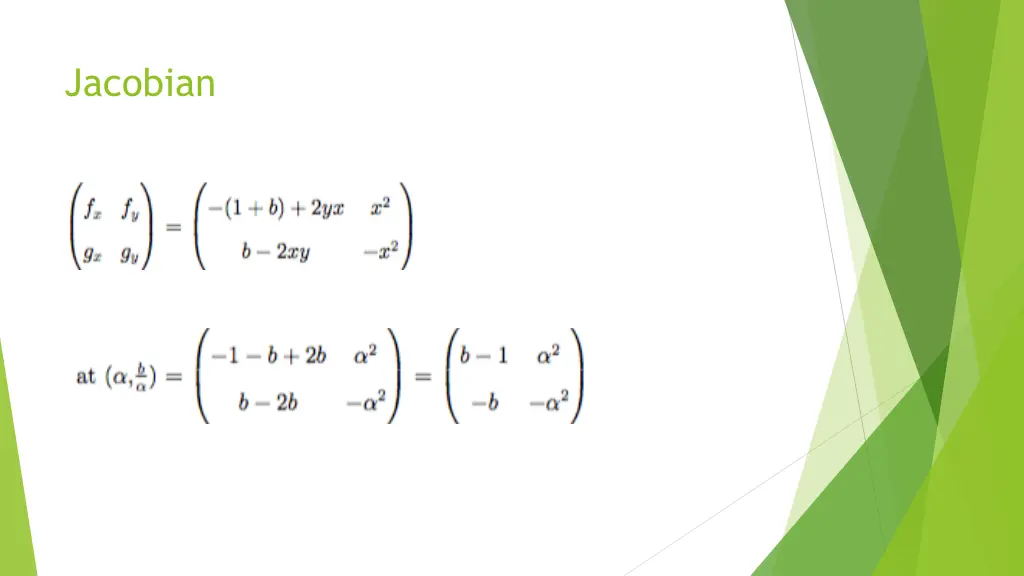
Linearize the System Use the Jacobian to linearize the system of differential equations Evaluate the Jacobian at the equilibrium point (0,0)
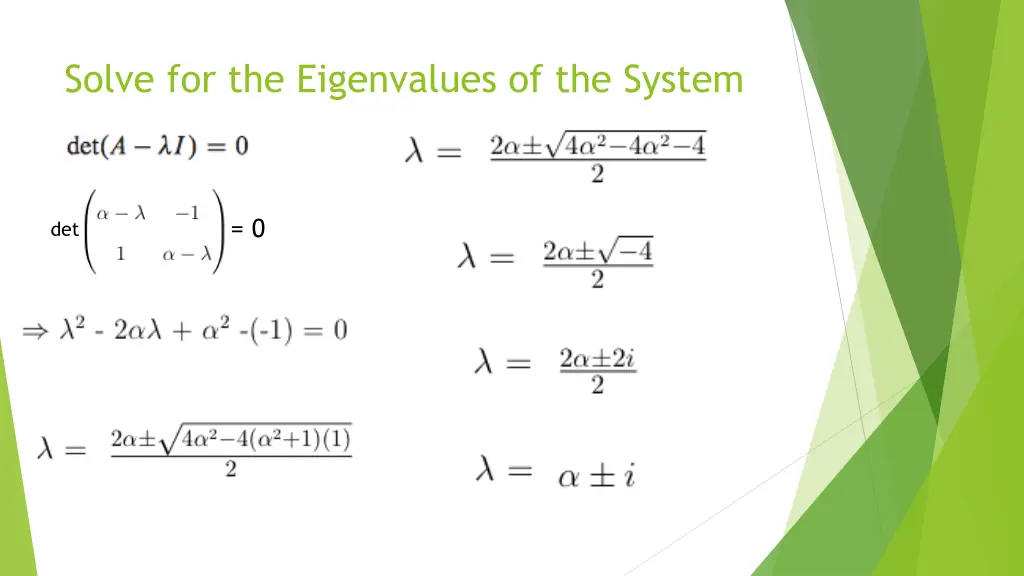
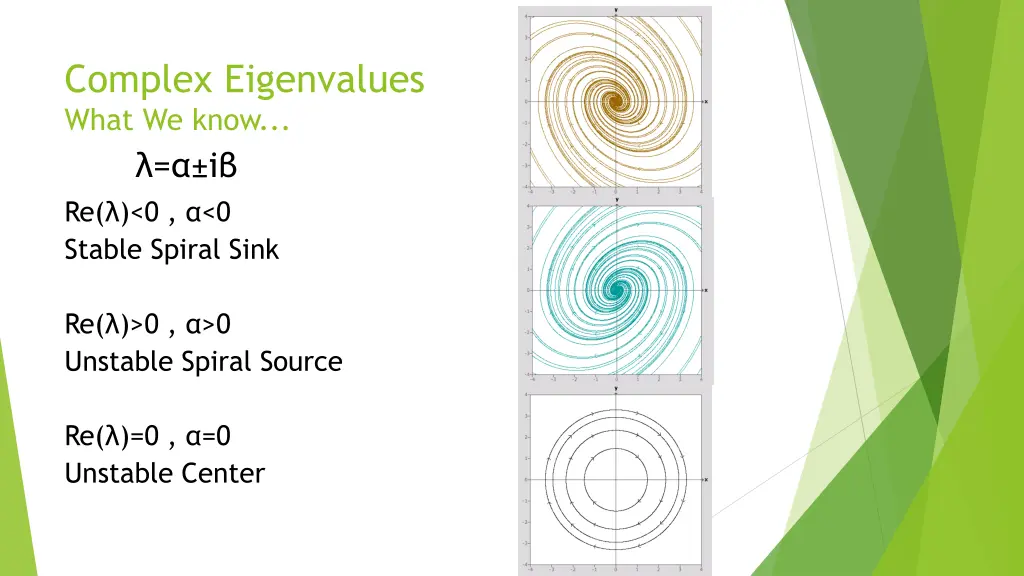
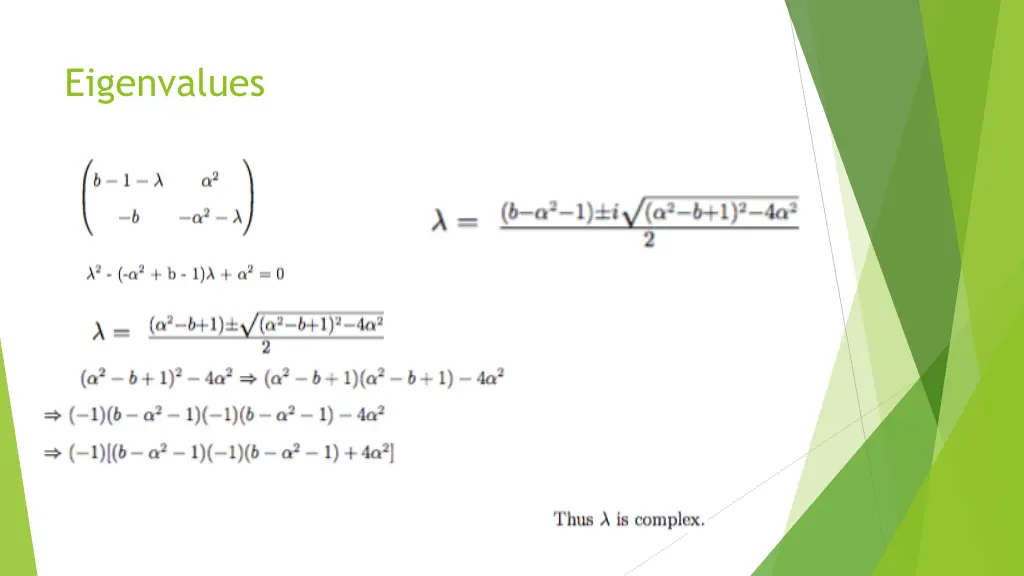
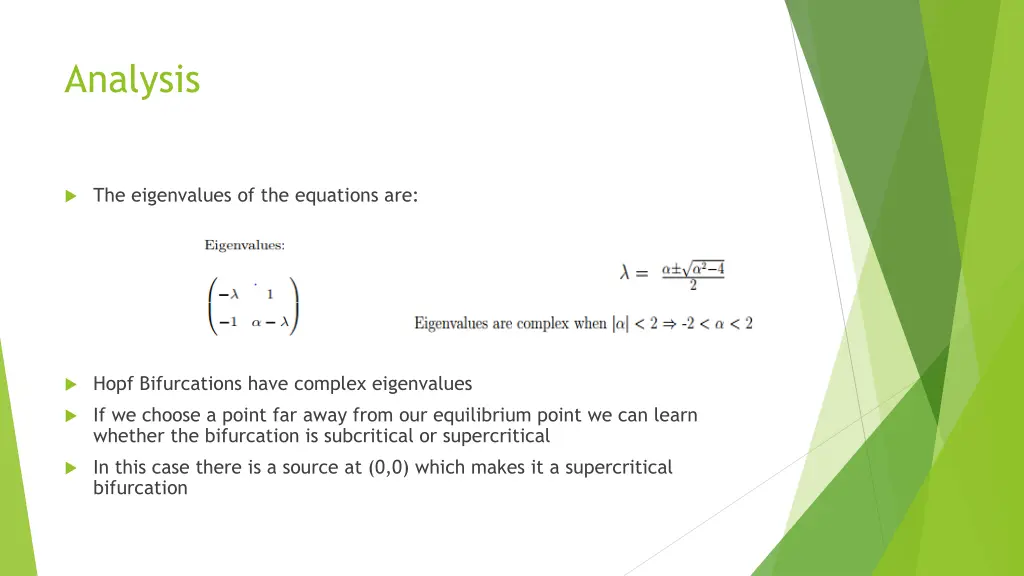
Complex Eigenvalues What We know... = i Re( )<0 , <0 Stable Spiral Sink Re( )>0 , >0 Unstable Spiral Source Re( )=0 , =0 Unstable Center
What we dont know What does the phase portrait look like when changes? How does this system of differential equations differ from ones that we have studied previously? and how do we find out?
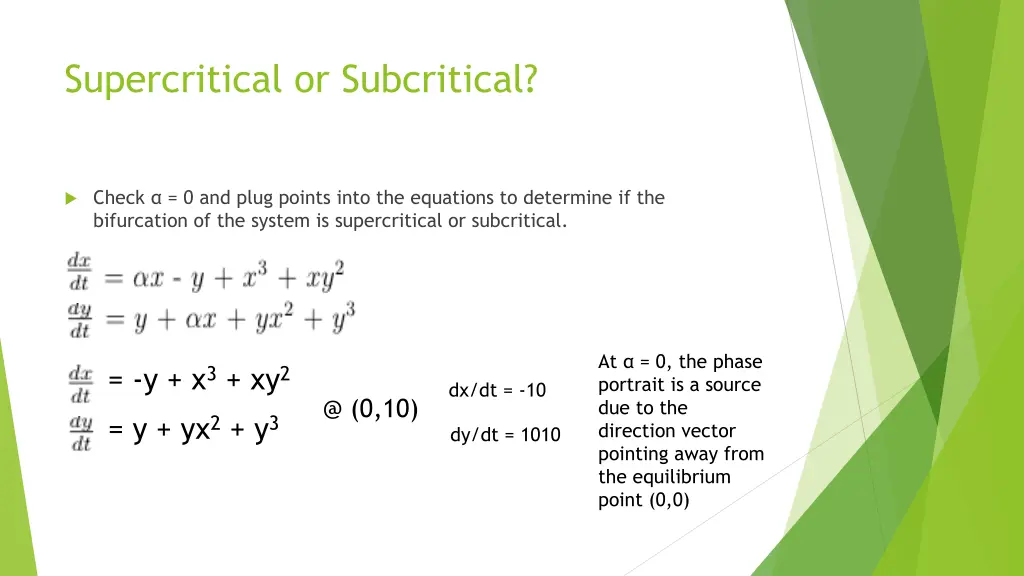
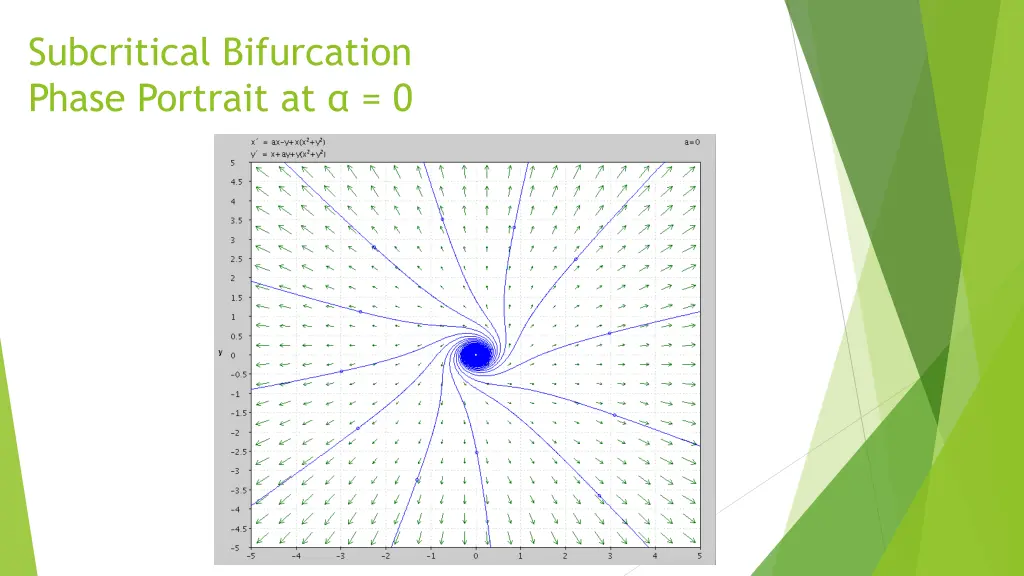
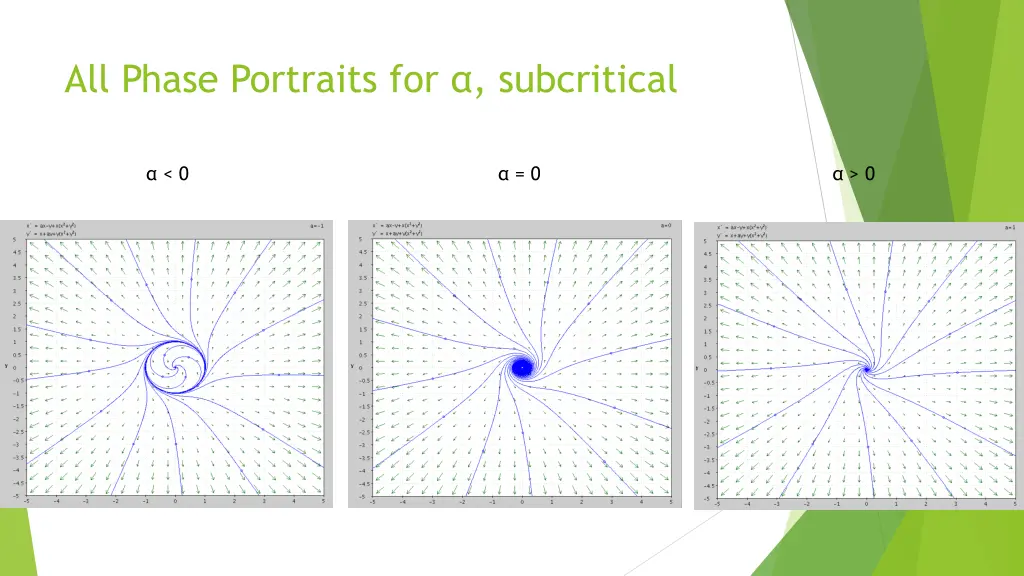
Supercritical or Subcritical? Check = 0 and plug points into the equations to determine if the bifurcation of the system is supercritical or subcritical. At = 0, the phase portrait is a source due to the direction vector pointing away from the equilibrium point (0,0) = -y + x3 + xy2 = y + yx2 + y3 dx/dt = -10 @ (0,10) dy/dt = 1010
Subcritical Bifurcation Phase Portrait at = 0
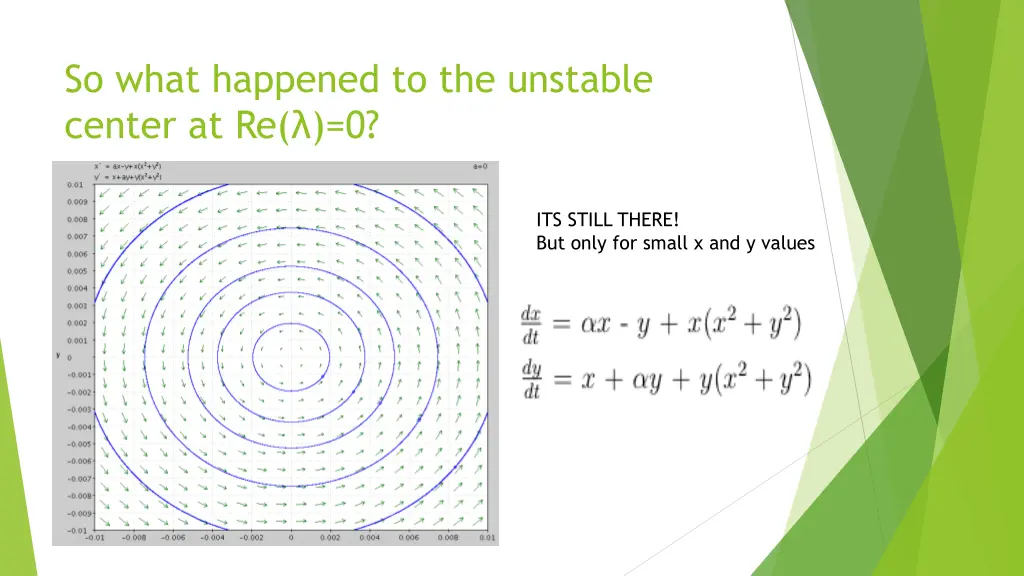
So what happened to the unstable center at Re( )=0? ITS STILL THERE! But only for small x and y values
All Phase Portraits for , subcritical < 0 = 0 > 0
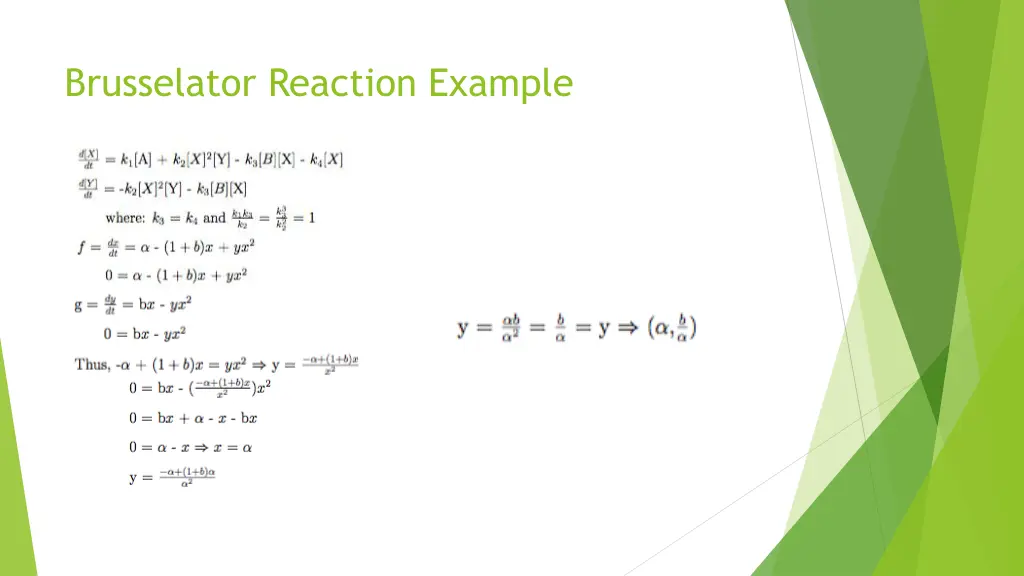
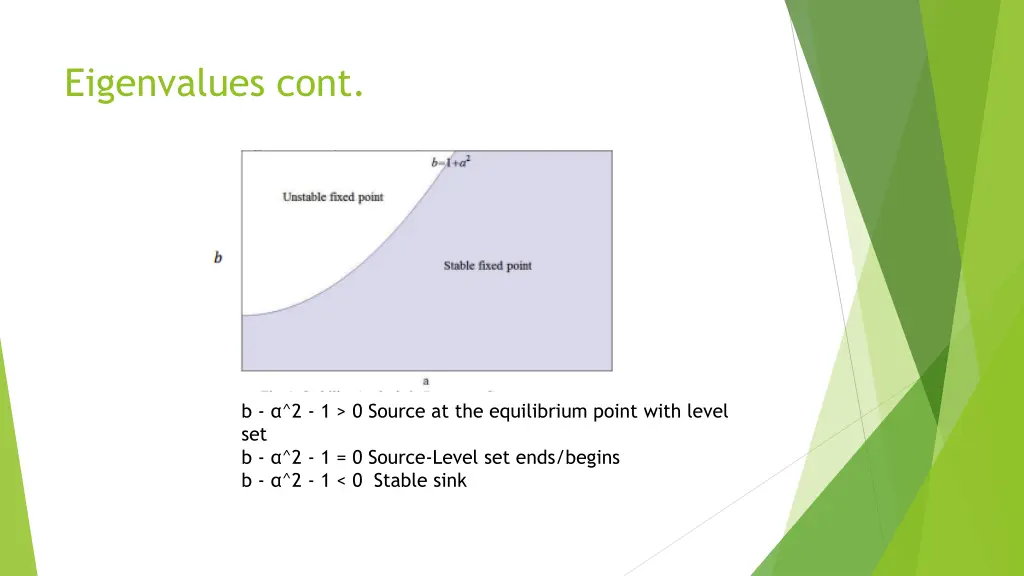
Eigenvalues cont. b - ^2 - 1 > 0 Source at the equilibrium point with level set b - ^2 - 1 = 0 Source-Level set ends/begins b - ^2 - 1 < 0 Stable sink
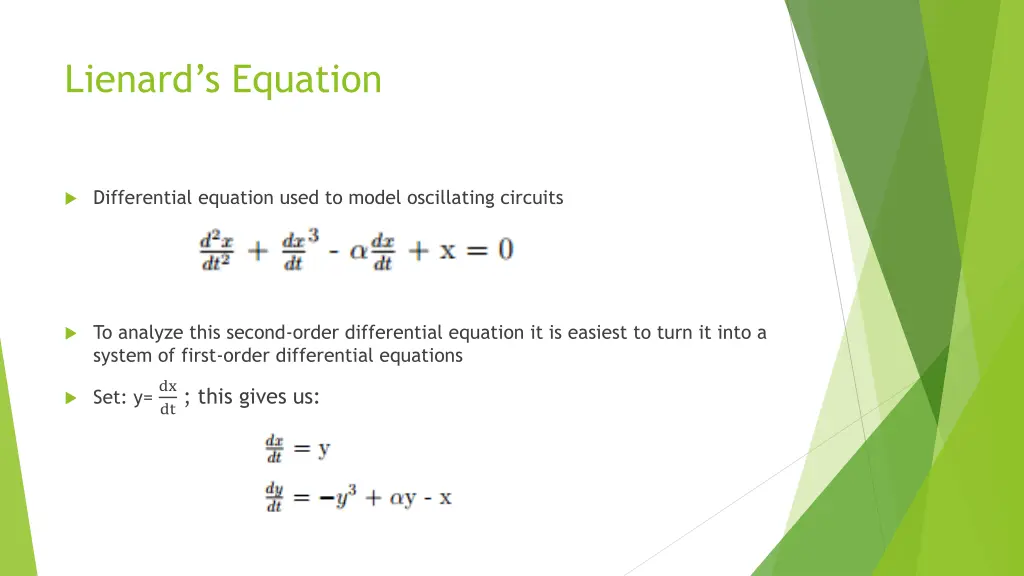
Lienards Equation Differential equation used to model oscillating circuits To analyze this second-order differential equation it is easiest to turn it into a system of first-order differential equations Set: y= dx dt ; this gives us:
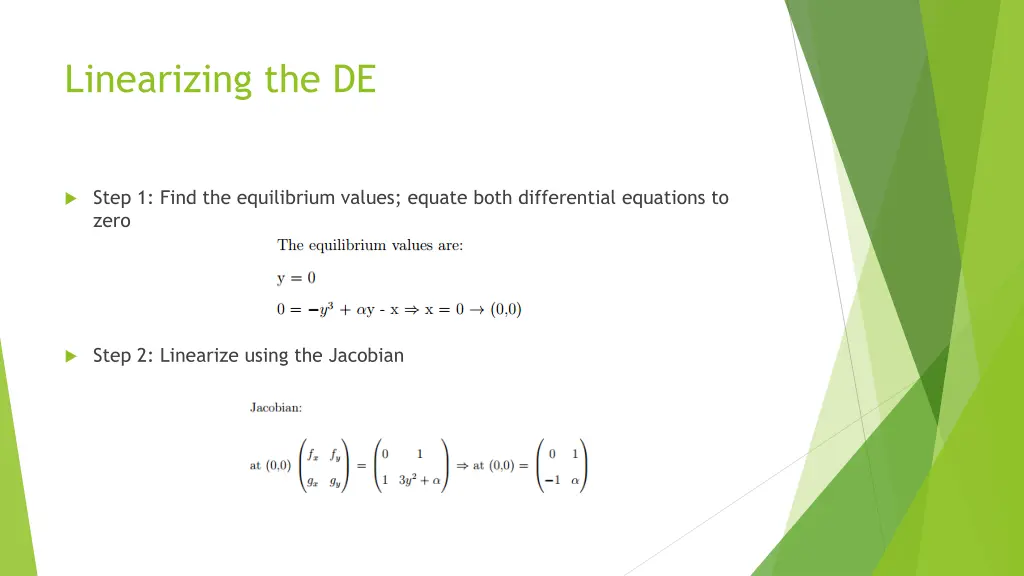
Linearizing the DE Step 1: Find the equilibrium values; equate both differential equations to zero Step 2: Linearize using the Jacobian
Analysis The eigenvalues of the equations are: Hopf Bifurcations have complex eigenvalues If we choose a point far away from our equilibrium point we can learn whether the bifurcation is subcritical or supercritical In this case there is a source at (0,0) which makes it a supercritical bifurcation