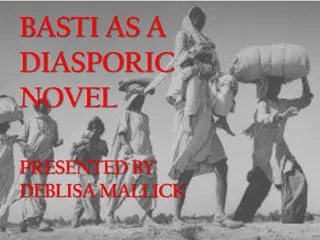
Delve into the complexities of diaspora, border identities, and transnational experiences in postcolonial Bildungsroman through the works of Jin Chien Huang. Understand the historical specificity and power dynamics of diasporic communities, highlighting the intersections of economics, politics, culture, gender, race, and more. Explore the intertwined concepts of diaspora and minority, shedding light on their political and cultural entanglements within the context of displacement and subjugation.
Please find below an Image/Link to download the presentation.
The content on the website is provided AS IS for your information and personal use only. It may not be sold, licensed, or shared on other websites without obtaining consent from the author. If you encounter any issues during the download, it is possible that the publisher has removed the file from their server.
You are allowed to download the files provided on this website for personal or commercial use, subject to the condition that they are used lawfully. All files are the property of their respective owners.
The content on the website is provided AS IS for your information and personal use only. It may not be sold, licensed, or shared on other websites without obtaining consent from the author.
E N D
Presentation Transcript
Postcolonializing Bildungsroman Diaspora, border and transnational identities Jin Chien Huang 404096106
Jewish After 70A.D, dispersal becomes a word to describe the Jew who do not have the place of their own. The dictionary also highlights the word s association with the dispersion of the Jews after the Babylonian exile. (Brah 178)
The Concept of Diaspora At the heart of the notion of diaspora is the image of a journey. (Brah 179) Diaspora are clearly not the same as casual travel. Nor do they normatively refer to temporary sojourns. (Brah 179) Paradoxically, diaspora journeys are essentially about settling down, about putting roots elsewhere . (Brah 179)
It is axiomatic that each empirical diaspora must be analyzed in its historical specificity. (Brah 180) The concept of diaspora concerns the historically variable forms of relationality within and between diasporic formations.(Brah 180) The concept of diaspora centres on configurations of power which differentiate diasporas internally as well as situation them in relation to one another. (Brah 180)
Other components of diaspora Economic, political and cultural specificities.(Brah 180) Gender, race, class religion, language and generation.(Brah 180) Diasporic community is differently imagined under different historical circumstances. (Brah 180)
Diaspora and Minority By minority discourse we mean a theoretical articulation of the political and cultural structures that connect different minority cultures in their subjugation and opposition to the dominant culture.(Brah 184) JanMohammed is careful to print out that a minority location is not a question o essence but a question position, subject position that in the final analysis can be defined only in political terms. (Brah 184)
What category of person is minoritised in a specific discourse? By bringing all subordinate classes, genders, ethnicities or sexualities within its orbit, then there would seem to be even less to gain by jettisoning the language of subordination which, at the very least, signals inequities of power. (Brah 185-6)
Where is home? On the one hand, home is a mythic place of desire in the diasporic imagination. In this sense it is a place of no return, even if it is possible to visit the geographical territory that is seen as the place of origin . (Brah 188) On the other hand, home is also the lived experience of a locality. (Brah 188-9) In other words, the varying experience of the pains and pleasures, the terrors and contentments, or the highs and humdrum of everyday lived culture that marks how.(Brah 189)
It is centrally about our political and personal struggles over the social regulation of belonging . (Brah 189) Not all diasporas inscribe homing desire through a wish to return to a place of origin . The word dispora often invokes the imagery of traumas of separation and dislocation, and this is certainly a very important aspect of the migratory experience. (Brah 190) Identity is always plural and in process. (Brah 191)
Whither diaspora? The homing desire, however, is not the same as the desire for a homeland . Contrary to general belief, not all diasporas sustain an ideology of return.(Brah 194) Moreover, the multi-placedness of home in the diasporic imaginary does not mean that diasporian subjectivity is rootless . (Brah 194) The concept of diaspora refers to multi- locationality within and across territorial, cultural and psychic boundaries. (Brah 194)