Enhance knowledge of CCSSM focusing on Number System and Mathematical Practice. Discussions on how students learn math, paradigm shifts, lesson design, and professional learning methodologies to ensure college and career readiness.
Please find below an Image/Link to download the presentation.
The content on the website is provided AS IS for your information and personal use only. It may not be sold, licensed, or shared on other websites without obtaining consent from the author. If you encounter any issues during the download, it is possible that the publisher has removed the file from their server.
You are allowed to download the files provided on this website for personal or commercial use, subject to the condition that they are used lawfully. All files are the property of their respective owners.
The content on the website is provided AS IS for your information and personal use only. It may not be sold, licensed, or shared on other websites without obtaining consent from the author.
E N D
Presentation Transcript
Mathematics Teachers Grades 6 and 7 October 9, 2013 Joy Donlin and Tony Lobascher
Todays Number Make a list of everything you know about the number, -8. Use words, pictures, models or other representations.
Outcomes Participants will increase their knowledge and understanding of the CCSSM with a focus on the Number System domain and the Standards for Mathematical Practice. Participants will apply their knowledge and understanding to an upcoming lesson design.
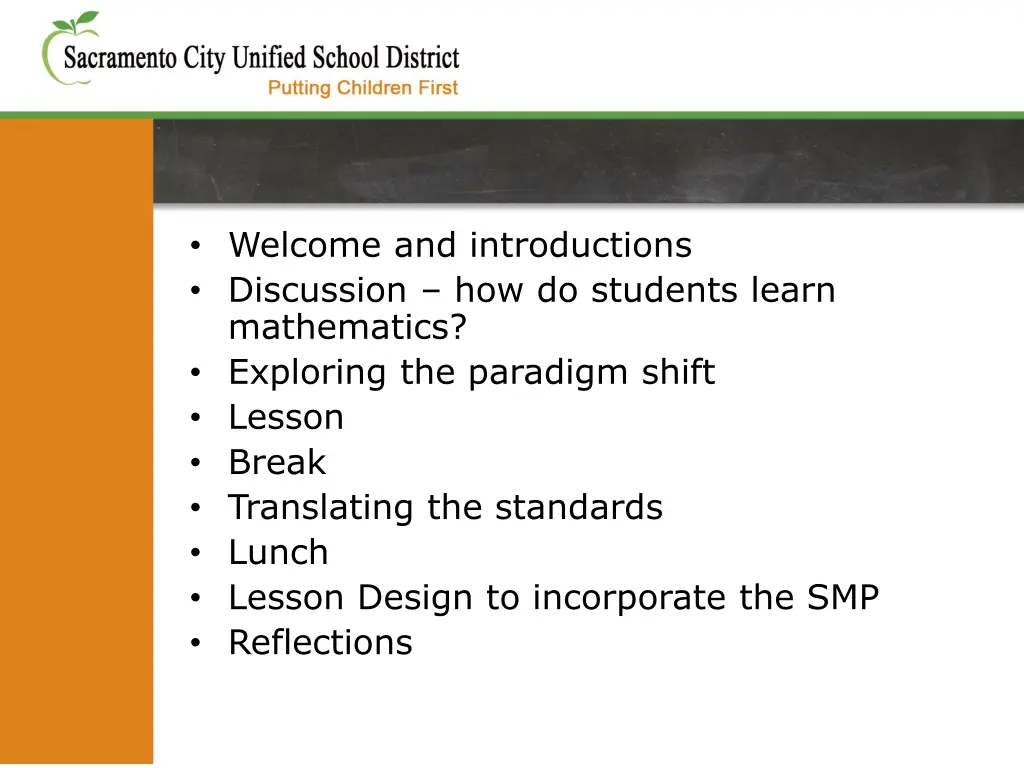
Welcome and introductions Discussion how do students learn mathematics? Exploring the paradigm shift Lesson Break Translating the standards Lunch Lesson Design to incorporate the SMP Reflections
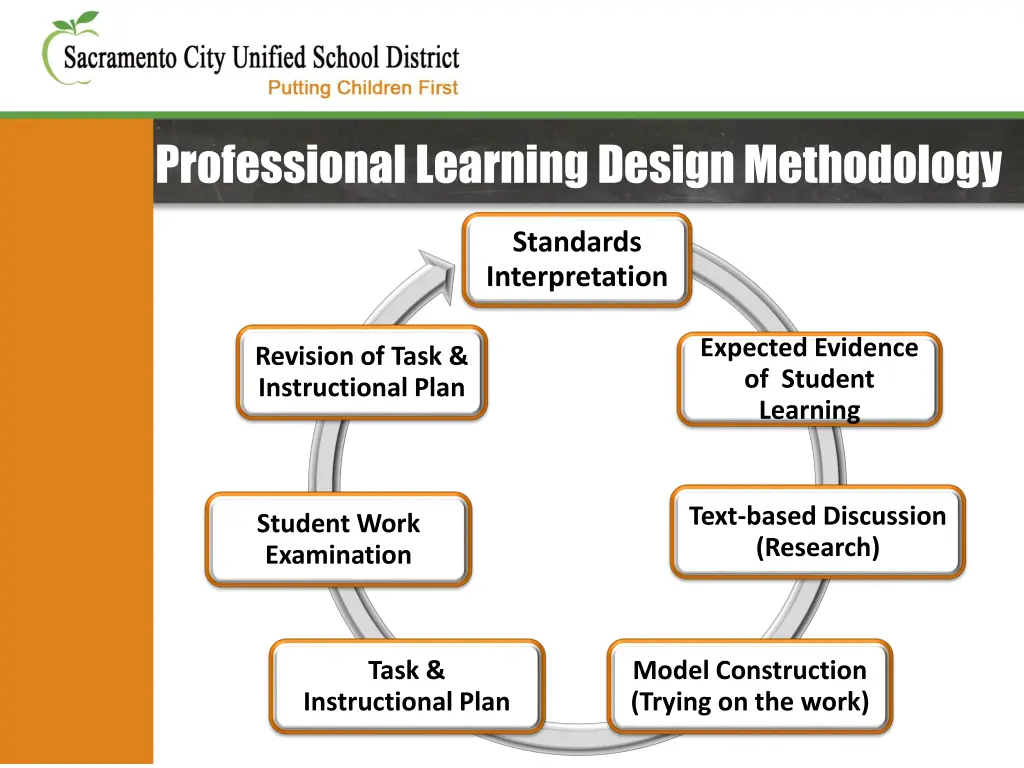
Professional Learning Design Methodology Standards Interpretation Expected Evidence of Student Learning Revision of Task & Instructional Plan Text-based Discussion (Research) Student Work Examination Task & Instructional Plan Model Construction (Trying on the work)
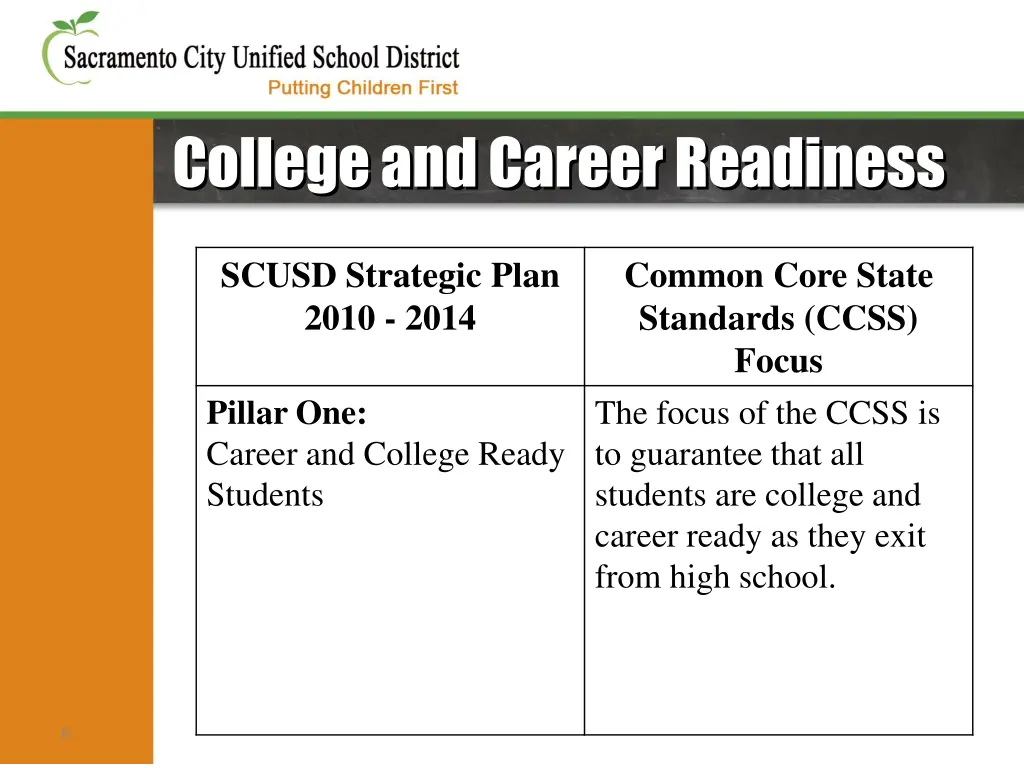
College and Career Readiness SCUSD Strategic Plan 2010 - 2014 Common Core State Standards (CCSS) Focus The focus of the CCSS is to guarantee that all students are college and career ready as they exit from high school. Pillar One: Career and College Ready Students 6
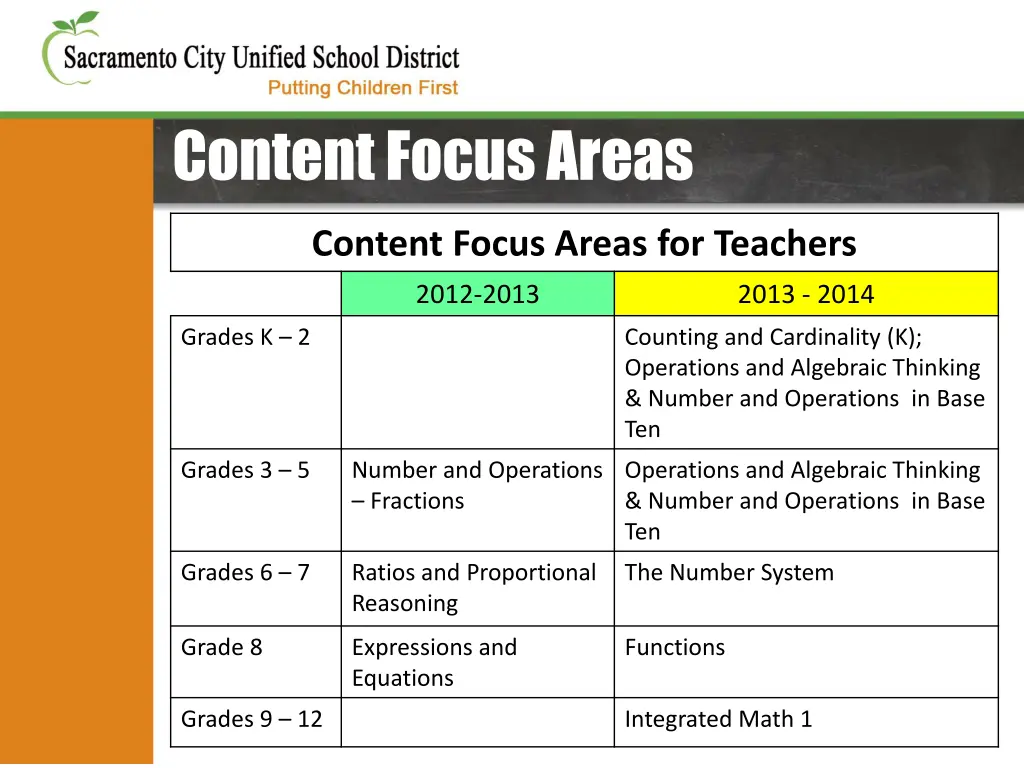
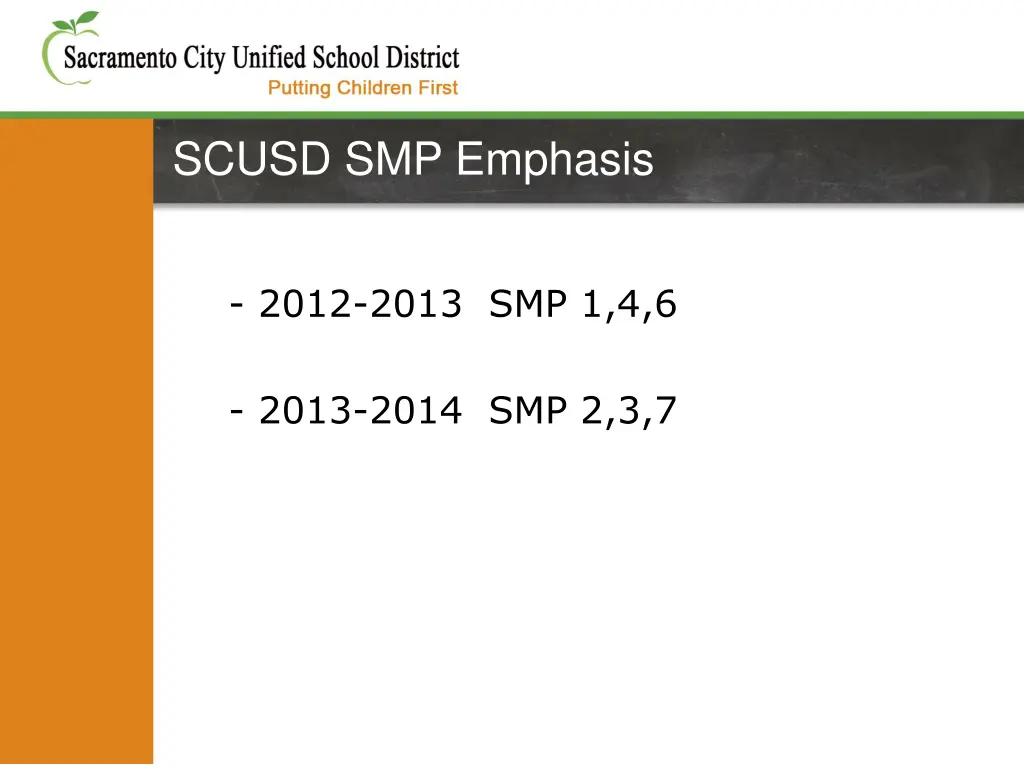
Content Focus Areas Content Focus Areas for Teachers 2012-2013 2013 - 2014 Grades K 2 Counting and Cardinality (K); Operations and Algebraic Thinking & Number and Operations in Base Ten Grades 3 5 Number and Operations Fractions Operations and Algebraic Thinking & Number and Operations in Base Ten Grades 6 7 Ratios and Proportional Reasoning The Number System Grade 8 Expressions and Equations Functions Grades 9 12 Integrated Math 1
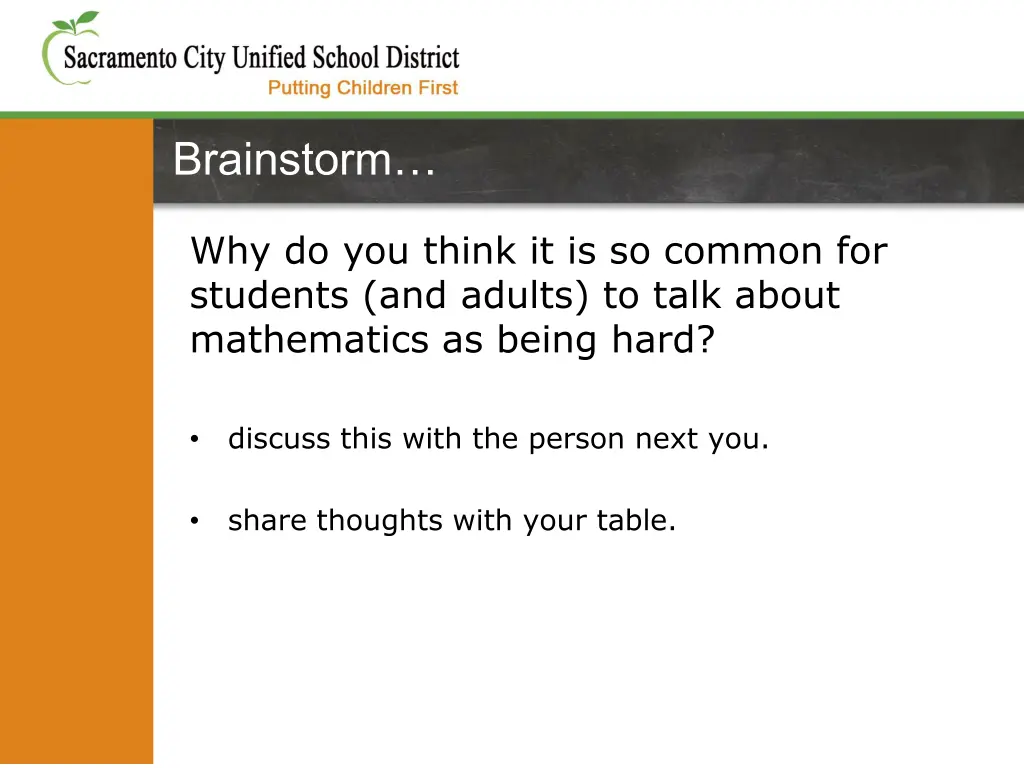
Brainstorm Why do you think it is so common for students (and adults) to talk about mathematics as being hard? discuss this with the person next you. share thoughts with your table.
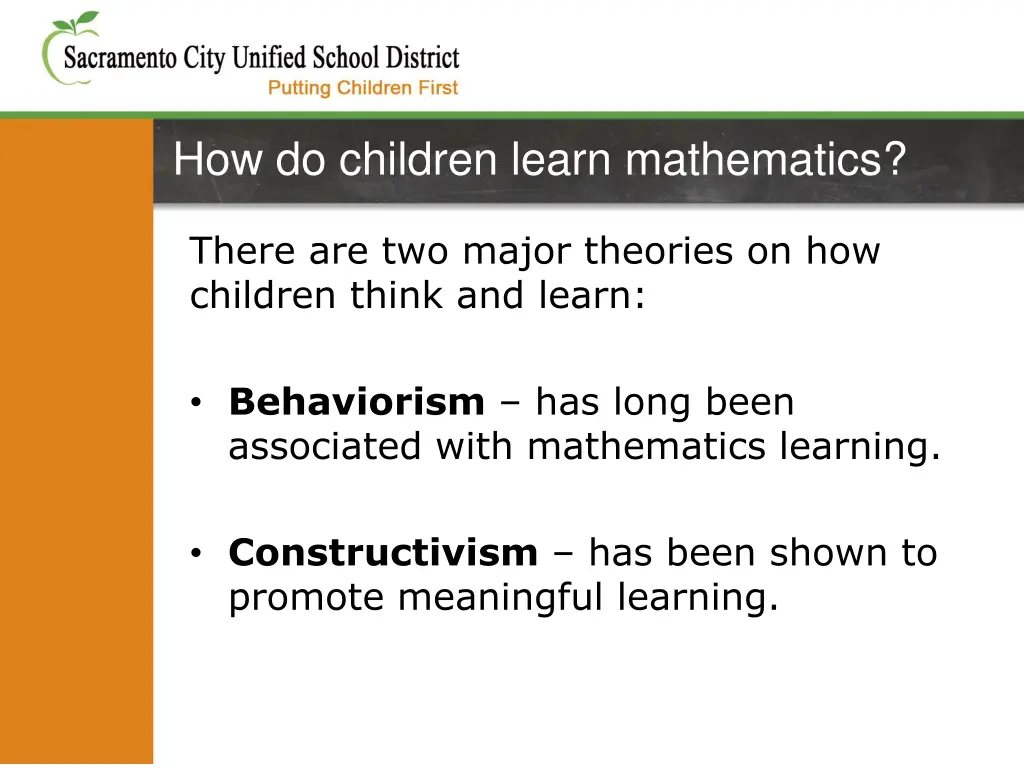
How do children learn mathematics? There are two major theories on how children think and learn: Behaviorism has long been associated with mathematics learning. Constructivism has been shown to promote meaningful learning.
Behaviorism Has roots in stimulus response and conditioned learning. Asserts that behavior can be shaped through rewards and punishment. Focus on low level thinking, not mathematical thinking.
Behaviorism Behaviorism has had a significant impact on mathematics teaching and learning: Students are shown algorithms. Mathematical relationships are illustrated in textbooks. Produces mastery of specific objectives but lacks critical connections that make knowledge meaningful and useful
Constructivism Constructivism advocates that: Knowledge is not passively received, but actively constructed by the learner. The learner uses prior knowledge to construct new meaning (Piaget). Learning is a social process (Vygotsky)
What is your Educational Platform? Think back to your list of top 5 things that support elementary students to learn mathematics. Is there evidence of Behaviorism and/or Constructivism on your list?
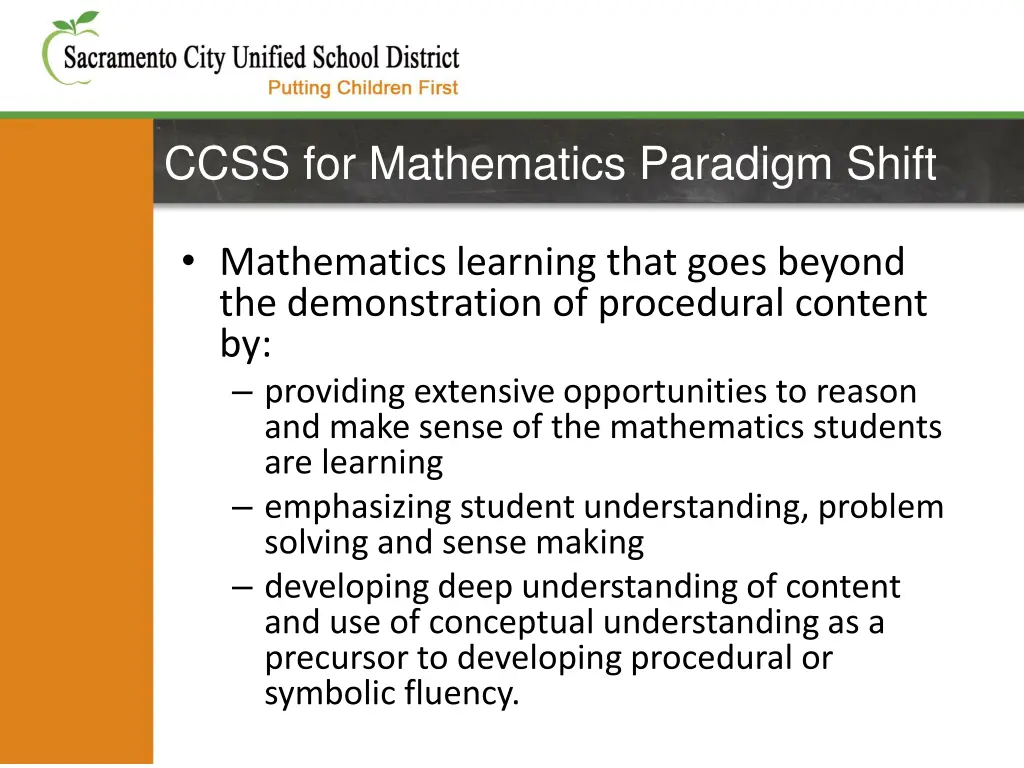
CCSS for Mathematics Paradigm Shift Mathematics learning that goes beyond the demonstration of procedural content by: providing extensive opportunities to reason and make sense of the mathematics students are learning emphasizing student understanding, problem solving and sense making developing deep understanding of content and use of conceptual understanding as a precursor to developing procedural or symbolic fluency.
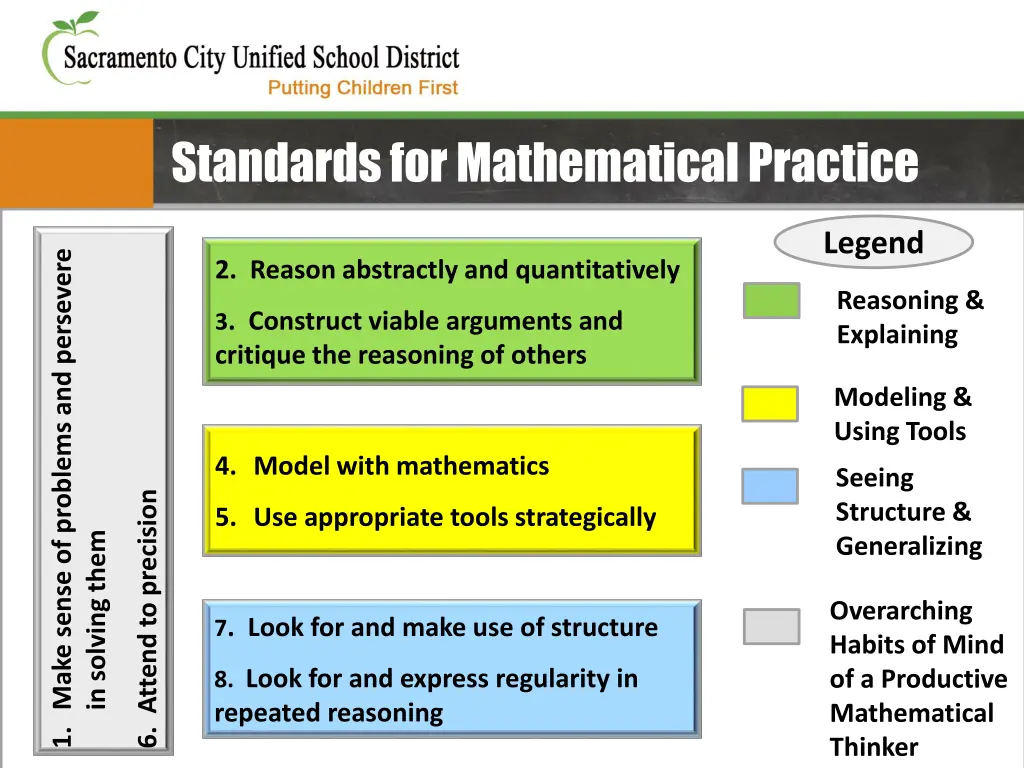
Standards for Mathematical Practice Legend 1. Make sense of problems and persevere 2. Reason abstractly and quantitatively Reasoning & Explaining 3. Construct viable arguments and critique the reasoning of others Modeling & Using Tools 4. Model with mathematics Seeing Structure & Generalizing L 6. Attend to precision 5. Use appropriate tools strategically in solving them Overarching Habits of Mind of a Productive Mathematical Thinker 7. Look for and make use of structure 8. Look for and express regularity in repeated reasoning
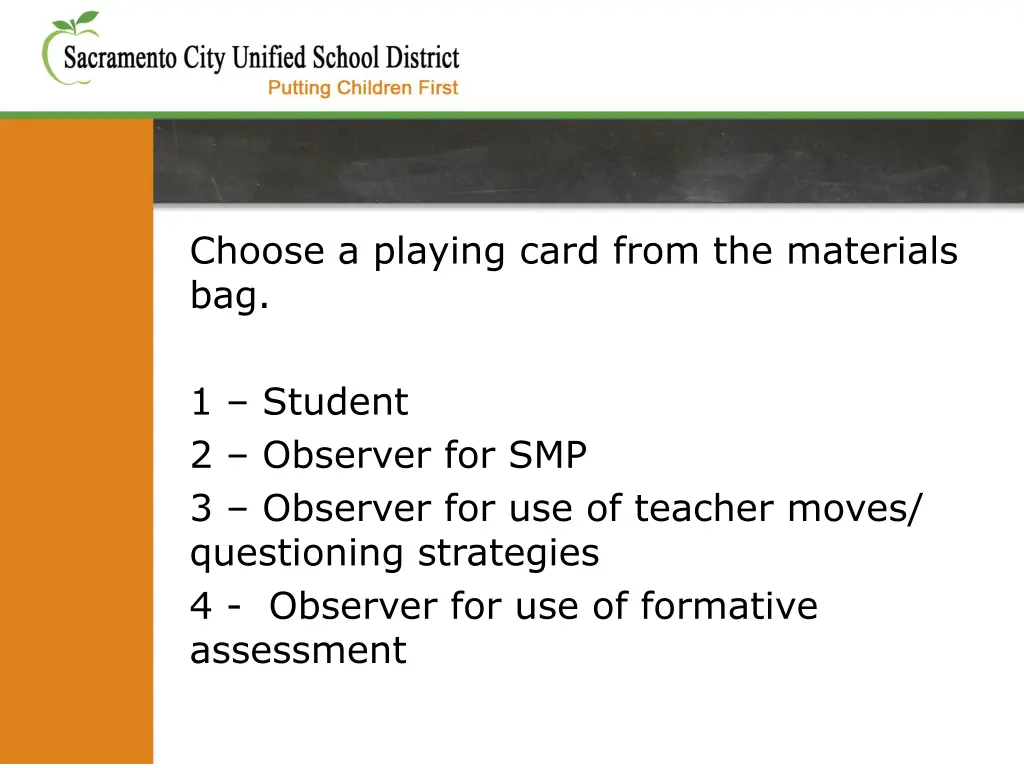
Choose a playing card from the materials bag. 1 Student 2 Observer for SMP 3 Observer for use of teacher moves/ questioning strategies 4 - Observer for use of formative assessment
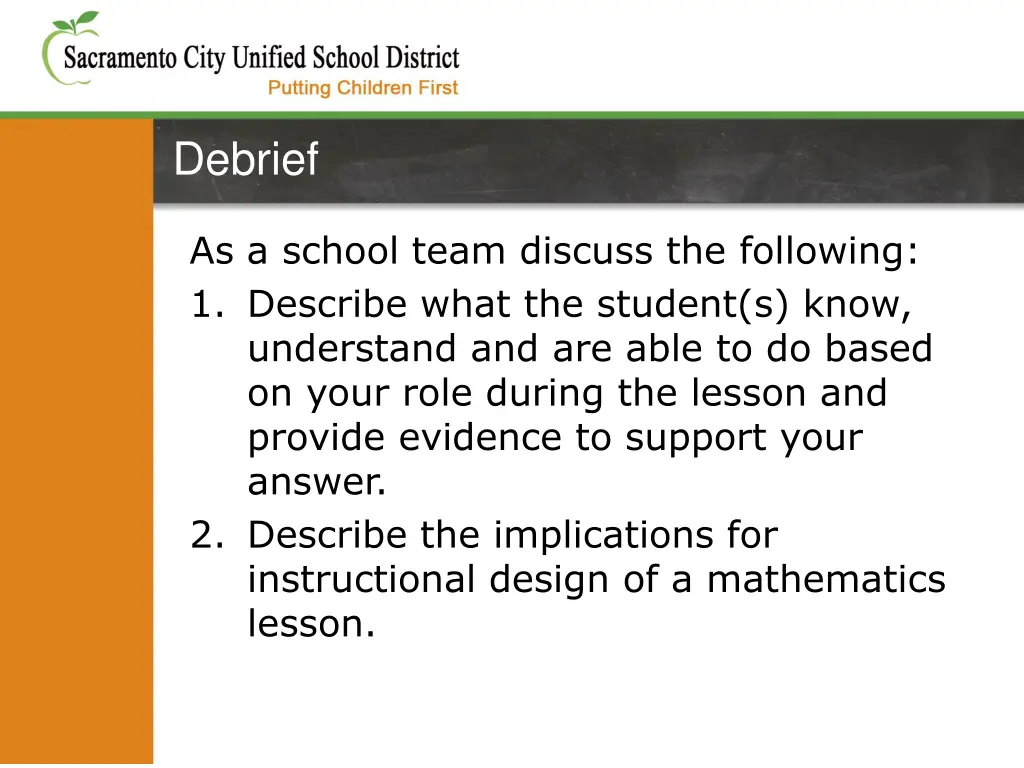
Debrief As a school team discuss the following: 1. Describe what the student(s) know, understand and are able to do based on your role during the lesson and provide evidence to support your answer. 2. Describe the implications for instructional design of a mathematics lesson.
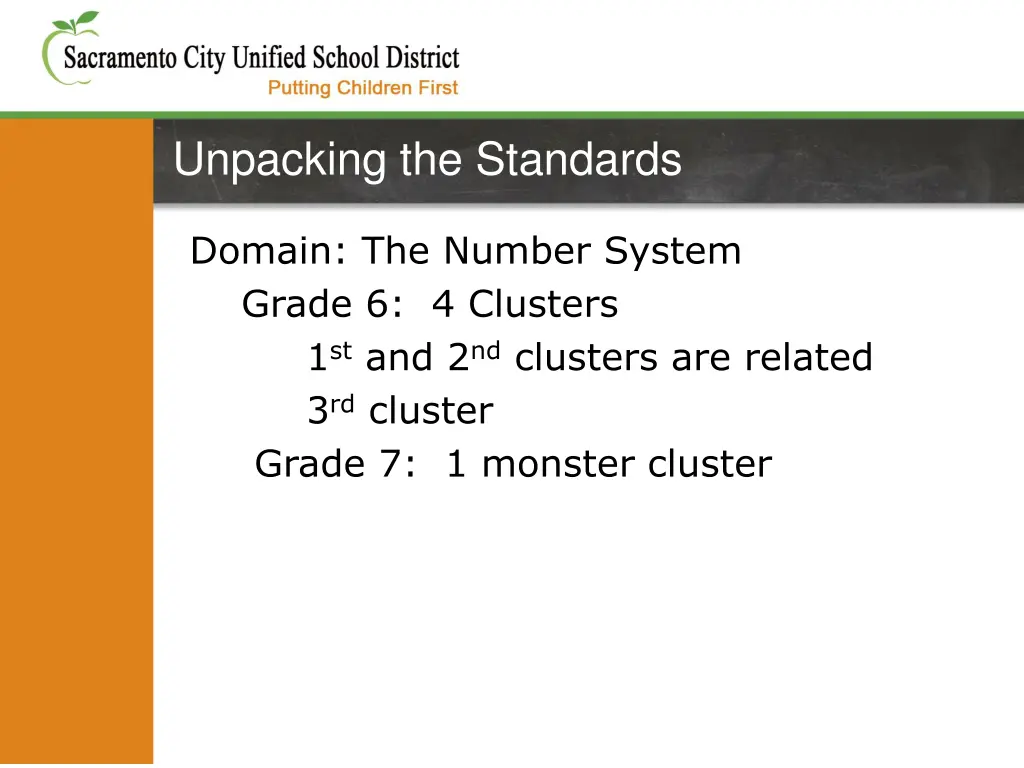
Unpacking the Standards Domain: The Number System Grade 6: 4 Clusters 1st and 2nd clusters are related 3rd cluster Grade 7: 1 monster cluster
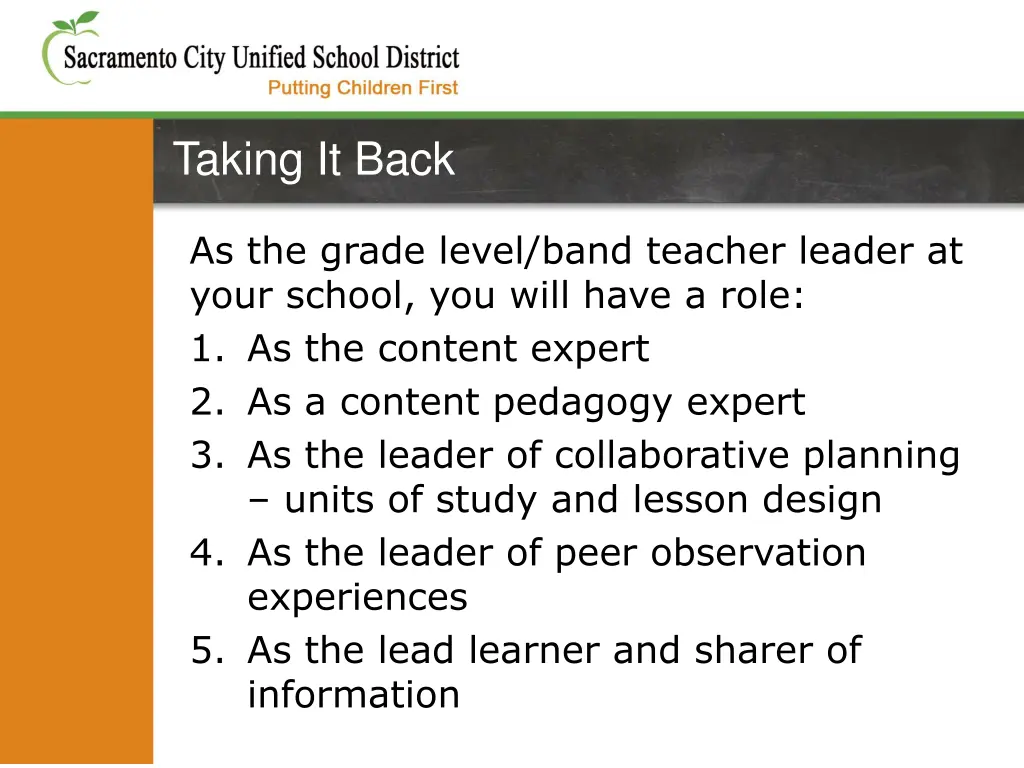
Taking It Back As the grade level/band teacher leader at your school, you will have a role: 1. As the content expert 2. As a content pedagogy expert 3. As the leader of collaborative planning units of study and lesson design 4. As the leader of peer observation experiences 5. As the lead learner and sharer of information
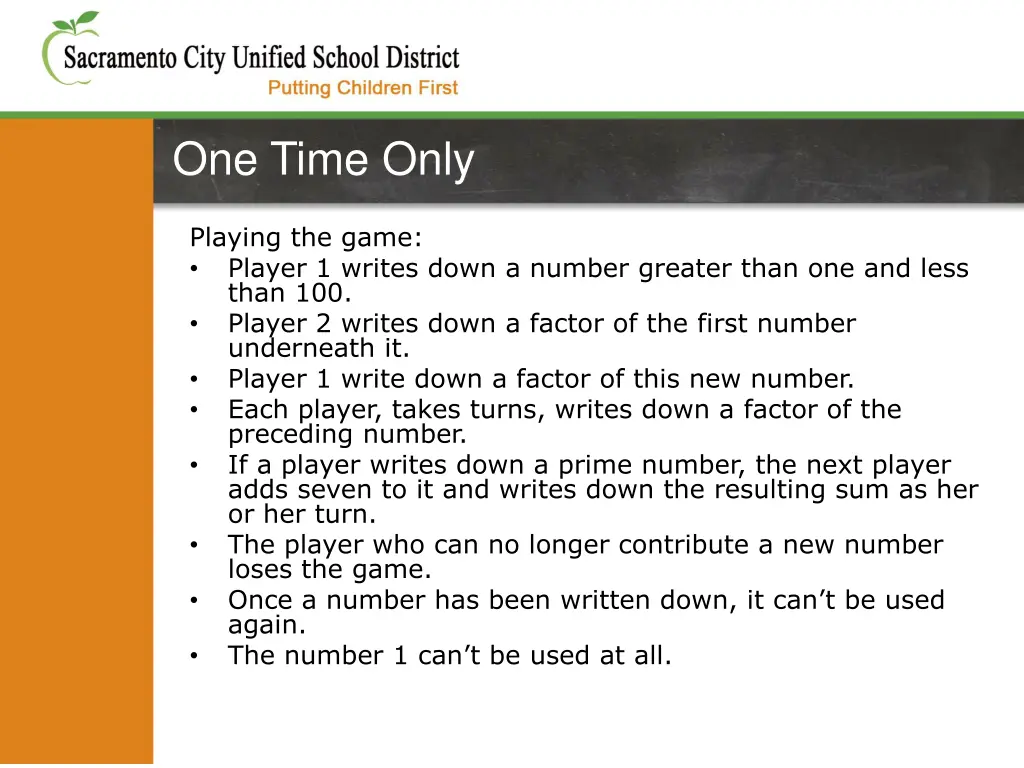
One Time Only Playing the game: Player 1 writes down a number greater than one and less than 100. Player 2 writes down a factor of the first number underneath it. Player 1 write down a factor of this new number. Each player, takes turns, writes down a factor of the preceding number. If a player writes down a prime number, the next player adds seven to it and writes down the resulting sum as her or her turn. The player who can no longer contribute a new number loses the game. Once a number has been written down, it can t be used again. The number 1 can t be used at all.
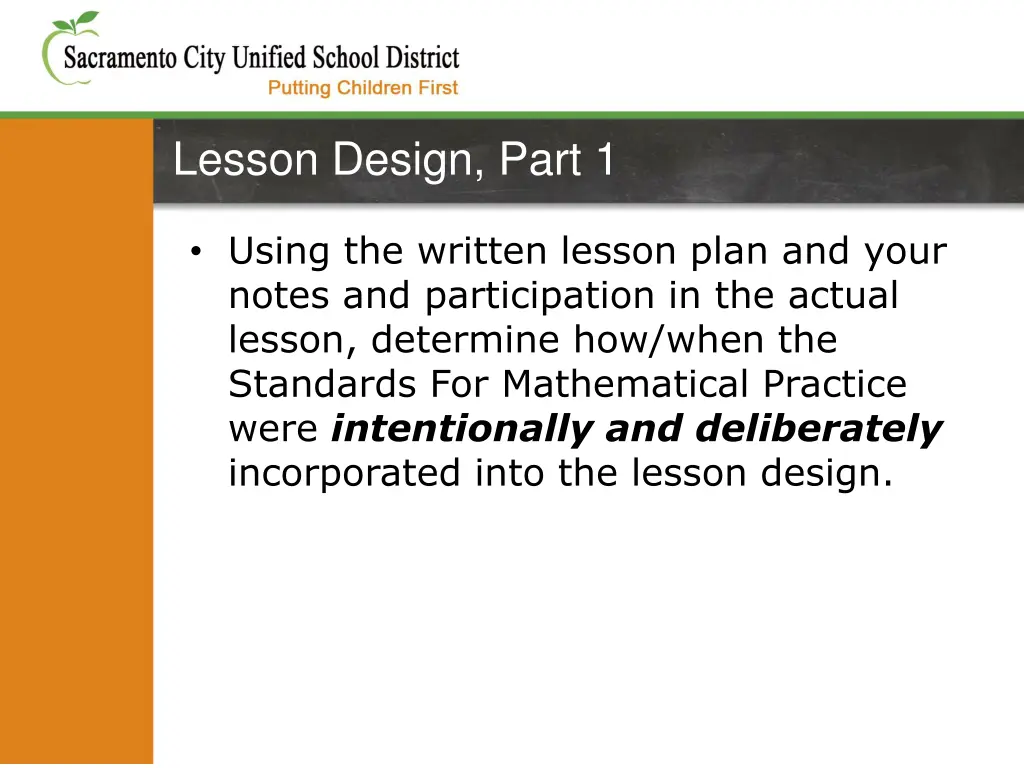
Lesson Design, Part 1 Using the written lesson plan and your notes and participation in the actual lesson, determine how/when the Standards For Mathematical Practice were intentionally and deliberately incorporated into the lesson design.
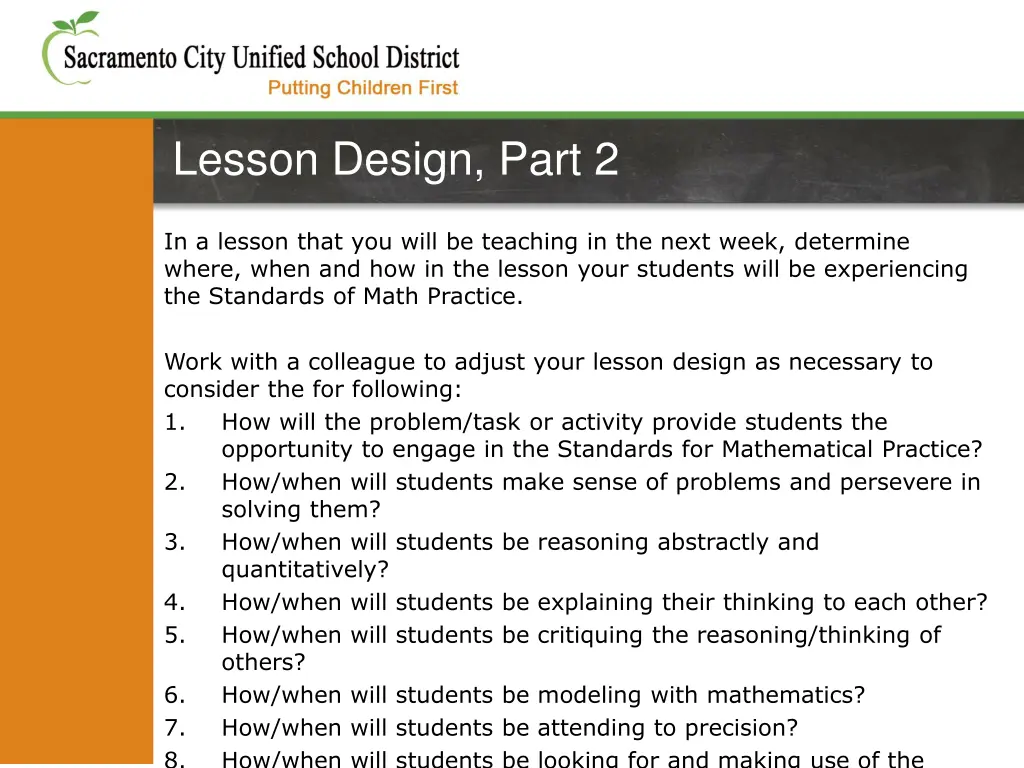
Lesson Design, Part 2 In a lesson that you will be teaching in the next week, determine where, when and how in the lesson your students will be experiencing the Standards of Math Practice. Work with a colleague to adjust your lesson design as necessary to consider the for following: 1. How will the problem/task or activity provide students the opportunity to engage in the Standards for Mathematical Practice? 2. How/when will students make sense of problems and persevere in solving them? 3. How/when will students be reasoning abstractly and quantitatively? 4. How/when will students be explaining their thinking to each other? 5. How/when will students be critiquing the reasoning/thinking of others? 6. How/when will students be modeling with mathematics? 7. How/when will students be attending to precision? 8. How/when will students be looking for and making use of the
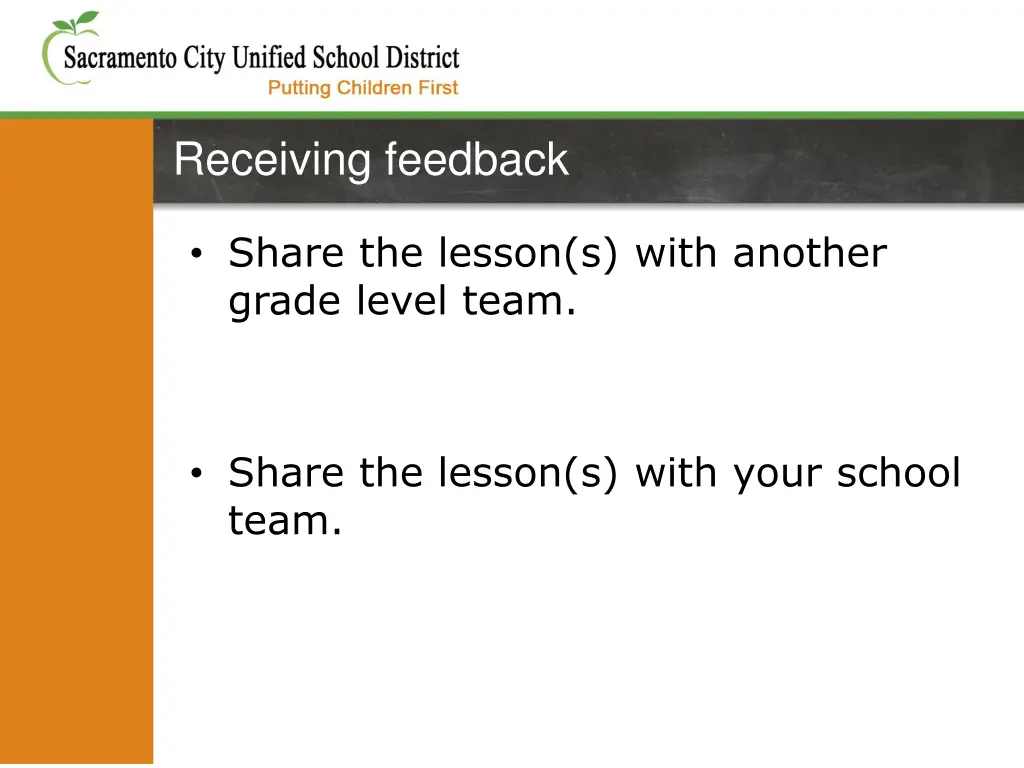
Receiving feedback Share the lesson(s) with another grade level team. Share the lesson(s) with your school team.
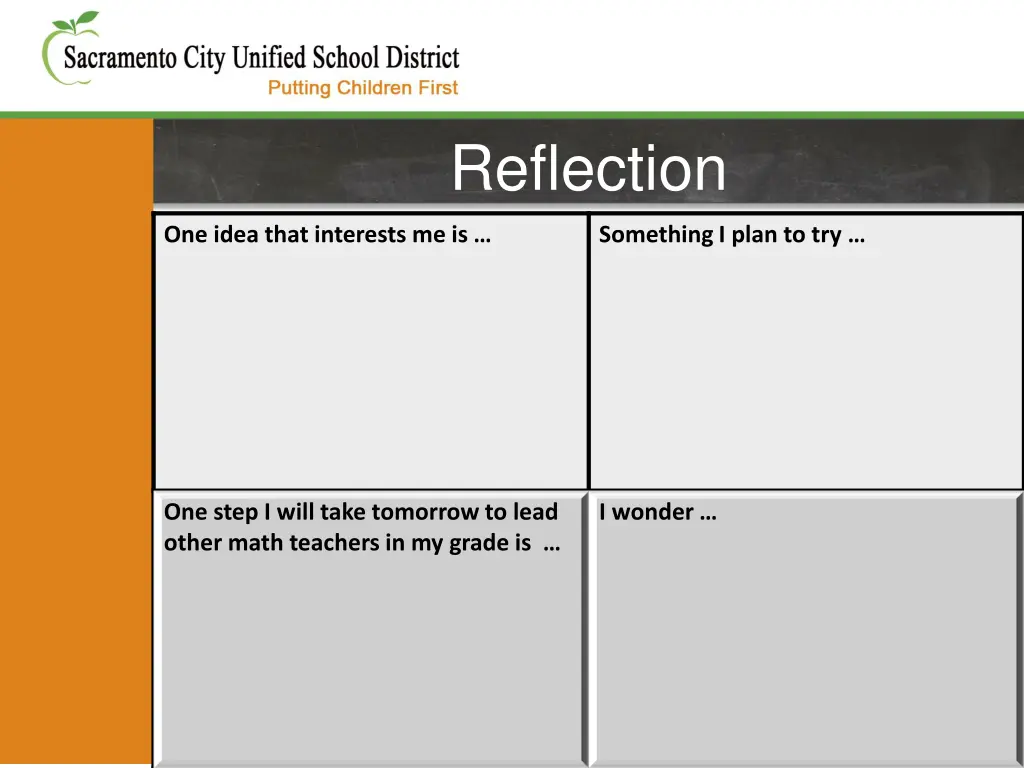
Reflection One idea that interests me is Something I plan to try One step I will take tomorrow to lead other math teachers in my grade is I wonder
Professional development works, if it works at all, by influencing what teachers do . . . Instructional Rounds in Education, pg. 24.
Next Steps - Examining student work - Developing a unit of study - Lesson study