Discover the world of MOOCs (Massive Open Online Courses) - what they are, how they work, who's involved, why they matter, and where they're headed. Dive into this revolutionary form of education that's reshaping the learning landscape globally.
Please find below an Image/Link to download the presentation.
The content on the website is provided AS IS for your information and personal use only. It may not be sold, licensed, or shared on other websites without obtaining consent from the author. If you encounter any issues during the download, it is possible that the publisher has removed the file from their server.
You are allowed to download the files provided on this website for personal or commercial use, subject to the condition that they are used lawfully. All files are the property of their respective owners.
The content on the website is provided AS IS for your information and personal use only. It may not be sold, licensed, or shared on other websites without obtaining consent from the author.
E N D
Presentation Transcript
MOOCs Scott Stevens and Susan Strayer This work is licensed under a Creative CommonsAttribution-ShareAlike 4.0 International License.
MOOCs Who has ever heard of MOOCs? Raise your hand! Who has ever taken a MOOC? Raise your hand!
What is it? A MOOC is a model of educational delivery that is, to varying degrees, massive, with theoretically no limit to enrollment; open, allowing anyone to participate, usually at no cost; online, with learning activities typically taking place over the web; and a course, structured around a set of learning goals in a defined area of study.
How does it work? Most MOOCs are structured similar to traditional online higher education courses: Syllabus Course content typically consists of readings, assignments, and lectures, which are often short (6 12 minutes) microlectures. Students watch the lectures, read assigned material, participate in online discussions and forums, and complete quizzes and tests on the course material.
Who is doing it? MOOCs are typically provided by higher education institutions, and often in partnership with non-profit and for-profit organizations. Consumers are students who take part for a variety of reasons: Informal learning Competency in a particular area Credit towards a formal degree or certification
Why is it significant? Disruptive ideas about the sources and processes of education Major changes to the financial model of higher education Development and availability of technologies including consumer hardware, widespread network access, and educational applications. Growing interest in open resources
Where is it going? MOOCs will continue to hold higher educations main interest for at least the short term. Georgia Institute of Technology is partnering with AT&T and Udacity to create low cost master s-degrees in computer science. Other companies are expanding resources and offering free translations of course lectures to an international audience.
Discussion Based on what you know now One group comprise a list of potential advantages of MOOCs potential disadvantages of MOOCs
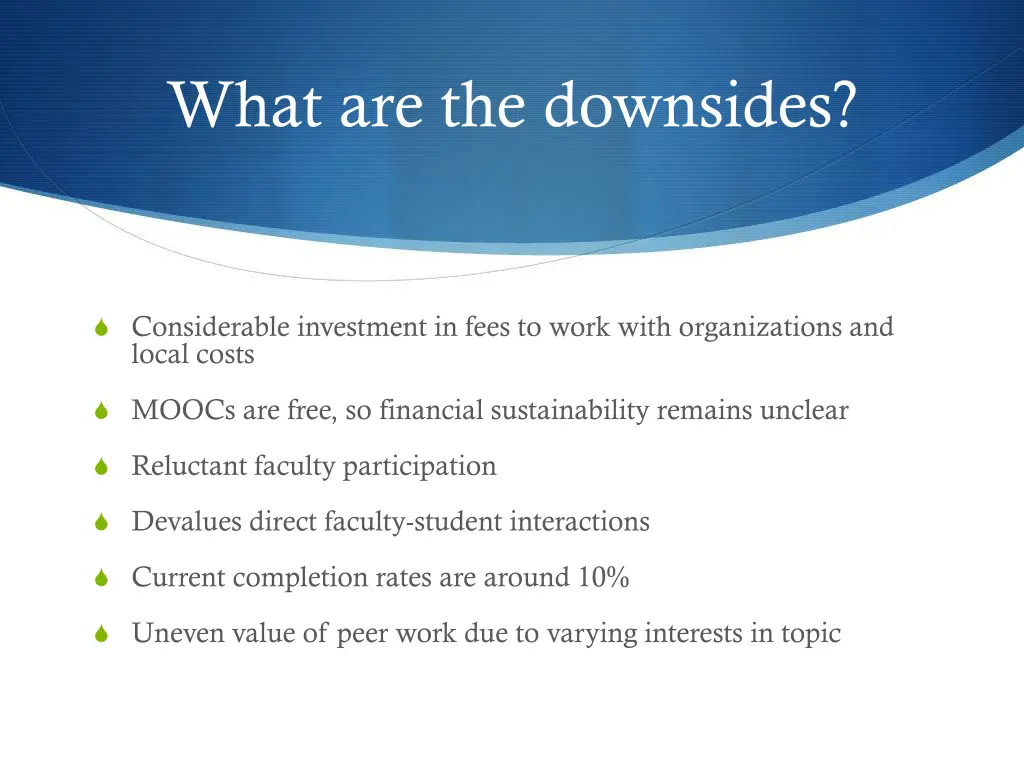
What are the downsides? Considerable investment in fees to work with organizations and local costs MOOCs are free, so financial sustainability remains unclear Reluctant faculty participation Devalues direct faculty-student interactions Current completion rates are around 10% Uneven value of peer work due to varying interests in topic
What are the implications for teaching & learning? Global access to higher education Makes learning a lifelong endeavor Creates a network of institutions, colleges, and universities Innovation lab for best practices for other online, blended, and face-to-face settings raise important questions and spark essential conversations about curriculum design, accreditation, what constitutes a valid learning experience, and who has access to higher education.
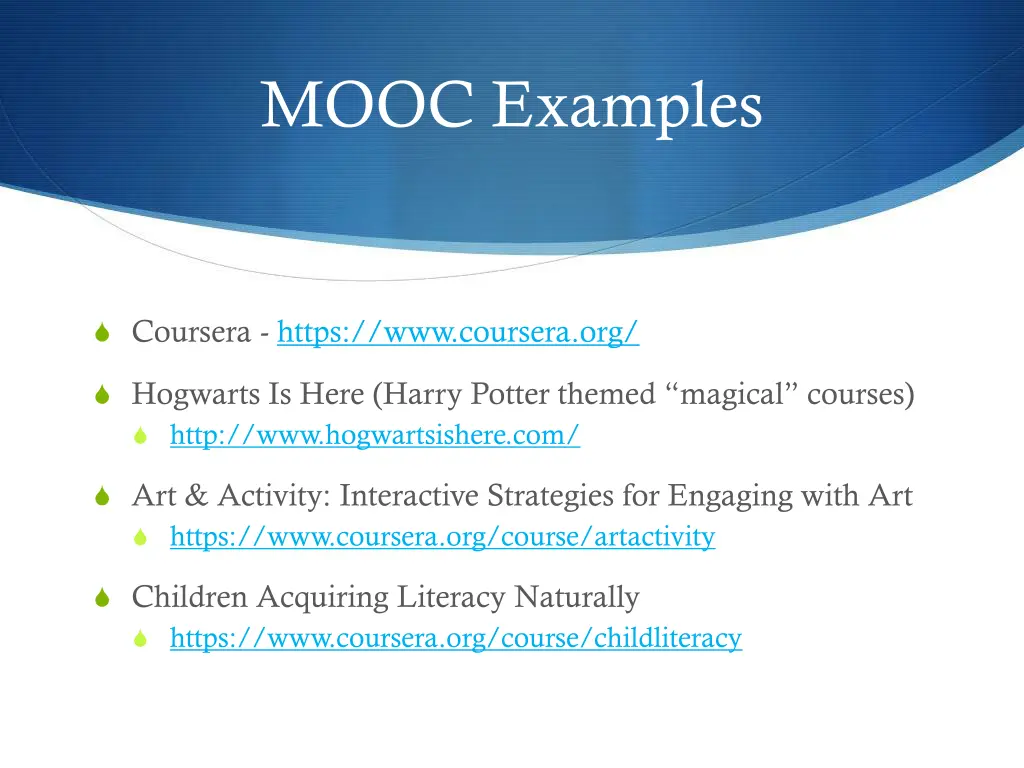
MOOC Examples Coursera - https://www.coursera.org/ Hogwarts Is Here (Harry Potter themed magical courses) http://www.hogwartsishere.com/ Art & Activity: Interactive Strategies for Engaging with Art https://www.coursera.org/course/artactivity Children Acquiring Literacy Naturally https://www.coursera.org/course/childliteracy
Credits Educause. ELI, 7 Things You Should Know About MOOCs. Educause/ELI. 2013. Web. 10 July 2014. Eudcause. MOOCs and Beyond. 2013. Web. 10 July 2014. <http://vimeo.com/70811271>.