Exploring Organic Light Emitting Diode (OLED) Technology
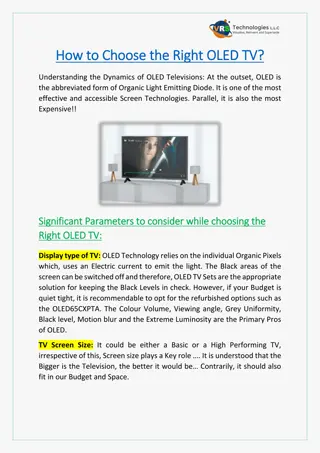
Uncover the world of OLED technology, its history, features, fabrication process, advantages, disadvantages, and applications. Understand the concept of OLED and its emergence as a prominent display technology for various devices.

Download Presentation

Please find below an Image/Link to download the presentation.
The content on the website is provided AS IS for your information and personal use only. It may not be sold, licensed, or shared on other websites without obtaining consent from the author. If you encounter any issues during the download, it is possible that the publisher has removed the file from their server.
You are allowed to download the files provided on this website for personal or commercial use, subject to the condition that they are used lawfully. All files are the property of their respective owners.
The content on the website is provided AS IS for your information and personal use only. It may not be sold, licensed, or shared on other websites without obtaining consent from the author.
E N D
Presentation Transcript
www.studymafia.org Seminar On OLED Technology Submitted To: www.studymafia.org Submitted By: www.studymafia.org
Content Introduction What is an OLED? History Features Structure of OLED(Figure) OLED Fabrication OLED Deposition Types of OLED OLED Advantages OLED Disadvantages Applications Conclusion References
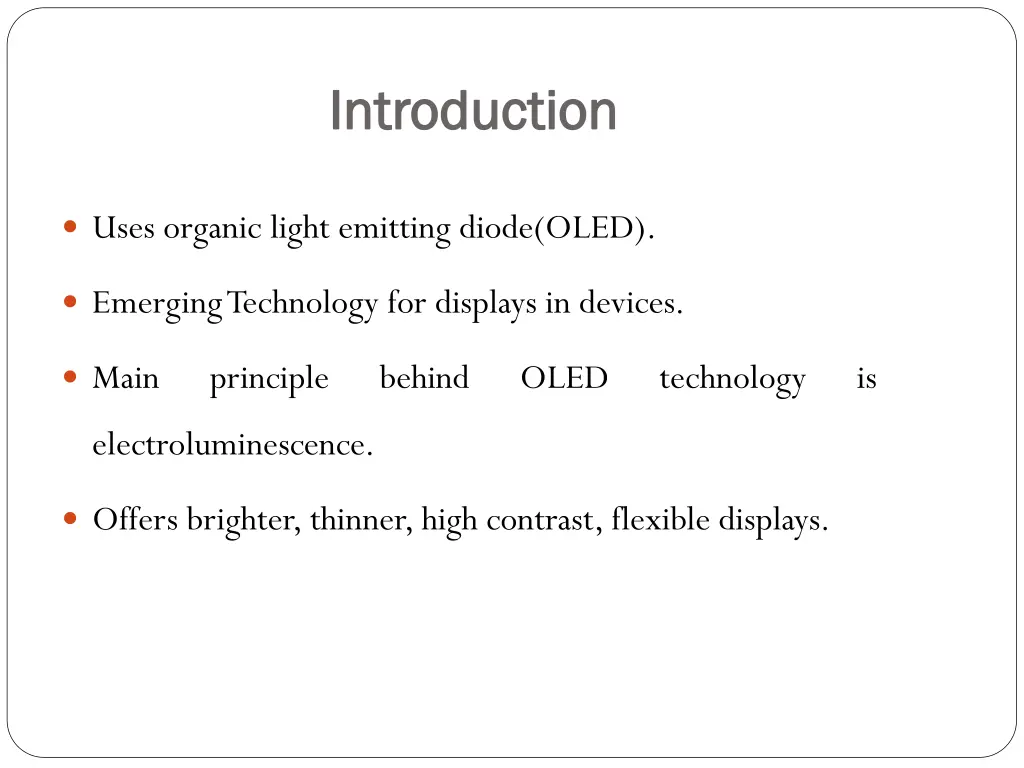
Introduction Introduction Uses organic light emitting diode(OLED). Emerging Technology for displays in devices. Main principle behind OLED technology is electroluminescence. Offers brighter, thinner, high contrast, flexible displays.
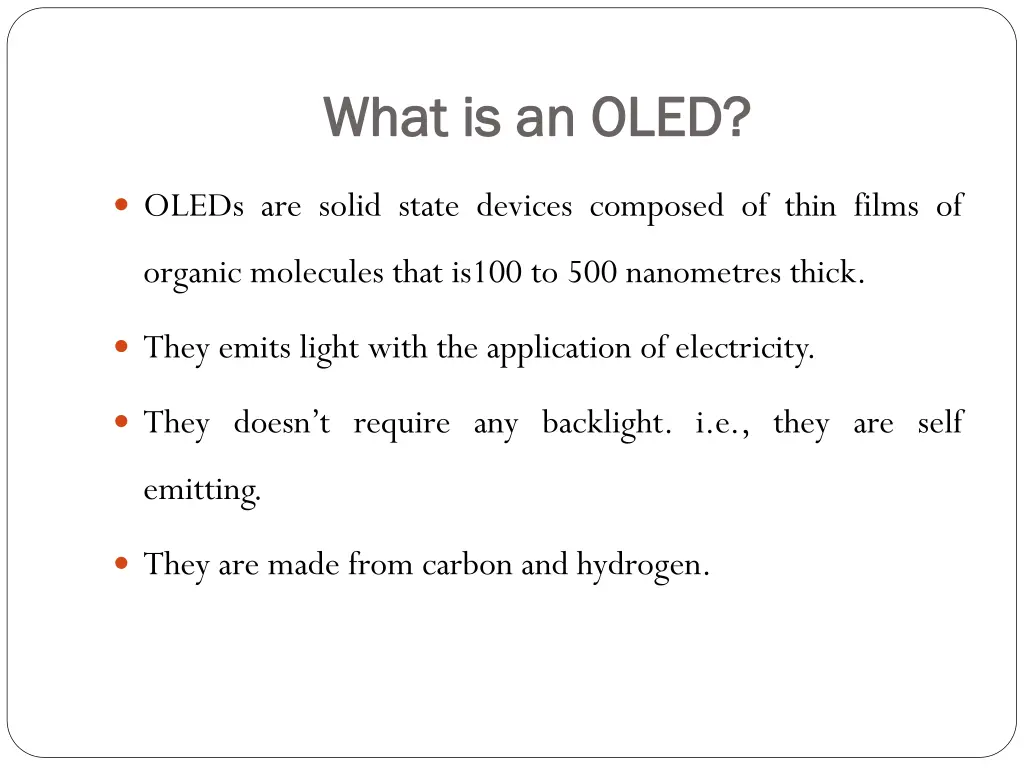
What is an OLED? What is an OLED? OLEDs are solid state devices composed of thin films of organic molecules that is100 to 500 nanometres thick. They emits light with the application of electricity. They doesn t require any backlight. i.e., they are self emitting. They are made from carbon and hydrogen.
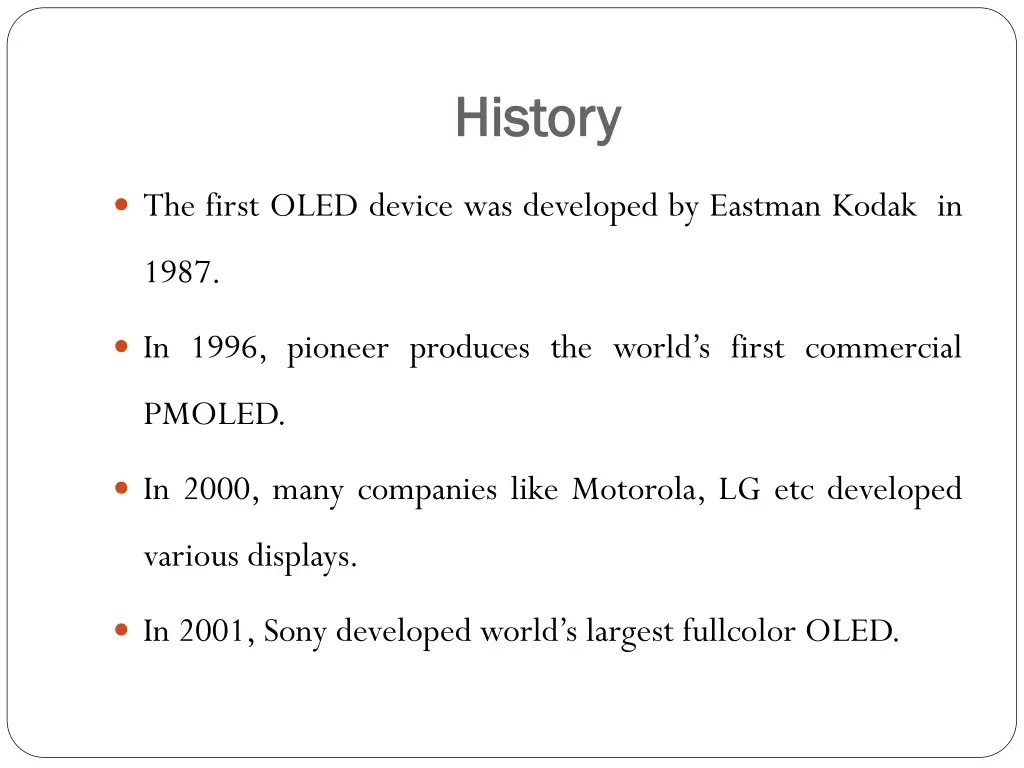
History History The first OLED device was developed by Eastman Kodak in 1987. In 1996, pioneer produces the world s first commercial PMOLED. In 2000, many companies like Motorola, LG etc developed various displays. In 2001, Sony developed world s largest fullcolor OLED.
History (contd.) History (contd.) In 2002, approximately 3.5 million passive matrix OLED sub-displays were sold, and over 10 million were sold in 2003. In 2010 and 2011, many companies announced AMOLED displays. Many developments had take place in the year 2012.
Features Features Flexibility. Emissive Technology. Light weight and thin. Low power consumption. High contrast, brighter and perfect display from all angles.
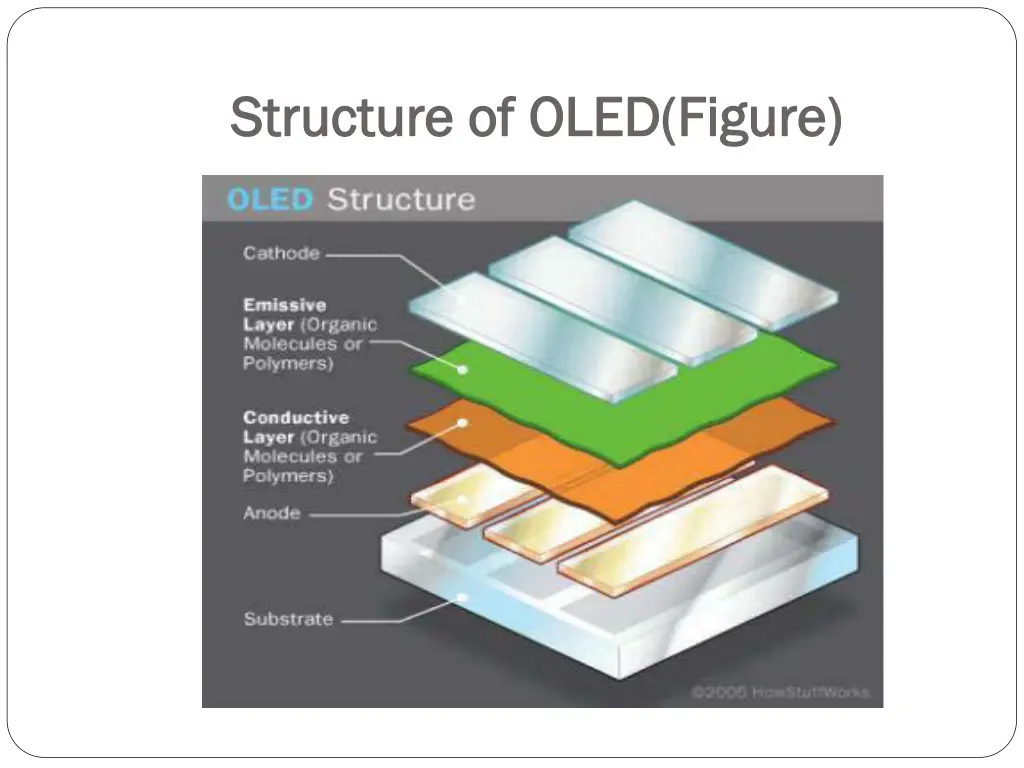
Structure of OLED(Figure) Structure of OLED(Figure)
OLED Fabrication OLED Fabrication Substrate preparation. Device deposition Deposit and pattern anode. Pattern organic layers. Vacuum deposit and pattern cathode. Encapsulation. Also involves making backplane.
OLED Deposition OLED Deposition Organic layers can be applied to the substrate using the following methods. - Evaporation and shadow masking. - Inkjet printing. - Organic vapor phase deposition.
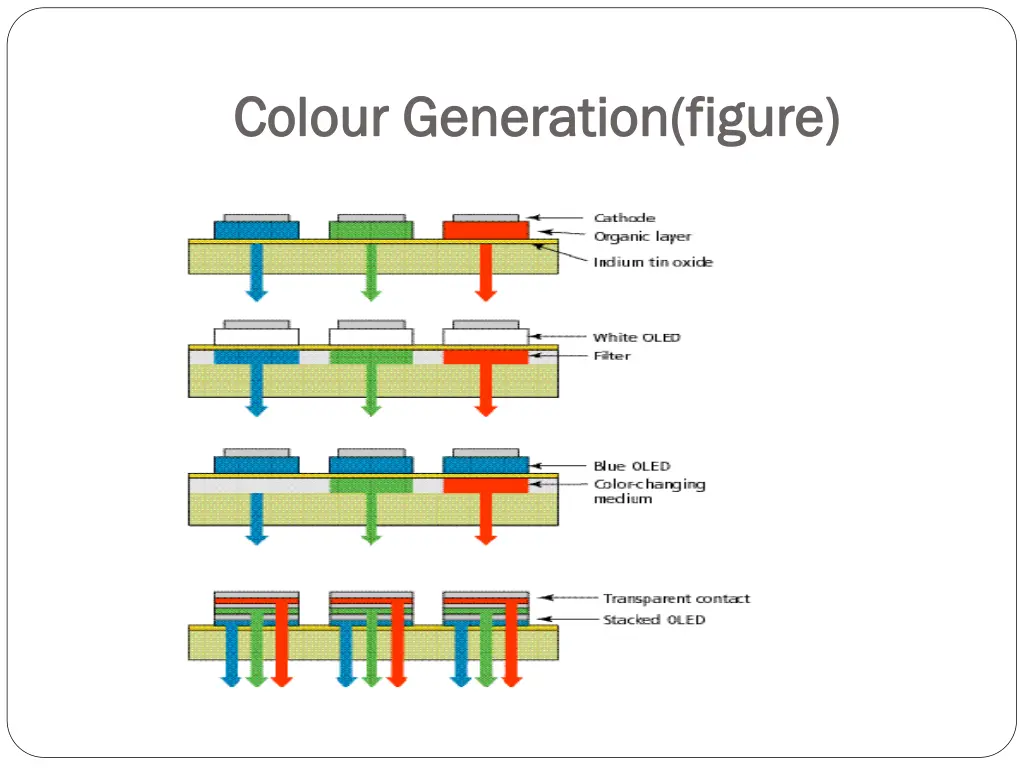
Colour Generation Colour Generation Different approaches for fabricating red, green and blue pixels. - Red, green and blue individual pixels. - White emitter and colour filters. - Blue emitter and colour converters. - Stacked OLED
Colour Generation(figure) Colour Generation(figure)
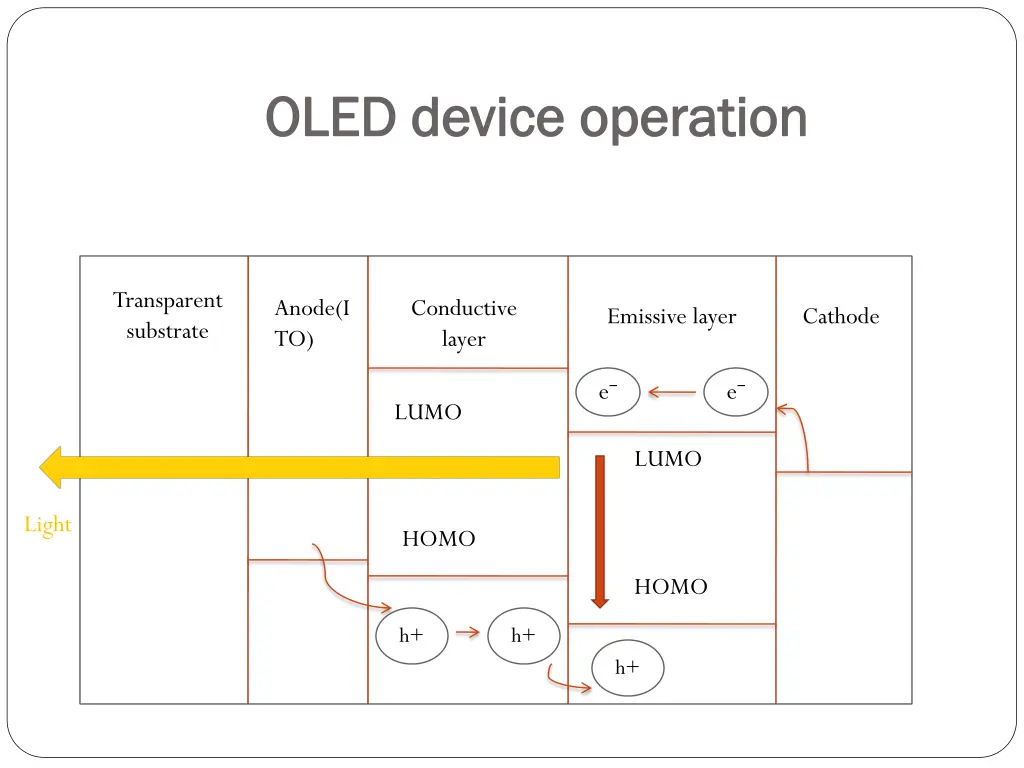
Working Principle Working Principle A voltage is applied across the anode and cathode. Current flows from cathode to anode through the organic layers. Electrons flow to emissive layer from the cathode. Electrons are removed from conductive layer leaving holes. Holes jump into emissive layer . Electron and hole combine and light emitted.
OLED device operation OLED device operation Transparent substrate Anode(I TO) Conductive layer Emissive layer Cathode e e LUMO LUMO Light HOMO HOMO h+ h+ h+
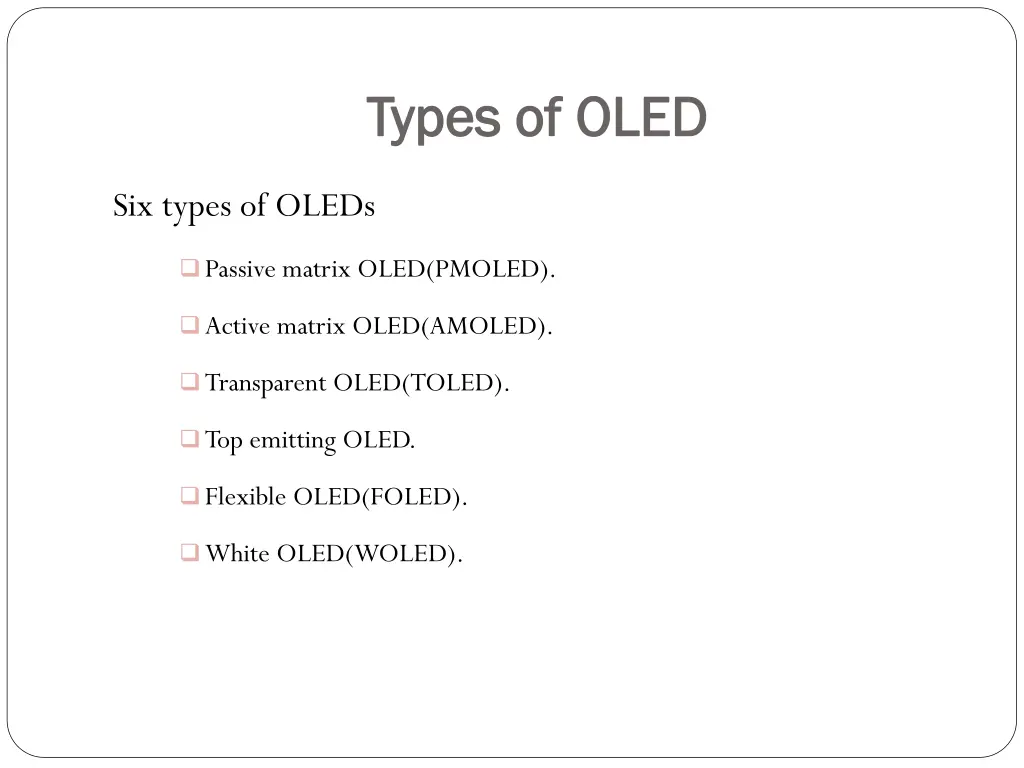
Types of OLED Types of OLED Six types of OLEDs Passive matrix OLED(PMOLED). Active matrix OLED(AMOLED). Transparent OLED(TOLED). Top emitting OLED. Flexible OLED(FOLED). White OLED(WOLED).
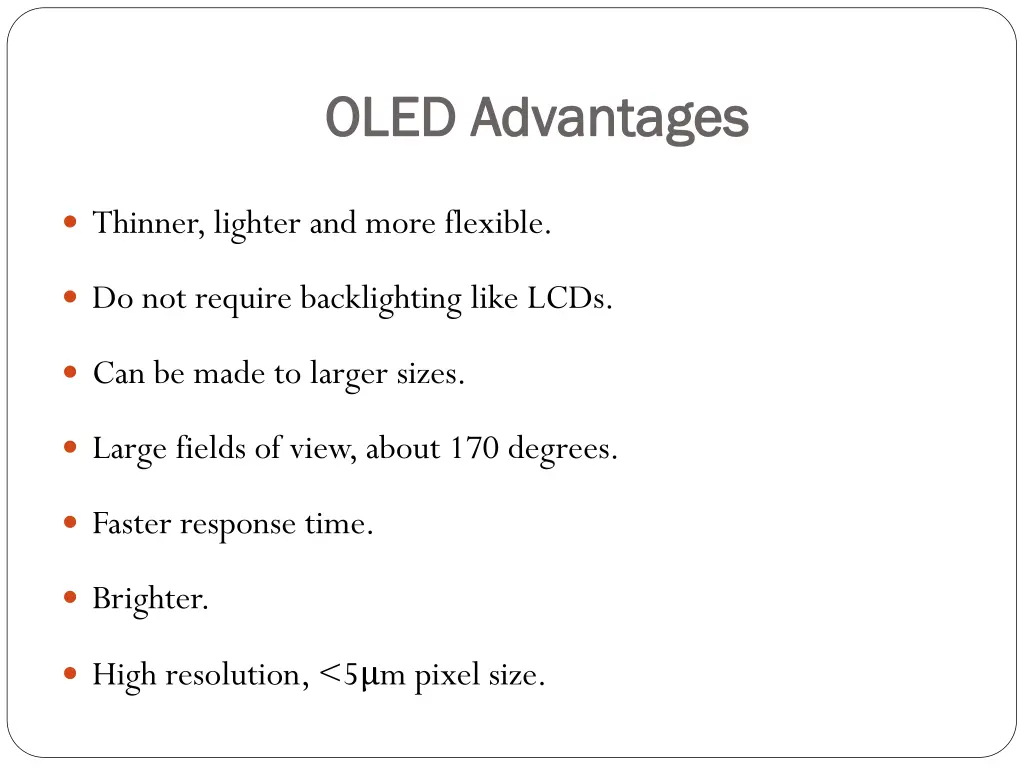
OLED Advantages OLED Advantages Thinner, lighter and more flexible. Do not require backlighting like LCDs. Can be made to larger sizes. Large fields of view, about 170 degrees. Faster response time. Brighter. High resolution, <5 m pixel size.
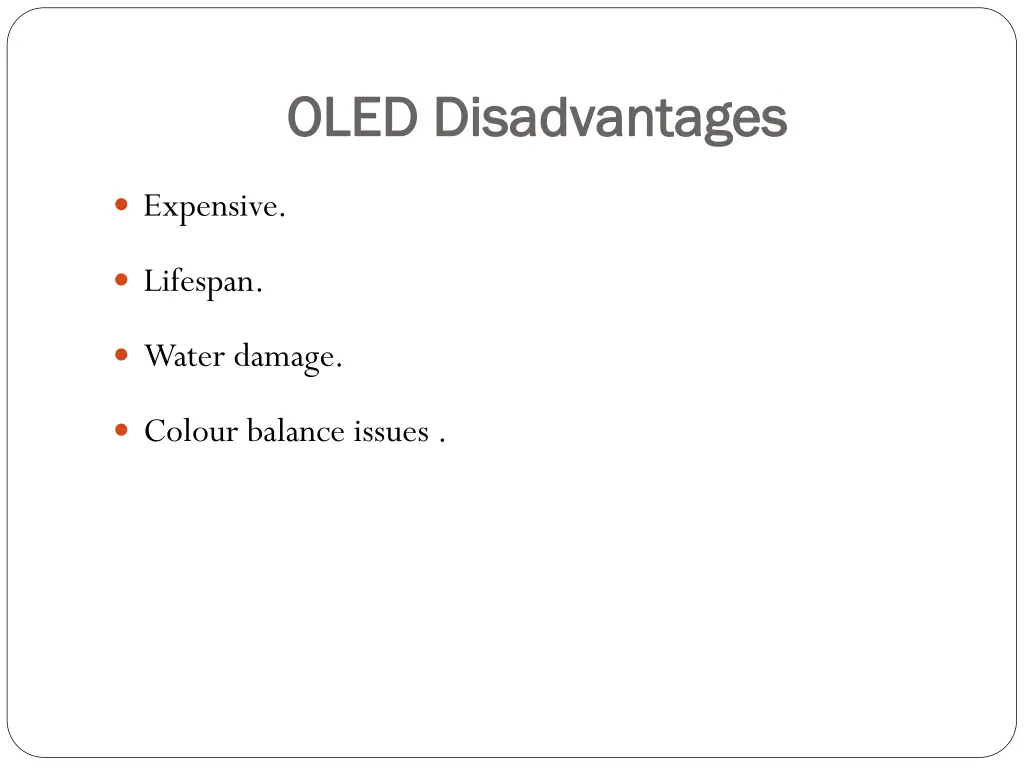
OLED Disadvantages OLED Disadvantages Expensive. Lifespan. Water damage. Colour balance issues .
Applications Applications Major applications of OLED technology are OLED TV. Mobile phones with OLED screens. Rolltop Laptop.
Conclusion Conclusion Organic Light Emitting Diodes are evolving as the next generation displays. As OLED display technology matures, it will be better able to improve upon certain existing limitations of LCD including high power consumption limited viewing angles poor contrast ratios.
References www.google.com www.wikipedia.com www.studymafia.org