Exploring Rational Choice Model in UK Voting Behavior Analysis
Dive into the relevance of the rational choice model versus other models in explaining voting behavior in the UK today, touching on key concepts like self-interest voting, economic factors, and contrasting with sociological perspectives.

Download Presentation

Please find below an Image/Link to download the presentation.
The content on the website is provided AS IS for your information and personal use only. It may not be sold, licensed, or shared on other websites without obtaining consent from the author. If you encounter any issues during the download, it is possible that the publisher has removed the file from their server.
You are allowed to download the files provided on this website for personal or commercial use, subject to the condition that they are used lawfully. All files are the property of their respective owners.
The content on the website is provided AS IS for your information and personal use only. It may not be sold, licensed, or shared on other websites without obtaining consent from the author.
E N D
Presentation Transcript
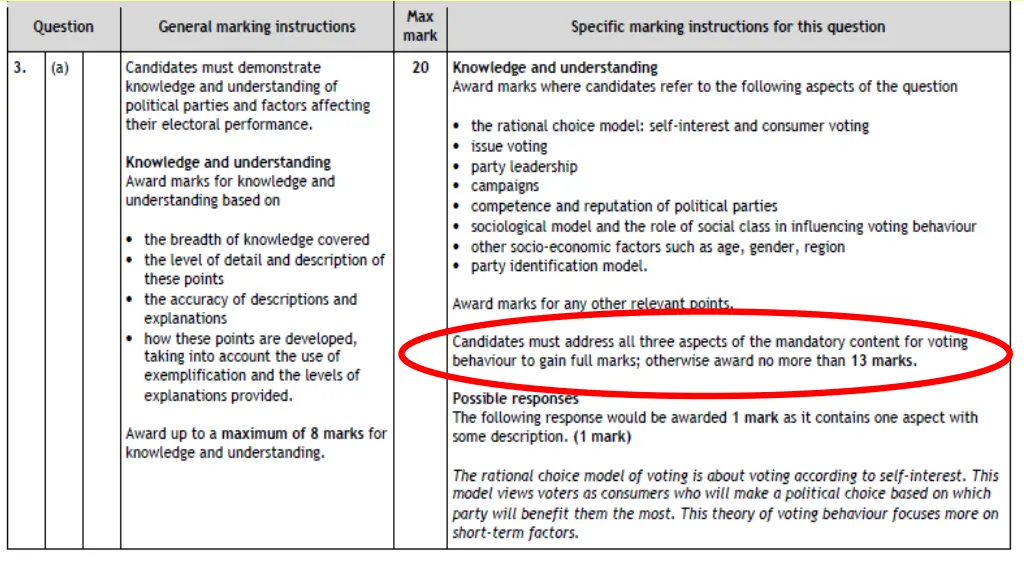
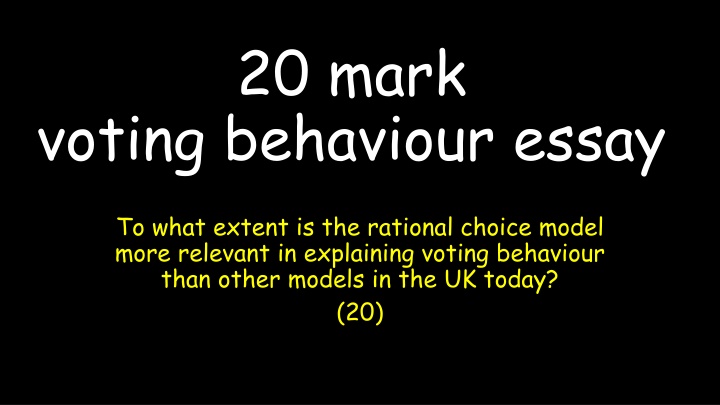
20 mark voting behaviour essay To what extent is the rational choice model more relevant in explaining voting behaviour than other models in the UK today? (20)
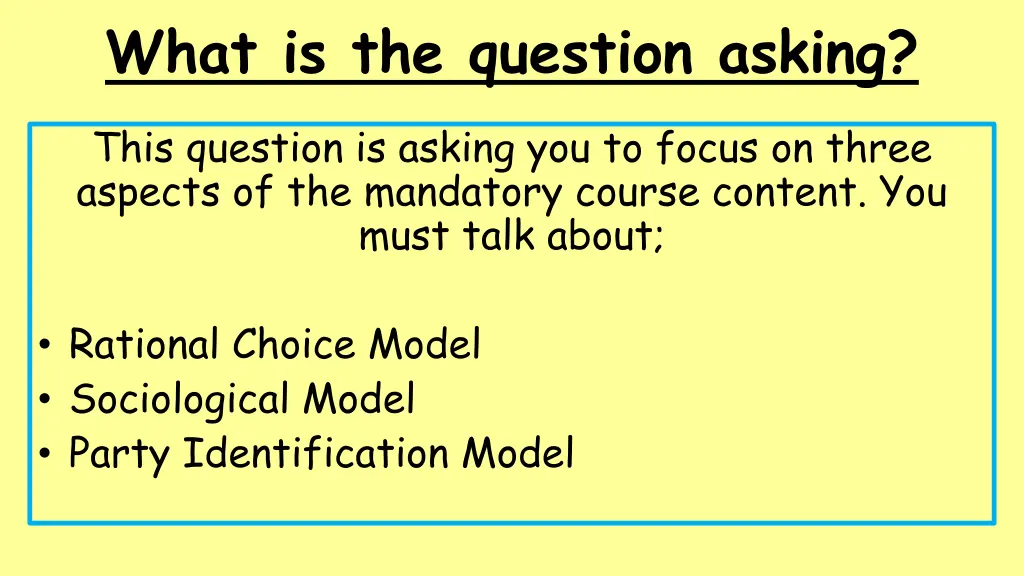
What is the question asking? This question is asking you to focus on three aspects of the mandatory course content. You must talk about; Rational Choice Model Sociological Model Party Identification Model
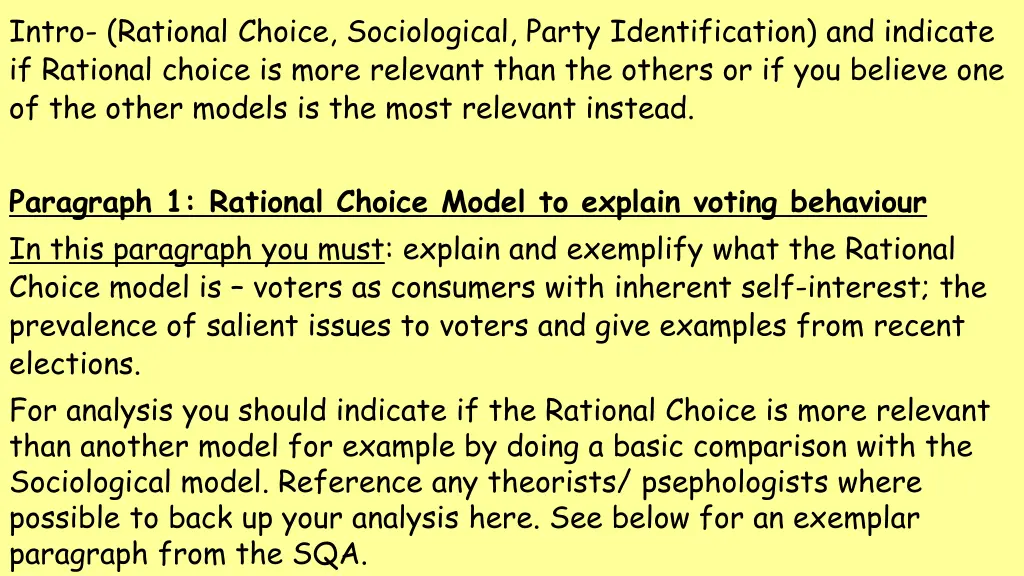
Intro- (Rational Choice, Sociological, Party Identification) and indicate if Rational choice is more relevant than the others or if you believe one of the other models is the most relevant instead. Paragraph 1: Rational Choice Model to explain voting behaviour In this paragraph you must: explain and exemplify what the Rational Choice model is voters as consumers with inherent self-interest; the prevalence of salient issues to voters and give examples from recent elections. For analysis you should indicate if the Rational Choice is more relevant than another model for example by doing a basic comparison with the Sociological model. Reference any theorists/ psephologists where possible to back up your analysis here. See below for an exemplar paragraph from the SQA.
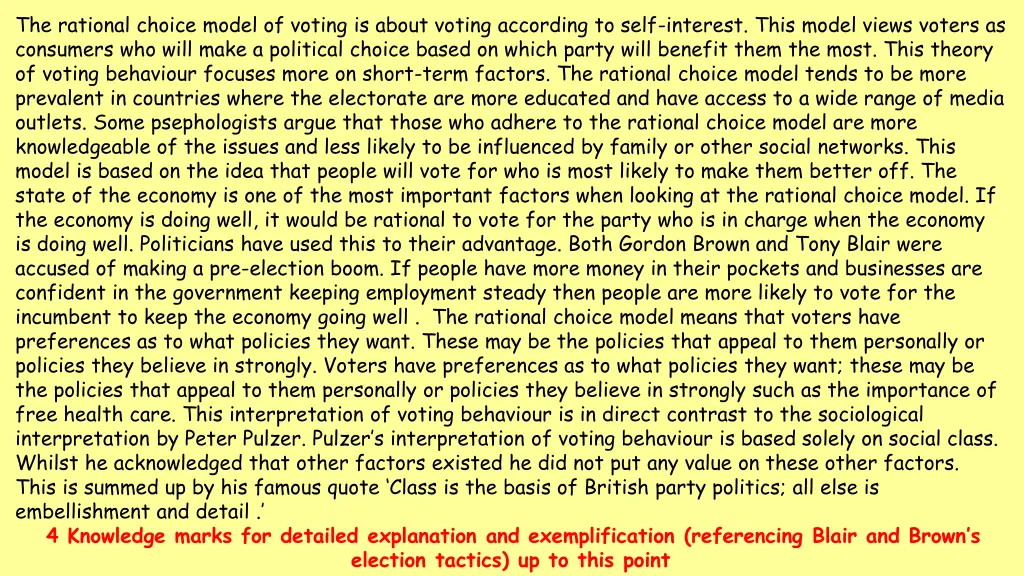
The rational choice model of voting is about voting according to self-interest. This model views voters as consumers who will make a political choice based on which party will benefit them the most. This theory of voting behaviour focuses more on short-term factors. The rational choice model tends to be more prevalent in countries where the electorate are more educated and have access to a wide range of media outlets. Some psephologists argue that those who adhere to the rational choice model are more knowledgeable of the issues and less likely to be influenced by family or other social networks. This model is based on the idea that people will vote for who is most likely to make them better off. The state of the economy is one of the most important factors when looking at the rational choice model. If the economy is doing well, it would be rational to vote for the party who is in charge when the economy is doing well. Politicians have used this to their advantage. Both Gordon Brown and Tony Blair were accused of making a pre-election boom. If people have more money in their pockets and businesses are confident in the government keeping employment steady then people are more likely to vote for the incumbent to keep the economy going well .The rational choice model means that voters have preferences as to what policies they want. These may be the policies that appeal to them personally or policies they believe in strongly. Voters have preferences as to what policies they want; these may be the policies that appeal to them personally or policies they believe in strongly such as the importance of free health care. This interpretation of voting behaviour is in direct contrast to the sociological interpretation by Peter Pulzer. Pulzer s interpretation of voting behaviour is based solely on social class. Whilst he acknowledged that other factors existed he did not put any value on these other factors. This is summed up by his famous quote Class is the basis of British party politics; all else is embellishment and detail . 4 Knowledge marks for detailed explanation and exemplification (referencing Blair and Brown s election tactics) up to this point
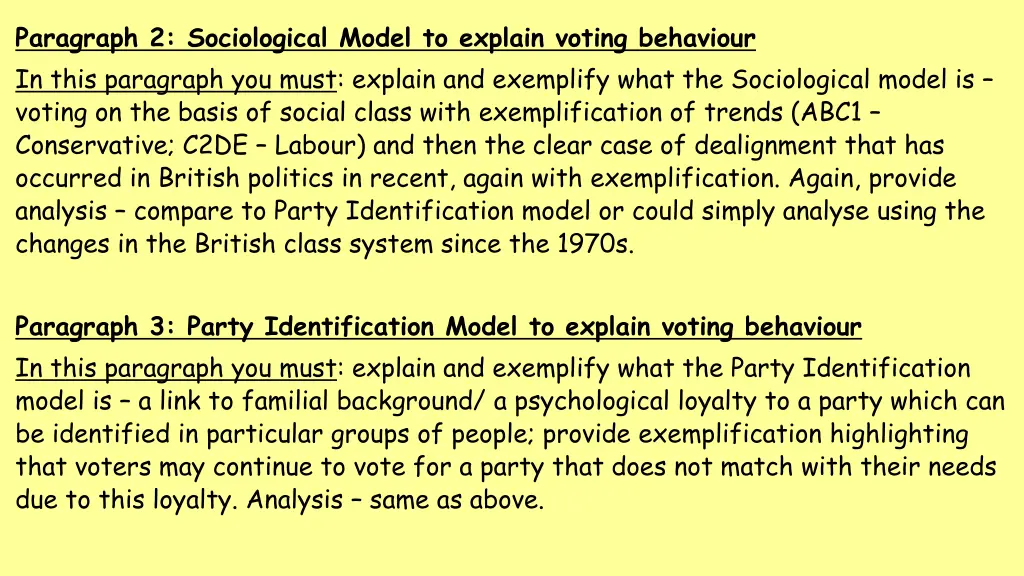
Paragraph 2: Sociological Model to explain voting behaviour In this paragraph you must: explain and exemplify what the Sociological model is voting on the basis of social class with exemplification of trends (ABC1 Conservative; C2DE Labour) and then the clear case of dealignment that has occurred in British politics in recent, again with exemplification. Again, provide analysis compare to Party Identification model or could simply analyse using the changes in the British class system since the 1970s. Paragraph 3: Party Identification Model to explain voting behaviour In this paragraph you must: explain and exemplify what the Party Identification model is a link to familial background/ a psychological loyalty to a party which can be identified in particular groups of people; provide exemplification highlighting that voters may continue to vote for a party that does not match with their needs due to this loyalty. Analysis same as above.
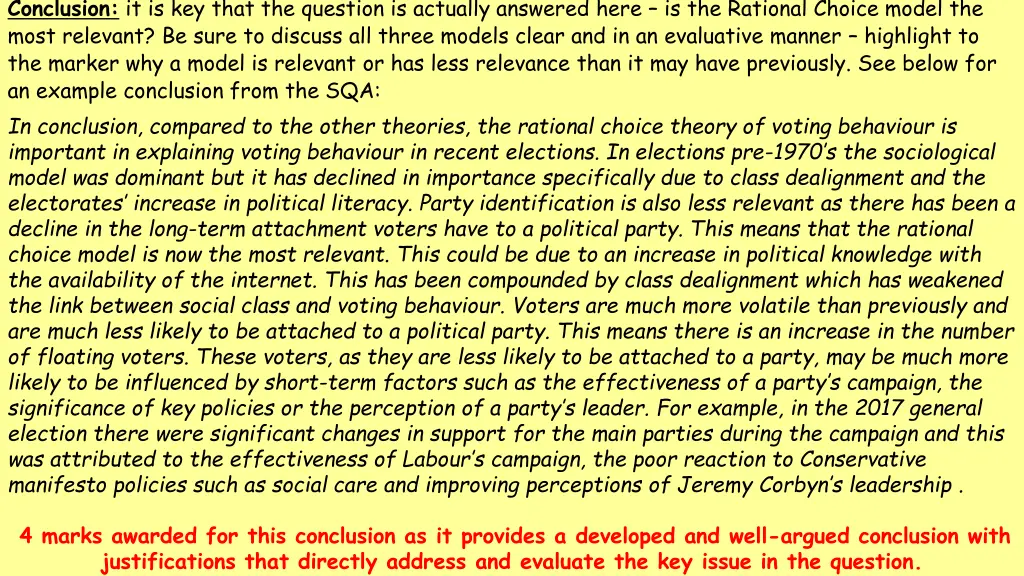
Conclusion: it is key that the question is actually answered here is the Rational Choice model the most relevant? Be sure to discuss all three models clear and in an evaluative manner highlight to the marker why a model is relevant or has less relevance than it may have previously. See below for an example conclusion from the SQA: In conclusion, compared to the other theories, the rational choice theory of voting behaviour is important in explaining voting behaviour in recent elections. In elections pre-1970 s the sociological model was dominant but it has declined in importance specifically due to class dealignment and the electorates increase in political literacy. Party identification is also less relevant as there has been a decline in the long-term attachment voters have to a political party. This means that the rational choice model is now the most relevant. This could be due to an increase in political knowledge with the availability of the internet. This has been compounded by class dealignment which has weakened the link between social class and voting behaviour. Voters are much more volatile than previously and are much less likely to be attached to a political party. This means there is an increase in the number of floating voters. These voters, as they are less likely to be attached to a party, may be much more likely to be influenced by short-term factors such as the effectiveness of a party s campaign, the significance of key policies or the perception of a party s leader. For example, in the 2017 general election there were significant changes in support for the main parties during the campaign and this was attributed to the effectiveness of Labour s campaign, the poor reaction to Conservative manifesto policies such as social care and improving perceptions of Jeremy Corbyn s leadership . 4 marks awarded for this conclusion as it provides a developed and well-argued conclusion with justifications that directly address and evaluate the key issue in the question.