Discover the Audio-Lingual Method, a technique focused on listening and speaking skills through dialogues and drills. Explore its characteristics, teaching process, and interactions between teachers and students for effective language learning.
Please find below an Image/Link to download the presentation.
The content on the website is provided AS IS for your information and personal use only. It may not be sold, licensed, or shared on other websites without obtaining consent from the author. If you encounter any issues during the download, it is possible that the publisher has removed the file from their server.
You are allowed to download the files provided on this website for personal or commercial use, subject to the condition that they are used lawfully. All files are the property of their respective owners.
The content on the website is provided AS IS for your information and personal use only. It may not be sold, licensed, or shared on other websites without obtaining consent from the author.
E N D
Presentation Transcript
The audio-lingual method is a method of foreign language teaching which emphasizes the teaching of listening and writing. It uses dialogues as the main form of language presentation and drills as the main training techniques. Mother tongue is discouraged in the classroom. speaking before reading and
The Audio Lingual Method, unlike the direct method, psychological theory for B. F. Skinner, that emaphasized ( including language learning ) was best learnt through repetition. Behaviorism tries to stimulus) caused a change in the behavior of an individual (a response) without using concepts like mind or ideas or any kind of mental behavior. is based on behaviorism, a that all behaviour explain how an external event (a
Teachers Goals Teaching communicatively. overlearning, automatically through forming new habits in the target language and overcoming the old ones in the native language. students to use done can language through respond to This students without is so stopping think
Teachers / Students roles : The teacher is a model, who should say the dialogue and do the drills more than once so the students would repeat afterwards. Also, the teacher leads, directs and controls the activities. The students are mainly imitators of what the teacher produces. They also have to follow the teacher s directions and respond as accurately and as rapidly as possible.
The teaching / learning process characteristics - Presenting language through a dialogue ( context ) - The dialogue is learnt through imitation and repetition - Using drills - Positive reinforcement - No grammar explanation is presented - Culture is presented in context ( through the dialogue ) - Reading & writing are based on the oral work done earlier.
Interaction : Teacher student interaction most of the time. There is student teacher and student student interaction, but to a very limited extent. Students feelings : No concern for students feelings How are language and culture viewed? Every language is seen as having its own system, which morphological and syntactic. Everyday life language is presented to the learner through the dialogue, which naturally would reflect culture. The level of difficulty must be graded according to the students level. comprises levels : phonological,
Language Components / skills : Teaching sounds and grammar are emphasized over vocabulary. Skills are taught according to their natural order writing, although the great attention is given to the oral/aural skills. Pronunciation should be taught systematically through using labs which help students to discriminate between sounds and minimal pairs ( e.g., live / leave ) : listening, speaking, reading and
The role of the native language Only the target language should be used in the classroom since it is believed that the native language would interfere with the students attempts to learn the target language. A contrastive analysis between the two language is thought to help the teacher understand the difficult areas for the learners to master.
Evaluation : It is done through discrete point tests, that is, each question in the test would focus on only one point of the language at a time. Error Correction : Errors should be corrected immediately, since language learning is thought to be habit formation. Making errors and not correcting them leads to incorrect habits. Correcting errors and repeating the correct forms leads to learning correct forms and acquiring corrects habits.
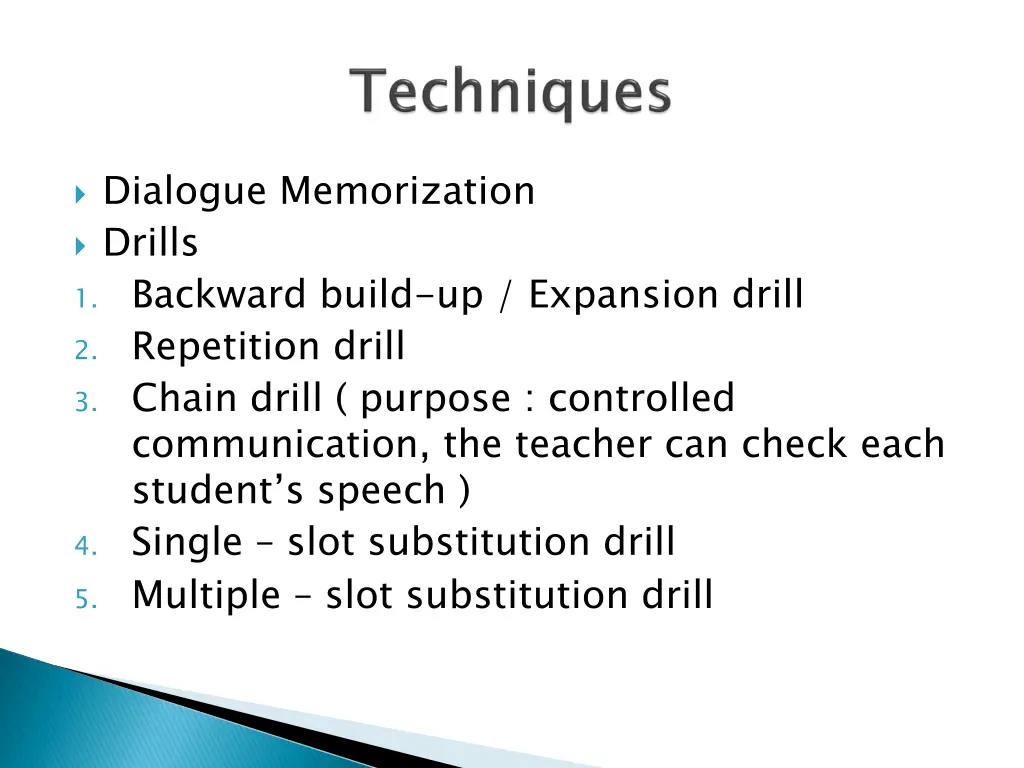
Dialogue Memorization Drills 1. Backward build-up / Expansion drill 2. Repetition drill 3. Chain drill ( purpose : controlled communication, the teacher can check each student s speech ) 4. Single slot substitution drill 5. Multiple slot substitution drill
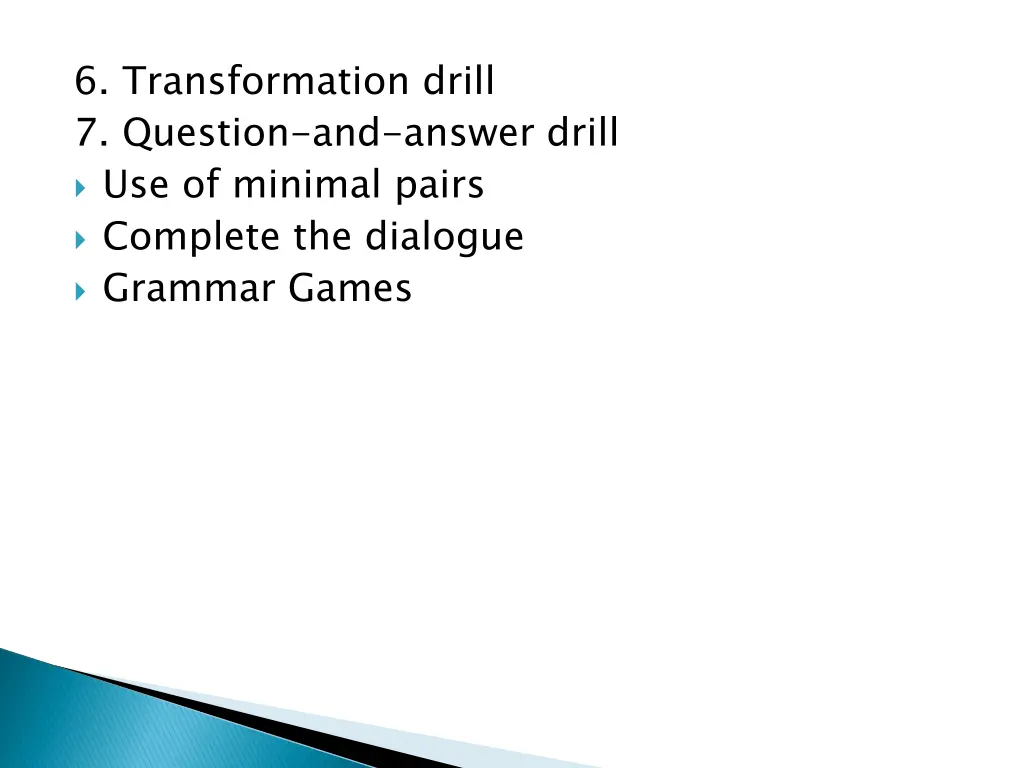
6. Transformation drill 7. Question-and-answer drill Use of minimal pairs Complete the dialogue Grammar Games
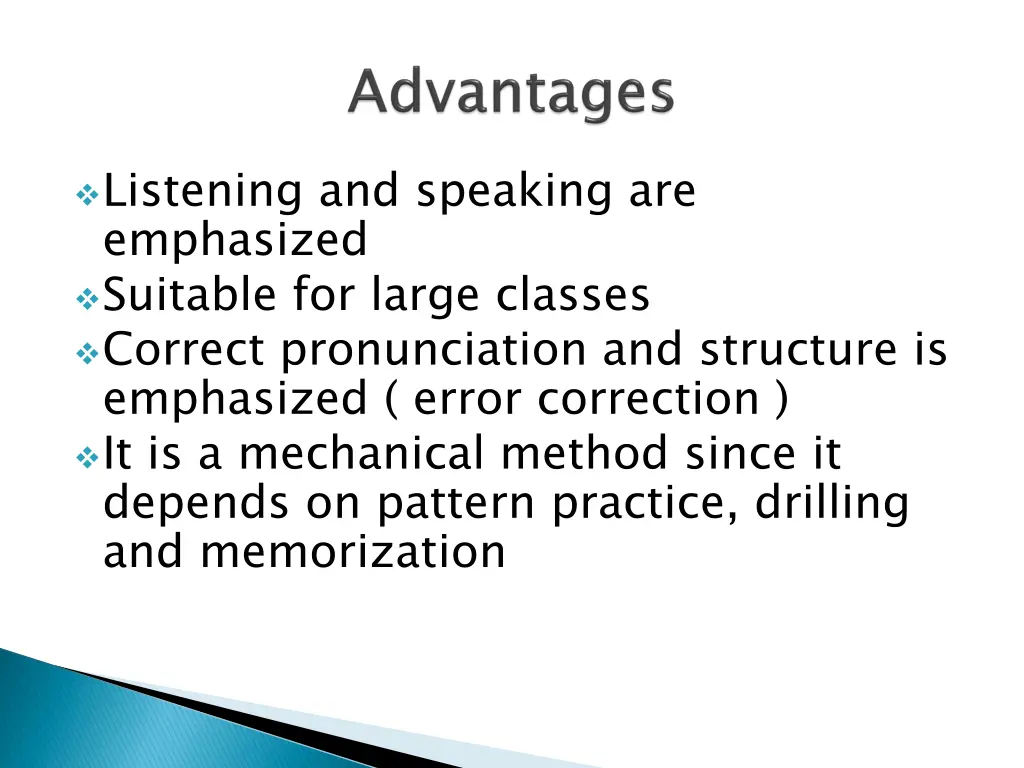
Listening and speaking are emphasized Suitable for large classes Correct pronunciation and structure is emphasized ( error correction ) It is a mechanical method since it depends on pattern practice, drilling and memorization
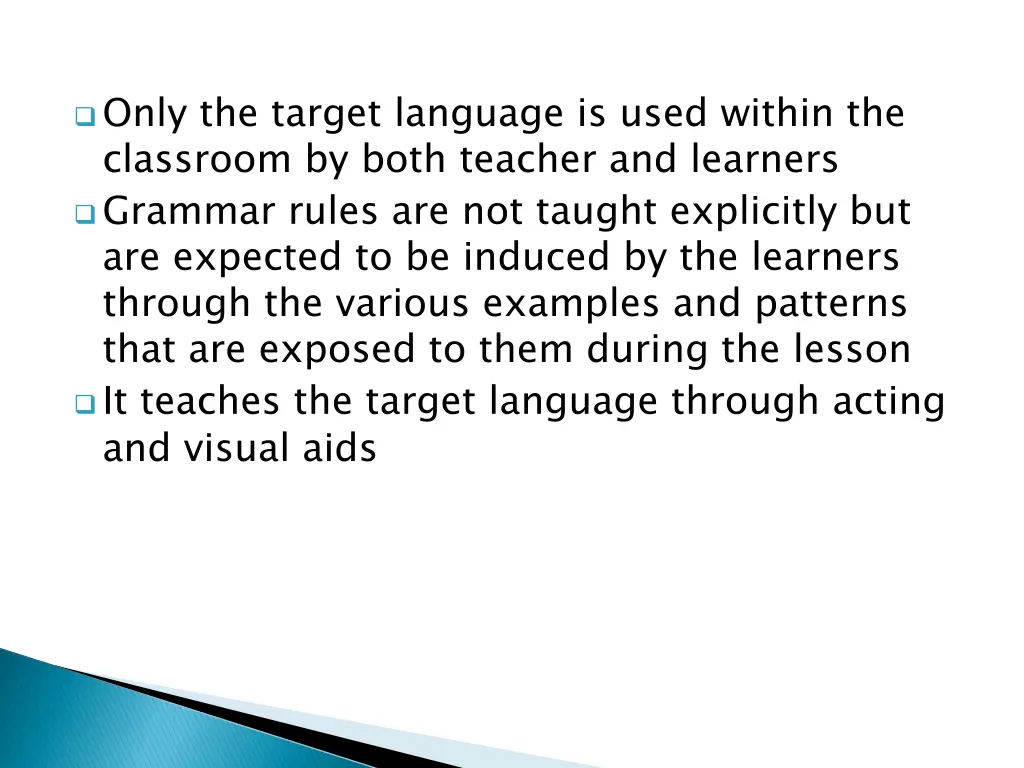
Only the target language is used within the classroom by both teacher and learners Grammar rules are not taught explicitly but are expected to be induced by the learners through the various examples and patterns that are exposed to them during the lesson It teaches the target language through acting and visual aids
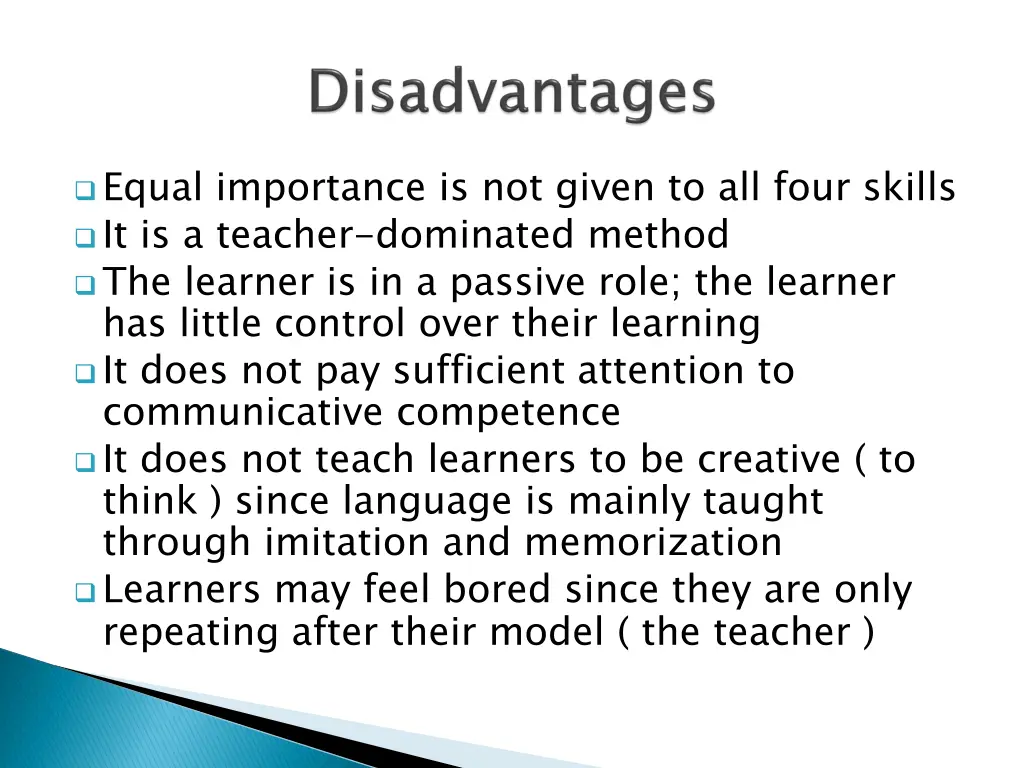
Equal importance is not given to all four skills It is a teacher-dominated method The learner is in a passive role; the learner has little control over their learning It does not pay sufficient attention to communicative competence It does not teach learners to be creative ( to think ) since language is mainly taught through imitation and memorization Learners may feel bored since they are only repeating after their model ( the teacher )
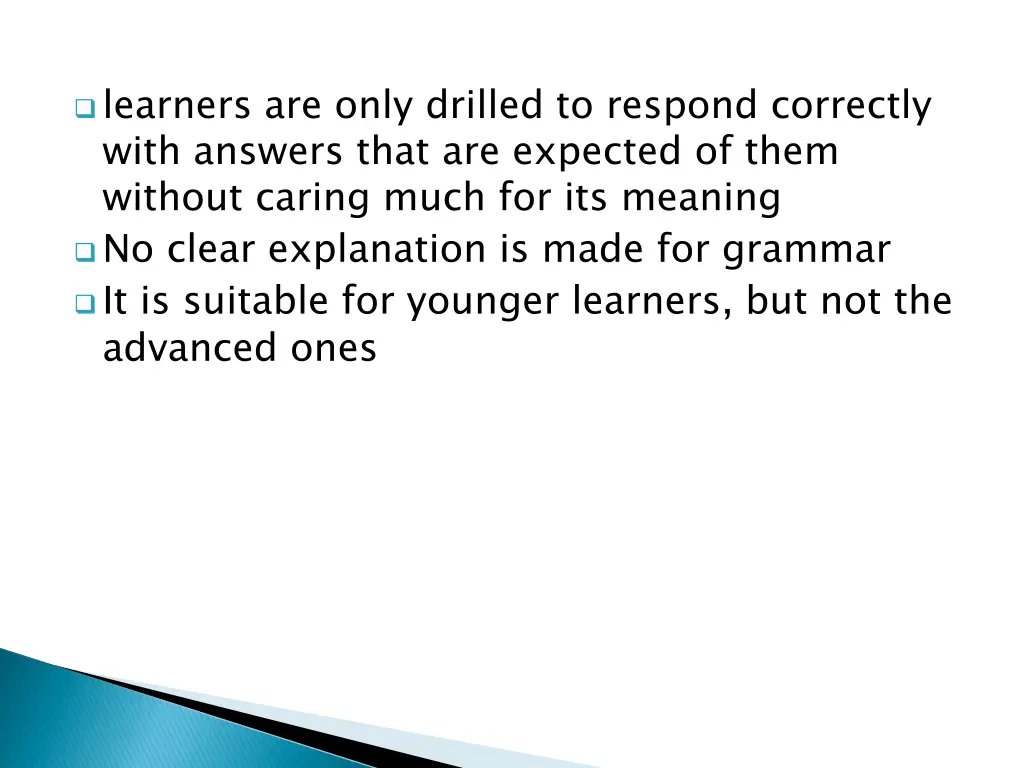
learners are only drilled to respond correctly with answers that are expected of them without caring much for its meaning No clear explanation is made for grammar It is suitable for younger learners, but not the advanced ones