Exploring the Impact of Elements in Thor: Ragnarok

Movies, particularly superhero ones like Thor: Ragnarok, leverage elements like cinematography, special effects, sound effects, music, and storytelling to engage viewers emotionally and intellectually. This project delves into how these facets interact to create a captivating cinematic experience and enhance viewer engagement. By analyzing scenes from Thor: Ragnarok through the lens of these elements, we gain insight into the intricate art of filmmaking and the power it holds in captivating audiences.

Download Presentation

Please find below an Image/Link to download the presentation.
The content on the website is provided AS IS for your information and personal use only. It may not be sold, licensed, or shared on other websites without obtaining consent from the author.If you encounter any issues during the download, it is possible that the publisher has removed the file from their server.
You are allowed to download the files provided on this website for personal or commercial use, subject to the condition that they are used lawfully. All files are the property of their respective owners.
The content on the website is provided AS IS for your information and personal use only. It may not be sold, licensed, or shared on other websites without obtaining consent from the author.
E N D
Presentation Transcript
DMS 474 Final Project Preview Adam Burke
Premise Movies have become a cultural phenomenon Superhero movies have become a phenomenon in their own right. The various elements of a movie find ways to interact with the viewer s mind and psyche. Cinematography; Special Effects; Sound Effects; Music; Storytelling.
Cinematography The camera should be placed to do two things. invoke an emotion or feeling in the viewer. Offer a piece of information to let the viewer on, whether it is subtle or not. Example: Low Angle Shots. Low angles should be used when desirable to inspire awe, or excitement; increase subject height or speed (Mascelli 41)
Special Effects Practical effects were more common in the past, while computer generated imagery (C.G.I) makes up for most effects today. Over the past decade, there has been both an enormous increase in the number of films shot using digital capture and a significant improvement in the quality of the images captured digitally (Beach 171). Many more stories can be told thanks to digital effects.
Sound Effects Sound effects are more than just a movie s sounds. Referring to Ben Burtt, [...] Burtt understood that sound could do more than capture a cinematic reality. It could create one (Whittington 32). Sounds should convey traits such as weight, matter, etc...
Music Music conveys emotions and ideas in a very similar way that cinematography does. As a result, music became crucial in establishing narrative intent, drive, and unity (Whittington 132). It s a go-to tool to invest the viewer in a scene.
Storytelling The story is one of the main traits that brings in audiences. The audience wants to follow a relatable protagonist who isn t perfect. A story doesn t become interesting to the audience until the desire comes into play (Truby 43). It is only because the opponent is attacking the hero s great weakness that the hero is forced to deal with it and grow (Truby 88).
Thor: Ragnarok For my project, I thought about watching a movie I hadn t seen in a long time. I haven t seen Thor: Ragnarok since it s initial release in November of 2017. I will take what I read about in the sources I used and apply them to some scenes in the movie and explain how this makes the movie more engaging for viewers.
Sources I Read Manovich, Lee. Software Takes Command. Bloomsbury Academic, 2013. Galloway, Alexander R. Gaming: Essays on Algorithmic Culture. University of Minnesota Press, 2006. Mascelli, Joseph V. The Five C s of Cinematography. 1sted., Silman-James Press, Los Angeles, 1965, Accessed 16 May 2019. Ascher, Steven, and Edward Pincus. The Filmmaker s Handbook: A Comprehensive Guide For the Digital Age. 4th ed, Plume, 2012. Gorbman, Claudia. Narrative Film Music. Yale French Studies, no. 60, 1980, pp. 183 203. JSTOR, www.jstor.org/stable/2930011. Accessed 25 Apr. 2021. Winter, Marian Hannah. The Function of Music in Sound Film. The Musical Quarterly, vol. 27, no. 2, 1941, pp. 146 164. JSTOR, www.jstor.org/stable/739462. Accessed 25 Apr. 2021. Prince, Stephen. The Emergence of Filmic Artifacts: Cinema and Cinematography in the Digital Era. Film Quarterly, vol. 57, no. 3, 2004, pp. 24 33. JSTOR, www.jstor.org/stable/10.1525/fq.2004.57.3.24. Accessed 28 Apr. 2021.
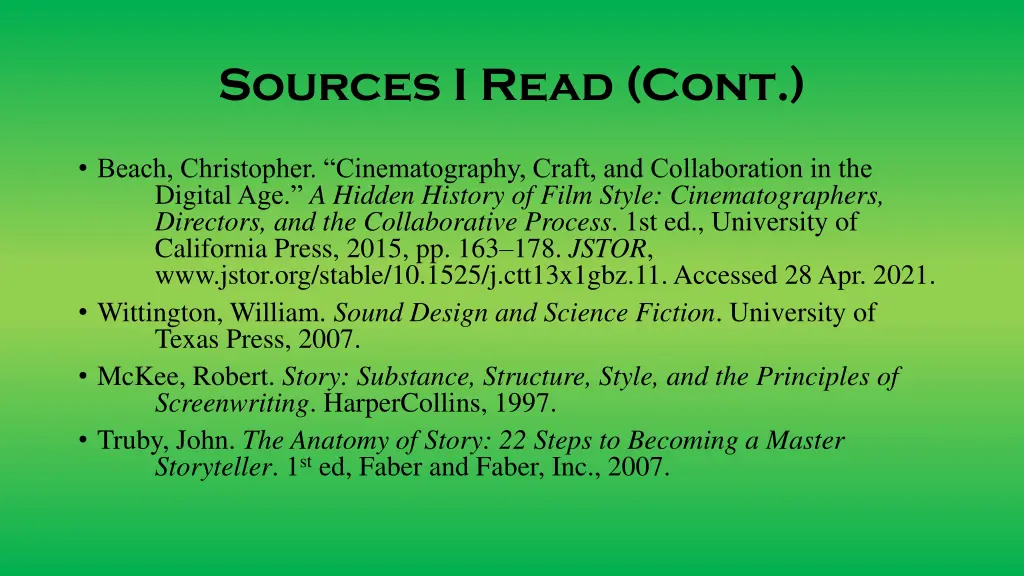
Sources I Read (Cont.) Beach, Christopher. Cinematography, Craft, and Collaboration in the Digital Age. A Hidden History of Film Style: Cinematographers, Directors, and the Collaborative Process. 1st ed., University of California Press, 2015, pp. 163 178. JSTOR, www.jstor.org/stable/10.1525/j.ctt13x1gbz.11. Accessed 28 Apr. 2021. Wittington, William. Sound Design and Science Fiction. University of Texas Press, 2007. McKee, Robert. Story: Substance, Structure, Style, and the Principles of Screenwriting. HarperCollins, 1997. Truby, John. The Anatomy of Story: 22 Steps to Becoming a Master Storyteller. 1sted, Faber and Faber, Inc., 2007.