Exploring the Origin of Subject-Predicate Structure in Thought
Delve into the origin and development of subject-predicate structure in thought processes, examining its relationship to human language faculties and logical frameworks. Join Paul M. Pietroski from the University of Maryland as he discusses the systematicity of thoughts and propositions, shedding light on the fundamental components of linguistic and philosophical constructs. Uncover the intriguing connection between subject-predicate formations and the evolution of propositional thought.

Download Presentation

Please find below an Image/Link to download the presentation.
The content on the website is provided AS IS for your information and personal use only. It may not be sold, licensed, or shared on other websites without obtaining consent from the author. If you encounter any issues during the download, it is possible that the publisher has removed the file from their server.
You are allowed to download the files provided on this website for personal or commercial use, subject to the condition that they are used lawfully. All files are the property of their respective owners.
The content on the website is provided AS IS for your information and personal use only. It may not be sold, licensed, or shared on other websites without obtaining consent from the author.
E N D
Presentation Transcript
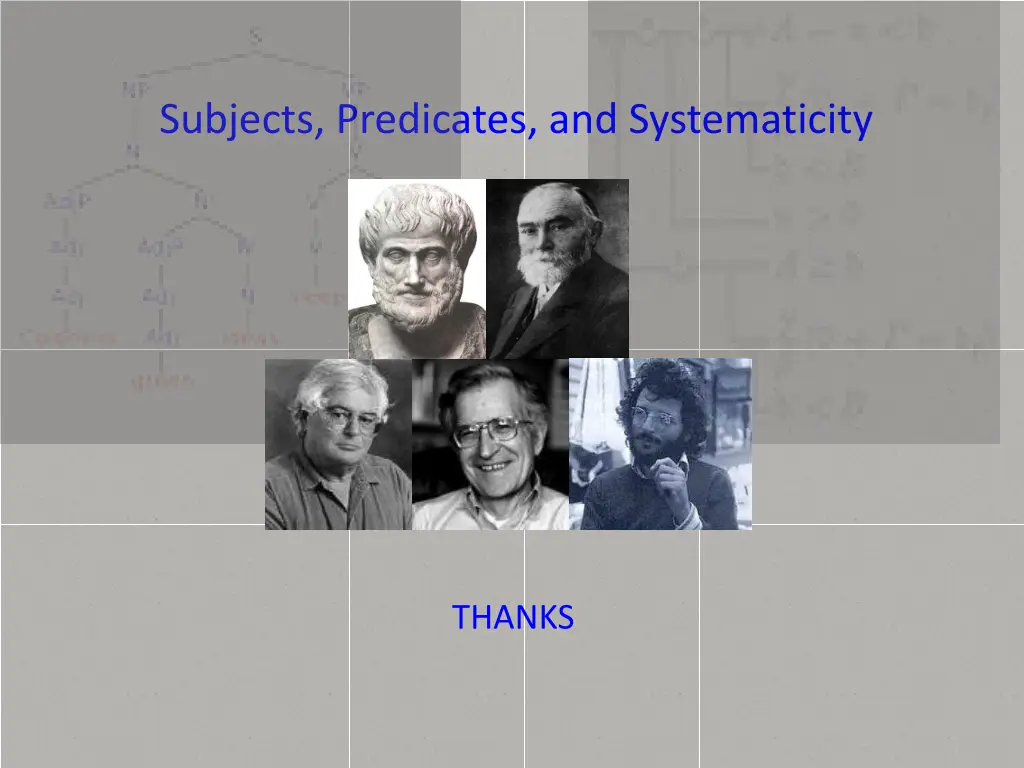
Subjects, Predicates, and Systematicity Paul M. Pietroski University of Maryland Dept. of Linguistics, Dept. of Philosophy
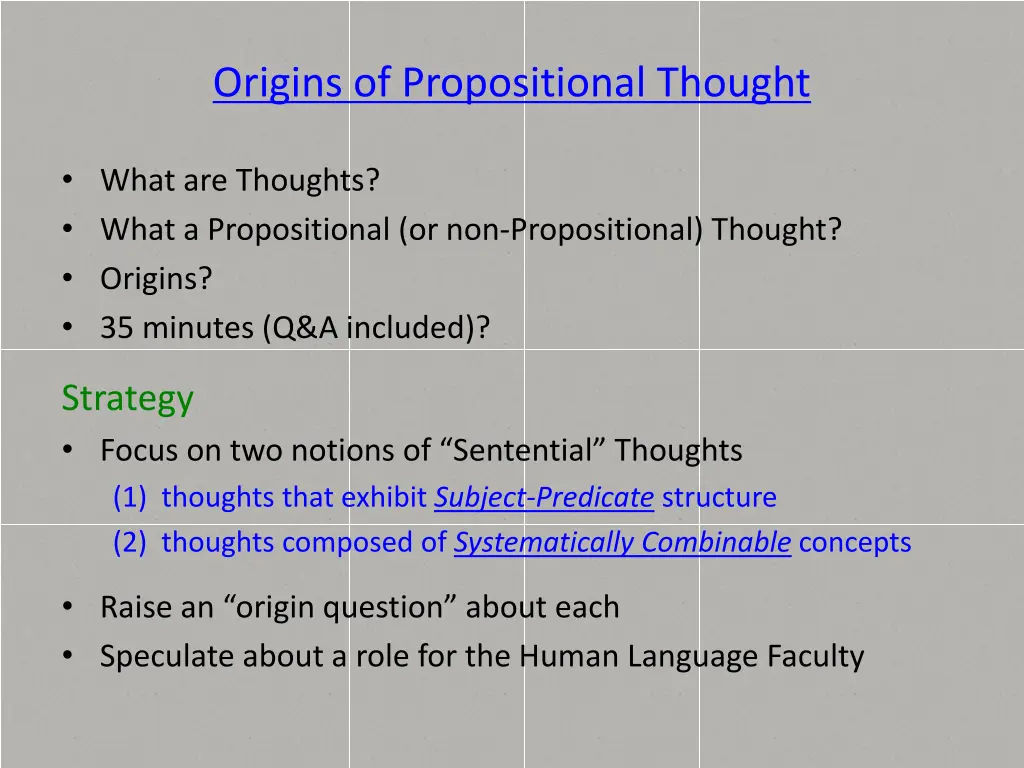
Origins of Propositional Thought What are Thoughts? What a Propositional (or non-Propositional) Thought? Origins? 35 minutes (Q&A included)? Strategy Focus on two notions of Sentential Thoughts (1) thoughts that exhibit Subject-Predicate structure (2) thoughts composed of Systematically Combinable concepts Raise an origin question about each Speculate about a role for the Human Language Faculty
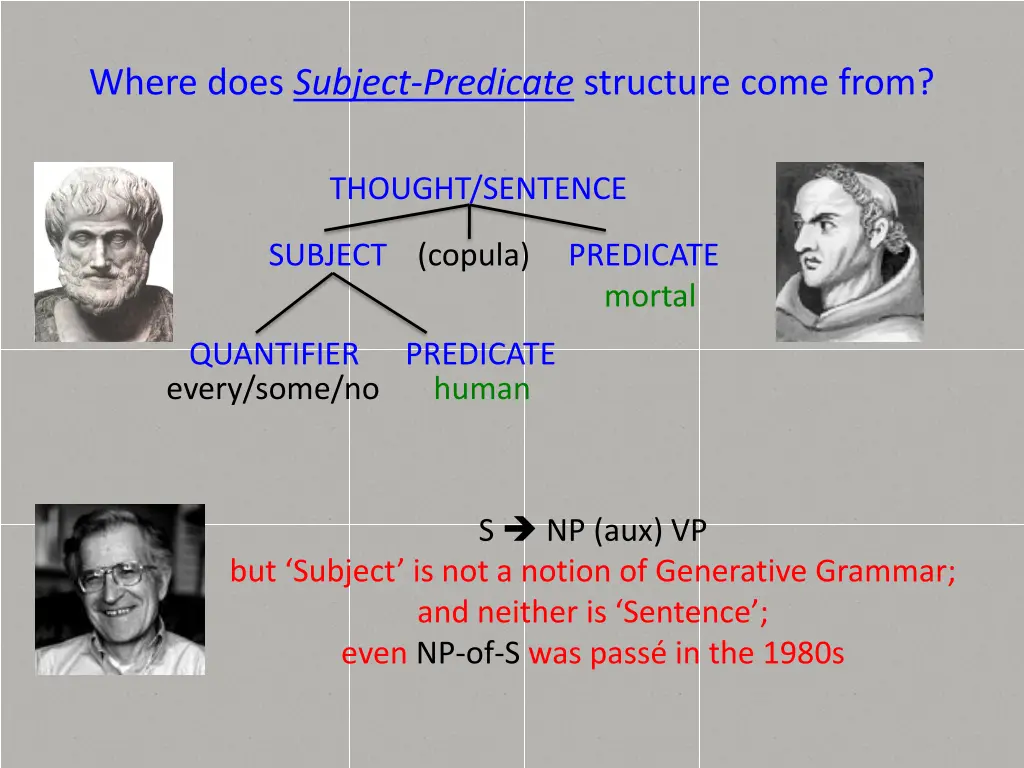
Where does Subject-Predicate structure come from? THOUGHT/SENTENCE SUBJECT (copula) PREDICATE mortal QUANTIFIER PREDICATE every/some/no human S NP (aux) VP but Subject is not a notion of Generative Grammar; and neither is Sentence ; even NP-of-S was pass in the 1980s
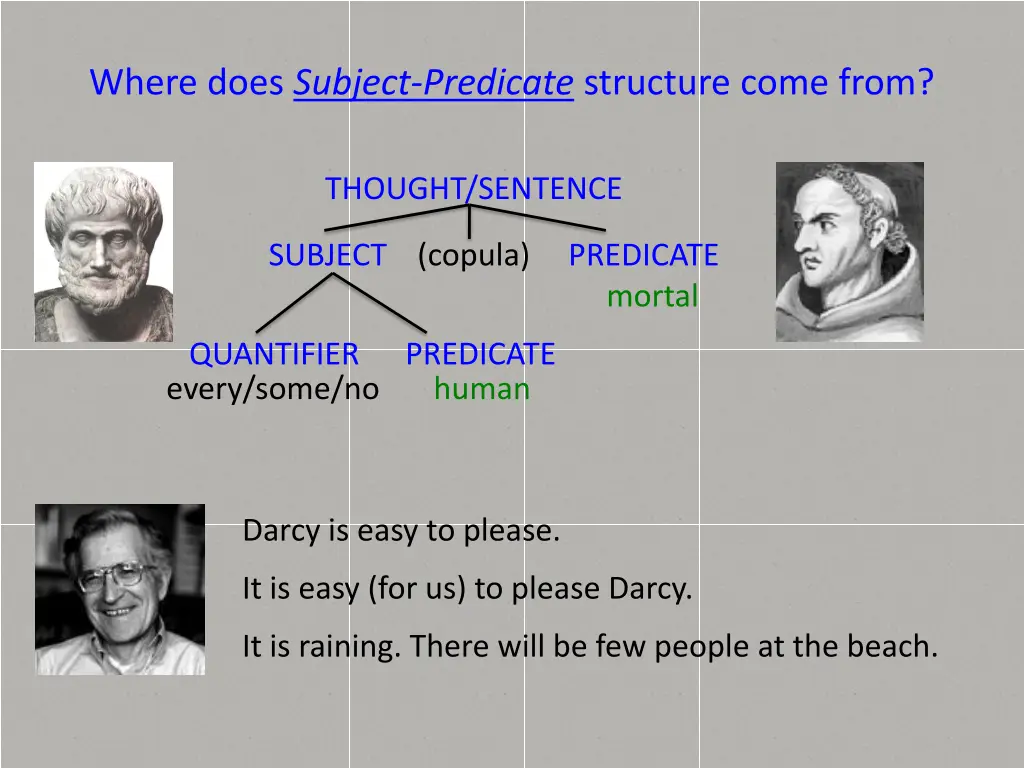
Where does Subject-Predicate structure come from? THOUGHT/SENTENCE SUBJECT (copula) PREDICATE mortal QUANTIFIER PREDICATE every/some/no human Darcy is easy to please. It is easy (for us) to please Darcy. It is raining. There will be few people at the beach.
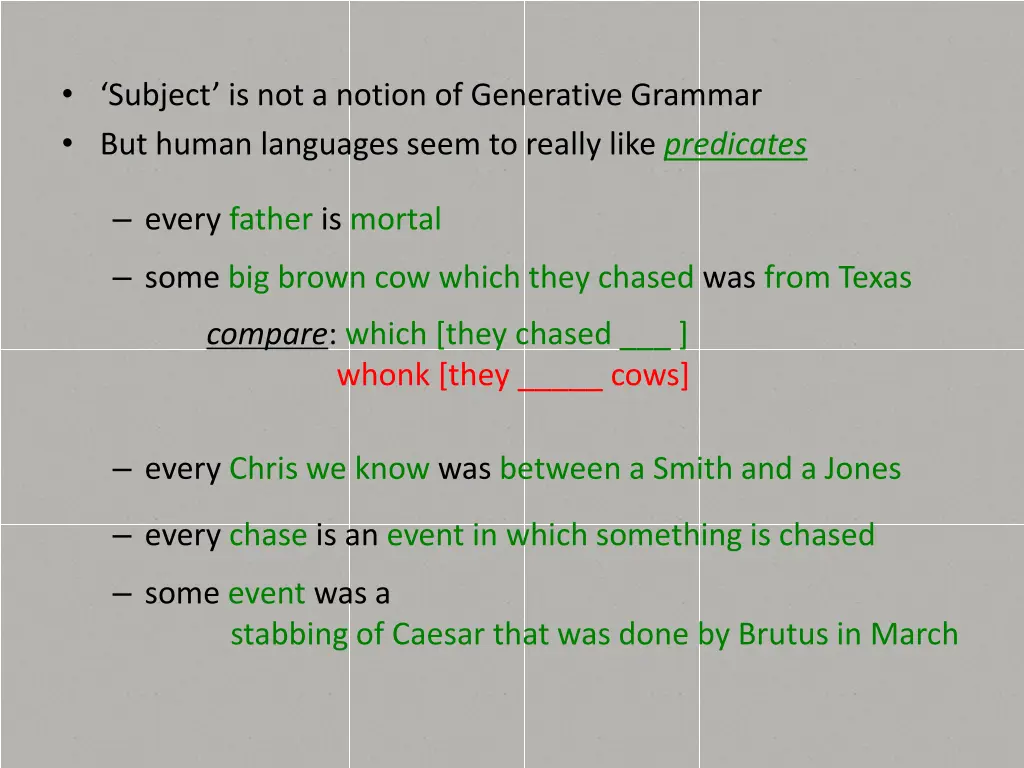
Subject is not a notion of Generative Grammar But human languages seem to really like predicates every father is mortal some big brown cow which they chased was from Texas compare: which [they chased ___ ] whonk [they _____ cows] every Chris we know was between a Smith and a Jones every chase is an event in which something is chased some event was a stabbing of Caesar that was done by Brutus in March
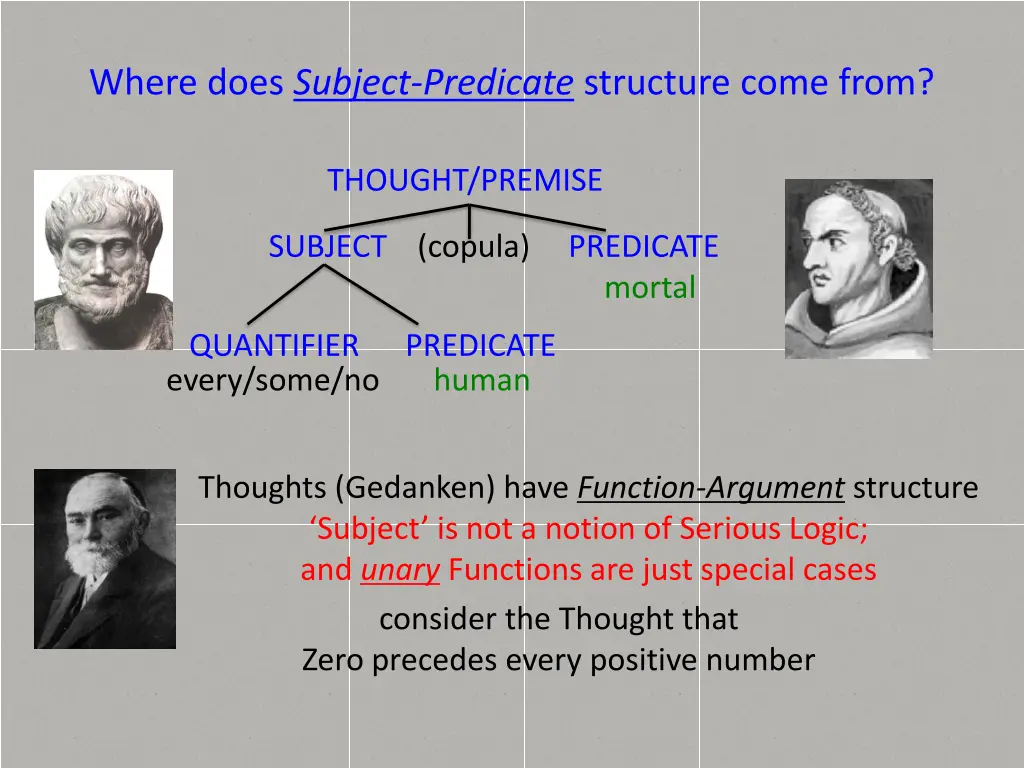
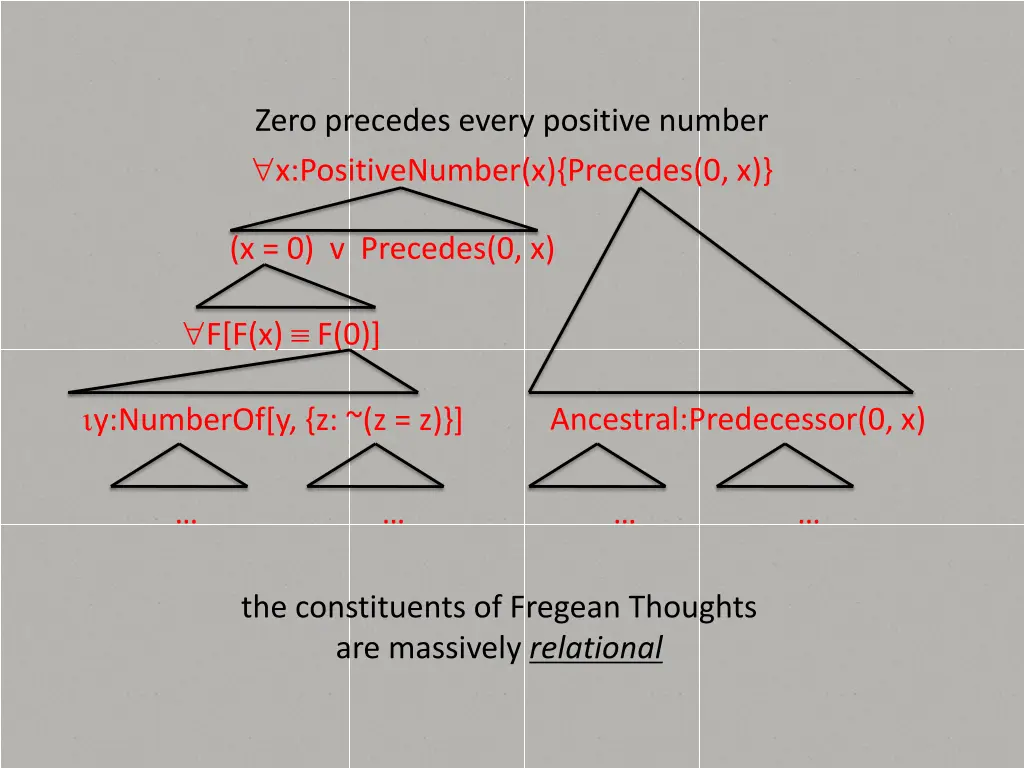
Where does Subject-Predicate structure come from? THOUGHT/PREMISE SUBJECT (copula) PREDICATE mortal QUANTIFIER PREDICATE every/some/no human Thoughts (Gedanken) have Function-Argument structure Subject is not a notion of Serious Logic; and unary Functions are just special cases consider the Thought that Zero precedes every positive number
Zero precedes every positive number x:PositiveNumber(x){Precedes(0, x)} (x = 0) v Precedes(0, x) F[F(x) F(0)] y:NumberOf[y, {z: ~(z = z)}] Ancestral:Predecessor(0, x) the constituents of Fregean Thoughts are massively relational
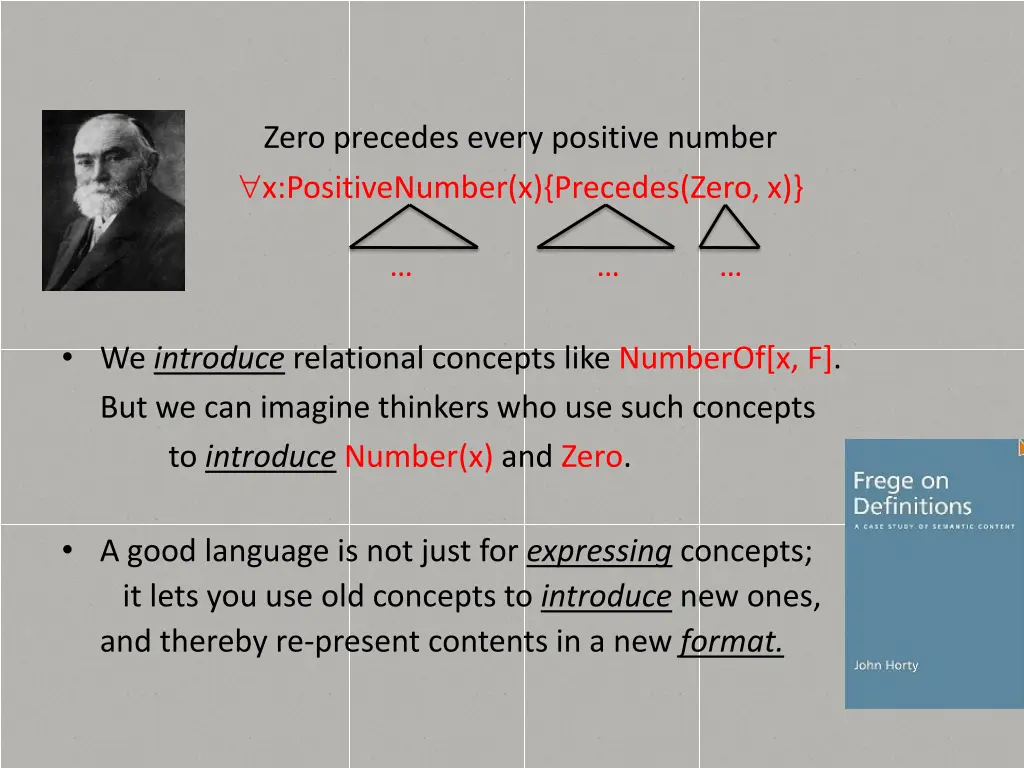
Zero precedes every positive number x:PositiveNumber(x){Precedes(Zero, x)} We introduce relational concepts like NumberOf[x, F]. But we can imagine thinkers who use such concepts to introduce Number(x) and Zero. A good language is not just for expressing concepts; it lets you use old concepts to introduce new ones, and thereby re-present contents in a new format.
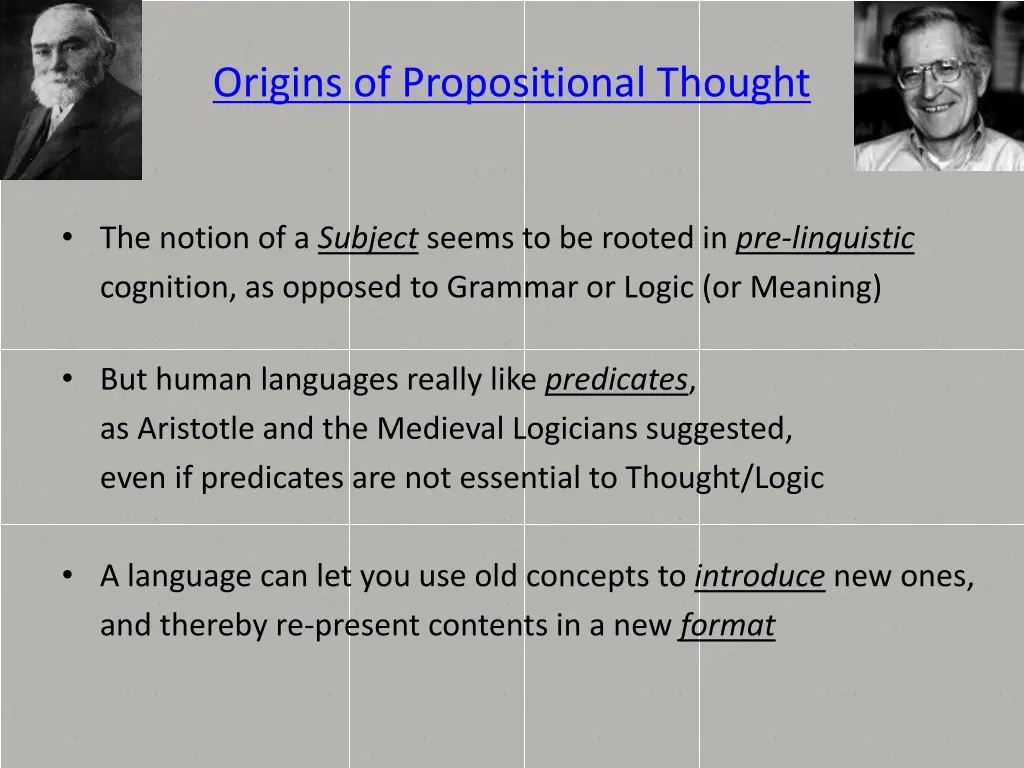
Origins of Propositional Thought The notion of a Subject seems to be rooted in pre-linguistic cognition, as opposed to Grammar or Logic (or Meaning) But human languages really like predicates, as Aristotle and the Medieval Logicians suggested, even if predicates are not essential to Thought/Logic A language can let you use old concepts to introduce new ones, and thereby re-present contents in a new format
Origins of Propositional Thought Minds house modules, whose characteristic representations exhibit distinctive formats. These informationally encapsulated cognitive systems provide inputs to at least one central system. Minds deploy concepts that are systematically combinable. But how did modular minds come to have such concepts?
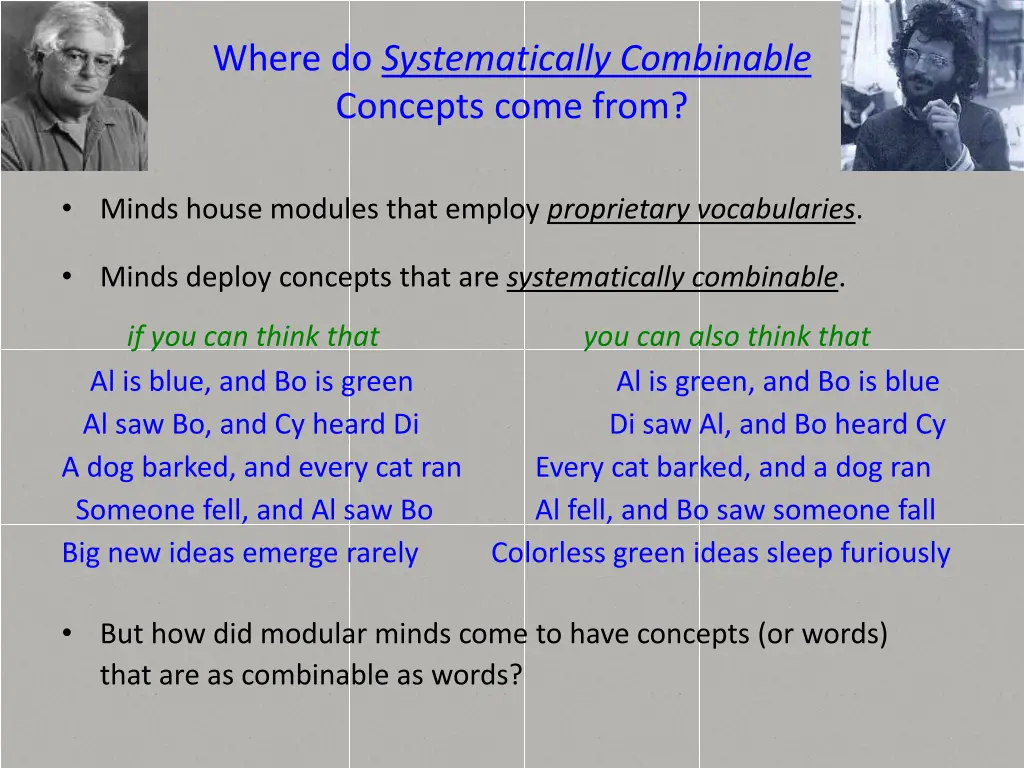
Where do Systematically Combinable Concepts come from? Minds house modules that employ proprietary vocabularies. Minds deploy concepts that are systematically combinable. Al is blue, and Bo is green Al saw Bo, and Cy heard Di A dog barked, and every cat ran Every cat barked, and a dog ran Someone fell, and Al saw Bo Al fell, and Bo saw someone fall Big new ideas emerge rarely Colorless green ideas sleep furiously if you can think that you can also think that Al is green, and Bo is blue Di saw Al, and Bo heard Cy But how did modular minds come to have concepts (or words) that are as combinable as words?
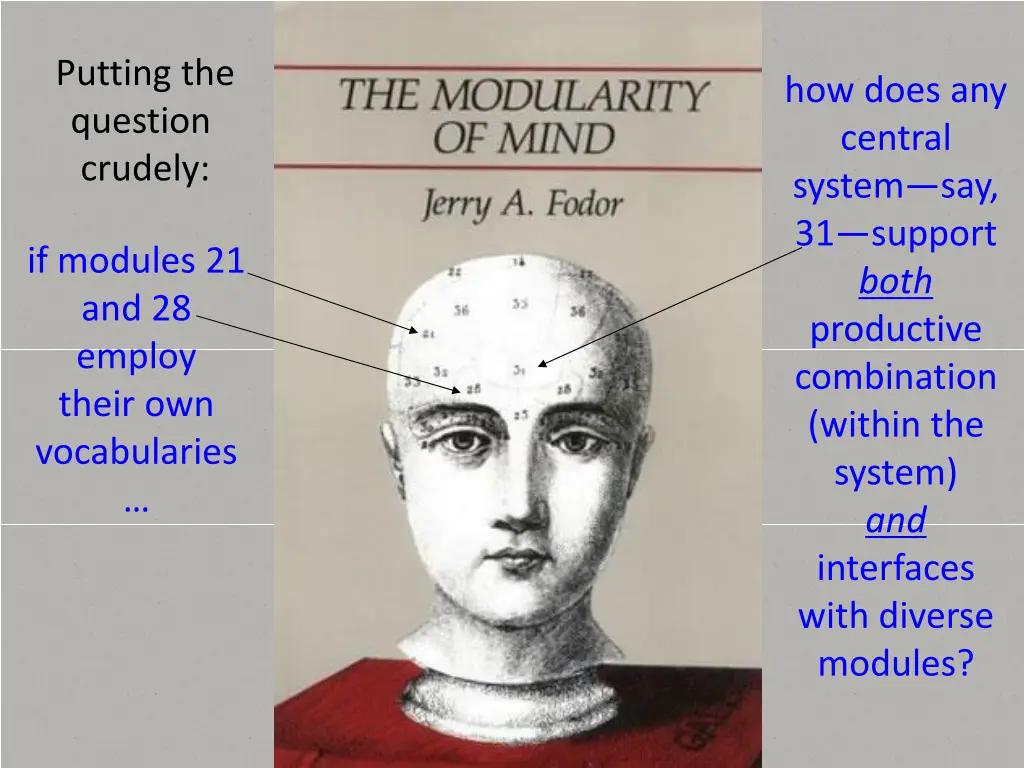
Putting the question crudely: how does any central system say, 31 support both productive combination (within the system) and interfaces with diverse modules? if modules 21 and 28 employ their own vocabularies
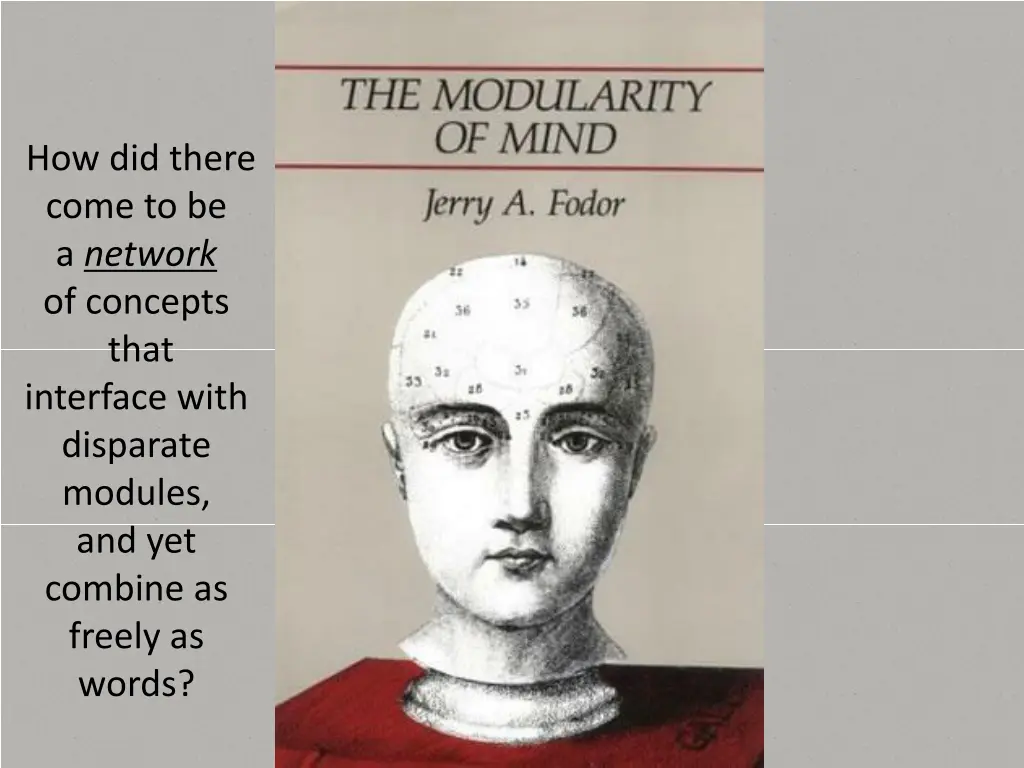
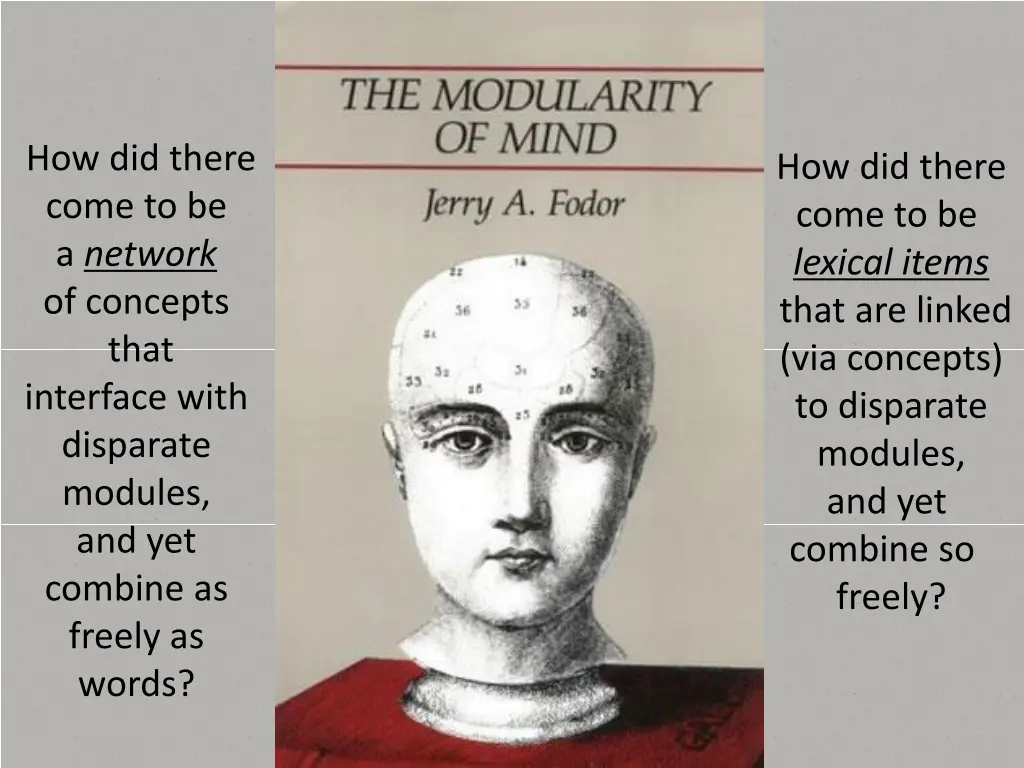
How did there come to be a network of concepts that interface with disparate modules, and yet combine as freely as words?
How did there come to be a network of concepts that interface with disparate modules, and yet combine as freely as words? How did there come to be lexical items that are linked (via concepts) to disparate modules, and yet combine so freely?
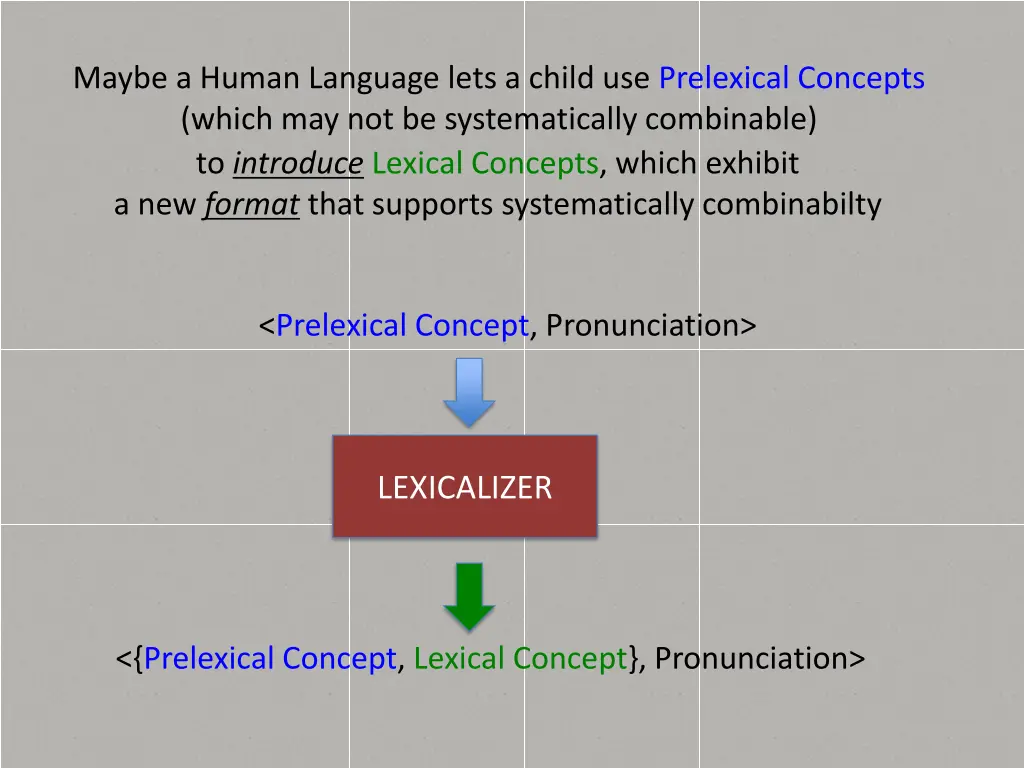
Maybe a Human Language lets a child use Prelexical Concepts (which may not be systematically combinable) to introduce Lexical Concepts, which exhibit a new format that supports systematically combinabilty <Prelexical Concept, Pronunciation> LEXICALIZER <{Prelexical Concept, Lexical Concept}, Pronunciation>
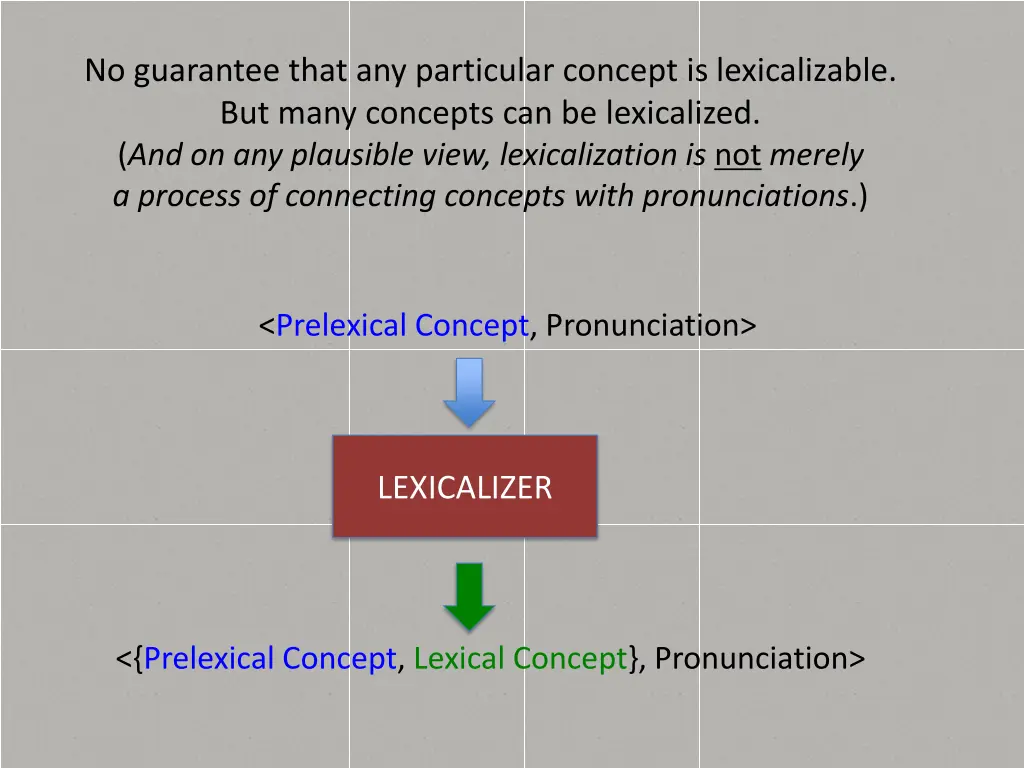
No guarantee that any particular concept is lexicalizable. But many concepts can be lexicalized. (And on any plausible view, lexicalization is not merely a process of connecting concepts with pronunciations.) <Prelexical Concept, Pronunciation> LEXICALIZER <{Prelexical Concept, Lexical Concept}, Pronunciation>
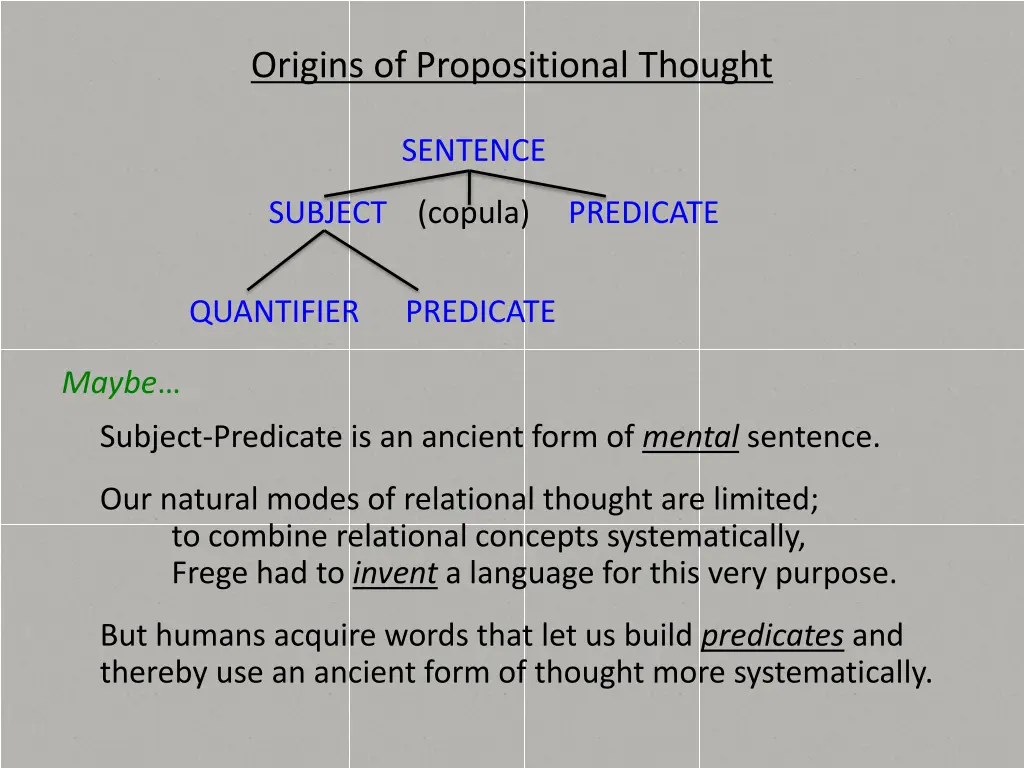
Origins of Propositional Thought SENTENCE SUBJECT (copula) PREDICATE QUANTIFIER PREDICATE Maybe Subject-Predicate is an ancient form of mental sentence. Our natural modes of relational thought are limited; to combine relational concepts systematically, Frege had to invent a language for this very purpose. But humans acquire words that let us build predicates and thereby use an ancient form of thought more systematically.