Factors Affecting Heat Transfer & Insulation Solutions
Identify factors influencing heat transfer rates, explore effective insulation methods, and determine optimal conditions for heat retention in buildings.

Download Presentation

Please find below an Image/Link to download the presentation.
The content on the website is provided AS IS for your information and personal use only. It may not be sold, licensed, or shared on other websites without obtaining consent from the author.If you encounter any issues during the download, it is possible that the publisher has removed the file from their server.
You are allowed to download the files provided on this website for personal or commercial use, subject to the condition that they are used lawfully. All files are the property of their respective owners.
The content on the website is provided AS IS for your information and personal use only. It may not be sold, licensed, or shared on other websites without obtaining consent from the author.
E N D
Presentation Transcript
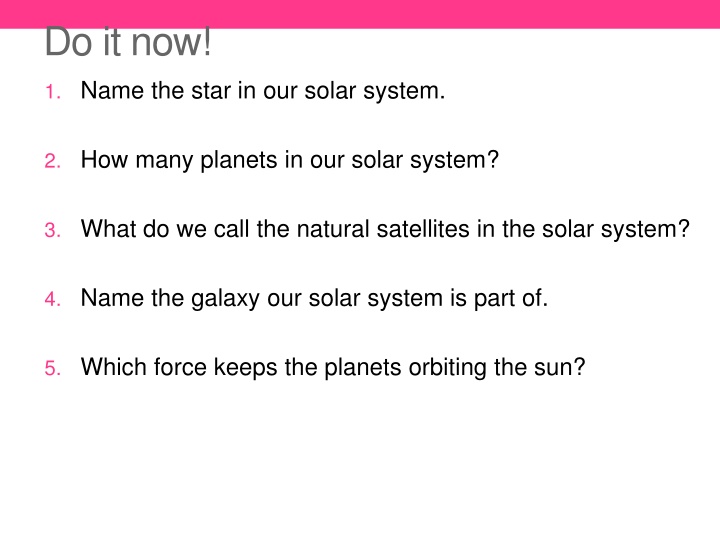
Do it now! 1. Name the star in our solar system. 2. How many planets in our solar system? 3. What do we call the natural satellites in the solar system? 4. Name the galaxy our solar system is part of. 5. Which force keeps the planets orbiting the sun?
1. Name the star in our solar system. The Sun. 2. How many planets in our solar system? 8 3. What do we call the natural satellites in the solar system? Moons. 4. Name the galaxy our solar system is part of. The Milky Way. 5. Which force keeps the planets orbiting the sun? Gravity.
Title: Date: Describe Thermal Conductivity Friday, 07 March 2025 WILF: Planners and equipment out GW: Identify some factors that affect the rate of heat transfer. Date and Title in your books, underlined! BI: Describe how to improve heat transfer. EW: Apply your understanding of air as a conductor to explain why this was the best insulator. Keywords: Thermal conductivity, Insulator.
GW: Identify some factors that affect the rate of heat transfer. Which house would keep the heat in best?
GW: Identify some factors that affect the rate of heat transfer. What makes this house so special? Slate for roof insulation
GW: Identify some factors that affect the rate of heat transfer. There are a number of factors that affect how quickly heat can be lost Does the material conduct heat well (high thermal conductivity)? Is there a large temperature difference? Is there a draught?
GW: Identify some factors that affect the rate of heat transfer. Think of the factors that affect how quickly heat can be lost. Which of the 3 little pigs houses would be the best insulated. Bullet point 2 reasons to explain your choice.
BI: Describe how to improve heat transfer. Heat will flow through the walls of a house by conduction. Thermal conductivity is defined as the ability of a material to allow the flow of heat from its warmer surface through the material to its colder surface. If a material is better at conducting heat (energy) out of the house per second- It has a greater thermal conductivity.
Practical Hypothesis: A thicker wall will transfer thermal energy at a slower rate than a thin wall 1. How would we test this? 2. What are the independent, dependent and control variables?
BI: Describe how to improve heat transfer. Thermal Conductivity Experiment Take 3 containers. Wrap one in 1 layer of bubble wrap and one in 3 Pour 100 cm3 of boiling water into each different container. SAFETY: CARRY THE KETTLE TO YOUR DESK Put a lid on the containers and a thermometer into the water. Insulating lid Wait until the temperature reading stops going up and record the start temperature. Start the watch 10,20 or30 layers of newspaper Can you draw your own table? Record the temperature every minute for 10 minutes
BI: Describe how to improve heat transfer. Time (min) Temperature (oC) 1 layers 3 layers 0 1 2 . 10
BI: Describe how to improve heat transfer. Time (min) Temperature (oC) 1 layer 3 layers 0 70 70 1 2 3 4 5 6 7 8 9 10 66 62 60 59 55 53 48 45 43 41 69 67 67 66 64 62 61 59 57 55
BI: Describe how to improve heat transfer. Analysis Identify the variables in this experiment The independent variable was . The dependent variable was The control variable was .. Write a conclusion for the experiment As the number of layers of bubble wrap increased The bubble wrap could represent in a house. You could increase the rate of energy transfer by
BI: Explain, using results, which insulator was best at its job. Higher Analysis Calculate (we will cover this in further detail later in the year) temperature drop with 1 layer in 10 minutes was ____oC energy lost through 1 layer = temp drop x 420 = _____ J average energy lost per second = ________ J Repeat this calculation for the 2 and 3 layers How does the number of layers of bubble wrap affect the rate of flow of thermal energy? Did the water cool down at a constant rate? What happened to the rate of cooling during the experiment? Why did this happen?
BI: Explain, using results, which insulator was best at its job. Heat energy passes through walls by conduction The rate heat passes through the wall depends on 1. The thermal conductivity 2. The thickness 3. The temperature across the wall of the material of the material difference The lower the thermal conductivity of the wall the less heat energy will pass through it.
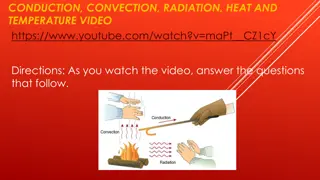
BI: Describe how to improve heat transfer. Heat energy passes through walls by conduction Conduction Convection Radiation The rate heat passes through the wall depends on 1. The thermal conductivity 2. The thickness 3. The temperature across the wall Thermal conductivity of the material of the material difference Temperature Thickness The lower the thermal conductivity of the wall the less/more heat energy will pass through it.
EW: Apply your understanding of air as a conductor to explain why this was the best insulator. Why did the heat transfer fall as we increase the number of sheets of bubble wrap? http://tse1.mm.bing.net/th?id=OIP.Ma2ab94b1a7e9b5eabb716fbd7c1ec3d9H0w=300h=286c=0pid=1.9rs=0p=0r=0 Adding layers of bubble wrap traps more air. Air is great as an insulating material. There are large gaps between particles in the air, making it difficult for energy to be passed on. This reduces the amount of heat that manages to escape through the bubble wrap ! Think of wearing a jumper to keep warm!
Challenging questions 1. Explain why the thermal conductivity value of a material is an important consideration when building properties. 2. Explain why insulators have a low thermal conductivity value. 3. Why would a pizza oven need to be made from a material with a low thermal conductivity value?
Challenging answers!-Green pen 1. Explain why the thermal conductivity value of a material is an important consideration when building properties. If the thermal conductivity is too high, too much heat can be lost through the walls or can enter if very hot outside.
Challenging answers!-Green pen 2. Explain why insulators have a low thermal conductivity value. Insulators/non-metals/plastics etc. have low thermal conductivities since the rate at which thermal energy is transferred through them is low and they are poor conductors this is because they do not have free electrons. 3. Why would a pizza oven need to be made from a material with a low thermal conductivity value? The material needs to have a low thermal conductivity so that heat cannot escape from the oven and can be used to cook the pizza.
EW: Link your results to explain how we make sure that double glazed windows are energy efficient. 12mm gap 2.9 16mm gap 2.7 20mm gap 2.8 Type of window 1. Glass type X with air 2. Glass type X with air and argon 2.7 2.6 2.6 3. Glass type Y with air 1.9 1.8 1.8 4. Glass type Y with air and argon 1.6 1.5 1.5 The diagrams show the cross-section of three double glazed windows. The gap between the two sheets of glass can be filled with either air or a mixture of air and argon. The thermal conductivity for different types of double glazed windows, using different types of glass X and Y, are given in the table. (a) Which type of window is the least energy efficient? 1 (b) Name two windows which could be compared to decide if adding argon to the gap improves the energy efficiency of the window? 1 and 2 same gap or 3 and 4 same gap (c) Which factor is the most important to consider when buying a window (glass type, gap size or gas). Explain your answer with evidence from the table Glass type e.g. 12mm gap adding argon makes a 0,2 difference, increasing gap 0.1, but type Y glass makes 1.0 difference