Factors Influencing Trade Union Membership among Polish Workers in the UK
Explore the economic, cultural, and social factors influencing the relatively low engagement of Polish workers in trade unionism in the UK. Factors such as economic instability, cultural perceptions, and social dynamics impact their participation levels. Dive into the complexities of Polish worker engagement in trade unions through a detailed analysis of various influences.

Download Presentation

Please find below an Image/Link to download the presentation.
The content on the website is provided AS IS for your information and personal use only. It may not be sold, licensed, or shared on other websites without obtaining consent from the author. If you encounter any issues during the download, it is possible that the publisher has removed the file from their server.
You are allowed to download the files provided on this website for personal or commercial use, subject to the condition that they are used lawfully. All files are the property of their respective owners.
The content on the website is provided AS IS for your information and personal use only. It may not be sold, licensed, or shared on other websites without obtaining consent from the author.
E N D
Presentation Transcript
Poles trade union membership in the UK Dr Roch Dunin-W sowicz Public Policy Group, London School of Economics and Political Science Dr Micha P. Garapich Crucible Centre for Human Rights Research, Department of Social Sciences, University of Roehampton
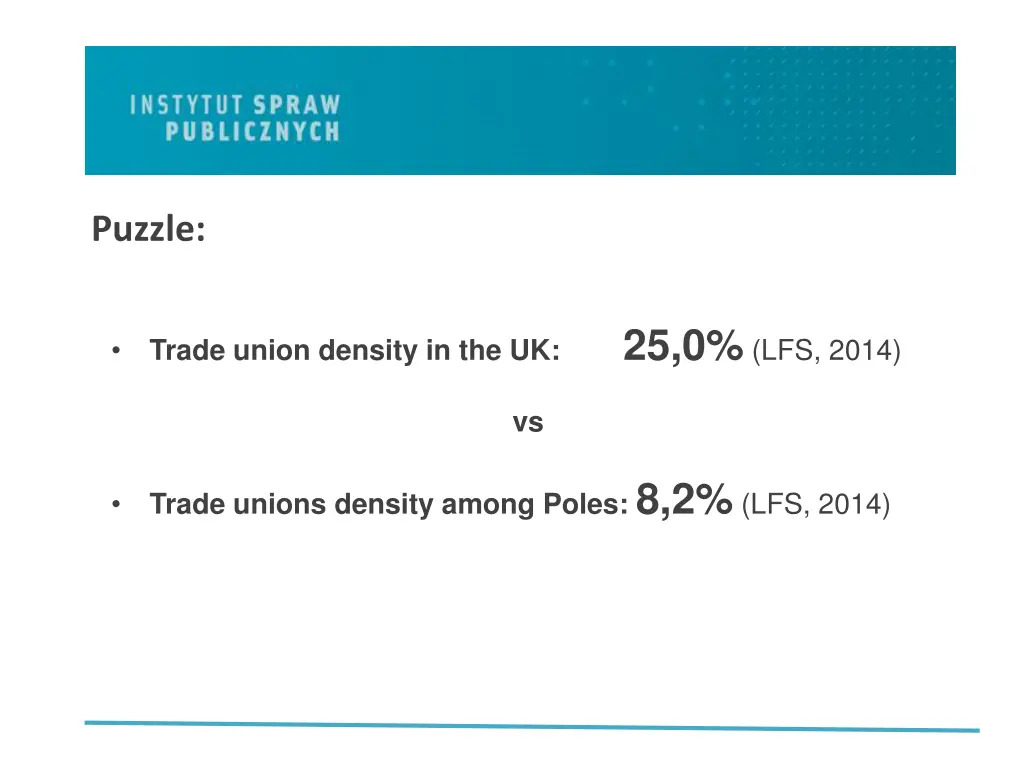
Puzzle: 25,0%(LFS, 2014) Trade union density in the UK: vs Trade unions density among Poles: 8,2%(LFS, 2014)
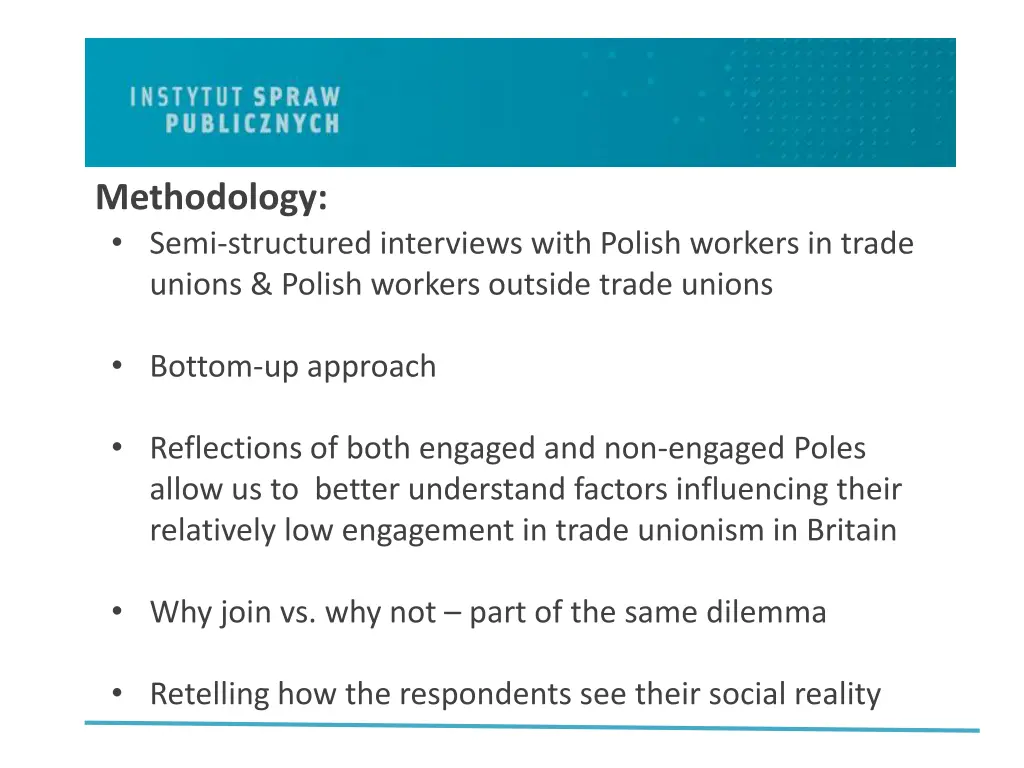
Methodology: Semi-structured interviews with Polish workers in trade unions & Polish workers outside trade unions Bottom-up approach Reflections of both engaged and non-engaged Poles allow us to better understand factors influencing their relatively low engagement in trade unionism in Britain Why join vs. why not part of the same dilemma Retelling how the respondents see their social reality
Factors influencing participation: Economic, Cultural & Social Structural in nature (external) Contingent on different forms of individual capital (innate & learned) Both are not static but dynamic
Economic factors Overwhelming employment supply 2004-2008 Economy in crisis 2008-2015 Decline in production & service industry growth Privatisation of public services and fragmentation of the workforce (Zero Hours Contracts) The precarious socio-economic condition (Standing 2011)
Cultural factors Polarised views on Trade Unions derived from Poland Politicization of trade unionism in Poland ( it s all about politics ) TU not seen as a reliable partner/help If seen, then with too much expectations (case of one English town) The culture of self-reliance I don t need anyone, I can find it myself (widespread self-employment by Polish migrants) Contrasting attitudes distance and lack of trust vs. unrealistic expectations
Social factors Trade unions policy change toward migrant workers: organising migrants to help them and help oneself Recognition of migration issues: discrimination and negative impact on wages and labour protections (agency work) Attitude shift in trade unions towards migrants slow but firm, opening up to newcomers, new members/activists but not without resistance (Aziz 2015) Fragmentation of advocacy not just TU that deal with employment rights, also independent NGOs, migration industry (Garapich 2008), also help is available on-line
Individual factors (forms of capital) General low socio-economic standing (economic) Very poor or virtually non-existent English language skills (cultural) which translates on trust, expectations Insufficient rights education (cultural) Initial lack of network support (social) Ethnic enclave issue evidence of very significant lack of employment rights recognition by Polish employers
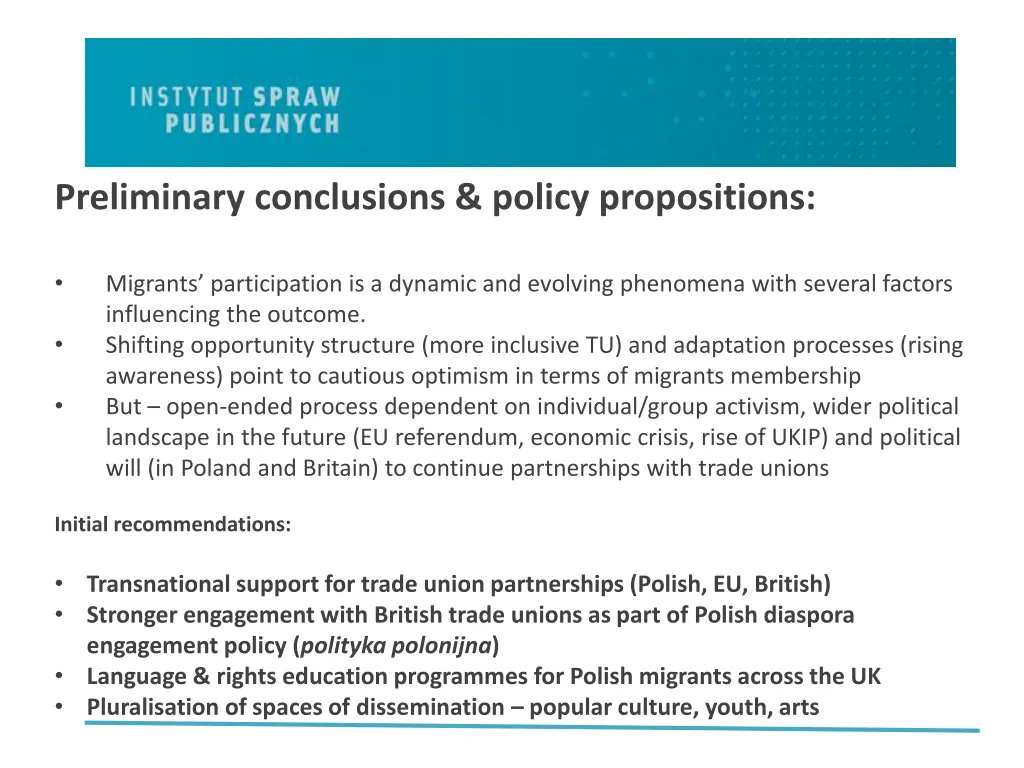
Preliminary conclusions & policy propositions: Migrants participation is a dynamic and evolving phenomena with several factors influencing the outcome. Shifting opportunity structure (more inclusive TU) and adaptation processes (rising awareness) point to cautious optimism in terms of migrants membership But open-ended process dependent on individual/group activism, wider political landscape in the future (EU referendum, economic crisis, rise of UKIP) and political will (in Poland and Britain) to continue partnerships with trade unions Initial recommendations: Transnational support for trade union partnerships (Polish, EU, British) Stronger engagement with British trade unions as part of Polish diaspora engagement policy (polityka polonijna) Language & rights education programmes for Polish migrants across the UK Pluralisation of spaces of dissemination popular culture, youth, arts
The project Solidarity in action. Employment rights, participation in social dialogue and membership in trade unions among Polish employees in the UK is co-financed by the Polish Ministry of Foreign Affairs within the Cooperation with Polish Diaspora and Poles abroad in 2015.