Explore the complex world of fake news with a workshop that delves into mediation, persuasive strategies, and diverse online audiences. Reflect on the Allegory of the Cave to understand the nature of truth and media consumption habits. Uncover the motivations behind fake news producers and learn about click-bait techniques.
Please find below an Image/Link to download the presentation.
The content on the website is provided AS IS for your information and personal use only. It may not be sold, licensed, or shared on other websites without obtaining consent from the author. If you encounter any issues during the download, it is possible that the publisher has removed the file from their server.
You are allowed to download the files provided on this website for personal or commercial use, subject to the condition that they are used lawfully. All files are the property of their respective owners.
The content on the website is provided AS IS for your information and personal use only. It may not be sold, licensed, or shared on other websites without obtaining consent from the author.
E N D
Presentation Transcript
Mediation and Fake News Creating Clickbait Headlines and Fabricated Personas Presenter Name Teaching About Fake News: Lesson Plans for Different Disciplines and Audiences
Workshop Goals Define mediation Recognize news as mediated experiences Identify persuasive marketing strategies Acknowledge diverse online audiences Search the ACRL Sandbox for more lessons with #fakenews
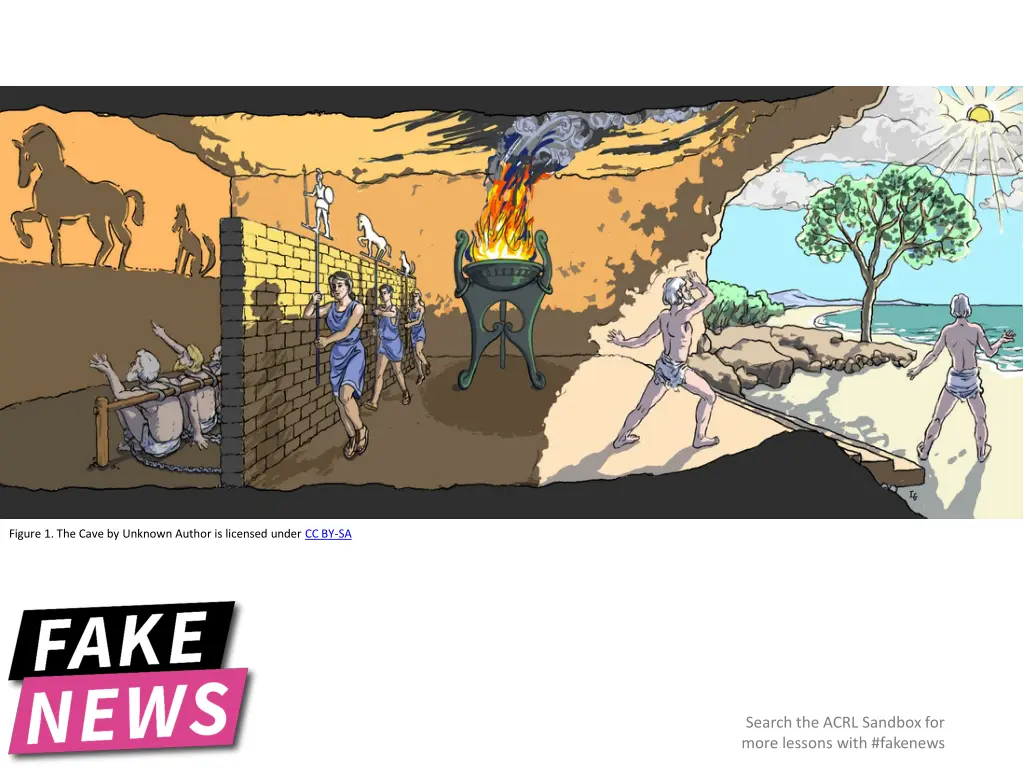
Reflect on Allegory of the Cave Key concept: Mediation Dealing with reality throughsomething else (Zengotita 8) Questions for understanding: 1. What does Plato tell us about the nature of truth and mediated experiences? 2. How might we view the prisoners of the cave as modern media consumers? 3. What are some examples of media? Search the ACRL Sandbox for more lessons with #fakenews
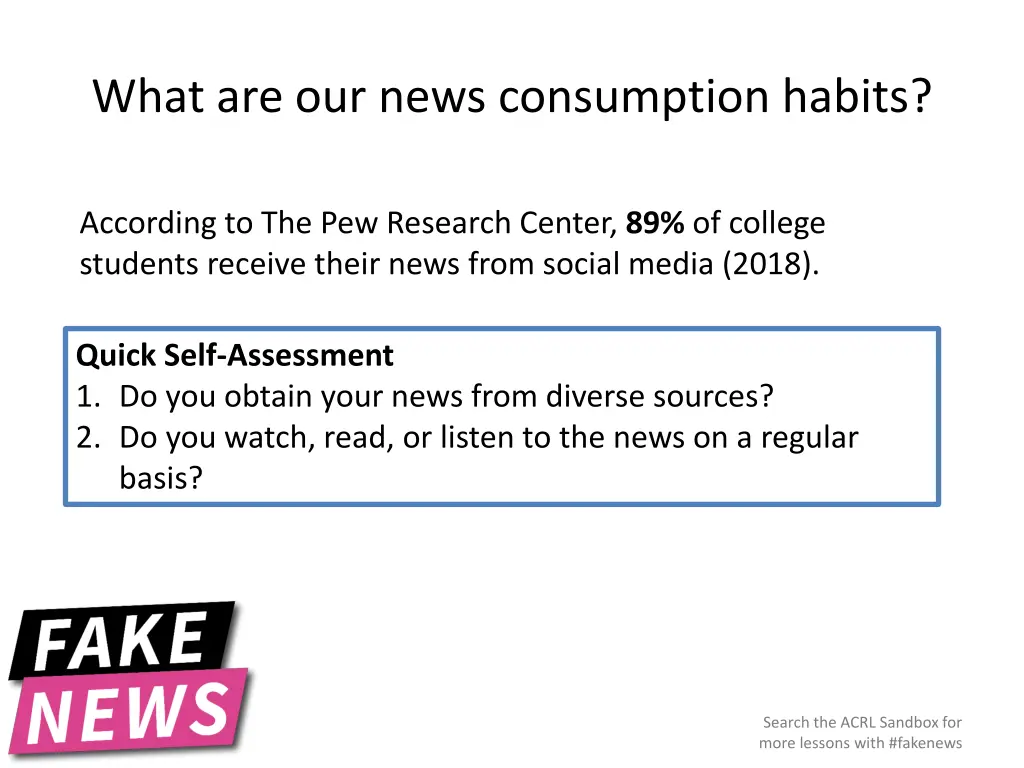
What are our news consumption habits? According to The Pew Research Center, 89% of college students receive their news from social media (2018). Quick Self-Assessment 1. Do you obtain your news from diverse sources? 2. Do you watch, read, or listen to the news on a regular basis? Search the ACRL Sandbox for more lessons with #fakenews
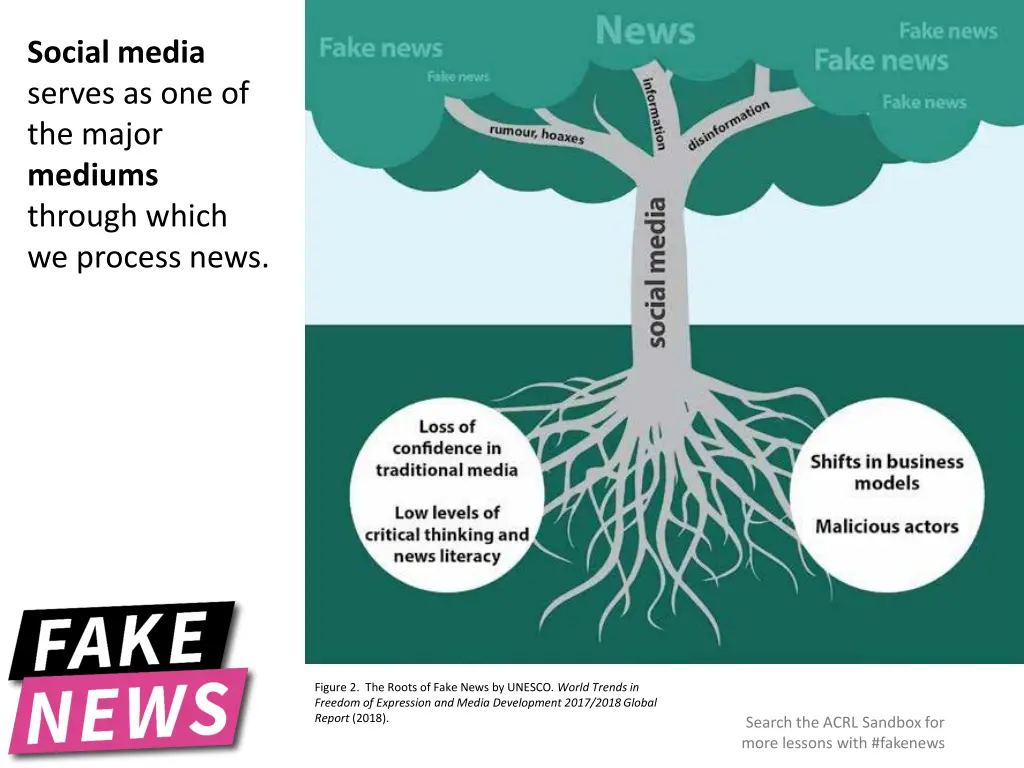
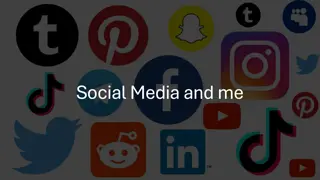
Social media serves as one of the major mediums through which we process news. Figure 2. The Roots of Fake News by UNESCO. World Trends in Freedom of Expression and Media Development 2017/2018 Global Report (2018). Search the ACRL Sandbox for more lessons with #fakenews
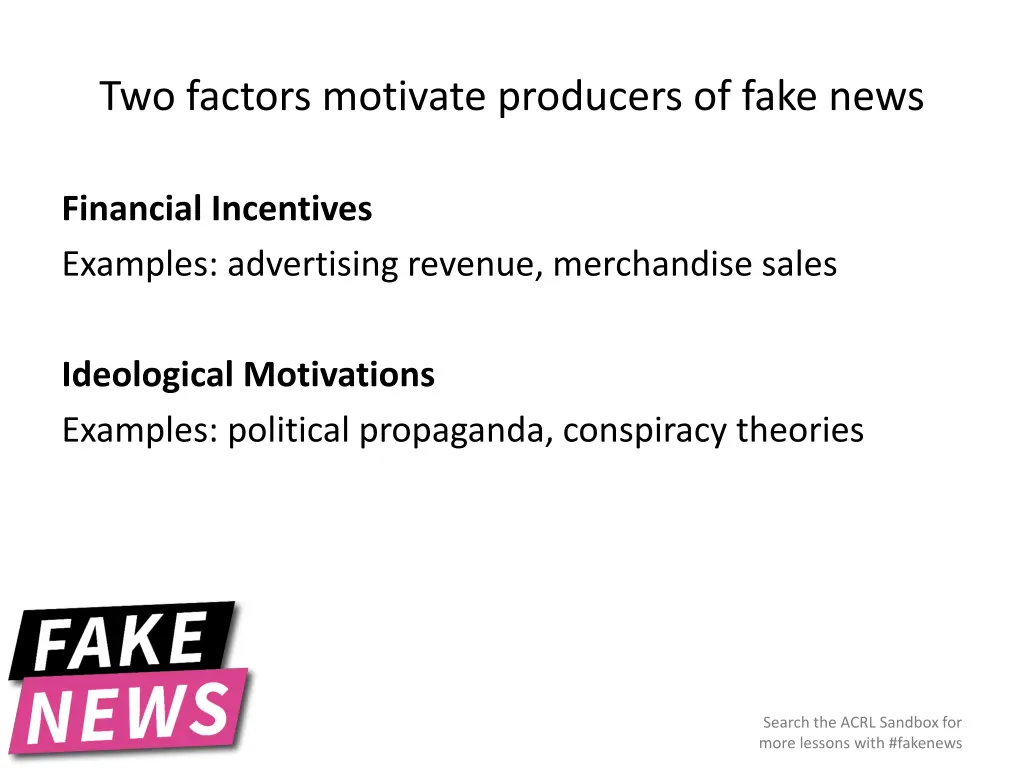
Two factors motivate producers of fake news Financial Incentives Examples: advertising revenue, merchandise sales Ideological Motivations Examples: political propaganda, conspiracy theories Search the ACRL Sandbox for more lessons with #fakenews
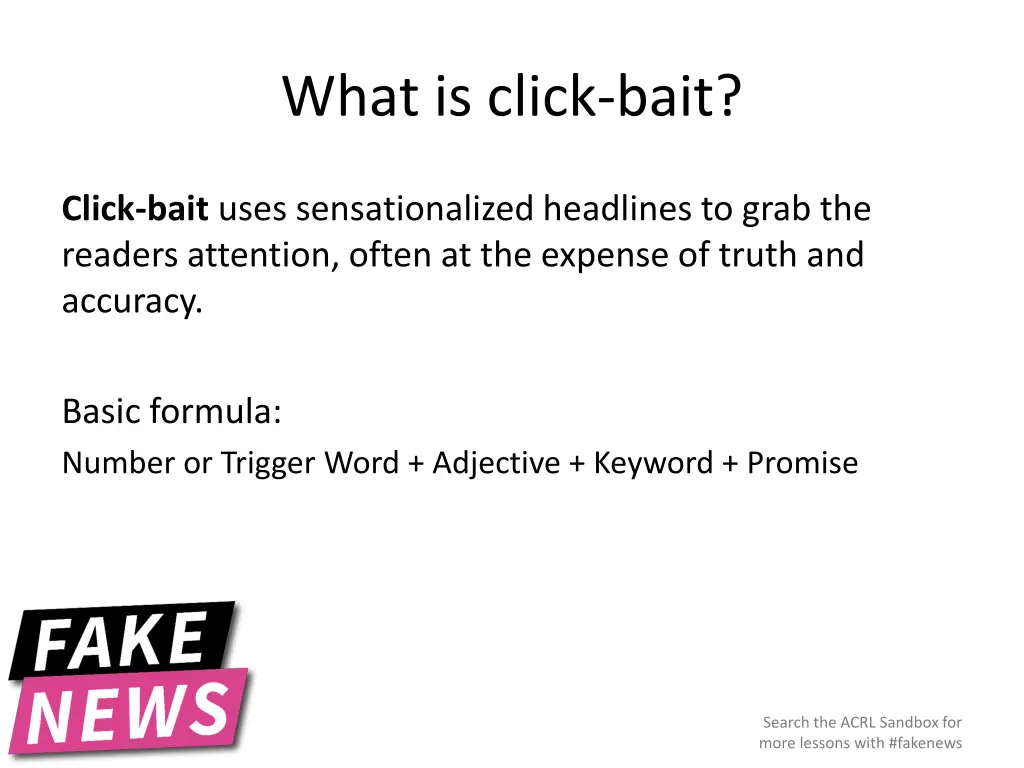
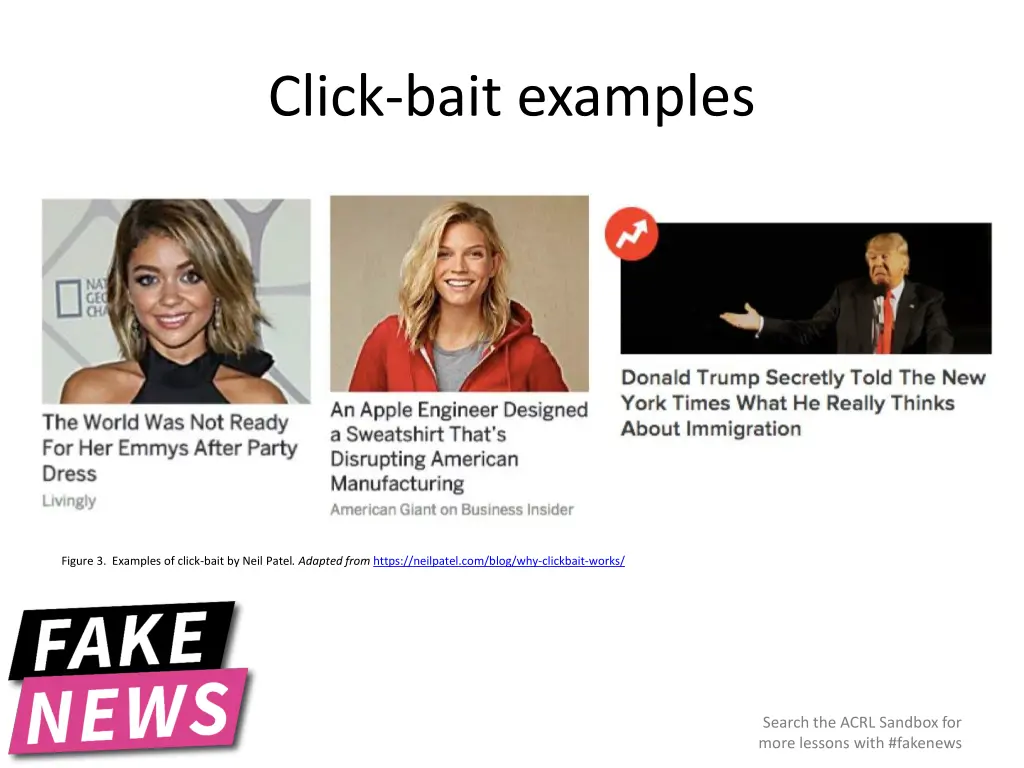
What is click-bait? Click-bait uses sensationalized headlines to grab the readers attention, often at the expense of truth and accuracy. Basic formula: Number or Trigger Word + Adjective + Keyword + Promise Search the ACRL Sandbox for more lessons with #fakenews
Click-bait examples Figure 3. Examples of click-bait by Neil Patel. Adapted from https://neilpatel.com/blog/why-clickbait-works/ Search the ACRL Sandbox for more lessons with #fakenews
Fake news targets diverse audiences Factors to consider: Cultural background Education Personal experience Political affiliation Search the ACRL Sandbox for more lessons with #fakenews
Become an enlightened media consumer Why is this important? Fake news damages credibility Gain critical analysis skills Better understand audience *Combating fake news is a civic responsibility Search the ACRL Sandbox for more lessons with #fakenews
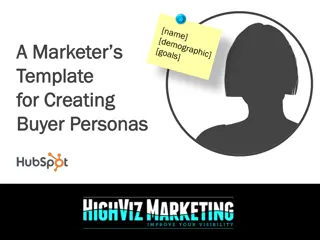
Activity 1. In your group, analyze the fake generated persona 2. Form clickbait headlines to cater to several specific details of the generated persona 3. Groups switch and create new headlines (Repeat) 4. Report out and reflect Search the ACRL Sandbox for more lessons with #fakenews
Questions for Reflection What did you discover about online article headlines? What types of information do clickbait articles exploit? How can social media as a medium be used to distort information by purveyors of fake news? How might these types of headlines contribute to the spread of misinformation and fake news? Search the ACRL Sandbox for more lessons with #fakenews
References Plato. The Republic: Book VII. The Internet Classics Archive. Accessed November 26, 2019. http://classics.mit.edu/Plato/ republic.8.vii.html. Rivage-Seul, D. Michael. Alternative Fact and Fake News Inside Plato s Cave. In The Magic Glasses of Critical Thinking: Seeing Through Alternative Fact and Fake News. New York: Peter Lang, 2018. Smith, Aaron and Monica Anderson. Social Media Use in 2018. Pew Research Center: Internet, Science & Tech. Pew Research Center, Mar. 1, 2018. https://www.pewresearch.org/internet/2018/03/01/social-media- use-in-2018 Solomon, Laura. The Librarian s Nitty-Gritty Guide to Content Marketing. Chicago: American Library Association, 2016. Zengotita, Thomas de. Mediated: How the Media Shapes Your World and the Way You Live in It. New York: Bloomsbury, 2005. Search the ACRL Sandbox for more lessons with #fakenews