Fault Tolerant Distributed Systems Overview
This lecture by Prof. Cinzia Bernardeschi explores fault models in distributed systems, emphasizing the design of fault-tolerant systems to handle various types of failures such as node and communication failures. It covers concepts like Byzantine failures, crash failures, building blocks for fault-tolerant systems, and architecting fault-tolerant systems considering different system models. The content discusses key elements like atomic actions, consensus, and trusted components essential for fault tolerance in distributed systems.

Download Presentation

Please find below an Image/Link to download the presentation.
The content on the website is provided AS IS for your information and personal use only. It may not be sold, licensed, or shared on other websites without obtaining consent from the author.If you encounter any issues during the download, it is possible that the publisher has removed the file from their server.
You are allowed to download the files provided on this website for personal or commercial use, subject to the condition that they are used lawfully. All files are the property of their respective owners.
The content on the website is provided AS IS for your information and personal use only. It may not be sold, licensed, or shared on other websites without obtaining consent from the author.
E N D
Presentation Transcript
Basic buiding blocks in Fault Tolerant distributed systems Lecture 4 Prof. Cinzia Bernardeschi Department of Information Engineering Univerisity of Pisa, Italy cinzia.bernardeschi@unipi.it May 7-10, 2019 Thessaloniki, Greece
Outline Fault models in distributed systems Atomic actions Consensus problem Conclusions May 7-10, 2019 Basic building blocks in Fault Tolerant distributed systems 2
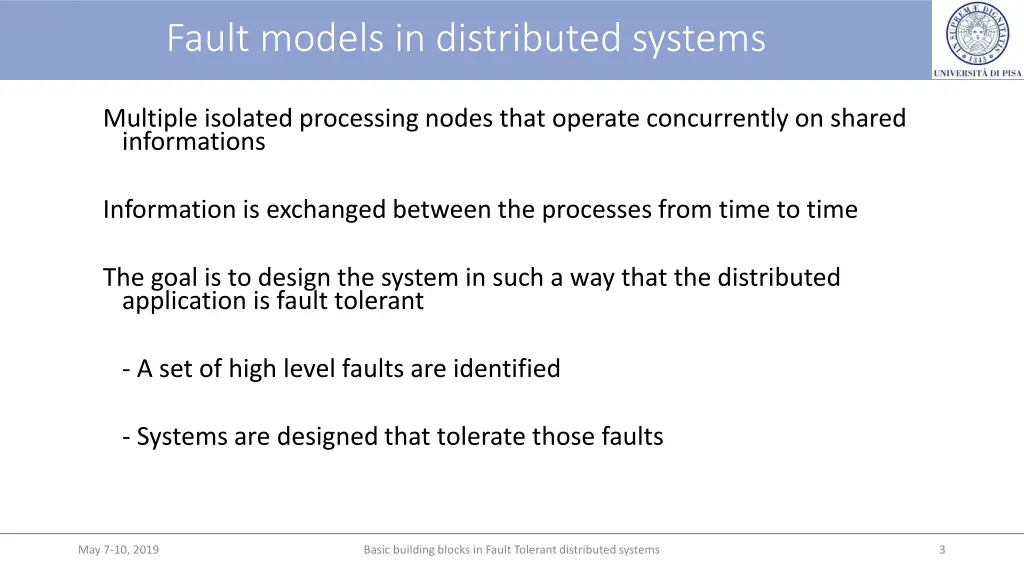
Fault models in distributed systems Multiple isolated processing nodes that operate concurrently on shared informations Information is exchanged between the processes from time to time The goal is to design the system in such a way that the distributed application is fault tolerant - A set of high level faults are identified - Systems are designed that tolerate those faults May 7-10, 2019 Basic building blocks in Fault Tolerant distributed systems 3
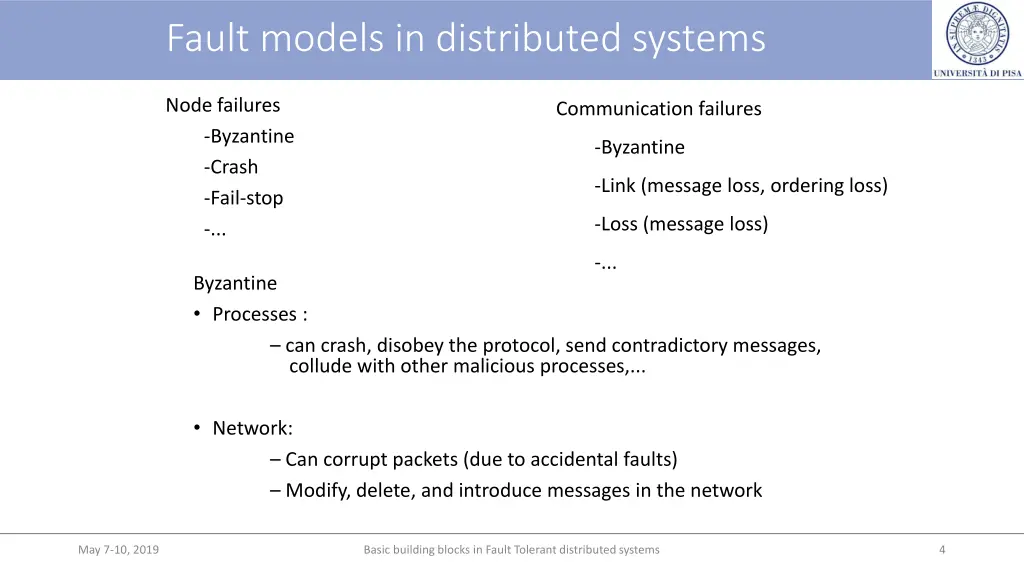
Fault models in distributed systems Node failures -Byzantine -Crash -Fail-stop -... Communication failures -Byzantine -Link (message loss, ordering loss) -Loss (message loss) -... Byzantine Processes : can crash, disobey the protocol, send contradictory messages, collude with other malicious processes,... Network: Can corrupt packets (due to accidental faults) Modify, delete, and introduce messages in the network May 7-10, 2019 Basic building blocks in Fault Tolerant distributed systems 4
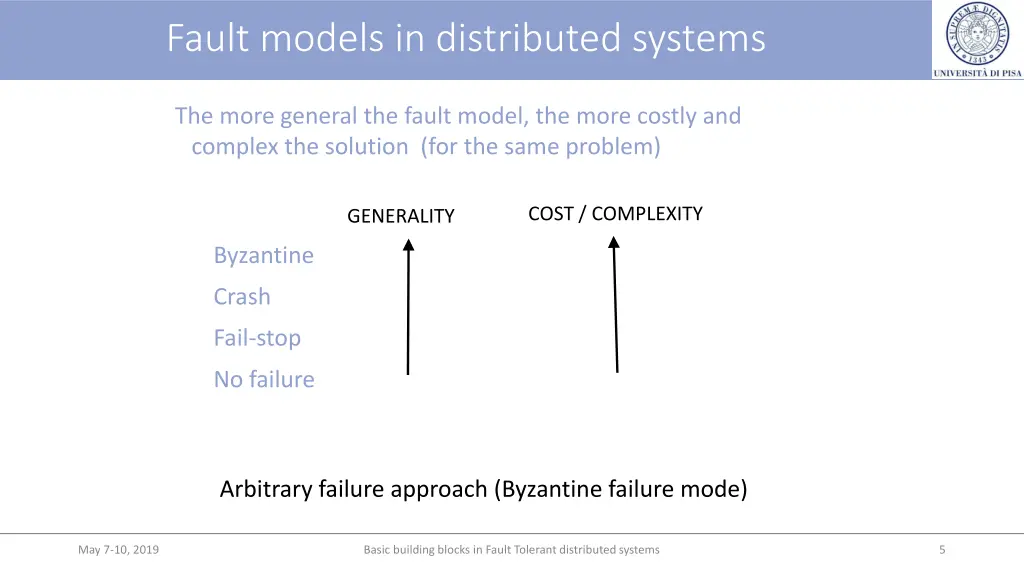
Fault models in distributed systems The more general the fault model, the more costly and complex the solution (for the same problem) COST / COMPLEXITY GENERALITY Byzantine Crash Fail-stop No failure Arbitrary failure approach (Byzantine failure mode) May 7-10, 2019 Basic building blocks in Fault Tolerant distributed systems 5
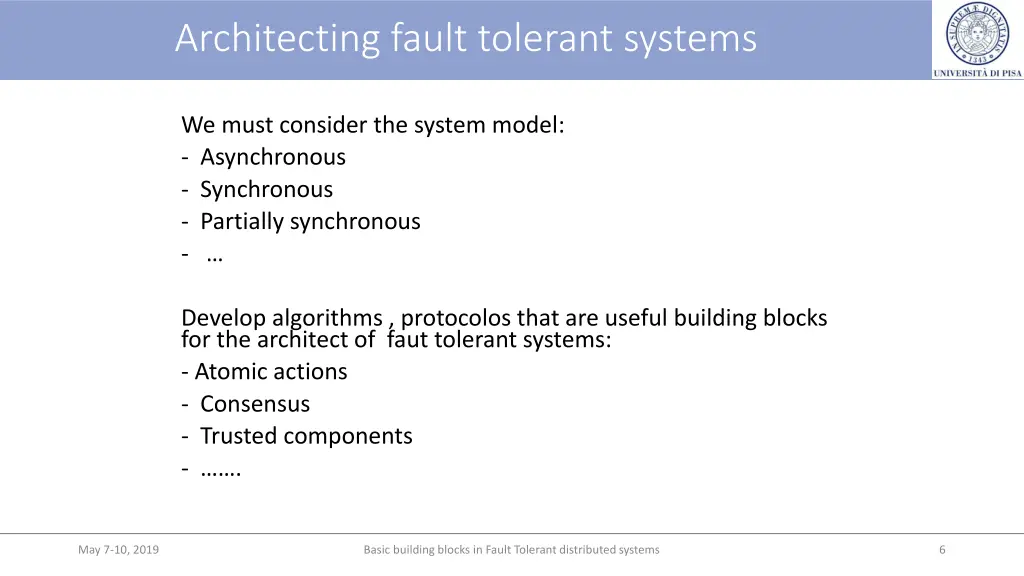
Architecting fault tolerant systems We must consider the system model: - Asynchronous - Synchronous - Partially synchronous - Develop algorithms , protocolos that are useful building blocks for the architect of faut tolerant systems: - Atomic actions - Consensus - Trusted components - . May 7-10, 2019 Basic building blocks in Fault Tolerant distributed systems 6
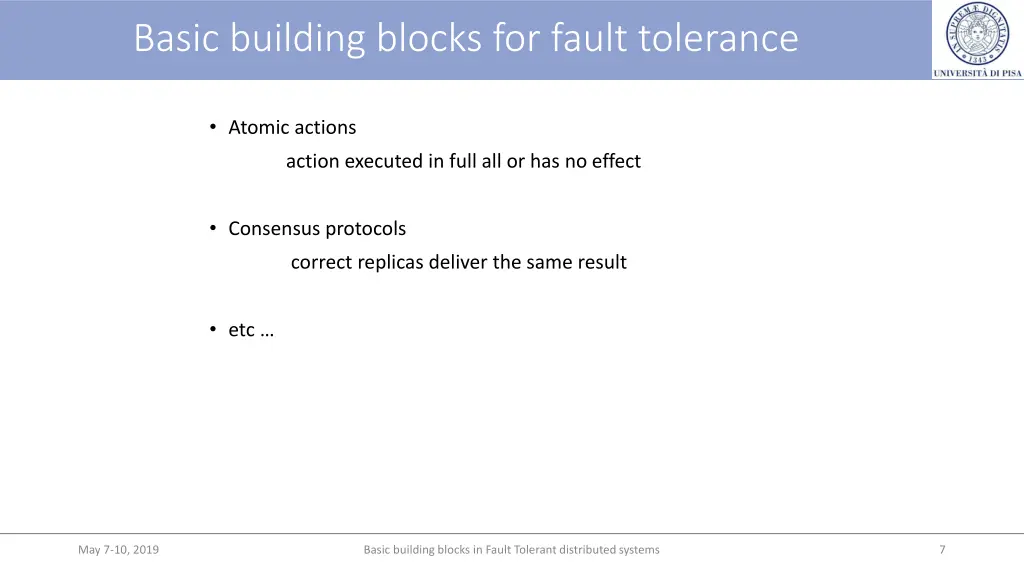
Basic building blocks for fault tolerance Atomic actions action executed in full all or has no effect Consensus protocols correct replicas deliver the same result etc May 7-10, 2019 Basic building blocks in Fault Tolerant distributed systems 7
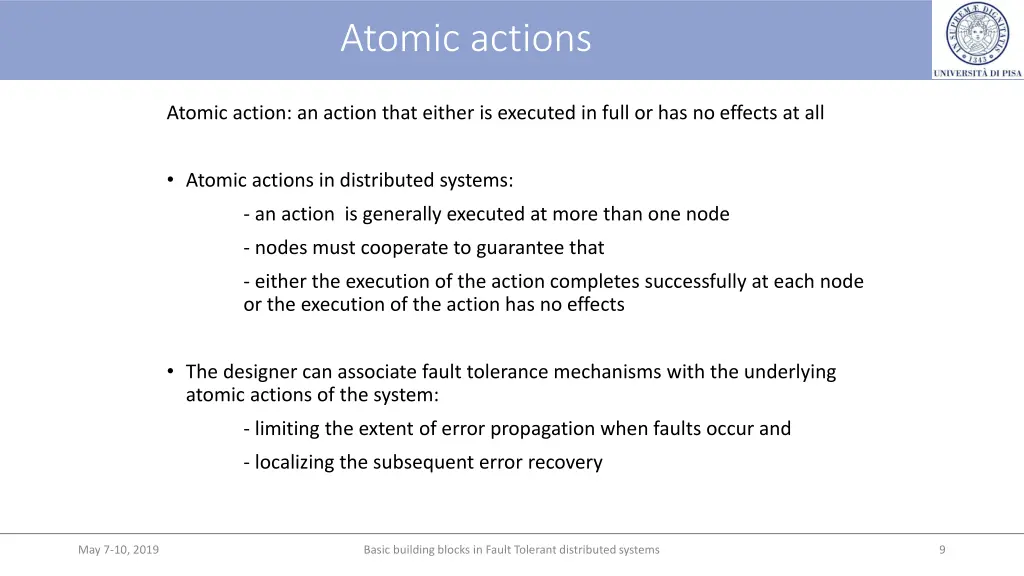
Atomic actions Atomic action: an action that either is executed in full or has no effects at all Atomic actions in distributed systems: - an action is generally executed at more than one node - nodes must cooperate to guarantee that - either the execution of the action completes successfully at each node or the execution of the action has no effects The designer can associate fault tolerance mechanisms with the underlying atomic actions of the system: - limiting the extent of error propagation when faults occur and - localizing the subsequent error recovery May 7-10, 2019 Basic building blocks in Fault Tolerant distributed systems 9
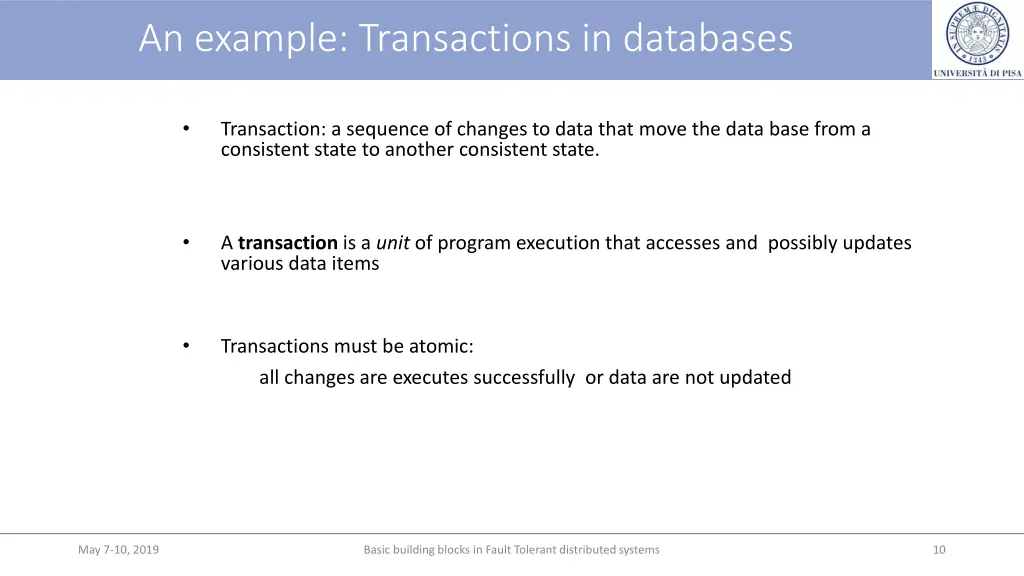
An example: Transactions in databases Transaction: a sequence of changes to data that move the data base from a consistent state to another consistent state. A transaction is a unit of program execution that accesses and possibly updates various data items Transactions must be atomic: all changes are executes successfully or data are not updated May 7-10, 2019 Basic building blocks in Fault Tolerant distributed systems 10
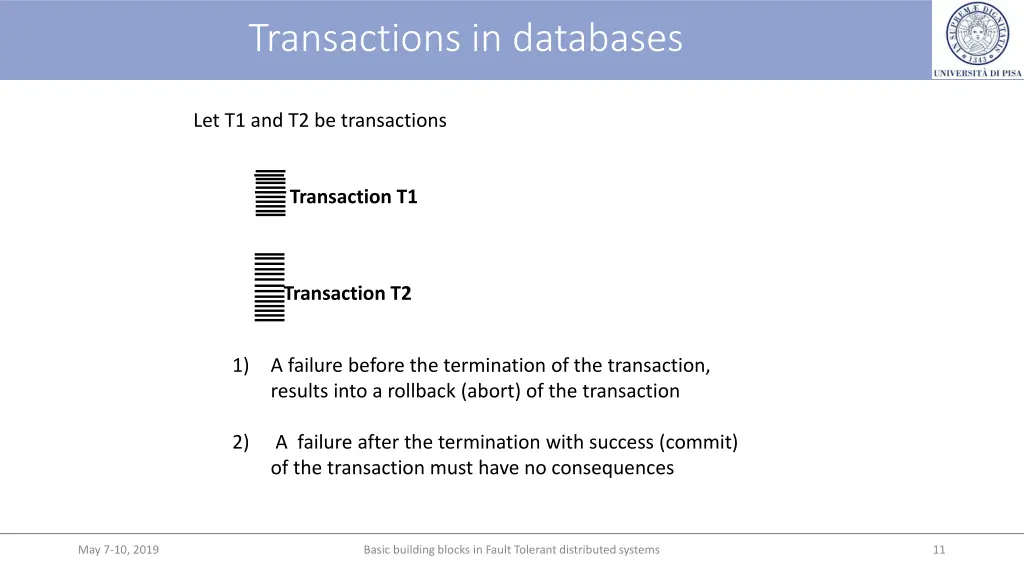
Transactions in databases Let T1 and T2 be transactions Transaction T1 Transaction T2 1) A failure before the termination of the transaction, results into a rollback (abort) of the transaction 2) A failure after the termination with success (commit) of the transaction must have no consequences May 7-10, 2019 Basic building blocks in Fault Tolerant distributed systems 11
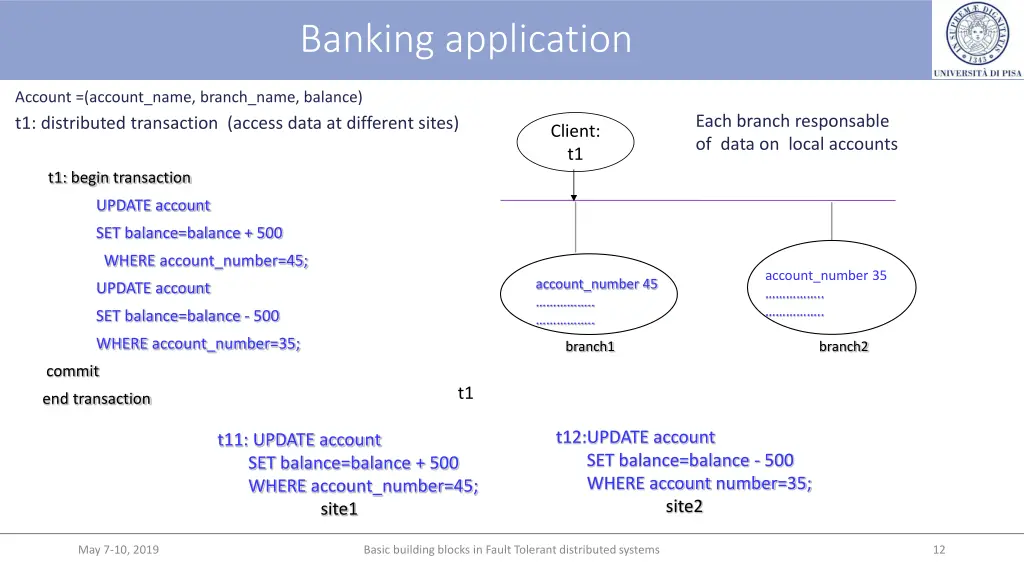
Banking application Account =(account_name, branch_name, balance) t1: distributed transaction (access data at different sites) Each branch responsable of data on local accounts Client: t1 t1: begin transaction UPDATE account SET balance=balance + 500 WHERE account_number=45; account_number 35 .. .. account_number 45 .. .. UPDATE account SET balance=balance - 500 WHERE account_number=35; branch1 branch2 commit t1 end transaction t12:UPDATE account SET balance=balance - 500 WHERE account number=35; site2 t11: UPDATE account SET balance=balance + 500 WHERE account_number=45; site1 May 7-10, 2019 Basic building blocks in Fault Tolerant distributed systems 12
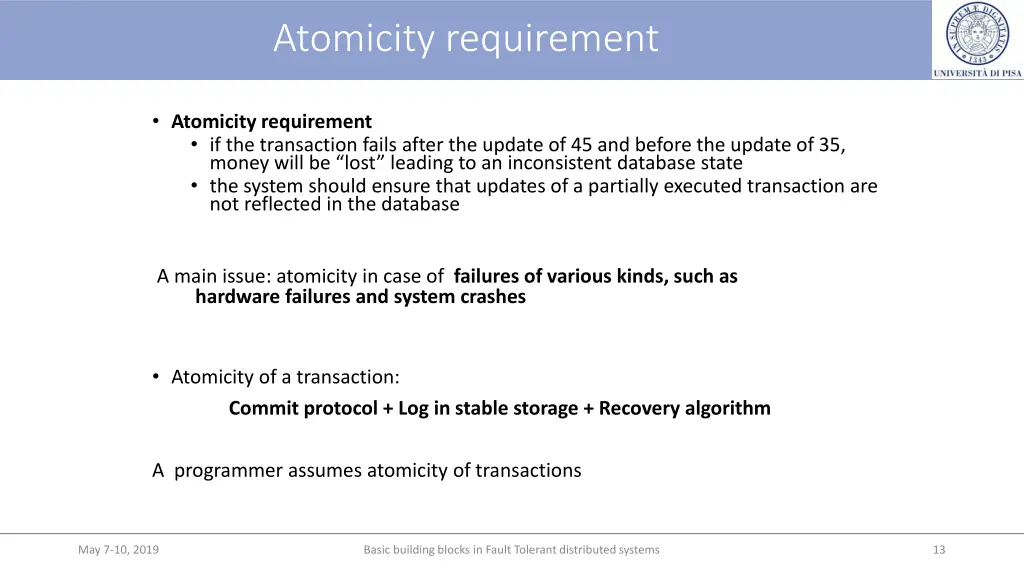
Atomicity requirement Atomicity requirement if the transaction fails after the update of 45 and before the update of 35, money will be lost leading to an inconsistent database state the system should ensure that updates of a partially executed transaction are not reflected in the database A main issue: atomicity in case of failures of various kinds, such as hardware failures and system crashes Atomicity of a transaction: Commit protocol + Log in stable storage + Recovery algorithm A programmer assumes atomicity of transactions May 7-10, 2019 Basic building blocks in Fault Tolerant distributed systems 13
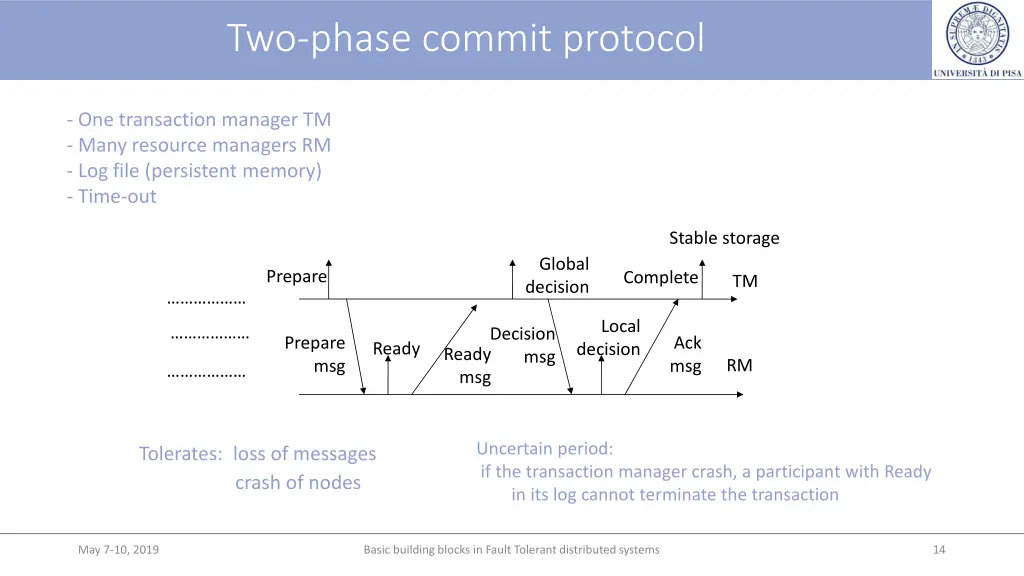
Two-phase commit protocol - One transaction manager TM - Many resource managers RM - Log file (persistent memory) - Time-out Stable storage Global decision Prepare Complete TM Local Decision Prepare msg Ack msg Ready decision Ready msg msg RM Uncertain period: if the transaction manager crash, a participant with Ready in its log cannot terminate the transaction Tolerates: loss of messages crash of nodes May 7-10, 2019 Basic building blocks in Fault Tolerant distributed systems 14
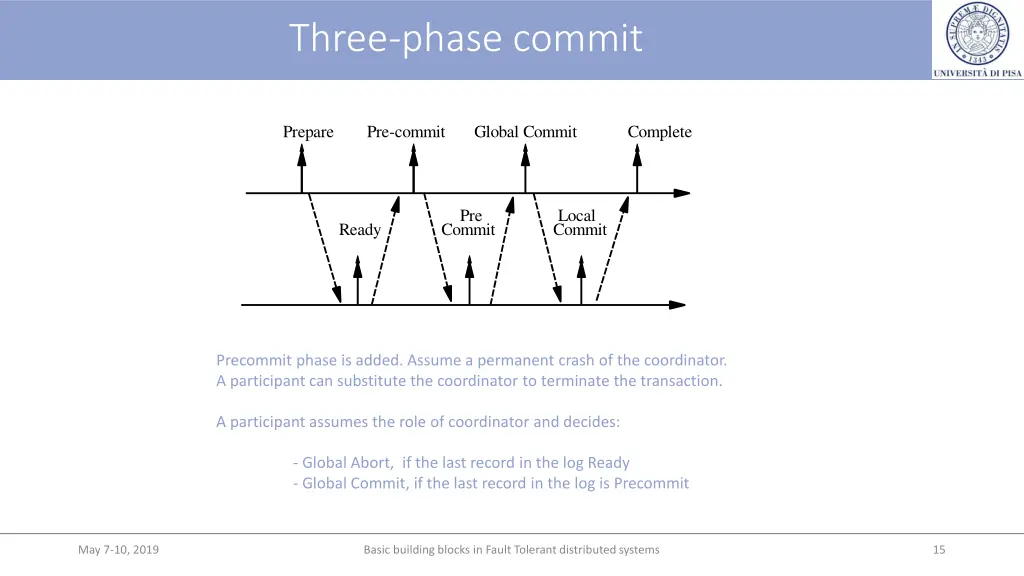
Three-phase commit Prepare Pre-commit Global Commit Complete Pre Local Commit Ready Commit Precommit phase is added. Assume a permanent crash of the coordinator. A participant can substitute the coordinator to terminate the transaction. A participant assumes the role of coordinator and decides: - Global Abort, if the last record in the log Ready - Global Commit, if the last record in the log is Precommit May 7-10, 2019 Basic building blocks in Fault Tolerant distributed systems 15
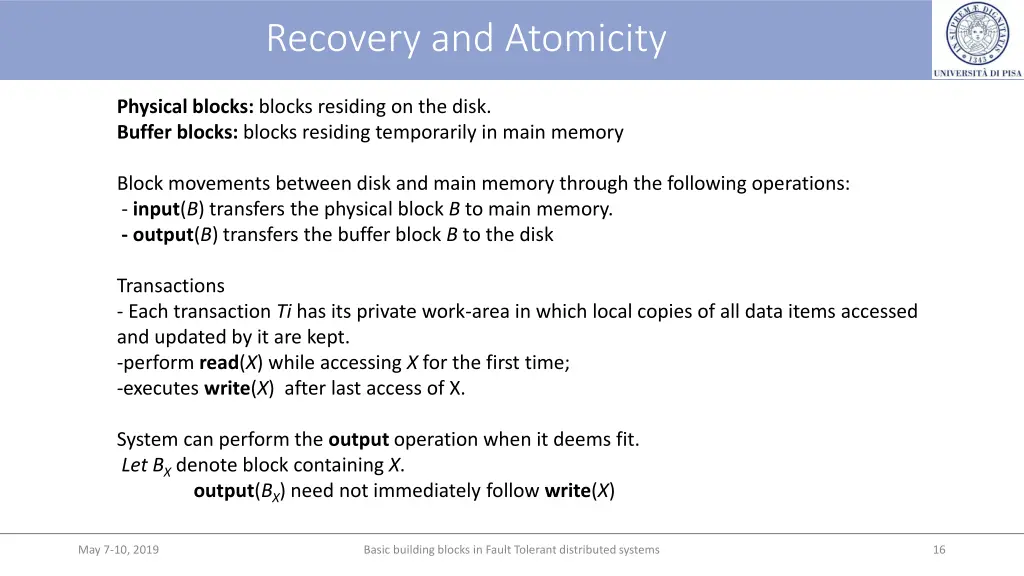
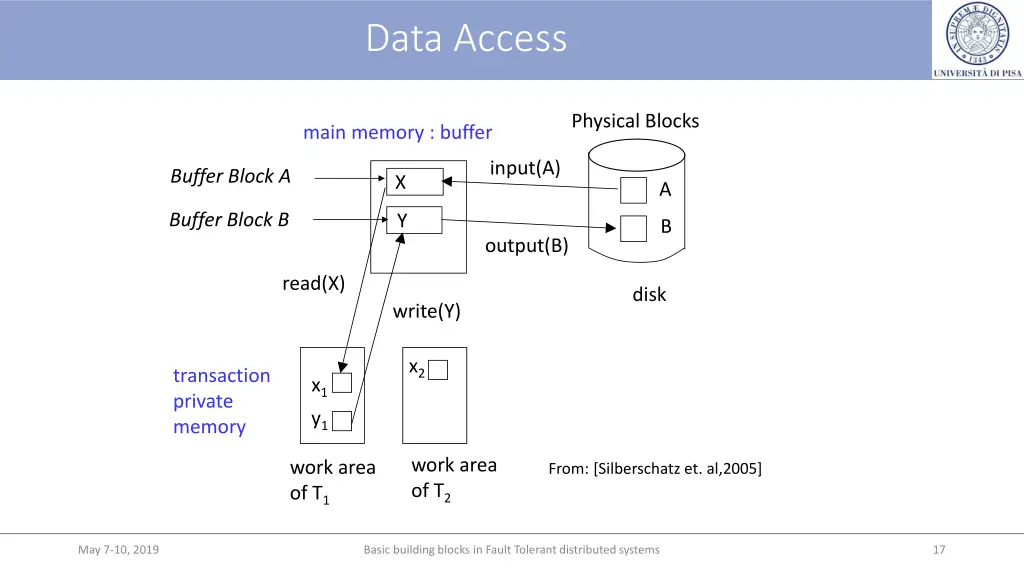
Recovery and Atomicity Physical blocks: blocks residing on the disk. Buffer blocks: blocks residing temporarily in main memory Block movements between disk and main memory through the following operations: - input(B) transfers the physical block B to main memory. - output(B) transfers the buffer block B to the disk Transactions - Each transaction Ti has its private work-area in which local copies of all data items accessed and updated by it are kept. -perform read(X) while accessing X for the first time; -executes write(X) after last access of X. System can perform the output operation when it deems fit. Let BXdenote block containing X. output(BX) need not immediately follow write(X) May 7-10, 2019 Basic building blocks in Fault Tolerant distributed systems 16
Data Access Physical Blocks main memory : buffer input(A) Buffer Block A X A Buffer Block B Y B output(B) read(X) disk write(Y) x2 transaction private memory x1 y1 work area of T2 work area of T1 From: [Silberschatz et. al,2005] May 7-10, 2019 Basic building blocks in Fault Tolerant distributed systems 17
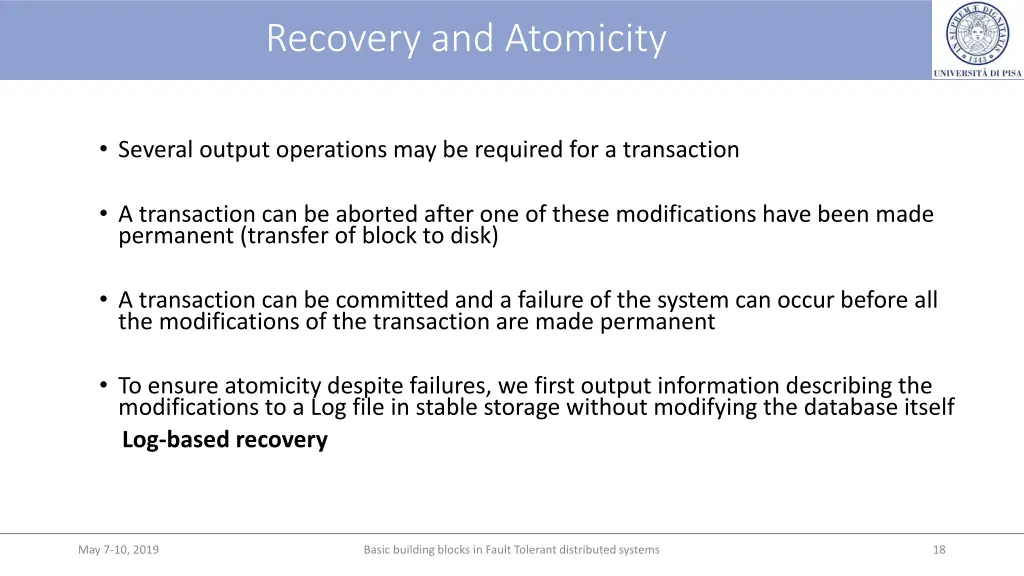
Recovery and Atomicity Several output operations may be required for a transaction A transaction can be aborted after one of these modifications have been made permanent (transfer of block to disk) A transaction can be committed and a failure of the system can occur before all the modifications of the transaction are made permanent To ensure atomicity despite failures, we first output information describing the modifications to a Log file in stable storage without modifying the database itself Log-based recovery May 7-10, 2019 Basic building blocks in Fault Tolerant distributed systems 18
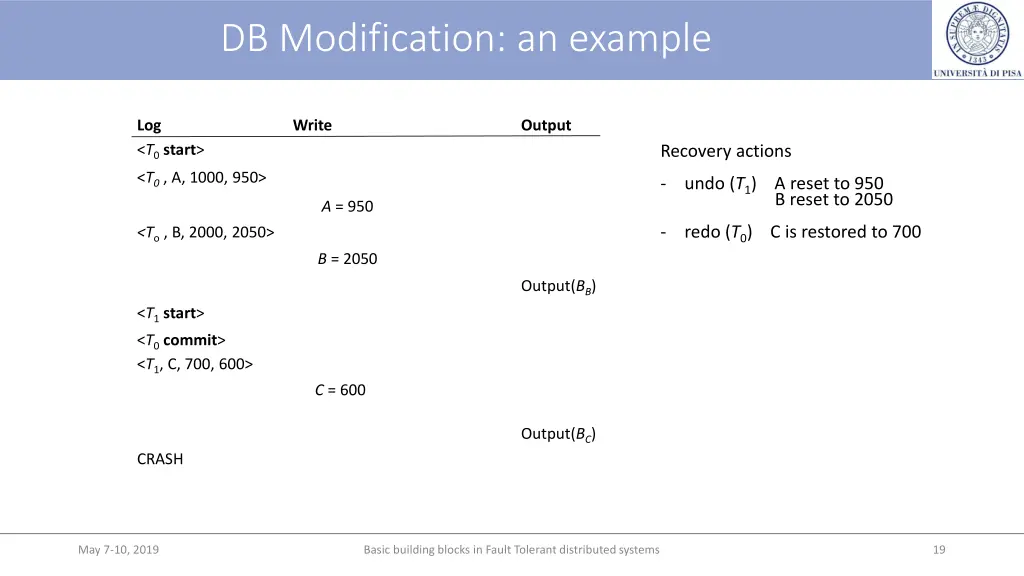
DB Modification: an example Log Write <T0start> <T0, A, 1000, 950> Output Recovery actions - undo (T1) A reset to 950 B reset to 2050 A = 950 - redo (T0) C is restored to 700 <To, B, 2000, 2050> B = 2050 Output(BB) <T1start> <T0commit> <T1, C, 700, 600> C = 600 Output(BC) CRASH May 7-10, 2019 Basic building blocks in Fault Tolerant distributed systems 19
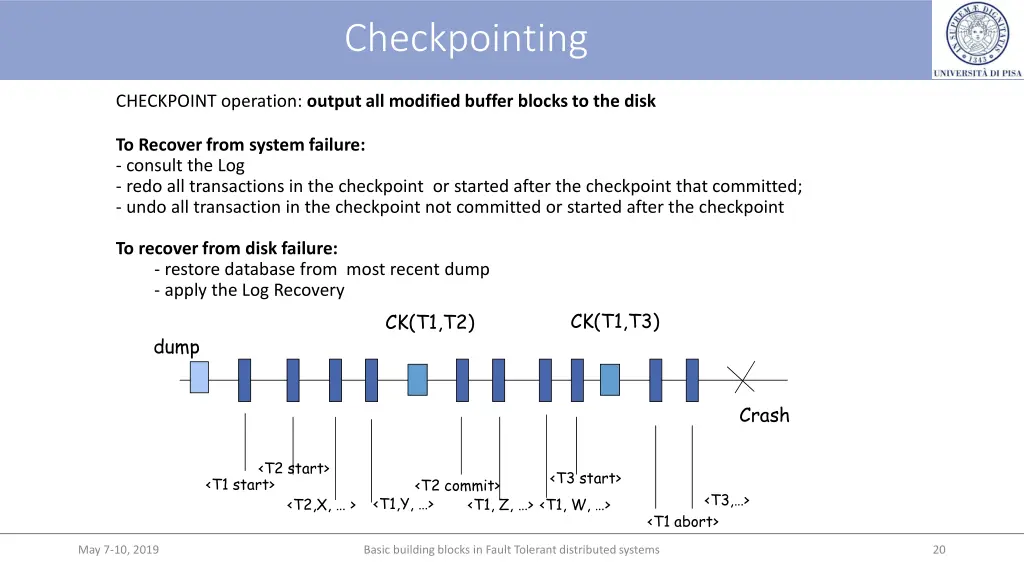
Checkpointing CHECKPOINT operation: output all modified buffer blocks to the disk To Recover from system failure: - consult the Log - redo all transactions in the checkpoint or started after the checkpoint that committed; - undo all transaction in the checkpoint not committed or started after the checkpoint To recover from disk failure: - restore database from most recent dump - apply the Log Recovery CK(T1,T3) CK(T1,T2) dump Crash <T2 start> <T3 start> <T1, W, > <T1 start> <T2 commit> <T1,Y, > <T3, > <T2,X, > <T1, Z, > <T1 abort> May 7-10, 2019 Basic building blocks in Fault Tolerant distributed systems 20
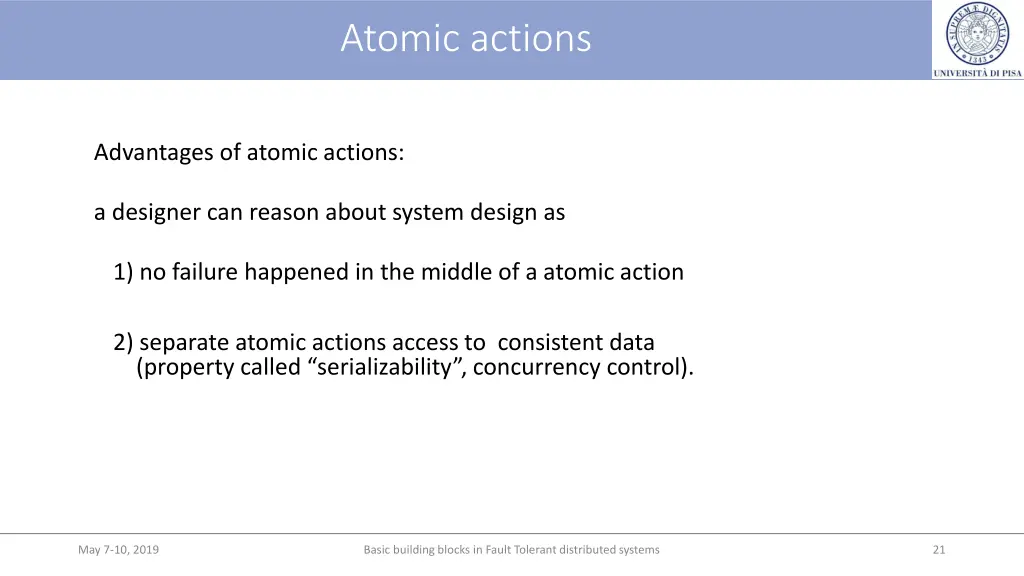
Atomic actions Advantages of atomic actions: a designer can reason about system design as 1) no failure happened in the middle of a atomic action 2) separate atomic actions access to consistent data (property called serializability , concurrency control). May 7-10, 2019 Basic building blocks in Fault Tolerant distributed systems 21
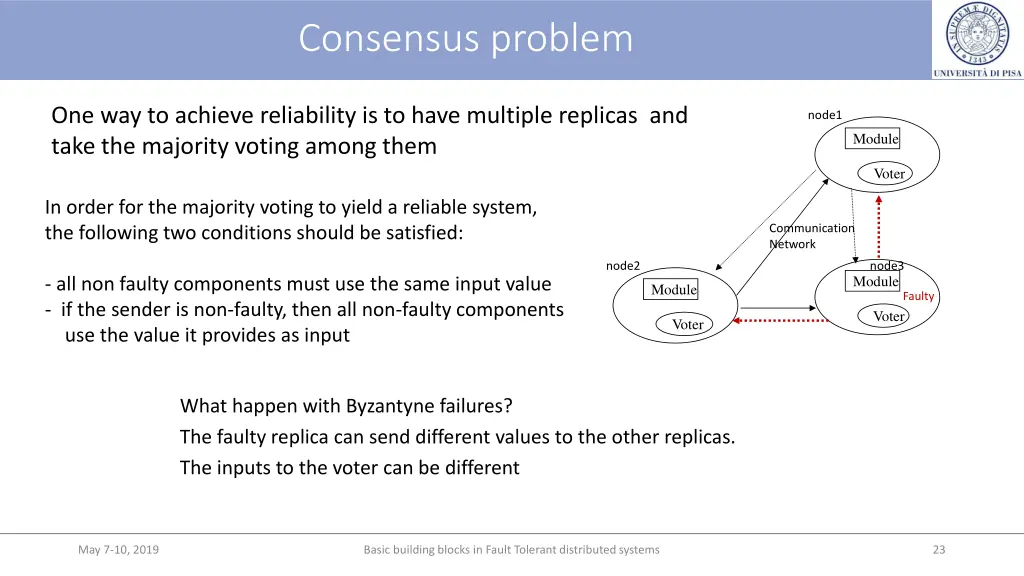
Consensus problem One way to achieve reliability is to have multiple replicas and take the majority voting among them node1 Module Voter In order for the majority voting to yield a reliable system, the following two conditions should be satisfied: - all non faulty components must use the same input value - if the sender is non-faulty, then all non-faulty components use the value it provides as input Communication Network node2 node3 Module Module Faulty Voter Voter What happen with Byzantyne failures? The faulty replica can send different values to the other replicas. The inputs to the voter can be different May 7-10, 2019 Basic building blocks in Fault Tolerant distributed systems 23
Consensus problem The Consensus problem can be stated informally as: how to make a set of distributed processors achieve agreement on a value sent by one processor despite a number of failures Byzantine Generals metaphor used in the classical paper by [Lamport et al.,1982] The problem is given in terms of generals who have surrounded the enemy. Generals wish to organize a plan of action to attack or to retreat. They must take the same decision. Each general observes the enemy and communicates his observations to the others. Unfortunately there are traitors among generals and traitors want to influence this plan to the enemy s advantage. They may lie about whether they will support a particular plan and what other generals told them. May 7-10, 2019 Basic building blocks in Fault Tolerant distributed systems 24
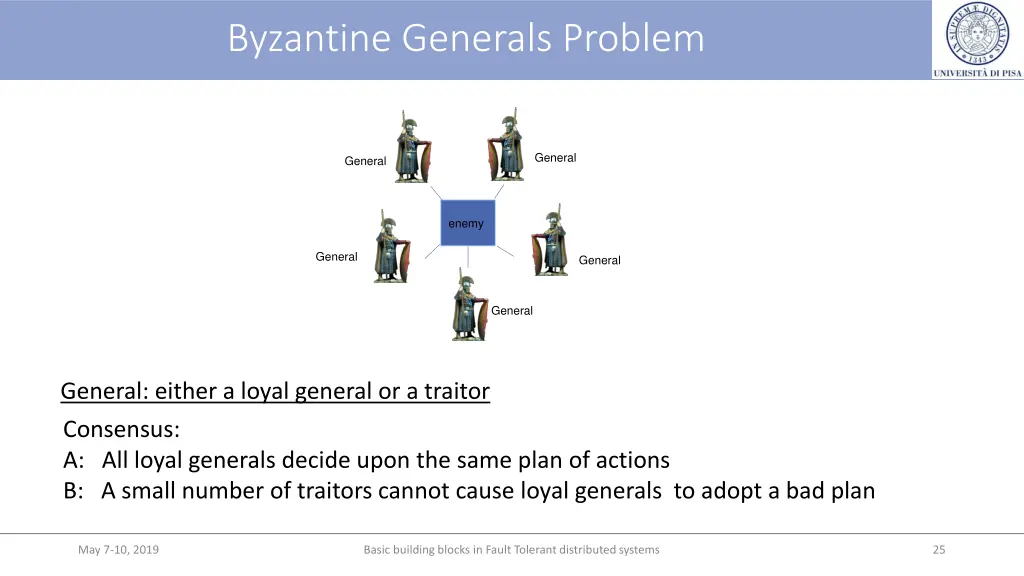
Byzantine Generals Problem General General enemy General General General General: either a loyal general or a traitor Consensus: A: All loyal generals decide upon the same plan of actions B: A small number of traitors cannot cause loyal generals to adopt a bad plan May 7-10, 2019 Basic building blocks in Fault Tolerant distributed systems 25
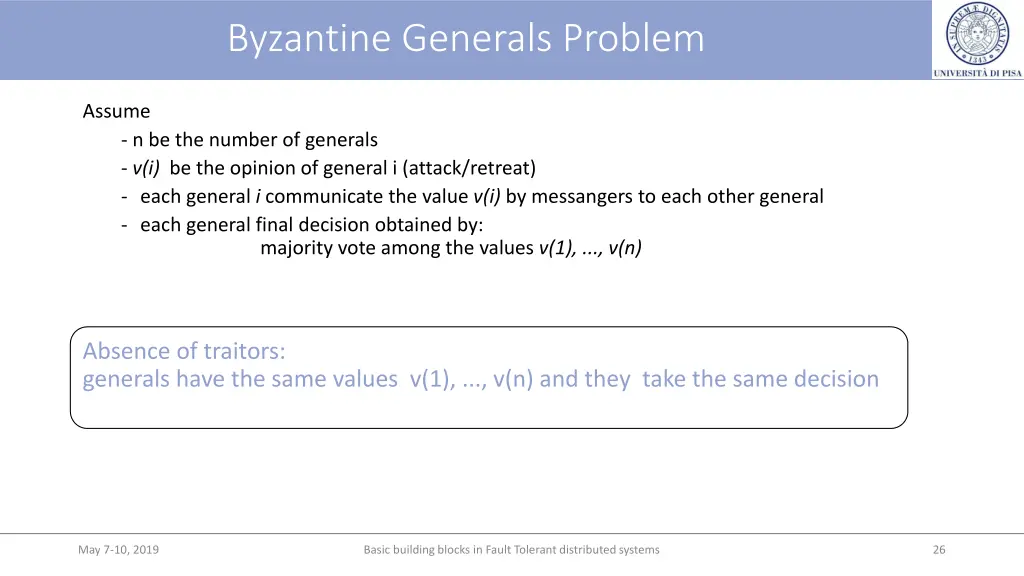
Byzantine Generals Problem Assume - n be the number of generals - v(i) be the opinion of general i (attack/retreat) - each general i communicate the value v(i) by messangers to each other general - each general final decision obtained by: majority vote among the values v(1), ..., v(n) Absence of traitors: generals have the same values v(1), ..., v(n) and they take the same decision May 7-10, 2019 Basic building blocks in Fault Tolerant distributed systems 26
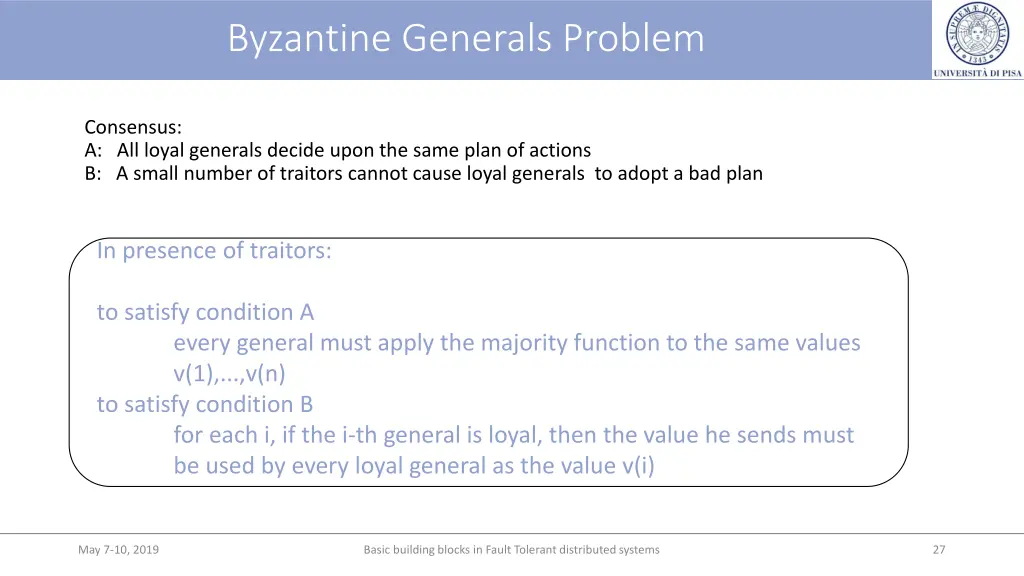
Byzantine Generals Problem Consensus: A: All loyal generals decide upon the same plan of actions B: A small number of traitors cannot cause loyal generals to adopt a bad plan In presence of traitors: to satisfy condition A every general must apply the majority function to the same values v(1),...,v(n) to satisfy condition B for each i, if the i-th general is loyal, then the value he sends must be used by every loyal general as the value v(i) May 7-10, 2019 Basic building blocks in Fault Tolerant distributed systems 27
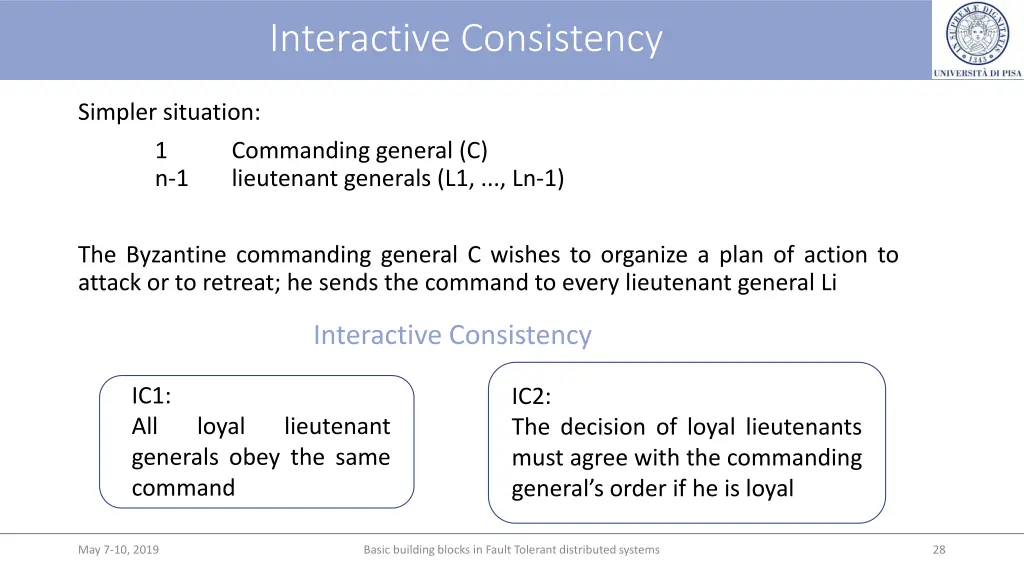
Interactive Consistency Simpler situation: 1 n-1 Commanding general (C) lieutenant generals (L1, ..., Ln-1) The Byzantine commanding general C wishes to organize a plan of action to attack or to retreat; he sends the command to every lieutenant general Li Interactive Consistency IC1: All generals obey the same command IC2: The decision of loyal lieutenants must agree with the commanding general s order if he is loyal loyal lieutenant May 7-10, 2019 Basic building blocks in Fault Tolerant distributed systems 28
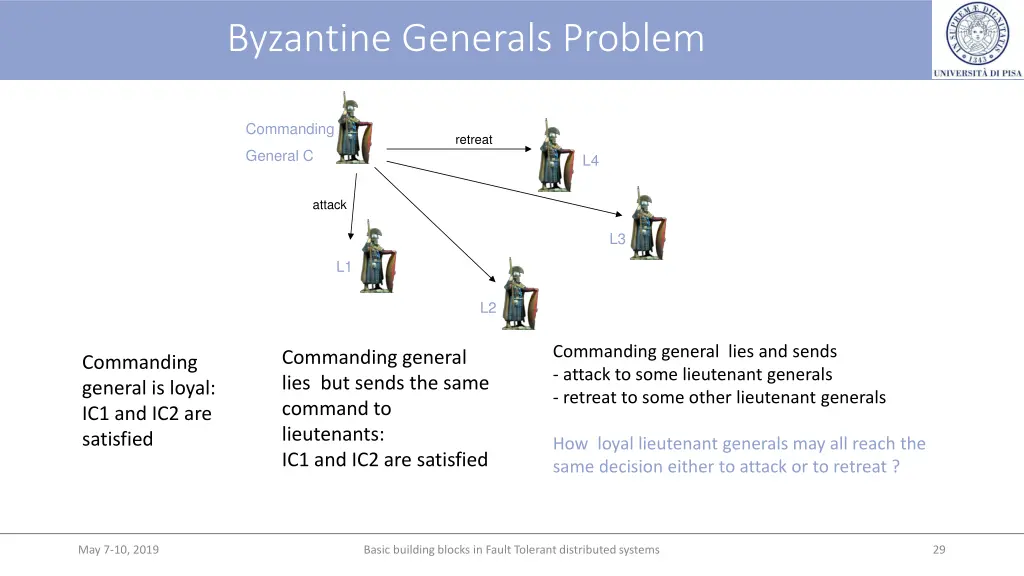
Byzantine Generals Problem Commanding retreat General C L4 attack L3 L1 L2 Commanding general lies and sends - attack to some lieutenant generals - retreat to some other lieutenant generals Commanding general lies but sends the same command to lieutenants: IC1 and IC2 are satisfied Commanding general is loyal: IC1 and IC2 are satisfied How loyal lieutenant generals may all reach the same decision either to attack or to retreat ? May 7-10, 2019 Basic building blocks in Fault Tolerant distributed systems 29
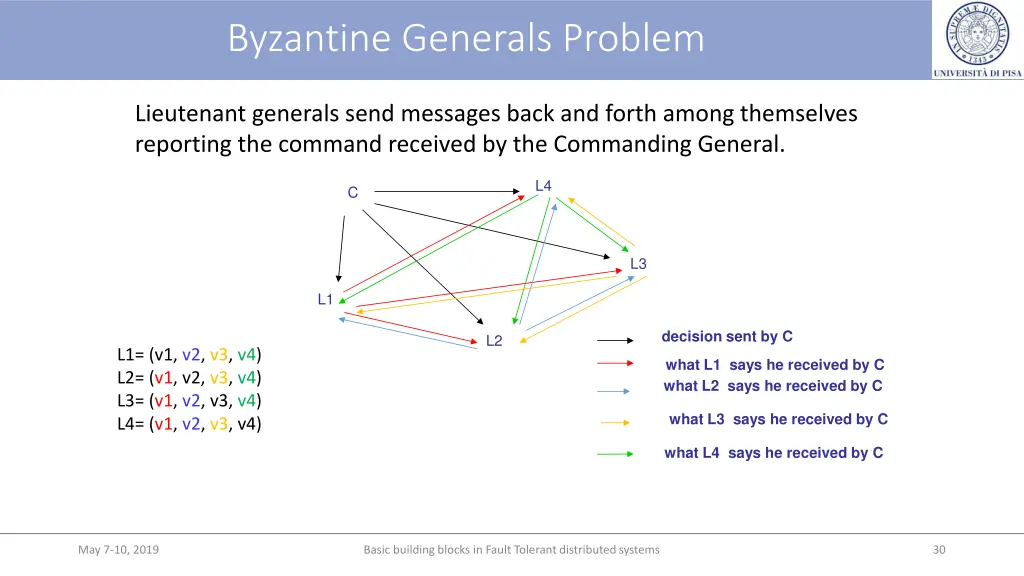
Byzantine Generals Problem Lieutenant generals send messages back and forth among themselves reporting the command received by the Commanding General. L4 C L3 L1 decision sent by C L2 L1= (v1, v2, v3, v4) L2= (v1, v2, v3, v4) L3= (v1, v2, v3, v4) L4= (v1, v2, v3, v4) what L1 says he received by C what L2 says he received by C what L3 says he received by C what L4 says he received by C May 7-10, 2019 Basic building blocks in Fault Tolerant distributed systems 30
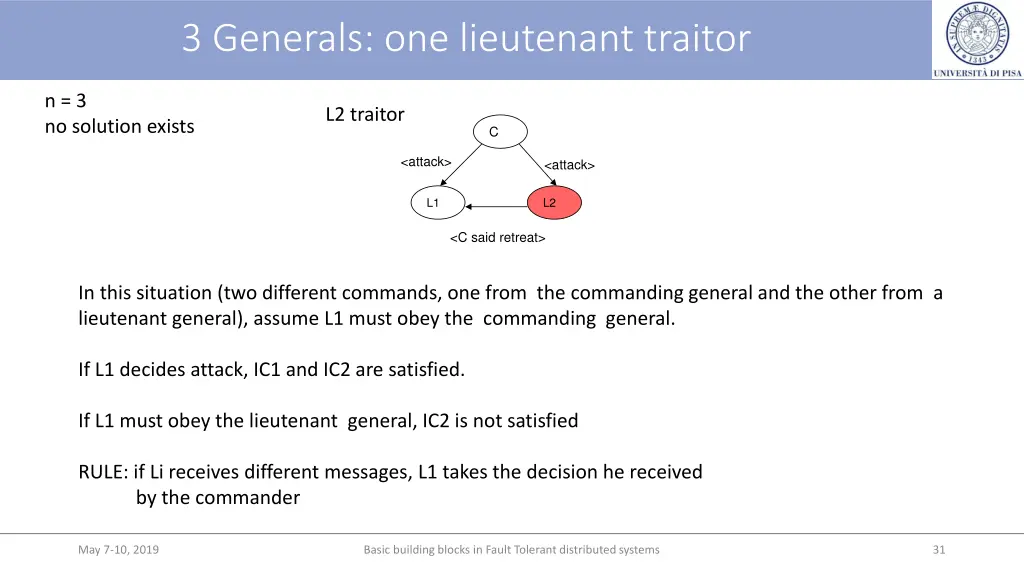
3 Generals: one lieutenant traitor n = 3 no solution exists L2 traitor C <attack> <attack> L1 L2 <C said retreat> In this situation (two different commands, one from the commanding general and the other from a lieutenant general), assume L1 must obey the commanding general. If L1 decides attack, IC1 and IC2 are satisfied. If L1 must obey the lieutenant general, IC2 is not satisfied RULE: if Li receives different messages, L1 takes the decision he received by the commander May 7-10, 2019 Basic building blocks in Fault Tolerant distributed systems 31
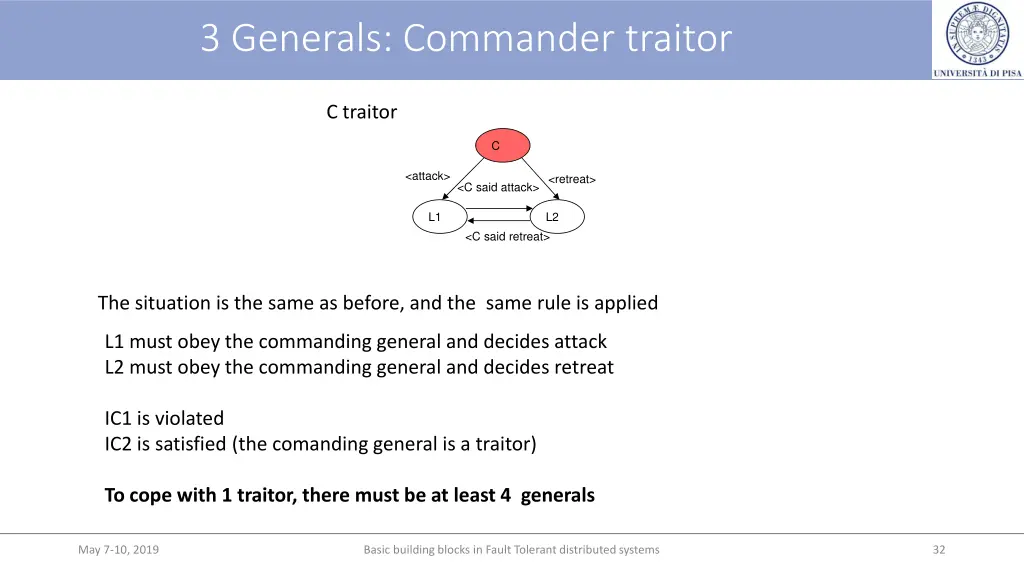
3 Generals: Commander traitor C traitor C <attack> <retreat> <C said attack> L1 L2 <C said retreat> The situation is the same as before, and the same rule is applied L1 must obey the commanding general and decides attack L2 must obey the commanding general and decides retreat IC1 is violated IC2 is satisfied (the comanding general is a traitor) To cope with 1 traitor, there must be at least 4 generals May 7-10, 2019 Basic building blocks in Fault Tolerant distributed systems 32
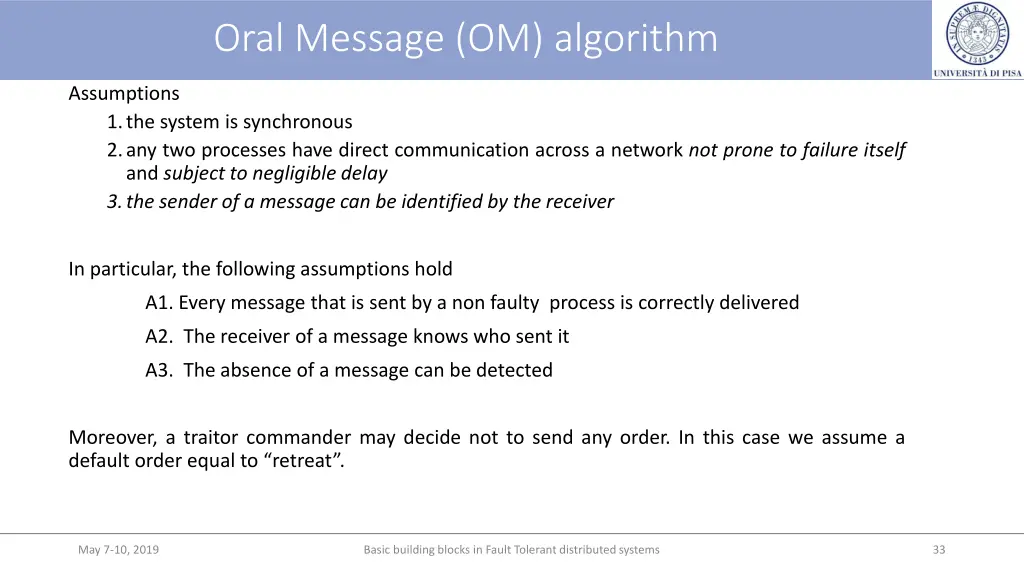
Oral Message (OM) algorithm Assumptions 1.the system is synchronous 2.any two processes have direct communication across a network not prone to failure itself and subject to negligible delay 3.the sender of a message can be identified by the receiver In particular, the following assumptions hold A1. Every message that is sent by a non faulty process is correctly delivered A2. The receiver of a message knows who sent it A3. The absence of a message can be detected Moreover, a traitor commander may decide not to send any order. In this case we assume a default order equal to retreat . May 7-10, 2019 Basic building blocks in Fault Tolerant distributed systems 33
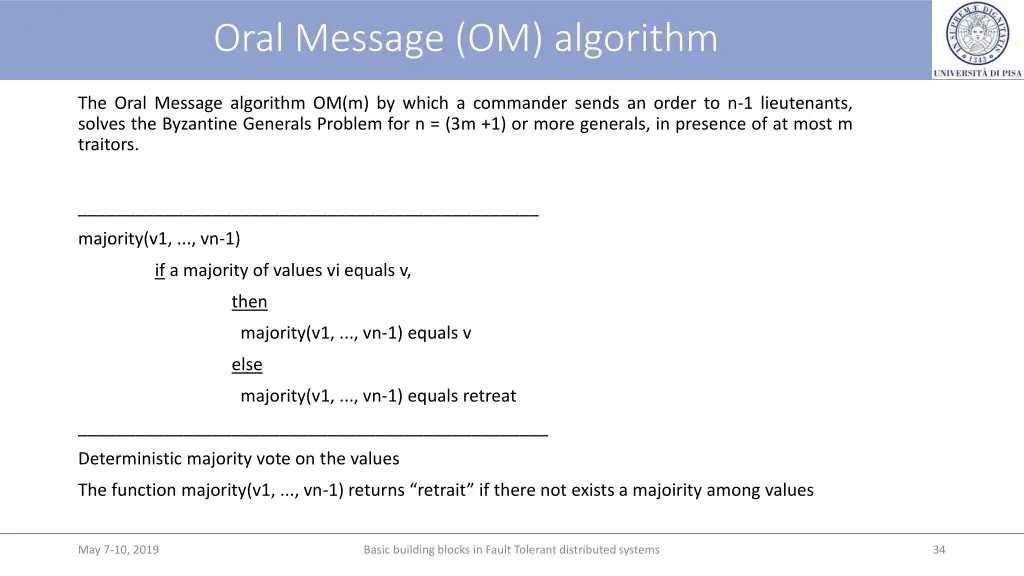
Oral Message (OM) algorithm The Oral Message algorithm OM(m) by which a commander sends an order to n-1 lieutenants, solves the Byzantine Generals Problem for n = (3m +1) or more generals, in presence of at most m traitors. ________________________________________________ majority(v1, ..., vn-1) if a majority of values vi equals v, then majority(v1, ..., vn-1) equals v else majority(v1, ..., vn-1) equals retreat _________________________________________________ Deterministic majority vote on the values The function majority(v1, ..., vn-1) returns retrait if there not exists a majoirity among values May 7-10, 2019 Basic building blocks in Fault Tolerant distributed systems 34
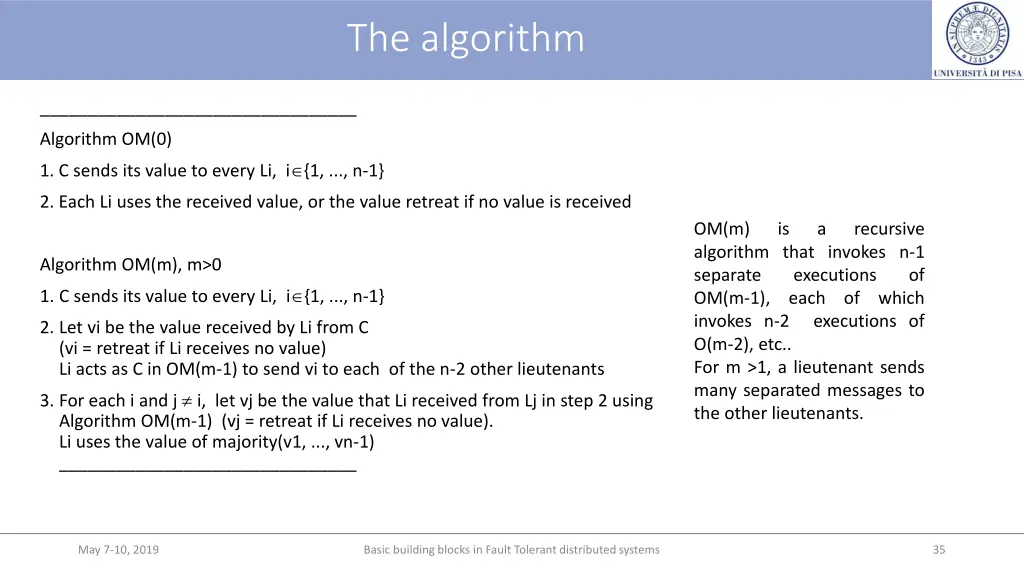
The algorithm _________________________________ Algorithm OM(0) 1. C sends its value to every Li, i {1, ..., n-1} 2. Each Li uses the received value, or the value retreat if no value is received OM(m) algorithm that invokes n-1 separate executions OM(m-1), each of which invokes n-2 executions of O(m-2), etc.. For m >1, a lieutenant sends many separated messages to the other lieutenants. is a recursive Algorithm OM(m), m>0 1. C sends its value to every Li, i {1, ..., n-1} of 2. Let vi be the value received by Li from C (vi = retreat if Li receives no value) Li acts as C in OM(m-1) to send vi to each of the n-2 other lieutenants 3. For each i and j i, let vj be the value that Li received from Lj in step 2 using Algorithm OM(m-1) (vj = retreat if Li receives no value). Li uses the value of majority(v1, ..., vn-1) _______________________________ May 7-10, 2019 Basic building blocks in Fault Tolerant distributed systems 35
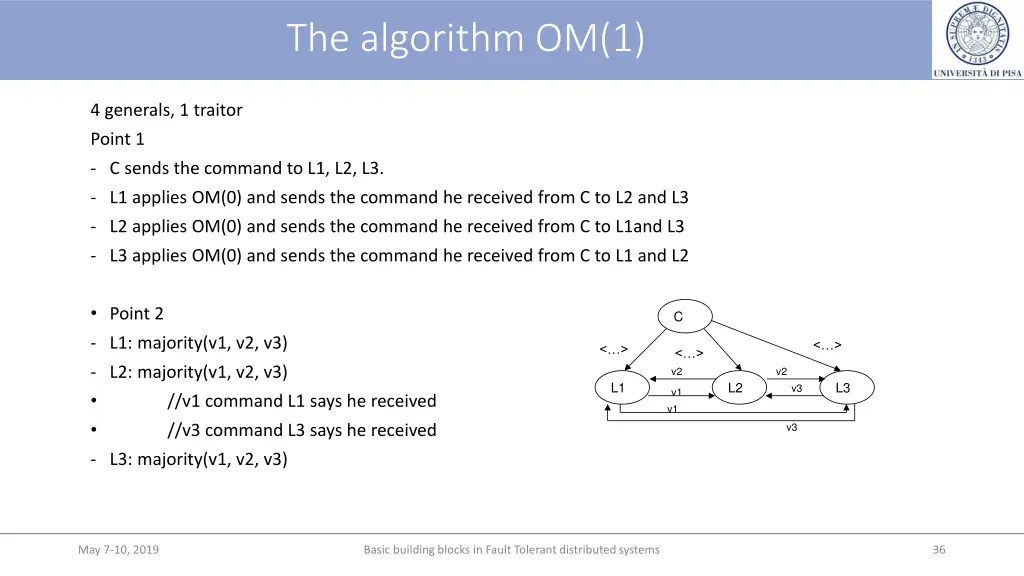
The algorithm OM(1) 4 generals, 1 traitor Point 1 - C sends the command to L1, L2, L3. - L1 applies OM(0) and sends the command he received from C to L2 and L3 - L2 applies OM(0) and sends the command he received from C to L1and L3 - L3 applies OM(0) and sends the command he received from C to L1 and L2 Point 2 C - L1: majority(v1, v2, v3) < > < > < > v2 - L2: majority(v1, v2, v3) //v1 command L1 says he received //v3 command L3 says he received v2 L1 L2 L3 v3 v1 v1 v3 - L3: majority(v1, v2, v3) May 7-10, 2019 Basic building blocks in Fault Tolerant distributed systems 36
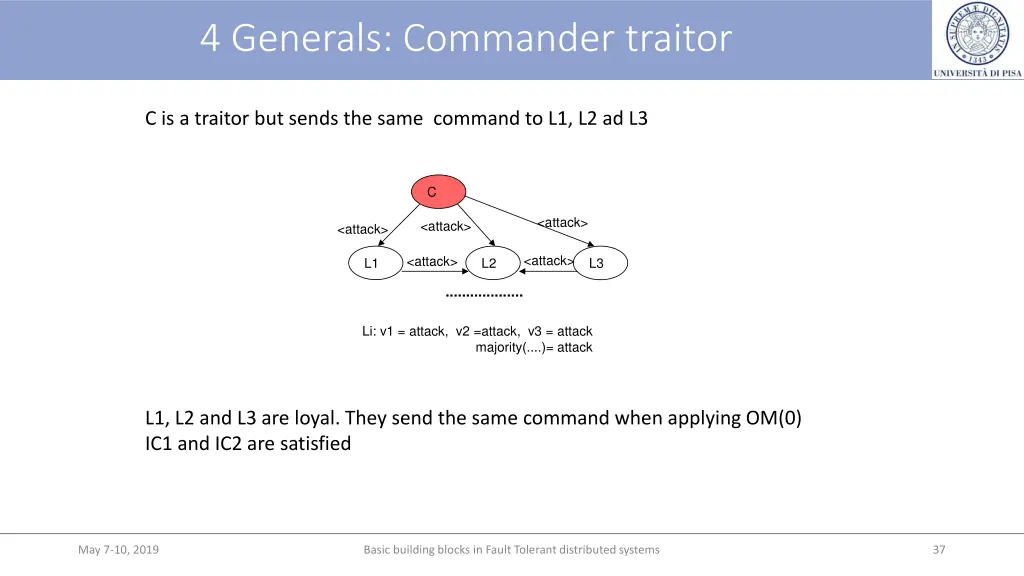
4 Generals: Commander traitor C is a traitor but sends the same command to L1, L2 ad L3 C <attack> <attack> <attack> <attack> <attack> L1 L2 L3 ................... Li: v1 = attack, v2 =attack, v3 = attack majority(....)= attack L1, L2 and L3 are loyal. They send the same command when applying OM(0) IC1 and IC2 are satisfied May 7-10, 2019 Basic building blocks in Fault Tolerant distributed systems 37
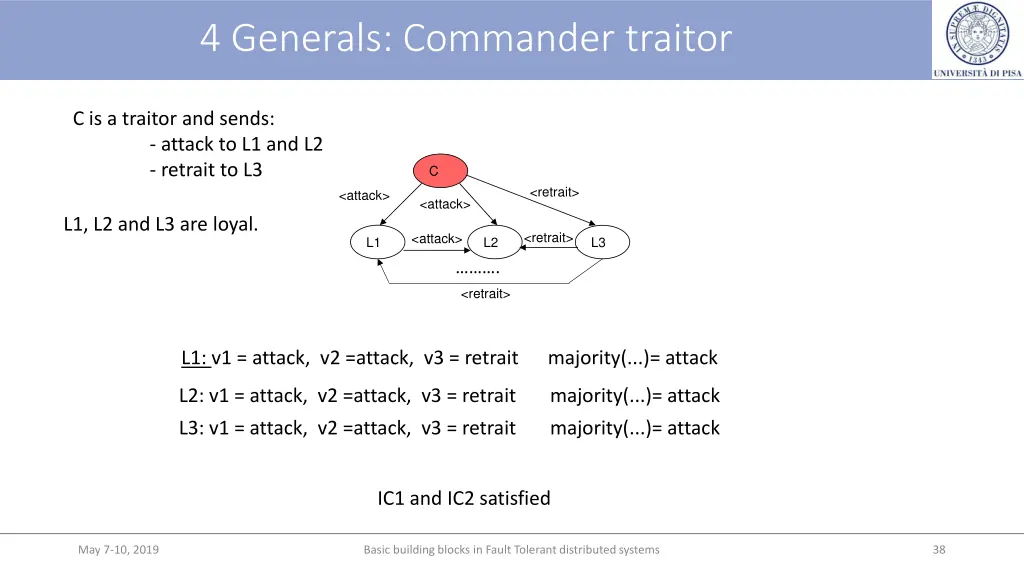
4 Generals: Commander traitor C is a traitor and sends: - attack to L1 and L2 - retrait to L3 C <retrait> <attack> <attack> L1, L2 and L3 are loyal. <retrait> <attack> L1 L2 L3 . <retrait> L1: v1 = attack, v2 =attack, v3 = retrait majority(...)= attack L2: v1 = attack, v2 =attack, v3 = retrait majority(...)= attack L3: v1 = attack, v2 =attack, v3 = retrait majority(...)= attack IC1 and IC2 satisfied May 7-10, 2019 Basic building blocks in Fault Tolerant distributed systems 38
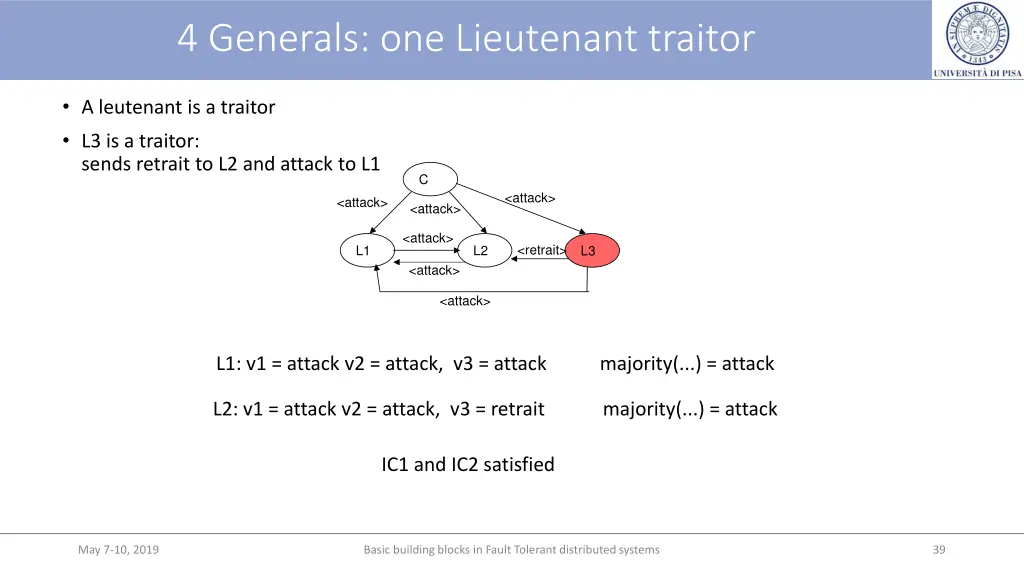
4 Generals: one Lieutenant traitor A leutenant is a traitor L3 is a traitor: sends retrait to L2 and attack to L1 C <attack> <attack> <attack> <attack> <retrait> L1 L2 L3 <attack> <attack> L1: v1 = attack v2 = attack, v3 = attack majority(...) = attack L2: v1 = attack v2 = attack, v3 = retrait majority(...) = attack IC1 and IC2 satisfied May 7-10, 2019 Basic building blocks in Fault Tolerant distributed systems 39
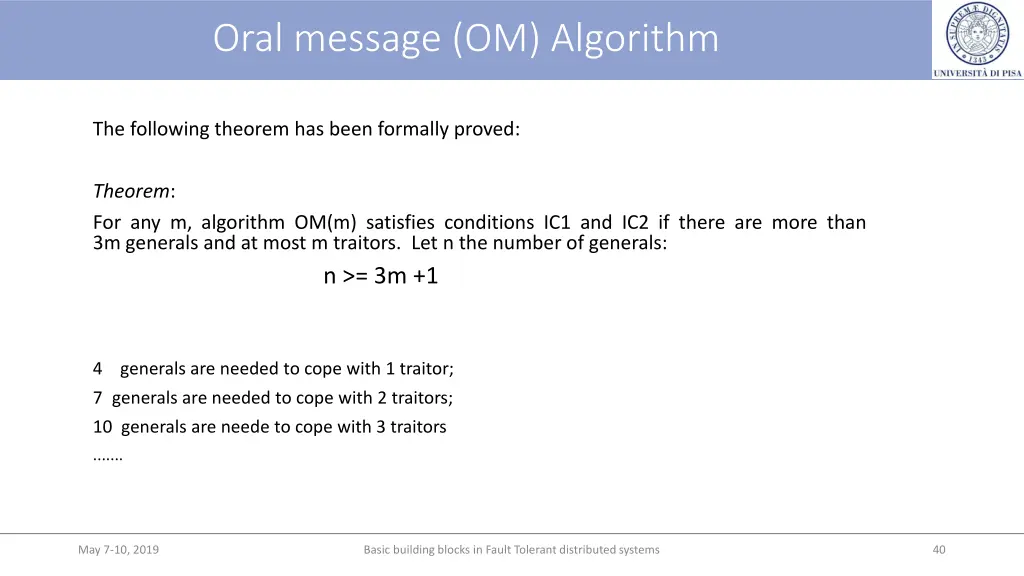
Oral message (OM) Algorithm The following theorem has been formally proved: Theorem: For any m, algorithm OM(m) satisfies conditions IC1 and IC2 if there are more than 3m generals and at most m traitors. Let n the number of generals: n >= 3m +1 4 generals are needed to cope with 1 traitor; 7 generals are needed to cope with 2 traitors; 10 generals are neede to cope with 3 traitors ....... May 7-10, 2019 Basic building blocks in Fault Tolerant distributed systems 40
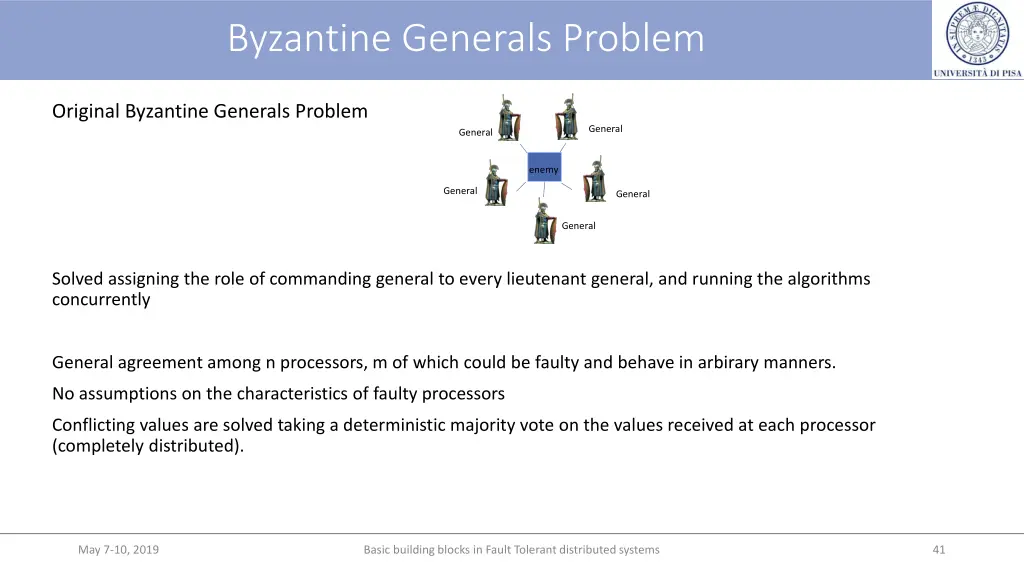
Byzantine Generals Problem Original Byzantine Generals Problem General General enemy General General General Solved assigning the role of commanding general to every lieutenant general, and running the algorithms concurrently General agreement among n processors, m of which could be faulty and behave in arbirary manners. No assumptions on the characteristics of faulty processors Conflicting values are solved taking a deterministic majority vote on the values received at each processor (completely distributed). May 7-10, 2019 Basic building blocks in Fault Tolerant distributed systems 41
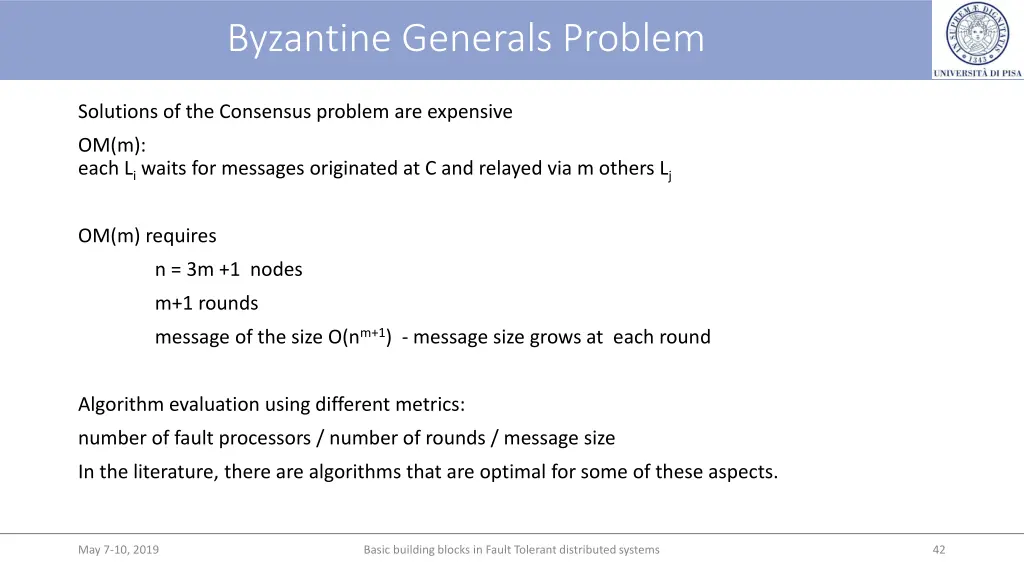
Byzantine Generals Problem Solutions of the Consensus problem are expensive OM(m): each Li waits for messages originated at C and relayed via m others Lj OM(m) requires n = 3m +1 nodes m+1 rounds message of the size O(nm+1) - message size grows at each round Algorithm evaluation using different metrics: number of fault processors / number of rounds / message size In the literature, there are algorithms that are optimal for some of these aspects. May 7-10, 2019 Basic building blocks in Fault Tolerant distributed systems 42
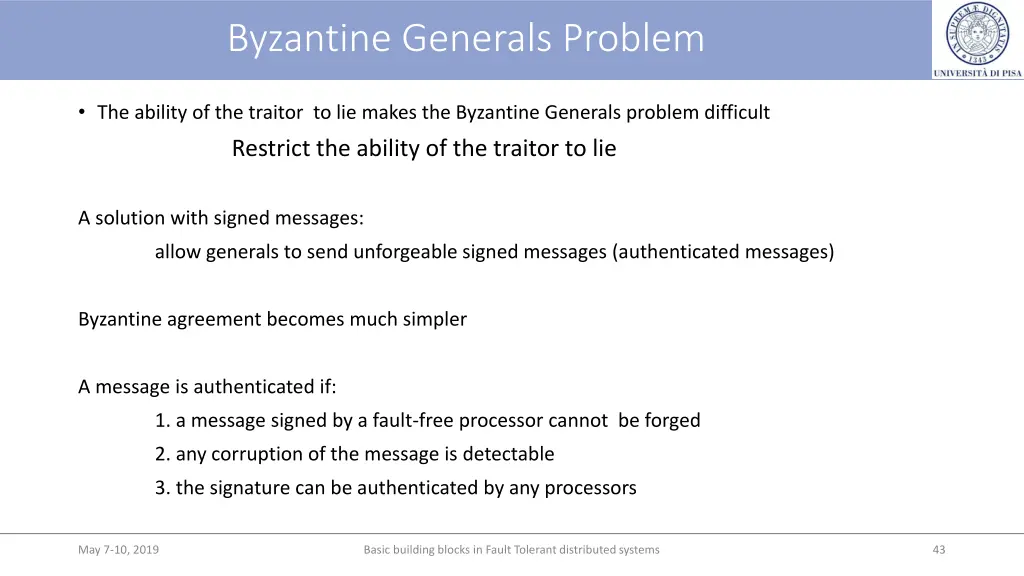
Byzantine Generals Problem The ability of the traitor to lie makes the Byzantine Generals problem difficult Restrict the ability of the traitor to lie A solution with signed messages: allow generals to send unforgeable signed messages (authenticated messages) Byzantine agreement becomes much simpler A message is authenticated if: 1. a message signed by a fault-free processor cannot be forged 2. any corruption of the message is detectable 3. the signature can be authenticated by any processors May 7-10, 2019 Basic building blocks in Fault Tolerant distributed systems 43
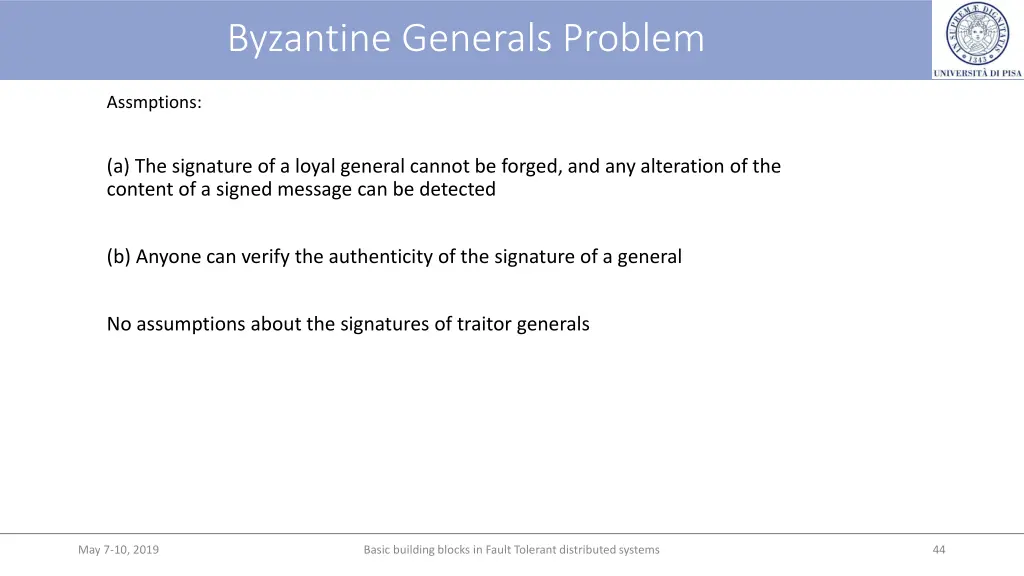
Byzantine Generals Problem Assmptions: (a) The signature of a loyal general cannot be forged, and any alteration of the content of a signed message can be detected (b) Anyone can verify the authenticity of the signature of a general No assumptions about the signatures of traitor generals May 7-10, 2019 Basic building blocks in Fault Tolerant distributed systems 44
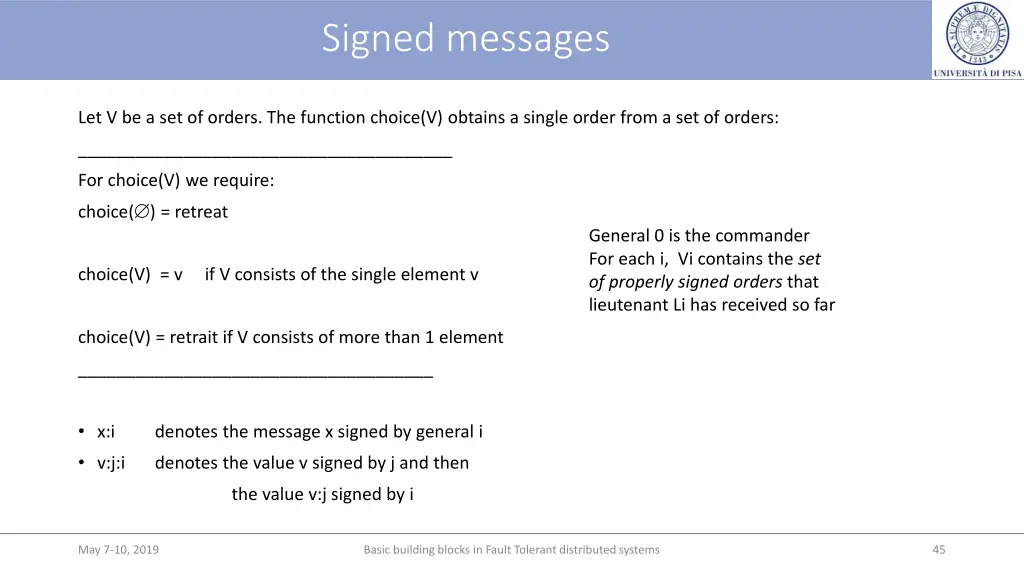
Signed messages Let V be a set of orders. The function choice(V) obtains a single order from a set of orders: _______________________________________ For choice(V) we require: choice( ) = retreat General 0 is the commander For each i, Vi contains the set of properly signed orders that lieutenant Li has received so far choice(V) = v if V consists of the single element v choice(V) = retrait if V consists of more than 1 element _____________________________________ x:i v:j:i denotes the message x signed by general i denotes the value v signed by j and then the value v:j signed by i May 7-10, 2019 Basic building blocks in Fault Tolerant distributed systems 45
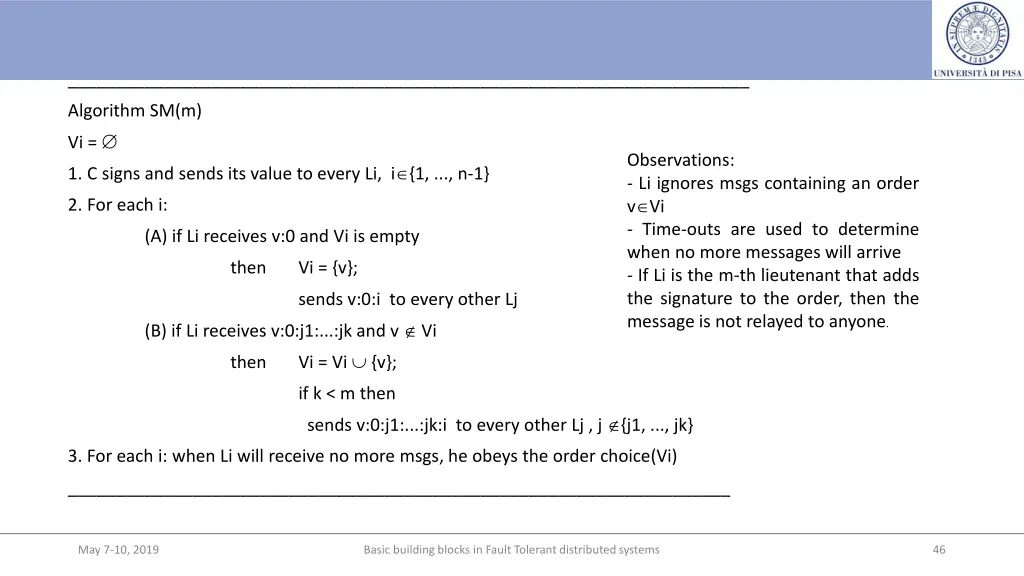
______________________________________________________________________________________________________________________________________________ Algorithm SM(m) Vi = 1. C signs and sends its value to every Li, i {1, ..., n-1} Observations: - Li ignores msgs containing an order v Vi - Time-outs are used to determine when no more messages will arrive - If Li is the m-th lieutenant that adds the signature to the order, then the message is not relayed to anyone. 2. For each i: (A) if Li receives v:0 and Vi is empty then Vi = {v}; (B) if Li receives v:0:j1:...:jk and v Vi sends v:0:i to every other Lj Vi = Vi {v}; then if k < m then sends v:0:j1:...:jk:i to every other Lj , j {j1, ..., jk} 3. For each i: when Li will receive no more msgs, he obeys the order choice(Vi) _____________________________________________________________________ May 7-10, 2019 Basic building blocks in Fault Tolerant distributed systems 46
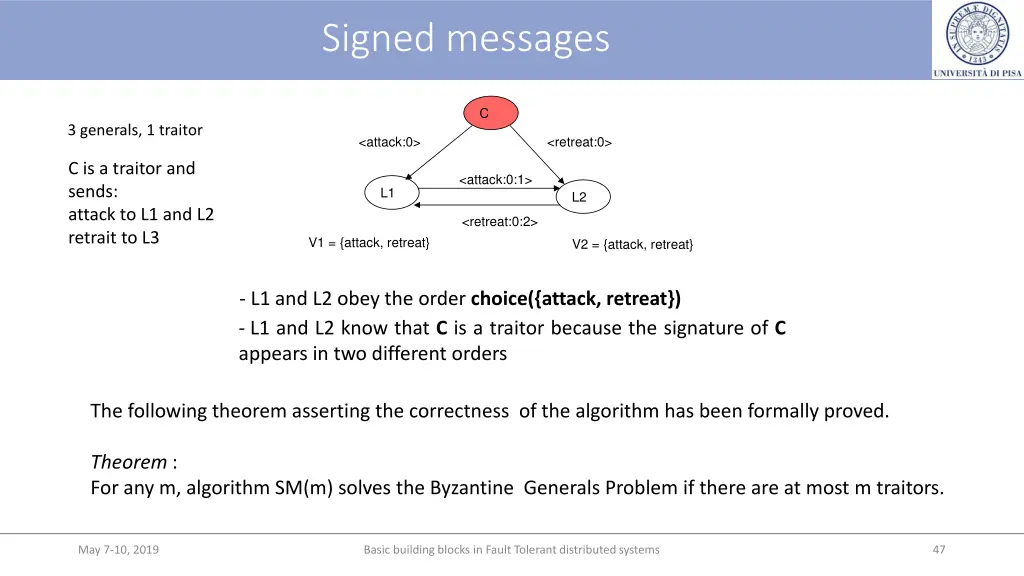
Signed messages C 3 generals, 1 traitor <attack:0> <retreat:0> C is a traitor and sends: attack to L1 and L2 retrait to L3 <attack:0:1> L1 L2 <retreat:0:2> V1 = {attack, retreat} V2 = {attack, retreat} - L1 and L2 obey the order choice({attack, retreat}) - L1 and L2 know that C is a traitor because the signature of C appears in two different orders The following theorem asserting the correctness of the algorithm has been formally proved. Theorem : For any m, algorithm SM(m) solves the Byzantine Generals Problem if there are at most m traitors. May 7-10, 2019 Basic building blocks in Fault Tolerant distributed systems 47
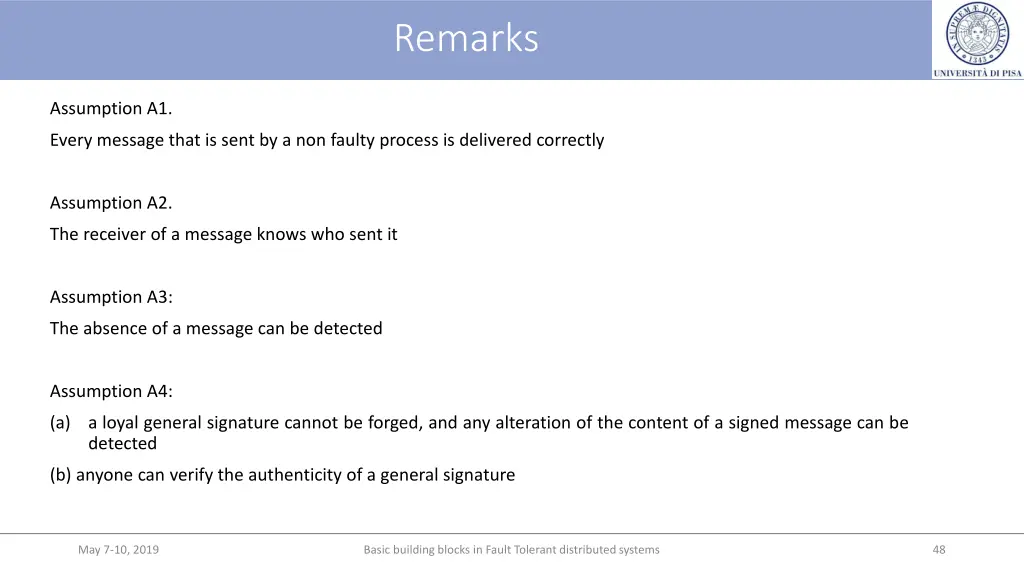
Remarks Assumption A1. Every message that is sent by a non faulty process is delivered correctly Assumption A2. The receiver of a message knows who sent it Assumption A3: The absence of a message can be detected Assumption A4: (a) a loyal general signature cannot be forged, and any alteration of the content of a signed message can be detected (b) anyone can verify the authenticity of a general signature May 7-10, 2019 Basic building blocks in Fault Tolerant distributed systems 48
Impossibility result Asynchronous distributed system: no timing assumptions (no bounds on message delay, no bounds on the time necessary to execute a step) Asynchronous model of computation: attractive. - Applications programmed on this basis are easier to port than those incorporating specific timing assumptions. - Synchronous assumptions are at best probabilistic: in practice, variable or unexpected workloads are sources of asynchrony May 7-10, 2019 Basic building blocks in Fault Tolerant distributed systems 49
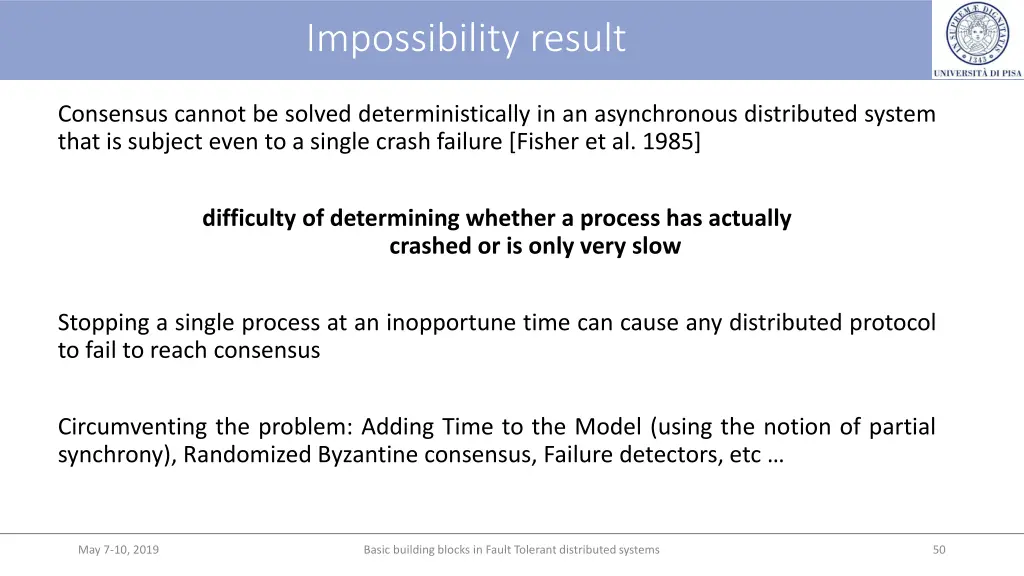
Impossibility result Consensus cannot be solved deterministically in an asynchronous distributed system that is subject even to a single crash failure [Fisher et al. 1985] difficulty of determining whether a process has actually crashed or is only very slow Stopping a single process at an inopportune time can cause any distributed protocol to fail to reach consensus Circumventing the problem: Adding Time to the Model (using the notion of partial synchrony), Randomized Byzantine consensus, Failure detectors, etc May 7-10, 2019 Basic building blocks in Fault Tolerant distributed systems 50