Explore technical considerations, environmental conservation activities, and refrigerant options in Japan's refrigeration sector. Learn about safety, performance, and cost factors in adopting low GWP alternatives.
Please find below an Image/Link to download the presentation.
The content on the website is provided AS IS for your information and personal use only. It may not be sold, licensed, or shared on other websites without obtaining consent from the author. If you encounter any issues during the download, it is possible that the publisher has removed the file from their server.
You are allowed to download the files provided on this website for personal or commercial use, subject to the condition that they are used lawfully. All files are the property of their respective owners.
The content on the website is provided AS IS for your information and personal use only. It may not be sold, licensed, or shared on other websites without obtaining consent from the author.
E N D
Presentation Transcript
Technical consideration of feasibility of low GWP alternatives: performance, cost, et.al. Workshop on HFC Management in Bangkok (20th Apr 2015) Kazuhiro Sato Mitsubishi Heavy Industries, Ltd. On behalf of The Japan Refrigeration and Air Conditioning Industry (JRAIA)
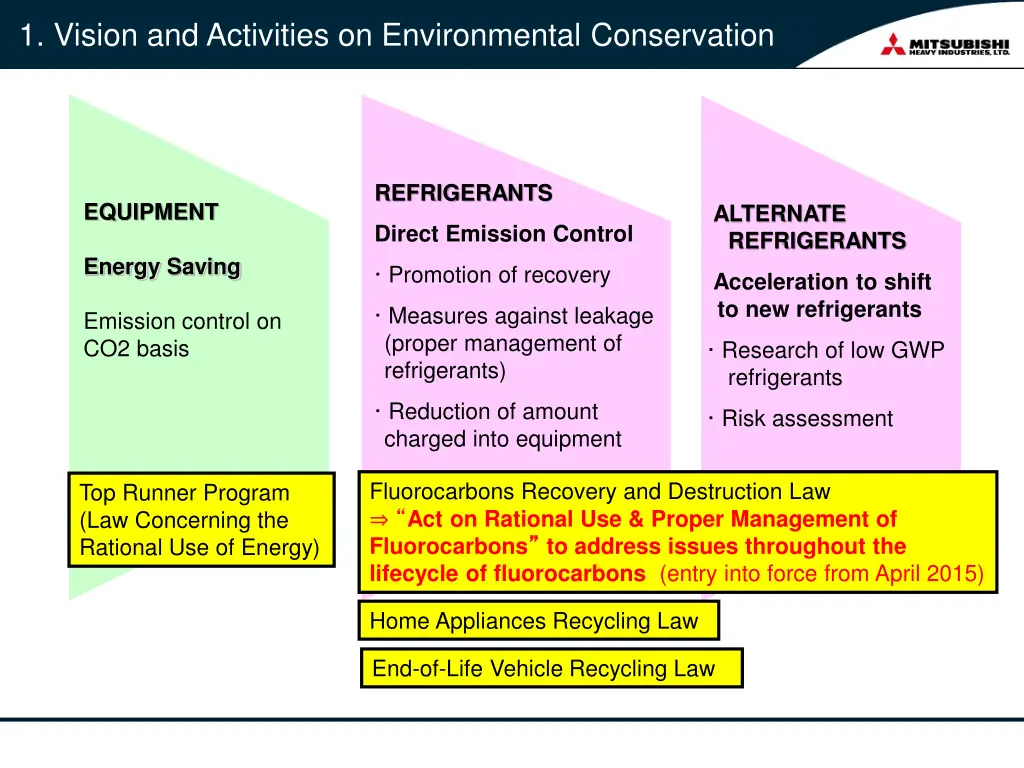
1. Vision and Activities on Environmental Conservation REFRIGERANTS EQUIPMENT ALTERNATE REFRIGERANTS Direct Emission Control Energy Saving Promotion of recovery Acceleration to shift to new refrigerants Measures against leakage (proper management of refrigerants) Emission control on CO2 basis Research of low GWP refrigerants Reduction of amount charged into equipment Risk assessment Fluorocarbons Recovery and Destruction Law Act on Rational Use & Proper Management of Fluorocarbons to address issues throughout the lifecycle of fluorocarbons (entry into force from April 2015) Top Runner Program (Law Concerning the Rational Use of Energy) Home Appliances Recycling Law End-of-Life Vehicle Recycling Law
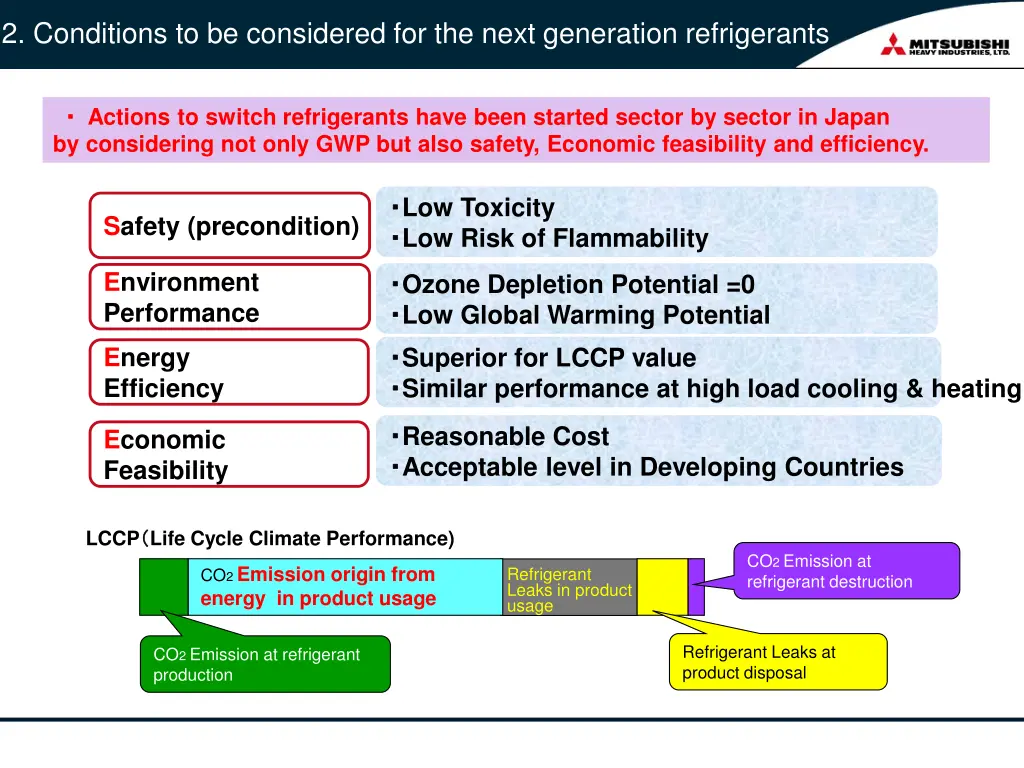
2. Conditions to be considered for the next generation refrigerants Actions to switch refrigerants have been started sector by sector in Japan by considering not only GWP but also safety, Economic feasibility and efficiency. Low Toxicity Low Risk of Flammability Safety (precondition) Environment Performance Ozone Depletion Potential =0 Low Global Warming Potential Superior for LCCP value Similar performance at high load cooling & heating Energy Efficiency Reasonable Cost Acceptable level in Developing Countries Economic Feasibility LCCP Life Cycle Climate Performance) CO2 Emission at refrigerant destruction CO2 Emission origin from energy in product usage Refrigerant Leaks in product usage Refrigerant Leaks at product disposal CO2 Emission at refrigerant production
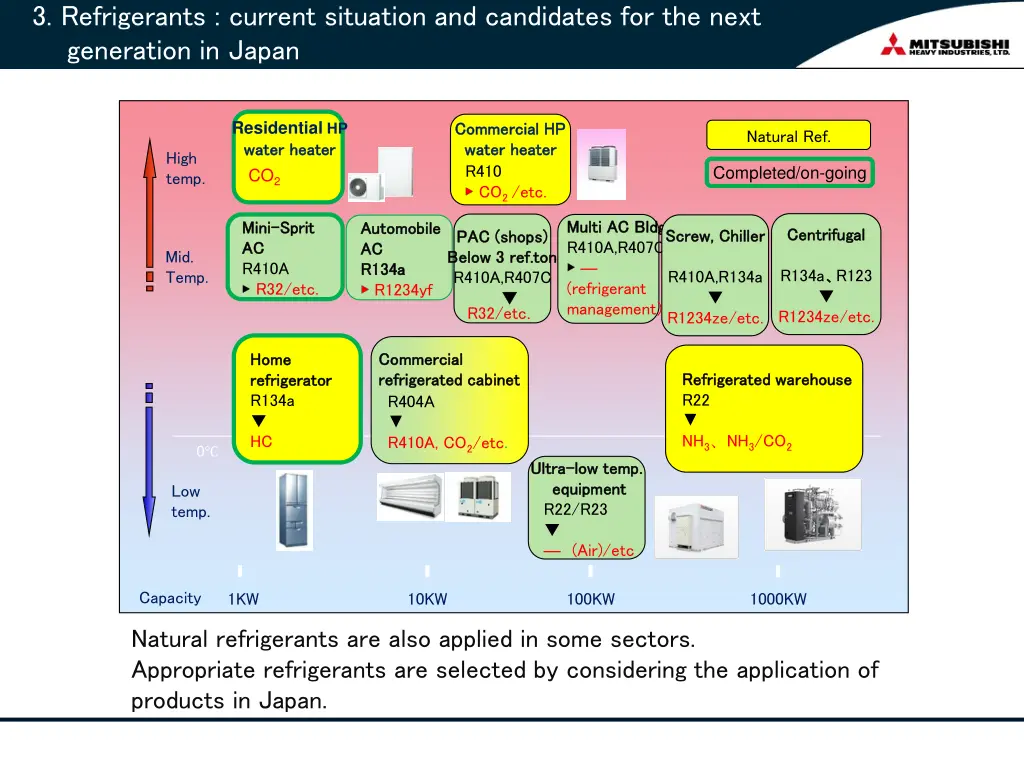
3. Refrigerants : current situation and candidates for the next generation in Japan Residential HP water heater water heater Commercial HP Commercial HP water water heater heater Natural Ref. High temp. R410 CO2 /etc. Completed/on-going CO2 Multi Multi AC R410A,R407C (refrigerant management AC Bldg Bldg. . Mini Mini- -Sprit Sprit AC AC R410A R32/etc. Automobile Automobile AC AC R134a R134a R1234yf Centrifugal Centrifugal Screw, Chiller Screw, Chiller PAC (shops) PAC (shops) Below 3 ref.ton Below 3 ref.ton R410A,R407C R32/etc. Mid. Temp. R134a R123 R1234ze/etc. R410A,R134a R1234ze/etc. Commercial Commercial refrigerated cabinet refrigerated cabinet Home Home refrigerator refrigerator R134a HC Refrigerated warehouse Refrigerated warehouse R22 NH3 NH3/CO2 R404A R410A, CO2/etc. 0 Ultra Ultra- -low temp. low temp. equipment equipment R22/R23 (Air)/etc Low temp. Capacity 100KW 1KW 10KW 1000KW Natural refrigerants are also applied in some sectors. Appropriate refrigerants are selected by considering the application of products in Japan.
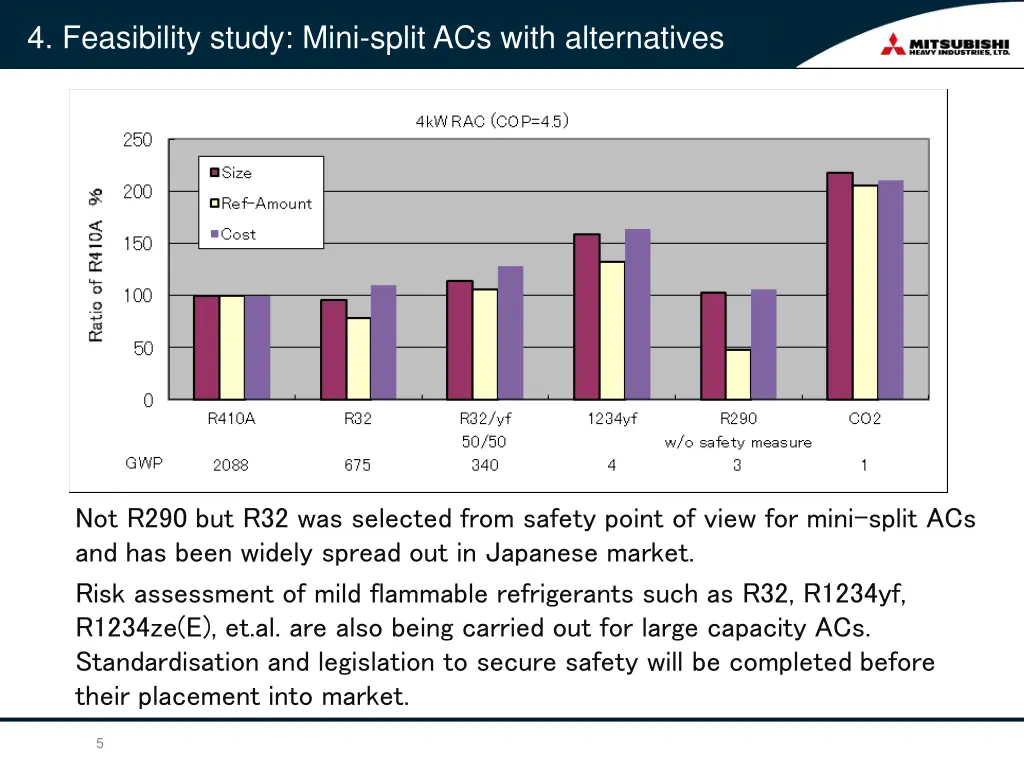
4. Feasibility study: Mini-split ACs with alternatives Not R290 but R32 was selected from safety point of view for mini-split ACs and has been widely spread out in Japanese market. Risk assessment of mild flammable refrigerants such as R32, R1234yf, R1234ze(E), et.al. are also being carried out for large capacity ACs. Standardisation and legislation to secure safety will be completed before their placement into market. 5