Field Research Grant Pre-Award Info-session
Provides detailed information on the upcoming Field Research Grant Pre-Award Info Session. Valuable insights will be shared to help applicants prepare competitive proposals and navigate the application process effectively. Attendees will gain a clear understanding of the eligibility criteria, submission requirements, and key deadlines. Experts will be on hand to answer queries and provide guidance for maximizing chances of success. Don't miss this opportunity to enhance your grant application skills!

Download Presentation

Please find below an Image/Link to download the presentation.
The content on the website is provided AS IS for your information and personal use only. It may not be sold, licensed, or shared on other websites without obtaining consent from the author.If you encounter any issues during the download, it is possible that the publisher has removed the file from their server.
You are allowed to download the files provided on this website for personal or commercial use, subject to the condition that they are used lawfully. All files are the property of their respective owners.
The content on the website is provided AS IS for your information and personal use only. It may not be sold, licensed, or shared on other websites without obtaining consent from the author.
E N D
Presentation Transcript
Field Research Grant Pre-Award Info-session
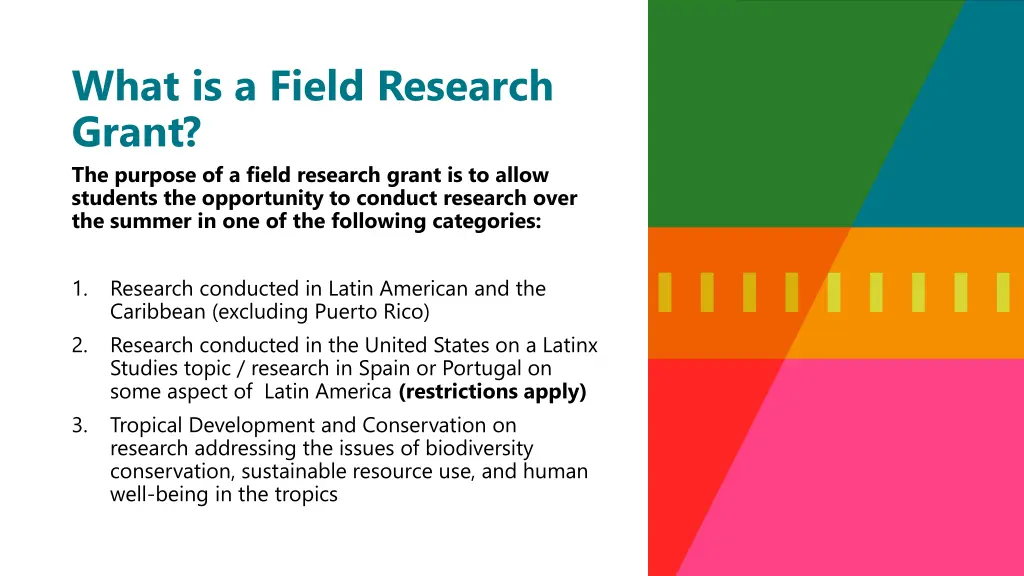
What is a Field Research Grant? The purpose of a field research grant is to allow students the opportunity to conduct research over the summer in one of the following categories: 1. Research conducted in Latin American and the Caribbean (excluding Puerto Rico) Research conducted in the United States on a Latinx Studies topic / research in Spain or Portugal on some aspect of Latin America (restrictions apply) Tropical Development and Conservation on research addressing the issues of biodiversity conservation, sustainable resource use, and human well-being in the tropics 2. 3.
Overview of Eligibility Must be a graduate student pursuing a Master or Post-Doctorate Degree in any department Priority will be given to applicants pursuing a Graduate Certificate or an M.A. in Latin American Studies (LAS) or enrolled in the TCD certificate program. Support is available for Master's thesis research and preliminary doctoral dissertation field visits (Ph.D. students who have advanced to candidacy are NOT eligible). Recipients must spend at least two weeks in the field If the recipient s research involves human or animal subjects, IRB approval is required before traveling to the research site. If your project requires IRB or IACUC approval, start the application process as soon as you know the purpose and design of your project. Currently, obtaining international IRB approvals can require 3 months or more. All travel MUST be completed before August 20th. Extensions may be granted but require prior approval.
UF IRBs review research involving human subjects to ensure the welfare and rights of research participants are protected as mandated by federal and state laws, local policies, and ethical principles. Institutional Review Board Faculty, staff, and students at the University of Florida, UF Health, and/or the North Florida/South Georgia Veteran s Health System (NF/SGVHS) must receive approval for any human subjects research from a UF IRB or have a certificate of exemption before conducting the research.
IRB IRB approval or exemption is the #1 most important thing in you will need in order to conduct research. Without this approval or exemption, you will not: - be able to use your data collected in any way or at any point in time - be eligible to use FRG award money / travel NOTE: if you begin your travel without final approval or if you are denied/rejected, you risk not getting a reimbursement of funds OR will have to pay back any award money used. Approval can take up to 3 months or longer depending on the complexity of your research. If you think you are going to do research, it s best to start applying now. There is no harm if you don t end up conducting your researching in the summer.
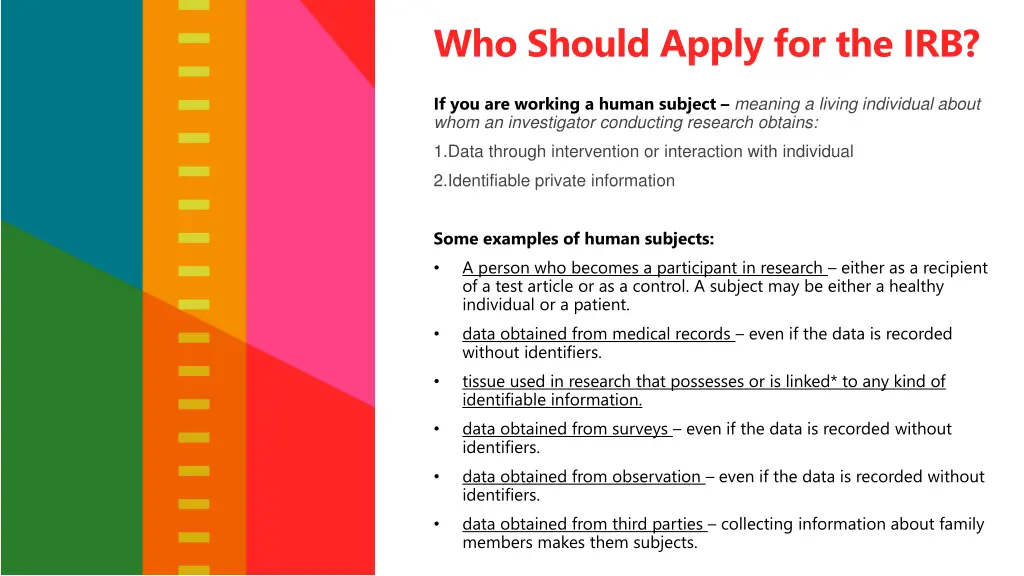
Who Should Apply for the IRB? If you are working a human subject meaning a living individual about whom an investigator conducting research obtains: 1.Data through intervention or interaction with individual 2.Identifiable private information Some examples of human subjects: A person who becomes a participant in research either as a recipient of a test article or as a control. A subject may be either a healthy individual or a patient. data obtained from medical records even if the data is recorded without identifiers. tissue used in research that possesses or is linked* to any kind of identifiable information. data obtained from surveys even if the data is recorded without identifiers. data obtained from observation even if the data is recorded without identifiers. data obtained from third parties collecting information about family members makes them subjects.
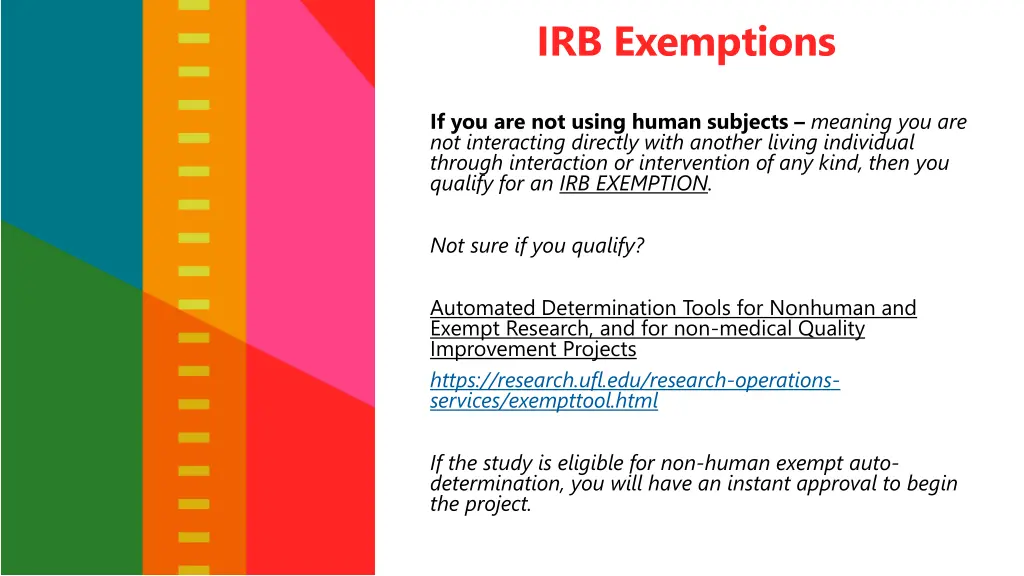
IRB Exemptions If you are not using human subjects meaning you are not interacting directly with another living individual through interaction or intervention of any kind, then you qualify for an IRB EXEMPTION. Not sure if you qualify? Automated Determination Tools for Nonhuman and Exempt Research, and for non-medical Quality Improvement Projects https://research.ufl.edu/research-operations- services/exempttool.html If the study is eligible for non-human exempt auto- determination, you will have an instant approval to begin the project.
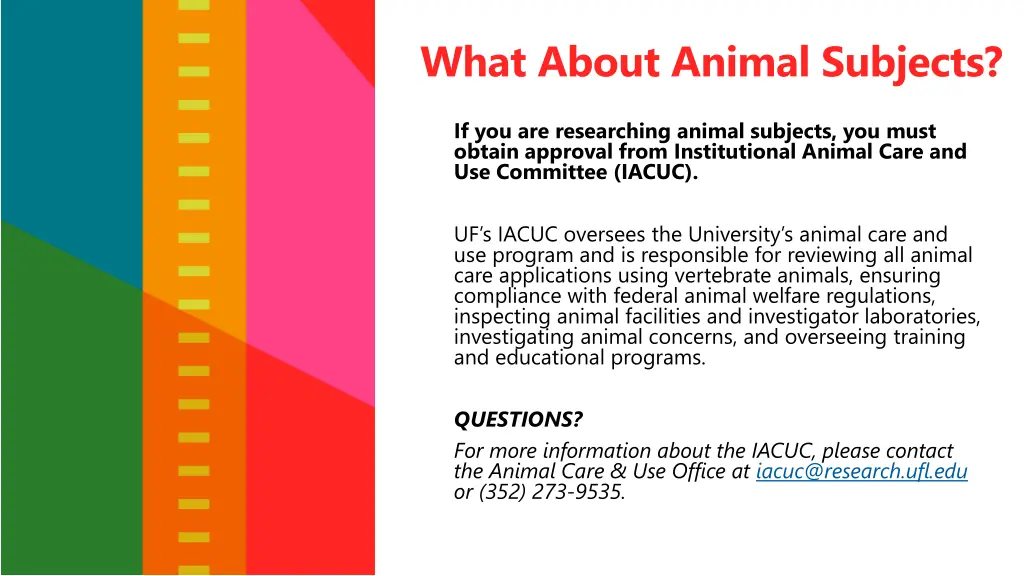
What About Animal Subjects? If you are researching animal subjects, you must obtain approval from Institutional Animal Care and Use Committee (IACUC). UF s IACUC oversees the University s animal care and use program and is responsible for reviewing all animal care applications using vertebrate animals, ensuring compliance with federal animal welfare regulations, inspecting animal facilities and investigator laboratories, investigating animal concerns, and overseeing training and educational programs. QUESTIONS? For more information about the IACUC, please contact the Animal Care & Use Office at iacuc@research.ufl.edu or (352) 273-9535.
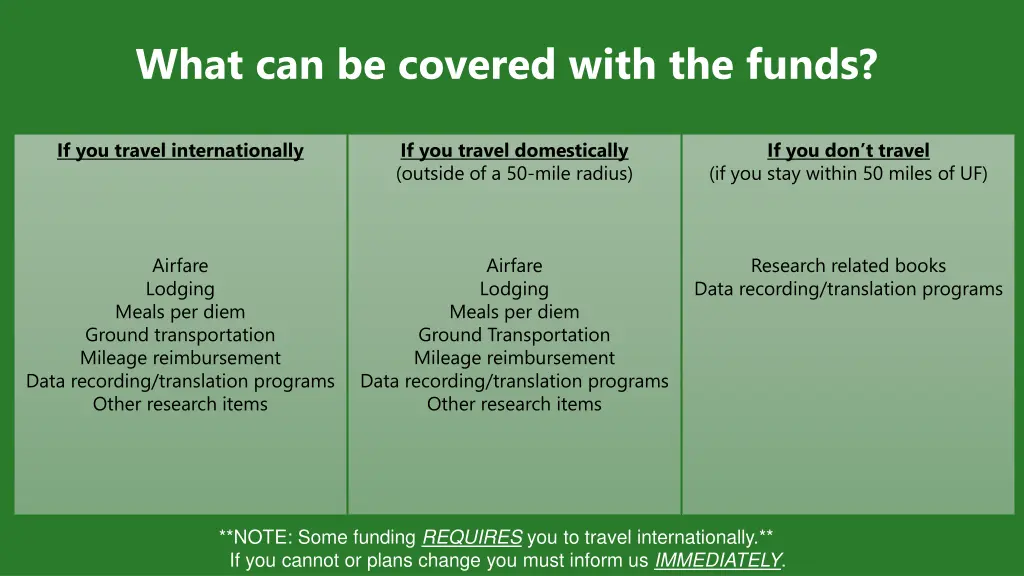
What can be covered with the funds? If you travel internationally If you travel domestically (outside of a 50-mile radius) If you don t travel (if you stay within 50 miles of UF) Airfare Lodging Meals per diem Ground transportation Mileage reimbursement Data recording/translation programs Other research items Airfare Lodging Meals per diem Ground Transportation Mileage reimbursement Data recording/translation programs Other research items Research related books Data recording/translation programs **NOTE: Some funding REQUIRES you to travel internationally.** If you cannot or plans change you must inform us IMMEDIATELY.
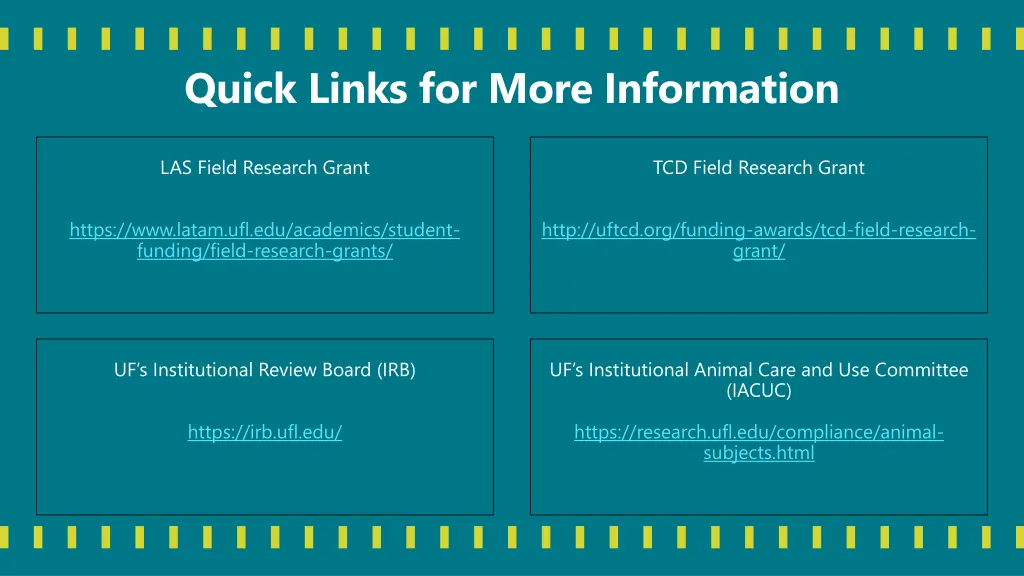
Quick Links for More Information LAS Field Research Grant TCD Field Research Grant https://www.latam.ufl.edu/academics/student- funding/field-research-grants/ http://uftcd.org/funding-awards/tcd-field-research- grant/ UF s Institutional Review Board (IRB) UF s Institutional Animal Care and Use Committee (IACUC) https://irb.ufl.edu/ https://research.ufl.edu/compliance/animal- subjects.html
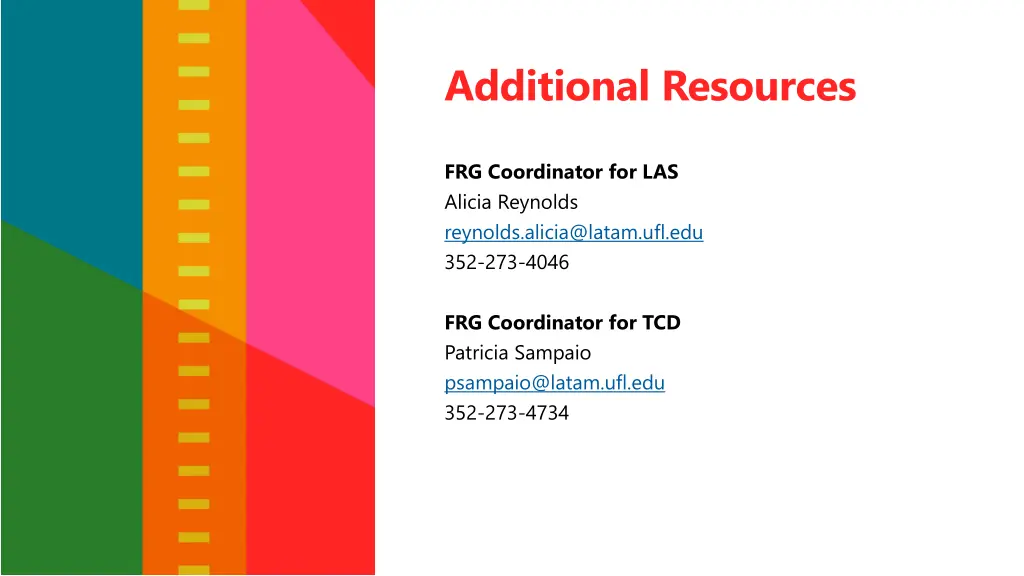
Additional Resources FRG Coordinator for LAS Alicia Reynolds reynolds.alicia@latam.ufl.edu 352-273-4046 FRG Coordinator for TCD Patricia Sampaio psampaio@latam.ufl.edu 352-273-4734