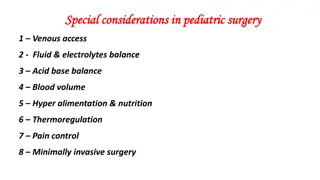
In this comprehensive presentation, detailed information on fluid balance in the human body is depicted through images and text. Topics covered include routes of fluid intake and loss, signs of volume deficit/excess, body systems affected by hyponatremia, and types of secretions with corresponding values. The content delves into volumes, electrolyte concentrations, and associated symptoms across various physiological systems.
Please find below an Image/Link to download the presentation.
The content on the website is provided AS IS for your information and personal use only. It may not be sold, licensed, or shared on other websites without obtaining consent from the author. If you encounter any issues during the download, it is possible that the publisher has removed the file from their server.
You are allowed to download the files provided on this website for personal or commercial use, subject to the condition that they are used lawfully. All files are the property of their respective owners.
The content on the website is provided AS IS for your information and personal use only. It may not be sold, licensed, or shared on other websites without obtaining consent from the author.
Body System Hyponatremia Central nervous system Headache, confusion, hyperactive or hypoactive deep tendon reflexes, seizures, coma, increased intracranial pressure Musculoskeletal Weakness, fatigue, muscle cramps/twitching GI Anorexia, nausea, vomiting, watery diarrhea Cardiovascular Hypertension and bradycardia if significant increases in intracranial pressure Tissue Lacrimation, salivation Renal Oliguria
a (Cushing, ( - ) ( )
Body System Hypernatremia Central nervous system Restlessness, lethargy, ataxia, irritability, tonic spasms, delirium, seizures, coma Musculoskeletal Weakness Cardiovascular Tachycardia, hypotension, syncope Tissue Dry sticky mucous membranes, red swollen tongue, decreased saliva and tears Renal Oliguria Metabolic Fever
System Potassium GI Nausea/vomiting, colic, diarrhea Neuromuscular Weakness, paralysis, respiratory failure Cardiovascular Arrhythmia, arrest Renal
Hypokalemia Inadequate intake Dietary, potassium-free intravenous fluids, potassium-deficient TPN Excessive potassium excretion Hyperaldosteronism Medications GI losses Direct loss of potassium from GI fluid (diarrhea) Renal loss of potassium (gastric fluid, either as vomiting or high nasogastric output)
System Potassium GI Ileus, constipation Neuromuscular Decreased reflexes, fatigue, weakness, paralysis Cardiovascular Arrest
Disorder Predicted Change Metabolic Metabolic acidosis Pco2= 1.5 x HCO3 + 8 Metabolic alkalosis Pco2= 0.7 x HCO3 + 21 Respiratory Acute respiratory acidosis pH = (Pco2 40) x 0.008 Chronic respiratory acidosis pH = (Pco2 40) x 0.003 Acute respiratory alkalosis pH = (40 Pco2) x 0.008 Chronic respiratory alkalosis pH = (40 Pco2) x 0.017
- Acute Uncompensated Chronic (Partially Compensated) Type of Acid-Base Disorder pH PCO2 (Respiratory Component) Plasma HCO3 a (Metabolic Component) pH PCO2 (Respiratory Component) Plasma HCO3 a(Metabolic Component) Respiratory acidosis N Respiratory alkalosis N Metabolic acidosis N Metabolic alkalosis N ?
Normal Anion Gap Acid administration (HCl) Loss of bicarbonate GI losses (diarrhea, fistulas) Ureterosigmoidoscopy Renal tubular acidosis Carbonic anhydrase inhibitor
Increased Anion Gap Metabolic Acidosis Exogenous acid ingestion Ethylene glycol Salicylate Methanol Endogenous acid production Ketoacidosis Lactic acidosis Renal insufficiency
Increased bicarbonate generation 1. Chloride losing (urinary chloride >20 mEq/L) Mineralocorticoid excess Profound potassium depletion 2. Chloride sparing (urinary chloride <20 mEq/L) Loss from gastric secretions (emesis or nasogastric suction) Diuretics 3. Excess administration of alkali Acetate in parenteral nutrition Citrate in blood transfusions Antacids Bicarbonate Milk-alkali syndrome
Narcotics Central nervous system injury Pulmonary: significant Secretions Atelectasis Mucus plug Pneumonia Pleural effusion Pain from abdominal or thoracic injuries or incisions Limited diaphragmatic excursion from intra-abdominal pathology Abdominal distention Abdominal compartment syndrome Ascites
Potassium Serum potassium level <4.0 mEq/L: Asymptomatic, tolerating enteral nutrition: KCl 40 mEq per enteral access x 1 dose Asymptomatic, not tolerating enteral nutrition: KCl 20 mEq IV q2h x 2 doses Symptomatic: KCl 20 mEq IV q1h x 4 doses Recheck potassium level 2 h after end of infusion; if <3.5 mEq/L and asymptomatic, replace as per above protocol
Mg Magnesium Magnesium level 1.0 1.8 mEq/L: Magnesium sulfate 0.5 mEq/kg in normal saline 250 mL infused IV over 24 h x 3 d Recheck magnesium level in 3 d Magnesium level <1.0 mEq/L: Magnesium sulfate 1 mEq/kg in normal saline 250 mL infused IV over 24 h x 1 d, then 0.5 mEq/kg in normal saline 250 mL infused IV over 24 h x 2 d Recheck magnesium level in 3 d If patient has gastric access and needs a bowel regimen: Milk of magnesia 15 mL (approximately 49 mEq magnesium) q24h per gastric tube; hold for diarrhea
Ca Calcium Normalized calcium level <4.0 mg/dL: With gastric access and tolerating enteral nutrition: Calcium carbonate suspension 1250 mg/5 mL q6h per gastric access; recheck ionized calcium level in 3 d Without gastric access or not tolerating enteral nutrition: Calcium gluconate 2 g IV over 1 h x 1 dose; recheck ionized calcium level in 3 d
Phosphate Phosphate level 1.0 2.5 mg/dL: Tolerating enteral nutrition: Neutra-Phos 2 packets q6h per gastric tube or feeding tube No enteral nutrition: KPHO4or NaPO40.15 mmol/kg IV over 6 h x 1 dose Recheck phosphate level in 3 d Phosphate level <1.0 mg/dL: Tolerating enteral nutrition: KPHO4or NaPO40.25 mmol/kg over 6 h x 1 dose Recheck phosphate level 4 h after end of infusion; if <2.5 mg/dL, begin Neutra-Phos 2 packets q6h Not tolerating enteral nutrition: KPHO4or NaPO40.25 mmol/kg (LBW) over 6 h x 1 dose; recheck phosphate level 4 h after end of infusion; if <2.5 mg/dL, then KPHO4or NaPO40.15 mmol/kg (LBW) IV over 6 h x 1 dose