The global food service market was valued at USD 3,486.58 billion in 2024 and is expected to increase to USD 4,027.61 billion in 2025, eventually reaching USD 6,810.86 billion by 2032. This reflects a compound annual growth rate (CAGR) of 7.79% durin
Please find below an Image/Link to download the presentation.
The content on the website is provided AS IS for your information and personal use only. It may not be sold, licensed, or shared on other websites without obtaining consent from the author. If you encounter any issues during the download, it is possible that the publisher has removed the file from their server.
You are allowed to download the files provided on this website for personal or commercial use, subject to the condition that they are used lawfully. All files are the property of their respective owners.
The content on the website is provided AS IS for your information and personal use only. It may not be sold, licensed, or shared on other websites without obtaining consent from the author.
E N D
Presentation Transcript
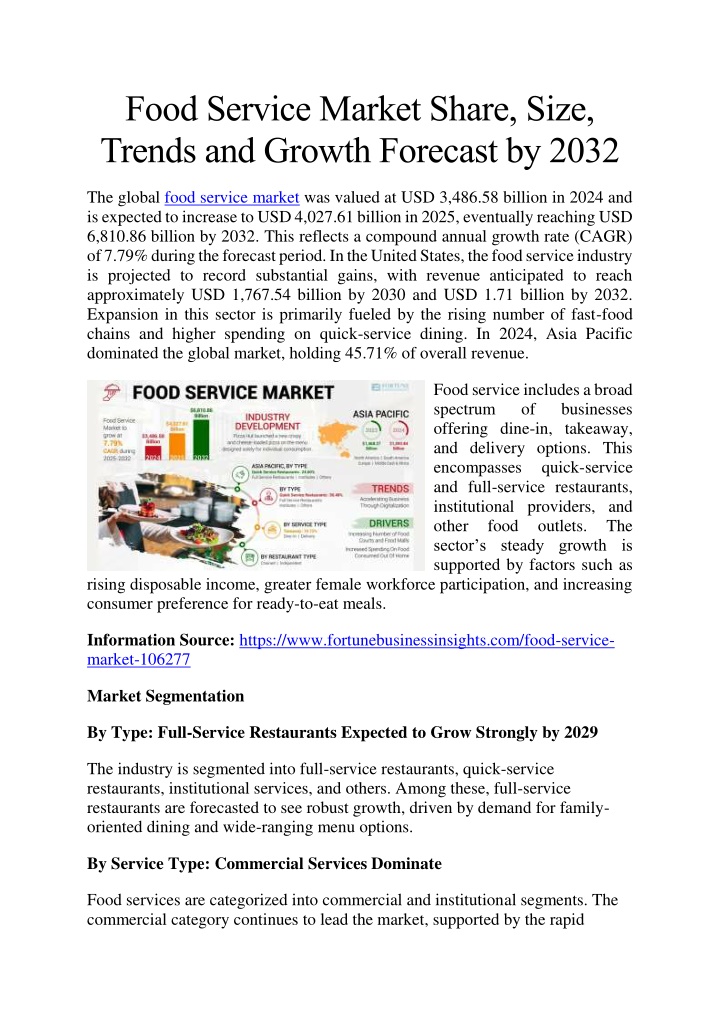
Food Service Market Share, Size, Trends and Growth Forecast by 2032 The global food service market was valued at USD 3,486.58 billion in 2024 and is expected to increase to USD 4,027.61 billion in 2025, eventually reaching USD 6,810.86 billion by 2032. This reflects a compound annual growth rate (CAGR) of 7.79% during the forecast period. In the United States, the food service industry is projected to record substantial gains, with revenue anticipated to reach approximately USD 1,767.54 billion by 2030 and USD 1.71 billion by 2032. Expansion in this sector is primarily fueled by the rising number of fast-food chains and higher spending on quick-service dining. In 2024, Asia Pacific dominated the global market, holding 45.71% of overall revenue. Food service includes a broad spectrum of offering dine-in, takeaway, and delivery options. This encompasses and full-service restaurants, institutional providers, and other food outlets. The sector s steady growth is supported by factors such as businesses quick-service rising disposable income, greater female workforce participation, and increasing consumer preference for ready-to-eat meals. Information Source: https://www.fortunebusinessinsights.com/food-service- market-106277 Market Segmentation By Type: Full-Service Restaurants Expected to Grow Strongly by 2029 The industry is segmented into full-service restaurants, quick-service restaurants, institutional services, and others. Among these, full-service restaurants are forecasted to see robust growth, driven by demand for family- oriented dining and wide-ranging menu options. By Service Type: Commercial Services Dominate Food services are categorized into commercial and institutional segments. The commercial category continues to lead the market, supported by the rapid
expansion of restaurants, cafs, food trucks, and the growing popularity of online delivery platforms. Report Scope The report covers: Comprehensive analysis of drivers, restraints, and opportunities Performance evaluation across regions and service types Profiles of leading companies and their growth strategies Updates on mergers, acquisitions, and product developments Insights into innovation and emerging industry trends Key Market Drivers and Challenges Growing Preference for Quick and Convenient Food Solutions The demand for fast, accessible meals, particularly among dual-income households and working professionals, is a major growth driver. Millennials inclination toward fast food and the expansion of quick-service brands into emerging economies further bolster market growth. However, certain segments continue to experience residual effects from the COVID-19 pandemic, which remain a challenge for the industry. Regional Insights North America Generated USD 989 Billion in 2021 In 2021, North America recorded over USD 989 billion in revenue, supported by a well-established fast-food ecosystem, high consumer spending, and evolving dining trends. The large millennial base and increasing number of working individuals are driving demand in the region. Asia Pacific is expected to post the fastest growth between 2022 and 2029, spurred by the rapid expansion of food outlets in smaller cities. Europe is also set for steady growth, with a rise in caf s, coffee shops, and restaurants contributing to its expansion. Competitive Landscape Mergers and Acquisitions Enhance Market Reach Although the pandemic delayed some expansion strategies, improved conditions have reignited investments in acquisitions and geographic diversification. For
instance, Imperial Dade expanded its U.S. presence by acquiring Empire Distributors, adding 91 facilities to its network. Similar consolidation strategies are being used by other key players to broaden market coverage. Key Market Players Include: McDonald s Corporation (U.S.) Starbucks Corporation (U.S.) Yum! Brands, Inc. (U.S.) Darden Restaurants, Inc. (U.S.) Restaurant Brands International Inc. (Canada) The Wendy s Company (U.S.) Bloomin Brands, Inc. (U.S.) Papa John s International, Inc. (U.S.) Chipotle Mexican Grill, Inc. (U.S.) Domino s Pizza, Inc. (U.S.) Get Sample PDF Brochure: https://www.fortunebusinessinsights.com/enquiry/request-sample- pdf/food-service-market-106277 Recent Development July 2021: Delivery Hero re-entered the German market by relaunching its Food Panda brand, strengthening its presence in one of Europe s largest consumer markets.