Formation of Metamorphic Ore Deposits
Ore deposits formed by regional metamorphism, known as metamorphic ore deposits, result in valuable non-metallic minerals like graphite, talc, garnet, asbestos, and more. These ores are directly formed by recrystallization and recombination of rock-forming minerals due to metamorphism. Metamorphosed ores, on the other hand, are preexisting ores altered by metamorphism affecting their mineralogy, texture, and structure. Graphite, for example, can originate through regional metamorphism, crystallization of igneous rocks, contact metamorphism, or hydrothermal processes. The genesis of metamorphic graphite involves the alteration of organic matter or the breakdown of carbonate rocks.

Download Presentation

Please find below an Image/Link to download the presentation.
The content on the website is provided AS IS for your information and personal use only. It may not be sold, licensed, or shared on other websites without obtaining consent from the author.If you encounter any issues during the download, it is possible that the publisher has removed the file from their server.
You are allowed to download the files provided on this website for personal or commercial use, subject to the condition that they are used lawfully. All files are the property of their respective owners.
The content on the website is provided AS IS for your information and personal use only. It may not be sold, licensed, or shared on other websites without obtaining consent from the author.
E N D
Presentation Transcript
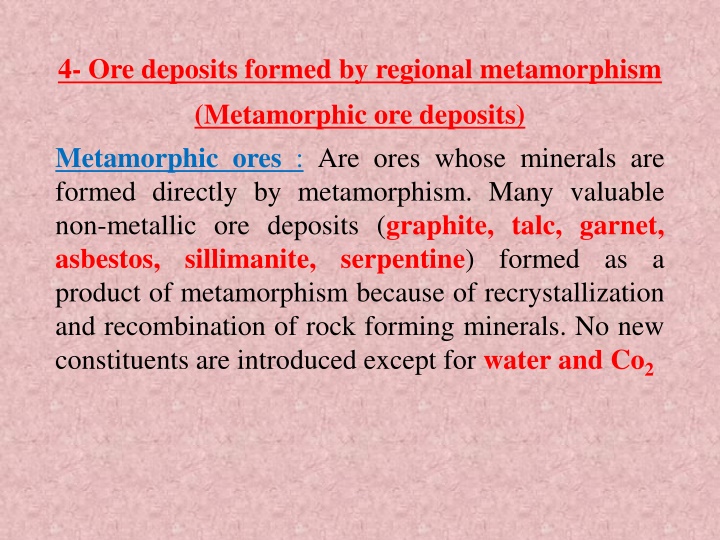
4- Ore deposits formed by regional metamorphism (Metamorphic ore deposits) Metamorphic ores : Are ores whose minerals are formed directly by metamorphism. Many valuable non-metallic ore deposits (graphite, talc, garnet, asbestos, sillimanite, serpentine) formed as a product of metamorphism because of recrystallization and recombination of rock forming minerals. No new constituents are introduced except for water and Co2
Metamorphosed ores: Are preexisting ores that suffer metamorphism after their formation. Metamorphism alters the `mineralogy, texture and structure of the ores. Agencies of metamorphism: heat, pressure, solution and time. Example : Graphite ore deposits
Graphite originates by: 1. Regional metamorphism 2. Crystallization of igneous rocks (it occurs in granite, syenite and basalt). 3. Contact metamorphism metamorphic silicates in limestone adjacent to igneous intrusion. It results from carbon compound bearing solution given off from the magma. 4. Hydrothermal (as vein deposits in pegmatite). It results from carbon compound bearing solution given off from the magma. (occurs in contact
Genesis of metamorphic graphite Two Views: 1- The graphite is altered organic matter present in the sediments : The black carbonaceous limestone altered by metamorphism to white marble and disseminated graphite. The carbonaceous matter is originally hydrocarbons that may be either broken up or reduced to graphite or it converted to CO and CO2that will be reduced to graphite. 2- The carbonate breaks down yielding their Ca, Mg and Fe to form silicates and releasing CO and CO2which in turn becomes reduced to form graphite. CO2+ 2H2 C + 2H2O 2CO C + CO2