Foundation of Artificial Intelligence by Nur Uddin, Ph.D.
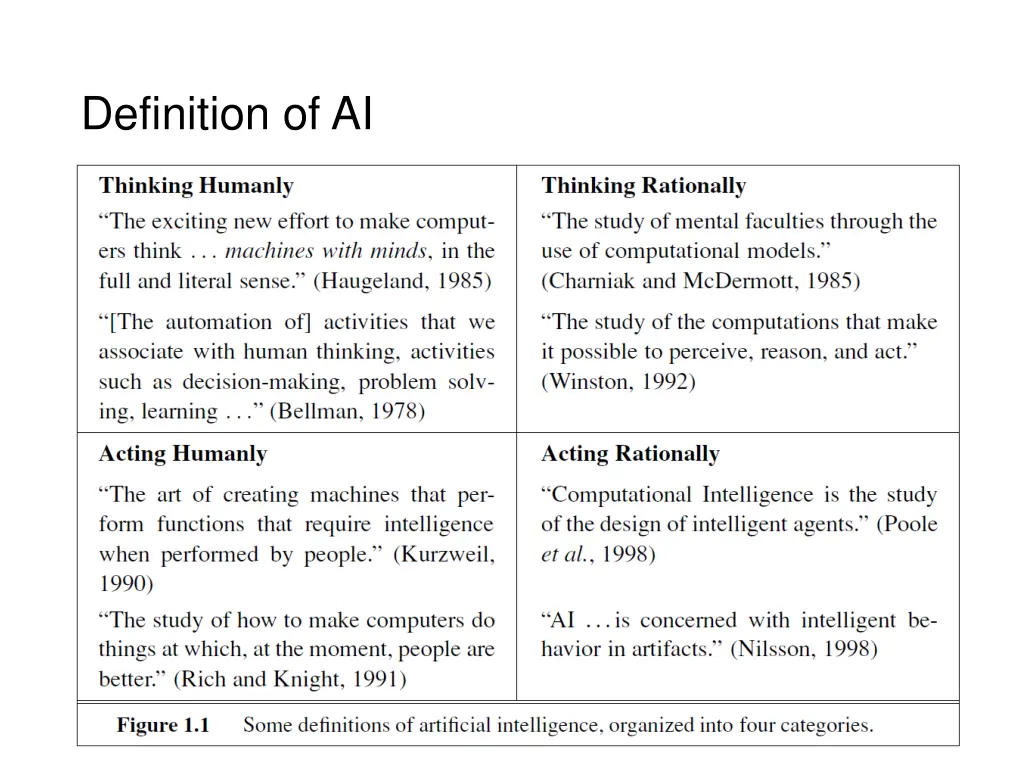
Artificial Intelligence (AI) emerged in 1956, aiming to replicate human-like thinking. This lecture explores various approaches to defining AI, including the Turing Test, cognitive modeling, and rational thought laws as laid out by Aristotle. Key figures like Alan Turing, Allen Newell, and Herbert Simon laid down foundations that examine how machines can imitate human thought processes, emphasizing the importance of natural language processing, knowledge representation, and machine learning in building intelligent systems.

Download Presentation

Please find below an Image/Link to download the presentation.
The content on the website is provided AS IS for your information and personal use only. It may not be sold, licensed, or shared on other websites without obtaining consent from the author.If you encounter any issues during the download, it is possible that the publisher has removed the file from their server.
You are allowed to download the files provided on this website for personal or commercial use, subject to the condition that they are used lawfully. All files are the property of their respective owners.
The content on the website is provided AS IS for your information and personal use only. It may not be sold, licensed, or shared on other websites without obtaining consent from the author.
E N D
Presentation Transcript
Artificial Intelligence Lecture 2: Foundation of Artificial Intelligence By: Nur Uddin, Ph.D 1
Artificial Intelligence (AI) The name of AI was coined in 1956 AI attempts to: to understand how we think to build intelligent entities 3
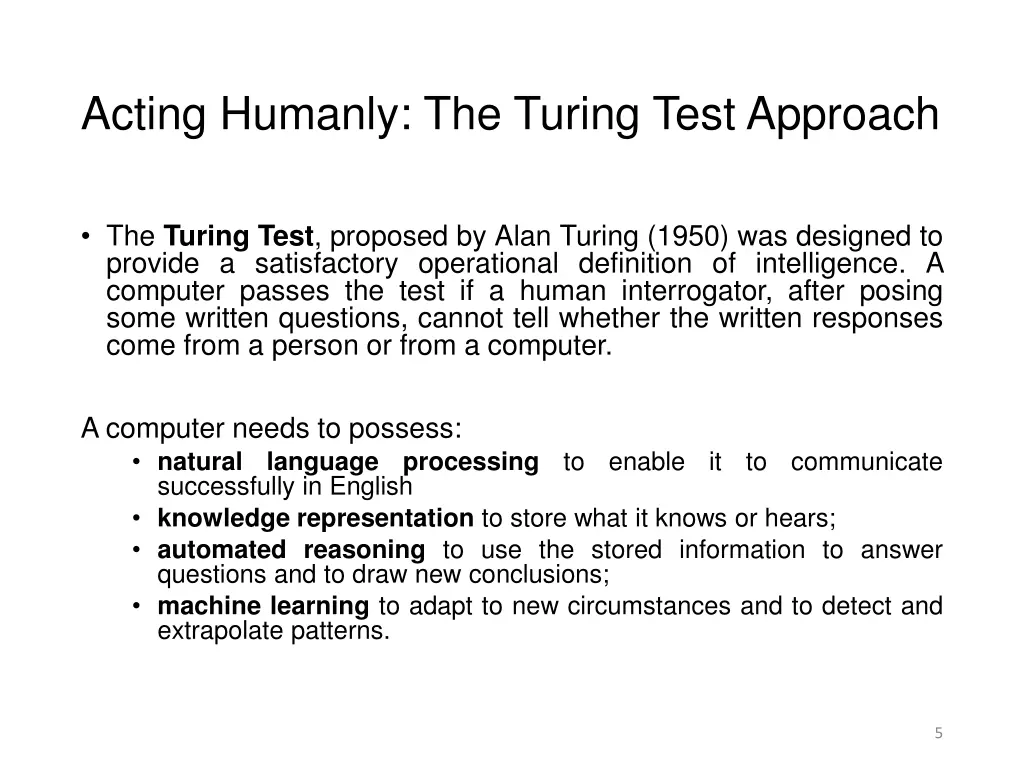
Acting Humanly: The Turing Test Approach The Turing Test, proposed by Alan Turing (1950) was designed to provide a satisfactory operational definition of intelligence. A computer passes the test if a human interrogator, after posing some written questions, cannot tell whether the written responses come from a person or from a computer. A computer needs to possess: natural language processing to enable it to communicate successfully in English knowledge representation to store what it knows or hears; automated reasoning to use the stored information to answer questions and to draw new conclusions; machine learning to adapt to new circumstances and to detect and extrapolate patterns. 5
Thinking humanly: The cognitive modeling approach (cont d) Allen Newell and Herbert Simon, who developed GPS, the General Problem Solver (Newell and Simon, 1961), were not content merely to have their program solve problems correctly. They were more concerned with comparing the trace of its reasoning steps to traces of human subjects solving the same problems. The interdisciplinary field of cognitive science brings together computer models from AI and experimental techniques from psychology to construct precise and testable theories of the human mind. 6
Thinking humanly: The cognitive modeling approach If we are going to say that a given program thinks like a human, we must have some way of determining how humans think. Human minds works in following ways: introspection trying to catch our own thoughts as they go by; psychological experiments observing a person in action; brain imaging observing the brain in action 7
Thinking rationally: The laws of thought approach The Greek philosopher Aristotle was one of the first to attempt to codify rightthinking, that is, irrefutable reasoning processes. His syllogisms provided patterns for argument structures that always yielded correct conclusions when given correct premises. For example, Socrates is a man; all men are mortal; therefore, Socrates is mortal. These laws of thought were supposed to govern the operation of the mind; their study initiated the field called logic. The so-called logicist tradition within artificial intelligence hopes to build on such programs to create intelligent systems. 8
Thinking rationally: The laws of thought approach (cont d) There are two main obstacles to this approach: it is not easy to take informal knowledge and state it in the formal terms required by logical notation, particularly when the knowledge is less than 100% certain. there is a big difference between solving a problem inprinciple and solving it in practice. 9
Acting rationally: The rational agent approach An agent is just something that acts (agent comes from the Latin agere, to do). Computer agents are expected to do: operate autonomously, perceive their environment, persist over a prolonged time period, adapt to change, create and pursue goals. A rational agent is one that acts so as to achieve the best outcome or, when there is uncertainty, the best expected outcome. 10
Acting rationally: The rational agent approach (cont d) In the laws of thought approach to AI, the emphasis was on correct inferences (conclusions). Making correct inferences is sometimes part of being a rational agent, because one way to act rationally is to reason logically to the conclusion that a given action will achieve one s goals and then to act on that conclusion. On the other hand, correct inference is not all of rationality; in some situations, there is no provably correct thing to do, but something must still be done. There are also ways of acting rationally that cannot be said to involve inference. 11
Acting rationally: The rational agent approach (cont d) All the skills needed for the Turing Test also allow an agent to act rationally. Knowledge representation and reasoning enable agents to reach good decisions. The rational-agent approach has two advantages over the other approaches: It is more general than the laws of thought approach because correct inference is just one of several possible mechanisms for achieving rationality. It is more amenable to scientific development than are approaches based on human behavior or human thought. This study therefore concentrates on general principles of rational agents and on components for constructing them. 12
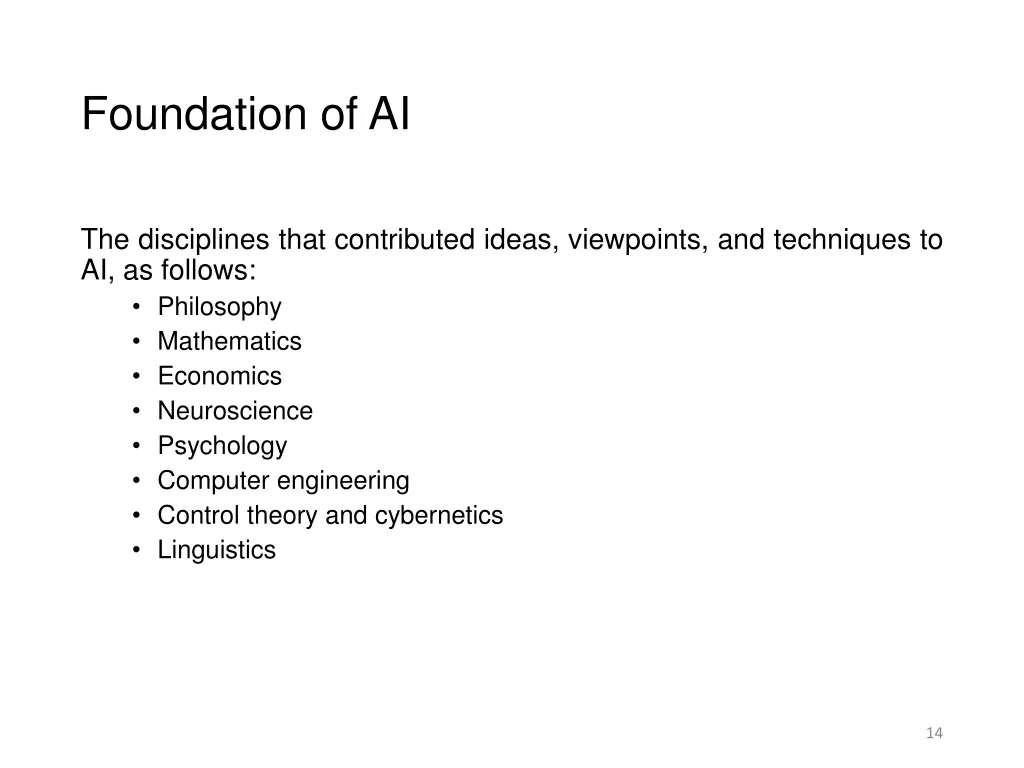
Foundation of AI The disciplines that contributed ideas, viewpoints, and techniques to AI, as follows: Philosophy Mathematics Economics Neuroscience Psychology Computer engineering Control theory and cybernetics Linguistics 14
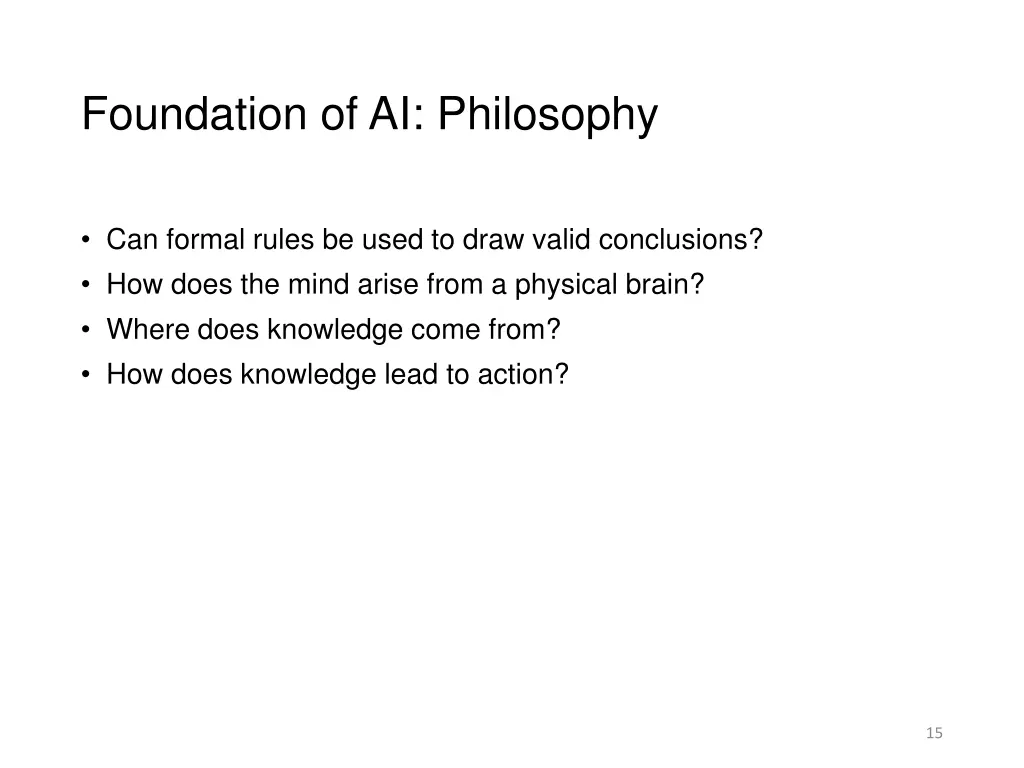
Foundation of AI: Philosophy Can formal rules be used to draw valid conclusions? How does the mind arise from a physical brain? Where does knowledge come from? How does knowledge lead to action? 15
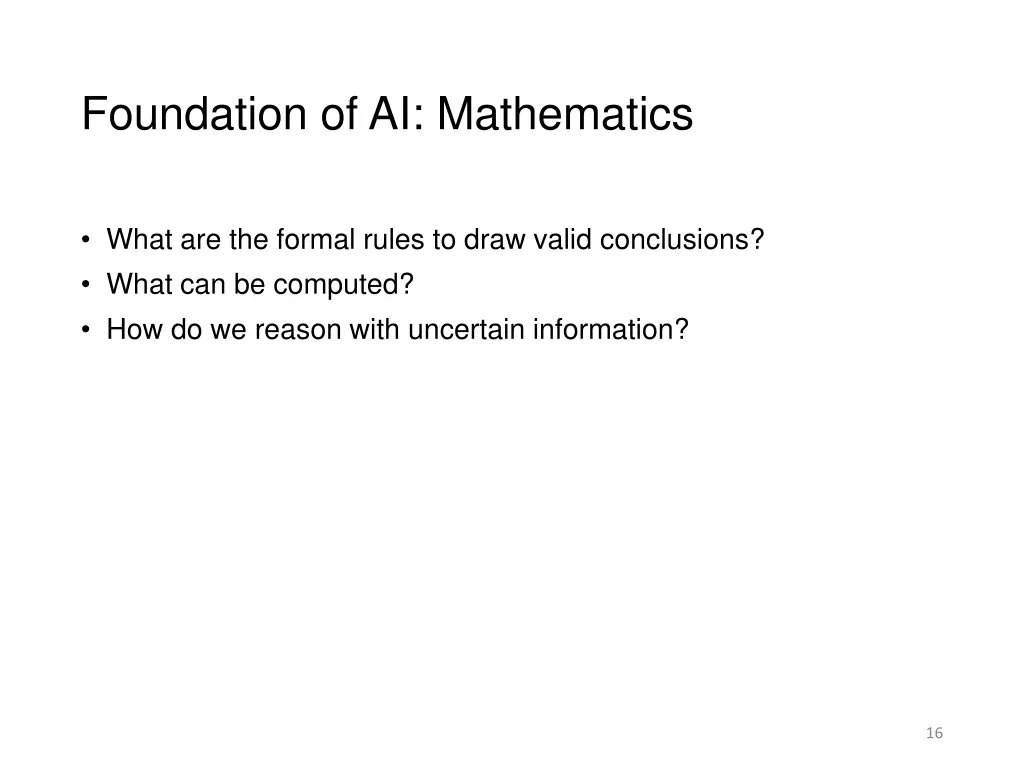
Foundation of AI: Mathematics What are the formal rules to draw valid conclusions? What can be computed? How do we reason with uncertain information? 16
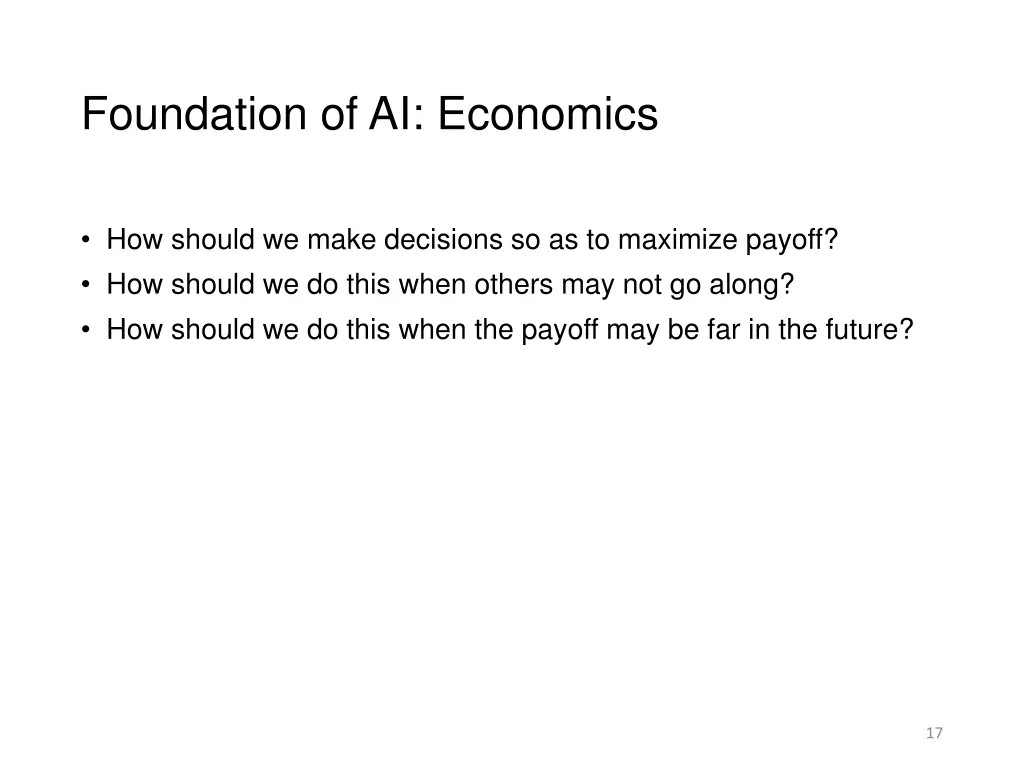
Foundation of AI: Economics How should we make decisions so as to maximize payoff? How should we do this when others may not go along? How should we do this when the payoff may be far in the future? 17
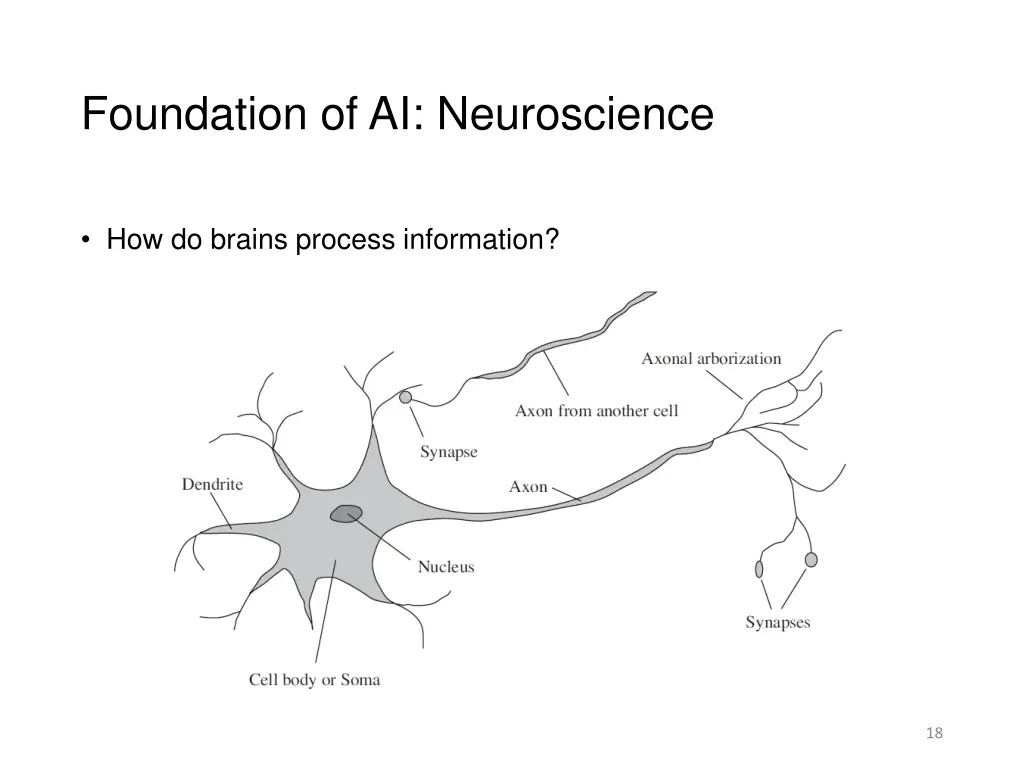
Foundation of AI: Neuroscience How do brains process information? 18
Foundation of AI: Psychology How do humans and animals think and act? Behaviorism Cognitive psychology 19
Foundation of AI: Computer Engineering How can we build an efficient computer? For artificial intelligence to succeed, we need two things: intelligence artifact. The computer is the artifact of choice. 20
Foundation of AI: Control Theory and Cybernetics How can artifacts operate under their own control? 21
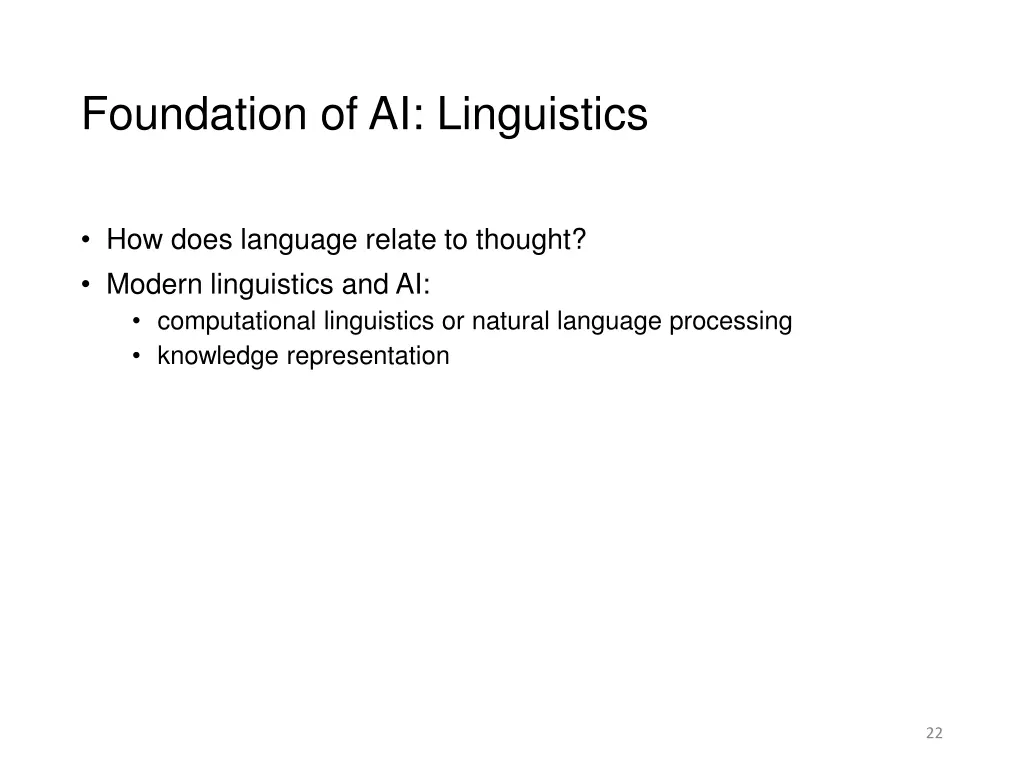
Foundation of AI: Linguistics How does language relate to thought? Modern linguistics and AI: computational linguistics or natural language processing knowledge representation 22
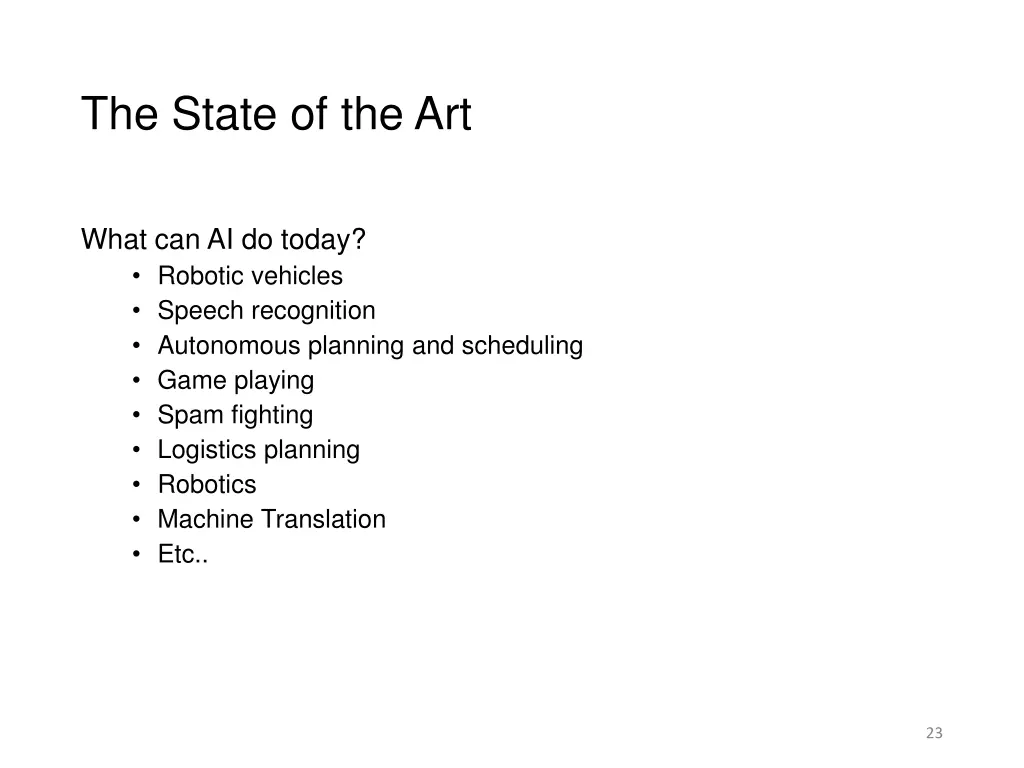
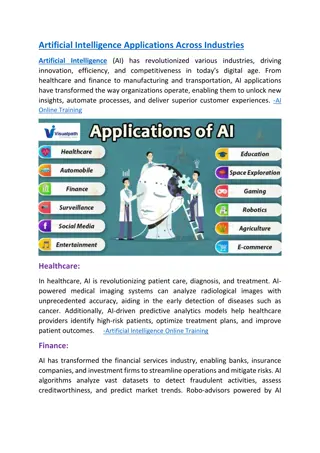
The State of the Art What can AI do today? Robotic vehicles Speech recognition Autonomous planning and scheduling Game playing Spam fighting Logistics planning Robotics Machine Translation Etc.. 23