FRACTURE FRACTURE - - II II
Fracture is a dissolution in the continuity of bone, causing a break in hard tissues with varying degrees of soft tissue damage. Learn about the etiology, classification, and types of fractures in veterinary surgery and radiology, including indirect trauma and pathological fractures.

Download Presentation

Please find below an Image/Link to download the presentation.
The content on the website is provided AS IS for your information and personal use only. It may not be sold, licensed, or shared on other websites without obtaining consent from the author.If you encounter any issues during the download, it is possible that the publisher has removed the file from their server.
You are allowed to download the files provided on this website for personal or commercial use, subject to the condition that they are used lawfully. All files are the property of their respective owners.
The content on the website is provided AS IS for your information and personal use only. It may not be sold, licensed, or shared on other websites without obtaining consent from the author.
E N D
Presentation Transcript
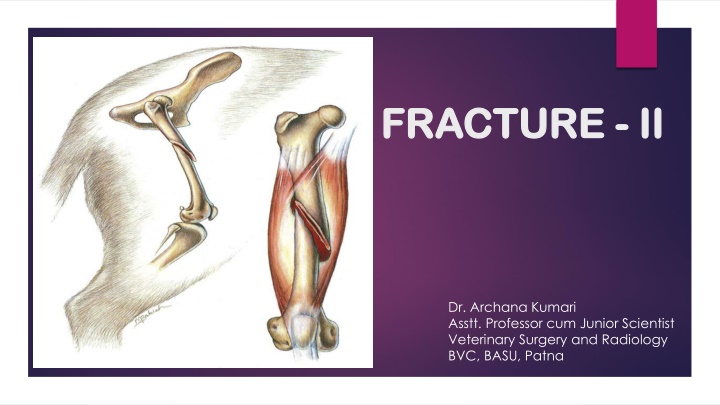
FRACTURE FRACTURE - - II II . Dr. Archana Kumari Asstt. Professor cum Junior Scientist Veterinary Surgery and Radiology BVC, BASU, Patna
FRACTURE Dessolution in the continuity of bone with or without displacement of fractured fragments is knows as fracture. Breach in the continuity of bone with or without displacement of fractured fragments associated with soft tissue damage of varying degree. A fracture is a break in the continuity of hard tissues.
Etiology Intrinsic cause Extrinsic cause Pathological fracture Muscular contraction Direct trauma Indirect trauma
INDIRECT TRAUMA Bending force Tensional force Shearing force Compressive force
Pathological fracture Bone tumors and cyst Osteoporosis Hyperparathyroidism Localized bone infection Osteoporosis caused by prolonged fixation
CLASSIFICATION On the basis of Communication of Fractured Site to the Environment 1. On the Basis of Extent of Bone Damage 2. On the Basis of Number of Fractured Fragments 3. On the Basis of Type of Bone Involved 4. On the Basis of Displacement of the Fractured Fragments 5.
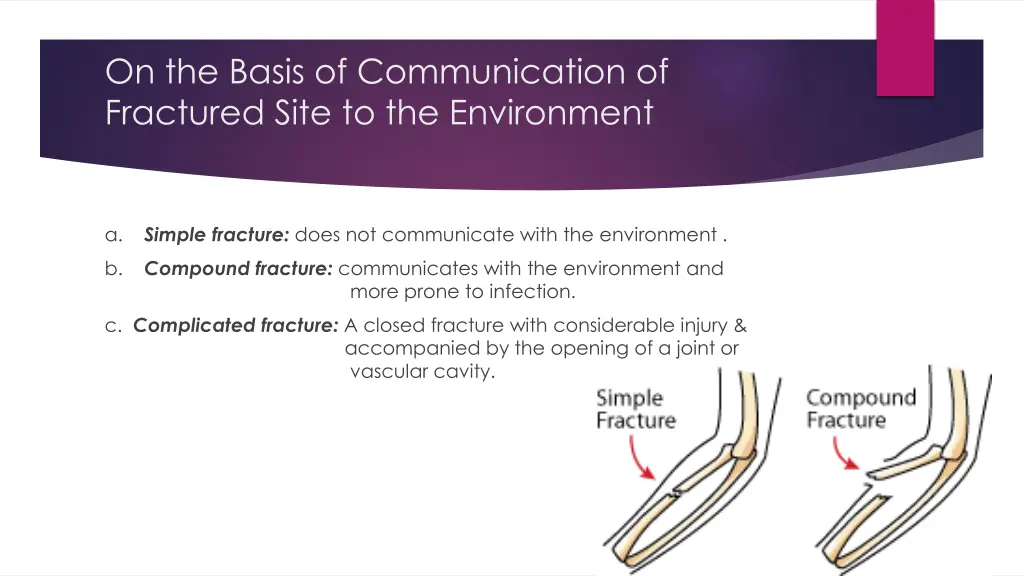
On the Basis of Communication of Fractured Site to the Environment a. Simple fracture: does not communicate with the environment . b. Compound fracture:communicates with the environment and more prone to infection. c. Complicated fracture: A closed fracture with considerable injury & accompanied by the opening of a joint or vascular cavity.
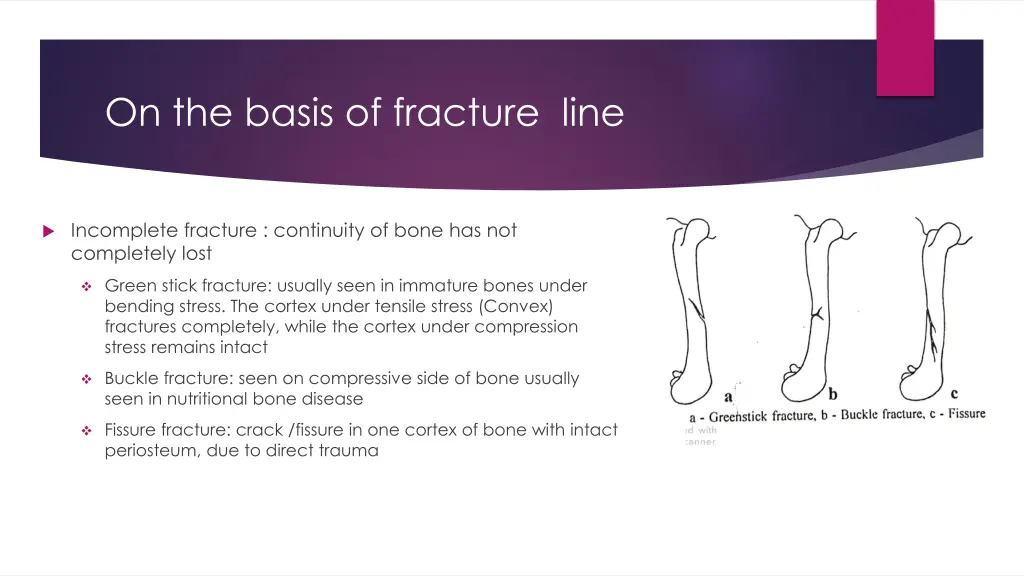
On the basis of fracture line Incomplete fracture : continuity of bone has not completely lost Green stick fracture: usually seen in immature bones under bending stress. The cortex under tensile stress (Convex) fractures completely, while the cortex under compression stress remains intact Buckle fracture: seen on compressive side of bone usually seen in nutritional bone disease Fissure fracture: crack /fissure in one cortex of bone with intact periosteum, due to direct trauma
. Fissure fracture:The fissure formed in one cortex of the bone and the periosteum remains intact. The fissure line may be longitudinal, transverse or oblique. Partial or splintered fracture:When splinters of bone are separated from the main bone i.e. by fire arms. Sub-periosteal (intra-periosteal) fracture:A fracture of the cortical bone without rupture of the periosteum. Deferred fracture:In which separation of fragments occur only after a varying period after incident due to subsequent violence, strain or concussion e.g. broken back in horse
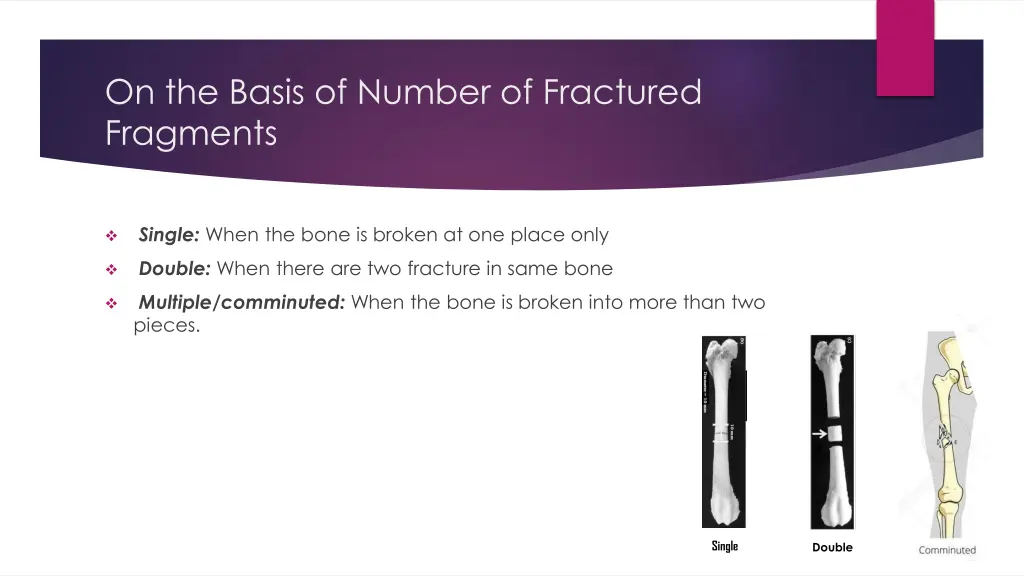
On the Basis of Number of Fractured Fragments Single: When the bone is broken at one place only Double:When there are two fracture in same bone Multiple/comminuted: When the bone is broken into more than two pieces. Single Double
On the Basis of Type of Bone Involved Cortical bone fracture:Fracture of diaphysis of long bone. Cancellous bone fracture:Fracture of skull bone or extremities of long bones.
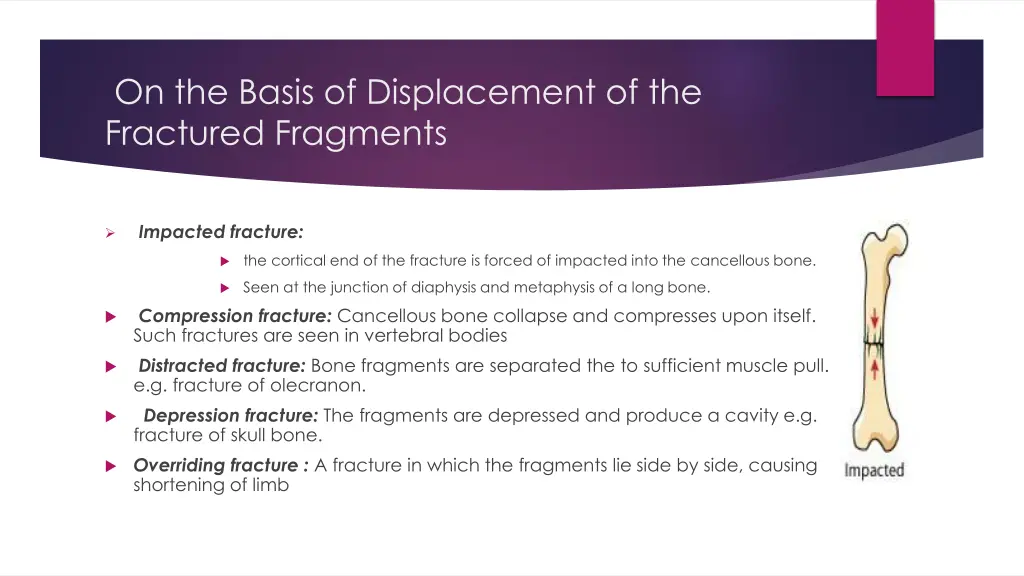
On the Basis of Displacement of the Fractured Fragments Impacted fracture: the cortical end of the fracture is forced of impacted into the cancellous bone. Seen at the junction of diaphysis and metaphysis of a long bone. Compression fracture: Cancellous bone collapse and compresses upon itself. Such fractures are seen in vertebral bodies Distracted fracture: Bone fragments are separated the to sufficient muscle pull. e.g. fracture of olecranon. Depression fracture: The fragments are depressed and produce a cavity e.g. fracture of skull bone. Overriding fracture : A fracture in which the fragments lie side by side, causing shortening of limb